
Wet Leaves on a Motorcycle: A Slow-Smooth-Scan Plan for Autumn Grip Changes
Use a conservative wet-leaf riding checklist to assess route risk, check your motorcycle, slow early, stay smooth, scan ahead, and know when to delay.

Fact-checked against cited official documentation
Reviewed against Fact-checked against MSF’s October 6, 2026 autumn safety guidance and the MSF Motorcycle Operator Manual on slippery surfaces, pre-ride checks, protective gear, and smooth control inputs..
Last updated October 13, 2026
Autumn can offer clear air, colorful roads, and comfortable riding temperatures. It can also create one of the least predictable surface hazards a street rider encounters: wet leaves. A thin layer may look harmless from a distance, yet it can hide the pavement edge, cover painted markings, mask potholes or debris, and reduce the confidence you would normally have in braking, cornering, or putting a foot down.
The useful response is not to try to prove that every patch is safe. It is to build margin before you reach it. For riding motorcycle on wet leaves safety, use a slow-smooth-scan plan: slow before the questionable surface, keep your inputs measured, scan beyond the leaf cover for a clean path and a safe exit, and give yourself permission to choose another route or stop for the day.
The Motorcycle Safety Foundation identifies wet leaves as a potentially slippery autumn hazard and advises riders to approach leaf-covered pavement cautiously, much as they would ice, without abrupt braking, acceleration, or steering. Its Motorcycle Operator Manual also places leaves among low-traction surfaces and emphasizes reducing speed before reaching them, then using gradual, smooth control inputs. Those principles are simple, but the real value comes from applying them early—before a bend, driveway, stop line, bridge approach, or shaded section leaves no room to revise the plan.
This is not a substitute for your motorcycle’s owner’s manual, professional instruction, or sound judgment at the scene. Your manufacturer’s tire-pressure, tire-condition, load, lighting, and maintenance guidance comes first. If your motorcycle has a warning light, a tire concern, an unusual brake or control feel, or any condition that makes you unsure of the machine, do not use a wet-leaf ride as the time to “see if it is probably fine.”
Why Wet Leaves Need Their Own Plan
Wet-leaf risk is not simply “rain riding, but in fall.” Rain affects a whole road surface and is often obvious enough to change your plan before departure. Leaves are patchy. They can appear after a dry stretch, around a blind corner, beneath a tree canopy, across an intersection approach, or in the narrow strip you intended to use for braking or a turn. Their irregular placement makes them easy to underestimate.
A leaf-covered patch can also change from one block to the next. A few scattered dry leaves might be mostly a visual distraction. A dense, damp layer in deep shade can be a different decision entirely. The rider does not need to identify exactly how much grip remains in either case. The safer assumption is that grip is uncertain and that abrupt demands for braking, drive, or lean are poor bets.
That distinction changes your priorities:
- Do not wait to react at the leaves. Make the speed decision while pavement is visible and comparatively predictable.
- Do not treat one clean tire track as a guarantee. It may disappear at the corner, merge with debris, or lead you toward a hazard hidden by leaves.
- Do not chase normal pace. A familiar road may no longer support the same entry speed, following distance, or passing plan it did in summer.
- Do not let other traffic set your margin. A driver behind you may be impatient, but that does not improve the available grip. Signal early where appropriate, create room, and make the conservative choice.
Autumn adds related factors that make leaf hazards more consequential. The MSF notes shorter daylight, cooler temperatures, road debris, and wildlife activity alongside wet leaves. In practical terms, a rider can be coping with lower visibility, a colder body, a busier visual environment, and a surface that changes quickly—all on the same ride. The answer is not hypervigilance until you are exhausted. It is a simpler plan with more time and space built in.
Read the Route Before You Commit
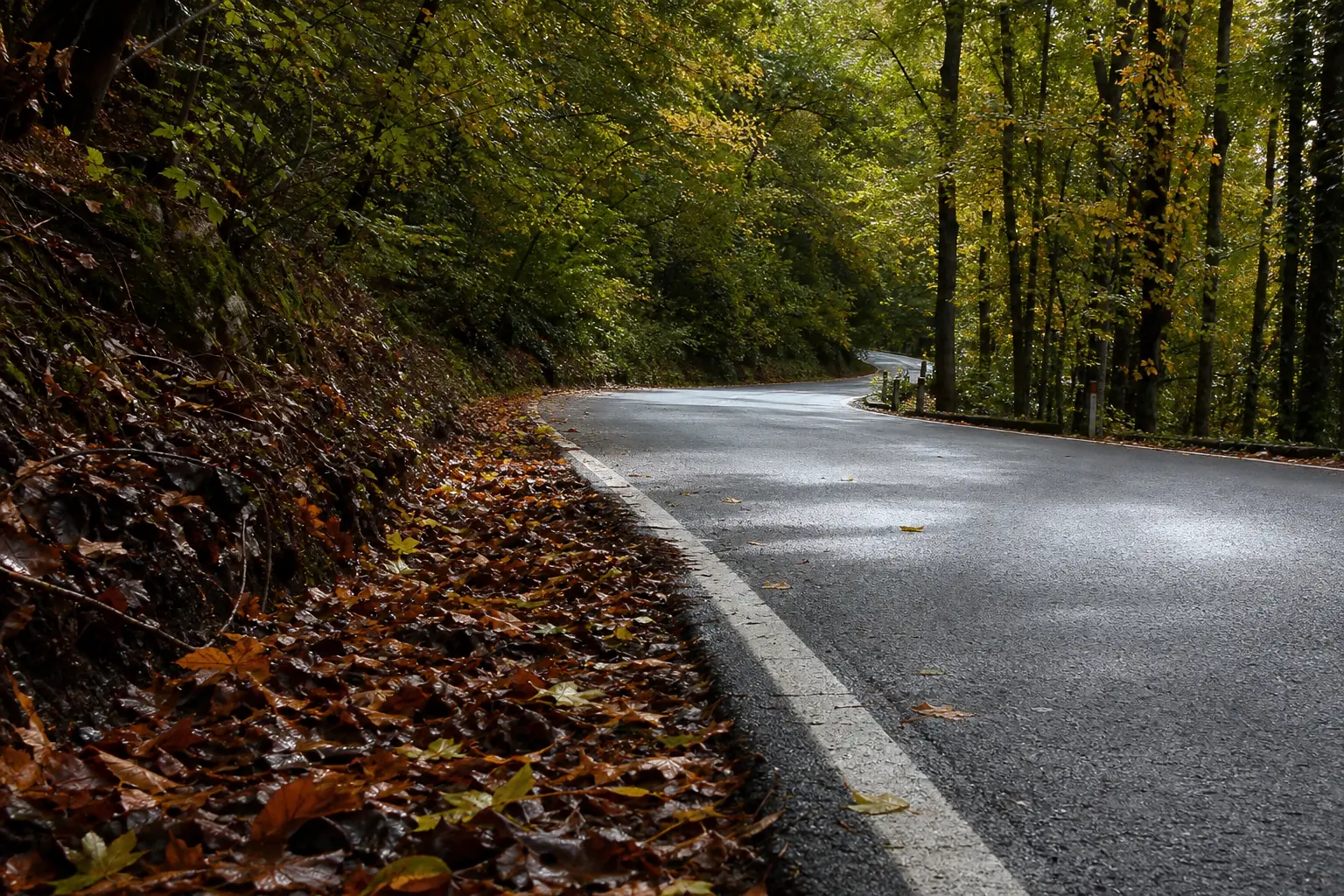
A wet-leaf decision starts before the motorcycle moves. Look at the conditions, the route, and the consequences of an unexpected low-grip patch. If several risk factors stack up, changing the ride is good judgment, not a failure of skill.
Start with the setting. Tree-lined residential streets, older neighborhoods with mature canopies, rural lanes, park roads, trailhead access roads, and shaded mountain routes can collect leaves in places where sightlines are already limited. Curbs, drains, crowns, uneven shoulders, and parked vehicles can shrink the usable part of the lane. A wet-leaf patch at a wide, straight, lightly traveled section has different consequences than the same patch just before a tight bend or a stop-controlled intersection.
Then ask what the weather has done recently. Overnight moisture, drizzle, fog, wet pavement that has not dried beneath trees, and a fresh rain after a leaf drop should all increase your caution. You do not need a precise traction forecast to recognize that leaves can retain moisture longer than exposed pavement. If the route will stay shaded, assume questionable areas may remain questionable.
Time of day matters too. At dawn and dusk, changing light can flatten contrast and make leaf piles harder to distinguish from pavement. Headlights can illuminate the near road while hiding surface texture farther ahead. Wildlife activity can also raise the cost of reducing your visual reserve. If you are riding later than planned, do not merely continue at the day-riding pace. Reassess the route and shorten the objective if needed.
Use these route questions before departure:
- Can I choose a road with clearer sightlines and fewer overhanging trees? A slightly longer main-road route may offer better visibility and more room to respond than a scenic shortcut.
- Will I need to make time-sensitive turns, steep descents, or tight corners? If yes, leave earlier or choose an alternative that reduces pressure.
- What is my exit if leaf cover becomes continuous? Identify a fuel stop, parking area, turnaround point, or straightforward route home before you need one.
- Am I carrying a passenger, cargo, or extra fatigue today? More load and more distraction are reasons to make the plan gentler, not reasons to press on.
- Would I still willingly ride this route if it were wet after dark? If the honest answer is no, a damp leaf-covered version of the same route is probably not the place to negotiate your limits.
A good route plan does not promise that you will avoid every leaf. It prevents the common trap of entering a difficult section already rushed, cold, low on fuel, uncertain of directions, or committed to keeping up with somebody else.
The Slow-Smooth-Scan Plan
The plan has three parts that support each other. Slow creates time. Smooth avoids demanding too much from uncertain pavement. Scan keeps you from locking onto the leaves directly in front of the tire and missing the safer line, changing road shape, or traffic problem beyond them.
Slow: reduce speed before the surface changes
The moment you identify a potentially slick patch, treat it as an approach problem. Close speed gradually while you still have visible pavement and a predictable path. That means avoiding the late, hard correction caused by arriving at the leaf cover too fast.
A conservative speed is not a fixed number. It is the speed that leaves you able to continue straight, make a modest change in path, or stop within the part of the road you can see is clear. The right answer becomes slower when the leaf layer is wet, dense, shaded, downhill, near a turn, mixed with mud or gravel, or concealed by glare and low light.
Give yourself extra following room. The point is not to memorize a universal distance; it is to preserve an option when the vehicle ahead brakes unexpectedly, turns across your view, or reveals a leaf-covered section too late. If your view is blocked by a larger vehicle, ease back rather than using its path as your only surface information.
At intersections and driveways, finish as much speed adjustment as possible before the leaf-covered zone. Drivers can pull out, pedestrians can step from behind parked cars, and leaf cover can obscure lane markings or road-edge changes. Entering with a calm, low-demand plan leaves more choices than carrying normal pace into uncertainty.
Smooth: make one calm job of each input
On questionable surfaces, the goal is not frozen rigidity. It is deliberate control. Keep your hands, arms, and lower body relaxed enough to steer accurately, look where you intend to go, and avoid turning every small surface change into a larger rider input.
Avoid stacking sudden actions together. Sharp steering while braking, abrupt throttle use in a lean, or a rushed downshift at the edge of traction asks more of the contact patches at the worst possible moment. The MSF specifically advises avoiding abrupt braking, acceleration, and steering around wet leaves. Think in phases instead: reduce speed early, select a simple path, look through it, and make gradual changes.
If you must ride across leaves, prioritize a stable, uncomplicated line. Where space and traffic rules allow, favor a path that avoids the densest visible accumulation and does not force a sudden lane movement. Do not make a last-second swerve for a small patch if that move would place you into another hazard, a blind area, oncoming traffic, or the road edge. A minor leaf patch is not automatically safer to avoid than to cross; the surrounding situation decides.
When a turn includes leaf cover, reduce the demands you place on the motorcycle. Enter slower than you would on clean pavement, turn your eyes toward the available exit, and avoid treating the corner as a performance exercise. If leaf cover prevents you from seeing the curve’s surface or exit, that is a reason to reduce speed further or choose a route with a clearer view.
Scan: keep looking past the hazard
Scanning is how you turn an unpleasant surprise into an early decision. Look well ahead for dark shaded strips, matte piles, leaf windrows near curbs, accumulation at the inside or outside of bends, and traffic patterns that could force you to brake on a compromised surface.
Do not stare at the nearest leaf patch. Your eyes should take in the road farther ahead, the path immediately ahead, the edges, and the behavior of surrounding traffic. This is especially important after a bend, behind a crest, under a canopy, and near bridges or drainage areas. The question is not only “Can I cross this?” It is “What will I need to do immediately after I cross it?”
Use a continuous scan for:
- leaf accumulation near intersections, crosswalks, painted lines, railroad approaches, driveway exits, and turn lanes;
- changes from open sun to tree shade, where pavement condition may change abruptly;
- wet-looking streaks, mud, gravel, branches, or debris mixed into leaf cover;
- traffic that is following too closely or blocking your view;
- wildlife movement near wooded edges, especially around dawn and dusk;
- a visible clean section where you can slow, reassess, or stop safely if conditions worsen.
The benefit of scanning is not perfect prediction. It is earlier recognition. Earlier recognition makes slow and smooth actions easier.
Pre-Ride Checks That Support Autumn Grip Decisions

Wet leaves cannot be managed only with riding technique. Start with a motorcycle that is ready for the conditions. The MSF advises a pre-ride check and specifically reminds riders that cooler conditions can lower tire pressure; it says adjustments should follow manufacturer recommendations. Your owner’s manual and tire-information label are the authority for your exact motorcycle, tire fitment, load, and cold-pressure specifications.
Do not guess a pressure because it “felt right last month,” copy a number from another model, or set a general target from a social post. Check pressure when the tires are cold according to the manufacturer’s instructions. If you are carrying a passenger or cargo, use the model-specific guidance for that load rather than assuming your solo setting applies.
Also take a conservative look at tire condition. You are not trying to certify a tire from a driveway inspection. You are looking for reasons to pause the ride and seek qualified help: obvious damage, a visibly underinflated tire, a puncture concern, abnormal wear, or any issue that makes you doubt the tire’s ability to do its job. Low-grip autumn surfaces are not the time to postpone a known tire concern.
Your basic checks should also include controls, lighting, and your ability to see clearly. Verify that the motorcycle’s lights and brake light work, that mirrors are useful for the clothes and luggage you are wearing, and that your visor or eye protection is clean enough to distinguish leaf cover, road texture, and changing light. The MSF Motorcycle Operator Manual stresses checking the motorcycle before each ride and using protective gear that allows clear vision. It also warns against tinted eye protection when available outside light is limited.
Dress for the whole ride, not just the temperature at departure. Cold hands, damp clothing, and fatigue can make smooth inputs harder and reduce your willingness to stop and reassess. Use gear appropriate to the conditions, with a securely fastened helmet, eye protection that remains clear, gloves that preserve control feel, and footwear with secure footing for stops on damp ground. If you become chilled or your vision begins to fog, stop in a safe place and correct the problem rather than trying to push through a degraded margin.
For a broader system of owner-manual-led checks, service planning, and seasonal reminders, see the Motorcycle Maintenance Guide.
Wet Leaves Motorcycle Checklist: Leave, Delay, or Turn Back
Use this checklist as a decision tool, not as a test of bravery. One checked caution item does not always cancel a ride. Several together are a strong reason to delay, reroute, or end the trip early.
Before you leave
- I checked my motorcycle using my owner’s manual as the model-specific reference.
- Tire pressures were checked cold and set according to the manufacturer’s current guidance for my load.
- I found no visible tire problem or other condition that makes the motorcycle questionable for a low-grip ride.
- My lights, brake light, controls, mirrors, and eye protection support clear operation and visibility.
- I have gear that will keep me warm, dry, and able to operate the controls comfortably through the expected ride.
- My intended route has a practical alternative if tree cover, wet leaves, or fading light become worse than expected.
- I am not trying to keep a schedule, chase a group, or prove something that would pressure me to ride faster than conditions allow.
While you ride
- I am scanning far enough ahead to spot leaf cover before I need to brake or turn.
- I slow on visible pavement before reaching wet leaves, rather than braking abruptly on them.
- I use gradual steering, braking, throttle, and gear changes.
- I leave more room behind traffic when my view or pavement information is limited.
- I avoid passing, aggressive lane changes, and unnecessary mid-corner corrections where surface grip is uncertain.
- I regularly reassess the light, temperature, surface, traffic, and my own concentration.
Delay, reroute, or stop when
- Leaf cover becomes continuous enough that you cannot identify a reliable path or see road features beneath it.
- A wet, shaded, downhill, curving, or low-light section combines multiple risks you cannot comfortably manage.
- You notice a tire, control, brake, lighting, or warning concern.
- Your visor fogs, your hands become numb, or fatigue is reducing your scan and control quality.
- Traffic behind you is forcing a pace that feels unsafe and you cannot create space by changing route or stopping safely.
- You are no longer making calm decisions. That is sufficient reason to pause.
Match Your Riding Plan to the Road Shape
Wet leaves do not present the same problem everywhere. Adjusting to the road shape can prevent you from carrying a generic “be careful” mindset into a specific high-demand situation.
| Road situation | Main concern | Conservative priority | A better decision when margin is gone |
|---|---|---|---|
| Straight, lightly leaf-strewn road | A patch may conceal debris or a surface change | Reduce speed early, keep a stable line, look well ahead | Continue only at a pace that permits a calm response |
| Leaf-covered bend | Unseen surface plus lean demand and limited sightline | Enter slower, avoid abrupt inputs, keep vision toward the exit | Reroute or turn around if the curve surface and exit cannot be read |
| Downhill approach | Less room to reduce speed before a stop or turn | Plan earlier, increase following space, simplify the path | Stop before the descent or choose a different route if leaf cover is dense |
| Intersection or driveway | Traffic may require braking or turning with little warning | Approach with extra time and a wide safety cushion | Wait, change position, or choose another route if the surface is obscured |
| Night or dusk under trees | Leaves, wet pavement, and road edges are harder to distinguish | Slow further, use clear eye protection, shorten the ride goal | End the ride if visibility no longer supports a confident scan |
| Group ride | Pace pressure can override individual judgment | Set expectations before departure and ride your own plan | Let the group go; regroup later rather than chasing |
The table is deliberately conservative because leaf hazards are variable. A rider cannot turn an unknown surface into a known one by using a more complicated technique. The reliable adjustment is to lower the consequences of uncertainty.
Common Pressure Traps—and Better Alternatives
The biggest mistake on wet leaves is often made before the tires touch them: deciding that you must continue normally. That decision can come from a late start, a reservation, a group pace, a familiar favorite road, or the thought that slowing down will make you look inexperienced. None of those changes the surface.
“I know this road.” Familiarity helps you anticipate turns and intersections, but it can also tempt you to use your summer reference points. Autumn road condition can invalidate those reference points. Keep the local knowledge, but reset the pace.
“The car in front went through it without a problem.” A car has a different number of wheels, a different footprint, and a different set of consequences. More importantly, its path may not show you what lies beneath the leaves or what you will need to do next. Use the vehicle ahead as traffic information, not as proof of available motorcycle grip.
“It is only a short section.” Short hazards can be difficult precisely because they arrive at a braking point, turn-in point, or lane merge. A short section still deserves an early speed adjustment if it compromises the part of the lane you need.
“I will just ride carefully.” Replace that vague idea with observable choices: slow before the patch, do not stack abrupt inputs, look beyond it, create following room, and identify a place to stop. Specific actions are easier to follow when the situation becomes stressful.
“I do not want to hold up the group.” A good group plan permits riders to separate and regroup without pressure. Tell the group in advance that wet leaves, darkness, or a personal comfort limit may change your pace. If the group cannot accommodate that, it is not the right group for that day’s conditions.
If the Motorcycle Feels Unsettled
A sudden change in feel can be alarming. Your job is to avoid adding panic to a low-grip situation. Keep your attention on where you want the motorcycle to travel, avoid an abrupt attempt to “fix” every sensation, and create time to slow and exit the hazard area safely.
Once you are on a clearer surface, reassess. Ask whether the change came from the leaves, a bump hidden by leaves, a mechanical issue, or your own hurried input. If anything about the motorcycle’s tires, wheels, brakes, steering, controls, or warning indicators seems abnormal, treat that as a separate safety concern. Stop when safe and arrange an appropriate inspection rather than continuing through more low-grip conditions.
Do not turn a moment of uncertainty into an on-road experiment. There is no value in repeatedly testing a leaf-covered section to learn how much traction it has. If the road surface leaves you doubtful, the prudent conclusion is that you have already learned enough to reduce demand or leave the area.
Build Skill Away From Autumn Hazards
The skills that help around wet leaves are fundamental: controlled braking, looking through turns, maintaining space, and making gradual inputs. They should be refreshed in a controlled setting, not discovered for the first time on a slick public road.
If you have not practiced recently, choose formal rider training or a legal, clean, open practice area with no leaf cover, traffic pressure, or hidden hazards. Start within your current ability and follow training guidance. The MSF Motorcycle Operator Manual recommends formal hands-on training as a way to develop riding skills and risk-management strategies. A refresher can be especially useful if you have been away from riding, changed motorcycles, or feel that your braking and corner-entry decisions have become hesitant.
Practice does not produce permission to take bigger risks on wet leaves. It gives you a calmer baseline from which to recognize that the road is asking for less, not more. The best autumn rider is not the one who can force a pace through every condition; it is the one who notices a shrinking margin early enough to make an easy change.
How Vojo Helps
Use Vojo to turn this seasonal plan into a repeatable workflow rather than a reminder you only remember after the first wet ride. Before an autumn ride, open your maintenance record in the Motorcycle Maintenance Tracker, log your owner-manual-based tire-pressure check and pre-ride inspection, then add a note such as “wet leaves on shaded route—use main-road alternative.” After the ride, record any conditions you encountered—leaf-heavy roads, fogging visor, colder-than-expected temperatures, or a route worth avoiding at dusk—so the next departure starts with useful context instead of guesswork.
Quick answers
Frequently asked questions
Are wet leaves really slippery for motorcycles?
They can be. The Motorcycle Safety Foundation identifies wet leaves as a potentially slippery autumn roadway hazard and advises riders to approach them cautiously, like ice, without abrupt braking, acceleration, or steering. Treat visible wet leaf cover as uncertain grip rather than trying to judge its exact traction while moving.
Should I brake when I see wet leaves ahead?
Reduce speed before the leaf-covered area while you still have a clearer, more predictable surface. The goal is to avoid arriving too fast and then needing abrupt braking on uncertain pavement. If traffic, road shape, or visibility leaves no comfortable margin, slow earlier, reroute, or stop.
Can I ride through a small patch of wet leaves?
A small patch is not automatically a reason to stop, but it is a reason to simplify your plan. Slow beforehand, avoid sudden control inputs, look beyond the patch, and do not make a last-second swerve that creates a larger conflict with traffic, road edge, or an unseen hazard.
What motorcycle checks matter most before autumn riding?
Follow your exact owner’s manual first. Pay particular attention to cold tire pressure for your load, visible tire condition, lights, brake light, controls, mirrors, and clear eye protection. If you find a tire concern, warning light, abnormal control feel, or other safety doubt, do not use a wet-leaf ride to test it.
Does ABS make wet leaves safe?
No rider aid changes the need to reduce demand when surface grip is uncertain. Wet leaves can affect braking, turning, and acceleration, and the safest approach remains slowing before the hazard, using smooth inputs, scanning ahead, and keeping room for a conservative decision.