
Motorcycle Fuel Storage: Why “Starting It Occasionally” Is Not a Universal Plan
Learn why motorcycle fuel storage guidance varies by model, why occasional starts are not a universal answer, and how to plan a safer return to riding.

Fact-checked against cited official documentation
Reviewed against Honda CRF250F and Yamaha owner manuals covering storage fuel guidance, long-term storage thresholds, fuel stabilizer direction, safe engine operation, and return-to-service checks..
Last updated September 26, 2026
Fuel is not a calendar-only maintenance item. If you are asking “motorcycle fuel storage: how long can gas sit?”, the safest answer is: use the storage and return-to-service instructions for your exact motorcycle, not a universal internet rule.
Official owner manuals illustrate why. One Honda CRF250F manual directs owners to drain and replace fuel after storage beyond two months, while Yamaha manuals for other motorcycles describe filling the tank and using stabilizer for storage, with one defining long-term storage as 60 days or more. Those are different instructions for different machines—not competing tips to mix and match. [1][2]3
That is also why “just start it occasionally” is not a complete storage plan. A brief start may not meet your manufacturer’s storage guidance, may not address fuel already sitting in every part of the system, and introduces an avoidable exhaust hazard if done in a garage or other enclosed space. Never run a motorcycle engine indoors or in a poorly ventilated area. 2
Start With the Model Manual, Not a Storage Myth
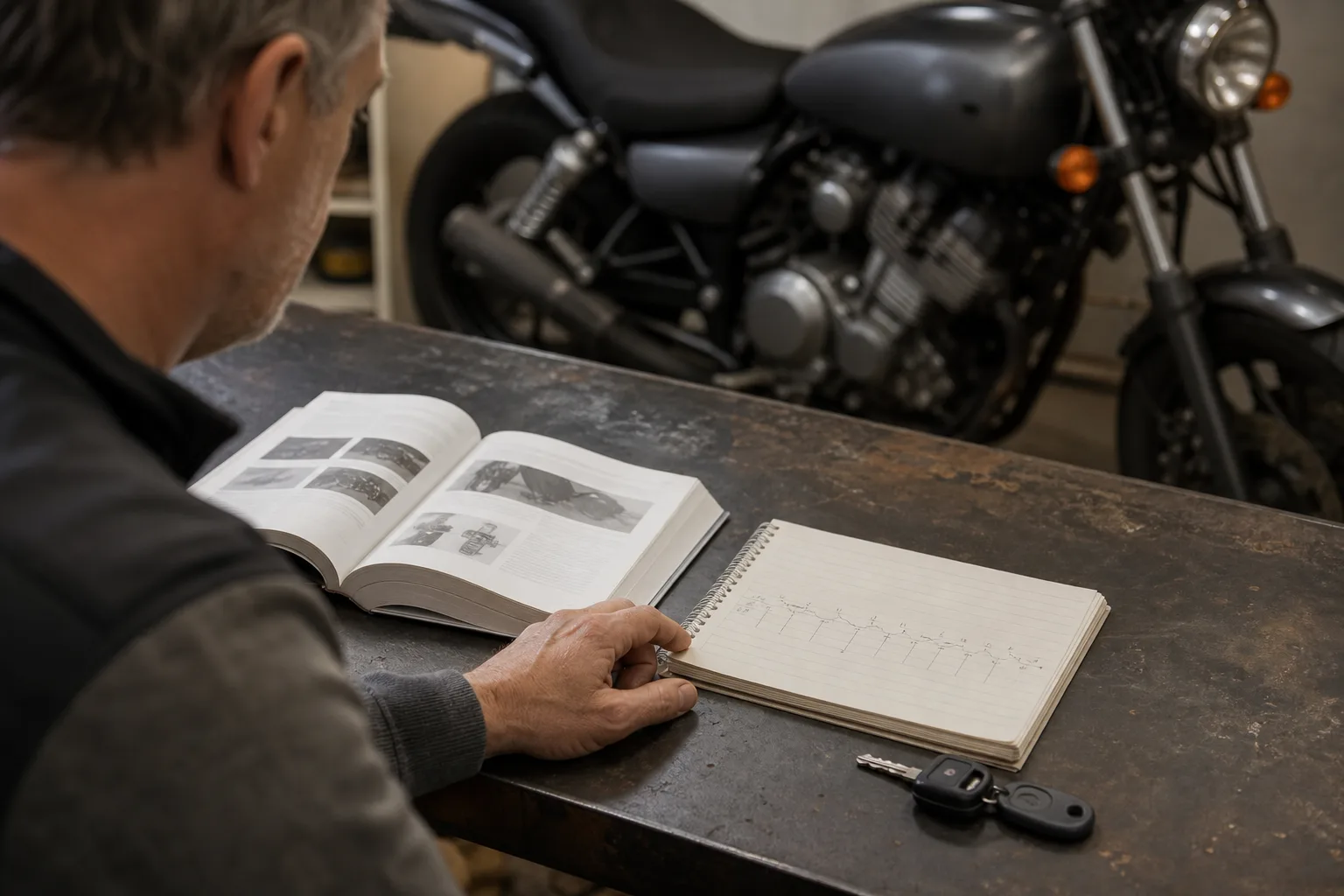
Before deciding whether to stabilize, replace, or otherwise manage stored fuel, identify:
- the exact model year and market version of the motorcycle;
- how long it is likely to sit, including delays caused by weather or travel;
- whether the manual gives separate short- and long-term storage instructions;
- whether the manual calls for a particular fuel-treatment approach or a return-to-service fuel step; and
- any separate instructions for the battery, tires, chain, fluids, and pre-ride checks.
A storage plan should be made before the motorcycle sits. If it has already been parked longer than expected, skip guesswork: read the manual’s removal-from-storage section and arrange qualified help if the bike will not start cleanly, leaks fuel, displays warnings, or has any other condition that makes it unsafe to ride.
| Storage decision | Why it matters | Conservative action |
|---|---|---|
| Expected storage length | Manuals may use different thresholds and definitions. | Record your planned last ride and planned return date, then compare both with your manual. |
| Fuel treatment guidance | Some manuals specify stabilizer; others may give a different fuel-management instruction. | Follow the model-specific wording and product directions rather than combining methods. |
| Return-to-service fuel step | A manual may require fuel replacement after a stated period. | Complete the stated fuel step before treating the motorcycle as ride-ready. |
| Occasional starting | It is not a substitute for documented storage guidance. | Do not rely on it unless your manual explicitly makes it part of the plan. |
| Storage location | Fuel vapor, heat, ignition sources, and exhaust all create safety concerns. | Store and inspect the motorcycle in an appropriate, ventilated location away from ignition sources. |
Why an Occasional Start Does Not Settle the Fuel Question
The appealing idea is simple: run the engine now and then, and the fuel system will be fine. The problem is that this shortcut does not answer the questions that actually matter:
- Does your owner’s manual endorse it? If not, it cannot override the published storage plan for the motorcycle.
- Has the motorcycle reached the manual’s storage threshold? A bike that sat longer than planned may require a different return step.
- What happens after the engine is switched off? Starting the motorcycle does not erase the amount of time fuel has spent in storage.
- Was it done safely? Idling an engine in a garage, shed, or partly enclosed space is a carbon-monoxide risk.
Treat an occasional start as something that may be mentioned in an individual model’s documentation—not as a universal preservation strategy.
Motorcycle Fuel Storage Checklist
Use this checklist for planning, not as a substitute for your owner’s manual.
- Locate the storage and removal-from-storage sections for your exact motorcycle.
- Write down the date the motorcycle was last ridden and the date you expect to return it to use.
- Compare that duration with the manual’s stated storage threshold, if one is provided.
- Follow the manual’s fuel direction—such as its guidance on stabilizer, fuel replacement, or another model-specific approach.
- Use any fuel-treatment product only as directed on its label and only where it aligns with the owner’s manual.
- Keep the motorcycle away from flames, sparks, and other ignition sources while storing or checking it.
- Do not start the engine in a garage, carport, barn, or other enclosed or poorly ventilated space.
- Before the first ride back, complete the manufacturer’s pre-ride checks and any listed removal-from-storage items.
- Do not ride if you notice a fuel leak, persistent starting problem, warning indication, abnormal running, or another condition that needs diagnosis.
For the broader inspection around a stored bike—not just the fuel plan—see the Motorcycle Maintenance Guide.
Returning a Stored Motorcycle to Service

Fuel is only one part of a return-to-riding decision. Your owner’s manual may pair its fuel instructions with checks or maintenance involving the battery, tires, drive chain, lubrication, fluids, controls, and a pre-ride inspection. Honda’s CRF250F storage guidance, for example, pairs its time-based fuel instruction with a pre-ride inspection and a low-speed test ride after storage. 1
Keep the first outing conservative. Confirm the motorcycle is operating normally in a low-risk setting before committing to traffic, passengers, luggage, distance, or higher speeds. If the machine does not behave normally, stop and use qualified service rather than repeatedly trying to start or ride through the issue.
How Vojo Helps
Create a Fuel Storage task in the Vojo Motorcycle Maintenance Tracker on the day you park the bike. Add the exact owner-manual storage threshold and fuel instruction in the task notes, set a return-to-service reminder before your intended first ride, and log the completed inspection afterward. That gives you a dated record instead of relying on memory when a short break becomes a longer layup.
Quick answers
Frequently asked questions
How long can gas sit in a motorcycle?
There is no single duration that safely applies to every motorcycle. Use the storage and return-to-service instructions in your exact owner’s manual. Official manuals can set different thresholds and prescribe different fuel actions.
Is starting my motorcycle once in a while enough during storage?
Not as a universal plan. An occasional start does not replace the model-specific fuel-storage guidance in the owner’s manual, and it must never be done in an enclosed or poorly ventilated space.
Should I use fuel stabilizer for motorcycle storage?
Use a stabilizer only when it is compatible with your motorcycle’s owner-manual guidance and follow the product directions. Some official manuals recommend stabilizer for storage, while other manuals specify a fuel replacement step after a certain storage period.
Should I drain fuel before storing a motorcycle?
Do not assume draining is universally required or universally unnecessary. Follow the storage instructions for your exact model, fuel system, and expected storage period.
What should I check before riding after storage?
Follow the manual’s removal-from-storage and pre-ride instructions. Treat fuel, battery condition, tires, controls, fluids, chain or drivetrain condition, leaks, and warning indicators as part of the decision—not fuel alone.