
Unexpected Gravel on Pavement: A Slow, Smooth, Straighten-and-Scan Plan for Motorcyclists
Learn how to ride a motorcycle over loose gravel on pavement with a conservative plan to slow early, stay smooth, create space, scan ahead, and train safely.

Fact-checked against cited official documentation
Reviewed against Fact-checked against the MSF Motorcycle Operator Manual on slippery surfaces, pre-ride checks, vision and control inputs, plus the MSF Basic RiderCourse curriculum on braking, traction, curves, swerving, and obstacle skills..
Last updated October 8, 2026
The short answer: reduce demand before the gravel
When loose gravel appears on pavement, the safest useful priority is not to make a dramatic correction. It is to reduce the demands you place on the tires before reaching it. If you have a clear, legal, traffic-safe way around the patch, take it early and gently. If you cannot avoid it, slow while the surface is still predictable, keep the motorcycle as straight as conditions allow, use smooth control inputs, and look beyond the loose material toward the space where you intend to continue.
That is the core of a slow, smooth, straighten-and-scan plan:
- Slow before the loose material whenever possible.
- Smooth every input: throttle, brakes, steering, and gear changes.
- Straighten the motorcycle and simplify the path as much as the roadway safely permits.
- Scan through and beyond the hazard for traffic, clean pavement, a safe stopping area, and the next threat.
The Motorcycle Safety Foundation (MSF) identifies gravel and areas where sand or gravel collect as poor-traction surfaces. Its Motorcycle Operator Manual emphasizes reducing speed before a slippery surface, avoiding sudden speed or direction changes, and applying braking pressure gradually. (msf-usa.org)
This is intentionally a conservative street-riding guide. It is not an invitation to practice slides, force a line through a blind corner, ride the shoulder, or treat electronic aids as permission to carry speed. Your motorcycle’s owner’s manual remains the authority for tire specifications, tire-pressure settings, warnings, loading limits, and all model-specific operating information.
Why gravel on pavement catches riders out
A road can look like normal pavement until the last seconds before the front tire reaches it. That is why unexpected gravel is not only a grip problem; it is a time-and-space problem. A rider may already be committed to a corner, following too closely, entering an on-ramp, or moving toward an intersection when the texture changes.
Loose stone can occur almost anywhere paved surface meets movement, weather, or unfinished work:
- at the outer edge of a curve, where debris migrates from the shoulder;
- on highway ramps and merge areas;
- at the end of a rural driveway or farm entrance;
- beside construction access points;
- near road repairs, broken pavement, and temporary work zones;
- after a vehicle leaves a gravel lot or unpaved side road;
- along shoulders, pull-offs, and lane edges;
- where water runoff has carried material across the pavement.
MSF specifically cautions that dirt and gravel can collect along road edges, particularly in curves and on freeway entrance and exit ramps. (msf-usa.org) That should shape how you read an unfamiliar route: an apparently open ramp or sweeping bend is not proof of a clean surface all the way through.
The immediate danger is not that every pebble causes a crash. The problem is uncertainty. Tire grip can change across a short distance, and loose material can shift beneath a tire. A sudden brake grab, sharp steering input, rushed downshift, or aggressive acceleration asks the tire to do more at the exact moment the surface offers less predictable traction. The practical response is to make fewer, smaller, calmer demands.
This also explains why gravel deserves a distinct plan from a pothole. A pothole is often a defined obstacle to avoid or cross; a loose-gravel patch is primarily a low-traction zone. The goal is usually not to strike it at a special angle or perform a maneuver. It is to enter with less speed, less lean, less urgency, and enough room to continue without a second abrupt decision.
Read the road early, not the gravel at the front tire
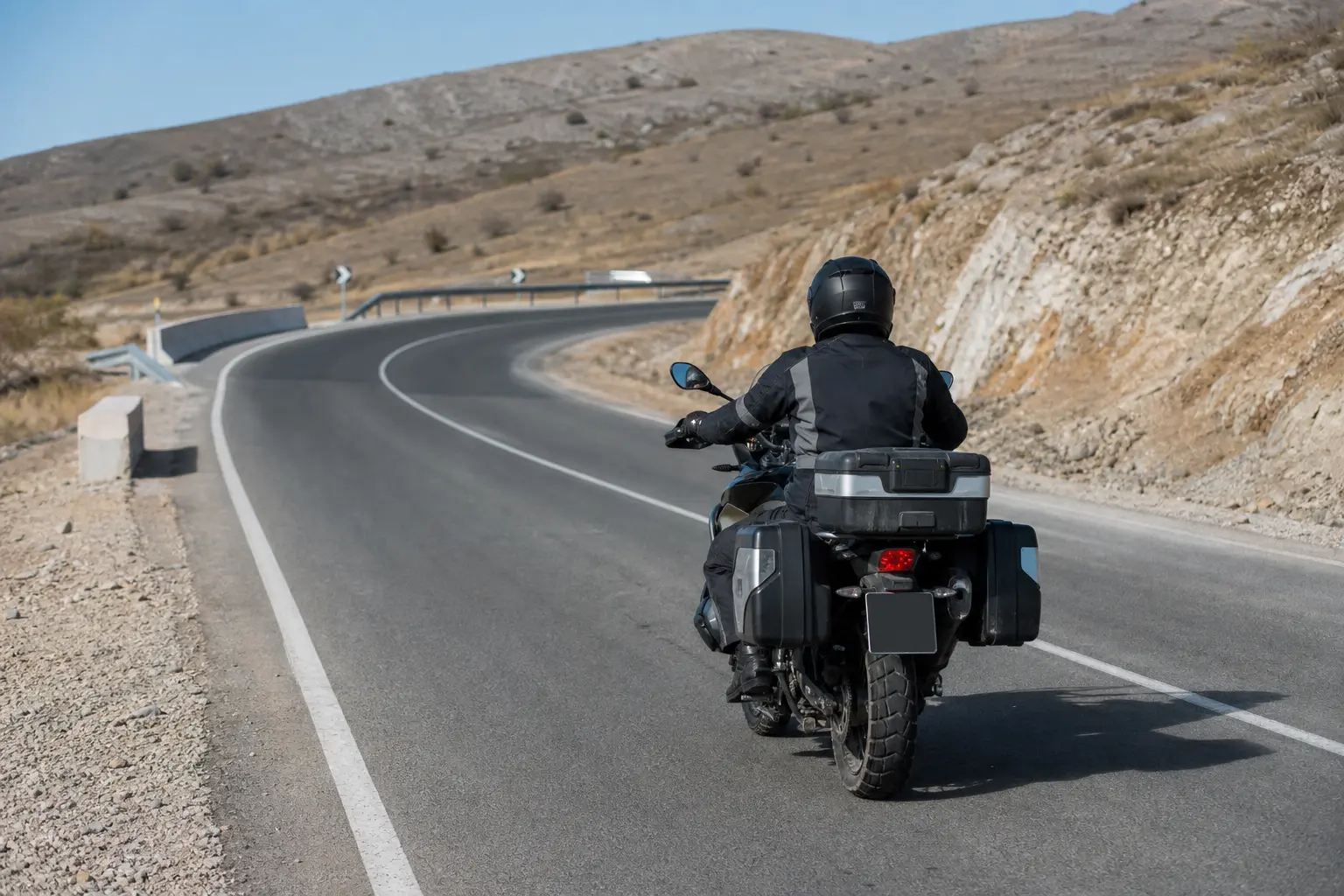
A rider who looks only a few yards ahead will discover gravel too late to make good choices. The better habit is to search far enough ahead that surface changes become route information rather than surprises. MSF recommends searching the intended path of travel well ahead and maintaining an adequate space cushion. (msf-usa.org)
On a familiar commute, this may mean noticing a pale fan of material exiting a driveway, a truck ahead with dusty tires, a work-zone sign, or a widening dirty margin near a ramp. On an unfamiliar rural road, it means treating limited sightlines, driveways, and transitions from shade to sun as reasons to reduce your pace before you see the exact hazard.
Clues that deserve an earlier roll-off
Use clues as prompts to create time, not as evidence that gravel is definitely present:
| Road clue | What it may signal | Conservative response |
|---|---|---|
| Gravel driveway or unpaved side road | Material may have been carried onto the lane | Ease off early and scan the lane surface beyond the entrance |
| Construction entrance or road work | Loose material, changing lanes, trucks, or uneven pavement | Increase following space; expect surface changes and follow traffic control |
| Tightening curve or downhill approach | Less time to identify traction changes and stop | Set a conservative entry speed before commitment |
| Ramp, shoulder, or lane edge | Accumulated debris may be nearer the boundary | Maintain a safe lane position with room to adjust, without drifting toward other traffic |
| Vehicle ahead raising dust or leaving a dirt lot | Possible fresh debris in your path | Back off, improve your view, and avoid riding in its immediate track |
| Wet, shaded, or low-light pavement | Gravel may be harder to distinguish and grip may be reduced further | Slow sooner and avoid combining the hazard with a rushed turn |
None of these clues requires a fixed lane position or a universal speed. Traffic, road width, sight distance, legal lane use, oncoming vehicles, and escape space all matter. The useful principle is simpler: when the surface is harder to read, keep more of your options available.
A good following distance is especially valuable. If a tall vehicle hides the road surface, the rider behind loses early warning. Dropping back can restore sight distance and create room to slow without turning a surface hazard into a hard-braking event. For broader route and pre-ride planning, see the Motorcycle Maintenance Guide.
The slow, smooth, straighten-and-scan plan
The plan works best when you think in sequence rather than trying to do everything at once. Each phase reduces the chance that the next decision becomes rushed.
1. Slow before the surface, not on it
If you identify the gravel in time, reduce speed on the clearer pavement leading up to it. This gives you a calmer entry and more room for traffic behind you to react. MSF’s guidance for slippery surfaces is direct: slow before reaching the low-traction surface because more distance may be needed to stop. (msf-usa.org)
That does not mean abruptly chopping speed the instant you notice a few stones. First check mirrors and surrounding traffic, then use a gradual, controlled reduction that fits the available space. If you need more slowing distance than the roadway offers, the answer is not to force an aggressive stop on questionable traction. Keep the motorcycle stable, preserve a path, and seek the safest available exit from the situation.
The speed goal is contextual: slow enough that you can remain composed, maintain your lane, and make only gentle adjustments. There is no responsible universal number because a small dry scattering on a straight road differs from a deeper patch on a damp downhill curve with traffic beside you.
2. Smooth the controls
Once you are approaching or crossing loose material, calmness at the controls matters. MSF warns that sudden changes in speed or direction can lead to a skid on slippery surfaces and advises riders to be as smooth as possible when accelerating, shifting, turning, or braking. (msf-usa.org)
In practical terms, avoid treating the gravel as a countdown to an emergency maneuver. Keep your hands relaxed enough to avoid accidental steering corrections. Avoid abrupt throttle changes. Do not add a hurried shift unless it is truly necessary for safe control. If braking is needed, use gradual pressure rather than a sudden grab; MSF notes that both brakes remain relevant on slippery surfaces and stresses gradual application. (msf-usa.org)
A useful mental cue is: quiet hands, quiet feet, quiet throttle. It reminds you that the goal is not to freeze, but to avoid injecting extra instability into an already uncertain situation.
3. Straighten where the road safely allows
A motorcycle is generally easier to manage when it is not being asked to corner aggressively while crossing a low-traction patch. If you can safely make the bike more upright before the gravel, do so through a normal, early adjustment—not a last-second swerve. Keep within your lane and respect traffic around you.
Sometimes a curve, intersection, or narrow lane means you cannot be perfectly straight. In that case, do not chase an unrealistic ideal. Instead, reduce the combined demands: enter more slowly, minimize lean as circumstances permit, make your line deliberate, and avoid changing your mind halfway through the patch.
This is not a claim that you should suddenly stand the bike up and abandon the turn. It means the same conservative principle used throughout hazard management: set speed and direction as early as practical, then carry a smooth, uncomplicated path through the limited-traction area.
4. Scan through the patch and beyond it
Where you look affects the quality of your decisions. Fixating on the loose stones may tempt you to steer toward the very thing you want to avoid or miss what is waiting after it. Keep your eyes moving: surface ahead, path through, traffic, pavement beyond, and the available safe space.
Scanning beyond the gravel also prevents the first hazard from hiding the second. A patch may lead straight into an intersection, a narrowing shoulder, a stopped vehicle, a second dirty area, or an upcoming curve. When conditions allow, identify where you want the motorcycle to be once the traction improves, then guide it there with measured inputs.
If you feel a small wander or looseness, resist the urge to fight every movement. Your priority is to keep a steady, legal path and avoid sharp corrective inputs. If the motorcycle does not feel normal after the patch, reduce speed gradually, move to a safe location away from traffic, and assess whether continuing is appropriate. A visible tire, wheel, control, or braking concern calls for a conservative no-ride decision and qualified help rather than roadside experimentation.
When avoidance is available—and when it is not
Avoiding a loose patch is often preferable, but only when the avoidance path is unquestionably safer than riding through it. That distinction prevents a common mistake: turning a manageable surface hazard into a traffic conflict.
Choose an early, gentle avoidance path only when all of these are true
- You can see a clean path with enough distance to move progressively.
- The move stays legal and within your lane, or otherwise complies with traffic control and road conditions.
- There is no vehicle, pedestrian, cyclist, lane boundary, curb, shoulder drop-off, or oncoming traffic conflict.
- You can complete the adjustment without sharp steering or a hurried brake application.
- The new path does not carry you into deeper debris, a blind area, or another hazard.
If one of those conditions is absent, simplify. Slow if possible, stay composed, keep the motorcycle stable, and cross the least hazardous available line rather than making an impulsive escape move.
Do not let lane edges become a false solution
The road edge is a frequent place for debris to accumulate, and it may also have poor pavement, a drop-off, drainage hardware, or no recovery space. Do not assume the shoulder is a traction reserve. MSF specifically notes the tendency for dirt and gravel to collect at roadway sides. (msf-usa.org)
Similarly, do not cut across lane markings, painted islands, or other surface transitions simply because they appear cleaner than the gravel. They may introduce their own traction or conflict problem, particularly when wet. A safe choice is based on the whole scene, not just the visible stones.
Gravel in curves, ramps, and intersections
The same four-part plan applies everywhere, but certain locations remove options faster. Recognize them early and adjust the plan before your motorcycle reaches the critical point.
In a curve
The highest-value action is a conservative entry. If the curve is blind, tightening, downhill, or dirty near the outer edge, set a pace that leaves room for a surface surprise. Once gravel appears mid-corner, avoid a panic response. Keep your attention through the corner, avoid abrupt changes, and seek the smoothest lawful path that preserves lane margin and separation from traffic.
Do not cross the centerline, drift into an opposing lane, or run wide onto a shoulder to escape the gravel. Those choices may turn a traction issue into a much more severe collision risk. If the available surface is too compromised for your comfort or ability, slowing, stopping only when it can be done safely, or turning around later is a sound judgment call—not a failure.
On ramps
Ramps combine speed, curvature, traffic merging, and debris-prone edges. Treat the ramp as a place to build margin before the bend starts. Do not use its posted advisory as a personal target; choose a speed appropriate for what you can see, the road surface, your motorcycle, load, experience, and the traffic flow.
If loose gravel appears during a merge or exit, do not sacrifice awareness of surrounding vehicles. Signal and lane position still matter. Smoothly create room where possible, avoid a rushed lane change, and prioritize keeping a predictable path for drivers who may not recognize the surface problem.
At an intersection or driveway
Loose gravel at a driveway or intersection may be paired with turning vehicles, pedestrians, and limited space. Slow early enough that you are not forced to divide your attention between a hard stop and a surface change. Keep an eye on vehicle wheels and likely crossing paths while retaining a view of the pavement where your tires will travel.
At very low speed, stopping surfaces deserve extra caution too. Put a foot down only after checking that the ground is stable and clear enough to support you. If the surface is loose or slippery, choose a safer stopping spot if traffic conditions allow.
What not to do when the surface suddenly changes
A short “do not” list can be more memorable than a long technique list:
- Do not stare at the gravel. Keep your visual attention on the usable path and the road beyond.
- Do not grab a brake or snap the throttle closed. Abrupt speed changes add demand when traction is uncertain.
- Do not make a sharp swerve without a clear, safe path. A rapid direction change can be worse than the surface itself.
- Do not assume ABS, traction control, or riding mode settings erase the hazard. They may assist in defined situations, but they do not create predictable pavement or replace judgment.
- Do not ride the shoulder as an automatic escape route. It may contain more loose material or leave little room to recover.
- Do not let another rider’s pace make the decision for you. Create space, communicate when practical, and ride within your own margin.
- Do not practice emergency responses in active traffic. Skills should be built in a controlled setting with qualified instruction.
The MSF Motorcycle Operator Manual is clear that reading material alone does not build the physical abilities for motorcycle control; it points riders toward practice and formal instruction. (msf-usa.org)
A pre-ride plan that makes gravel less surprising
You cannot remove every loose stone from the road, but you can make your ride more resilient to it. Start with the rider, then the motorcycle, then the route.
Rider readiness
Wear protective gear suited to the conditions, including a securely fitted DOT-compliant helmet and effective eye protection. MSF describes eye and face protection as important defenses against wind and road debris that can distract a rider from the road. (msf-usa.org) Clear vision is particularly valuable when loose material is hard to detect in glare, shadow, dusk, or rain.
Also be honest about fatigue, unfamiliarity with the motorcycle, passenger load, cargo, and stress. A gravel patch that is manageable on a rested solo ride can feel very different when you are tired, carrying a passenger, or trying to keep up with a group.
Motorcycle readiness
Before leaving, use your owner’s manual and normal pre-ride process. MSF’s T-CLOCS framework includes tire and wheel condition and inflation, brake feel, controls, lights, fluid checks, chassis items, and stands. (msf-usa.org) That does not guarantee traction, but it helps reduce the risk of meeting a road hazard with an avoidable mechanical or tire-related concern already present.
Do not guess at tire pressure, suspension adjustments, or load limits based on a generic article. Use the specifications and instructions for your exact motorcycle and its current load. If you find a concern that could affect safe control—such as a tire issue, a brake-control concern, or a damaged wheel—do not make a gravel encounter the test of whether it is acceptable.
Route readiness
Before an unfamiliar ride, identify roadwork, unpaved-road segments, dense driveway areas, and routes that may put you on fast ramps or blind rural curves. This is not a reason to avoid every imperfect road. It is a reason to choose an appropriate pace, leave time for rerouting, and avoid making up lost time where traction is uncertain.
Clearly titled checklist: Loose Gravel on Pavement Checklist
Before you ride
- Check tires, wheels, brakes, controls, lights, fluids, chassis, and stands using the owner’s manual and a consistent pre-ride routine.
- Confirm tire pressures and loading arrangements against the motorcycle’s own documentation.
- Clean your eye protection and choose a lens or shield that gives you a clear view for the available light.
- Identify whether the route includes road work, gravel driveways, rural lanes, ramps, or unfamiliar curves.
- Leave enough time that you do not feel pressured to carry speed through uncertain surfaces.
When you spot loose gravel ahead
- Scan mirrors and traffic before changing speed or position.
- Reduce speed progressively on cleaner pavement before the hazard when possible.
- Decide early whether a legal, clearly safe path around the patch exists.
- If crossing is necessary, aim for the simplest path available and reduce lean where safely possible.
- Keep throttle, braking, shifting, and steering inputs smooth.
- Look through the hazard toward the usable pavement and traffic space beyond it.
After crossing it
- Continue scanning: the debris may extend farther than the first visible patch.
- Avoid treating the return to clean pavement as a cue for a sudden acceleration or sharp turn.
- If the motorcycle feels abnormal, reduce speed gradually and stop only in a safe location.
- Do not continue riding if you identify a concern that could compromise control; arrange qualified inspection or assistance.
- Make a brief note of the location for future route planning if it is a recurring hazard.
Train for judgment, not bravado
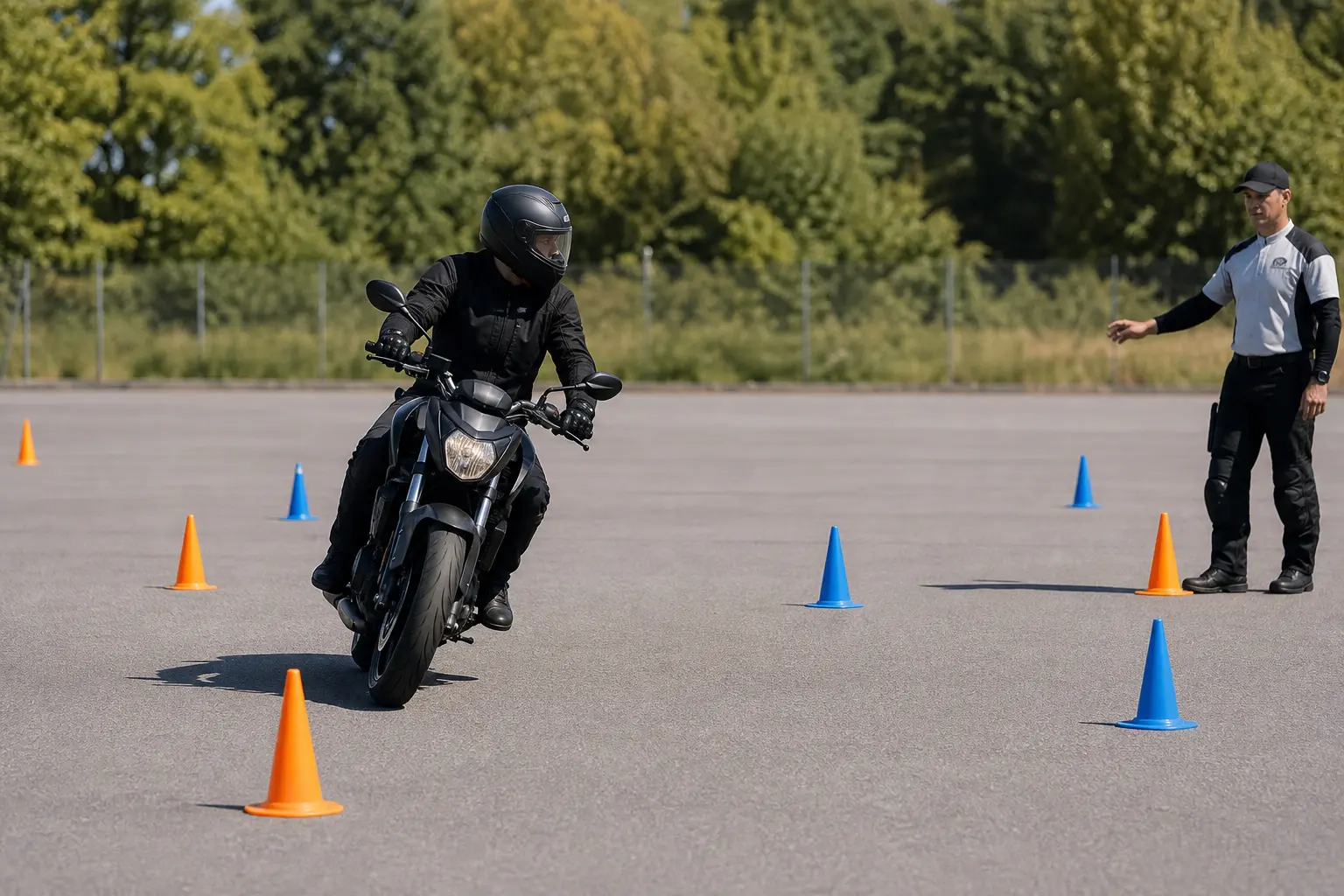
A written plan can improve recognition and decision-making, but it cannot substitute for supervised practice. The MSF Basic RiderCourse includes structured on-motorcycle exercises covering stopping, progressive braking, curves, traction management, obstacle crossing, and swerving. (msf-usa.org) Those are relevant foundations because gravel incidents often become serious when a rider must choose between braking, changing direction, and maintaining a path with little time.
Training is especially worthwhile if any of these situations feels unfamiliar:
- you hesitate when surface grip changes unexpectedly;
- you find yourself looking down rather than through a hazard;
- a curve with debris makes you freeze or overcorrect;
- your braking inputs become abrupt under stress;
- you recently changed motorcycles, added a passenger, or returned to riding after time away.
Choose an approved course or qualified instructor rather than trying to recreate loose-surface surprises on public roads. The objective is not to become comfortable taking risks on gravel. It is to build smoother habits, better visual discipline, and earlier decisions so a real road hazard requires less last-second improvisation.
How Vojo Helps
Create a “low-traction route readiness” checklist in Vojo before a ride that includes your pre-ride tire and control checks, route notes for ramps or construction areas, and one personal reminder: “slow before uncertain surfaces.” After the ride, log any recurring gravel locations and any motorcycle observations in your service history so you can distinguish a repeat road hazard from a condition that needs attention. Use the Motorcycle Service History to keep those route and inspection notes together with your maintenance record.
Download Vojo on the App Store
Bottom line
Unexpected gravel on pavement is a reminder that safe riding is often decided before the tires arrive at the hazard. Scan early enough to notice surface clues. Create time and space. Slow while traction is more predictable. Keep your inputs smooth. Make the motorcycle as upright and the path as simple as conditions safely permit. Then look through the hazard to the road and traffic situation beyond it.
If you cannot do those things because the curve is blind, traffic is too close, the surface is broadly covered, or you do not feel confident in the available margin, take that information seriously. A route change, a pause, or further training is a better outcome than trying to force a technical answer to a road that has stopped offering one.
Quick answers
Frequently asked questions
Should I brake if I see loose gravel on pavement?
If you have room, reduce speed progressively before reaching the loose material. The MSF advises slowing before slippery surfaces and using gradual brake pressure rather than abrupt inputs. If you are already on the gravel, avoid a panic grab; keep the motorcycle stable and make the smoothest safe choice the traffic situation allows.
Should I stand up when riding over loose gravel on a paved road?
This article does not treat standing as a universal street response. On public pavement, first prioritize early speed reduction, a stable path, smooth inputs, and traffic awareness. Your position must still allow confident control of the motorcycle. Build any additional low-traction skills with qualified, supervised training rather than experimenting in traffic.
Does motorcycle ABS make loose gravel safe?
No. ABS may help manage wheel lock in some braking situations, but it does not create traction, remove loose material, guarantee a stopping distance, or solve a poor line choice. Use the same conservative plan: scan early, reduce speed before the hazard, and avoid abrupt inputs.
Where is gravel most likely to collect on paved roads?
It is commonly found near driveways, construction access points, shoulders, road edges, ramps, broken pavement, and curves where debris can accumulate. The MSF specifically flags road edges, curves, and highway ramps as places where dirt and gravel may collect.
What if gravel appears in the middle of a corner?
Avoid an abrupt correction. Keep your attention on the available path through the corner, reduce further demands on the tires, and make inputs as smooth as possible. Do not cross the centerline or run onto a shoulder simply to avoid a small patch. If this scenario feels beyond your current comfort or skill, pursue structured rider training.
What should I check after riding through a larger gravel patch?
If the motorcycle feels normal, continue cautiously because debris may extend beyond the first patch. If you notice an abnormal feel, reduce speed gradually and stop in a safe location. A visible tire, wheel, brake, or control concern should be assessed conservatively using your owner’s manual and qualified assistance where needed.