
Decreasing-Radius Motorcycle Curves: How to Build a Conservative Entry Plan Before the Turn Tightens
Learn how to read decreasing-radius motorcycle curves, choose a conservative entry plan, preserve lane margin, and know when training is the safer next step.
Fact-checked against cited official documentation
Reviewed against Fact-checked against MSF guidance on changing curve geometry, flexible lane position, curve-related traction limits, cornering within skill limits, and hands-on curve-judgment training..
Last updated September 28, 2026
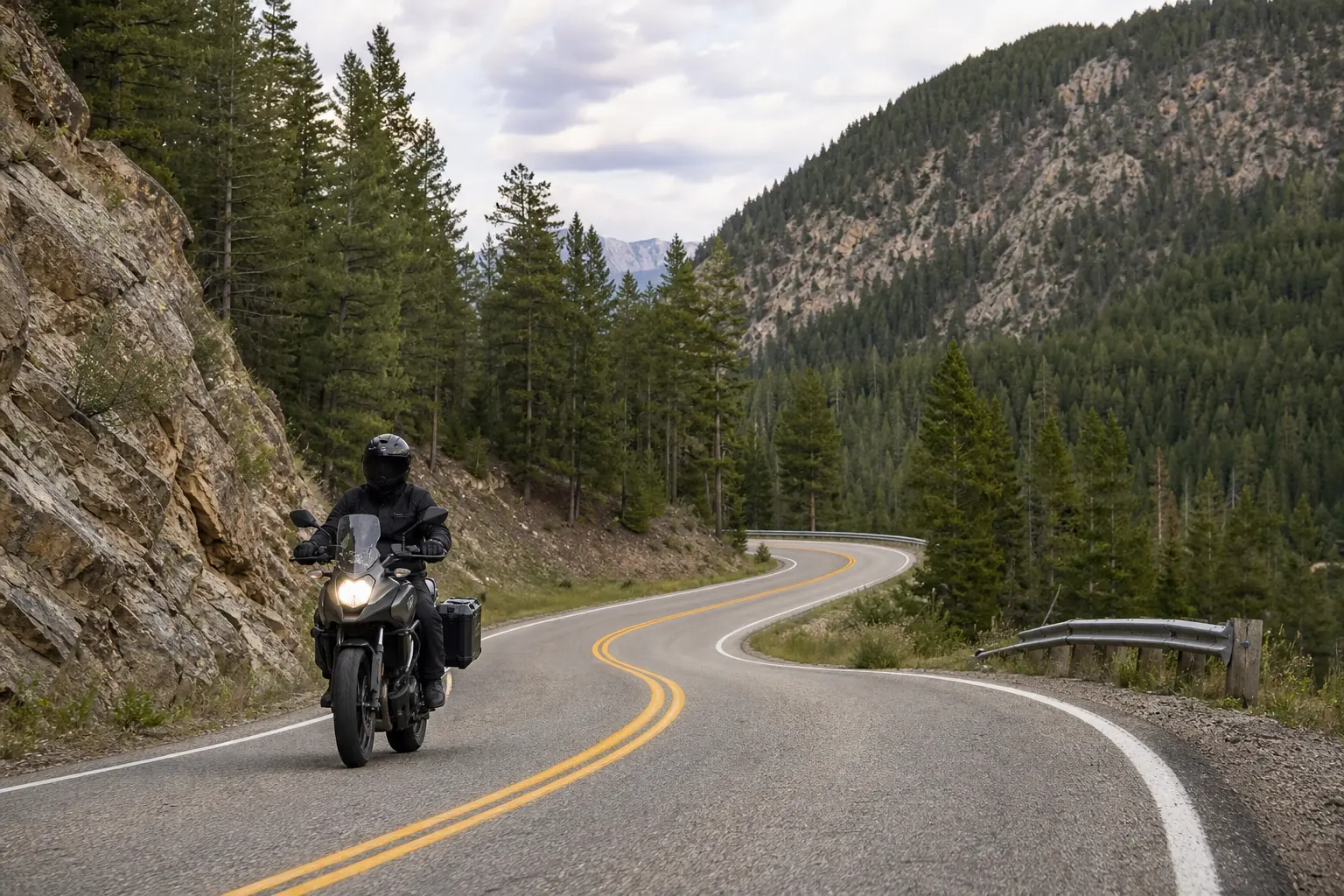
A decreasing-radius curve is a turn that becomes tighter after you enter it. The important challenge is not finding a universal “perfect line.” It is recognizing uncertainty early enough to arrive with enough speed, space, attention, and skill margin to stay in your lane if the road keeps closing.
The Motorcycle Safety Foundation (MSF) identifies curves that get tighter as a distinct road pattern and advises riders to account for traffic, surface conditions, and changing curve geometry rather than treating every corner alike.1 For street riding, the conservative answer to how to ride decreasing radius motorcycle curves is simple: plan for the turn to tighten before you know that it will not.
Recognize the turn that keeps closing

A curve can be decreasing-radius even when its entry looks open. The road may disappear behind trees, a cut hillside, parked vehicles, glare, or the first part of the bend. As you approach, keep reassessing whether the visible exit is moving farther away, whether the far edge of the road bends back toward you, and whether an advisory sign, chevrons, changing pavement, or a downhill section suggests more demand ahead.
Treat these as prompts to increase caution, not as a reason to force a faster pace. The MSF emphasizes continuous searching for changing conditions and using time and space to manage hazards.2
| What you notice | What it can mean | Conservative response |
|---|---|---|
| The exit is not yet visible | You cannot confirm the curve’s full shape | Enter at a speed that leaves room for the unknown. |
| The far edge appears to curl back inward | The turn may tighten after the first bend | Keep your plan adjustable rather than committing to a fast entry. |
| Gravel, wet patches, leaves, or poor pavement near the bend | Available traction may be reduced | Add more margin or wait for a safer opportunity to continue. |
| An oncoming vehicle is near or over the centerline | Your usable lane space may shrink | Prioritize staying within your lane and preserving separation. |
| Night, glare, fatigue, or an unfamiliar road | Your ability to read the curve is reduced | Slow earlier, reduce the pace, or choose a route and time with better visibility. |
Build the entry plan before you lean
A conservative plan begins before the motorcycle is committed to the turn:
- Set a pace for the tightest plausible part of the curve, not the inviting entry. Posted limits, advisory signs, weather, visibility, traffic, and your own readiness all matter. A sign is not a personal target speed.
- Look through the available path. Keep scanning toward where you want the motorcycle to travel while continuing to gather information about the road surface, the exit, and other road users.
- Choose lane position for information and space, not for a ritualized racing line. The MSF notes that lane position should vary with traffic, road conditions, and the curve. A center-lane setup can be a useful starting choice in some circumstances, but debris, sightlines, oncoming traffic, and local road conditions may make another within-lane position more appropriate.1
- Keep a lane boundary in your plan. Do not borrow pavement from oncoming traffic or depend on the shoulder to complete the turn.
- Leave an adjustment margin. A decreasing-radius curve asks more of a rider who enters too quickly. A smaller entry commitment gives you more options as the view develops.
This approach is intentionally less dramatic than chasing an apex. On a public road, the goal is not to prove that the curve can be ridden quickly; it is to retain judgment when the curve, surface, or traffic situation is worse than expected.
Use lane position as a flexible safety tool
Lane position is not a fixed formula. The useful question is: Which part of my lane currently gives me the best combination of view, separation, surface quality, and escape space?
For example, a position that improves your view around one bend may become unsuitable if it brings you closer to debris, a wet center strip, an encroaching vehicle, or a blocked sightline. Re-evaluate rather than defending the position you chose at entry.
Manufacturer-first guidance matters here: use the owner’s manual for your motorcycle’s pre-ride checks, tire information, loading limits, and any operating warnings that affect handling. If anything about the motorcycle’s tires, brakes, steering, throttle, suspension, or load gives you doubt, do not use a demanding road as the place to find out. Start with the broader Motorcycle Maintenance Guide before building speed or confidence on curves.
If the curve tightens more than expected
The safest outcome is usually created before the surprise: earlier speed reduction, a realistic view of the road, and enough room to stay calm. If you realize the turn is tightening, keep your attention on the available path within your lane rather than staring at the edge you fear reaching.
Avoid treating this moment as an invitation to improvise a high-pressure maneuver. Surface grip, lean angle, traffic, and rider skill can all limit options. The MSF notes that cornering uses traction and that braking demands in a curve require particular care; it also recommends formal instruction for building physical control skills rather than relying on reading alone.1
If you routinely feel rushed or run wide in familiar curves, reduce your street pace and seek structured rider training. MSF’s Basic RiderCourse includes exercises on initiating and adjusting lean, curve judgment, multiple curves, and safety margins in a controlled setting.3
Decreasing-radius curve checklist
Before entering an unfamiliar or tightening curve, ask:
- Can I see enough road to confirm the curve’s exit and surface?
- Have I chosen an entry pace that allows for a tighter second half?
- Is my lane position helping me see, maintain separation, and avoid obvious hazards?
- Am I leaving the entire opposing lane and shoulder out of my plan?
- Have weather, darkness, glare, fatigue, passenger or cargo load, or an unfamiliar motorcycle reduced my margin?
- Is the motorcycle ready for the ride under its owner’s-manual guidance?
- If the answer to any of these is no, can I slow sooner, create more space, or postpone the ride?
Training is the right escalation
Reading about decreasing-radius curves can improve your decision-making, but it does not substitute for coached practice. The MSF specifically frames rider education as a way to develop the mental and physical skills of riding, and its hands-on curriculum progresses through curve judgment and multiple-curve exercises.3
Choose training when you are new to street riding, returning after time away, changing to a different motorcycle, or noticing that curves cause panic, target fixation, repeated lane-position errors, or near-misses. The responsible target is not a more aggressive corner entry. It is a steadier process for recognizing limits early and riding within them.
How Vojo Helps

Create a saved “curve-readiness” pre-ride checklist in the Vojo motorcycle maintenance tracker that prompts you to confirm tire condition and pressure per your owner’s manual, control feel, lighting, weather, fatigue, and any passenger or cargo change. Before a route with unfamiliar mountain or back roads, review the checklist, log any concern, and choose the conservative route or pace before leaving—not after a curve has already tightened.
Download Vojo on the App Store
Footnotes
Quick answers
Frequently asked questions
What is a decreasing-radius motorcycle curve?
It is a curve that becomes tighter after entry. Because the full shape may not be visible at first, it calls for a conservative pace and ongoing visual assessment.
Should I use the same lane position in every decreasing-radius curve?
No. Use a position within your lane that supports visibility, separation from traffic, surface awareness, and an adequate space cushion. Conditions can change before and during the curve.
Should I enter a decreasing-radius curve at the posted speed limit?
Not automatically. Posted limits do not account for your view, surface condition, weather, traffic, motorcycle load, familiarity with the road, or personal skill margin.
What should I do if I realize the curve is tighter than expected?
Keep your focus on the usable path within your lane, avoid fixating on the road edge, and use only the smooth, controlled responses you have learned and practiced. If this happens often, reduce pace and pursue formal training.
Do decreasing-radius curves require a special motorcycle setup?
There is no universal setup. Follow your exact owner’s manual for tires, pressures, load limits, inspection, and maintenance. Do not rely on a curve to test a motorcycle with unresolved handling or control concerns.