
New Motorcycle Tires: What the First 100 Miles Should Feel Like
Learn how to break in new motorcycle tires during the first 100 miles, what handling changes are normal, and when a vibration means stop and inspect.

Fact-checked against cited official documentation
Reviewed against Fact-checked against the Motorcycle Safety Foundation Motorcycle Tire Guide and its official New Tire Installation and Precautions guidance..
Last updated November 1, 2026
New motorcycle tires can make a familiar bike feel unfamiliar. The steering may seem more eager, the motorcycle may hold a line differently, and the transition from upright to leaned can feel more noticeable than it did with worn tires. That change does not automatically mean something is wrong. It does mean the first miles deserve more attention than an ordinary commute.
The safest way to think about the first 100 miles is not as a magic distance or a target to complete quickly. It is a gradual familiarization period. Use short, low-consequence rides to learn how the motorcycle responds, while leaving a generous margin for braking, cornering, traffic, weather, and mistakes. The exact tire manufacturer’s instructions and your motorcycle’s owner’s manual take priority over any general checklist.
The Motorcycle Safety Foundation’s Motorcycle Tire Guide emphasizes correct selection, inspection, maintenance, matching, balancing, alignment, and adapting to changed handling after replacement. Its tire-installation guidance also recommends professional installation and balancing and a cautious period for becoming accustomed to new-tire behavior. Those principles are more useful than treating “100 miles” as a universal break-in prescription.
Why New Tires Can Feel Different
A replacement tire changes the part of the motorcycle that connects it to the road. Even when the replacement follows the specified size and type, its profile and construction may not feel identical to the tire it replaces. The old tire may also have developed a flattened center or uneven wear. A fresh tire can therefore make steering feel lighter, more responsive, or more progressive than expected.
That contrast is easiest to notice when replacing both tires. The motorcycle may turn with less effort, feel less reluctant to change direction, or seem to reach its familiar cornering attitude sooner. A rider who has spent months adapting to worn profiles can interpret a healthy change as instability simply because the old response had become normal.
The correct response is not to test the new tire’s limits. It is to reduce the demands placed on it while you learn the new response. Smooth inputs, conservative speed, and uncomplicated roads give you better information than an aggressive corner or emergency-style braking test.
New tires can also have a different surface condition immediately after installation. That is one reason the MSF guidance recommends a cautious break-in period rather than an immediate return to hard acceleration, heavy braking, or high-speed cornering. The practical goal is controlled adaptation, not proving that the tire is ready for maximum performance.
Before the First Ride
A careful first ride begins at the shop or at home before the motorcycle moves. If a shop installed the tires, ask what was fitted and confirm that the work was completed for your exact motorcycle. If you supplied the tires, keep the packaging or receipt so the size, model, and ratings can be checked against the motorcycle manufacturer’s specification.
Professional installation matters because mounting, balancing, valve condition, and wheel installation are safety-critical. The MSF installation guidance specifically points riders toward qualified tire service and balancing. This article does not replace the installer’s inspection or the motorcycle manufacturer’s instructions.
Before setting off, confirm the following in a calm, parked inspection:
- The front and rear tires match the motorcycle’s specified sizes and type requirements.
- The tire pressures are set according to the motorcycle manufacturer’s cold-pressure information, not a number chosen from the tire sidewall alone.
- The wheels, valves, and visible tire surfaces look free from obvious damage.
- Nothing appears to contact the tire as the suspension moves or the handlebars turn.
- Any work-order concerns, unusual noises, or questions about fit have been discussed with the installer.
- You have enough fuel, time, and daylight to stop early rather than press on because you are late.
Do not use the first ride to compensate for uncertainty about fit, pressure, balancing, or installation. If the shop cannot explain what was fitted or you notice a concern before leaving, pause and ask for clarification. A professional should resolve installation questions before the motorcycle enters traffic.
For broader preparation, use the inspection habits in the Motorcycle Maintenance Guide. New tires do not remove the need to consider the rest of the motorcycle: controls, brakes, lights, load, and weather all affect the margin available during a familiarization ride.
What the First 100 Miles Should Feel Like
There is no single sensation that proves a tire is correctly installed, and there is no official universal mileage point at which every tire is “broken in.” Instead, look for a gradual improvement in your own confidence and a consistent response from the motorcycle.
During the earliest miles, normal adaptation may include:
- Steering that feels more responsive than it did with the worn tires.
- A different effort required to hold a line through a gentle bend.
- A change in how quickly the motorcycle transitions from upright to leaned.
- A surface feel that becomes more familiar as you ride smoothly and observe the response.
- Less need to make steering corrections once you have adjusted your inputs.
Those sensations should be evaluated in context. A mild, repeatable change that matches the expected difference between worn and new tires is not the same as a wobble, a strong pull, a repeating vibration, or a sudden loss of confidence. The motorcycle should remain controllable and predictable even while it feels different.
A useful first-ride progression is to divide the distance into observations rather than milestones:
| Stage | Riding environment | What to do | What you are learning |
|---|---|---|---|
| First few miles | Quiet, familiar streets with good visibility | Use gentle acceleration, braking, and steering | Whether the motorcycle tracks predictably and controls feel normal |
| Early familiarization | Short local route with broad, uncomplicated bends | Increase demands only slightly and leave space around the bike | How the new profile changes turn-in and line holding |
| Middle portion | A route you already know, in favorable conditions | Make smooth, ordinary riding inputs; avoid deliberate limit testing | Whether the response remains consistent as confidence returns |
| Later portion | Normal riding only if earlier checks were uneventful | Continue monitoring pressure and behavior | Whether the motorcycle is ready for more varied trips, not whether it can be pushed |
This table is a planning framework, not a manufacturer interval. Stop the progression if the motorcycle gives you a new concern. A tire that feels different is a reason to adapt; a tire that behaves inconsistently is a reason to investigate.
A Conservative First-Ride Plan
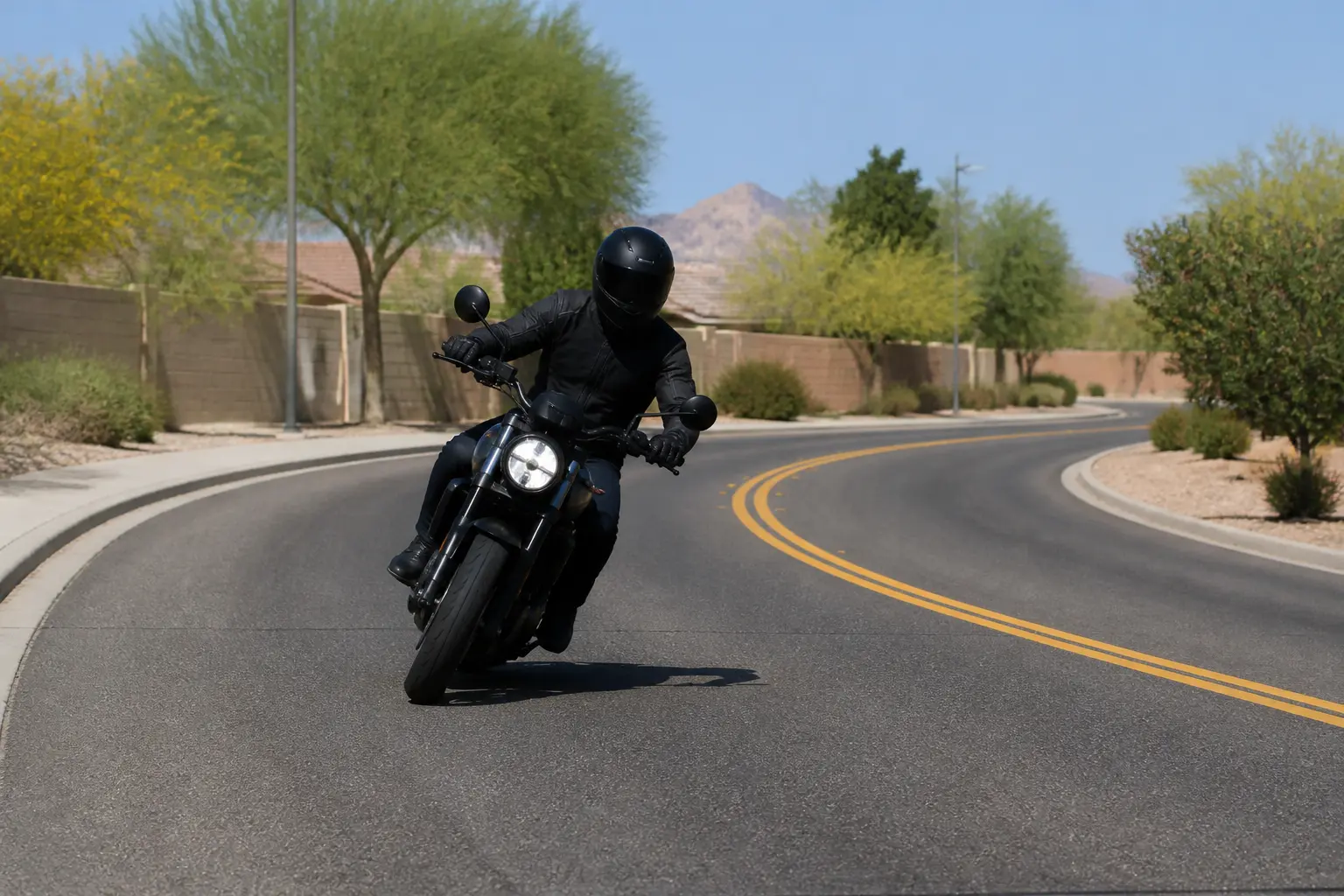
Choose a route that lets you concentrate on the motorcycle. Avoid beginning with a busy highway, wet pavement, gravel, steep downhill, tight mountain bends, or a trip where turning around would be difficult. The best route is familiar, reasonably smooth, and short enough that you can return to the installer without becoming committed to a long journey.
Start with the motorcycle upright and your controls relaxed. Use modest throttle and progressive braking. Let the bike’s response develop without abrupt steering, rapid lane changes, hard acceleration, or deep cornering. You are gathering information, not creating a performance test.
Keep your attention on repeatability. Does the motorcycle go where you expect with normal input? Does it remain composed when you gently slow? Is the steering response similar from one comparable bend to the next? You do not need to diagnose a tire from the saddle. You only need to notice whether the behavior is predictable enough to continue.
After a short loop, stop somewhere safe and make a deliberate decision. Ask yourself:
- Did the motorcycle track straight and respond consistently?
- Did any vibration, pulsing, wobble, or pull appear?
- Did anything sound or feel loose?
- Did the controls remain normal?
- Do the tires and wheels still look as expected?
If the answers are reassuring, a second short ride can be slightly more representative of your ordinary use. It should still avoid aggressive testing. Confidence should come from repeated predictable behavior, not from how much lean, speed, or braking force you managed to use.
Do not assume that a calm first few minutes prove everything is perfect. Continue paying attention through the first several rides, especially if the motorcycle will carry a passenger, luggage, or a different load than the initial ride. Recheck pressure when the tires are cold according to the motorcycle manufacturer’s guidance, and use the appropriate loaded setting when the manual provides one.
Normal Adaptation or a Problem?
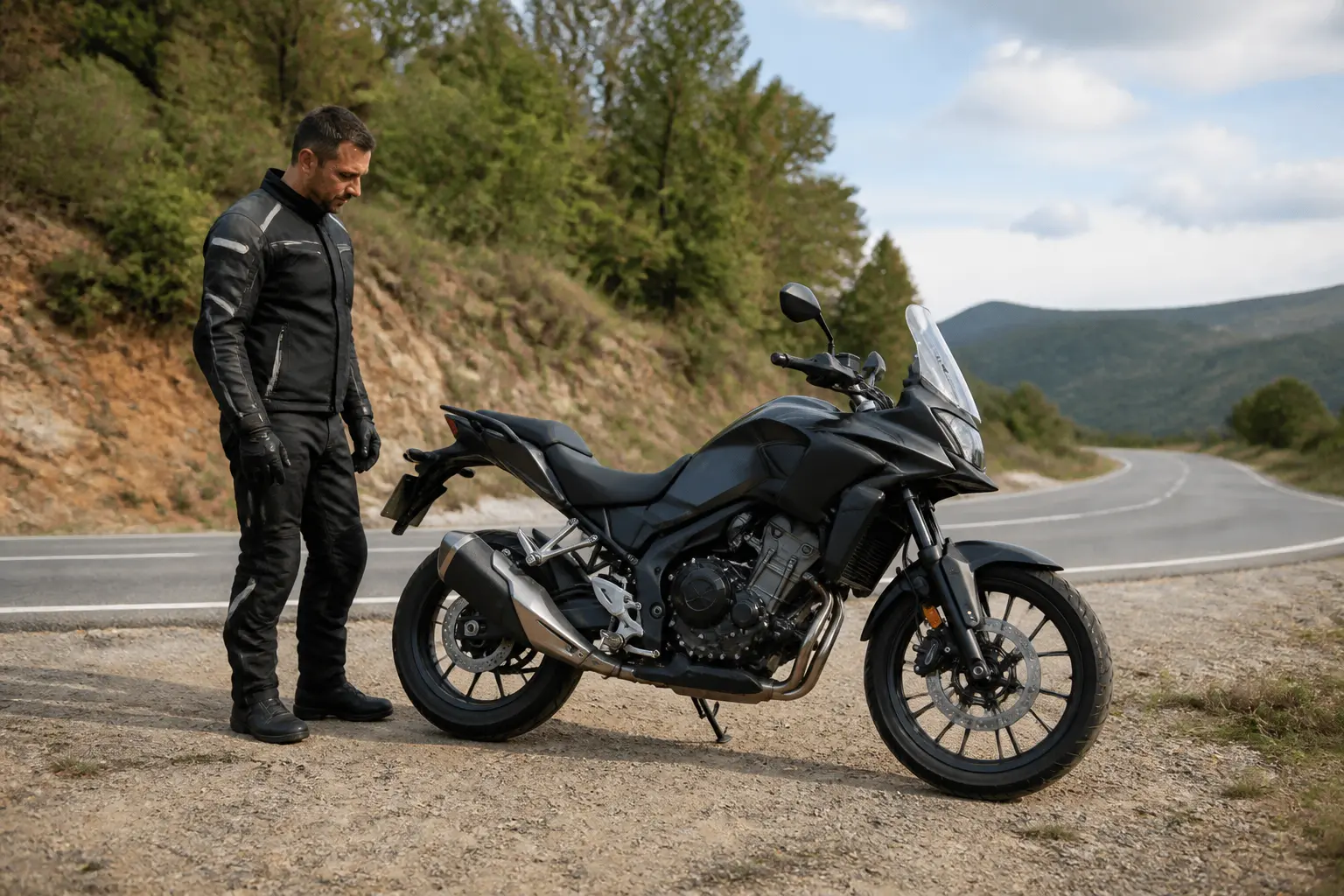
The central judgment is whether the motorcycle feels different in a steady, understandable way or whether it feels wrong in a way that could indicate installation, balance, alignment, pressure, damage, or another issue.
A normal adaptation generally has these characteristics:
- The change is mild enough to manage with ordinary inputs.
- The response is repeatable rather than random.
- The motorcycle tracks where you aim it.
- There is no new strong vibration or wobble.
- The behavior makes sense as a contrast with the worn tires.
- Your comfort improves as you ride conservatively.
A concern deserves a pause and professional assessment when you notice:
- A strong or repeating vibration, especially one that increases with speed.
- A wobble, weave, shake, or instability that was not present before the tire change.
- A persistent pull that makes the motorcycle difficult to keep on line.
- A sudden change in steering effort or a response that varies from one direction to the other.
- Unusual noise, rubbing, scraping, or contact near a tire or wheel.
- Visible damage, a displaced-looking tire, or a pressure concern.
- Any behavior that makes you unsure you can control the motorcycle safely.
These signs do not identify one specific cause. They are stop-and-check clues. Reduce speed smoothly, move to a safe location, and arrange qualified inspection rather than trying to diagnose or correct a safety-critical installation problem beside the road. If the motorcycle does not feel safe to ride, use appropriate recovery or transport.
A new tire should not be used to explain away every new symptom. “It is still breaking in” is not a safe answer to a severe vibration, wobble, or pressure loss. Break-in explains the need for cautious familiarization; it does not excuse behavior that threatens control.
Pressures, Loads, and Conditions
Pressure is part of the first-ride plan because it changes handling and available margin. Check pressure cold, using the motorcycle manufacturer’s specified information. Do not substitute a maximum pressure molded into a tire sidewall for the motorcycle’s normal operating recommendation without understanding what each figure means.
A passenger, luggage, or changed cargo arrangement can alter the motorcycle’s behavior. That does not turn a new-tire ride into a load test. Set up the motorcycle for the actual load using the manufacturer’s instructions, secure the load, and recognize that a tire familiarization ride should begin with the simplest sensible configuration.
Weather and road surface matter too. Wet pavement, contamination, loose material, cold conditions, and poor visibility all reduce the usefulness of an early evaluation. If conditions are poor, postpone the ride. You want to distinguish tire feel from environmental uncertainty, not combine several unknowns.
The same conservative principle applies to a long trip. Do not make a newly fitted tire’s first meaningful test a remote ride with limited access to qualified service. If travel is unavoidable, build in time for short stops and inspection, and avoid treating the planned distance as permission to continue through a concern.
First 100 Miles Checklist
Use this checklist as a decision aid, while giving your exact motorcycle owner’s manual and tire manufacturer’s information priority.
Before leaving the installer
- Confirm the installed tire sizes and type are appropriate for the motorcycle.
- Confirm the cold pressures for the intended load.
- Ask whether the wheels were balanced and whether any installation concern remains.
- Look over the visible tire, wheel, and valve areas.
- Make sure controls, luggage, and other equipment are secure.
- Choose a short, familiar route with favorable conditions.
On the first ride
- Use smooth throttle, braking, and steering.
- Keep speed and cornering demands conservative.
- Notice whether the motorcycle tracks predictably.
- Do not deliberately test maximum grip or lean angle.
- Leave enough space to stop or turn back without pressure.
- Stop if a wobble, strong vibration, pull, unusual noise, or visible concern appears.
Between early rides
- Reassess your confidence based on repeatable behavior, not one uneventful moment.
- Check cold pressure at the interval and conditions specified by the manufacturer.
- Reconsider the plan if weather, load, passenger, or road surface changes.
- Arrange professional inspection for any unresolved symptom.
- Record the installation date, tire details, and any observations.
Before returning to demanding riding
- Confirm several ordinary rides have been predictable.
- Ensure the tires remain correctly inflated and visibly sound.
- Avoid using the first 100 miles as a performance challenge.
- Follow the tire maker’s and motorcycle maker’s instructions if they are more restrictive.
Common Mistakes to Avoid
The most common mistake is confusing new-tire caution with a requirement to ride unnaturally. You do not need to crawl through every corner or make abrupt steering corrections. Ride normally but conservatively: smooth, alert, and with more margin than usual.
Another mistake is assuming that a matching size guarantees identical handling. Size is important, but the motorcycle’s specified tire type, construction, load requirements, and intended pairing also matter. Use the manufacturer’s approved information and qualified tire advice rather than selecting only by appearance or price.
Some riders also wait for a symptom to become dramatic before stopping. That is unnecessary. If a vibration or pull makes you uncertain, end the ride early and ask a qualified professional to inspect the motorcycle. Early caution is cheaper and safer than accumulating speed, distance, or anxiety.
Finally, do not let a mileage number override evidence. One motorcycle may feel familiar quickly; another may require more time because the old tires were heavily worn or the new profile is notably different. The first 100 miles is a useful planning horizon, not a guarantee, deadline, or permission to ride beyond your comfort.
How Vojo Helps
Use Vojo to turn the first-ride plan into a small, dated maintenance workflow. Before leaving the installer, create a tire service entry with the installation date, front and rear tire details, the cold pressures you confirmed, and the motorcycle’s mileage. After each short ride, add a note such as “predictable steering,” “new turn-in feel,” or “inspection requested.” If a symptom appears, record when it happened, the road conditions, speed range, load, and whether it repeated—without treating the note as a diagnosis.
That record gives a qualified technician a clearer starting point and helps you avoid relying on memory. You can keep the installation and observations together in the Motorcycle Service History, then use the entry to plan the next cold-pressure check and any follow-up inspection.
Quick answers
Frequently asked questions
How many miles does it take to break in new motorcycle tires?
There is no universal official mileage that applies to every tire and motorcycle. Treat the first 100 miles as a cautious familiarization period, follow the tire maker’s instructions, and return to demanding riding only after the motorcycle feels predictable.
Can I ride normally after installing new motorcycle tires?
Ride conservatively at first. Use smooth acceleration, braking, and steering on a familiar route, avoid deliberate limit testing, and increase demands only when the motorcycle’s response is consistent.
Is different steering feel normal with new motorcycle tires?
It can be. New tires may feel more responsive than worn tires, whose profiles may have changed through use. A mild, repeatable difference is adaptation; a wobble, strong vibration, persistent pull, or unpredictable response needs inspection.
Should a shop balance new motorcycle tires?
Professional installation and balancing are part of the Motorcycle Safety Foundation’s new-tire guidance. Ask the installer to confirm the work for your motorcycle, and have any new vibration or instability assessed rather than assuming it is break-in.
What should I do if new tires vibrate during the first ride?
Slow smoothly, stop in a safe location, and arrange qualified inspection. Do not continue at higher speed or attempt an exact roadside repair. A vibration can have several causes, so it should be assessed rather than explained away as normal break-in.
Should I check tire pressure after fitting new tires?
Confirm cold pressure before riding and continue checking it according to the motorcycle manufacturer’s instructions. Use the specified setting for the actual load, and do not treat the tire sidewall maximum as a substitute for the motorcycle’s operating recommendation.