
Motorcycle Tire Blowout: What to Do First, What Not to Do, and How to Reduce the Odds
Learn what to do during a motorcycle tire blowout: stay composed, keep the bike tracking straight, slow gradually, stop safely, and prevent repeat risk.
Fact-checked against cited official documentation
Reviewed against Fact-checked against MSF equipment-failure and rider-training guidance, plus NHTSA motorcycle pre-ride and tire-condition safety information..
Last updated September 29, 2026
A motorcycle tire blowout is a high-stress equipment failure because it changes the motorcycle’s stability, steering feel, and available traction without warning. The goal is not to perform a perfect maneuver. It is to avoid panic inputs, keep the motorcycle traveling in a controlled direction, reduce speed progressively, and get stopped in a safer location.
The Motorcycle Safety Foundation’s guidance is deliberately simple: hold the handlebars firmly, ease off the throttle, slow down gradually, and focus on keeping the motorcycle pointed where you intend to go. Rapid deceleration, harsh braking, abrupt steering, or a rushed turn toward the shoulder can turn a tire failure into a loss-of-control crash.
A true blowout, rapid air loss, or suddenly flat tire can feel different depending on which tire is affected, your speed, the motorcycle, road camber, cargo, passenger load, wind, and traffic. You may notice a sharp noise, vibration, a heavy or vague steering sensation, a wandering rear end, or handling that suddenly feels unlike the motorcycle you were riding seconds earlier. You may not hear a dramatic bang at all. Treat an unexplained, sudden handling change as a reason to become conservative immediately.
This guide is about the first moments, the stop, and the decisions after the motorcycle is stationary. It is not permission to attempt a roadside repair or to continue riding on a damaged tire.
The First Priority: Direction Before Speed
When a tire loses air quickly, the rider’s instinct may be to grab the brakes, roll off the throttle abruptly, or look down to identify the problem. Those reactions make sense emotionally, but they take attention away from the immediate task: preserving a straight, stable path.
Start with the horizon and the route ahead. Keep your eyes up. Look where you need the motorcycle to travel rather than at the tire, the controls, the shoulder edge, or the vehicle behind you. Use a firm, calm grip rather than a rigid locked-arm posture. Let the motorcycle communicate what has changed while you keep it pointed along a predictable line.
The MSF advises riders to hold the handlebars firmly and keep the front wheel pointed where they want to go until stopped. That matters because a deflated tire can shudder, deform, or make the motorcycle feel unsettled. The sensation can be alarming, but the right immediate objective remains basic directional control.
Do not try to diagnose the failure while moving. You do not need to know, in the first second, whether it is a puncture, a damaged valve, impact damage, a tire separation, or another problem. You need a stable path and time to slow down.
Ease Off the Throttle and Let Speed Come Down Gradually
Once the motorcycle is tracking predictably, ease off the throttle smoothly. The word “smoothly” is important. A sudden throttle chop can shift weight abruptly and upset a motorcycle that is already reacting to a damaged or deflated tire.
Allow speed to fall in a controlled way. Avoid aggressive downshifts. Avoid treating this like a normal emergency stop. The motorcycle may be capable of slowing quickly under ordinary conditions, but a tire failure is not an ordinary condition. Your margin is lower because the contact patch, shape, and stability of one tire may be compromised.
You may need to travel farther than you would like before you can stop. That is not a failure. A longer, controlled slowdown is safer than forcing the motorcycle toward a shoulder, driveway, median opening, or parking area before it is settled enough to get there.
Traffic can make this difficult. If vehicles are close behind, continue prioritizing predictable control rather than making a sudden move simply because another driver may be impatient. Signal if you can do so without losing focus. If you can gradually move toward a safe refuge area, do it only after the motorcycle is slowing and your line is stable.
Braking Is a Last, Deliberate Choice During the Slowdown
MSF guidance warns against braking hard during a blowout. If braking is necessary, it advises gradual pressure to the brake associated with the tire that is still sound—if you are certain which tire is affected. That conditional point matters. Guessing under stress can be worse than allowing the motorcycle to slow a little longer.
For a rider, the practical takeaway is conservative:
- Do not make a sudden, maximum-effort braking input.
- Do not stab at a control because the motorcycle feels unstable.
- Do not assume you can identify the failed tire instantly.
- Use only the braking input you can apply progressively and deliberately, after directional control is established.
- If you are not sure which tire has failed, give yourself more distance and allow speed to decrease as smoothly as conditions permit.
A front-tire failure may make the steering feel unusually heavy or imprecise. A rear-tire failure may make the back of the motorcycle feel as if it is moving or swaying. Those are useful broad clues, not an invitation to make a split-second technical diagnosis. The rider’s job is still the same: straight course, gradual slowdown, controlled stop.
Motorcycles equipped with ABS may provide useful support in many ordinary braking situations, but ABS does not turn a compromised tire into a normal tire. Do not rely on an electronic system to make abrupt braking appropriate after a tire failure. Use the same conservative response: settle the bike, reduce speed gradually, and stop.
Move to Safety Only When the Motorcycle Is Settled
A shoulder can be dangerous, narrow, sloped, dirty, wet, or bordered by a sharp pavement edge. It may not be the safest place to make an immediate turn. Your first responsibility is not to reach the shoulder instantly; it is to arrive there without adding a sudden steering input to an already unstable motorcycle.
When speed has reduced and the motorcycle feels manageable, edge toward the safest available stopping place. Keep the transition shallow and smooth. Avoid aiming for loose gravel, deep debris, standing water, an abrupt curb, or a sharply crowned edge if another controlled option exists.
Once you are off the active travel lane, bring the motorcycle to a complete stop. Secure it only when you can do so without placing yourself in traffic danger. If the location is exposed, move yourself away from travel lanes and, if needed, contact roadside assistance or emergency services from a protected position.
Do not stand on the traffic side of the motorcycle. Do not crouch beside the bike where you are hidden from approaching drivers. If the motorcycle cannot be moved safely, prioritize personal visibility and distance from moving traffic over saving time or protecting the machine.
Motorcycle Tire Blowout: Quick Response Table
| Moment | Primary objective | Conservative action | Avoid |
|---|---|---|---|
| Sudden vibration, pull, wobble, or odd handling | Recognize a possible tire failure | Look ahead and hold the handlebars firmly | Looking down or trying to inspect the tire while moving |
| First seconds | Preserve a predictable path | Keep the motorcycle tracking straight and steer smoothly | Abrupt lane changes or sharp countersteering |
| Reducing speed | Lower energy without upsetting the bike | Ease off the throttle progressively | Snapping the throttle closed or aggressive downshifts |
| Braking decision | Avoid worsening instability | If absolutely necessary, apply braking gradually only when you are certain which tire remains sound | Hard braking or guessing which tire failed |
| Leaving the lane | Reach a safer stopping place | Move over only after the motorcycle has slowed and settled | Diving for a shoulder, curb, or narrow gap |
| After stopping | Prevent a second incident | Stay out of traffic and arrange qualified help | Riding onward on a visibly damaged or deflated tire |
What Not to Do During a Blowout
The most useful emergency guidance often comes from removing bad options before they become reflexes. A tire failure creates a strong urge to “do something” immediately. In many cases, the better action is to make fewer, smoother inputs.
Do not grab the brakes
Hard braking can transfer weight and demand traction from a tire that may no longer provide predictable support. The MSF specifically cautions that hard braking can make the situation worse. A controlled reduction in speed is the priority.
Do not chop the throttle or downshift aggressively
Sudden engine braking may create a rapid change in load and chassis attitude. Ease off rather than snapping off. Leave yourself time to feel whether the motorcycle remains stable as speed falls.
Do not try to “ride it out” at normal pace
If the motorcycle is handling strangely, your route should change from getting to your destination to getting safely stopped. Continuing at road speed in the hope that the feeling will disappear can turn a manageable problem into a more severe failure.
Do not make abrupt steering corrections
A deflated tire can make the motorcycle feel as if it is pulling, weaving, or resisting your intended line. Sharp corrections can amplify that movement. Choose smooth steering and a broad path to safety.
Do not immediately attempt a roadside fix
A roadside tool kit may be helpful for some situations, but it does not establish that a tire is safe to ride. A tire that has lost pressure quickly may have damage that is not obvious from a brief visual check. Sidewall damage, wheel damage, bead problems, a large puncture, or internal tire damage require a qualified assessment. Do not treat mobility equipment as automatic authorization to resume a ride.
Do not assume the tire is the only concern
A tire incident may follow an impact with debris or a pothole. Before the motorcycle returns to service, consider the possibility of damage beyond the rubber itself. A qualified technician can assess the tire, wheel, valve area, and any other components affected by the event.
After You Stop: A Conservative No-Ride Decision
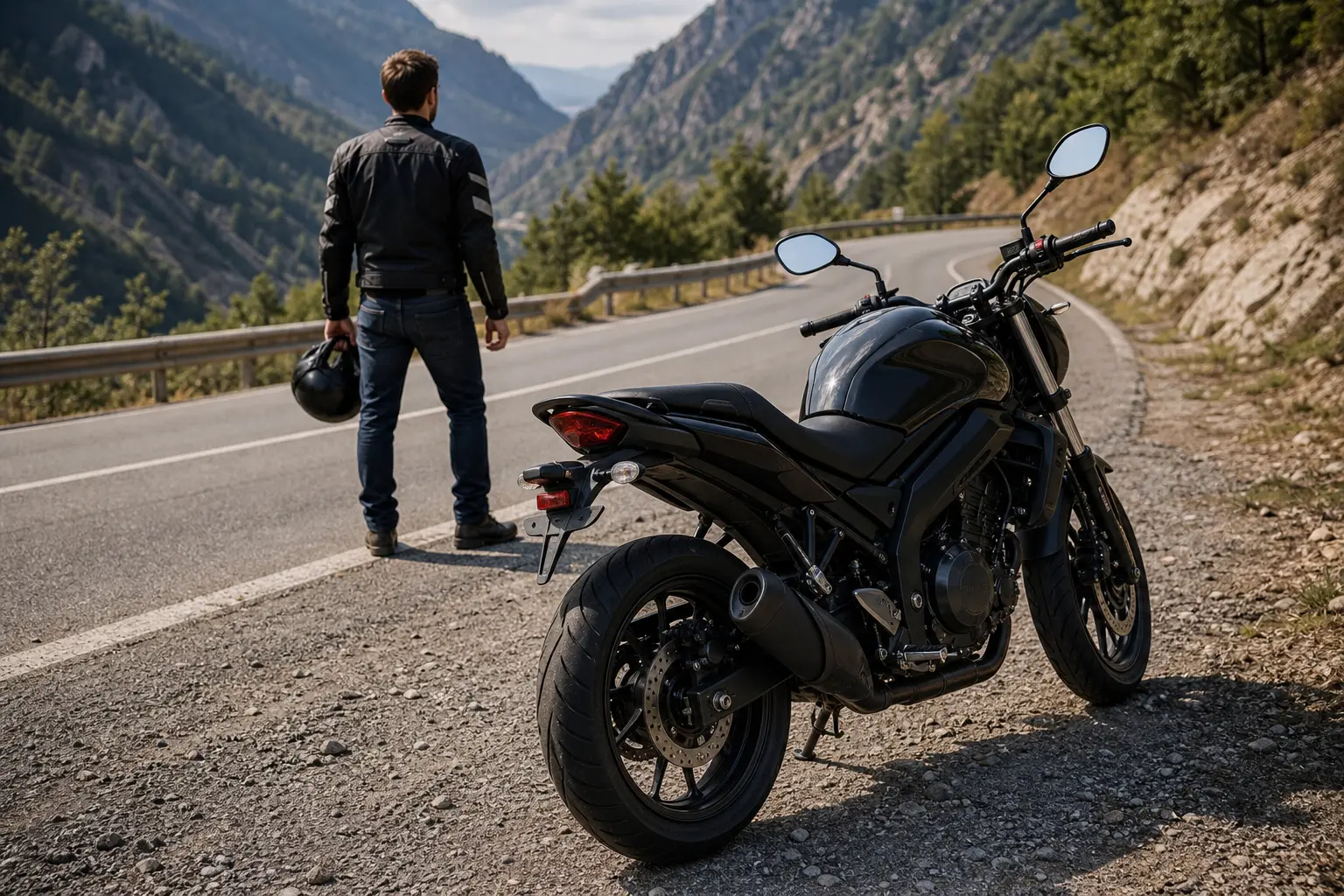
After a tire blowout or rapid loss of pressure, the default should be do not continue riding until the cause and condition are properly assessed. The fact that a tire seems to hold some air after stopping does not prove that it is safe. Likewise, adding air at the roadside does not tell you why air was lost or whether the casing, sidewall, bead, wheel, or valve has been compromised.
Begin with scene safety. Get out of the roadway if you can do that without exposure. Put distance between yourself and moving traffic. If you are injured, feel shaken, or cannot safely manage the motorcycle, ask for help rather than trying to solve the mechanical issue alone.
From a safe position, note what happened. Record the location, road condition, approximate speed range, whether you struck an object or pothole, and the symptoms you felt. Take photos if it is safe. This information can help a service professional understand whether the event may involve more than a simple puncture.
Then arrange transportation or qualified assistance. This is especially important after:
- A tire is visibly flat, torn, cut, bulged, cracked, or separated.
- The wheel contacted a pothole, curb, debris, or other obstacle.
- You cannot identify why pressure was lost.
- The motorcycle shook, swayed, or handled abnormally before stopping.
- The tire has come off its normal seating area on the wheel.
- You have any doubt about the tire’s integrity.
The safest answer is not always the fastest or least expensive one. It is the one that avoids asking a damaged tire to handle braking, cornering, road heat, and load again before it has been evaluated.
A Useful Distinction: Slow Leak, Flat, and Blowout
Riders often use “blowout” for any tire-pressure problem. The response should remain cautious, but recognizing the difference helps with planning.
A slow leak may reveal itself during a pre-ride pressure check, repeated need to add air, or a tire that loses pressure while parked. It should not be ignored. A tire that will not maintain its specified cold pressure needs attention before the next ride.
A flat tire may be discovered before moving or after the motorcycle begins to feel wrong at low speed. Do not ride a visibly flat tire to a shop. The damage caused by rolling on it can make a previously limited issue more serious.
A rapid air-loss event or blowout happens while riding and demands the immediate control sequence discussed above: firm grip, smooth direction, gradual throttle reduction, conservative braking only if necessary, and a controlled move to a safe stop.
You do not need a perfect label to make a safe decision. Any unexpected tire-related handling change deserves a reduction in pace and a stop for assessment.
How to Reduce the Odds Before the Ride
No inspection can guarantee that a tire will never fail. Road debris, unseen hazards, and manufacturing defects can exist. But regular, manufacturer-first maintenance reduces avoidable risk and makes changes easier to spot before they become on-road emergencies.
Start with your exact motorcycle owner’s manual. Use its specified tire sizes, approved fitment information, cold pressure settings, load guidance, and inspection or replacement criteria. The pressure molded into a tire sidewall is not a universal setting for your motorcycle. Your motorcycle manufacturer’s documentation is the starting point because it accounts for the machine’s intended tire fitment and operating load.
NHTSA recommends checking motorcycle tire pressure and tread depth before every ride. That is a strong baseline, particularly before a longer ride, a passenger trip, a loaded trip, or a ride after the motorcycle has been parked for a while. Use a dependable gauge, check pressure when the tires are cold as specified by the motorcycle manufacturer, and do not simply rely on a visual glance. Motorcycle tires can be meaningfully underinflated before they look obviously low.
Also inspect the tire surface and sidewalls in good light. You are looking for changes, not performing a certification inspection. Stop and seek professional advice if you see cuts, punctures, cracks, bulges, exposed cords, irregular wear, or objects embedded in the tire. Pay attention to new vibration, repeated pressure loss, unusual noise, or a handling change; NHTSA notes that performance changes such as trouble maintaining pressure, noise, or vibration are reasons to consult a tire service professional.
Tread matters, but it is not the only factor. A tire can have visible tread and still be unsuitable because of age, damage, uneven wear, or pressure loss. NHTSA notes that tires become more prone to failure as they age. Read the date code, monitor condition, and use the guidance from your tire and motorcycle manufacturers rather than assuming that appearance alone establishes safe serviceability.
Load also matters. Passenger weight, cargo, and accessories change what the tires must carry. NHTSA advises riders carrying cargo to secure and balance it, and to adjust suspension and tire pressure to accommodate the added weight. Do not guess at a loaded pressure setting or maximum load. Confirm what your owner’s manual says for your exact motorcycle and its intended load.
For a broader routine that places tire checks alongside controls, fluids, lights, and drivetrain awareness, use this Motorcycle Maintenance Guide. The value of a repeatable process is not that it predicts every failure. It is that it gives you a better chance of noticing a tire that has changed before you are relying on it at speed.
Tire-Failure Prevention Checklist
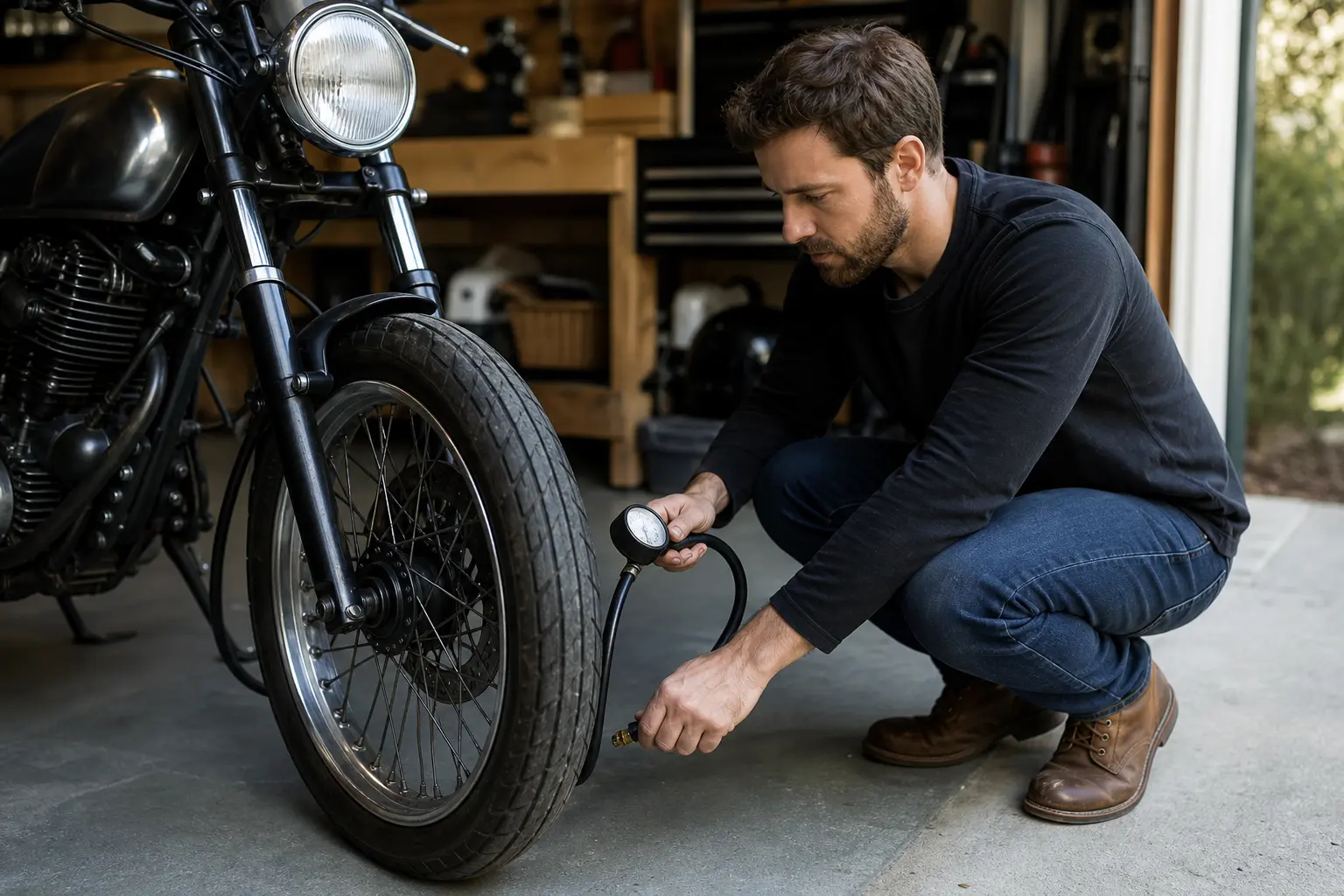
Use this checklist before a ride, after a hard impact, before carrying a passenger or cargo, and whenever the motorcycle has been stored or unused for an extended period.
- Check both tires cold against the pressure specified for your exact motorcycle and planned load.
- Confirm the tires visually match the approved size and type listed by the motorcycle manufacturer.
- Look across the tread and sidewalls for cuts, punctures, cracks, bulges, embedded debris, exposed structure, or unusual wear.
- Check for signs that either tire has repeatedly lost pressure since the last ride.
- Notice whether the motorcycle has developed new vibration, pull, noise, wandering, or odd steering feel.
- Review tread condition and wear indicators using the limits and guidance applicable to your tires and motorcycle.
- Read the tire date code when assessing older or unfamiliar tires; do not let remaining tread be the only decision factor.
- Recheck the manufacturer’s passenger and cargo guidance before riding loaded.
- After striking a pothole, curb, or debris, pause the ride and inspect the tire and wheel area before proceeding.
- If anything looks damaged, feels different, or creates doubt, choose no ride and arrange qualified inspection.
Build the Response Into Your Riding Habits
A blowout is not the moment to invent a plan. The plan should be simple enough to recall under stress:
- Look ahead and hold a stable line.
- Ease off the throttle.
- Let the motorcycle slow gradually.
- Avoid hard braking and sudden steering.
- Move to a safer stopping place when the bike is settled.
- Do not resume riding until the tire issue is properly assessed.
Reading this sequence is useful, but professional rider education offers a better setting to build controlled responses and understand the limits of your skills. The MSF identifies equipment failures, including blowouts, as scenarios riders should be prepared to handle. A recognized training course can help riders practice smooth observation, braking, and control skills in an organized environment—before a road emergency demands them.
The goal is not to become fearless about a tire failure. A healthy respect for it is appropriate. The goal is to replace panic with a short, conservative sequence that protects direction, reduces speed, and creates time.
How Vojo Helps
Create a recurring tire check for each motorcycle in the Vojo Motorcycle Maintenance Tracker, then log the cold-pressure reading, tread observations, tire date-code note, and any vibration or air-loss concern after each inspection. Before a passenger, cargo, or long-distance ride, review the last completed check and record the manufacturer-specified loaded setup from your owner’s manual. If a tire-related incident occurs, add the symptoms, photos, date, and service outcome to the bike’s record so the next inspection starts with context rather than memory.
Quick answers
Frequently asked questions
What should I do first if my motorcycle tire blows out?
Keep your eyes ahead, hold the handlebars firmly, maintain a straight and smooth course, and ease off the throttle. Prioritize directional control before trying to stop quickly.
Should I use the brakes during a motorcycle tire blowout?
Avoid hard braking. MSF guidance says that if braking is necessary, it should be gradual and applied to the brake associated with the tire that is still sound—but only if you are certain which tire has failed. If you are unsure, allow more time and distance for a gradual slowdown.
How can I tell whether the front or rear tire has gone flat?
A front-tire failure may make steering feel heavy or vague, while a rear-tire failure may make the rear of the motorcycle feel as if it is swaying. These are broad signs only; do not rely on a rushed diagnosis while moving. Focus first on a stable line and gradual reduction in speed.
Can I ride slowly to a tire shop after a blowout?
Treat a rapid pressure loss or blowout as a no-ride situation until the tire and related components have been assessed. A tire can sustain damage that is not clear from a quick roadside look, and riding it can increase the risk.
Can ABS prevent a crash after a tire blowout?
ABS can support braking control in many normal situations, but it cannot restore a compromised tire’s stability or structure. A tire failure still calls for smooth direction, gradual speed reduction, and conservative braking choices.
How do I lower the risk of a motorcycle tire failure?
Follow your exact owner’s manual for tire fitment, cold pressures, load settings, and maintenance guidance. Check pressure and tread before rides, inspect for damage or unusual wear, monitor tire age and recurring air loss, and have any unusual vibration or handling change evaluated.