
Can You Change Motorcycle Tire Size? Compatibility, Load Rating, Clearance, and ABS Limits
Can I put a different size tire on my motorcycle? Learn how size, load and speed ratings, rim fit, clearance, and ABS affect safe choices.
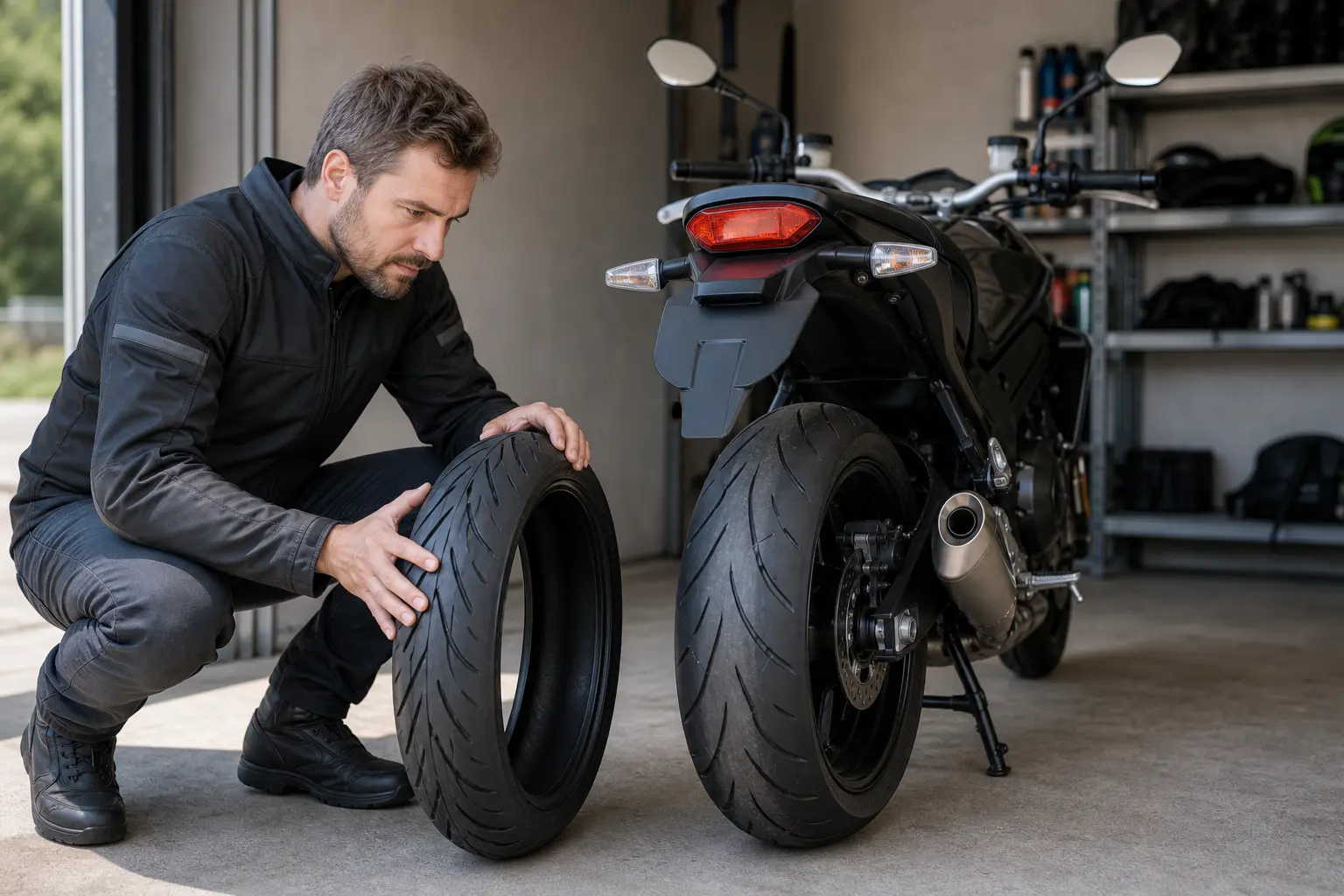
Fact-checked against cited official documentation
Reviewed against Fact-checked against Harley-Davidson tire guidance covering original-equipment sizing, load and speed ratings, construction, rim and tube/tubeless considerations, handling effects, and new-tire caution..
Last updated October 12, 2026
If you are asking, “can I put a different size tire on my motorcycle?”, the safe default is no—not unless your motorcycle manufacturer specifically approves that exact alternative for your model, wheel, and intended position.
A motorcycle tire is not a cosmetic bolt-on. It is part of a matched system that includes the rim, suspension, brakes, chassis geometry, clearance around fixed parts, and—in many modern motorcycles—electronic safety systems. A wider rear tire, a taller sidewall, a lower-profile front tire, or a different construction may look close enough on a retailer’s fitment screen. That does not prove it is a safe replacement.
Start with the tire specification in your exact owner’s manual or manufacturer fitment documentation. Match the approved front or rear position, tire size, construction, load rating, speed rating, and any stated tire model or approved alternatives. Harley-Davidson’s tire guidance, for example, recommends replacement tires in the original equipment size, speed rating, load rating, and construction, and explains that changing width or aspect ratio can affect fit, ride height, steering geometry, and steering response. 1
This is deliberately more conservative than the common advice to “go one size wider” or “use whatever fits the rim.” A tire can physically mount and still be a poor or unsafe choice. If the manual does not list an alternative, or if the motorcycle has ABS, traction control, tire-pressure monitoring, a modified wheel, or unusual load demands, pause the purchase and obtain model-specific confirmation from the manufacturer or a qualified dealer.
The short answer: fitment is more than the numbers on the sidewall
A motorcycle tire sidewall contains useful information, but it is not a universal permission slip. Consider a common metric marking such as 180/55ZR17:
- 180 is the nominal tire width in millimeters.
- 55 is the aspect ratio: the sidewall-height relationship to the nominal width.
- Z/R communicates speed-category and construction information; the exact marking must be read as a complete specification rather than treated as decoration.
- 17 is the rim diameter in inches.
Changing any one part can change more than one real-world dimension. A tire advertised with the same nominal width can have a different actual profile, carcass shape, shoulder shape, or mounted width depending on its design and the rim used. Conversely, a tire that seems only slightly different on paper can alter overall diameter enough to change clearance or the motorcycle’s stance.
That is why it is risky to reason from a single dimension alone:
- “It is only 10 mm wider” ignores carcass profile and rim compatibility.
- “The diameter is the same” may ignore construction, load capability, or front-versus-rear design.
- “My friend runs it on the same model” does not establish that your wheel, brakes, electronics, loading, or local model specification are identical.
- “The tire shop can mount it” confirms neither manufacturer approval nor system compatibility.
The correct question is not, “Will it go on?” It is, “Has the motorcycle manufacturer approved this complete tire specification for this exact position and model?”
Why original-size tires are the manufacturer-first baseline
Motorcycle manufacturers choose tire specifications as part of the chassis package. The selected tire works with a particular wheel width, suspension arrangement, steering geometry, brake system, and permitted vehicle load. Harley-Davidson notes that a larger tire can interfere with motorcycle parts, that a different aspect ratio can alter ride height and steering geometry, and that a wider tire can change steering response or fit the rim poorly. 1
Those are not merely track-day concerns. They matter in routine riding:
- At parking-lot speed, a different profile can change steering weight and low-speed balance feel.
- In a turn, tire shape influences how progressively the motorcycle rolls onto its edge.
- Under braking, the tire must provide predictable grip while carrying a changing load.
- With a passenger, luggage, or rough pavement, clearance and load margin matter more than a static garage check suggests.
- In rain, a change in tire model or condition can change how the motorcycle feels long before a rider reaches any performance limit.
Original-equipment specification does not necessarily mean you must buy the identical brand in every case. It means the exact manual and manufacturer-approved fitment information should lead the decision. Some manufacturers list approved alternatives; some identify a specific tire family; others require a particular combination by model, market, or wheel option. Use documentation for your motorcycle’s VIN-relevant configuration, not a generic description of the model line.
Harley-Davidson also states that its specified tires should match original-equipment size, speed rating, load rating, and construction. Its replacement guidance describes wrong tires as a safety concern because manufacturers select tires as an integral part of motorcycle performance. 2
What changes when tire size changes
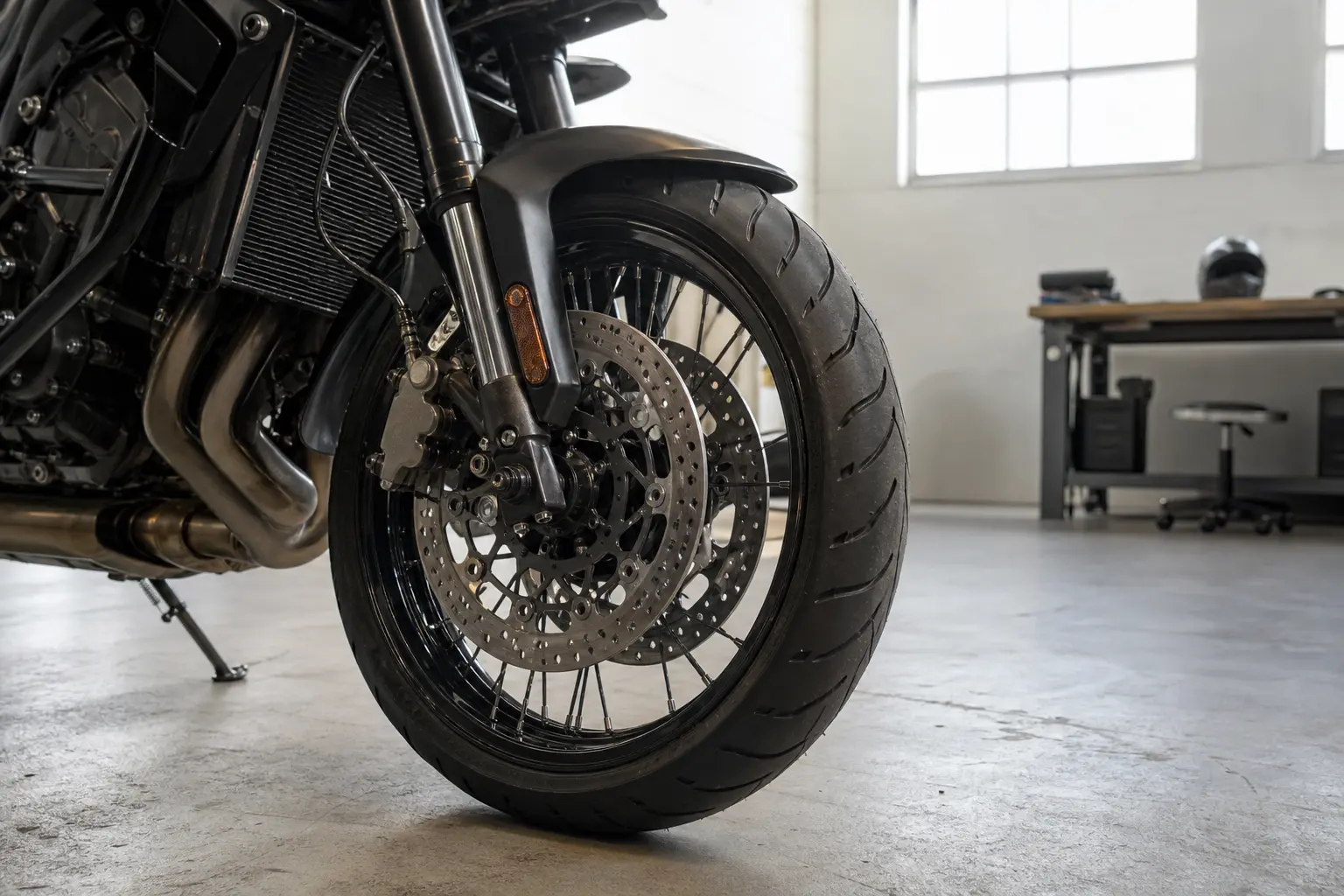
A size change can affect several systems at once. The table below is a decision tool, not a substitute for manufacturer approval.
| Proposed change | What may change | Why a visual check is not enough | Safer decision |
|---|---|---|---|
| Wider tire | Mounted shape, steering response, side clearance, rim relationship | Clearance can reduce when the suspension moves or the tire flexes under load | Use only a manufacturer-approved size and wheel pairing |
| Taller profile or larger overall diameter | Ride height, chassis attitude, fender and swingarm clearance | A tire can clear while parked but contact parts during suspension travel | Verify the specified size; do not infer approval from static clearance |
| Shorter profile or smaller overall diameter | Ride height, steering geometry, lean behavior, electronic wheel-speed assumptions | “Lower” does not automatically mean better handling or safer reach | Use an approved chassis or ergonomic solution instead of an unverified tire change |
| Different construction | Flex characteristics, heat behavior, handling feel, rim suitability | The marking may look similar while the construction is not equivalent | Match the manual’s required construction and position |
| Lower load or speed rating | Capacity or operating margin under load and speed | The tire may appear normal until it is used near its limits | Never downgrade below the manufacturer specification |
| Front/rear swap or mixed intended positions | Water evacuation, carcass behavior, braking and steering response | Direction and position are engineered into many tire designs | Fit tires only in their approved position and direction |
A helpful mental model is that every tire change has three separate questions:
- Is it dimensionally compatible? It must fit the specified rim diameter and approved rim width.
- Is it capability-compatible? It must meet the specified load, speed, construction, and position requirements.
- Is it system-compatible? It must be approved for the motorcycle’s chassis and, where equipped, its electronic systems.
If any answer is uncertain, it is not ready to buy or ride.
Load rating: the number that matters when the bike is loaded
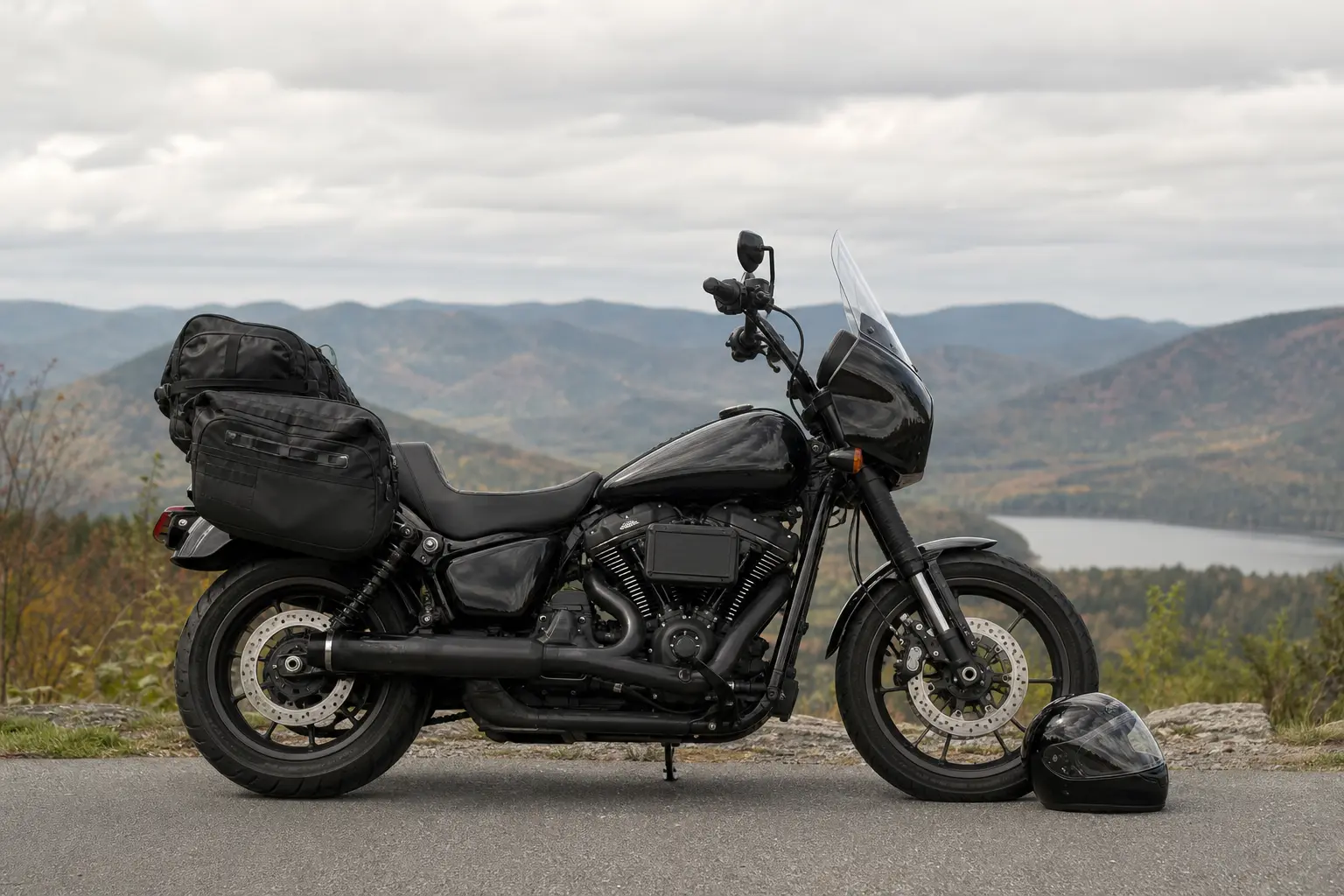
A tire’s load rating is not a suggestion based on how much the motorcycle weighs empty in a listing. The tire must support its share of the motorcycle, rider, passenger, luggage, accessories, and dynamic loading from braking, bumps, and acceleration.
The practical rule is simple: do not select a replacement tire with a load rating below the manufacturer’s specification. A seemingly similar tire may be intended for a lighter motorcycle, different riding role, or different wheel size. A tire choice that feels fine during a short solo ride may not provide the required margin when the motorcycle is fully loaded.
Treat these situations as reasons to be especially strict about original specification:
- regular two-up riding;
- touring with luggage;
- adding heavy accessories or cargo systems;
- long, hot highway runs;
- off-pavement travel that adds impacts;
- a motorcycle near its stated load limit.
Do not try to solve an overloaded motorcycle with a “stronger-looking” tire. Tire selection does not override the motorcycle’s gross vehicle weight rating, axle limits, luggage limits, or the manual’s tire-pressure instructions. Load management begins with the motorcycle documentation, then continues with correct tire condition and cold pressure.
For a broader pre-ride and ownership routine, use the Motorcycle Maintenance Guide alongside the exact manual for your bike.
Speed rating: avoid downgrades and incomplete comparisons
A speed rating is part of the tire’s intended operating capability under specified conditions. It is not a target speed, and it does not mean the tire can safely be used regardless of load, pressure, heat, damage, or road conditions.
When comparing candidates, do not stop at width and rim diameter. Confirm the full marking and ensure the replacement meets the manufacturer’s stated speed-rating requirement. Harley-Davidson’s guidance specifically says to use the speed rating specified by the motorcycle manufacturer, while also recommending original-equipment size, load rating, and construction. 1
A few important boundaries:
- A higher-looking speed letter does not automatically make a tire compatible.
- A lower speed rating is not an acceptable trade merely because you do not plan to ride at the tire’s limit.
- The load and speed specifications must be considered with the stated cold inflation pressure and intended use.
- A tire described as suitable for a broad category—cruiser, adventure, sport, or dual-sport—still may not be approved for your exact motorcycle.
In other words, do not “upgrade” one part of the sidewall marking while overlooking an incompatible construction, profile, or tire position.
Rim width, bead seating, and tire construction are not optional details
The wheel is not just a round support for any tire with the same rim diameter. Tire makers and motorcycle manufacturers specify approved rim relationships because rim width affects the mounted tire’s shape and how the bead is supported. A tire that is too narrow or too wide for a particular rim can take on a profile different from the one its designer intended.
That altered profile can affect steering response, contact-patch behavior, and clearance. It can also create fitment questions that cannot be answered accurately with a tape measure across the tire’s outermost point.
Construction matters too. Motorcycle tire markings can distinguish radial and bias-ply construction, and the motorcycle manual may specify one construction or a particular approved alternative. Do not assume that matching nominal width and diameter makes a construction change harmless. Harley-Davidson’s manufacturer guidance includes construction among the characteristics it says should match original equipment. 1
Tube, tubeless, valve, and wheel-sealing arrangements also need model-specific confirmation. A tire-and-wheel system may include requirements beyond the tire itself. If you are changing wheels, converting a wheel configuration, or are unsure whether a tube is required, that is a qualified-service and manufacturer-documentation question—not a guess-and-test project.
Clearance: check the whole range of motorcycle movement
Clearance is often discussed as though the only question is whether the tire rubs a swingarm while the bike is parked. That is too narrow a test.
A motorcycle moves relative to its wheels during suspension compression, braking, acceleration, leaning, and loading. Tires can also deflect and grow slightly in use. A setup that appears to have room at rest may lose that margin with a passenger, cargo, rough pavement, or full suspension travel.
Potential interference points vary by motorcycle, but can include:
- fenders and fender braces;
- chain, belt, or final-drive components;
- swingarm and shock area;
- fork legs, fork brace, or front fender;
- brake hoses, ABS sensor wiring, and guards;
- side covers, mudguards, and luggage-related hardware.
Do not rely on a casual spin of the wheel as approval. It cannot reproduce real loading, tire deflection, suspension movement, steering movement, or the consequences of an incorrect tire profile. Manufacturer-approved fitment is the primary evidence; a professional inspection is the safer next step when the specification is unclear.
ABS, traction control, and wheel-speed systems: do not assume a size swap is invisible
On motorcycles equipped with ABS or other wheel-speed-based rider aids, tire and wheel choices deserve additional caution. These systems rely on information associated with wheel rotation. A change in effective rolling circumference can be relevant to how the motorcycle’s systems interpret wheel speed.
The practical takeaway is not to calculate your way into an exception from a forum formula. It is to treat non-specified tire sizes, different wheel diameters, and unapproved wheel-and-tire combinations as a manufacturer-confirmation issue. Ask whether the proposed combination is approved for your exact year, model, market, and electronic-equipment configuration.
This matters even if:
- the ABS warning lamp does not appear immediately;
- the proposed size is only slightly different;
- another rider says the motorcycle “rides fine”; or
- the tire clears all visible components.
A warning lamp is not the only standard for compatibility. The absence of an obvious fault does not prove the system remains within its intended calibration or that braking and handling behavior remain as designed.
If you have already fitted a non-specified tire and an ABS, traction-control, tire-pressure, or other warning appears, do not try to diagnose the system by riding harder or repeatedly cycling the ignition. Follow the owner’s manual and arrange qualified inspection. The safest route is to return to the approved tire specification unless the manufacturer has documented the alternative.
Common reasons riders want a different size—and better ways to solve them
“I want more grip.”
More width is not a universal route to more usable grip. Grip is affected by tire compound, temperature range, pressure, condition, surface, load, tread design, and the tire’s suitability for the motorcycle. Select an approved tire designed for your actual riding conditions rather than treating width as a standalone performance upgrade.
“I want the rear to look fuller.”
A cosmetic objective is not enough to override fitment, handling, and clearance requirements. If a different appearance matters, seek a manufacturer-approved wheel-and-tire package or accept that the safe answer may be to retain the specified size.
“I want a lower seat height.”
A smaller-diameter tire can change stance, but it is an indirect and potentially disruptive way to address reach. Explore approved seat, suspension, boot, or ergonomics options for your model instead. Those options can be evaluated as a system rather than introducing an unverified tire mismatch.
“The original tire is unavailable.”
Do not fill the gap by choosing only the nearest size on a shelf. Contact the motorcycle manufacturer, an authorized dealer, or a qualified tire professional with the exact manual specification. Ask for a documented approved replacement that preserves the required position, size, construction, load rating, speed rating, and wheel compatibility.
“I am building a custom motorcycle.”
A custom build is not a reason to lower the safety threshold; it is a reason to raise it. Wheel changes, suspension changes, brake changes, and tire changes interact. Obtain competent professional design and inspection support, and consider legal and insurance implications in your area. A generic online fitment claim is especially weak evidence for a heavily modified bike.
A manufacturer-first tire-size checklist
Use this checklist before ordering a tire that differs in any way from what is currently on the motorcycle.
- Identify the motorcycle by exact year, model, market, and wheel configuration—not only by family name.
- Open the owner’s manual or official manufacturer fitment information for that exact configuration.
- Record the required front and rear tire sizes separately.
- Record the required load rating, speed rating, and construction.
- Confirm whether the manual names a required tire model, an approved tire list, or a specific front/rear pairing.
- Confirm the tire’s intended mounting position and rotation direction.
- Check whether the motorcycle has ABS, traction control, tire-pressure monitoring, or a wheel-size option that requires additional confirmation.
- Confirm the proposed tire is approved for the wheel rim and that tube, tubeless, valve, and sealing requirements are correct for the wheel.
- Consider your normal passenger, luggage, accessory, and terrain use rather than shopping only for an unloaded solo ride.
- Stop and ask the manufacturer or a qualified dealer if the proposed tire differs in size, construction, rating, wheel pairing, or system compatibility.
- After professional installation, use the motorcycle manual’s cold-pressure specification and make a conservative first ride while you assess normal handling.
That final point matters even when you install the correct size. New tires can feel different from worn tires because the profile and tread are new. Harley-Davidson advises a gradual break-in period and cautions riders to avoid aggressive moves while becoming familiar with new tire behavior. 1
When not to ride until the tire question is resolved
Choose a no-ride or arrange-service decision if any of the following apply:
- the tire rubs, appears close to a fixed component, or has unknown clearance under suspension movement;
- the tire’s size, load rating, speed rating, construction, or position does not match the manufacturer specification and you do not have written approval for the alternative;
- the front and rear tire combination is an improvised mix rather than an approved pairing;
- the tire is damaged, bulged, cut, badly worn, or cannot hold the manual-specified cold pressure;
- the motorcycle displays a braking or rider-aid warning after a tire or wheel change;
- you cannot verify whether the wheel is tube-type, tubeless, or correctly matched with its valve and sealing components;
- the bike has been modified and no competent person can document the final tire-and-wheel compatibility.
A tire is a small part with outsized consequences. Being conservative is not overthinking it—it is recognizing that steering, braking, load capacity, and stability all meet at the contact patches.
How Vojo Helps
Create a tire entry in the Vojo Motorcycle Maintenance Tracker before you order: save the exact manual specification for the front and rear, photograph the sidewall markings on the current tires, add the proposed replacement as a note, and attach the manufacturer-fitment confirmation or dealer invoice. Then log the installation date, mileage, cold-pressure check, and a reminder for the first follow-up inspection. This gives you a simple record that separates verified fitment from assumptions and makes future tire decisions faster.
Download Vojo on the App Store
Bottom line
You can change motorcycle tire size only when the manufacturer has specifically approved the alternative for your motorcycle and wheel configuration. Physical fit is not enough. Preserve the required tire position, size, construction, load rating, speed rating, rim relationship, clearance, and compatibility with ABS or other electronic systems.
When the exact replacement is unavailable or you want a different look or ride feel, make manufacturer documentation your first stop—not a width conversion chart, a retailer filter, or another rider’s setup. The safest tire upgrade is usually an approved tire that suits your conditions while keeping the motorcycle’s intended system intact.
Sources
1 Harley-Davidson, Motorcycle Tires 101 – All About Motorcycle Tires.
2 Harley-Davidson, When to Replace Your Motorcycle’s Tires.
3 Harley-Davidson, Tubeless vs Tubed Tires for Motorcycles.
Quick answers
Frequently asked questions
Can I go one size wider on my motorcycle tire?
Not by default. A wider tire can change steering response, rim relationship, clearance, and chassis behavior. Use it only if the motorcycle manufacturer approves that exact size and tire specification for your model and mounting position.
Can I use the same tire size with a different load or speed rating?
Do not downgrade below the manufacturer’s required load or speed rating. A matching size alone does not establish compatibility; construction, intended position, and approved wheel fit also matter.
Will a different tire size affect motorcycle ABS?
It can be relevant on motorcycles that use wheel-speed information for ABS or related rider aids. Do not assume a small size difference is harmless. Confirm any non-specified tire or wheel combination with the motorcycle manufacturer for your exact model.
Can I put a rear motorcycle tire on the front?
No, unless the tire and motorcycle manufacturer specifically identify that tire for front use. Front and rear tires can have different intended roles, profiles, structures, and rotation requirements.
Does a tire that clears the swingarm prove it fits?
No. A parked clearance check does not prove clearance during suspension movement, under load, or with tire deflection. It also does not confirm rim, rating, construction, or electronic-system compatibility.
What should I do if my original tire size is unavailable?
Use the owner’s manual and official manufacturer or dealer guidance to find an approved alternative. Do not choose the nearest-looking size solely because it can be mounted.