
Motorcycle Wheel Bearing Symptoms: A Parked-Bike Check for Play, Roughness, and No-Ride Clues
Learn motorcycle wheel bearing symptoms you can screen for while parked, including wheel play and roughness, plus conservative no-ride clues.
Fact-checked against cited official documentation
Reviewed against MSF T-CLOCS guidance for wheel play and growling checks, plus Harley-Davidson service information on sealed wheel bearings, scheduled inspection, and adverse-condition frequency..
Last updated October 10, 2026
A motorcycle wheel bearing problem is not a sound you should try to “ride out.” The useful rider skill is more limited and more practical: recognize possible wheel-bearing symptoms while the motorcycle is parked, avoid turning a quick feel-check into a diagnosis, and choose a conservative next step before a wheel-related concern becomes a ride decision.
The Motorcycle Safety Foundation’s T-CLOCS checklist places bearings in the tires-and-wheels portion of a pre-ride inspection. Its basic screen is straightforward: with the wheel safely unloaded, hold the tire at the top and bottom and flex it; there should be no free play between the hub and axle, and the wheel should not growl when spun. (msf-usa.org) Those observations are useful because they tell you whether the wheel deserves immediate professional attention—not because they identify a specific failed part by themselves.
This guide is deliberately conservative. It does not tell you how to remove a wheel, replace a bearing, set fastener torque, judge an acceptable amount of movement, or return a motorcycle to service after repair. Those actions are model-specific and safety-critical. Use your exact owner’s manual and service documentation first, then arrange qualified service when the screen reveals a concern.
For broader routines around tires, chassis, controls, fluids, and records, see the Motorcycle Maintenance Guide.
What Motorcycle Wheel Bearing Symptoms Can Feel Like
A wheel bearing supports controlled wheel rotation at the hub. From a rider’s perspective, the important point is not the bearing’s internal construction. It is that a wheel, tire, brake assembly, axle, and associated hardware all work together in an area where unwanted movement or rough rotation deserves a serious response.
The parked-bike symptoms riders most commonly notice fall into two categories:
- Movement when the wheel is checked for play. With the motorcycle supported safely and the relevant wheel unloaded, you may feel a click, knock, or distinct movement when gently flexing the tire from the top and bottom.
- Roughness or a growling sensation or sound during rotation. When the wheel is turned by hand, it may not feel smooth, or it may produce a growling quality instead of a normal, unobtrusive rotation.
Those categories match the MSF’s screening language: no free play between the hub and axle, and no growl when spinning the wheel. (msf-usa.org) They are signs to take seriously, but they are not a permission slip to name the fault, order a part, or continue riding until a convenient appointment.
A rider may also become concerned after a pothole strike, curb contact, a long period of storage, repeated wet or dirty conditions, or an unexplained change in how the motorcycle feels. Treat those events as context rather than proof. They can justify a closer inspection, but neither the event nor a single sensation confirms a wheel-bearing issue.
Symptom, observation, and decision are different things
It helps to separate three questions that are often blended together:
| Question | Safe answer from a parked check | What the answer cannot establish |
|---|---|---|
| “Do I feel movement at the wheel?” | Whether you can detect apparent free play during a careful screen | The exact component responsible for the movement |
| “Does the wheel feel or sound rough as it turns?” | Whether rotation seems smooth or shows a growling/rough quality | The condition of every internal part or the repair required |
| “Can I ride it?” | Whether a concerning result calls for a conservative no-ride decision and professional assessment | Whether a short ride is low-risk because the symptom seems mild |
| “When should it be inspected?” | Your model documentation sets the schedule; unusual conditions can justify earlier attention | A universal mileage interval for every motorcycle |
This distinction keeps you out of two risky habits: dismissing an observation because you cannot diagnose it, or declaring the motorcycle safe because you cannot identify the cause.
Why a Parked-Bike Screen Is Better Than Guessing on the Road
Wheel-related concerns can feel vague while riding. Road surface, wind, tire condition, load, rider tension, and ordinary chassis feedback can all change what you notice. Trying to interpret a possible symptom at speed encourages attention to move away from traffic and toward the motorcycle’s behavior at exactly the wrong time.
A parked-bike check changes the task. You can slow down, use light and space, look at the tire and wheel, and make an intentional decision before committing to traffic. It also stops the common escalation pattern: a rider notices something unusual, rides “just around the block” to see whether it disappears, then keeps extending the test because the motorcycle has not failed dramatically.
The MSF checklist supports this preventive approach by putting wheel condition, wheel bearings, seals, brakes, and other chassis items in a pre-ride inspection framework. (msf-usa.org) The practical lesson is that wheel checks belong before the ride, not as a roadside experiment.
There is an important limit: a parked screen does not replace your model’s scheduled maintenance. Harley-Davidson service information, for example, identifies front and rear wheel bearings as inspection items in its stated schedule and calls for more frequent attention in adverse conditions; it also gives a winter-use interval for the covered model documentation. (serviceinfo.harley-davidson.com) That is not a universal mileage rule for every motorcycle. It is evidence that bearing attention is both scheduled and condition-sensitive, so your own manufacturer’s documentation must control for your motorcycle.
Before You Check: Set Safe Limits
Do not turn this into a garage test of strength, balance, or improvisation. A motorcycle can fall, and a falling motorcycle can injure you or damage the machine.
Before any hands-on check, use these limits:
- Read the owner’s manual for the approved support method for your exact motorcycle.
- Work on level, stable ground with adequate lighting.
- Do not use a stand, lift, jack, or support method you do not understand or cannot use securely.
- Do not place any part of your body where it could be trapped if the motorcycle shifts.
- Do not run the engine for this check.
- Do not use force, pry tools, impact, or disassembly to make a subtle sensation easier to detect.
- If you cannot safely unload the wheel, stop there and book an inspection rather than trying to create a workaround.
This is an observation task, not a repair task. The most useful result may be, “I cannot safely perform this check at home, so I will not ride until a qualified shop examines it.” That is a sound safety decision, not a failed inspection.
A Conservative Parked-Bike Check for Wheel Play and Roughness
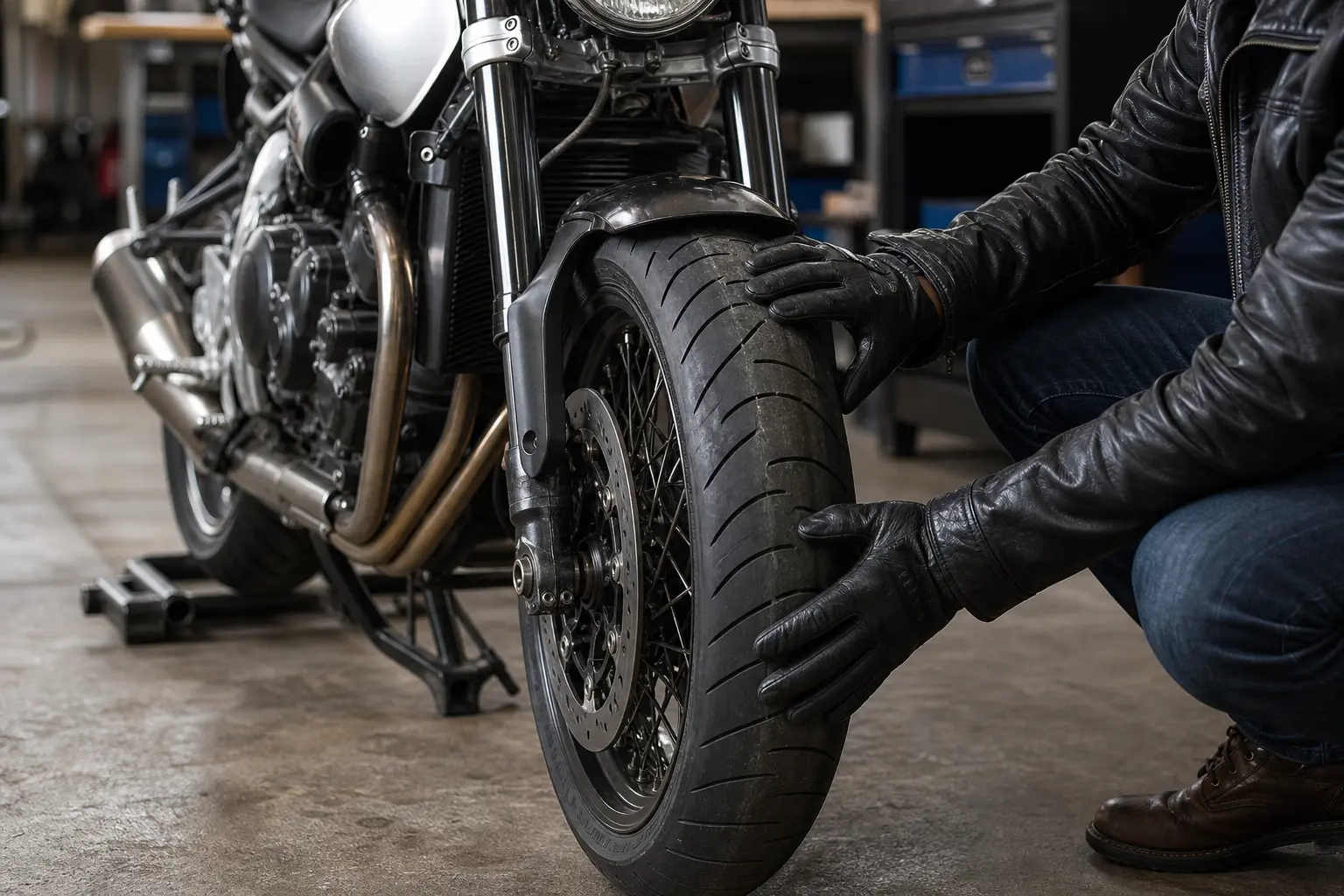
Use the following as a limited screen. It is based on the MSF’s wheel-bearing checks, organized to help a rider avoid overconfidence. (msf-usa.org)
1. Start with a walk-around, not the bearing
Before focusing on a bearing, look at the wheel area generally. You are not trying to certify every component. You are looking for obvious reasons to stop and arrange service, such as visible wheel damage, a tire that looks compromised, loose-looking hardware, a damaged seal area, or evidence that something has contacted the wheel.
The MSF checklist includes tires, wheel spokes or cast-wheel condition, rims, bearings, seals, and brakes in the same inspection section. (msf-usa.org) That grouping is useful: a wheel concern should not be isolated from the surrounding tire, rim, brake, and axle area.
If you see obvious damage or a condition that makes you uncertain about the wheel’s integrity, do not proceed on the assumption that a quick spin will resolve the question. Photograph what you see for your service provider, note which wheel is involved, and arrange an assessment.
2. Support the motorcycle only as your manual permits
The check only makes sense if the relevant wheel can be examined safely. On some motorcycles, the equipment supplied with the bike or the service instructions may make that practical. On others, it may not be a sensible owner task.
Do not confuse “the wheel is barely off the ground” with “the motorcycle is securely supported.” If the bike is not stable, if the wheel cannot turn freely enough for a basic observation, or if you are unsure whether your support method affects what you feel, stop. A qualified technician can inspect it with the correct equipment.
3. Check for apparent free play at the tire
With the wheel safely unloaded, place one hand near the top of the tire and the other near the bottom. Apply only a gentle alternating push-pull motion intended to sense movement, not to flex the tire or shake the entire motorcycle.
The MSF’s stated criterion is no free play—or click—between the hub and axle. (msf-usa.org) Your job is not to decide whether a tiny sensation is within a tolerance. Your job is to notice whether there is a clear, repeatable movement or click that concerns you.
If you detect a distinct, repeatable click or movement:
- Stop the check rather than escalating force.
- Do not assume you have identified the cause.
- Record which wheel was checked and what you felt.
- Treat riding as a no-go until the motorcycle is assessed by qualified service or according to model-specific manufacturer instructions.
A repeatable result matters more than a dramatic one. Do not wait for the wheel to feel obviously loose before acting.
4. Rotate the wheel by hand and listen without forcing it
Next, turn the wheel by hand if it can rotate safely. Pay attention to whether the rotation feels generally smooth or whether it feels rough and produces a growling quality.
Again, the MSF’s screen is simple: no growl when spinning the wheel. (msf-usa.org) Avoid trying to turn that phrase into a detailed acoustic diagnosis. Your motorcycle may have normal sounds from nearby components, and brake contact or drivetrain-related resistance can change how a wheel turns. A rider cannot safely sort those causes by guessing.
Instead, ask a narrower question: Does the rotation produce a new, clearly concerning rough or growling sensation or sound that I cannot confidently explain from normal operation? If yes, take the conservative path: do not ride for the purpose of testing it; arrange an inspection.
5. Compare observations only to your own baseline
If you are checking both wheels and both can be safely unloaded, you may notice that they do not rotate with the same resistance. That alone does not establish a defect. Different wheel positions, brake layouts, drivetrains, and motorcycle designs can make direct comparison misleading.
Use comparison only as a note for the service provider: for example, “The front wheel felt smooth, while the rear wheel had a repeatable rough sensation.” Do not use comparison to clear a suspicious wheel because the other one also makes some sound.
6. Reassemble nothing and alter nothing
A screen should leave the motorcycle as found. Do not loosen axle hardware, remove seals, add lubricant, wash parts to improve visibility, or attempt a bearing adjustment. The Harley-Davidson documentation used here describes sealed wheel bearings for the covered motorcycle and says they do not require additional lubrication. (serviceinfo.harley-davidson.com) That model-specific information reinforces a broader safety point: do not invent a universal lubrication or adjustment remedy for a wheel-bearing concern.
Clearly Titled Checklist: Wheel-Bearing Symptom Screen Before You Ride
Use this checklist when something about a wheel feels different, after a notable impact or harsh exposure, before a longer trip, or when your maintenance record says an inspection is due.
- I checked my exact owner’s manual for approved support and inspection guidance.
- The motorcycle is on level, stable ground with enough space and light.
- I will not improvise a lifting or support method.
- I looked over the tire, rim, wheel area, visible seals, and nearby hardware for obvious concerns.
- If safely supported, I gently checked the tire at the top and bottom for apparent play or a repeatable click.
- If safely supported, I turned the wheel by hand and listened for roughness or a growling quality.
- I did not use force, tools, disassembly, lubrication, or adjustment to chase a result.
- I wrote down which wheel I checked, what I felt or heard, and when it began.
- If I found clear play, a repeatable growl/roughness, visible damage, or unresolved uncertainty, I will not ride and will arrange qualified inspection.
No-Ride Clues: When to Stop Treating It as a Minor Question
A rider does not need an exact diagnosis to make a no-ride decision. In fact, the uncertainty is often the reason to pause.
Choose not to ride and arrange inspection when any of the following applies:
- You feel clear, repeatable play or a click during the top-and-bottom tire check.
- The wheel has a repeatable rough or growling sensation or sound when turned by hand.
- You see obvious damage in the tire, wheel, rim, hub area, seal area, or nearby hardware.
- The concern appeared after a significant strike, contact, or event and you cannot confirm the wheel is unaffected.
- The motorcycle cannot be safely supported for the needed inspection and the concern remains unresolved.
- You are tempted to take a “short test ride” solely because you are unsure.
The final point deserves emphasis. A brief ride is not a neutral diagnostic tool when the question involves wheel security or rotation. The safer plan is transport, roadside assistance, or a qualified inspection—not adding speed, traffic, braking, and cornering forces to an unanswered question.
What Not to Conclude From These Symptoms
The phrase “motorcycle wheel bearing symptoms” can create false certainty. A click is not a part number. A growl is not a repair authorization. A smooth-feeling wheel is not proof that all wheel-related systems are healthy.
Avoid these conclusions:
“I found no play, so there cannot be a problem.”
A limited screen is only a screen. Follow the manufacturer’s service schedule and investigate meaningful changes in handling, sound, or condition even if a quick check seems normal.
“The noise is faint, so I can wait until the next service.”
Severity is difficult to judge by ear or feel. If the observation is new, repeatable, or concerning, document it and seek professional advice rather than assigning it a safe remaining lifespan.
“I can fix it by adding grease.”
Do not assume lubrication is appropriate. The Harley-Davidson material cited here specifically describes sealed wheel bearings on the covered motorcycle and says they do not require additional lubrication. (serviceinfo.harley-davidson.com) Other motorcycles may differ in design and service requirements, which is exactly why the model manual must lead.
“The bike rode normally yesterday.”
Yesterday’s normal ride does not resolve today’s concern. Pre-ride inspection is about catching visible or detectable changes before the next ride, not proving that a past ride was uneventful.
“If I tighten something, the movement will disappear.”
Do not alter wheel, axle, brake, or suspension fasteners as a home experiment. Hardware settings, component order, and inspection requirements are model-specific. Incorrect work can create a separate safety hazard and can make later diagnosis harder.
Maintenance Records Matter More Than Memory

Wheel-bearing concerns are easier to handle when you can give a technician useful context. Instead of saying, “The wheel seemed weird,” provide a compact timeline:
- Motorcycle year, make, model, and current mileage.
- Which wheel raised the concern.
- Whether the concern was play, a click, roughness, a growl, visible damage, or a riding-feel change.
- The date and conditions when you first noticed it.
- Recent tire work, wheel work, storage, severe weather exposure, impacts, or unusual road conditions.
- Whether the motorcycle was ridden after the observation.
- The maintenance schedule or owner’s-manual section you reviewed.
The Harley-Davidson schedule in the source material is a good reminder that service needs can become more frequent in adverse conditions and winter operation for the motorcycle it covers. (serviceinfo.harley-davidson.com) Record those conditions rather than assuming every mile is equivalent. Your service provider can use the history, the exact model documentation, and an in-person inspection to decide what is needed.
How Vojo Helps
Create a wheel-and-tire inspection entry in the Vojo Motorcycle Maintenance Tracker before your next ride. Log the date, mileage, wheel checked, support method approved by your manual, and a plain-language result such as “no apparent play; rotation felt smooth” or “repeatable roughness; motorcycle parked for inspection.” Attach photos of any visible concern and set a follow-up reminder for the manufacturer-specified service interval or your service appointment. This turns a vague memory into a record you can compare after tire work, storage, wet-weather riding, or a shop visit.
Download Vojo on the App Store
Bottom Line
The most useful motorcycle wheel bearing symptom check is modest: look over the wheel area, safely unload the wheel only if your manual supports the method, feel for apparent free play, and turn the wheel by hand for roughness or a growling quality. The MSF explicitly identifies no free play between hub and axle and no growl during rotation as the target condition. (msf-usa.org)
If you find either concern, do not stretch the evidence into a home diagnosis or use a short ride as a test. Park the motorcycle, preserve the information you observed, consult your exact manufacturer documentation, and arrange qualified service. That response protects both the rider and the value of the evidence needed to inspect the motorcycle correctly.
Quick answers
Frequently asked questions
What are the most useful motorcycle wheel bearing symptoms to check while parked?
The most useful parked-bike observations are apparent free play or a repeatable click when gently flexing a safely unloaded tire at the top and bottom, plus roughness or a growling quality when the wheel is turned by hand. These are screening observations, not a diagnosis.
Can I tell if a motorcycle wheel bearing is bad by wiggling the wheel?
You can use a gentle top-and-bottom tire check to screen for apparent play, as described in the MSF T-CLOCS checklist. A clear result means the motorcycle should be inspected; it does not identify the exact component responsible or specify a repair.
Should I ride if I hear a growl when I spin the motorcycle wheel?
No. A repeatable growling or rough sensation during a parked inspection is a conservative no-ride clue. Do not take a test ride to investigate it; arrange qualified service and consult the model-specific manual.
Do all motorcycle wheel bearings need regular lubrication?
Do not assume so. The Harley-Davidson documentation used for this article describes sealed wheel bearings on its covered motorcycle and says they do not require additional lubrication. Follow the instructions for your exact motorcycle rather than applying a universal rule.
Is there one mileage interval for motorcycle wheel-bearing inspection?
No universal interval is appropriate. Follow your exact manufacturer schedule. The Harley-Davidson source here specifies an interval for the motorcycle it covers and calls for more frequent checks in adverse conditions, but that schedule should not be transferred to other models.