
Motorcycle Riding on Poor Pavement: A Traction-and-Input Plan for Uneven Surfaces
Use a practical motorcycle plan for patched, uneven, damp, and changing pavement: read ahead, choose margin, protect space, and keep inputs calm.
Fact-checked against cited official documentation
Reviewed against Fact-checked against Motorcycle Safety Foundation guidance covering uneven surfaces, adverse road conditions, visual search, speed management, smooth handling, and escape paths..
Last updated November 7, 2026
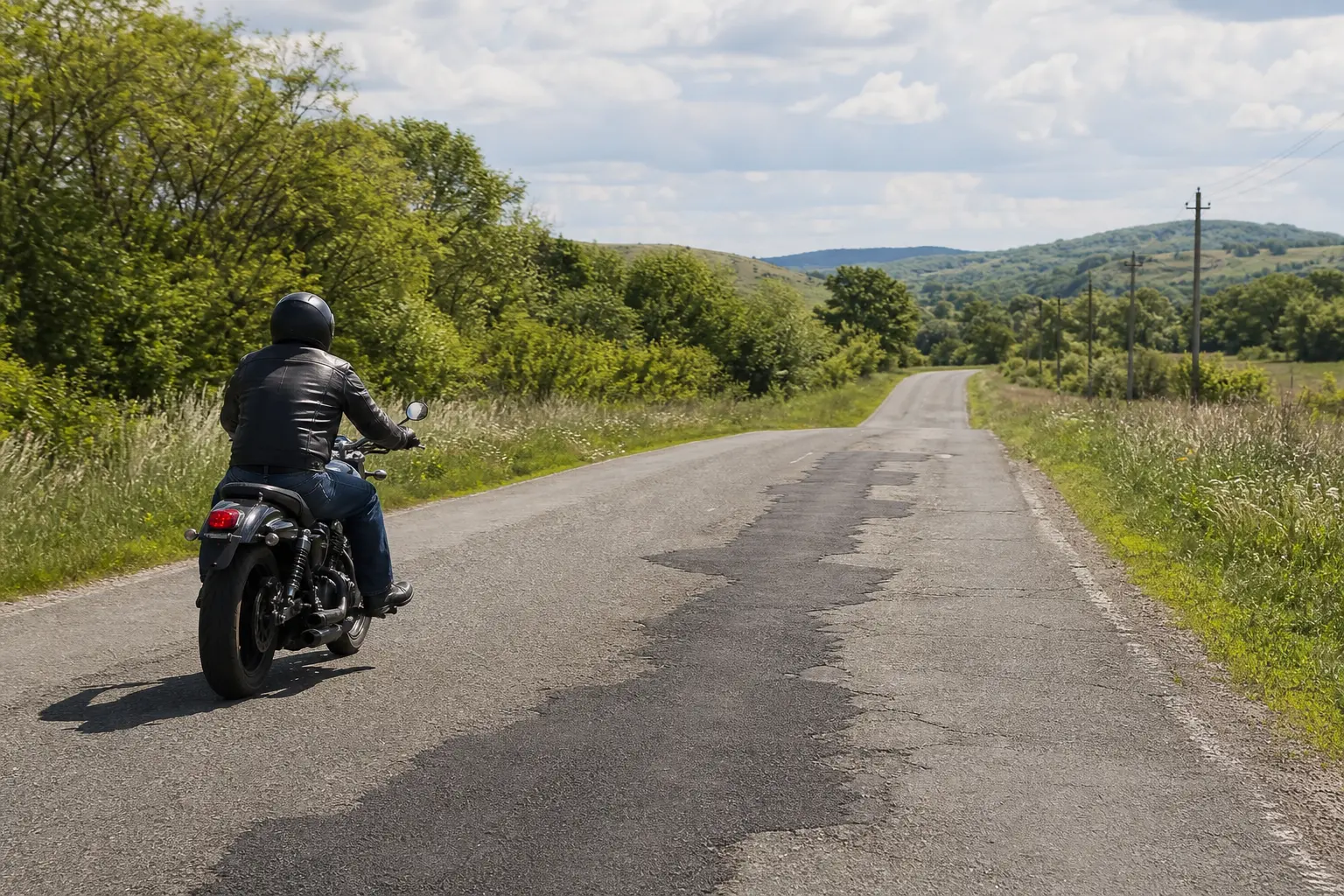
Uneven pavement rarely announces itself as one simple obstacle. A route can shift from worn asphalt to a raised repair, damp patch, rippled lane, scattered debris, or a rough section hidden beyond a bend. The challenge is not to find a magic response for every variation. It is to use a repeatable plan that gives you more time, more space, and fewer sudden decisions.
For motorcycle riding on uneven pavement, the useful sequence is: spot the surface change early, lower the workload before you reach it, choose a path with options, and keep your braking, steering, and throttle actions measured. That approach helps on roads with patches, ridges, uneven repairs, wet transitions, and uncertain grip. It is not a substitute for training, local law, or your motorcycle manufacturer’s instructions.
The Motorcycle Safety Foundation identifies uneven surfaces and wet or sandy roads as adverse conditions riders need to understand. It also emphasizes maintaining escape paths and riding within personal limits. Its riding guidance frames surface management around observation, speed choice, and controlled handling rather than a single trick. Read the official If You Ride A Motorcycle resource and You and Your Motorcycle: Riding Tips alongside this planning guide.
Motorcycle Riding on Uneven Pavement: What Changes
A poor surface can alter the ride in several ways at once. A rough repair may interrupt the motorcycle’s line. A dark area may be damp, merely discolored, or hiding a change in texture. A lane depression may make the road harder to read, especially when traffic, shadows, glare, or rain restrict what you can see. The surface itself is only part of the problem; the surrounding traffic and the space available to respond often matter just as much.
Think of the situation as a workload problem. When the road is smooth and clear, you have time to scan far ahead and make gradual choices. When a broken section appears, you may need to judge speed, lane position, visibility, traffic movement, and the road’s exit in a shorter distance. Trying to solve all of that at the final moment is what turns an ordinary rough patch into a high-pressure event.
Uneven pavement can also tempt riders into fixation. Looking directly at a seam or repair for too long can crowd out the information that matters next: a stopped car, narrowing lane, curve, puddle, or safe area beyond the rough section. Notice the problem, choose a conservative path, then keep your attention moving toward where you need to go.
Do not assume that a road is safe simply because another vehicle crossed it. A car may cover defects from your view, use a different path, or have more room to absorb an irregular surface. Another motorcycle rider may have different experience, loading, equipment, or risk tolerance. Your plan needs to fit the information you can see and the margin you personally have.
A Traction-and-Smooth-Inputs Plan for Changing Surfaces
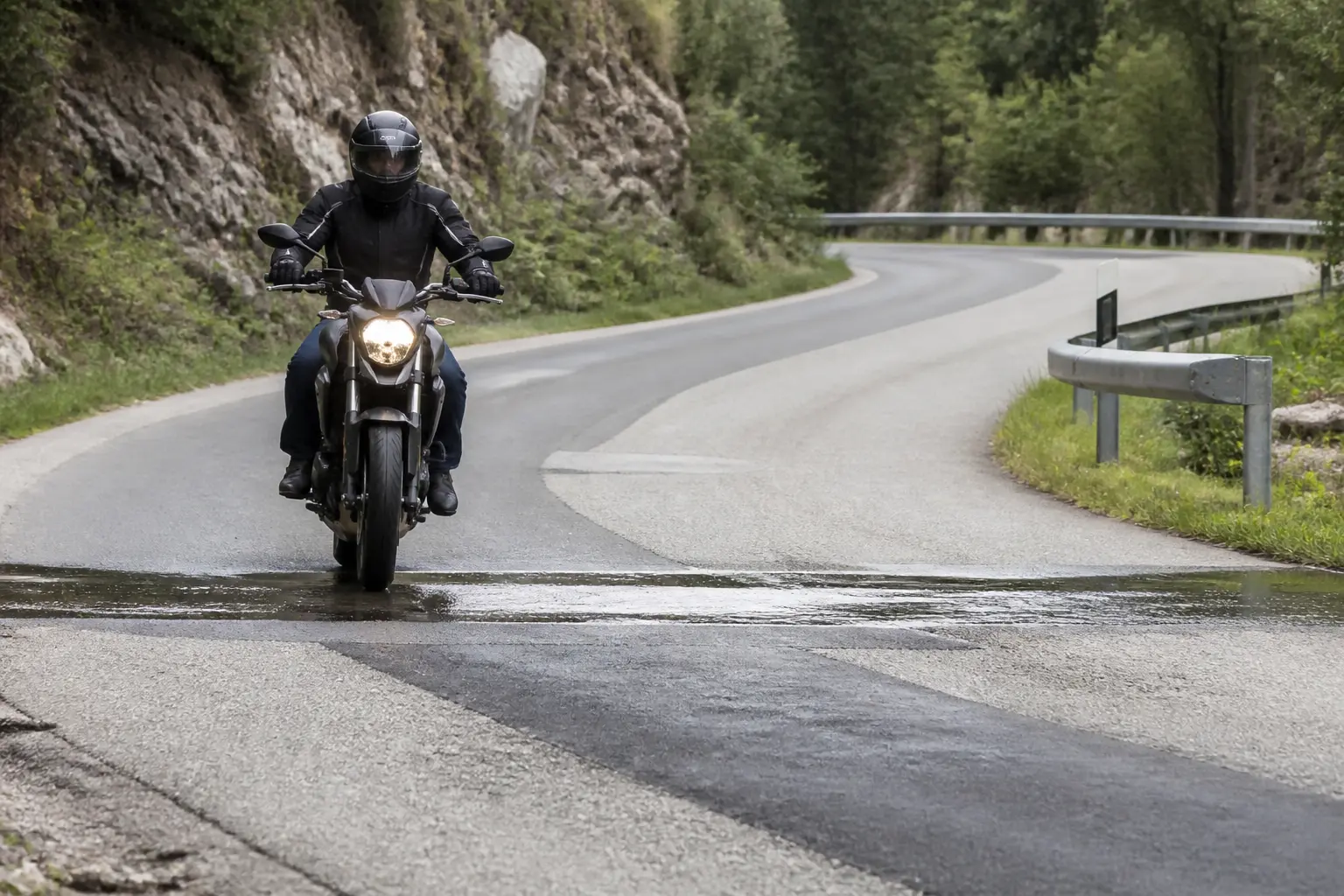
Use this three-part framework whenever pavement looks inconsistent: read, prepare, cross. It is a way to organize decisions before the front wheel reaches the uncertain area.
Read: identify what is actually changing
Search beyond the immediate road texture. Look for changes in color, repaired strips, uneven edges, pooled water, ripples, reflective areas, wheel tracks, and traffic moving away from one part of the lane. Then ask what the visible change may mean:
- Is the concern height, texture, moisture, lane width, or visibility?
- Does the section end quickly, continue through a curve, or disappear beyond a crest?
- Is there traffic limiting a lateral move or safe stop?
- What is beyond it if the surface is worse than it first appears?
You do not need perfect certainty to make a safer choice. If you cannot confidently read the surface, treat that uncertainty as a reason to create more margin.
Prepare: reduce demands before the rough area
Make the important speed and spacing decisions while you still have predictable pavement and a clear view. Ease off early when conditions call for it. Leave more following distance so a leading vehicle does not hide the road or force an urgent reaction. Complete unnecessary lane changes before the roughest area rather than trying to reposition at the last second.
Preparation also means considering the full situation. A repair that is manageable in daylight on an empty road may deserve far more caution in rain, at night, in a bend, with a passenger, or while surrounded by vehicles. If you cannot see a clear route through the hazard with room to respond, slowing further, taking another route, or postponing the ride can be the better decision.
Cross: keep the motorcycle and your choices calm
Once you have selected a reasonable path, keep looking through the section. Avoid sudden swerves toward a shoulder, opposing traffic, or another blind area. Make only the control adjustment the situation requires, and preserve room to revise the plan if a second hazard appears.
“Smooth inputs” does not mean ignoring a developing emergency or becoming rigid on the motorcycle. It means avoiding abrupt, unnecessary changes when traction and surface behavior are uncertain. Use the emergency responses taught in qualified rider training when needed, and follow the manufacturer’s instructions for your particular machine.
| Surface cue | What may be uncertain | Planning priority | Avoid this response |
|---|---|---|---|
| Long patch or repair strip | Height and texture may change along its length | Read its exit and reduce speed in advance | Making a late, sharp move to chase a narrow line |
| Raised seam or ridge | The motorcycle may be nudged from the intended path | Keep space and look beyond the crossing point | Staring at the seam until traffic disappears from attention |
| Wavy or sunken lane | The road may demand repeated small corrections | Lower speed and simplify other tasks before entry | Adding speed without knowing what follows |
| Damp-looking transition | Available grip may differ across the lane | Increase margin and keep controls progressive | Treating an unclear patch as certainly dry or harmless |
| Rough pavement in a bend | Surface and direction demands arrive together | Set a conservative entry plan and retain options | Waiting for mid-corner to make the first speed decision |
| Hidden surface over a rise | The path and exit are not visible | Let sight distance guide pace | Riding as if the unseen road matches the visible road |
Speed and Spacing: Build Time Before the Surface Arrives
There is no one correct speed for poor pavement. Road condition, sight distance, weather, traffic, rider experience, load, and the motorcycle’s setup all change the answer. The more useful question is: Does this pace leave enough time to understand the next surface change and enough space to respond without panic?
Slow earlier when the road is hidden by a crest, curve, glare, spray, or vehicle. Do the same when a repair extends farther than expected, the lane narrows, a vehicle occupies your usable space, or wet and rough conditions overlap. A passenger, luggage, fatigue, unfamiliar route, and reduced visibility are all reasons to add reserve.
The point is not to crawl over every imperfection. It is to avoid arriving at the decision point with no decision left. If you need to brake hard, make a sudden direction change, or accelerate abruptly merely to stay on your intended path, the plan was probably made too late. Choose a pace that allows deliberate actions while you can still see the road.
Following distance is a major part of that reserve. A close lead vehicle can hide patches, water, ridges, and traffic changes. More distance gives you a longer look at the lane and makes it less likely that another person’s braking will force you to solve a surface hazard under pressure.
Do not let a tailgater determine your speed. Protect the space ahead and look for a safe, lawful opportunity to let the vehicle go by. In a group, every rider should have room to make an independent speed choice; no one should feel required to rush through an uncertain section to remain connected.
Visual Search for Uneven Pavement and Escape Space
Effective surface planning uses an active scan rather than a fixed stare. Divide your attention across four areas:
- Immediate path: What is directly in your travel line?
- Developing road: How far does the rough or damp surface continue, and what lane space remains?
- Distance: What curve, vehicle, intersection, or road change is coming after the visible defect?
- Escape options: If the path closes, where is the least hazardous available direction?
This scan helps prevent a common error: solving the first patch while missing the second. A wet repair may lead into a bend; a raised strip may be followed by stopped traffic; a rough approach may conceal a narrowing shoulder. The safe line is not always the visually smoothest strip under your front wheel. It is the route that keeps visibility, traffic separation, and options as favorable as practical.
Lane position should therefore change only with a reason. A move may improve your view or avoid an obvious defect, but it can also reduce separation from vehicles, place you near a poor road edge, or eliminate an escape direction. Check the entire intended path before moving laterally. Choose a sensible position early and avoid repeated weaving in search of perfect pavement.
At night, the road provides less usable information. Headlight reach, glare, shadows, and reflected moisture can make an irregular surface difficult to interpret. The posted limit does not automatically provide a safe answer for what you can see. When the surface or its exit cannot be read with adequate margin, reduce pace and consider a safe stop or route change.
Smooth Inputs When Traction Is Uncertain
Smooth control begins before the rough section. Give yourself a stable, attentive riding position and avoid creating extra tasks just before the surface change. If a speed adjustment is needed, decide early rather than waiting until the motorcycle reaches the most irregular part of the lane.
Keep your actions purposeful. Sudden acceleration can shorten the time available to read the road beyond the first defect. Abrupt steering can send you toward traffic or an edge hazard. A hurried braking decision may combine with the rough surface at the moment when you have the least margin. None of this means you should freeze or avoid necessary action; it means that earlier planning produces calmer choices.
The official MSF riding material discusses poor surfaces, wet conditions, skids, wind, and other changing-road scenarios as part of wider observation and control skills. The MSF scooter riding tips are also useful for riders whose smaller wheels and urban routes often bring them into contact with grooves, transitions, and imperfect pavement. These sources support a conservative, smooth approach, but your owner’s manual remains the authority for model-specific operating guidance.
If the motorcycle reacts in a way that seems unusual after a severe impact or rough segment, do not diagnose it while riding. Move to a safe location. Use the manufacturer’s inspection guidance, and obtain qualified assistance if you cannot confidently establish that the motorcycle is safe to continue.
Wet Transitions, Repairs, and Curves
Changing pavement deserves added attention when moisture is involved. Rain can collect in depressions, follow a seam, or make only part of a lane appear darker. A dark patch is not a reliable label for either “safe” or “slick.” Treat an unclear surface as information that you need more time and more space.
Where conditions allow, make speed changes before the wet or irregular transition. Continue looking ahead after crossing the first damp patch, because the road may contain a sequence of repairs, paint, metal covers, polished traffic paths, or pooled areas. The goal is not to dodge every visible variation. It is to avoid an abrupt reaction that introduces a bigger conflict with traffic or the road edge.
Curves increase the importance of early judgment because their exits may hide the condition you need to manage. Set a conservative approach using the information available before turn-in. Keep searching toward the curve’s exit and avoid treating the first visible section as proof that the whole bend is consistent.
If rough pavement becomes apparent after you are already in a curve, do not make a frantic escape toward opposing traffic or off the road. Stay focused on the available path, use measured actions consistent with your training, and reassess after the section. A better approach on the next curve is simply to carry less speed into the area where information is limited.
Manufacturer-First Preparation Before a Rough Route
Riding strategy cannot compensate for a motorcycle that is not ready for the trip. Before unfamiliar, weather-affected, or poor-road travel, use the inspection and operating instructions supplied by your motorcycle or scooter manufacturer. Follow the manual for tires, loads, controls, warnings, and any model-specific requirements.
Avoid changing tire pressure, suspension adjustments, loading arrangements, or equipment based on generic online advice. Those decisions depend on the exact motorcycle, tire, load, and documented manufacturer guidance. If you have doubts about a safety-related condition, seek qualified service rather than trying an unfamiliar roadside repair.
Rider readiness belongs in the same plan. Protective gear, weather preparation, communication, route timing, and rest all influence how well you can search and make decisions. Being cold, overheated, tired, distracted, or rushed shrinks the mental capacity available for changing surfaces.
For a broader planning foundation, use the Motorcycle Maintenance Guide to organize your questions and records. It should complement—not override—your owner’s manual and qualified technicians for motorcycle-specific safety decisions.
Uneven Pavement Riding Checklist
Use this checklist before and during a ride. It is a planning tool, not a replacement for hands-on training, the owner’s manual, or local traffic rules.
Before departure
- Check whether weather, construction, darkness, or an unfamiliar route could reduce surface visibility.
- Review manufacturer guidance relevant to tires, loading, controls, and routine inspection.
- Confirm the motorcycle is ready rather than assuming a previous ride proves current condition.
- Wear protective gear appropriate to the forecast and route.
- Decide in advance what would make you slow down, stop, turn back, or postpone.
- If riding with others, agree that each rider can choose a comfortable pace.
- Leave enough time to avoid turning rough pavement into a rushed choice.
Approaching a changing surface
- Scan the near road, developing road, distance, and potential escape area.
- Identify whether the concern is texture, height, moisture, visibility, lane width, or a combination.
- Increase following distance so you can see the pavement ahead.
- Reduce speed while a predictable, visible section of road remains available.
- Check whether traffic allows a safe, legal path through the area.
- Avoid a last-second move toward a shoulder, blind space, or opposing lane.
Crossing and continuing
- Look through the rough section toward the path beyond it.
- Keep a controlled line rather than hunting for a flawless wheel track.
- Make braking, steering, and throttle movements as measured as conditions permit.
- Keep scanning for the next patch, vehicle, narrowing, or wet transition.
- Reassess immediately if the surface lasts longer or behaves differently than expected.
After a significant impact or rough segment
- Notice any unexpected change in handling, sound, vibration, or direction.
- Stop only in a safe location if something seems wrong.
- Follow the owner’s manual and seek qualified help if you cannot confirm safe condition.
- Record the route and conditions so you can plan differently next time.
When the Best Choice Is to Stop or Reroute
Turning around is not a failure of riding skill. It can be the most disciplined answer when the road, traffic, weather, and visibility together exceed your available margin. Consider stopping or selecting another route when you cannot see enough to choose a controlled path, vehicles remove your escape space, or repeated surprises show that the situation is escalating.
A passenger, heavy load, unfamiliar bike, fatigue, darkness, or worsening weather can all justify a larger safety buffer. Find a legal, visible place to make a deliberate change of plan. Avoid abrupt stops, U-turns, or roadside decisions that create a fresh hazard.
The same principle applies if the motorcycle itself may have become part of the problem. A machine that continues to run is not automatically ready for more rough pavement after a hard impact. Use manufacturer-first guidance and qualified support when the condition is uncertain.
How Vojo Helps

Use Vojo to turn one difficult road section into useful preparation for the next ride. Before leaving, create a route note such as “reduce pace before the patched rise; keep extra space after the crest.” Afterward, save the location, weather, traffic level, visibility, and whether your chosen pace left enough room to react. Before riding that route again, review the note and decide whether a different time, weather window, or road is wiser.
If rough pavement raises a genuine inspection concern, add a neutral observation to the Motorcycle Maintenance Tracker, such as an unfamiliar vibration noticed after a particular location. Then compare that record with your owner’s manual or qualified technician advice instead of guessing at a diagnosis. This keeps ride learning and maintenance history connected without treating a note as a repair instruction.
Quick answers
Frequently asked questions
What is the safest general approach to motorcycle riding on uneven pavement?
Notice the surface change early, reduce speed while you still have clear pavement, increase space from traffic, choose a reasonable path, and keep control actions measured. If you cannot identify a controlled route through the area, slow further, stop safely, or choose another way.
Should I speed up to get over rough or patched pavement?
Do not rely on a generic acceleration tactic. More speed can reduce the time available to read the road beyond the first defect and may add workload when conditions are uncertain. Choose a conservative pace based on visibility, space, training, and manufacturer guidance.
Where should I ride in the lane on poor pavement?
There is no fixed best lane position. Favor the path that gives you better visibility, avoids the most obvious hazard, preserves separation from traffic and edges, and leaves an escape option. Avoid sudden lateral moves that solve one surface issue by creating a traffic risk.
How should I handle a damp or dark patch of pavement?
Treat its condition as uncertain. Where possible, adjust speed before reaching it, leave additional space, keep inputs progressive, and continue scanning beyond it. Do not assume that appearance alone tells you exactly how much grip is available.
What should I do if the motorcycle feels different after a rough section?
Move to a safe place to stop, then consult the owner’s manual and use qualified help if you cannot confidently confirm that the motorcycle is safe. Do not attempt an unfamiliar safety-critical repair in traffic or while roadside conditions are unsafe.