
Motorcycle Riding at Night: Speed, Distance, and Headlight Limits
Motorcycle riding at night requires more than a working headlight. Learn how to set speed, preserve stopping distance, manage glare, and plan safer stops.
Fact-checked against cited official documentation
Reviewed against Fact-checked against the Motorcycle Safety Foundation operator manual and its “If You Ride A Motorcycle” safety guidance for night visibility, speed, spacing, lighting, searching, and escape routes..
Last updated October 25, 2026
Night riding changes the question from “Can I see the road?” to “Can I stop or avoid what my headlight reveals?” A clear, dry road can still become a demanding environment after sunset. Your useful sight distance is shorter, roadside shapes are harder to interpret, oncoming headlights create glare, and a dark object can appear later than you expect.
The safest response is not to search for a magic speed or a universal following-distance number. It is to make your speed, spacing, lane position, and route choices match the information available right now. If the visible road does not give you enough time to respond, the correct adjustment is to slow down, increase space, change your route, or stop riding.
The Motorcycle Safety Foundation’s operator guidance specifically connects night riding with reduced visibility, lower speed, greater following distance, appropriate high-beam use, reflective material, and avoiding a speed greater than the distance you can see. Its broader rider guidance also emphasizes a working headlight, continuous searching, escape routes, and staying within your skill and situation limits (Motorcycle Safety Foundation operator manual; If You Ride a Motorcycle).
This article turns those principles into a practical night-riding plan. It does not replace your owner’s manual, local law, rider training, or a professional inspection. For maintenance context, see the Motorcycle Maintenance Guide.
Why Night Riding Reduces Your Margin
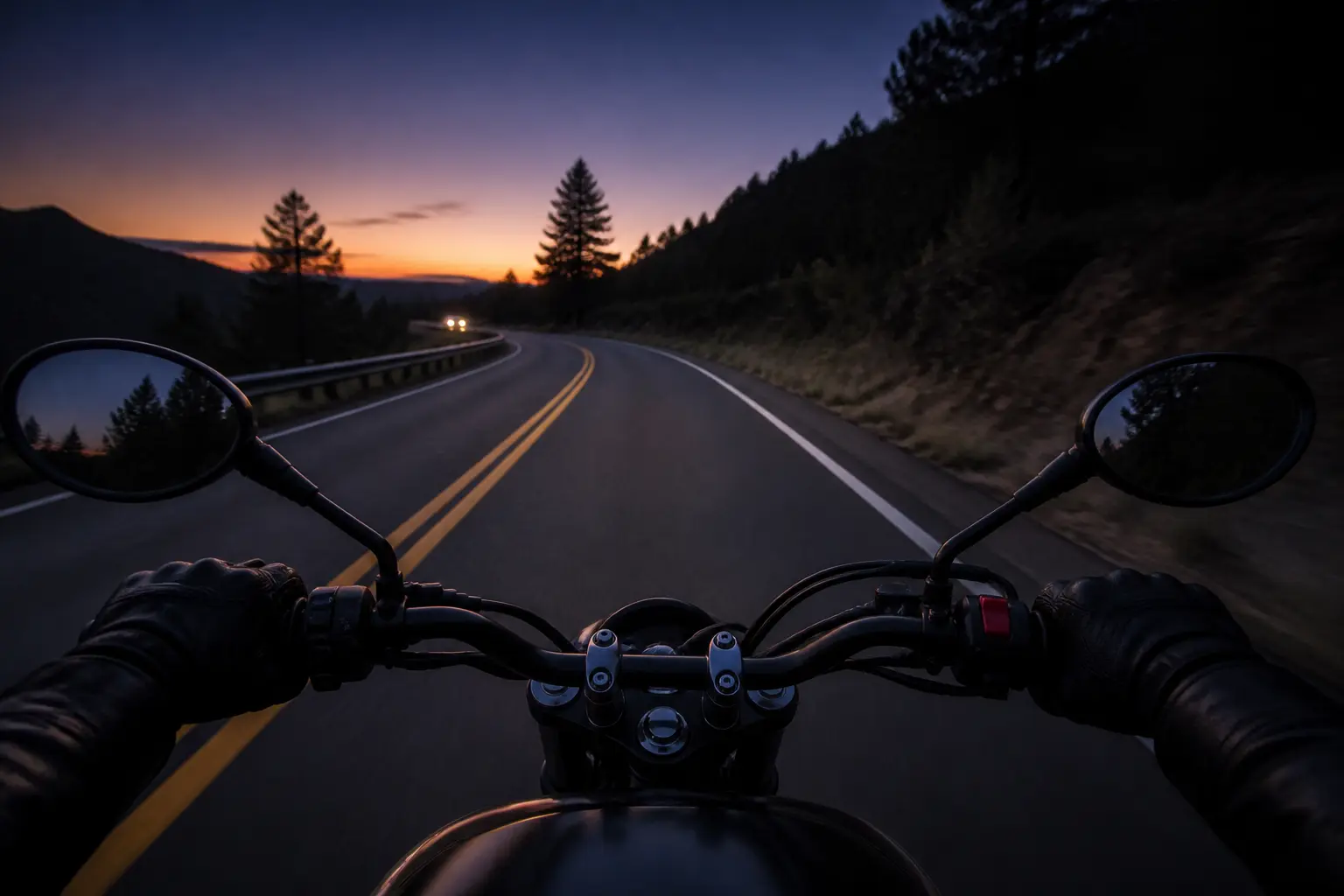
During daylight, your eyes can use color, shadows, road texture, movement, and background contrast to identify hazards. Darkness removes or weakens much of that information. A dark motorcycle, pedestrian, animal, stalled vehicle, pothole, or piece of debris may blend into the background until it is close.
Distance judgments also become less reliable. Two lights ahead may belong to a vehicle that is much farther away than it appears, while a single light may make it difficult to judge the size or angle of an approaching vehicle. A bend, crest, driveway, or roadside obstruction can hide a hazard until your available stopping distance is already shrinking.
The important distinction is between headlight range and usable decision range. Your lamp may illuminate a patch of pavement, but that does not mean you can clearly identify every hazard in that patch. Glare, rain, a dirty visor, a curved road, uneven pavement, and visual fatigue can all reduce the portion of the road you can interpret confidently.
Treat the visible road as a changing limit, not as a fixed specification. If the beam reaches only to the next bend, your speed needs to leave room for a response before that bend. If an oncoming vehicle washes out your view, your usable range has temporarily become shorter. If you crest a hill, enter a wooded section, or meet a vehicle with misaligned or unusually bright lamps, reassess immediately.
The headlight limit in plain language
A useful rule is simple: do not ride faster than you can stop within the clear distance you can see. This is not a promise that every hazard will be avoidable. It is a discipline that keeps you from voluntarily creating a situation in which an ordinary obstacle becomes impossible to manage.
That rule includes more than braking distance. You also need time to recognize the object, decide what it is, choose a response, and use the control inputs you can make smoothly. A rider who is surprised at close range may need to brake, steer, or both while the motorcycle is leaned, the surface is imperfect, or traffic is nearby.
A speed that feels comfortable on a familiar road can still be too high when the road is wet, the lane is narrow, the surface is uncertain, or glare has reduced your view. Comfort is not proof of margin.
Choosing a Night-Riding Speed
Speed selection should begin before you leave, then continue as an active scan during the ride. Posted limits are not a target that must be maintained in every condition. They describe a legal maximum or general road framework; they do not guarantee that the visible road gives you enough time to respond.
Start with a conservative pace on a route you know well. Familiarity can help with route planning, but it can also create overconfidence. Road work, parked vehicles, pedestrians, animals, surface damage, and traffic patterns may be different at night. Let the headlight, sightline, traffic, weather, and your condition determine the pace.
Use these questions repeatedly:
- Can I identify the usable lane and its edges?
- Can I see far enough through the next curve or over the next crest to respond?
- If something appears in the lane now, do I have time and space to slow smoothly?
- Is an oncoming vehicle, mirror, sign, or wet surface reducing my view?
- Would a slower pace give me more time without creating a new traffic conflict?
- Am I still processing information accurately, or am I tired and narrowing my attention?
If the answer becomes uncertain, roll off early and create margin before the hazard arrives. Avoid waiting until the object is close and then making a sudden correction.
A practical speed decision table
| Road condition at night | What it does to your information | Conservative response |
|---|---|---|
| Familiar, dry, straight road with clear sightline | Provides the most usable visual information, but still less than daylight | Choose a moderate pace that stays inside the visible stopping distance |
| Curves, crests, wooded edges, or driveways | Hides hazards and shortens the decision window | Slow before the blind area and keep an escape option |
| Oncoming glare or following glare | Reduces contrast and makes objects harder to identify | Ease off, look toward the lane area you can still read, and avoid fixation on the light |
| Rain, spray, or a wet visor | Scatters light and obscures surface detail | Reduce speed substantially, increase space, and consider stopping if vision degrades |
| Dense traffic or frequent parked vehicles | Adds unpredictable movement and blocked sightlines | Increase following distance and avoid riding alongside hidden access points |
| Fatigue, illness, or reduced concentration | Delays recognition and decision-making | End the ride or take a genuine break in a safe place |
The table is a decision aid, not a formula. Your owner’s manual and local rules remain the first references for the motorcycle and roadway. If the conditions exceed what you can interpret confidently, do not try to compensate with confidence or brighter equipment alone.
Following Distance Is a Night-Riding Tool
Following another vehicle at night can feel reassuring because its lamps outline the road. That apparent help can become a trap. The vehicle ahead may hide a pothole, animal, stopped vehicle, or debris until it moves around it. Its brake lights may also give you less information than daylight cues, particularly when glare or rain is present.
Leave more room than you would in an uncomplicated daylight situation. A larger gap gives you additional time to recognize a change, respond to braking, and move away from a developing problem. It also reduces the chance that your headlight is aimed into the back of a vehicle at a distance where you cannot see around it.
Do not use the vehicle ahead as a substitute for your own sightline. If you cannot see beyond it, your speed should reflect the blocked view. When possible, choose a lane position that gives you information without placing you in another vehicle’s blind area or reducing your escape space. Avoid riding beside a vehicle simply to see around it; the vehicle may drift, turn, or change lanes without seeing you.
Following distance is especially important behind large vehicles. Their size can block the road and their lights can create glare. Turbulence, spray, and debris may add further problems. If you cannot maintain a comfortable view and margin, let the vehicle go ahead or take a safe opportunity to separate from it.
A useful night habit is to ask not only “How far behind am I?” but also “What can I see if this vehicle brakes right now?” If the answer is only its rear lights, you need more time, a better sightline, or a different position.
Using High Beam Without Overtrusting It
High beam can extend the area illuminated on an empty, dark road, but it does not remove the headlight limit. It cannot reveal an object hidden around a bend or behind a crest, and it cannot make a wet visor clear. Use it only in a way that complies with local law and does not impair other road users.
The owner’s manual is the manufacturer-first reference for your motorcycle’s lighting controls, indicator behavior, and any model-specific restrictions. Do not assume that a lamp that looks bright from the rider’s seat is correctly aimed or functioning as intended. If the headlight, tail light, brake light, or turn signal is not working properly, treat that as a reason to address the problem before a night trip rather than attempting to compensate on the road.
When meeting traffic, dim the beam as required and avoid staring at the approaching light. Shift your visual attention toward the lane and edge information you can still interpret while keeping the vehicle in your peripheral awareness. If glare has erased your useful sight distance, slow down. Do not maintain speed simply because the road was clear a moment earlier.
Bright auxiliary lighting and replacement bulbs may have legal, compatibility, aiming, heat, or electrical implications. Follow the motorcycle manufacturer’s documentation and applicable regulations. More light is not automatically safer if it blinds others, creates distracting reflections, or encourages a faster pace than the road supports.
Managing Glare, Reflections, and Visual Overload
Glare is not limited to oncoming headlights. It can come from mirrors, wet pavement, reflective signs, shop windows, vehicle paint, and lights behind you. A visor or windscreen can amplify the problem when it is scratched, dirty, fogged, or covered in fine moisture.
Before riding, clean the surfaces that affect your view and make sure your eye protection is appropriate for the conditions. Keep a clear option available for darkness; do not assume a tinted solution that is comfortable in daylight will provide the same useful information at night. If your vision remains compromised, stop in a safe location rather than improvising while moving.
When glare appears, avoid locking your eyes onto the brightest point. Keep scanning the lane, road edge, and available escape areas. A small reduction in speed can make the same visual field more useful because it gives your eyes and brain additional time to process it.
Reflections can also mislead you about the road surface. A shiny area may be water, an old repair, paint, or simply reflected light. Do not make abrupt steering inputs because a surface looks different at a distance. Reduce speed early, keep the motorcycle as stable as conditions permit, and leave room for uncertainty.
Lane Position and Escape Space After Dark
Lane position should help you see and be seen while preserving a path away from trouble. There is no permanently correct side of a lane for every road. The best position changes with curves, traffic, parked cars, driveways, road edges, glare, surface condition, and the location of potential hazards.
Avoid hiding in another vehicle’s blind zone. At the same time, do not move toward the centerline or road edge merely to gain a few feet of view if that sacrifices a safe buffer. Think in terms of a usable zone: enough room to maneuver, enough distance from fixed hazards, and enough visibility for the next decision.
At night, a parked vehicle deserves extra suspicion. You may not be able to see a person preparing to open a door, a driver about to pull out, or a vehicle with its lights off. Give parked vehicles space and reduce speed where they constrain your escape route. A driveway or side street can be difficult to read when the surrounding area is dark.
Do not ride with your attention fixed only on the illuminated center of the lane. Search near the edges, through openings, at intersections, and beyond vehicles when possible. The goal is not to predict every event. It is to notice changes early enough to preserve choices.
Night Riding in Rain, Fog, and Cold Air
Darkness and weather multiply one another. Rain can turn every light into a reflection and reduce the contrast between pavement, standing water, and debris. Fog can make the headlight reflect back toward you, leaving less useful forward information. Cold air may increase visor fogging or make fatigue arrive sooner.
Treat a forecast for deteriorating visibility as a route decision, not merely a clothing decision. Ask whether there are well-lit stopping places, whether the road has reliable shoulders or safe pull-offs, and whether you can end the ride before conditions become difficult. A route that is manageable during the day may offer few safe choices after dark.
If rain begins, reduce speed before the surface becomes difficult to read. Increase following distance and avoid assuming that the vehicle ahead has identified hazards for you. If spray or fog prevents you from seeing a safe stopping path, leave the traffic stream only at a safe, legal location and wait for conditions to improve.
Cold and fatigue deserve equal attention. A rider who is shivering, mentally dull, or impatient may make poor speed and spacing decisions even when the road looks clear. A warm drink or short break is not a substitute for ending the ride when concentration has deteriorated.
A Pre-Ride Night-Riding Checklist
Use this checklist before every planned ride after dark. It is deliberately conservative: if a response is uncertain, resolve the uncertainty before departure or choose not to ride.
Motorcycle and equipment
- Read the motorcycle manufacturer’s instructions for lighting controls and relevant equipment.
- Confirm that the headlight, tail light, brake light, and turn signals work as intended.
- Check that lenses, mirrors, windscreen, and eye protection are clean enough for the conditions.
- Make sure your protective clothing and reflective elements do not restrict control movement or vision.
- Carry communication, identification, and a way to contact assistance.
- Confirm that the motorcycle is appropriate for the route, weather, load, and your current skill level.
Route and timing
- Check the weather, temperature, precipitation, and likely visibility for the whole trip.
- Choose roads with reasonable sightlines, safe stopping options, and a route home if conditions worsen.
- Identify fuel, rest, and emergency stopping locations before leaving.
- Tell someone your expected route and return plan when the ride warrants it.
- Avoid scheduling a demanding night ride at the end of an already tiring day.
On-road decisions
- Set a speed that stays within the clear distance you can see.
- Increase following distance when glare, traffic, weather, curves, or fatigue reduce your margin.
- Use high beam only when appropriate, lawful, and considerate of other road users.
- Search continuously for movement, changing surfaces, intersections, animals, parked vehicles, and blocked sightlines.
- Preserve an escape route instead of riding beside hazards or inside blind spots.
- Slow before curves, crests, intersections, and areas where the beam cannot show the full hazard zone.
- Stop riding when you can no longer identify a safe path or make calm decisions.
When to End the Ride
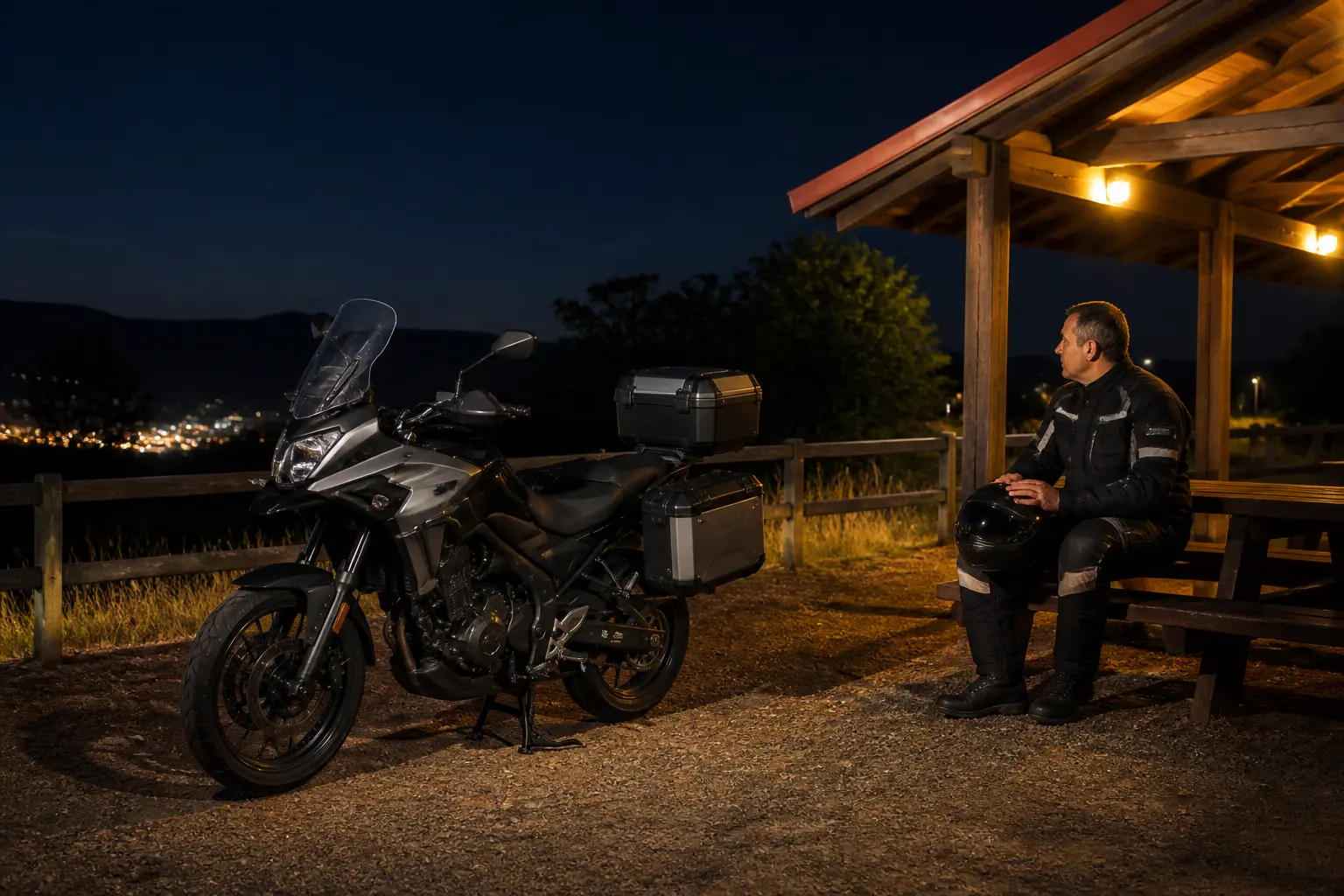
The most important night-riding skill may be recognizing when the ride is no longer offering reasonable choices. End the trip or take a substantial break when your eyes are straining, your visor will not stay clear, glare is persistent, rain is obscuring the lane, or you are repeatedly surprised by objects that should have been visible earlier.
Also stop when you notice behavioral warnings: following too closely, running wide in curves, braking late, missing turns, fixating on lights, or feeling pressure to keep the original schedule. These are not character flaws. They are information that the current plan is exceeding your available margin.
Choose a safe, legal place to stop. Avoid pulling onto an unlit shoulder where passing traffic may not expect you, unless an emergency leaves no better option. Make yourself visible, stay clear of the traffic path, and arrange assistance if the motorcycle or conditions are not suitable for continuing.
A planned stop is better than an emergency stop. Build one into the route before departure, and give yourself permission to use it earlier than planned.
How Vojo Helps
A practical Vojo workflow is to create the night ride as a trip or maintenance task before departure, record the route and planned stop points, then attach a short pre-ride note: “headlight confirmed, clear eye protection, weather checked, conservative pace.” After the ride, log the actual conditions, where glare or fatigue appeared, and whether you ended earlier than planned. That record can improve the next route decision instead of relying on memory.
You can keep the inspection and follow-up history together in the Motorcycle Maintenance Tracker, then use the saved notes to distinguish a motorcycle issue from a visibility or judgment issue. The goal is not to turn night riding into a data exercise; it is to make the conservative choice easier to repeat.
Quick answers
Frequently asked questions
How fast should I ride a motorcycle at night?
There is no universal safe night speed. Choose a pace that lets you identify the road and stop within the clear distance you can see, then slow further for curves, glare, weather, traffic, fatigue, or uncertain surfaces.
How far should I follow another vehicle at night on a motorcycle?
Leave more space than in an uncomplicated daylight situation, especially when glare, rain, traffic, or a large vehicle blocks your view. The gap should give you time to recognize braking or an obstacle and preserve an escape option.
Should I always use high beam when riding at night?
No. Use high beam only when appropriate and lawful, and dim it for other road users as required. High beam cannot reveal hazards around curves or through blocked sightlines, and it does not justify traveling faster than your visible stopping distance.
What should I do if oncoming headlights blind me?
Avoid staring at the brightest point, keep scanning the lane and edge information you can still interpret, and reduce speed. If glare leaves you without a safe usable sightline, stop at a safe, legal location rather than continuing at the same pace.
Is night riding safe in rain?
Rain can scatter light, create reflections, hide surface changes, and reduce contrast. Slow down, increase following distance, keep your vision clear, and consider ending the ride if you cannot identify a safe path or stopping place.
When should I cancel a night motorcycle ride?
Cancel or end it when visibility, weather, fatigue, equipment condition, or route complexity exceeds your ability to make calm decisions and preserve stopping and escape margin. A changed plan is safer than forcing the original schedule.