
Motorcycle Following Distance: How Many Seconds Create a Real Safety Cushion?
Learn how many seconds to leave behind traffic on a motorcycle, why two seconds is only a baseline, and when sightlines, grip, and escape routes demand more.
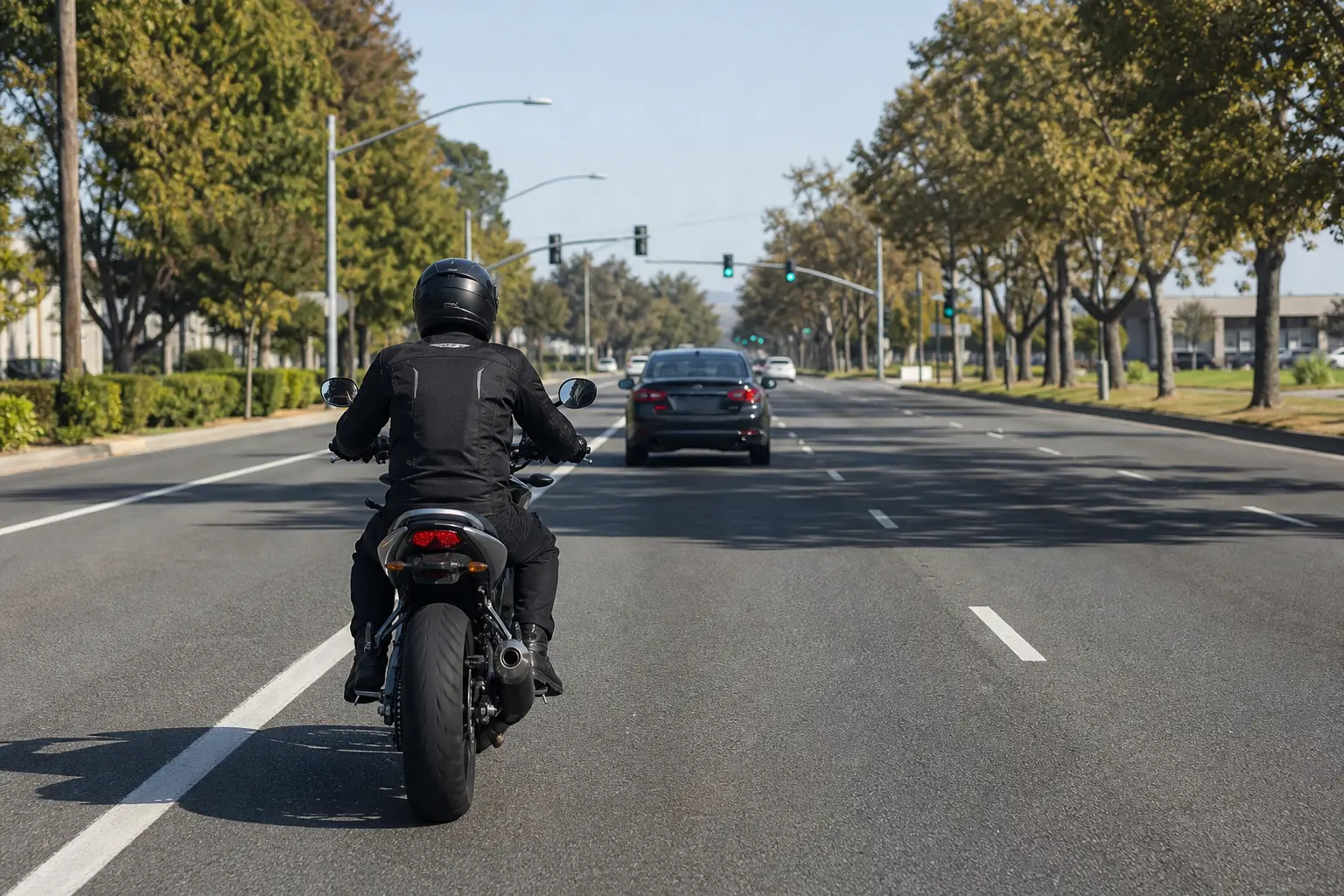
Fact-checked against cited official documentation
Reviewed against Checked against MSF guidance for the two-second baseline, increased space in poor traction, heavy traffic and blocked views, stopped-traffic spacing, and group-formation margins..
Last updated October 8, 2026
A rider asking “motorcycle following distance: how many seconds?” is usually looking for a number that is easy to remember in traffic. A number is useful—but only if it is treated as a starting point rather than a permanent answer.
The Motorcycle Safety Foundation (MSF) uses a two-second minimum following-distance check for normal riding conditions. Its guidance also makes the important next point: the space cushion should grow when pavement is slippery, traffic is heavy, or the vehicle ahead prevents you from seeing the road situation developing farther ahead. In other words, the count is not a target to hold at all costs. It is a quick way to notice when your margin has become too small. MSF’s Motorcycle Operator Manual provides the foundation for that approach.
A useful following gap gives you more than stopping room. It gives you time to recognize brake lights several vehicles ahead, notice a queue forming beyond a hill, identify a patch of poor surface, and decide whether slowing is enough or whether another path is becoming necessary. It also gives you a better chance of avoiding an urgent reaction to the vehicle immediately in front of you.
That is why the most useful rule is not simply, “Keep a fixed number of seconds.” It is:
Keep enough time and space to see the traffic picture, slow smoothly, and retain a realistic option if the situation changes.
For riders, that means managing three connected margins:
- Time margin — enough time between you and the vehicle ahead to perceive and respond.
- Sightline margin — enough view past, around, or beyond that vehicle to understand what may be coming.
- Maneuvering margin — enough clear, verified space to stay composed if braking alone is not the best answer.
The practical answer is therefore conditional: start with the MSF two-second minimum in clear, predictable conditions, then deliberately enlarge it whenever your information, grip, or options are reduced.
Motorcycle Following Distance: Is Two Seconds, Three Seconds, or More Right?
The comparison below answers the “how many seconds?” question without pretending that one count fits every road, motorcycle, or traffic pattern.
| Following-distance choice | When it can fit | What it does not solve | Better rider focus |
|---|---|---|---|
| Less than two seconds | It does not provide the MSF minimum reference margin for ordinary conditions | Leaves little time to read traffic changes or respond calmly | Ease off and rebuild a usable gap rather than trying to hold position |
| Two seconds | Clear pavement, open view, stable traffic, and a rider who is not boxed in | Does not compensate for blocked sightlines, poor grip, dense traffic, or limited escape space | Treat it as a minimum baseline, not an ideal finish line |
| Three seconds or more | A vehicle blocks your view, traffic is compressing, a merge is likely, or conditions are less predictable | Does not make a curve, slick surface, or dark road automatically safe | Pair the larger gap with lower speed and continuing observation |
| More than three seconds | Visibility is shortened, surface confidence is poor, traffic behavior is unsettled, or rider workload is high | Cannot replace a safe speed or a sound decision to delay, stop, or change route | Keep enlarging the margin until the road picture and available options feel manageable |
Two seconds is valuable because it adjusts with speed. A fixed distance in feet may seem generous at a slow intersection approach yet become inadequate when traffic accelerates. A time check changes as the pace changes.
To make the check, select a fixed roadside reference such as a sign shadow, pavement joint, or roadside marker. When the vehicle ahead passes it, begin a calm count. If your motorcycle reaches that reference before the count is complete, you have less than the two-second minimum reference. This is a scan tool, not a reason to fixate on the pavement or take attention away from traffic.
MSF guidance describes two seconds as a minimum amount of time to stop or swerve when the vehicle ahead stops suddenly, and it calls for more space when normal stopping distance is affected, when your view is obstructed, or when traffic conditions may place another vehicle in front of you. That distinction matters because following distance is not just about the rear bumper in front of your headlight. It is about the full chain of events that can develop beyond that bumper. MSF’s Motorcycle Operator Manual
A rider can count two seconds accurately and still be too close for the conditions. For example, a tall truck can block the view of slowing traffic well ahead. A wet road can reduce confidence in available grip. A busy interchange can create several competing movements at once. In each case, the clock tells only part of the story. The safer response is to create additional time before an emergency develops.
Why a Motorcycle Needs a Sightline Cushion, Not Just Empty Road
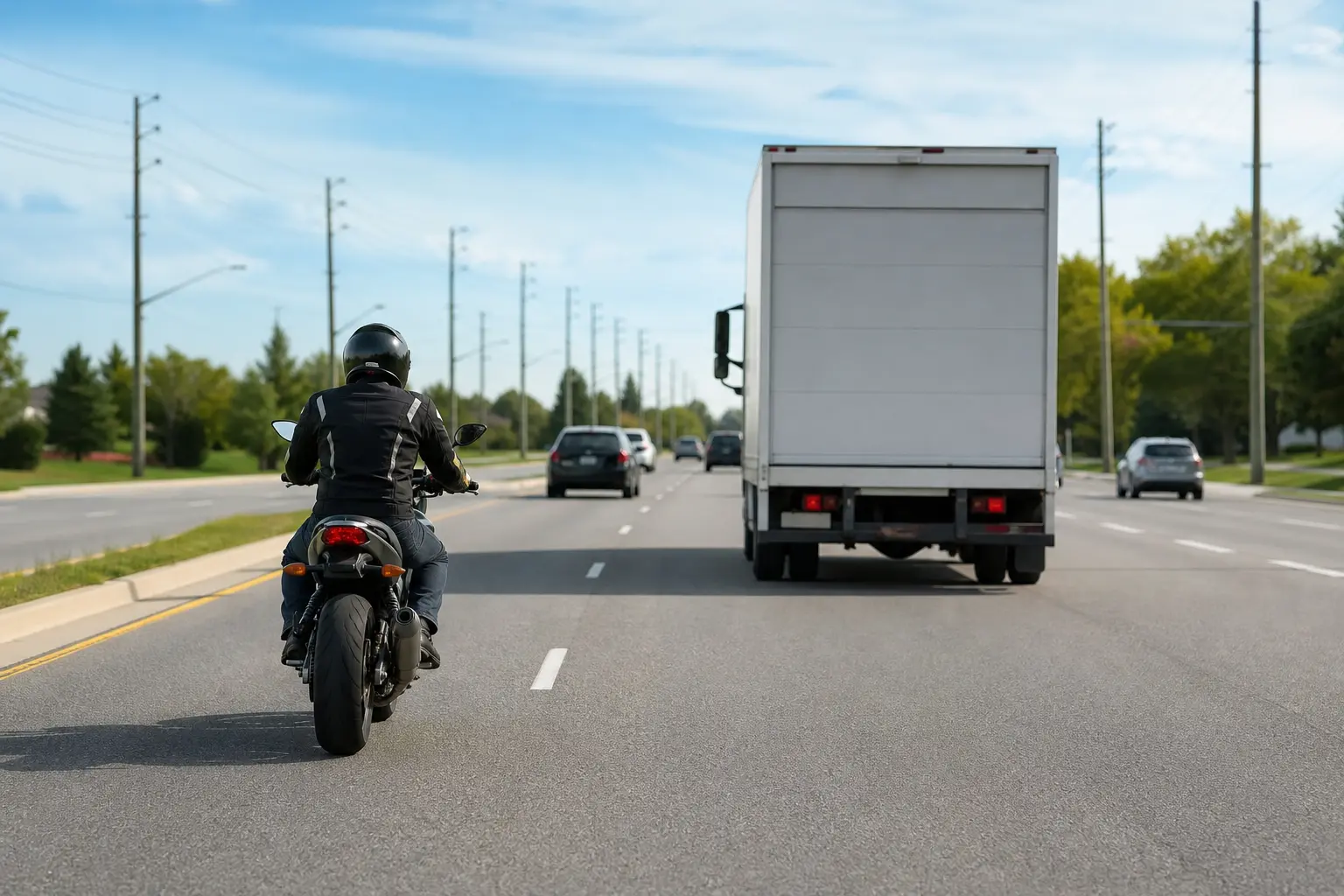
The gap ahead is useful because it opens a window into the roadway. When you sit close behind a vehicle, especially a tall SUV, van, bus, truck, or loaded trailer, that vehicle becomes a moving visual barrier. You may only learn about traffic compression, road debris, standing water, or a lane closure when the driver ahead reacts.
That is late information. Late information creates hurried choices.
A better position and a larger gap can help reveal clues farther up the road. The goal is not to weave around within the lane or to ride near another vehicle’s blind area. It is to choose a stable lane position that gives you a clearer view while preserving room from adjacent vehicles, road edges, parked cars, and surface hazards.
A sightline is useful when it lets you see meaningful changes early enough to act without panic. Examples include:
- Brake lights appearing several vehicles ahead.
- Cars beginning to bunch before an exit, toll area, signal, work zone, or lane reduction.
- An adjacent vehicle moving toward a lane line or leaving a widening gap that suggests a lane change.
- Changes in pavement color, texture, water, loose material, or debris.
- A curve, hill crest, glare zone, or large vehicle that is reducing what can be seen ahead.
- A line of traffic that is traveling at a different pace than your lane.
Seeing the rear window or taillights of the nearest car is not the same as having a useful traffic picture. You may be able to see the vehicle, yet still have no information about why it is braking or where the road is leading next.
If your view is blocked, solve that problem first by adding space. A modest position adjustment can sometimes improve your angle of view, but it does not replace the reaction time created by a bigger following gap. Do not treat a brief glimpse around a vehicle as proof that the path is clear. The road picture can change before you reach it.
Large vehicles deserve particular patience. They may conceal hazards and braking patterns ahead, throw spray in rain, and make airflow less predictable. The conservative choice is often to stay back until you can regain an open view or complete a pass only when the entire passing decision is clear and lawful. Crowding the vehicle’s rear corner or lingering beside it is not a substitute for information.
Build an Escape-Route Cushion Before You Need It
A following gap is only part of your protection. You also need an active awareness of where you could go if traffic changes faster than expected.
An escape route should not mean “I will suddenly dart somewhere.” It means you have been continuously checking the space around you and have noticed the least-conflicted direction available if you need more room. Depending on the road, that might be clear lane space ahead, a portion of your lane with better room, or an adjacent area that you have actually observed—not merely assumed is empty.
The questions to ask are simple:
- If the vehicle ahead slows abruptly, can I reduce speed smoothly without immediately reaching its rear?
- Is another vehicle beside me limiting where I can move?
- Is the driver behind closing rapidly and making extra space ahead more important?
- Does a curb, barrier, parked vehicle, shoulder edge, loose surface, or road seam make one side less usable?
- If I cannot clearly see ahead, have I reduced speed enough for the distance I can see?
The answer may change every few seconds. That is normal. Traffic is not a static diagram.
A larger gap often prevents the need for a dramatic maneuver altogether. When you see a queue forming early, you can roll off and slow progressively. When a vehicle begins entering your lane, you have more time to recognize it and let the situation settle. When a surface change appears, you can reduce speed before reaching it rather than making abrupt control inputs at the last moment.
This is one reason a rider should resist the urge to close a gap just to discourage a car from merging. A car may still enter. If it does, a close gap removes your best reserve: time. Letting the vehicle in may be inconvenient, but rebuilding space is generally a better choice than competing for a narrow opening.
Your motorcycle’s owner’s manual remains the first source for machine-specific safety items. Follow it for tire condition and pressure requirements, passenger and cargo limits, load placement guidance, and any operating cautions for your exact motorcycle. General riding principles can help you choose a margin in traffic; they cannot replace the limits specified for your motorcycle.
When Should You Increase Motorcycle Following Distance?
The MSF identifies slippery pavement, obstructed views, and heavy traffic as reasons to create more following distance. In practical riding, those categories cover many situations that can reduce the margin available to you. MSF’s Motorcycle Operator Manual
Low-grip or uncertain surfaces
Wet pavement is the obvious example, but it is not the only one. Gravel near a driveway, damp shade under trees, leaves, painted road markings, metal covers, construction residue, and pooled water can all change how much certainty you have about the surface.
Do not wait for the vehicle ahead to brake on a questionable surface before opening the gap. Reduce speed early and make the cushion larger while the situation is still simple. More room reduces pressure to brake hard or make a sudden path change over pavement you have not fully assessed.
Reduced visibility
Darkness, fog, rain spray, low sun, glare, a dirty visor, curves, and crests all reduce useful viewing distance. A tall vehicle in front can create the same effect even at midday.
If the road information available to you shrinks, the following gap should increase—and your speed may need to decrease as well. More time behind another vehicle does not help if you are still traveling too fast for the distance you can identify as clear. Avoid using the taillights ahead as your only guide through poor visibility. Their driver can react late, choose an unsuitable line, or miss a hazard too.
Dense, merging, or stop-and-go traffic
Heavy traffic produces chain reactions. A small brake application several cars ahead can reach you as a sudden stop if each driver reacts later than the last. Merges and lane reductions add the possibility that another vehicle will occupy part of your planned gap.
Keep looking through the flow rather than concentrating only on the nearest car. Watch for brake-light patterns, lane lines filling, vehicles leaving space beside them, and drivers whose wheel movement suggests a lane change. If someone enters your cushion, do not rush to reclaim it by crowding the new vehicle. Rebuild your margin gradually.
Tall, unpredictable, or frequently stopping vehicles
The label on the vehicle matters less than its behavior. A vehicle may require extra space because it hides the road, changes pace repeatedly, makes deliveries, tows a trailer, appears to be searching for an address, or moves inconsistently within its lane.
Use observable risk rather than assumptions about the driver. If you cannot predict its speed or see around it, give yourself more time and seek a clearer traffic picture.
Curves, ramps, crests, and transitions
A road that bends or rises limits how much you can inspect in advance. A ramp may also combine traffic merging, changing speed, barriers, wind, and a narrowing lane picture. These are poor places to accept a compressed gap merely because traffic is moving quickly.
Reduce the workload before the road asks more of you. A bigger buffer, an appropriate speed, and a lane position that leaves options are more valuable than trying to maintain the pace of the vehicle ahead.
Passenger, cargo, fatigue, or route complexity
A passenger, luggage, unfamiliar route, navigation demands, cold, heat, stress, and fatigue can all increase the rider’s workload. The pavement may not have changed, but your available attention has.
The conservative adjustment is to make the task easier: open the gap, slow the pace, reduce unnecessary passes, and take a break or change plans if your concentration is declining. Never let schedule pressure or group pressure turn reduced capacity into closer spacing.
Motorcycle Following-Distance Checklist: Sightline and Escape Route
Use this checklist at the beginning of a ride, after traffic conditions change, and anytime you notice that the ride is beginning to feel rushed.
Sightline and Escape-Route Cushion Checklist
- Begin with at least the MSF two-second minimum only when conditions are clear, dry, and predictable.
- Add more time whenever pavement grip is questionable, visibility is reduced, traffic is dense, or the lead vehicle blocks your view.
- Use a fixed roadside point for a brief time-gap check instead of guessing by vehicle length.
- Look beyond the nearest vehicle for brake lights, queues, intersection activity, lane changes, and road-surface changes.
- Choose a lane position that improves your view without giving up safe margin from hazards or nearby traffic.
- Check mirrors often enough to recognize a vehicle approaching too quickly from behind.
- Identify the least-conflicted space around you; do not assume an adjacent lane will remain open.
- Rebuild your space calmly after another vehicle merges in front of you.
- Increase room before curves, hill crests, ramps, work zones, rain, glare, darkness, and spray.
- Reduce speed if a larger gap still does not give you enough information to make calm decisions.
- Use your motorcycle’s owner’s manual for passenger, cargo, tire, and operating requirements before riding loaded.
This checklist is not a replacement for rider training. If you are unsure about hazard recognition, braking control, swerving decisions, or managing traffic pressure, seek structured hands-on instruction rather than trying to develop emergency skills in live traffic. MSF offers training resources for riders at different experience levels. MSF rider training information describes its course pathways and skill-development options.
Following Distance at Stops: Keep Room to Move
Following distance matters when traffic reaches zero speed, too. A motorcycle stopped tightly against the vehicle ahead has fewer choices if a driver behind approaches too fast. It may also have less room if the vehicle ahead rolls backward or reverses unexpectedly.
MSF advises riders to remain well behind the vehicle ahead when stopped, both to make it easier to move out of the way of traffic approaching from the rear and to leave room if the vehicle ahead backs up. MSF’s Motorcycle Operator Manual
As you approach a queue, keep monitoring mirrors and avoid mentally switching off just because the traffic is stopping. Leave a deliberate forward buffer until you have a clearer sense of the traffic behind you. The correct amount is not a universal measured distance; it depends on grade, lane layout, vehicle behavior, and the space actually available.
At a red light or stopped queue, keep reading the scene. The vehicle ahead may creep, stop again, move unexpectedly, or leave an opening that changes the flow. The vehicle behind may arrive too quickly. A rider who preserves room and stays observant has more options than one who treats stopped traffic as automatically low-risk.
Group Riding: Formation Must Not Erase Your Space Cushion
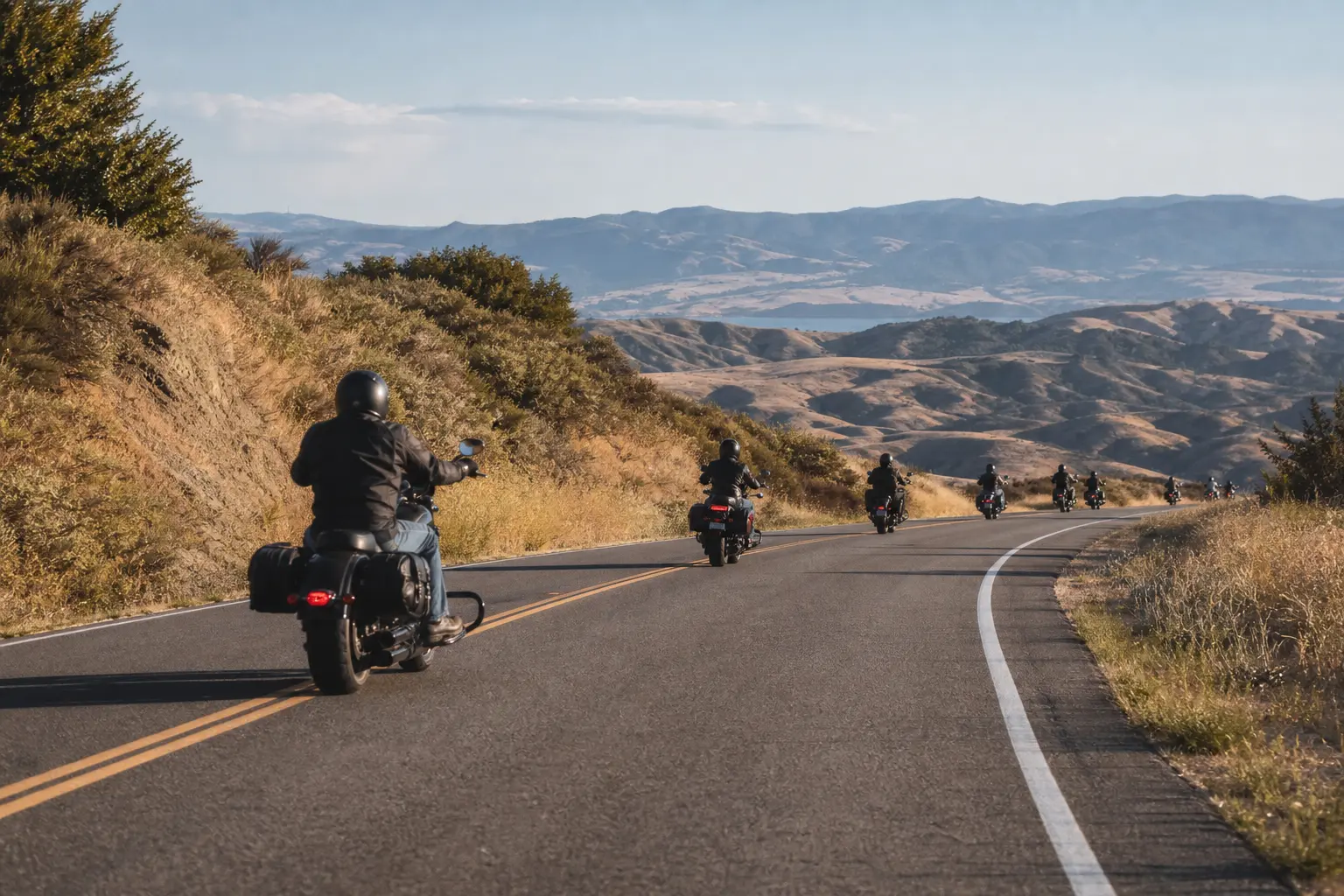
In group rides, riders may feel pressure to remain visually close, hold a formation through every change, or catch up immediately after a light or turn. Those goals should never override the individual rider’s ability to see, slow, and choose a safe path.
MSF’s group-riding guidance explains that staggered formation can provide space for riders to maneuver and react. It also says single-file formation with a minimum two-second following distance is preferred in curves, poor visibility, poor road conditions, highway entries and exits, and other situations that need more maneuvering room. The guidance also advises against riding side by side because it reduces the space available for a swerve. MSF’s Guide to Group Riding
The comparison is important:
- Staggered formation can work in suitable, predictable conditions when each rider still has enough room and a clear understanding of the formation.
- Single file is the more conservative choice when the road or visibility takes away options and every rider needs additional individual room.
Neither formation is a reason to ride closer than conditions allow. The rider ahead may brake, alter line, or encounter a hazard that is not yet visible to you. The rider offset in the other lane track is also part of your space calculation. Formation should support safety, not become a reason to ignore it.
If someone falls behind, the safer group plan is to slow or regroup rather than make that rider chase. MSF specifically advises separated riders not to panic or ride beyond their skills to catch up. MSF’s Guide to Group Riding
Common Errors When Judging Motorcycle Following Distance
Treating two seconds as a permanent target
A two-second count is a minimum reference in normal conditions, not a promise that all variables are covered. If the view is blocked or the pavement is uncertain, add distance before the situation becomes urgent.
Closing the gap to defend it from merging traffic
A smaller opening may not prevent a driver from moving in. It does make your response harder if they do. Preserve your safety margin, let traffic settle, and rebuild the gap.
Watching only the vehicle immediately ahead
The nearest brake lights often reveal the problem late. Look through the traffic flow for patterns that give you more time to respond smoothly.
Assuming a visible lane is an available escape path
Traffic beside you changes constantly. An option is only useful when it has been checked recently and the surface, vehicles, and road edge support it.
Following a large vehicle as though it is a guide
A tall vehicle may make route-following feel easier, but it can hide the events you most need to anticipate. More distance and a better view usually reduce uncertainty more effectively.
Letting group pace determine personal margin
If the group’s speed, spacing, or route conditions exceed your comfort or capability, create room and use the group’s regroup plan. A safe group does not require a rider to erase their own cushion.
How Vojo Helps
Before a commute, weekend ride, or group departure, create a route note in Vojo’s Motorcycle Ride App that records the conditions most likely to affect your following margin: rain risk, highway merging, tall commercial traffic, night riding, passengers, or cargo. Add one concrete reminder, such as “increase gap behind vehicles that block the road view.” At a planned stop, log any pattern that repeatedly reduced your cushion—glare on a particular road, heavy lane changes near an interchange, or a wet shaded section. After several rides, review those notes before choosing departure time, route, or pace so you can plan a bigger margin before traffic forces the decision.
Download Vojo on the App Store
Make Following Distance Part of Overall Ride Readiness
Following distance is more reliable when the rider and motorcycle are both ready for the trip. Use your owner’s manual for the model-specific inspection items and operating limits that apply to your motorcycle. Then keep the broader planning side organized with the Motorcycle Maintenance Guide.
A clear visor, appropriate tire condition and pressure, working lights, secure cargo, realistic route expectations, and a rested rider all support the same safety goal: preserving usable time when the roadway becomes less predictable.
The habit to take away is simple. When your view narrows, grip becomes uncertain, traffic begins to compress, or your workload rises, make the space in front of you larger early. That space is not wasted pavement. It is time to recognize trouble, time to choose calmly, and room to avoid being locked into someone else’s mistake.
Quick answers
Frequently asked questions
How many seconds should a motorcycle follow behind a car?
Use the MSF two-second minimum as a baseline in clear, predictable conditions. Increase the gap when pavement is slippery, the vehicle ahead blocks your view, or traffic may move into your space. If you still cannot see enough road or identify a workable response path, add more distance and reduce speed.
Is three seconds enough for motorcycle following distance?
Sometimes, but it is not a universal answer. Three seconds or more is a sensible increase when visibility, traction, traffic flow, or available maneuvering room worsens. Continue enlarging the gap if the road picture still feels restricted or the situation remains unpredictable.
Should I leave more space behind trucks, vans, and SUVs?
Often yes. Taller vehicles can hide brake lights, traffic queues, debris, surface changes, and lane closures farther ahead. More space can improve your view and provide more time if the vehicle slows suddenly.
How should following distance change in rain?
Increase it beyond the ordinary minimum before you reach low-grip sections. MSF identifies slippery pavement as a reason to enlarge your space cushion. Pair the wider gap with reduced speed and smooth control inputs rather than waiting for traffic to brake.
How much space should motorcycles leave in a group ride?
MSF says staggered formation can create a proper space cushion in suitable conditions. It prefers single file with a minimum two-second following distance on curvy roads, in poor visibility, on poor road surfaces, and when entering or leaving highways. Each rider still needs their own sightline and room to react.
Why should a motorcyclist leave room ahead at a stoplight?
A forward buffer can provide room to move if traffic behind approaches too quickly and can help if the vehicle ahead reverses or rolls back. Continue using mirrors and reading traffic while coming to a stop rather than assuming a stopped queue is risk-free.