
Motorcycle Group Riding: Make a No-Pressure Plan That Keeps Slower Riders From Chasing
Use motorcycle group riding rules to set pace, formation, regroup points, and communication so nobody feels pushed to ride beyond their limits.
Fact-checked against cited official documentation
Reviewed against Fact-checked against MSF group-riding guidance and its Motorcycle Operator Manual for rider meetings, roles, route planning, formation, spacing, and regrouping principles..
Last updated September 29, 2026
Motorcycle group riding rules start with permission to ride your own ride
A good motorcycle group ride is not a rolling test of confidence, corner speed, navigation skill, or endurance. It is a shared trip in which every rider can make safe decisions without worrying that one missed light, one cautious corner entry, or one fuel stop will leave them stranded behind the group.
That is the central rule: the group’s plan must work when riders become separated. If the plan only works when everyone maintains the leader’s pace, it quietly turns every gap into pressure. The slower or less-experienced rider then has a bad choice: hurry, make a risky pass, run a light, or get lost. None is an acceptable operating system for a social ride.
Motorcycle Safety Foundation guidance supports a different model: hold a riders’ meeting, make the route and stops clear, assign lead and sweep riders, observe riders behind, and use an agreed regroup process rather than expecting someone to race back into position. It also directs riders not to exceed their skills merely to catch up. (msf-usa.org)
This article turns those principles into a practical, no-pressure plan. It is intended for road-legal motorcycles on public roads, from a small ride with friends to an informal club outing. It is not a substitute for your state’s traffic laws, formal rider training, or the instructions in your specific motorcycle’s owner’s manual. Before departure, use the manufacturer’s requirements for tire condition and inflation, load limits, passenger use, warning indicators, and any model-specific pre-ride checks. If a motorcycle has a safety-related concern, the rider should resolve it before joining rather than treating the group as roadside support.
The objective is not to keep a perfectly shaped formation at all times. The objective is to create enough clarity, space, and flexibility that each person can ride attentively and within personal limits.
The no-pressure principle
A no-pressure plan replaces the vague instruction to “keep up” with several specific promises:
- No rider has to break a law to stay with the group.
- No rider has to ride faster than their sight line, grip, comfort, training, or motorcycle allows.
- A missed turn or traffic separation triggers the plan, not panic.
- The group adjusts to the rider with the least available margin that day.
- Anyone may opt out, stop, or take a different route without embarrassment.
These promises matter because group behavior affects individual judgment. A rider may be fully capable of making a conservative decision alone but override it when they think a dozen people are waiting. The ride leader cannot see every rider’s fatigue, unfamiliarity with a road, tire concern, passenger distraction, or changing comfort level. A stated permission structure makes it easier for that rider to choose the safer option early.
The MSF Motorcycle Operator Manual frames group riding around preparation, route knowledge, lead and sweep roles, avoiding competition, avoiding passing other riders, and keeping an eye on the person behind. It specifically places inexperienced riders near the front, behind the leader, so they are not expected to chase the group. (msf-usa.org)
That does not mean labeling someone as “slow” in a way that makes them self-conscious. It means matching the ride’s design to real conditions. A rider can be experienced but new to mountain roads, be carrying a passenger, be on an unfamiliar motorcycle, be returning after time away, or simply be having an off day. Group position should be a planning tool, not a status ranking.
Replace pace hierarchy with route certainty
The most powerful way to remove pressure is to make the next destination obvious. Share the route before kickstands go up. Identify planned fuel, rest, meal, and final stops. If navigation technology is available, encourage every rider to load the route independently—but do not assume every phone, headset, mount, battery, or data connection will work all day.
Then add a simple fallback: if separated, continue safely to the next named regroup point unless the briefing says otherwise. The wording is important. “Continue safely” means obeying traffic controls, selecting a lawful route, and stopping when a rider needs to stop. It does not mean blindly following a screen through a closed road or riding past fuel, weather, mechanical, or health concerns.
A route card can be remarkably useful even when everyone uses navigation. It can be a short note in a phone: start location, major road changes, fuel stops, lunch stop, final destination, leader contact, sweep contact, and the separation rule. Its value is not sophistication. Its value is that nobody has to invent a plan while stressed at a busy intersection.
Build the ride around the least forgiving condition
“Ride to the least-experienced rider” can sound like a fixed judgment about skill. A better planning question is: what is the least forgiving condition likely to be present today?
The answer might be a newer rider. It might also be a rider with a passenger, a hot afternoon, unfamiliar pavement, a route with dense urban intersections, reduced visibility, a long gap between fuel stops, or a rider managing an older injury. Build the pace, duration, and break pattern around that constraint.
A group that wants a more demanding ride has options that do not require pressuring anyone:
- Split into smaller groups with separate lead and sweep riders.
- Offer a shorter, simpler route and an advanced route that converge at a meal or destination.
- Set an early decision point where riders can choose a relaxed or more technical section.
- Make the destination social, rather than insisting every person rides every mile.
- Plan a return route that is straightforward enough for a rider to leave independently.
MSF recommends keeping groups manageable—ideally five to seven riders—and dividing a larger gathering into smaller groups with their own lead and sweep riders. That reduces the communication and spacing burden while making it easier to notice when someone needs assistance or a slower pace. (msf-usa.org)
A practical role map
| Role | Primary job | What the role should not become | Useful briefing question |
|---|---|---|---|
| Lead rider | Navigate, read conditions ahead, communicate early, preserve a manageable pace | A pace-setter trying to prove speed or “drop” riders | “Where is our next confirmed regroup point?” |
| Sweep rider | Remain last, monitor the group, assist with a planned stop or separation response | A substitute mechanic, medic, or rider expected to solve every problem alone | “How will you tell the lead that the group has changed?” |
| Rider behind lead | Sets the practical comfort reference near the front and receives early navigation cues | A person expected to lead if they do not want that responsibility | “Are you comfortable with this route and the planned stops?” |
| Every rider | Ride independently, maintain personal space, communicate needs, know the next stop | A follower required to mimic another rider’s line, pace, or decisions | “If we split at a light, what is your plan?” |
The sweep is not there to make a slow rider feel watched. The sweep exists so the entire group has situational awareness. Likewise, the lead is not responsible for making traffic cooperate. The lead’s real responsibility is to choose a pace and plan that anticipate ordinary disruptions.
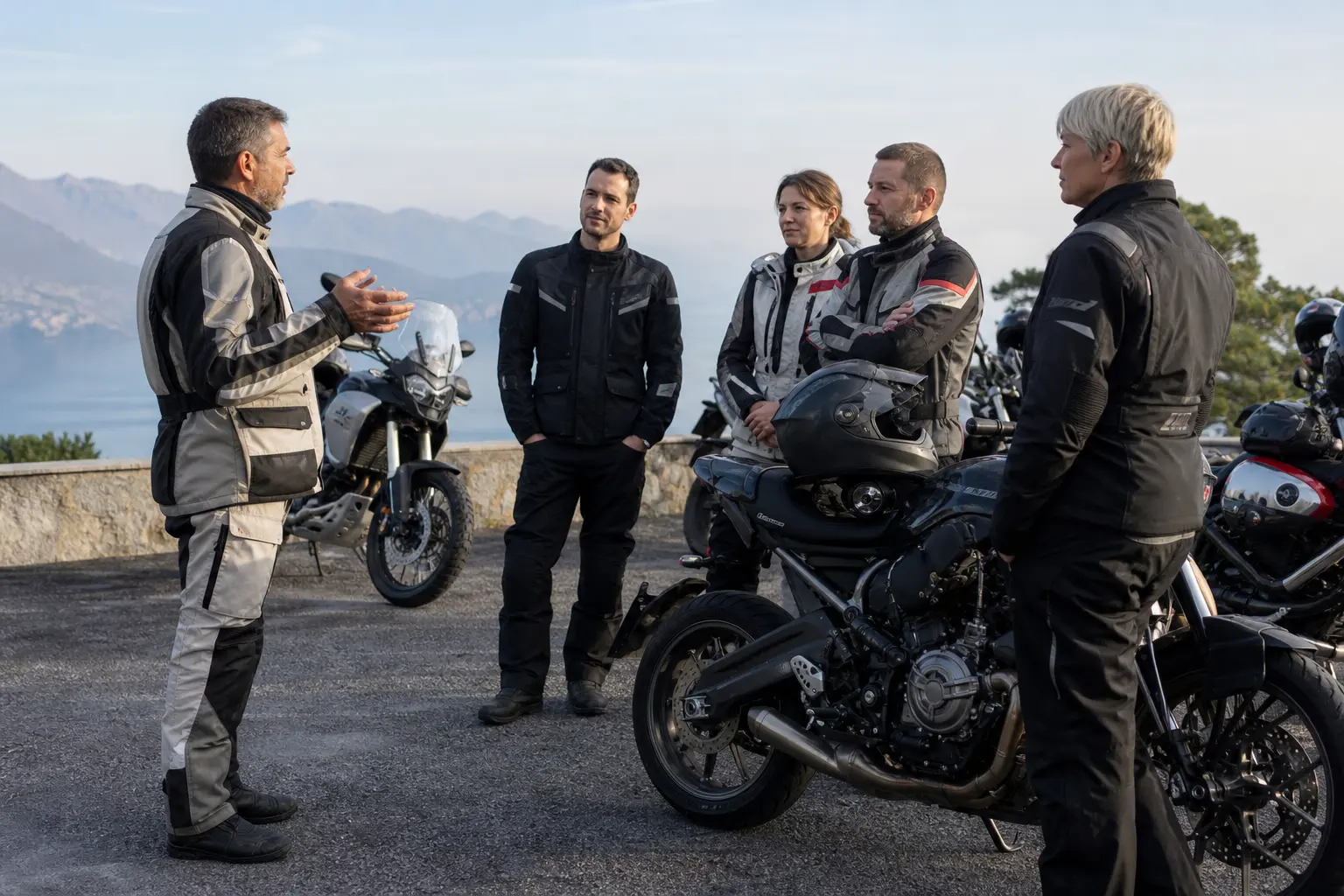
Hold a riders’ meeting that riders can actually remember
A riders’ meeting should be brief enough that people pay attention and specific enough to prevent improvisation. It is not a speech about how experienced the organizer is. It is a decision-making agreement.
MSF advises discussing the route, rest and fuel stops, hand signals, and lead and sweep roles before the ride. Its operator manual also emphasizes making sure everyone knows the route so a separated rider does not feel compelled to hurry to avoid getting lost. (msf-usa.org)
Use plain language. Ask riders to confirm the plan rather than merely nod. For a recurring group, repeat the essentials every time; a familiar group can still have a new rider, passenger, route, road condition, or weather concern.
No-Pressure Group Ride Checklist
Before riders leave the meeting point:
- State the ride’s purpose: relaxed scenic loop, commute-style transfer, destination ride, or training-oriented outing.
- Name the lead rider and sweep rider for each subgroup.
- State the next fuel stop, first rest stop, and final destination.
- Tell every rider how to access the route independently, plus the backup route-card plan.
- Say the separation rule out loud: if traffic divides the group, ride lawfully and safely to the next agreed regroup point.
- Confirm that nobody should chase, pass within the group, tailgate, run lights, or make risky maneuvers to rejoin.
- Identify the formation expectation and when it changes to single file.
- Review only the hand signals or communication cues the group genuinely plans to use.
- Invite private concerns: fuel range, passenger needs, time limits, weather gear, unfamiliar roads, or a desire for a slower subgroup.
- Make the opt-out rule explicit: anyone may leave, stop, or take the direct route home after notifying the group when safely able.
- Ask every rider to do their own pre-ride check according to the owner’s manual and to speak up before departure if the motorcycle is not ready.
- Confirm a plan for urgent mechanical or medical problems: stop safely, contact emergency services when needed, and avoid creating additional roadside risk.
A checklist does not make a ride rigid. It makes the safety-critical choices before engines, noise, traffic, and social momentum make those choices harder.
Keep the briefing honest about ability and readiness
The best question is not “Who is the newest rider?” It is “What would make this ride uncomfortable or unsuitable for you today?” That wording leaves room for useful answers. Someone may not want to publicly announce that their visor fogs, their passenger is new, their motorcycle has short fuel range, they have not ridden at night recently, or they need to be home by a particular time.
Leaders can invite a private response before the meeting or a quick check-in while riders are gearing up. The important part is to act on what you learn. If the schedule is too long, reduce it. If a rider is unsure about freeway travel, provide an alternate meeting route. If weather has changed the day’s risk, shorten or postpone the ride. A group plan is successful when it adapts before the road forces the issue.
Use formation as space management, not group identity
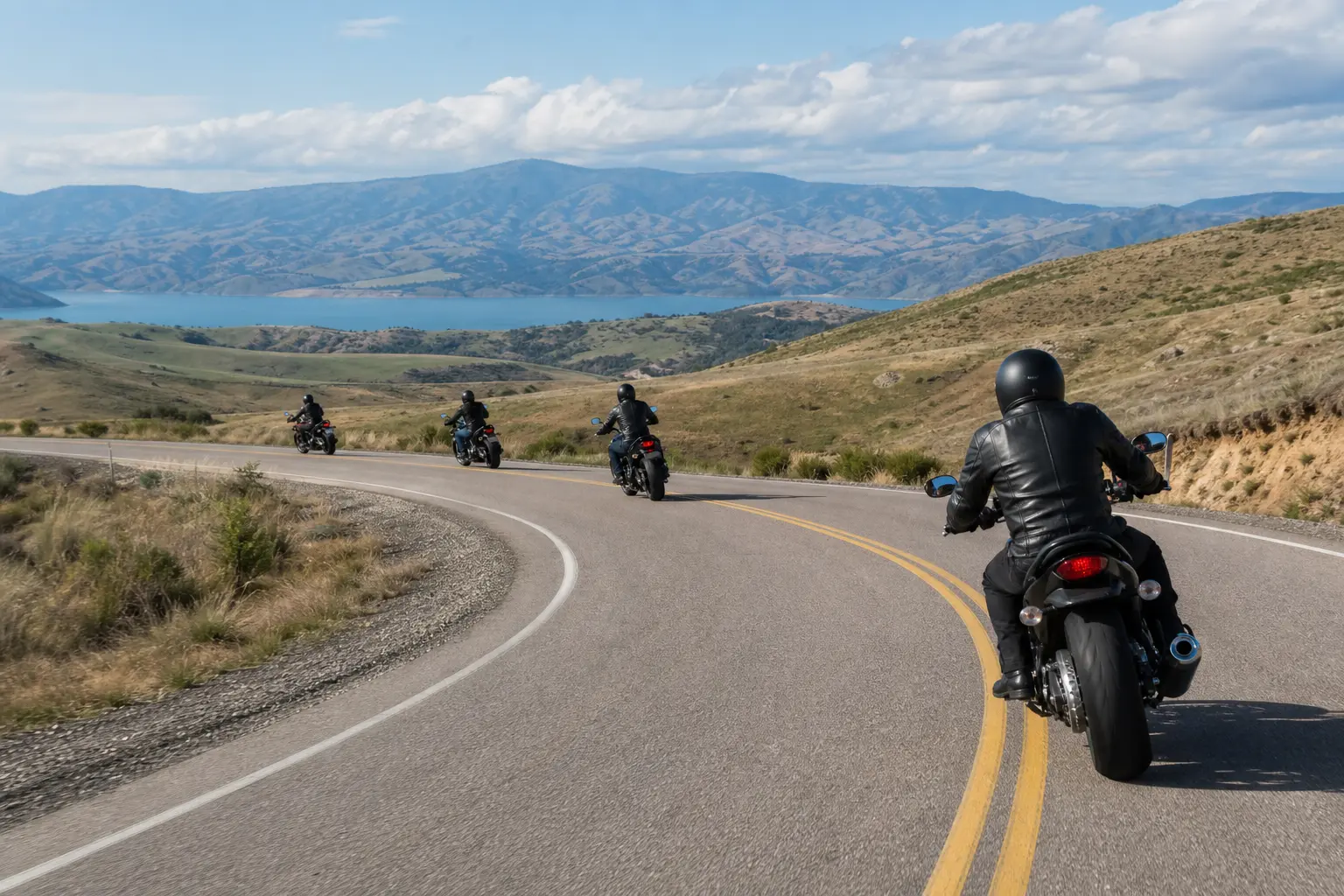
Formation is not about looking organized in photos. It is a way to preserve maneuvering room and visibility while traveling together.
MSF describes a staggered arrangement in which the lead occupies one side of the lane and the next rider follows in the other lane position with a time gap. It advises against riding side-by-side because that reduces room to maneuver. MSF also advises single file, with greater spacing, where curves, visibility, surface conditions, highway transitions, or other conditions call for more space. (msf-usa.org)
The operational idea is simple: each rider needs a usable space cushion and must remain free to respond to the road independently. A staggered arrangement is not an instruction to crowd together, nor does it give anyone ownership of an entire lane. Every rider still needs to choose lane position for sight lines, surface hazards, traffic, wind, and their own safe route through a situation.
When to change the plan before the road makes you change it
Move to a more conservative arrangement early when the route becomes less predictable. Examples include:
- Curves that limit what riders can see ahead.
- Wet, dirty, uneven, or otherwise questionable pavement.
- A work zone, narrow lane, bridge surface, or complex merge.
- Dense traffic where vehicles may enter gaps.
- A rider who needs additional room to process the situation.
- An intersection sequence where the group could easily be split.
Do not wait until a rider is already uncomfortable. The leader can signal or communicate the change, but every rider retains responsibility for spacing and lane position. If the formation becomes ragged because conditions demand it, that is not a failure. It is the group responding to conditions.
Do not create passing problems inside the group
A predictable group is easier to manage than one in which positions constantly change. The MSF operator manual lists no competition, no passing other riders, and no tailgating among its most important group-riding rules. (msf-usa.org)
That does not mean a rider is trapped behind a pace that is clearly unsuitable. It means solve the mismatch at a stop. A faster rider can move to a different subgroup, depart for a prearranged destination, or lead another group under an agreed plan. Trying to rearrange the order dynamically on public roads adds decisions, closing speeds, blind spots, and uncertainty when riders should be focused on traffic and surfaces.
Make regrouping automatic, not emotional

A separation is ordinary. Red lights change, traffic fills gaps, turns are missed, a rider stops for fuel, and a rider may decide that the conditions no longer work for them. The problem begins when the group treats any separation as an emergency or personal failure.
MSF’s guidance is direct: if a rider falls behind, the group should slow so the group can remain together; if a rider becomes separated, the group should have a preplanned way to regroup, and the rider should not break the law or exceed personal skills to catch up. (msf-usa.org)
Here is a durable regroup framework:
- Notice the gap. Riders use mirrors when conditions allow to notice whether the rider behind is still present. This is awareness, not a reason to stare in mirrors while approaching hazards.
- Avoid an abrupt response. Do not brake sharply or stop in an unsafe location just because the group has stretched out.
- Continue to the named safe regroup point. The lead does not make an unannounced, difficult U-turn or pull over where the group cannot safely fit.
- Confirm the situation. At the regroup point, use the communication plan to learn whether the rider is safely proceeding, stopped voluntarily, needs assistance, or has chosen another route.
- Adjust the next segment. If the separation resulted from pace, route complexity, fatigue, or changing conditions, alter the plan rather than repeating the same setup.
The key is that riders must know which regroup point is next. “We will stop somewhere up ahead” is not a plan. “If separated before the overlook, continue to the gas station at Route 8 and Pine” is a plan.
The corner-marker trap
Some groups use a rider to wait at a turn and point the following rider in the correct direction. This can appear helpful, but it also creates ambiguity: Does the marker wait until the sweep arrives? What happens if the marker is missed? Does the marker pull out hurriedly to catch the group? Can the marker wait safely at that location?
For a casual ride, a route shared to each rider and fixed regroup points are usually clearer. If a group deliberately uses corner marking, it needs an explicit procedure, safe locations, a sweep confirmation method, and a clear instruction that nobody leaves a safe waiting point until the process says they may. Do not invent the method mid-ride.
Plan for intersections, highways, and stops without compressing safety margins
Intersections are where a tightly connected group often comes apart. That is normal. A traffic signal is not an invitation to accelerate through yellow or follow another motorcycle into an unsafe gap. MSF advises that when part of a group does not clear an intersection, riders should stop at a safe location ahead and wait rather than creating pressure to speed up or run a red light. (msf-usa.org)
The leader can reduce the likelihood of a split by avoiding needlessly complex routing, signaling and communicating early, and naming a regroup point after busy junctions. Riders can help by avoiding last-second lane changes or assuming the person ahead has seen the same sign or hazard.
Highway entry and exit deserve the same humility. The group may need to stretch out, merge one rider at a time, and reform only when traffic and space permit. On exits, the group may need to become single file early. There is no prize for preserving a visual pattern through a difficult ramp or dense interchange.
At fuel and meal stops, prevent a different kind of pressure: the hurried restart. Make the departure time clear, but treat it as a checkpoint, not a command to skip water, gear adjustment, a restroom stop, or a needed conversation. Before rolling, the lead should restate the next destination and ask whether everyone is ready. The group should depart in an orderly manner rather than forcing several motorcycles into traffic simultaneously.
Manufacturer-first readiness before joining the ride
Group structure cannot compensate for a motorcycle that is not ready to be ridden. Every rider should follow the inspection and maintenance guidance for the exact motorcycle, including any requirements that change with passenger or cargo use. MSF emphasizes that the owner’s manual is the primary source for inspection and maintenance information and advises a pre-ride check before every ride. (msf-usa.org)
For the organizer, the right boundary is clear: encourage preparation, but do not diagnose another rider’s bike in the parking lot or pressure them to continue with an unresolved concern. If a warning light, braking concern, tire issue, loose luggage, control problem, leak, or other safety-related uncertainty arises, the rider should make a conservative decision and consult the model-specific manual or a qualified service professional as appropriate.
This is also why load and passenger conversations matter. Extra mass and luggage can change how a motorcycle behaves, and the manufacturer’s guidance controls for load limits, approved passenger accommodations, pressures, and adjustments. A group should not assume that every motorcycle is equipped or configured for the same trip. For broader preparation habits, see the Motorcycle Maintenance Guide.
How Vojo Helps
Use Vojo to turn the pre-ride conversation into a repeatable workflow instead of rebuilding the plan from memory. Create the ride in the app, add the route’s fuel, rest, and regroup points as notes, then record a short rider briefing checklist: lead, sweep, next destination, separation rule, and any planned subgroup split. Before departure, each rider can log their own readiness items and service context in the motorcycle maintenance tracker, while the organizer keeps the day’s plan in one place for the next stop.
After the ride, save what changed: a fuel stop that arrived too late, a regroup point that was hard to find, a road segment that warranted single file, or a break schedule that better matched the group. Over time, that creates a practical record of routes and ride formats that fit the people who actually attend—not an imaginary group that never gets separated.
Download Vojo on the App Store
A leader’s script for a calm departure
A script prevents the leader from forgetting the most important message when everyone is ready to leave. It can be as short as this:
“Today is a no-pressure ride. The next confirmed stop is the fuel station on Oak Road, then lunch at the lake. If a light separates us, do not chase or take risks—ride safely to the next stop. We have a lead and sweep. Ride your own ride, leave space, and tell us if you need fuel, a break, or a different plan. Curves, poor surfaces, and ramps mean single file. Nobody needs to prove anything today.”
Adapt the words to the group, but preserve the commitments. The script says that separation is expected, that caution is respected, and that there is a known destination beyond the next motorcycle’s taillight.
The standard to use after every group ride
Do not judge the day only by whether everyone arrived at the destination. Ask better questions:
- Did every rider know where to go when visual contact was lost?
- Did anyone feel hurried at a light, corner, merge, or fuel stop?
- Did the pace leave room for changing road or weather conditions?
- Did the lead and sweep have enough information to do their roles?
- Did the group alter formation when conditions called for more space?
- Could a rider leave or slow down without feeling like they had failed the group?
If the answer to any of those is no, the fix is usually not “tell riders to be better.” The fix is a clearer route, a smaller group, more frequent regroup points, more realistic timing, a different subgroup, or a more candid briefing.
The best group ride does not feel like being pulled along. It feels like riding with people who have made room for sound judgment. When the plan makes it safe to be separated, the group can stay connected without making anyone chase.
Quick answers
Frequently asked questions
What are the most important motorcycle group riding rules?
The essentials are to hold a pre-ride meeting, know the route and regroup points, assign lead and sweep riders, avoid competition, avoid passing other riders within the group, preserve following space, and never pressure someone to chase after a separation. Ride lawfully and within personal limits.
Where should a less-experienced rider ride in a motorcycle group?
A practical default is just behind the lead rider, with the sweep remaining at the back. This gives the rider early route cues and reduces the chance that they will feel obliged to chase a faster-moving group. Position should be based on the day’s needs, not treated as a label.
Should motorcycles ride side-by-side in one lane?
No. Side-by-side riding reduces the room each rider has to maneuver around a hazard. A staggered arrangement may be useful where conditions support it, while single file is the more conservative choice for curves, limited visibility, poor surfaces, highway transitions, and other situations that need additional space.
What should happen when a group gets split at a red light?
The separated riders should obey the signal and continue safely to the next agreed regroup point. The riders ahead should continue to a safe planned location and wait or make contact according to the briefing. Nobody should speed up, run a light, or take a risky route to reconnect.
How large should a motorcycle riding group be?
Smaller groups are easier to manage. MSF identifies five to seven riders as an ideal manageable size and recommends breaking a larger gathering into smaller groups, each with a lead and sweep rider. Actual size should also reflect route complexity, weather, traffic, and the riders’ experience.