
Motorcycle Curve Planning: Use Search, Setup, and Smooth Inputs on Multiple Bends
Build a calmer plan for linked motorcycle bends with search, setup, and smooth inputs that protect visibility, space, and options.
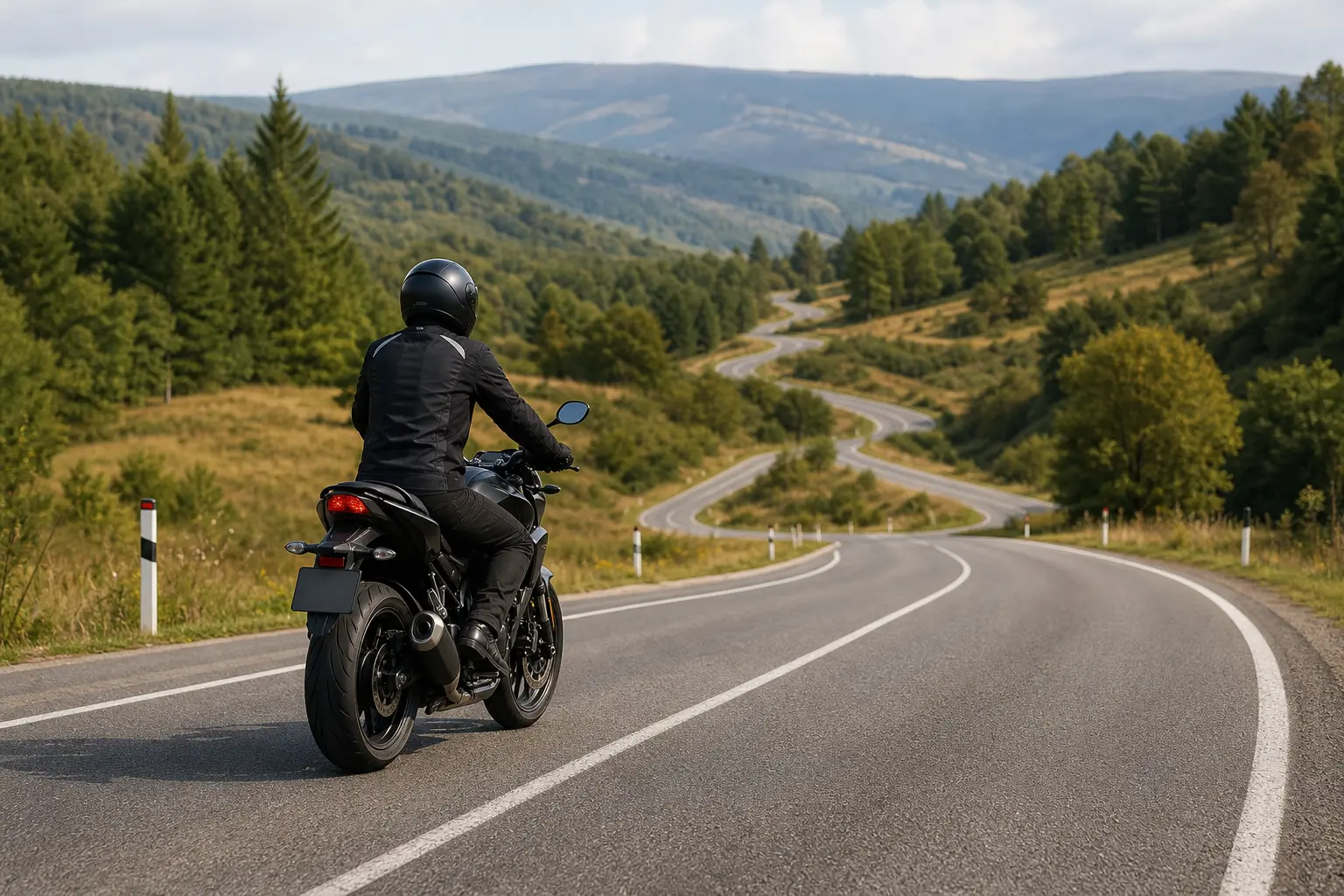
Fact-checked against cited official documentation
Reviewed against Fact-checked against MSF’s SEE strategy, Basic RiderCourse topics covering curve judgment and multiple curves, and MSF’s advanced rider-training overview..
Last updated November 3, 2026
Several bends joined together ask more of a rider than a single corner. The road can hide its next direction, alter the available view midway through the first turn, or present a different surface just as attention moves to the next one. A rider can make a reasonable decision for bend one and still be poorly positioned—mentally or physically—for bend two.
That is why motorcycle search setup smooth strategy multiple curves is best treated as a continuous decision cycle, not as a formula for a preferred line or a target pace. First, gather useful information. Next, decide what that information means for your available space and time. Then make calm, purposeful inputs while continuing to update the plan.
The Motorcycle Safety Foundation describes SEE as Search, Evaluate, Execute: a strategy for noticing hazards, weighing risk, and responding deliberately (Why it Helps to SEE). MSF’s Basic RiderCourse also includes curve judgment, multiple curves, safety margins, and a search-setup-smooth approach in its rider-development curriculum (Basic RiderCourse).
This article applies those broad principles to ordinary public-road travel. It is not a substitute for your motorcycle’s owner’s manual, road rules, or hands-on instruction. When visibility, weather, traffic, fatigue, or confidence reduces your margin, the manufacturer-first choice is to slow your plan down, take a safe stop, alter the route, or postpone the ride.
Motorcycle Search Setup Smooth Strategy for Multiple Curves
The useful distinction between a single curve and a linked sequence is that the rider must protect capacity for the road that has not yet appeared. The immediate bend matters, but it is only the first part of a larger problem.
Imagine a road that turns one way, briefly straightens, then changes direction behind trees. The opening curve may look generous, while the second one may have less view, a narrower lane, a different grade, or traffic emerging from a driveway. Planning only for the first visible arc leaves little time to reassess when the second situation develops.
A better framework has three parts:
- Search: Look for meaningful information in the present lane, through the visible bend, and beyond its exit.
- Setup: Choose a pace, road position, following space, and attention level that remain workable if the picture changes.
- Smooth: Avoid rushed decisions and let each input support a revised plan rather than force the road to match the original assumption.
These ideas do not promise certainty. A blind section remains blind, and a clear-looking road can still contain contamination, an oncoming vehicle, an animal, or a stopped vehicle. Their value is that they make uncertainty part of the plan before it becomes a surprise.
For linked curves, think in rolling horizons. The first horizon is the pavement you will reach shortly. The second is the furthest road you can currently see. The third is the uncertainty beyond that view. A conservative rider does not fill the unseen horizon with optimism; the rider leaves enough time and room for it to contain something unexpected.
Search: Build the Picture Beyond the First Bend
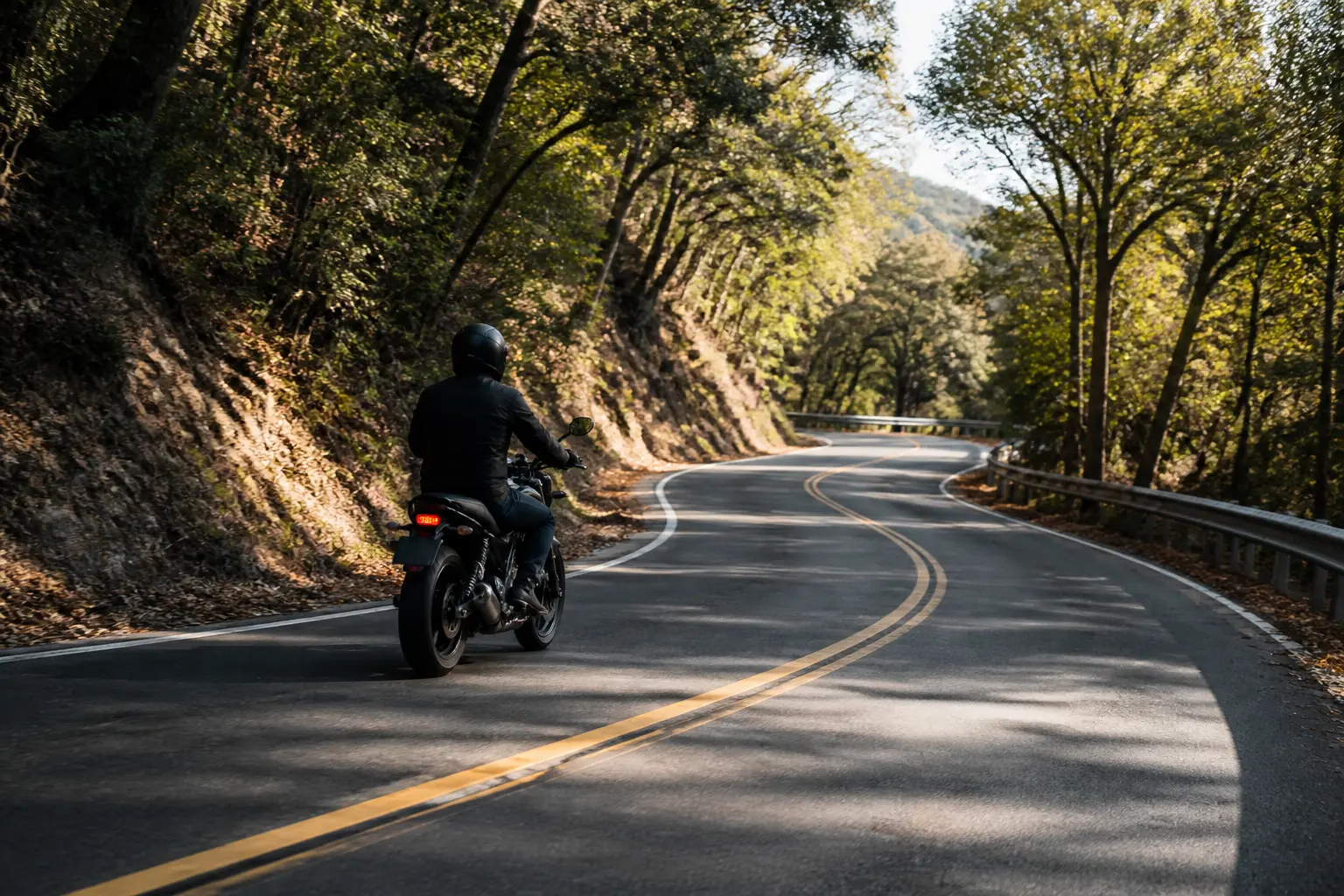
Searching is active. It is not simply aiming your eyes farther down the road. It means looking for information that could change the decision you are about to make.
Before a sequence begins, notice the visible road shape and the surroundings that may affect it. A crest, tree line, wall, guardrail, building, parked vehicle, or strong shadow can reduce what is knowable. Changes in light can make surface detail harder to read. A junction, farm entrance, trailhead, or residential access can introduce crossing traffic even where the road appears quiet.
Roadside clues may help you form questions. The movement of vehicles ahead, the direction of barriers, and the roadway visible in the distance can suggest where the route continues. But none is proof of curve radius, pavement condition, or lane availability. Treat every clue as evidence to evaluate—not permission to commit to more speed.
A useful visual routine is to move attention deliberately among several areas:
- the current travel path and lane boundaries;
- the furthest visible section of roadway;
- the transition where one bend appears to lead to another;
- surface changes such as repairs, leaf cover, standing water, gravel, or shade;
- traffic, vulnerable road users, driveways, intersections, and roadside activity.
Your mirrors remain useful, particularly before a change that may affect following traffic, but they should not displace attention from the road immediately ahead. The point is not to perform a rigid eye sequence. It is to avoid locking onto a single point while the situation is evolving.
Search for what is missing, too
Missing information is information. If the road disappears behind a hedge or over a rise, the correct conclusion is not that the space is clear. It is that you do not yet know whether it is clear. That distinction matters because it changes the amount of margin your plan needs.
Ask a simple question as the first bend approaches: What would invalidate my present plan? The answer could be a tighter continuation, a wet section in shade, a vehicle over the centerline, debris, a cyclist, a side-road entrant, or fatigue that makes your reactions feel less measured. Naming possible changes does not create danger; it keeps them from arriving as unexamined surprises.
Search also includes the rider. Cold, stress, distraction, unfamiliar luggage, pressure from friends, and an ambitious arrival time can narrow the practical margin available on any road. If your mind is occupied by something other than the next decision, the route may need a break before your motorcycle needs one.
Setup: Preserve Time, Lane Space, and Choice
Setup happens before the first curve demands a response. It is the portion of the process where a rider creates options rather than trying to recover them later.
There is no one correct pace for a series of bends. Road design, visibility, weather, traffic, load, tire condition, rider experience, and the particular motorcycle all matter. Local requirements and your manufacturer’s guidance remain the authority for the motorcycle and its operation. From a planning perspective, the useful standard is straightforward: choose a pace that lets you respond to the road you can see while leaving a reserve for the road you cannot.
A sound setup usually feels unremarkable. You are not depending on the next few seconds going perfectly. You are not arriving at the bend with a need to make a hurried choice. You have space from lane boundaries and hazards, and you can still notice what appears after the opening curve.
Lane position should be selected conservatively and legally within your lane. It can influence sight distance, but no position is automatically best. A choice that improves one view may reduce clearance from an oncoming vehicle, the road edge, a barrier, loose material, or pavement damage. Avoid treating either the centerline or edge as a destination. The better choice is the one that supports your current view while retaining usable room for uncertainty.
Following traffic deserves its own decision. A close vehicle can make a rider feel compelled to continue faster than the available view supports. That pressure does not improve the road or your margin. If conditions allow, create separation through a safe, lawful opportunity. Do not turn linked curves into a contest to prevent someone from catching up.
For group rides, this matters even more. One rider’s confidence, motorcycle, load, and risk tolerance do not define the right plan for everyone. Agree in advance that riders can take their own pace and regroup later. A no-pressure plan is much safer than asking a less comfortable rider to chase a disappearing tail light.
Setup questions before commitment
| What to assess | Conservative planning response | Benefit to the next bend |
|---|---|---|
| Limited sight distance | Treat unseen pavement as an active unknown | Reduces reliance on last-second decisions |
| Different light or surface texture | Lower the demand on the plan and keep more reserve | Allows time to reassess changing conditions |
| Traffic near the centerline or roadside | Retain extra lane room and avoid being rushed | Protects space when other road users behave unpredictably |
| A quick transition to another bend | Plan beyond the first visible arc | Keeps attention available for the sequence |
| Tailgating or group pressure | Separate safely rather than matching the pressure | Prevents another person from choosing your pace |
| Doubt about motorcycle readiness | Follow the owner’s manual or seek qualified help | Keeps model-specific concerns with the manufacturer or technician |
Motorcycle condition supports every ride decision. Before departure, use the manufacturer’s inspection and operating instructions for your model, including any warnings, loading limits, and maintenance requirements. Do not substitute a generic online interval for the manual. For organizing service records and reminders, see the Motorcycle Maintenance Guide, while keeping manufacturer documentation as the governing source.
Smooth: Keep the Plan Adaptable
Smooth inputs are not a performance objective. They are a way of keeping the motorcycle and the rider’s attention aligned with a sensible plan. The aim is not to make every bend feel identical or to carry momentum through uncertainty. The aim is to avoid adding abruptness when the road has already reduced your options.
In a sequence of curves, an early overcommitment can create pressure later. If the first bend receives all the attention, the next bend may appear with too little room for a calm reevaluation. A rider who enters with reserve can make smaller, more considered adjustments as new information becomes available.
Use these principles as decision reminders:
- Make the broad pace decision while the available view is still useful.
- Let changes in visibility, traffic, grade, or surface trigger a fresh evaluation.
- Keep looking toward useful roadway information instead of staring at one hazard.
- Leave a buffer from lane boundaries rather than relying on exact placement.
- Do not mistake familiar curves for guaranteed conditions.
If the road no longer resembles the plan, protect margin first. The sensible outcome may be a controlled reduction in demand, a safe stop, greater following space, or a different route. The correct physical response varies with the rider’s training, motorcycle, road, and conditions, so this guide does not prescribe an exact control procedure.
The space between curves is especially valuable. Even a short straight or open section can become a reset point: update the view, notice whether traffic changed, and decide whether the next bend deserves a more conservative approach. It is not automatically an invitation to accelerate.
MSF offers additional rider-training pathways for those who want structured development beyond foundational instruction (Advance Your Ride). Training is the appropriate place to receive feedback on braking, cornering, vision, and decision-making under supervised conditions. Public roads should not become a personal testing ground.
A Rolling Plan for Linked Motorcycle Bends

A repeatable routine is useful because it gives you something to return to when the route becomes busy or unfamiliar. The following is a planning framework, not a substitute for formal training.
Before the visible sequence
Start with the largest available picture. How many bends can you see? Does the road climb, descend, narrow, or enter shade? Are there warning signs, turnouts, driveways, junctions, parked vehicles, or signs of outdoor activity? Is another road user likely to appear from behind the visual obstruction?
Then evaluate whether your current pace is compatible with that picture. If the answer relies on an assumption such as “the next one is probably similar,” reduce the assumption rather than increasing the commitment. A good setup accepts that the road may become more difficult after the first bend.
During the opening bend
Keep the first curve in context. Continue gathering information where visibility permits, but do not abandon awareness of your immediate path. Notice whether the road opens, tightens, changes grade, or leads directly into a transition. Observe the surface and the behavior of other road users.
The main question is not whether the first bend has gone well. It is whether you still have choices for the road that follows. If the view narrows, the safer plan becomes more patient. If the surface looks less predictable, the plan should demand less from the motorcycle and rider.
At the transition
Treat the point where one curve reveals another as a new decision point. Ask yourself:
- What can I now see that I could not see before?
- Has the next bend changed direction, apparent tightness, or sight distance?
- Has the road surface, lighting, width, or grade changed?
- Are there vehicles, cyclists, pedestrians, animals, or access points ahead?
- Do I still have enough space and time for the uncertainty that remains?
If the answers are incomplete, that is a reason for continued restraint. A transition does not require you to preserve the pace chosen for the earlier bend.
Through the remaining bends
Repeat the cycle: search, evaluate, execute. Each curve can reveal a new situation, so each should earn its own decision. Keep the entire sequence paced for the least visible or least predictable portion—not for the section that looked easiest at the start.
When the route becomes more demanding than anticipated, it is acceptable to abandon the original idea. Stop at an appropriate safe location, take a break, let traffic separate, or choose another road. The successful outcome is not completing a sequence at a planned pace; it is finishing with usable safety margin.
Checklist: Search, Setup, and Smooth Inputs for Multiple Curves
Use this checklist before departure, at a safe stop, or when reviewing a ride afterward. It is not intended to be read while actively riding.
Before the ride
- I checked conditions that may affect visibility, including weather, daylight, and route familiarity.
- I followed my motorcycle manufacturer’s pre-ride, loading, and operating guidance.
- My gear and eyewear support clear, comfortable attention for the expected conditions.
- I have enough time that I do not need to ride to an artificial deadline.
- I am rested and willing to stop if concentration drops.
- If riding with others, we have agreed on a regroup plan that does not pressure slower riders.
Before the first bend
- I identified the furthest visible roadway and the areas hidden from view.
- I checked for traffic, surface changes, driveways, junctions, animals, and roadside activity.
- My pace fits the view and conditions rather than my memory of the route.
- I retained lane space from both boundaries and obvious hazards.
- I am not letting a vehicle or rider behind me dictate my decision.
- I have mentally allowed for the next bend to be different from the first.
Between bends
- I updated my plan when the next section became visible.
- I noticed changes in light, surface, road width, grade, and traffic.
- I kept reserve for an unseen hazard rather than assuming the road is clear.
- I avoided treating a short opening as a reason to rush.
- I remain willing to slow the overall plan, stop safely, or take another route.
After the sequence
- I can identify one piece of information that helped my planning.
- I can identify any point where I felt hurried, surprised, or overcommitted.
- I will address any motorcycle concern through the owner’s manual or a qualified technician.
- If I found a recurring skill gap, I will seek structured training rather than practicing at my limits on public roads.
Common Errors That Shrink Your Margin
Giving all attention to bend one
A rider can become so focused on the first curve that the following road appears late. The correction is not to ignore the immediate path; it is to keep a broader information habit and avoid committing all available attention to one visual point.
Treating familiarity as proof
A road ridden last week is not automatically the same road today. Rain, leaves, construction, shadows, traffic patterns, and visibility can change. Familiarity should help you ask better questions, not excuse fewer questions.
Letting the rider ahead choose your pace
The rider in front may have different experience, load, tires, eyesight, goals, and tolerance for uncertainty. Ride from your own available view. If the group stretches out, use the agreed regroup point rather than making risky efforts to close a gap.
Confusing a better view with a guaranteed outcome
Improved sight distance is valuable, but it does not erase the risks of traffic, surface changes, or narrow road space. Use visibility to make a calmer decision, not to justify a more demanding one.
Continuing after attention has degraded
Curve planning depends on noticing change early. If fatigue, cold, stress, glare, or emotional pressure is reducing that ability, the next safe stop may be more useful than another mile. Conservative route decisions are an active riding skill.
When Formal Training Is the Better Tool
Reading can help organize your thinking, but it cannot observe your habits or offer immediate coaching. Formal instruction is especially valuable for new riders, riders returning after time away, people who feel consistently rushed by linked bends, or anyone uncertain about braking and cornering fundamentals.
Choose a program suited to your current experience and use a controlled setting for deliberate skill development. MSF’s course information provides an official starting point for exploring foundational and further rider education (Basic RiderCourse; Advance Your Ride).
A productive learning aim is not “go through curves faster.” It is “see the next decision sooner, keep more room for uncertainty, and feel less urgency when conditions change.” That aim applies whether you ride a short local route, a mountain road, or a long trip with unfamiliar terrain.
How Vojo Helps
Use Vojo to turn this advice into a practical before-and-after ride workflow. Before departure, create a ride entry and add a short note identifying sections likely to contain linked bends, expected weather changes, planned rest stops, and a personal reminder to reassess if visibility shrinks. Review your motorcycle’s recent records first so any unresolved concern is not lost among route notes.
After the ride, add a brief observation: where did changing light, traffic pressure, or a hidden transition alter the plan? Then attach a follow-up task if you noticed a possible motorcycle issue, rather than relying on memory. The Motorcycle Service History gives you one place to separate maintenance follow-up from riding lessons.
Use those records to improve preparation and judgment, never to measure risky pace. Download Vojo on the App Store
Quick answers
Frequently asked questions
What does search, setup, smooth mean on a motorcycle road with multiple curves?
Search means actively collecting information about the present bend, the road beyond it, traffic, surfaces, and hidden areas. Setup means choosing a conservative pace and lane space before commitment. Smooth means making measured decisions that can be adjusted when the next bend reveals something new.
How should I plan for a curve I cannot fully see?
Treat the hidden section as uncertain rather than assuming it is clear. Choose a plan that leaves time, space, and attention for a changed surface, traffic, a tighter continuation, or another hazard. If uncertainty increases, reduce the demand of the plan.
Should I use one lane position through every linked curve?
No. A legal, conservative lane position should reflect current visibility, road edges, traffic, surface conditions, and available clearance. Do not treat the centerline or road edge as a target. Reassess when the road and view change.
What if another rider or vehicle pressures me to ride faster?
Do not let following traffic set your pace. Preserve your own view and margin, then use a safe, lawful opportunity to create separation or regroup. In a group, an agreed no-pressure plan is safer than chasing the rider ahead.
Is public-road riding the right place to practice linked-curve skills?
Public roads require conservative transportation decisions, not limit testing. Use an appropriate training program or controlled environment for deliberate skills practice. If linked bends repeatedly feel rushed or unpredictable, structured instruction can provide better feedback than repeated self-testing.