
Motorcycle Emergency Braking or Swerving: Which Input Comes First?
Learn when motorcycle emergency braking or swerving is the safer first response, how to assess space, and how to practice both skills without panic.

Fact-checked against cited official documentation
Reviewed against Fact-checked against the Motorcycle Safety Foundation operator manual and its If You Ride A Motorcycle rider guidance for braking, swerving, escape routes, cornering, and ABS context..
Last updated November 12, 2026
A rider sees a vehicle turn across the lane, a stopped car appear beyond a crest, or debris fall into the motorcycle’s path. The instinctive question is immediate: should you brake, or should you swerve?
The safest answer is not a universal command such as “always brake” or “always swerve.” It is a decision based on what is actually open, how much distance remains, whether the motorcycle is upright or cornering, and whether the rider can make a controlled input without creating a second hazard.
The important distinction is that emergency braking and swerving are separate control problems. Braking is about reducing speed and stopping in the space available. Swerving is about changing the motorcycle’s path while maintaining enough control to avoid the hazard. Trying to perform both as a panicked, unplanned reaction can make each less effective.
The Motorcycle Safety Foundation’s operator manual treats emergency braking, cornering, progressive control, and obstacle avoidance as skills that need deliberate practice rather than last-second improvisation. Its rider guidance also emphasizes identifying escape routes and developing braking and swerving skills before traffic riding. Motorcycle Maintenance Guide can help with the separate question of keeping the motorcycle ready for those skills; this article focuses on the rider’s decision when a hazard appears.
The Short Answer: Read the Hazard Before Choosing the Input
Start by asking three fast questions:
- Is the path ahead open, and is there enough room to stop? If yes, controlled braking may be the clearest response.
- Is the path blocked, but is there a genuinely open escape route? If yes, a controlled swerve may avoid the hazard more effectively than trying to stop in the remaining distance.
- Are both the stopping path and escape route uncertain? Reduce speed with a controlled response while continuing to search for space, and avoid an abrupt combined reaction.
These are not mathematical calculations. In a real emergency, there may be no time to name the options. The purpose of the questions is to build a mental habit before the emergency: scan beyond the vehicle immediately in front, preserve following distance, and notice where the motorcycle could go if the original path disappeared.
The answer can also change from one moment to the next. A clear shoulder may become occupied by a pedestrian, a vehicle may begin moving, or a lane that looked open may contain gravel. “Swerving” does not mean choosing a side automatically. It means making a deliberate path change toward space that has been assessed as safer than continuing straight.
What Emergency Braking Is Trying to Accomplish
Emergency braking is the response when reducing speed or stopping in the current travel corridor offers the best available outcome. It is especially relevant when the hazard fills the possible escape routes, when traffic surrounds the motorcycle, or when the rider has enough visible distance to reduce speed before reaching the hazard.
The goal is not to make the motorcycle stop with theatrical force. The goal is to use the available braking capability while keeping the motorcycle stable and under direction. The MSF operator manual describes progressive control rather than a panicked grab, and it discusses using both brakes appropriately for an emergency stop. Consult the motorcycle manufacturer’s owner’s manual for the model-specific braking system, controls, and ABS information before relying on any general training description. Motorcycle Safety Foundation, Motorcycle Operator Manual
A rider should also understand what braking cannot do. It cannot guarantee that the motorcycle will stop before an object if the available distance is too short. It cannot make a blocked lane safe. It cannot remove the effects of speed, surface condition, visibility, tires, load, or reaction time. Those limits are why space management and early hazard recognition matter more than trying to become heroic at the final instant.
When the motorcycle is upright and pointed along the intended stopping line, the rider has a simpler control problem than when braking while leaned in a turn. A corner may require a different response, and an abrupt attempt to change direction or braking force can exceed the grip available for the combined demands. The operator manual includes separate guidance on braking in a curve; riders should learn that situation from official training and their motorcycle’s documentation rather than treating this article as a substitute for instruction.
Signs braking is the better first response
Braking deserves priority when:
- The area directly ahead is open enough to reduce speed or stop.
- The hazard is broad, and there is no verified route around it.
- Surrounding traffic makes a lateral move unpredictable.
- The shoulder, adjacent lane, or roadside may contain a person, vehicle, drop-off, loose material, or another hidden danger.
- The motorcycle is already aligned and upright, so braking can begin without an unnecessary steering change.
- The rider has enough space to slow while continuing to reassess.
Even in these cases, braking is not permission to stare only at the object. Look for the space beyond it and keep reassessing. A rider who begins braking for a stopped vehicle may still need to steer around it if the remaining distance is insufficient.
What Swerving Is Trying to Accomplish
Swerving is an escape maneuver: a controlled change of path around a hazard when stopping in the original line is unlikely to work or when a clear alternative path offers more safety. It is not a high-speed stunt, a sharp zigzag, or a reason to cross into an unverified lane.
A swerve depends on information. The rider must identify where the motorcycle can go, whether that space remains open for the whole maneuver, and whether other road users have a conflicting path. An open-looking shoulder may hide a ditch. An adjacent lane may contain a vehicle beside the motorcycle. A gap may close before the motorcycle reaches it. A painted area, uneven surface, or loose material may not provide the control margin the rider expects.
The MSF’s rider guidance places escape routes, space, and deliberate hazard assessment at the center of collision avoidance. It also recommends developing swerving skill before riding in traffic. If You Ride A Motorcycle, Motorcycle Safety Foundation
The practical lesson is simple: do not decide that “the left side” or “the right side” is always the answer. Search for space early, and treat the route as provisional until you have checked it.
Signs a path change may be necessary
A swerve may deserve priority when:
- The object or vehicle blocks the stopping line.
- The remaining stopping distance is clearly inadequate.
- A route around the hazard is visible and remains open.
- The route does not require an unsafe move into an occupied lane or toward a person.
- The rider can direct the motorcycle toward the escape space without a confused sequence of abrupt inputs.
If the route is not verified, it is not a safe escape route merely because it looks less threatening than the object ahead. Continue reducing speed as appropriate, keep looking for usable space, and avoid making a blind lateral move.
Braking Versus Swerving: A Practical Comparison
| Situation | First priority | Why | Main caution |
|---|---|---|---|
| Open lane with a visible hazard ahead | Controlled braking | Speed can be reduced in the current corridor | Do not assume the distance is sufficient; keep scanning |
| Hazard blocks the lane and a clear route around it is visible | Escape-path decision, potentially a swerve | Staying on the original line may lead directly to the hazard | Verify the route and nearby traffic before changing path |
| Vehicle beside the motorcycle or an unclear adjacent lane | Preserve control and reduce speed as space allows | A blind lateral move can create a new collision | Do not swerve toward unverified space |
| Motorcycle already in a curve | Smooth, trained response based on the available path | Braking and cornering place different demands on control | Use manufacturer and professional training guidance; avoid improvisation |
| Wet, loose, uneven, or unfamiliar surface | Earlier speed reduction and larger margin | Available control and stopping confidence may be reduced | Avoid abrupt inputs and do not practice at the limit on public roads |
| ABS-equipped motorcycle | Use the system as described by the manufacturer while maintaining direction | ABS behavior is model-dependent and does not create extra space | Learn the system from the owner’s manual and controlled training |
This table is a decision aid, not a promise that one input will work in every crash scenario. Surface, motorcycle condition, rider experience, visibility, speed, traffic, and space can change the result.
The Most Important Skill Happens Before the Hazard
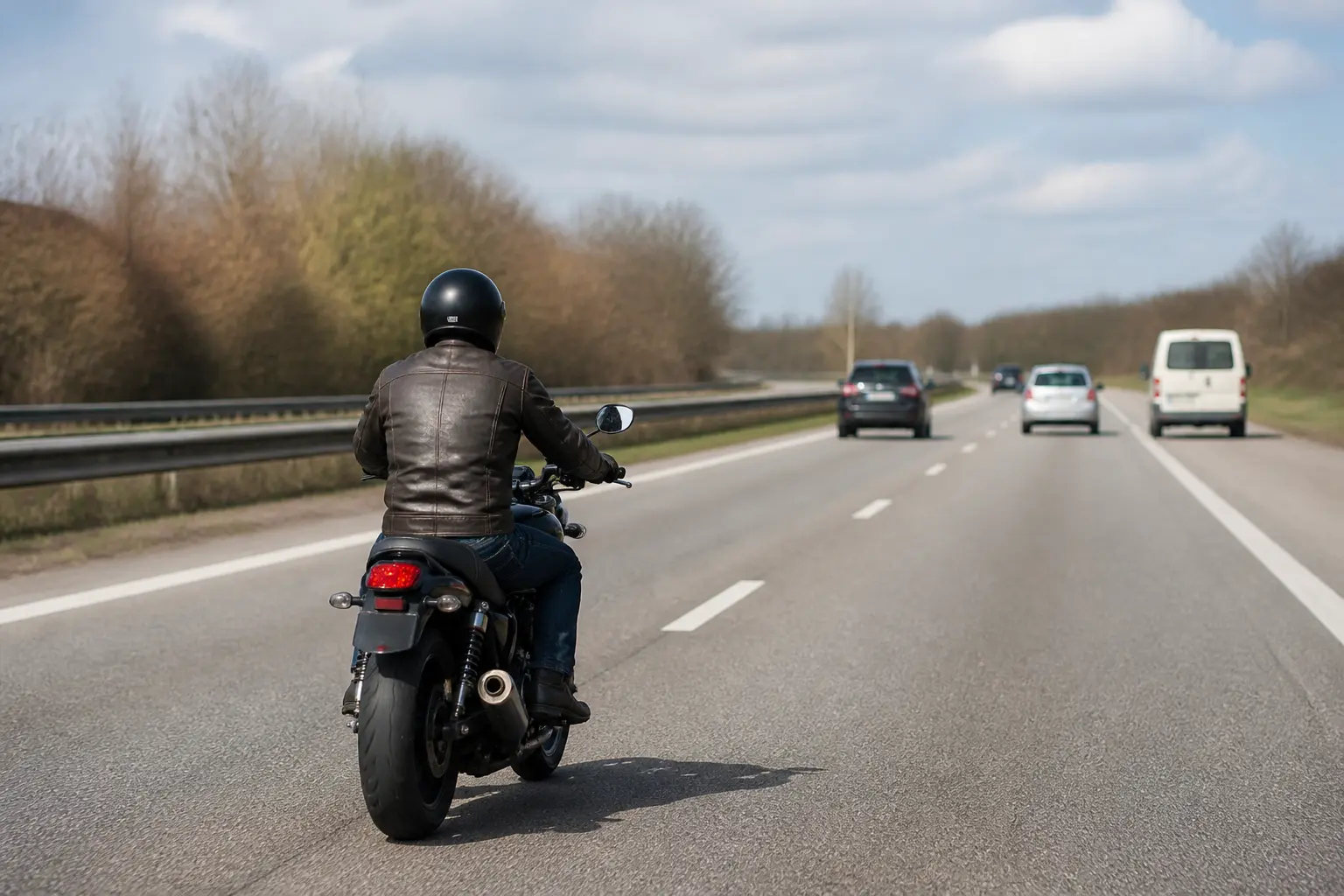
Emergency response begins with ordinary riding choices. The rider who follows too closely, looks only at the vehicle ahead, or enters a blind bend too quickly has fewer options when something changes. The rider who preserves space and scans beyond the first vehicle has more time to choose between stopping and escaping.
Build a continuous “where could I go?” habit. On a straight road, identify the open area ahead and the usable space to each side without fixating on it. In traffic, notice which lanes are occupied and whether a gap is likely to remain open. Near parked vehicles, expect a door, pedestrian, or vehicle movement. At intersections, assume that visibility can be deceptive until the crossing path is clearly accounted for.
This is not about riding nervously. It is about making the emergency decision earlier, when the options are still broad. A rider with more time can brake sooner, move position gradually, or choose a route with less uncertainty.
Speed planning matters for the same reason. Entering a blind area at a speed that leaves no meaningful stopping or escape option turns a manageable surprise into a forced gamble. The right speed is not simply the posted limit; it also reflects visibility, traffic, surface, weather, and the rider’s ability to respond.
Why Combining Braking and Swerving Can Become Confusing
Braking and steering are both necessary motorcycle skills, but they create different immediate demands. In a panic, a rider may grab the controls, turn sharply, look at the object, and then change direction again. That sequence is not a plan; it is a loss of priorities.
A better mental model is to separate the decision from the input:
- Decision: Is the current line usable, or is an escape path safer?
- Input: Once the priority is selected, make the controlled input that matches the choice.
- Reassessment: Continue looking through the hazard and toward available space.
“Separate” does not mean a rider can never brake while changing direction. Real roads are not training diagrams, and situations evolve. It means riders should not assume that a dramatic combination of maximum braking and sudden steering is automatically superior. The Motorcycle Safety Foundation’s training material should be the baseline for learning how these controls interact, especially in a curve or on a motorcycle with ABS.
A particularly dangerous habit is target fixation: looking directly at the vehicle, pothole, animal, or debris the rider wants to avoid. Vision should support the intended path. If the rider chooses an escape route, attention needs to move toward that route and beyond it, while still maintaining awareness of the hazard and surrounding traffic.
ABS Does Not Decide the Route for You
Anti-lock braking can help prevent wheel lock under conditions where the system activates, but it does not select an escape path, eliminate stopping distance, or make every surface equally predictable. System behavior varies by motorcycle, and the owner’s manual is the manufacturer-first source for how the fitted system operates.
Do not treat ABS as a reason to follow more closely or enter a hazard with less margin. A rider still needs to recognize the problem, apply the controls as trained, keep the motorcycle directed toward the intended space, and leave room for the road surface and traffic to change.
If the motorcycle has a combined braking system, linked controls, traction electronics, or other rider aids, learn their operation from the manufacturer’s documentation and an appropriate course. This article deliberately avoids model-specific operating instructions because those details cannot safely be generalized.
A Conservative Practice Plan
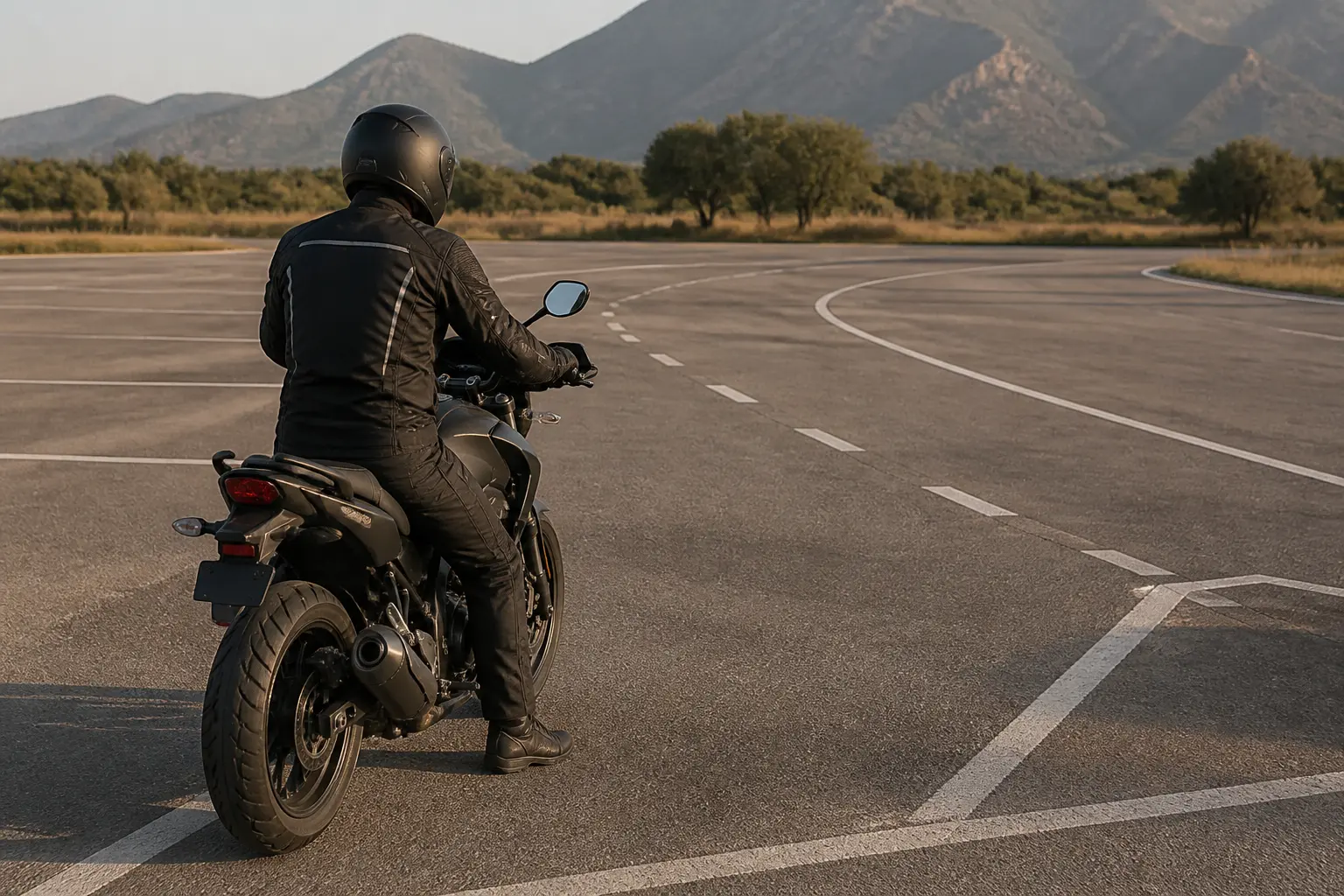
Practice should make the decision calmer, not create a personal contest for the shortest stop or sharpest turn. Public traffic is not a practice environment. A closed, appropriate training area or qualified rider course is a better setting, and professional instruction is especially valuable if the rider has never practiced emergency responses.
Before practice
- Read the motorcycle owner’s manual for braking controls, ABS, tire requirements, and warnings.
- Check that the motorcycle is in suitable operating condition; do not use a skills exercise to diagnose a suspected fault.
- Choose a clean, dry, lawful area with no public traffic, pedestrians, walls, curbs, poles, or hidden entrances in the practice path.
- Wear the protective equipment appropriate to the activity.
- Begin at a conservative speed and leave generous runoff space.
- Practice one skill at a time before introducing a decision between stopping and changing path.
- Stop if weather, surface, fatigue, fear, or equipment condition reduces control.
A progression that builds judgment
First, rehearse the mental scan while stationary or moving only in a controlled training setting: identify the current path, a possible stopping area, and a possible escape area. Next, refresh smooth braking at a conservative pace under instruction or within a formal course structure. Focus on repeatability and control rather than a target distance.
Then work on path changes separately, using a clearly marked, low-risk exercise designed by an instructor or recognized training program. The objective is to look toward open space and make a deliberate path change, not to dodge increasingly narrow objects. Do not place improvised obstacles in a public road, and do not practice close passes around people or vehicles.
Only after each skill feels familiar should the rider practice a simple decision exercise under qualified supervision: an unexpected but clearly controlled prompt to stop or choose an open route. The exercise should remain slow enough, spacious enough, and predictable enough that a mistake does not become a crash. A course can provide feedback that a solo rider cannot see, such as late vision, abrupt control changes, or an escape path that was never actually open.
The best measure of progress is not a dramatic maneuver. It is earlier recognition, smoother control, better space selection, and the ability to abandon a practice attempt before it becomes unsafe.
Checklist: Make the Decision Before You Need It
On every ride
- Scan beyond the vehicle immediately ahead.
- Keep a following distance that gives you time to assess and respond.
- Notice open areas and possible escape routes without fixating on them.
- Adjust speed for visibility, traffic, surface, weather, and line of sight.
- Expect parked vehicles, intersections, blind crests, and bends to conceal hazards.
- Keep your controls and protective equipment in a condition appropriate for riding.
When a hazard appears
- Look for the current stopping line and the space beyond the hazard.
- Ask whether the original path is open, blocked, or uncertain.
- If stopping space is available, prioritize controlled braking.
- If the path is blocked and a clearly open route exists, consider the escape path.
- Do not swerve into an unverified lane, shoulder, person, vehicle, or surface.
- Avoid staring at the object you are trying to avoid.
- Do not add abrupt, confused inputs simply because the first response feels frightening.
- Continue reassessing as traffic and space change.
Before skills practice
- Read the manufacturer’s manual.
- Choose a controlled location or take professional training.
- Inspect the motorcycle and stop if a safety concern is present.
- Use conservative speed, generous space, and suitable protective gear.
- Practice braking and swerving as separate skills before combining decisions.
- End the session while control and attention are still strong.
Common Mistakes That Shrink the Safety Margin
Treating swerving as an automatic alternative to braking. A lateral route is useful only if it is open and remains open. Otherwise, the rider may exchange one hazard for another.
Braking because the object is frightening without checking the path. Fear can narrow vision. If the stopping line is blocked and a verified escape route exists, remaining on the line may be the wrong choice.
Swerving because stopping feels too difficult. A rider may steer toward a shoulder without seeing its surface or occupants. The route needs assessment, not wishful thinking.
Looking at the hazard. The motorcycle tends to follow attention. Deliberately searching for open space supports a better decision.
Relying on ABS as a substitute for space. Electronic assistance does not remove physical limits or decide where the motorcycle should travel.
Training at the edge of control. Repeated near-misses are not evidence of improvement. If the drill needs a narrow gap, high speed, or public traffic to feel challenging, it is poorly designed for a refresher.
Using generic advice to override the owner’s manual. Controls and rider aids vary. Manufacturer instructions come first for the motorcycle in front of you, and qualified training comes first for skills that are difficult to self-assess.
When Professional Training Is the Better Choice
A formal course is a strong option if braking feels unfamiliar, the rider has recently returned after a long break, a crash has reduced confidence, or the motorcycle has changed substantially. It is also useful when a rider cannot tell whether a problem is late vision, excessive speed, control tension, target fixation, or poor route selection.
An instructor can select an appropriate environment, provide an outside view, and increase complexity only when the rider is ready. That is safer than copying an online stunt, placing cones on a public road, or asking a friend to create a surprise without a controlled plan.
The aim is not to memorize a single answer to “brake or swerve?” The aim is to develop a reliable process: recognize early, preserve options, choose the safer available path, make a deliberate input, and keep reassessing.
How Vojo Helps
After a practice session or training course, record what you worked on in Vojo instead of relying on memory. Create a maintenance or riding note with the date, motorcycle, training location, weather, surface, skill practiced, and one specific takeaway such as “looked too late toward the escape route.” On the next ride, review that note before departure and set one modest focus for the session. Store any follow-up inspection or manufacturer-recommended service separately in the Motorcycle Maintenance Tracker, so rider-skill observations do not get confused with mechanical work. This creates a simple workflow: prepare from the owner’s manual, practice in a controlled setting, log the result, and review the next time you ride.
Quick answers
Frequently asked questions
Should I always brake before swerving on a motorcycle?
No. Choose based on the available path. If the current line is open, controlled braking may be best. If the line is blocked and a verified escape route exists, a controlled path change may be safer. Do not make a blind lateral move.
Can I brake and swerve at the same time?
Real emergencies can evolve quickly, but riders should not assume that a maximum braking input combined with abrupt steering is automatically safest. Learn the interaction from the motorcycle’s manual and qualified training, especially for cornering and ABS-equipped motorcycles.
Does ABS make emergency braking safe on every surface?
No. ABS behavior is motorcycle-specific and does not remove stopping distance, surface limitations, or the need to choose a route. Follow the manufacturer’s instructions and maintain a safety margin.
How can I practice swerving safely?
Use a closed, appropriate training area or a qualified course, begin conservatively, and practice path changes separately from emergency braking. Do not practice around traffic, pedestrians, improvised obstacles, or roadside objects.
What if I cannot see a safe escape route?
Treat the route as unverified. Reduce speed with a controlled response as appropriate, continue scanning for usable space, and avoid steering toward a shoulder or lane whose condition and occupancy you cannot assess.
Is this advice a substitute for a motorcycle safety course?
No. The article provides a decision framework. A recognized course can teach braking, swerving, cornering, and motorcycle-specific control with feedback in a controlled environment.