
Motorcycle Emergency Braking in Traffic: Build a Straight-Line Stop Before Panic
Prepare for motorcycle emergency braking in traffic with straight-line stop practice, earlier hazard recognition, space planning, and manufacturer-first guidance.
Fact-checked against cited official documentation
Reviewed against Fact-checked against MSF guidance on emergency braking, space management, traction and ABS awareness, plus Basic RiderCourse structured stopping objectives..
Last updated November 7, 2026
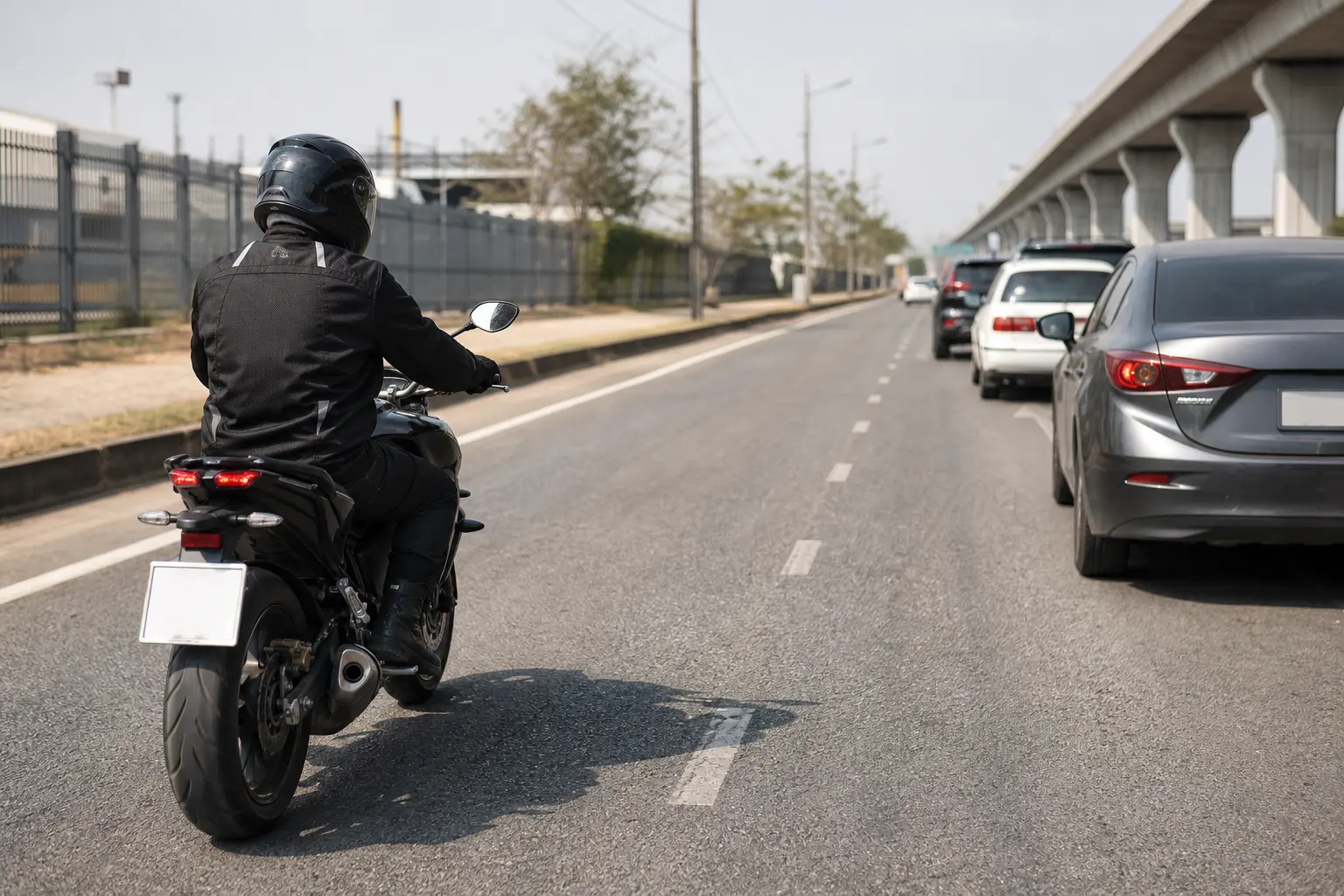
A sudden stop in traffic is rarely caused by one dramatic event. More often, the warning signs arrive in pieces: a line of cars begins to compress, a front wheel creeps from a driveway, brake lights appear beyond the vehicle ahead, or a driver leaves a gap that looks ready to close. Motorcycle emergency braking in traffic depends on noticing those clues early enough to make a calm, straight-line stop possible.
The useful goal is not to become comfortable with panic. It is to build an orderly response before panic has a chance to take over: recognize the problem, reduce speed early, preserve a stopping lane, apply the brakes in the way your motorcycle’s manufacturer and training support, and continue watching the traffic environment as the motorcycle slows.
The Motorcycle Safety Foundation (MSF) advises riders to develop emergency-braking ability before riding in traffic, maintain room for escape, and ride within their current skill level. Its If You Ride A Motorcycle guidance presents those habits as connected parts of risk management, not as isolated control tricks. The MSF’s Motorcycle Operator Manual likewise treats speed choice, traction, braking, curves, and rider judgment as related subjects.
This article concentrates on the common traffic case in which the best available response is to slow or stop while travelling straight. It is not a substitute for the owner’s manual, a manufacturer training program, or a qualified riding instructor. Your motorcycle may have specific requirements for its controls, braking system, load, tires, ABS, ride modes, warnings, or passenger use. Those instructions come first.
Motorcycle Emergency Braking in Traffic Starts Before the Brake Lever
A good emergency stop begins with what happens several seconds before brake pressure increases. If a rider discovers a hazard only when it fills the windscreen, the remaining choices can become harsh and narrow. Earlier recognition creates time; time supports smoother inputs; smoother inputs give the rider more control.
Think of traffic observation as building a moving picture rather than watching the back of one vehicle. The car immediately ahead matters, but it is not the whole scene. Look for changing brake-light patterns farther ahead, a lane that is losing its flow, a vehicle drifting toward a turn lane, a pedestrian area, an opening in roadside parking, or vehicles waiting at side streets. None of these signs proves that a conflict will occur. Together, they can justify reducing speed before the situation becomes urgent.
A motorcycle rider also benefits from identifying where a stop could occur. That does not mean choosing a fixed point and staring at it. It means asking whether the current lane has room, whether the road surface looks consistent, where adjacent vehicles might move, and whether there is usable space if the first plan changes. A rider with no imagined stopping path is more likely to react late.
The practical sequence is simple:
- Detect change early. Notice traffic behavior, road layout, and side hazards before they demand immediate action.
- Buy time. Ease off speed when the scene becomes visually complex or unpredictable.
- Keep options open. Avoid placing the motorcycle where a queue, vehicle flank, curb, or lane boundary removes every alternative.
- Choose a response. When a clear, direct stopping path remains, commit attention to an upright, controlled stop.
- Reassess continuously. The first hazard may move, and a second vehicle may create a new problem while you are slowing.
This approach is not about riding nervously. It is about replacing hope with observation. Traffic is easier to manage when a rider accepts that another road user may brake, turn, merge, open a door, or misjudge distance without giving a useful warning.
Build Space for a Straight-Line Stop Before Traffic Closes It
Following space is not merely a courtesy gap. It is working room for perception, decision-making, braking, and a possible route change. The MSF operator material discusses the connection between speed, distance, and control; that connection becomes especially important where traffic is compressed or sightlines are limited.
A useful gap changes with conditions. Dry pavement and clear visibility are different from wet pavement, fading light, heavy vehicles, unfamiliar roads, or a motorcycle carrying a passenger or luggage. Rather than searching for one universal distance, keep enough room to see developing traffic and respond without assuming the vehicle ahead will behave perfectly.
Lane position also affects what you can see and what you can do. Choose a position that improves your view around the vehicle ahead while avoiding blind spots and obvious surface hazards. Re-evaluate it as traffic changes. A lane position that was useful behind a moving car may become unhelpful beside a van, near a merging lane, or alongside parked vehicles.
Avoid treating an opening as a promise. A gap near an intersection may be occupied by a turning vehicle a second later. A clear shoulder may contain debris. An adjacent lane may look available until a driver begins changing lanes. The point of escape planning is not to guarantee a way out; it is to prevent the rider from having no awareness of the available choices.
Common traffic clues worth respecting
- Brake lights appearing two or three vehicles ahead.
- A vehicle waiting to turn with its front wheels beginning to move.
- A driver’s view blocked by a larger vehicle.
- A line of parked cars near shops, schools, or transit stops.
- A lane ending, merging, narrowing, or approaching an interchange.
- A vehicle leaving unusually little room in front of you.
- A surface change such as paint, patches, standing water, loose material, or uneven pavement.
The safest response to a clue is often modest and early: reduce speed, extend following room, improve your view, and prepare to stop. That is far preferable to accelerating toward uncertainty and later trying to recover the missing distance with a hard brake application.
The Straight-Line Stop: What You Are Trying to Achieve
In a direct traffic threat, a straight-line stop aims to keep the motorcycle travelling in line with its path while speed is reduced under control. The rider is not attempting to prove maximum braking ability. The rider is trying to use available grip and available space without adding unnecessary steering, abruptness, or distraction.
The basic priorities are:
- keep the motorcycle as upright as circumstances allow;
- look toward the usable path rather than locking attention onto the hazard;
- operate the brakes as taught for the motorcycle and specified by its manufacturer;
- build braking force with control rather than making a startled, uncontrolled grab; and
- keep evaluating the road, traffic, and balance as the motorcycle approaches walking speed.
The word “progressive” can be misunderstood. It does not mean delaying meaningful braking or touching the controls so gently that the motorcycle continues toward the hazard. It means increasing braking in a coordinated manner instead of delivering a chaotic first input. The right amount and timing depend on the motorcycle, surface, speed, load, tires, and rider skill. That is why this article cannot supply a universal pressure setting, stopping distance, or single technique for every motorcycle.
Use both brakes only in the manner specified in your owner’s manual and reinforced through recognized training. Do not make assumptions based on a different motorcycle, a video demonstration, or a friend’s advice. Brake control can feel substantially different across models and conditions.
The MSF’s Basic RiderCourse includes controlled work on brake application, rapid stopping, distance awareness, and braking-related decisions as part of a structured learning environment. That is an important distinction: riders should build this ability in a planned setting rather than discover their limits during a crowded commute.
Vision during the stop
Vision influences more than confidence. Fixating on the rear bumper, curb, pothole, or obstacle can make it harder to notice open space or a changing threat. Keep awareness of the immediate hazard while directing your eyes toward the place you intend the motorcycle to travel and stop.
Looking up also helps after the initial danger has passed. A successful stop can still leave a rider exposed if a following vehicle approaches too quickly, a neighboring vehicle turns into the space, or the motorcycle has stopped in an unsafe location. Continue assessing the environment until you are fully stable and clear of the immediate conflict.
What a straight-line stop is not
It is not a substitute for trained obstacle avoidance. It is not a promise that a motorcycle can always stop before an impact. It is not an excuse to follow closely because ABS is fitted. And it is not the same challenge as braking while leaned over in a curve.
If an obstacle blocks the entire path, the rider may need a different response. Avoid inventing a last-second maneuver in traffic. Braking and swerving are related but distinct skills, and each should be developed separately in a controlled environment.
ABS Is a Rider Aid, Not a Reason to Delay
If your motorcycle has an anti-lock braking system, learn what the manufacturer says about its operation, warning indicators, limitations, and any model-specific conditions. The MSF operator material addresses ABS as an aid that can help manage wheel lock, while making clear that riders must still use sound judgment and braking technique.
ABS does not erase speed, reaction time, following distance, road condition, tire condition, or visibility. It does not turn every surface into high grip, and it does not make a late decision early. A rider who notices a forming queue early and begins braking sooner still has more options than a rider who relies on electronics after the available distance has largely disappeared.
Do not deliberately seek ABS activation in public traffic. If you want supervised familiarity with braking technology, pursue a training setting and follow the motorcycle manufacturer’s information. Never assume that the behavior of one ABS-equipped motorcycle predicts the behavior of another.
Before any ride, take a warning indicator seriously. If a brake-related warning, unfamiliar lever feel, damaged control, tire concern, or other abnormal behavior is present, do not use a braking exercise to investigate it. Consult the owner’s manual and obtain qualified help where appropriate.
Practice Motorcycle Emergency Braking Away From Traffic
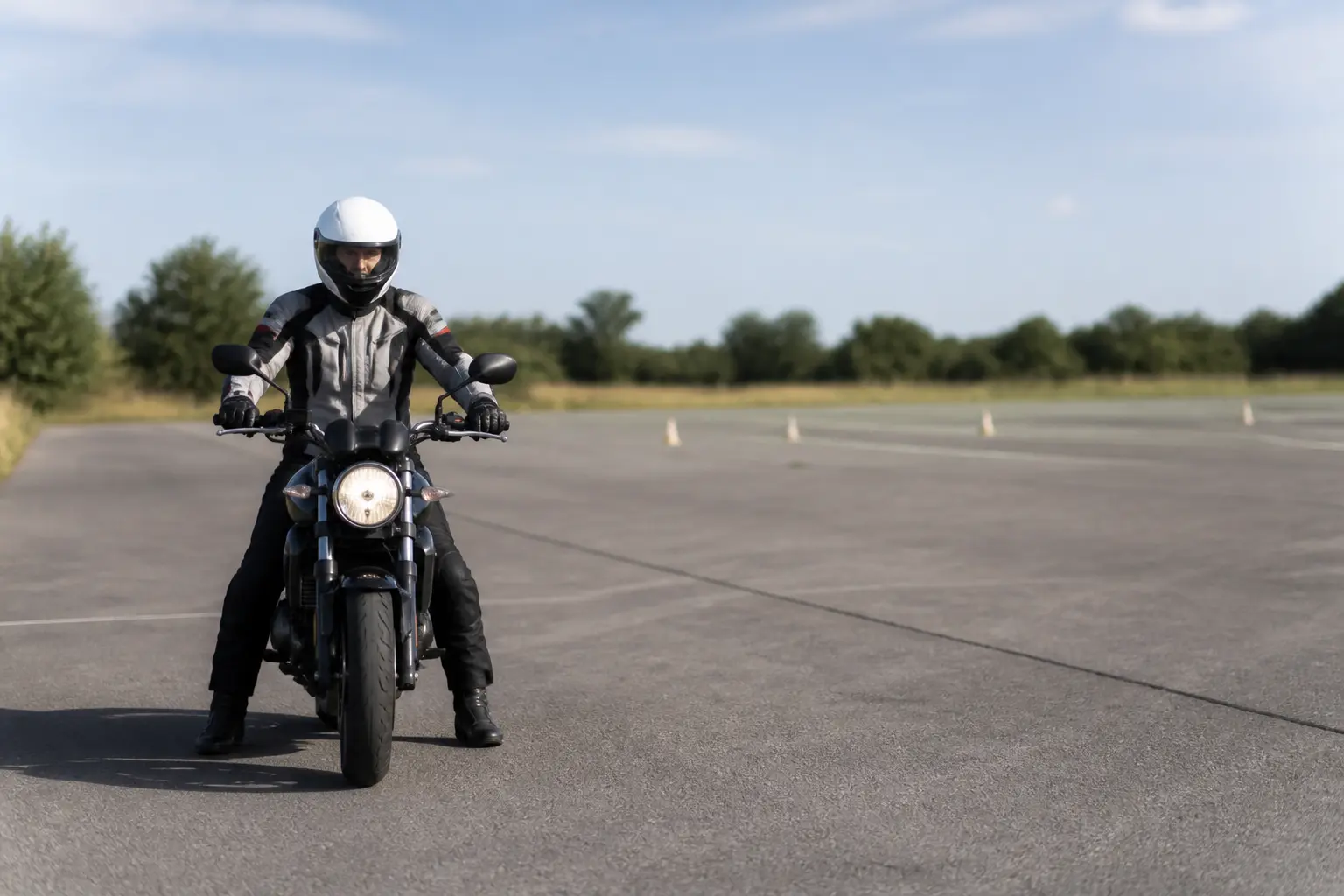
Practice should make the traffic response more familiar without recreating traffic danger. The right environment is legal, open, inspectable, and free from through traffic, pedestrians, surprise vehicles, loose obstacles, and hidden entrances. It should provide far more room than you expect to use.
Begin only after checking the motorcycle in line with the owner’s manual. Wear appropriate protective equipment, consider weather and surface condition, and stop the session if you are fatigued, rushed, upset, or uncertain about the motorcycle. Training is most useful when it removes distractions instead of piling them up.
The following progression is deliberately conservative. It is a planning framework, not an exact drill or a replacement for a course.
| Practice phase | Purpose | Rider focus | Pause, reduce difficulty, or seek coaching when… |
|---|---|---|---|
| Control familiarization | Reconnect with normal brake controls at low demand | Relaxed posture, clear vision, smooth coordination | You are unsure of the controls or notice an equipment concern |
| Predictable straight stops | Build consistency at a comfortable pace | Motorcycle tracks straight and stops under control | Inputs become abrupt, tense, or inconsistent |
| Visual-cue response | Link observation to a planned stop | Eyes move from a simple cue to the chosen stopping path | The cue causes fixation, freezing, or rushed actions |
| Space-awareness work | Notice how earlier decisions create more room | Entry speed, available room, and an unhurried response | You begin chasing shorter distances or treating the session as a contest |
| Added scanning | Maintain wider observation without live traffic | Side-hazard awareness and route assessment | Attention becomes overloaded or the practice site becomes busy |
| Coached development | Receive correction and structured feedback | Vision, timing, posture, decisions, and control use | A recurring issue remains despite careful solo practice |
Change only one element at a time. Do not raise speed, add a surprise signal, practice on a new surface, ride a different motorcycle, and carry a passenger in the same session. Combining variables makes it difficult to learn what changed and easier to exceed your comfort margin.
Do not convert observations from a practice area into promises about public roads. Actual stopping space varies with the surface, slope, weather, traffic, tire state, load, vehicle condition, rider response, and many other factors. The value of practice is better awareness and repeatable control—not a number to rely on in an emergency.
Traffic Scenarios That Demand Earlier Decisions
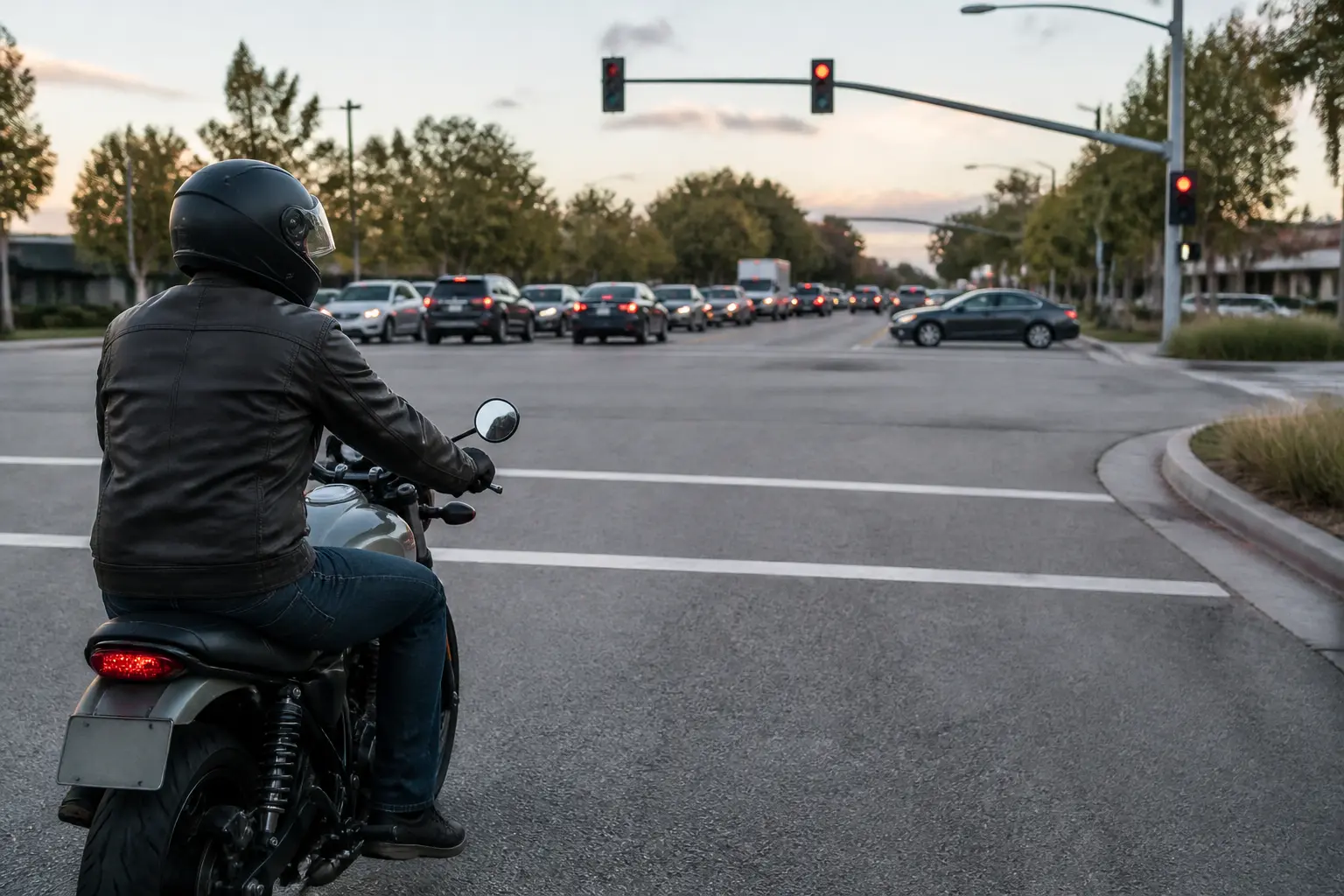
A queue begins to compress
When traffic tightens, look beyond the nearest vehicle if sightlines permit. Brake lights in the distance can reveal a problem before the vehicle directly ahead reacts. Reduce speed early, preserve a lane position that gives information, and avoid entering a narrow gap that leaves no room if the queue stops completely.
A vehicle may turn across your path
A turn signal can be useful information, but it is not certainty. A vehicle may turn without signaling, signal without turning, stop unexpectedly, or be pushed into a decision by surrounding traffic. Approach intersections and driveway areas at a speed that leaves room to respond. If the vehicle’s path becomes unclear, prioritize space and controlled speed rather than trying to guess its intent.
A tailgater is behind you
A close-following driver creates pressure, but it should not force the rider into unsafe speed or sudden moves. Where conditions allow, increase the space ahead so your own slowing can be more gradual. Make predictable decisions, avoid responding from anger, and let the other road user move away when a safe opportunity exists.
Parked vehicles and roadside activity
Doors, pedestrians, delivery activity, and vehicles leaving parking spaces can create short-notice conflicts. Increase separation where safe, reduce speed, and keep a broader visual scan. If you need to brake, remember that the first hazard may conceal another one.
Uncertain grip
Painted areas, metal covers, water, dirt, fuel contamination, broken pavement, and loose material may change the confidence a rider has in available grip. The best time to deal with uncertain grip is before the motorcycle reaches it: reduce speed smoothly, create more room, and avoid abrupt actions. For broader manufacturer-first preparation and inspection planning, see the Motorcycle Maintenance Guide.
When a Course Is Better Than More Solo Repetitions
Solo practice has limits. Choose formal instruction if you have not previously learned controlled stopping, feel unable to stay calm when a cue appears, repeatedly lose alignment, remain unsure how your motorcycle’s controls should be used, or cannot judge when to brake versus when to avoid.
A course is also a sensible next step after a long time away from riding, after moving to a motorcycle with meaningfully different behavior, or after an incident has made you hesitant. An instructor can identify patterns that a rider may not notice while concentrating on the road ahead.
The MSF Basic RiderCourse is an example of a structured foundation program, and its official course information describes guided skill development rather than unsupervised high-risk experimentation. If confidence and control are not improving, adding pressure alone is not the answer. Better feedback, a clearer practice environment, and a lower-demand restart are often more productive.
Straight-Line Emergency Braking Traffic Checklist
Use this checklist before a braking refresher and as a mental prompt before entering dense, fast-changing traffic.
- I have checked the owner’s manual for motorcycle-specific braking, ABS, tire, load, and warning guidance.
- I will not ride or practice with an unresolved brake, tire, control, or warning-indicator concern.
- My protective equipment suits the ride and conditions.
- I am scanning beyond the vehicle immediately ahead.
- I am leaving enough room to observe traffic changes and slow without panic.
- I have considered where a straight stop could occur if traffic suddenly compresses.
- I am reducing speed before intersections, driveways, queues, merges, and limited-visibility areas demand it.
- If a clear stopping path exists, I will aim to keep the motorcycle upright and aligned.
- I will use the brakes only as taught for this motorcycle and in line with the manufacturer’s guidance.
- I will keep my eyes active rather than staring at the object I fear hitting.
- I will not test braking limits or ABS activation in public traffic.
- I will seek qualified instruction if my response feels uncertain, abrupt, or inconsistent.
How Vojo Helps
Use Vojo to make emergency-stop preparation a repeatable pre-ride workflow. Before a planned practice session, open your motorcycle profile and review recent service entries, open maintenance notes, and any unresolved warning or handling observations. Then create a ride entry that records the intended location type, surface condition, weather, and a single objective such as “refresh straight stops and traffic scanning.”
Afterward, add a short reflection: what you noticed earlier, whether you maintained a clear stopping path, and whether a concern needs professional attention or formal coaching. This creates a useful record without treating app notes as a diagnosis or a substitute for the owner’s manual. The Motorcycle Service History view can help keep inspection, service, and practice context together when planning the next ride.
Quick answers
Frequently asked questions
Should I always use both brakes for a motorcycle emergency stop?
Use the braking controls as specified by your motorcycle’s manufacturer and taught through recognized training. Do not rely on a universal rule from another model or rider; motorcycle setup and braking systems vary.
Does ABS guarantee a shorter motorcycle stop?
No. ABS is a rider aid, not a guarantee. It does not remove the effects of speed, grip, traffic distance, visibility, reaction time, tire condition, or road surface. Follow the owner’s manual for your system.
Should I practice emergency braking in live traffic?
No. Practice belongs in a legal, controlled, open area with an inspectable surface and generous room. Public traffic adds unpredictable vehicles, pedestrians, changing surfaces, and pressure that make learning less safe.
Why does traffic scanning matter for emergency braking?
Earlier recognition gives you more time to reduce speed and preserve space. Seeing a queue form or a possible turning conflict before it becomes immediate can prevent a rushed, last-second response.
Is a straight-line stop the right answer for every motorcycle emergency?
No. When a clear stopping path exists, an upright straight stop can simplify the task. A blocked path or a motorcycle already in a turn may require different judgment and skills that should be trained separately.
When should I take a course instead of practicing alone?
Seek structured instruction if you have never learned controlled stopping, freeze under pressure, repeatedly struggle to keep the motorcycle aligned, are unsure about the controls, or have changed to a substantially different motorcycle.