
Motorcycle Emergency Braking in a Curve: What to Practice Before the Panic
Prepare for motorcycle braking while leaned in a curve with a conservative practice checklist, better hazard recognition, and clear training limits.
Fact-checked against cited official documentation
Reviewed against Fact-checked against MSF guidance on curve and emergency handling, the SEE hazard-management framework, and Street Strategies course coverage of curves and emergencies..
Last updated October 23, 2026
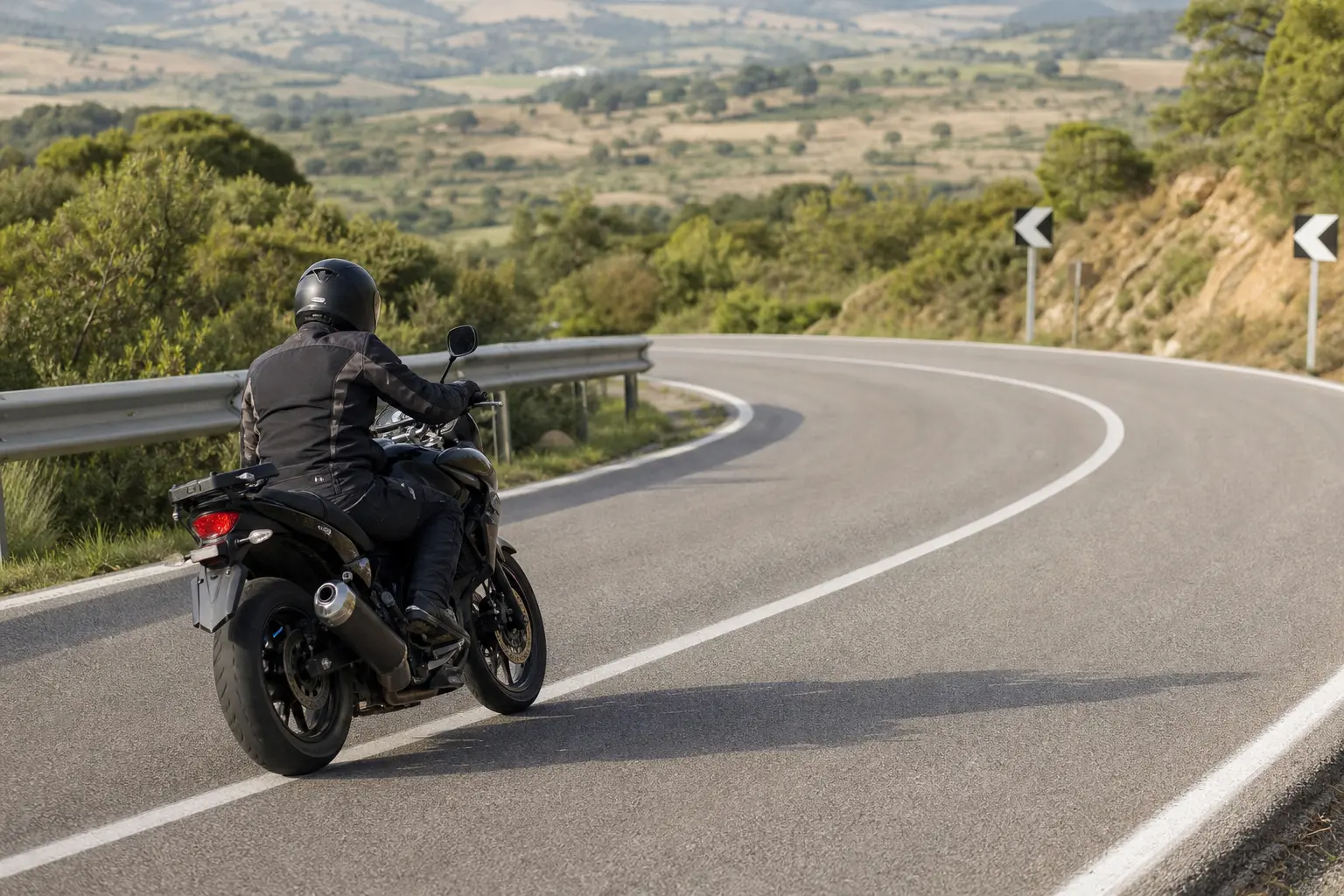
A hazard in a bend can make the road feel as though it has changed all at once. A queue may be around the next section of road, the turn may narrow unexpectedly, or a surface change may appear only after the motorcycle is already committed to the curve. The rider’s challenge is not to find a magic response at the last second. It is to arrive with enough time, vision, space, and composure to make the least-bad available decision.
That is why motorcycle braking while leaned in curve practice deserves its own preparation plan. It is not simply a harder version of stopping in a straight line. It combines observation, corner planning, speed choice, motorcycle familiarity, and a response to changing circumstances. The Motorcycle Safety Foundation (MSF) includes emergency braking and braking while leaned in a curve among the handling situations riders should understand and practice. Its street-riding learning material also addresses curves, emergencies, and emergency-maneuver practice. MSF riding tips and the MSF Street Strategies eCourse are useful starting points for structured learning.
Begin with the motorcycle manufacturer. The owner’s manual is the authority for the machine’s controls, warnings, approved loads, tires, rider-assistance systems, and intended operation. Do not let general internet advice override model-specific instructions. Before treating an odd sensation as a riding-skills issue, establish that the motorcycle is fit to ride. The Motorcycle Maintenance Guide can help organize a broader maintenance baseline, but it does not replace the manual or professional inspection.
This article does not prescribe a universal brake-control sequence. Different motorcycles can have different brake-system behavior, electronic assistance, control feel, tires, suspension settings, and loading. Instead, it gives you a conservative way to prevent many curve emergencies, decide what to practice, and recognize when supervised instruction is the appropriate next step.
Motorcycle Braking While Leaned in a Curve Starts Before the Bend
The best time to make a curve-braking decision is usually before the motorcycle is deeply committed to the turn. A rider who has already entered with a manageable speed, a useful sightline, and room to adapt is less likely to need an abrupt solution.
Treat every limited-view curve as an information problem. You do not know everything beyond the point where the road disappears. That uncertainty should affect pace and positioning. A blind turn, a crest, a dense hedgerow, parked vehicles, oncoming traffic, shadows, or an unfamiliar route all reduce the confidence available for carrying speed.
The MSF’s SEE approach offers a practical mental structure: Search, Evaluate, Execute. It links visual collection of information with judgment and action rather than treating control use as an isolated reflex. Read the MSF overview of Search, Evaluate, Execute and use it as a repeatable routine before and during curves.
A conservative approach is not timid riding. It is deliberate riding. It means leaving capacity for a rider ahead who slows, a hidden driveway, a curve that tightens, loose material, or a vehicle that uses more of its lane than expected. It also means accepting that a route, group pace, or navigation arrival time is never a good reason to remove your own margin.
The useful pre-curve question is: If the visible situation changes, do I still have reasonable options? If the answer is uncertain, reduce the demand early while conditions are simpler.
A Practical SEE Plan for Curves and Sudden Slowdowns
SEE is most valuable when it becomes ordinary, not when it is remembered only during a near miss. The following table turns the framework into a curve-focused planning tool. It is a decision aid, not a substitute for a training course or the manufacturer’s instructions.
| SEE stage | What to notice in or before a curve | Conservative rider objective | When to reduce the plan further |
|---|---|---|---|
| Search | Sightline, road edge, surface changes, traffic movement, driveways, weather, shadows, signs, and the apparent curve exit | Build an accurate picture before committing more speed | The view is blocked, the pavement is hard to read, or another road user is unpredictable |
| Evaluate | Available lane space, entry speed, road shape, your fatigue, motorcycle load, and the consequences of an error | Decide whether the existing pace still leaves a usable margin | You cannot explain where you would go if the turn narrows or traffic slows |
| Execute | The safest lawful path and the trained response appropriate to your motorcycle and conditions | Make one calm, deliberate choice rather than stacking rushed inputs | You feel surprised, tense, fixated, or unsure how the motorcycle will respond |
Search beyond the obvious obstacle
Searching is active. It includes looking for evidence that a problem may emerge, not merely noticing a problem after it fills the lane. On approach, observe the road’s direction, the edge line or edge of pavement, opposing traffic, vehicle brake lights, access points, and anything that interrupts your view. Notice whether the surface looks consistent or whether it contains changed texture, repairs, water, debris, or other uncertainty.
Keep attention moving. The intended path matters, but so do the surroundings that may change it. A rider who stares only at one point can miss a developing queue or narrowing road. Conversely, a rider who looks only at a hazard may fail to see the safest space still available.
Evaluate with an honest margin
Evaluation is where riders convert observations into a plan. The same curve can demand a different pace on a hot familiar afternoon than it does in rain, darkness, fatigue, traffic, or with a passenger and luggage. There is no respectable prize for using the same speed in unlike conditions.
Ask yourself whether the visible distance, road shape, and motorcycle state support the pace you chose. Consider whether a changing radius would surprise you, whether the next section is hidden, and whether you are following another rider’s speed rather than your own judgment. If uncertainty rises, make the next decision easier: slow earlier, create space, or choose a less demanding route.
Execute without turning one problem into two
Execution should be compatible with your training and your motorcycle’s manual. In a genuine surprise, avoid adding unnecessary actions simply because they feel urgent. A rushed direction change, a glance at the obstacle, or an attempt to imitate an advanced technique can take attention away from the available path.
The immediate goal is not to prove control skill. It is to manage risk. Keep assessing where the motorcycle can safely go, stay aware of lane boundaries and other road users, and use only responses you understand and have been taught for the motorcycle you are riding. When an avoidance route would put you into opposing traffic, a ditch, a barrier, or another conflict, it is not a safe escape route.
Why Curve-Braking Practice Needs a Different Mindset
Some riders think practice means repeatedly making a maneuver more intense. That approach can overlook the actual chain of events that produces a curve emergency: a late observation, a poor speed choice, distraction, fatigue, unfamiliar controls, or pressure to keep up.
A productive practice plan starts farther upstream. First, improve the recognition of limited sightlines and changing conditions. Next, make conservative entries routine. Then refresh basic motorcycle familiarity in an appropriate environment. Only after that should a rider consider more demanding instruction, ideally with an approved trainer who can observe the rider and establish a sensible progression.
The MSF identifies both curve-related braking and emergency braking as situations to understand and practice, but that does not make a public road an appropriate place to create a surprise scenario. Real traffic, variable surfaces, intersections, and limited runoff turn an experiment into an uncontrolled risk. Formal street-riding education can provide a curriculum that addresses curves and emergencies without asking a rider to invent a drill in live traffic. The MSF Street Strategies eCourse is one official resource to review when deciding what structured learning should cover.
Avoid using speed, lean angle, or stopping distance as personal scorecards. Those figures can be influenced by the motorcycle, tire condition, surface, temperature, load, rider aids, and many other circumstances. A better standard is whether you consistently recognize a problem earlier, choose a pace you can justify, and remain composed enough to make a measured decision.
Controlled Practice: Build Capacity in Small Steps
Before any riding practice, review the owner’s manual for warnings and operating instructions relevant to braking, tires, electronic systems, carrying loads, and rider modes. If you have changed motorcycles, tires, accessories, luggage, or passenger arrangements, treat the new configuration as unfamiliar until you have received appropriate guidance and become comfortable with it in low-demand conditions.
Choose a legal, low-conflict setting with predictable pavement and a generous buffer from people, vehicles, fixed objects, edges, and other hazards. The point is not to reproduce a street emergency. The point is to develop awareness and smooth decision-making without adding avoidable danger.
Start with familiarization, not intensity. Before moving, confirm that you feel rested, focused, equipped, and unhurried. During easy riding, notice whether the controls feel normal and whether anything about the motorcycle requires manufacturer or professional attention. A warning indicator, a suspected leak, damaged tire, unusual control feel, or unexplained handling concern is a reason to stop and seek qualified help rather than press ahead with practice.
Then work on visual habits at an undramatic pace. On broad, readable turns, look where you need to travel, observe the available exit, and ask whether your entry pace leaves time to adapt. The goal is to make early decision-making boringly familiar. If the exercise produces tension, surprises, or repeated uncertainty, reduce the complexity instead of forcing another attempt.
For braking while leaned or any maneuver that exceeds your current skill, seek qualified instruction. A competent instructor can help determine whether the environment, pace, and exercise suit your experience. They can also identify patterns a rider may not notice, such as late visual pickup, rigid posture, target fixation, or decisions that begin too late. Self-coaching has value at the fundamentals; it has clear limits when the consequence of misunderstanding is high.
Curve-Braking Practice Checklist
Use this checklist as a readiness filter. It is intentionally conservative. Skipping a session is a sound choice when the motorcycle, location, weather, or rider condition does not support calm learning.
Manufacturer and motorcycle check
- I reviewed the owner’s manual guidance that applies to my motorcycle’s braking controls, rider aids, tires, loads, and operating warnings.
- I know whether my motorcycle has systems or modes that affect braking behavior, and I am not relying on assumptions about them.
- There are no unresolved warning lights, visible damage, suspected leaks, tire concerns, or unfamiliar control sensations.
- I am not using the session to diagnose a mechanical or electronic issue.
- The motorcycle’s current luggage, accessories, and passenger arrangement are compatible with the intended ride and manufacturer guidance.
Rider and location check
- I am rested, sober, properly equipped, and free to stop without schedule pressure.
- The location is legal, predictable, and separated from ordinary traffic conflicts.
- The pavement and weather are suitable for a low-stress learning session.
- I have enough space that an error does not immediately lead to a curb, drop, wall, person, or vehicle.
- I will stop if I become tense, fatigued, confused, or surprised by the motorcycle’s behavior.
- I have a way to contact help if an incident occurs.
Learning-plan check
- Today’s goal is specific and modest, such as better visual scanning or more conservative curve entries.
- I am beginning with basic familiarization rather than a maximum-effort attempt.
- I will not create a simulated emergency around public traffic or blind sightlines.
- I will use only techniques taught by a qualified instructor and suitable for this motorcycle.
- I have decided what question I will take to an instructor, manufacturer, or technician if something is unclear.
When a Real Curve Surprise Develops
On the road, the useful sequence is recognition, space assessment, and a controlled response—not a prewritten stunt. First notice what changed: traffic has slowed, the road is narrower than expected, the radius has altered, the surface looks compromised, or an object has entered the usable path. Then continue searching for safe space instead of treating the first alarming detail as the only thing that exists.
Follow your training and the manufacturer’s direction for the motorcycle you are operating. Avoid assuming there is one answer for every curve, road, and machine. The safest available action can vary with the road layout, speed, grip, available lane, traffic, and your actual skill level. It may be possible to reduce speed with calm inputs; it may be necessary to prioritize a clear path; it may be safer to accept a slower, earlier approach before the situation becomes urgent.
Do not let embarrassment make the decision worse. If a group pulls away, let it go. If a bend looks beyond your present comfort, reduce pace. If you miss a turn, continue to a safe place to reroute. Choosing more margin is competent risk management, not a failure of confidence.
After a close call, do not rush immediately into the next demanding section. When safe, stop somewhere appropriate and assess yourself, your motorcycle, and your willingness to continue. Adrenaline can mask fatigue and make a rider overestimate readiness. Note the conditions that mattered: visibility, road shape, traffic, surface, load, weather, attention, and the moment the concern became visible. That record can reveal a training need more clearly than a vague determination to “brake better.”
Common Errors That Make Curve Emergencies Harder
Treating familiar roads as known quantities. A route can change with weather, roadwork, traffic, agricultural activity, parked vehicles, or wildlife. Familiarity should improve observation, not replace it.
Following a faster rider into a smaller margin. Another person’s motorcycle, experience, sightline, and appetite for risk are not yours. Maintain a pace that allows independent decisions.
Delaying the decision because the curve looks manageable. By the time a hidden problem is undeniable, options may be reduced. Respond to uncertainty sooner rather than waiting for proof that a hazard is severe.
Practicing an advanced response after seeing it online. Short demonstrations rarely show the rider’s prior training, the setup, or the safety controls around the exercise. Seek instruction instead of recreating a clip.
Ignoring an unfamiliar motorcycle signal. A new vibration, warning light, control concern, or unexpected behavior is not a challenge to ride through. Refer to the manual and obtain qualified assessment.
Continuing while mentally overloaded. Fatigue, stress, heat, pressure, and repeated surprises reduce the quality of judgment. End the session or change the route before a difficult corner becomes a test of endurance.
Choosing Instruction Instead of More Solo Practice
Formal training is a wise next move if you are new to street riding, returning after a long break, changing to a different motorcycle, carrying a passenger, or unsure about the behavior of your braking system. It is also valuable after a crash, a recurring near miss, repeated wide entries, persistent target fixation, or any incident you cannot explain.
Ask prospective training providers what their curriculum covers, how they match exercises to experience, and how they provide feedback. Look for instruction that addresses scanning, hazard management, curve planning, emergency response, and thoughtful practice progression. MSF’s public resources connect these subjects: its riding tips identify relevant handling situations, its SEE material describes a decision framework, and its Street Strategies content includes curves and emergencies. MSF riding tips provide a useful official reference point for what riders should seek to understand.
Manufacturer information still comes first whenever a course discussion conflicts with the model’s manual. That is especially important after changes to tires, accessories, rider settings, luggage, or passenger use. A generic lesson cannot account for every motorcycle configuration.
Make Conservative Curve Planning an Everyday Habit

The most durable outcome of practice is not a dramatic maneuver. It is an ordinary routine that lowers the chance of needing one. Before an unfamiliar curve, observe the approach, choose a pace based on what is visible, keep space from predictable conflicts, and remain willing to slow further when the road gives you less information.
Afterward, use a brief mental review: Did the entry pace fit the sightline? Did you notice surface or traffic clues in time? Were you riding your own plan or reacting to someone else’s? This is not self-criticism. It is a way to identify one small improvement for the next ride.
Over time, that pattern supports better decisions in many situations beyond curves: intersections, changing weather, traffic queues, unfamiliar routes, and group rides. The MSF SEE framework is useful precisely because it puts attention and judgment before the physical response. Review the MSF SEE strategy as a reminder that earlier recognition often creates the most valuable safety margin.
How Vojo Helps
Use Vojo to connect your curve-riding observations with a practical follow-up workflow. Before a route that includes unfamiliar or demanding roads, open your motorcycle record and review recent tire, brake, and service notes alongside your owner’s manual. Add a short ride intention such as “leave extra margin for blind turns” or “stop if I feel rushed.” After the ride, log the road conditions, any close call, and the exact question that remains unresolved.
Then create a follow-up item in the Motorcycle Maintenance Tracker: review a manufacturer warning, arrange a professional inspection for an unfamiliar motorcycle symptom, or find qualified rider training for a skill that should not be self-taught. Keeping the riding observation and the next action together helps distinguish a maintenance question from a training question. Vojo is a planning tool, not a replacement for the owner’s manual, a technician, an instructor, or judgment at the roadside.
Quick answers
Frequently asked questions
Should I deliberately practice braking while leaned over on a public road?
Do not create emergency scenarios in live traffic or around blind corners. Use a legal, predictable setting for basic practice and seek qualified instruction before attempting curve-braking exercises that exceed your current training or confidence.
What should I do before entering a curve with a hidden exit?
Use a more conservative plan. Search for clues, evaluate how much road and space you can actually see, and select a pace that leaves room for a changing radius, traffic, or surface problem. The MSF SEE framework supports this search-evaluate-execute approach.
Is there one braking method that works for every motorcycle in a curve?
No. Motorcycle controls, braking systems, electronic aids, tires, loads, and manufacturer instructions vary. Follow the owner’s manual for your motorcycle and use techniques taught in appropriate rider training.
When should I stop riding after a near miss in a curve?
Stop when it is safe if you are shaken, fatigued, unsure about the motorcycle’s condition, or unable to concentrate. Review what changed, and decide whether you need rest, a route change, manufacturer guidance, professional inspection, or rider training before continuing.
What should I write down after a difficult curve event?
Record the road type, visibility, weather, surface, traffic, load, fatigue, and the point at which you recognized the problem. Turn that note into one specific next action, such as checking the owner’s manual, booking training, or arranging a professional assessment.