
Motorcycle Braking on Low-Grip Surfaces: Build a Conservative Margin Before the Ride
Build a safer motorcycle braking margin on wet, loose, uneven, or uncertain roads through earlier decisions, smoother inputs, space, and route planning.
Fact-checked against cited official documentation
Reviewed against Fact-checked against MSF guidance covering progressive braking, traction while leaned, road-surface adaptation, scanning, space, and escape-route awareness..
Last updated November 3, 2026
Motorcycle braking low grip surfaces traction margin is primarily a planning problem, not a search for one magic control technique. When pavement is wet, dirty, patched, uneven, sandy, leaf-covered, or simply hard to read, the amount of dependable grip is uncertain. The practical response is to ask less of the tires before the uncertain section turns into an urgent situation.
That approach changes the ride well before the brake lever is used. It means looking farther ahead, arriving slower, leaving more room around traffic, and avoiding a line that requires a sudden correction. It also means accepting that the sensible choice may be to wait, reroute, or end the ride when the available margin no longer feels credible.
The Motorcycle Safety Foundation (MSF) discusses progressive braking, the effect of lean on traction, braking in a curve, skids, and adjusting to surface conditions in its Motorcycle Operator Manual. Its If You Ride A Motorcycle guidance also emphasizes actively searching for hazards, retaining space, identifying escape routes, and responding thoughtfully to changing pavement such as wet, sandy, or irregular roads.
This article is a conservative decision framework, not an exact riding drill. Your owner’s manual remains the first source for motorcycle-specific information, including tires, braking equipment, warning indicators, and rider-assistance systems. Formal training is the right setting for skill development. On the street, the objective is simpler: preserve enough room in the plan that calm actions remain possible.
Motorcycle braking on low-grip surfaces starts before the brake
A low-grip surface is not always obvious. A large puddle or a pile of gravel is easy to notice, but many changes announce themselves less clearly: a dark strip beneath trees, a glossy-looking lane at an intersection, a repair seam, debris near a driveway, or a texture change at a bridge approach. At night, glare and shadows further reduce the information available to you.
For that reason, treat grip as a confidence question rather than a visual label. Instead of asking whether a road is definitely slippery, ask whether you know enough about its surface to demand normal braking and turning from it. If the answer is uncertain, create a larger buffer.
That buffer has several parts:
- More time to recognize what is ahead.
- Less entry speed before the questionable area.
- More separation from traffic in front.
- Fewer simultaneous actions from the motorcycle.
- A clearer route through the hazard.
- A realistic alternative if the route no longer makes sense.
The word margin matters because no rider can measure available traction precisely from the saddle. Surface contamination, weather, temperature, traffic, road construction, and visibility can all change quickly. A rider does not need a number to react wisely. The useful decision is to lower the requested braking, turning, and acceleration demands when the surface becomes less predictable.
This is also why a familiar road deserves continued attention. Familiarity can encourage a dry-day pace even after rain, roadworks, fallen leaves, or changing light have altered the route. A road remembered as straightforward may require a different approach today.
Why uncertain traction changes braking decisions
Braking does not happen in isolation. The motorcycle may also be turning, traveling over an uneven section, moving through traffic, or reacting to a vehicle ahead. Each additional demand narrows the room available for a mistake or an unexpected surface change.
A straightforward section of clean pavement generally gives the rider more predictable feedback. A mixed surface gives less. Water may conceal holes or debris. Loose material can shift. Painted, metal, or repaired sections may look different from nearby asphalt. An irregular road may upset the motorcycle’s path at the same moment that traffic requires attention.
The important conclusion is not that every blemish requires panic or that every altered surface is equally hazardous. It is that uncertainty should alter the plan. On an uncertain section, preserve choices rather than spending them all at once.
For example, a rider who enters a bend slowly enough to observe the exit has time to respond if the road surface changes. A rider who arrives at the same bend at an aggressive pace may need to combine braking, turning, and traffic avoidance after the options have already narrowed. The hazard may be identical; the available decision time is not.
The MSF materials support adapting to road conditions rather than treating one braking response as universal. Manufacturer-first riding also means recognizing the limits of any fitted equipment. Do not assume that a familiar motorcycle, recent tires, or electronic assistance makes an uncertain surface equivalent to clean, dry pavement. Follow the instructions and limitations in the owner’s manual for your exact motorcycle.
Scan for clues, not certainty
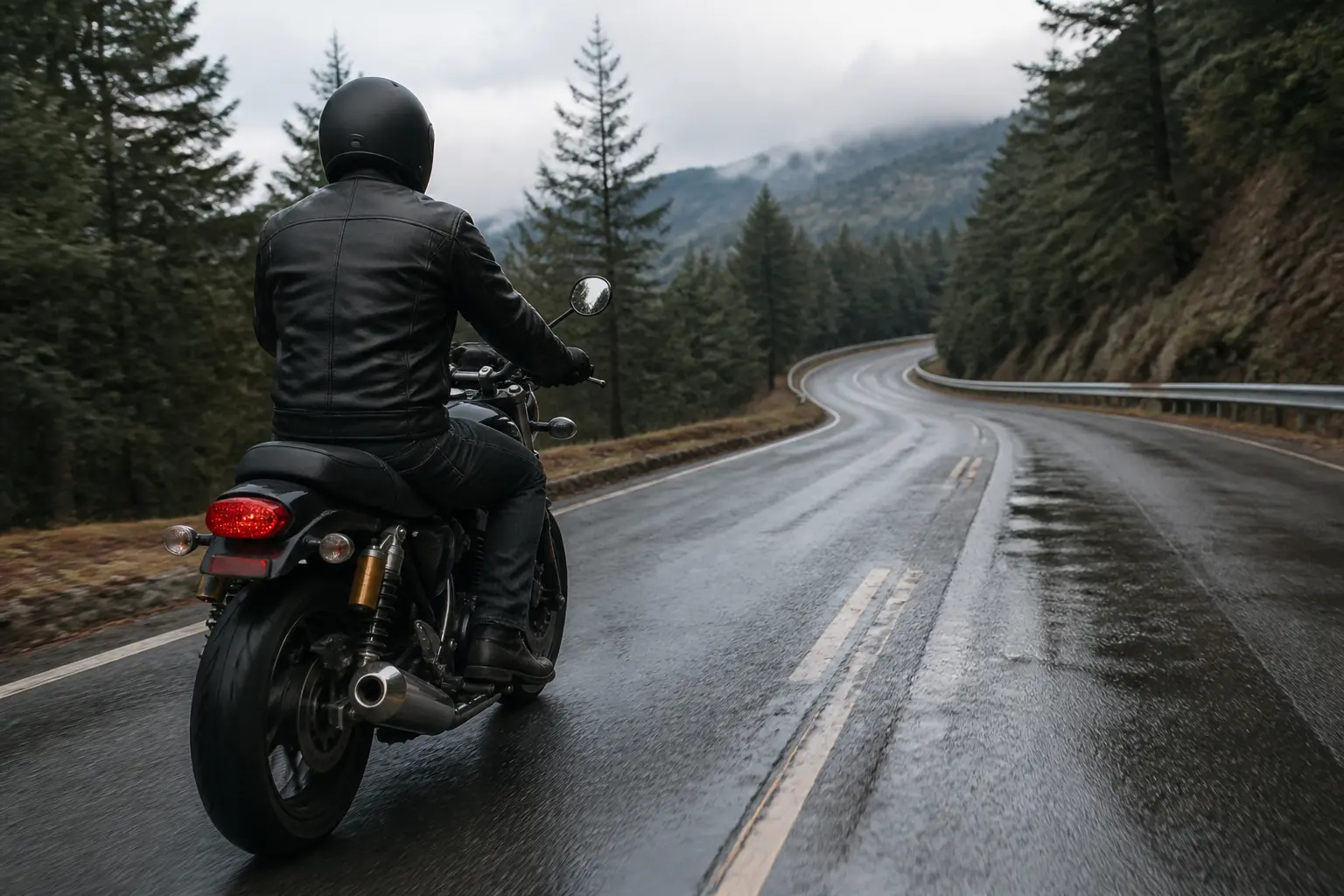
Early observation is one of the best ways to protect a traction margin. Search well beyond the front of the motorcycle and keep updating the picture as you approach. You are not trying to diagnose pavement from a distance; you are looking for reasons to arrive with less speed and more room.
Useful visual prompts include:
- Water, reflected light, or areas that appear darker than the surrounding road.
- Loose material near junctions, construction entrances, shoulders, and turning areas.
- Leaves, mud, or debris collected along the usual wheel tracks.
- Surface repairs, ridges, uneven joints, and abrupt texture transitions.
- Vehicles that obscure your view of the lane ahead.
- Shadows, glare, spray, dusk, or other visibility limits.
- Brake lights, queues, pedestrians, or cross traffic near a questionable surface.
A clue does not prove exactly what the tires will encounter. It gives you a reason to avoid committing to an arrival speed that leaves no room for revision. If you can see that a truck is masking the road ahead, for instance, the sensible action is not to guess what is behind it. It is to leave enough time to discover it.
Keep the scan broad. Fixating on a patch of debris can reduce awareness of the traffic beside you, the changing roadway beyond it, or a safer open space. Look where you intend to travel while continuing to monitor the hazard in context. This supports a more stable, deliberate response than staring at the object you hope not to hit.
Build the margin with speed, space, and simplicity
A conservative traction margin is built before the tires reach the poor surface. The goal is to reduce the chance that a normal surprise becomes an emergency. The following table turns that principle into ride-planning choices.
| Situation | Conservative question to ask | Margin-building response |
|---|---|---|
| Road looks wet or reflective | Can I clearly judge the lane ahead? | Reduce speed earlier and extend the gap to traffic. |
| Loose material appears near a bend | Can I make a simple path without abrupt changes? | Slow before the area and avoid arriving with a large turning or braking demand. |
| Traffic blocks the view | What could be hidden beyond the vehicle? | Preserve time and avoid following so closely that its braking dictates yours. |
| Surface changes near an intersection | Are other road users likely to create an extra demand? | Enter at a speed that permits observation and a controlled response. |
| Conditions worsen during the ride | Is my visibility and comfort still sufficient for the route? | Stop somewhere safe, wait, choose another route, or end the ride. |
Speed is often the largest adjustable factor. Reducing it early is different from waiting until the front tire reaches the hazard and then trying to solve everything at once. Early speed reduction gives the rider more time to scan, more room to use progressive braking, and more freedom to choose a simpler line.
Space is just as important. A following distance that feels acceptable on an open, dry road may be inadequate when spray, loose material, or hidden pavement changes are possible. Additional room helps you avoid mirroring a sudden action from the vehicle ahead. It also gives you time to see whether that vehicle has passed through water, debris, or a road defect.
Simplicity means resisting the urge to solve every uncertainty with a sharp maneuver. If traffic allows, choose a stable path and let the motorcycle travel through the section with minimal extra requests. If traffic does not allow that, recognize the limitation early and reduce the pace accordingly.
Keep major braking and lean demands separated when possible
Road geometry can make a perfectly straight approach impossible, but planning can still reduce competing demands. A motorcycle that is leaned is already using its tires to follow a curved path. Adding a substantial braking request, a rushed steering input, or a sudden surface change can reduce the available room for error.
The MSF Operator Manual addresses traction limits in a lean and braking in curves. The street-riding lesson is not an absolute prohibition that ignores real traffic conditions. It is to plan so major speed changes occur before the curve or before the uncertain patch whenever practical and safe.
That begins with the approach. Look toward the curve exit as early as visibility allows. If the exit is hidden, treat that lack of information as a reason for a more restrained entry. If you see wet pavement, scattered gravel, stopped traffic, or an irregular repair after turn-in, the best available action may be to avoid an abrupt response rather than trying to recover a pace chosen too early.
Keeping the motorcycle more upright where possible can leave more capability available for braking. But do not make a sudden correction simply to force the motorcycle upright. An abrupt change may introduce its own risk. The useful habit is upstream planning: select a speed and line that do not require a last-second correction.
A conservative entry is not wasted progress. It is a reserve of decision-making capacity. It allows the rider to see more, adjust earlier, and avoid asking the motorcycle to do several difficult things at once.
Use controlled inputs without treating smoothness as a guarantee
Smooth control use matters most when the surface is inconsistent. A controlled transition into slowing, turning, or accelerating gives the rider more opportunity to notice what the motorcycle is doing and respond without escalating the situation.
Smooth does not mean timid. It does not mean applying inadequate braking when a stop is genuinely required. It means avoiding unnecessary abruptness: a sudden demand followed by a rushed correction, then another sudden demand. In low-confidence conditions, those stacked reactions consume the margin quickly.
Think of control use as a sequence of intentional transitions:
- Notice the changing surface or reduced visibility.
- Decide whether speed, path, or route must change.
- Make the largest necessary adjustment while conditions are comparatively stable.
- Continue through the area with calm attention and minimal extra inputs.
- Reassess only after the motorcycle and traffic situation are clear.
This sequence is not a substitute for formal instruction or the directions in your owner’s manual. It is a way to organize attention under uncertainty. It reminds the rider that the preferred time to make a large decision is before reaching the least predictable part of the road.
No control input can manufacture traction. A gentle response cannot make deep water, loose gravel, oil contamination, or severe road damage safe. When the route offers no dependable path or the required action exceeds your confidence and visibility, slowing down may not be enough. The safer decision is to stop in an appropriate location or select another plan.
Wet pavement and reduced visibility require a wider buffer
Rain affects more than tire contact. It can reduce visibility, blur surface detail, collect debris in the lane, change how other drivers behave, and cover potholes or damaged pavement. Spray from larger vehicles can remove the view you need to make a measured braking decision.
Do not treat all wet roads as identical. A light dampness, a long wet stretch, and standing water create different levels of uncertainty. Rather than trying to classify every condition precisely while moving, set your pace based on what you can see and the amount of space available.
Pay particular attention when water combines with other factors: a blind bend, night glare, traffic queues, road paint, bridge joints, construction zones, or a downhill approach. The combined problem is often more significant than one surface feature alone. A route can be manageable in daylight and inappropriate later when rain and darkness erase the information needed to maintain a conservative margin.
If your visor, lighting, or weather exposure prevents you from seeing far enough ahead to make gradual decisions, reduce speed to match the available sight distance or stop safely. Continuing at a pace borrowed from dry, clear conditions is not a sound substitute for visibility.
Loose material, uneven pavement, and changing road texture
Sand, gravel, soil, leaves, and other loose material can appear where a rider least expects it. Turning traffic may move debris across a junction. Construction activity may change a road between morning and evening. Wind and rain can redistribute material. Organic debris can also conceal the texture beneath it.
Where possible, identify the safer path early without crossing into a new traffic conflict. The shoulder, opposite lane, and road edge are not automatically safe alternatives; they may contain more loose material, irregular pavement, drainage features, or other hazards. A path is only useful if it remains lawful, visible, and compatible with the surrounding traffic.
Uneven pavement deserves the same planning mindset even when it is not visibly slippery. Ridges, depressions, cracked repairs, and transitions can disturb the motorcycle’s movement and make precise braking or steering more difficult. Approach them with enough time that you are not still making a major adjustment as you arrive.
If the motorcycle feels unsettled after crossing a rough or loose section, avoid responding with a string of sharp corrections. Continue to look ahead, maintain room around other road users, and allow the situation to stabilize before returning to ordinary pace. Your mental state matters too. A rider who tenses up or rushes to regain speed may miss the next hazard immediately beyond the first.
Low-Grip Surface Pre-Ride Checklist
Use this checklist before a ride when weather, route conditions, or season suggest uncertain traction:
- Check the route context: Identify unfamiliar roads, construction areas, bridges, shaded sections, rural lanes, steep grades, and locations where surface changes are likely.
- Check the timing: Consider whether darkness, rain, fog, wind, or temperature changes could reduce visibility or alter the road during the ride.
- Check motorcycle readiness: Follow the owner’s manual for required checks of tires, brakes, controls, lights, and any warning indicators.
- Set a slower default: Decide in advance to reduce pace before corners, junctions, crests, and places where the road cannot be read clearly.
- Plan extra following space: Leave enough room to see around traffic and slow without depending on a sudden response.
- Identify safe stop options: Notice fuel stations, pull-offs, parking areas, or other legitimate places where you could reassess if conditions deteriorate.
- Choose a turnaround trigger: Be willing to stop, wait, reroute, or return if visibility, road condition, traffic pressure, fatigue, or confidence erodes.
A broader maintenance routine supports this preparation. The Motorcycle Maintenance Guide can help organize manufacturer-first inspection and service decisions. If you notice a warning indication, tire damage, changed brake feel, or another mechanical concern, do not use a riding article to diagnose it. Follow the manufacturer’s guidance and arrange qualified inspection where appropriate.
Traffic can spend your traction margin too
A poor surface becomes harder to manage when traffic compresses your options. The vehicle ahead may brake abruptly. A vehicle behind may follow too closely. A large truck can hide water, debris, or stopped traffic until the final moment. A vehicle alongside can remove the space you expected to use.
This is why separation is a riding control, not merely a courtesy. A larger gap can turn a sudden brake light into a gradual response. It can also give you time to avoid riding directly into a patch the vehicle ahead has just revealed.
At intersections, assume several demands may overlap: turning vehicles, lane markings, changing pavement, stopped traffic, and limited sight lines. Enter with a speed that preserves observation. At blind bends and crests, make room for information you do not yet possess. The point is not to predict the exact surprise. It is to avoid traveling so fast that any ordinary surprise requires an extraordinary action.
If another road user pressures you from behind, avoid retaliatory braking or an unpredictable lane move. Continue with lawful, deliberate choices and seek a safe opportunity to increase separation. Maintaining composure protects the margin better than allowing another rider or driver to dictate an unsafe pace.
Know when slowing is no longer enough

There is a point where a lower speed does not fully solve the problem. If water, debris, road damage, fog, darkness, traffic density, or mechanical concerns prevent a predictable path, reassessment is the safer response.
Consider stopping in a safe place when you cannot see enough road to make progressive decisions, when surface conditions deny a reasonable route through the lane, or when traffic has eliminated a viable escape option. The same applies when you are becoming fatigued, tense, or increasingly uncertain about the motorcycle’s behavior.
Stopping is not an admission of poor skill. It is a decision to avoid transferring uncertainty to the tires. Waiting for weather to ease, choosing a different road, seeking assistance, or returning another day can be the most capable choice available.
How Vojo Helps
Before an uncertain-weather ride, create a condition note in your motorcycle service history that records the route, expected weather, and any manufacturer-required inspection items you completed. After the ride, add observations such as recurring gravel near a junction, reduced visibility on a particular stretch, or a decision to turn around. If you notice a motorcycle concern, create a dated reminder for the next owner-manual-recommended check or qualified inspection. This produces a useful record for planning future rides without treating an app as a replacement for training, the owner’s manual, or professional service.
Download Vojo on the App Store
Final takeaway: protect the margin before the hazard
Low-grip braking is best managed before braking becomes urgent. Search for changes early, reduce speed before the uncertain area, maintain space, simplify the motorcycle’s tasks, and keep a genuine alternative available. A calm, conservative plan cannot remove every road hazard, but it can reduce the chance that a changing surface forces a last-second decision.
The strongest result is rarely a dramatic recovery. It is recognizing uncertainty soon enough that you do not need one.
Quick answers
Frequently asked questions
What is the first thing to do when I notice a low-grip surface ahead?
Create time and space before reaching it. Reduce speed early, increase separation from traffic where practical, choose a simple path, and avoid waiting until the motorcycle is already on the uncertain section to make a large decision.
Should I avoid braking while leaned over?
Plan major speed reduction before a turn whenever practical. Leaning and braking can place simultaneous demands on available traction, especially when the surface is uncertain. If an immediate hazard requires action, rely on formal training and your motorcycle manufacturer’s guidance rather than a universal rule.
Does ABS make wet or loose surfaces safe for motorcycle braking?
ABS may support braking control in some circumstances, but it does not create traction, improve visibility, or remove the risks from water, loose material, excessive speed, or poor route choices. Follow the owner’s manual for your motorcycle’s system and its limitations.
How much following distance should I use on uncertain pavement?
Use enough space to see developing hazards and slow progressively without copying a sudden action from the vehicle ahead. The appropriate amount changes with speed, visibility, traffic, and road condition, so increase it as certainty decreases.
When should I stop riding because of road conditions?
Stop, wait, or reroute when you cannot see far enough to make measured decisions, the road surface offers no predictable path, traffic removes your options, conditions are worsening, or a mechanical concern affects confidence in the motorcycle.