
Motorcycle Railroad Crossings: A Straight-Line, Low-Surprise Approach
Use a calm motorcycle railroad crossing plan: slow early, scan beyond the rails, cross as close to perpendicular as practical, and keep inputs smooth.
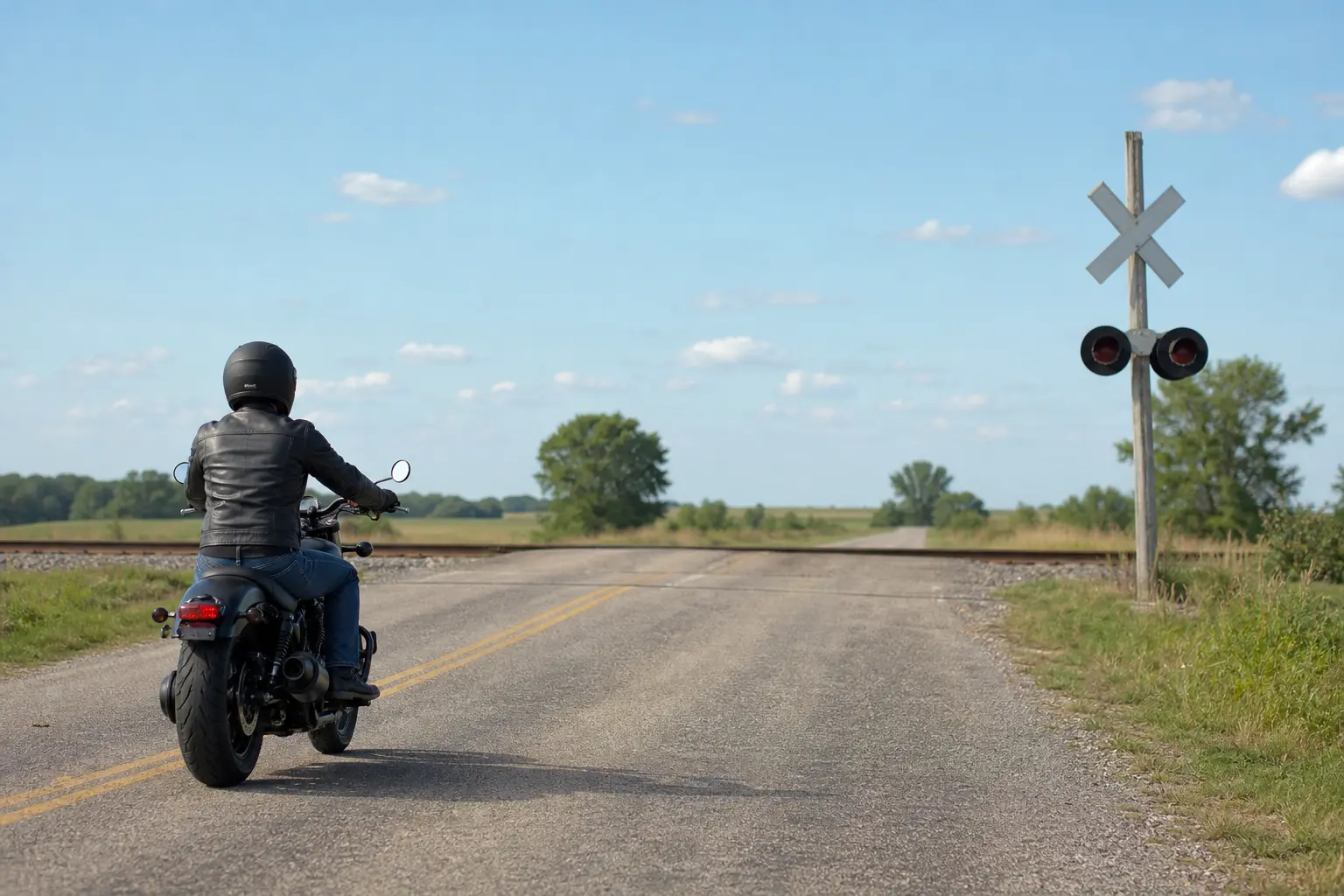
Fact-checked against cited official documentation
Reviewed against Fact-checked against Motorcycle Safety Foundation guidance on railroad crossings, changing surfaces, visibility, time and space, smooth control, and escape paths..
Last updated October 28, 2026
Railroad tracks are not just another change in pavement. A motorcycle has to manage a narrow, potentially uneven surface while preserving balance, traction, visibility, and room to respond to traffic. The safest crossing is usually the one you identify early and approach without rushing.
The central idea is simple: reduce surprises before the front wheel reaches the rails. Search ahead for the crossing, assess the angle and surface, create enough time and space to slow, and cross as close to perpendicular as the road and traffic situation allow. Keep the motorcycle stable, make deliberate inputs, and do not allow a following driver or a missed turn to force a hurried approach.
This is a riding plan, not a substitute for the motorcycle manufacturer’s owner’s manual, local law, or formal training. Motorcycle Safety Foundation guidance also emphasizes preparing before a ride, searching for changing road conditions, preserving time and space, and maintaining escape options. See the Motorcycle Safety Foundation’s riding tips and If You Ride a Motorcycle for the underlying official guidance.
Why Railroad Crossings Deserve a Separate Plan
A crossing can combine several problems at once:
- Rails may sit above or below the surrounding pavement.
- The track may cross the lane at an awkward, shallow angle.
- The surface may be wet, dirty, polished, patched, or uneven.
- Road markings, flangeway gaps, or surrounding pavement may interrupt your preferred path.
- A vehicle ahead may conceal the crossing until the last moment.
- A vehicle behind may make you feel pressured to maintain speed.
- A second track, traffic signal, stop sign, or turn may compete for your attention.
- Sightlines may be poor because of buildings, vegetation, parked vehicles, or the rail alignment itself.
The danger is not limited to the metal rail. The approach can also involve a sudden change in direction, a rushed brake application, a low-speed wobble, or a need to alter your line while the motorcycle is crossing a less forgiving surface.
A good plan therefore has three phases: prepare before the crossing, cross with as little unnecessary disturbance as possible, and regain a normal riding rhythm only after the motorcycle is clear. That sequence helps you avoid treating the rails as an isolated obstacle.
The Straight-Line Principle: Choose the Best Available Angle
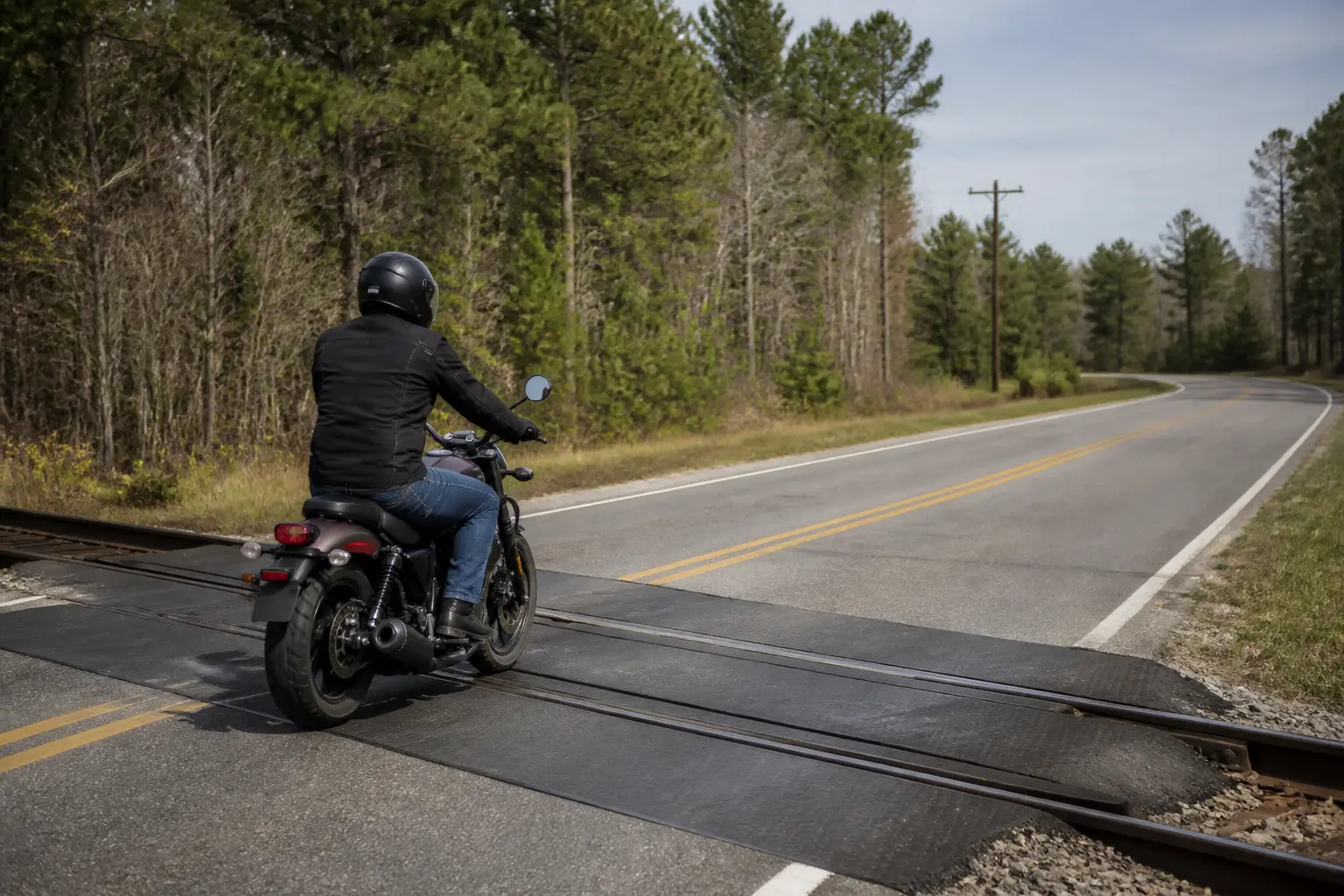
When a rail crosses the road diagonally, the motorcycle may encounter it at a shallow angle. That can require a longer period of contact with the rail and can make the front wheel more likely to follow or deflect from the intended path. The general riding objective is to cross the rail as close to perpendicular to the track as conditions permit.
“Perpendicular” is a planning reference, not a command to make a dramatic swerve. Never cut across a lane, enter an opposing lane, cross a solid boundary, or move into another road user’s path merely to improve the angle. A legal, visible, controlled path is more important than achieving a mathematically perfect line.
Use this order of priorities:
- Stay in a legal, usable portion of your lane.
- Select a line that approaches the rail as directly as practical.
- Avoid unnecessary steering while the tires are on the rail or rough surrounding surface.
- Leave room for traffic, debris, and a safe correction.
If the crossing is extremely skewed, the best available line may still be imperfect. In that case, reduce your approach speed early, choose the cleanest legal path, and make the motorcycle as stable and upright as the roadway allows. Do not wait until the front tire is at the rail to decide where you are going.
The same principle applies when several rails or track panels are present. Look beyond the first rail and plan for the whole crossing. A line that works for the first rail may place you poorly for the next one.
Prepare Before the Front Wheel Reaches the Rails
Preparation begins when you first recognize the crossing, not when you are a few feet away. Use your visual search to answer practical questions: Is a train approaching? Is the crossing active or blocked? What is the traffic doing? Is the surface dry and clean? How sharply does the rail meet the road? Where is the clearest legal path?
Then create time and space. Roll off or reduce speed early enough that you are not forced into abrupt braking at the rail. The exact speed depends on the motorcycle, road design, visibility, traffic, surface, and your ability; there is no universal safe crossing speed that fits every rider or crossing.
Before the crossing, complete as much of the decision-making as possible:
- Identify whether you need to stop, continue, or choose another route.
- Check behind you so a speed reduction does not become a surprise to a following driver.
- Scan for vehicles entering from side roads and for pedestrians near the track.
- Look beyond the rail rather than staring at the near edge.
- Select a path with the least abrupt surface change.
- Make sure the motorcycle is settled before it reaches the rail.
The Motorcycle Maintenance Guide can help you keep routine readiness separate from on-road decision-making. A crossing plan works best when basic motorcycle condition, tire condition, controls, and required equipment have already been handled according to the owner’s manual.
Smooth Inputs Matter More Than Bravery
A railroad crossing is a poor place for a last-second experiment. Sudden braking, a sharp steering correction, or an abrupt change in acceleration can disturb the motorcycle when the tires are dealing with an uneven or lower-traction surface.
Aim for a settled motorcycle and smooth controls. That means reducing speed before the rail, choosing the line early, and avoiding unnecessary changes while crossing. Keep your attention moving: look through the crossing, maintain awareness of traffic, and be ready to respond if the surface or situation differs from your first assessment.
Smooth does not mean passive. If the crossing is unsafe, stop where stopping is legal and safe, or choose another route. If a train, congestion, poor visibility, or a blocked lane changes the situation, reassess rather than trying to preserve your original plan.
Do not let a vehicle behind you dictate your timing. A driver’s impatience is not a reason to carry excess speed into a crossing. A clear brake light and an early, predictable reduction in speed give other road users more opportunity to understand what you are doing, but you must still allow for drivers who do not react appropriately.
Wet, Raised, Dirty, or Uneven Crossings
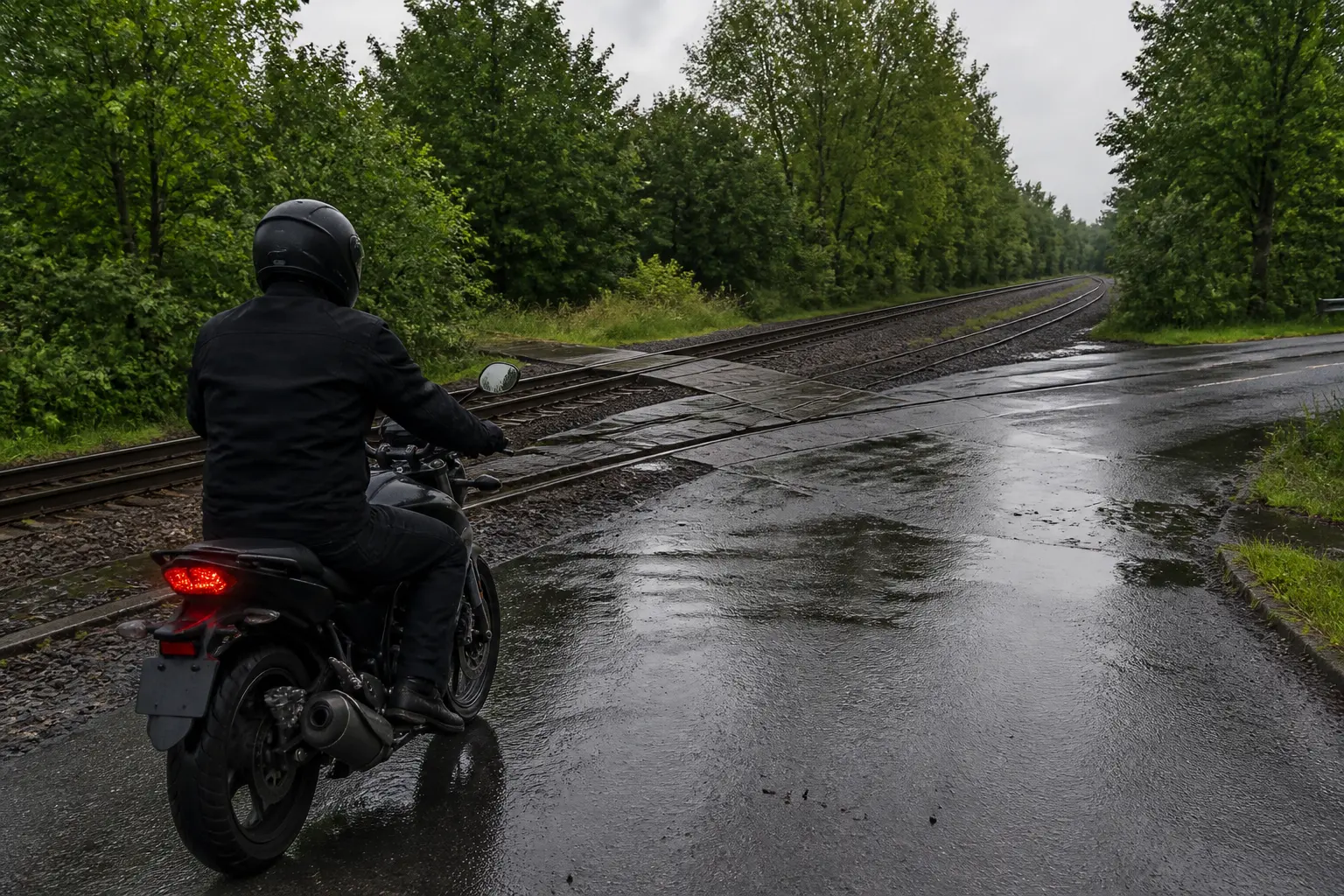
The crossing deserves extra margin when the rails or surrounding pavement are wet, muddy, oily-looking, covered with leaves, or visibly damaged. Metal and painted or sealed surfaces may not offer the same confidence as clean, dry pavement. Raised rails, depressions, gaps, and abrupt edges can also alter the motorcycle’s path.
Treat the entire area as a changing road surface rather than focusing only on the shiny strip of rail. Search for standing water, loose material, broken pavement, and places where the road funnels a tire toward an edge. If you cannot see the surface clearly, assume the approach deserves more time and less speed.
A conservative response is to:
- Slow while the motorcycle is still on predictable pavement.
- Keep the motorcycle’s path deliberate and avoid leaning more than necessary.
- Cross the rail and adjacent irregularities on the cleanest legal line.
- Avoid abrupt throttle, braking, or steering changes on the questionable surface.
- Continue scanning after the crossing for a second hazard or a slippery exit.
There is no universal maneuver that makes a wet or damaged crossing safe. If the surface, visibility, traffic, or train activity exceeds your available margin, stopping or rerouting may be the better decision.
Sightlines, Signals, and the Space Beyond the Track
A crossing can look manageable from a distance and become difficult when a vehicle, building, hedge, or curve hides the exit. Look through the crossing and identify what happens immediately afterward. Is there a stopped queue? A turn? A traffic signal? A narrowing lane? A driveway? Another set of rails?
Search for trains and obey crossing signals, gates, signs, and local traffic controls. Never attempt to go around a lowered gate or disregard a warning because the crossing appears empty. If a train is approaching, stopped, or blocking the route, wait in a safe position and follow the crossing’s controls. Keep clear of the tracks and do not position the motorcycle where a small forward or backward movement would place it in danger.
Poor sightlines also affect your lane choice. You may need to prioritize visibility over the shortest path. Avoid riding alongside a vehicle that blocks your view of the track area. If traffic prevents a clear assessment, create distance or wait rather than entering a situation you cannot see.
The official MSF material frames this kind of riding as a search for changing conditions with enough time and space to respond. That is especially useful at rail crossings because the hazard often includes both the surface and the traffic environment around it.
A Practical Decision Table
| Situation | Main concern | Conservative response |
|---|---|---|
| Clean, dry crossing with a clear approach | Choosing a stable line | Slow early, scan beyond the rails, and cross as directly as the lane permits. |
| Rail crosses at a shallow angle | Tire deflection and extended contact with the rail | Select the most direct legal line before arrival; avoid a last-second swerve. |
| Wet or dirty surface | Reduced confidence and changing traction | Add time and space, reduce speed on predictable pavement, and keep inputs smooth. |
| Raised rail, gap, or rough pavement | Sudden change in the motorcycle’s path | Look through the whole crossing, choose the cleanest legal path, and avoid abrupt corrections. |
| Poor sightline or blocked view | Late discovery of traffic or surface hazards | Slow or wait until you can assess the crossing and exit. |
| Following vehicle close behind | Pressure to hurry | Remain predictable, preserve your margin, and do not let the following driver set your speed. |
| Multiple rails or a wide crossing | Attention and line can be lost between rails | Plan for the full width, not only the first rail; keep scanning after each surface change. |
| Train, gate, or warning signal active | Collision risk and legal control | Stop and wait in a safe position; obey the crossing controls and never bypass a gate. |
The table is a planning aid, not a substitute for observing the actual crossing. Road design and conditions can change from one block to the next.
Motorcycle Railroad Crossing Checklist
Before the approach
- Identify the crossing early enough to make a calm decision.
- Search for trains, gates, signals, signs, pedestrians, and nearby traffic.
- Check mirrors and understand what vehicles behind you are doing.
- Scan the entire crossing, including the exit and any second rail.
- Assess the angle, surface condition, visibility, and available lane space.
- Choose the cleanest legal line as close to perpendicular as practical.
- Reduce speed before the uneven or questionable surface.
- Decide whether stopping or rerouting provides a better margin.
At the crossing
- Keep the motorcycle settled and your path deliberate.
- Look through the crossing rather than fixating on the nearest rail.
- Keep steering, braking, and acceleration inputs smooth.
- Avoid a last-second lane change or dramatic angle correction.
- Maintain awareness of vehicles that may pass, crowd, or turn around you.
- Treat wet, dirty, raised, or broken surfaces as higher-risk conditions.
After the crossing
- Continue scanning for a second rail, debris, traffic queue, or turn.
- Confirm the motorcycle is stable before returning to normal pace.
- Recheck traffic if the crossing required a speed change or unusual line.
- If the approach felt uncontrolled, treat that as feedback for future route planning or skills practice.
Common Mistakes and Better Alternatives
Waiting too long to slow
A rider notices the rails late, brakes sharply, and arrives unsettled. The better alternative is to recognize crossings as part of the forward search and reduce speed while the motorcycle is still on ordinary pavement.
Chasing a perfect angle
A rider makes an aggressive move across the lane to approach at a more ideal angle. That can create a larger traffic risk than the rail itself. Choose the best legal line available and prioritize stability, visibility, and space.
Looking only at the near rail
The rider clears one rail and is surprised by a second rail, a rough patch, or stopped traffic. Look through the whole crossing and plan the exit before entering.
Letting a follower set the pace
A close vehicle can make a rider feel compelled to maintain speed. Preserve your decision-making margin. Predictability is useful, but you are not required to sacrifice control to satisfy an impatient driver.
Treating dry rails as harmless
A dry crossing may still be raised, uneven, angled, or surrounded by loose material. Surface appearance is only one part of the assessment.
Using the crossing to practice a new technique
A public crossing is not a training area. Build skills in a controlled environment through appropriate instruction and practice, then apply familiar techniques conservatively on the road.
Assuming every crossing is the same
The next crossing may have a different angle, traffic pattern, surface, or sightline. Reassess each one rather than repeating a memorized maneuver.
When Waiting or Rerouting Is the Right Call
A conservative rider is not obligated to cross every railroad track immediately. Waiting makes sense when a signal or gate requires it, when a train blocks or approaches the crossing, or when traffic leaves no safe path. It may also be sensible when heavy rain, glare, darkness, flooding, severe surface damage, or a blocked view prevents a reliable assessment.
Rerouting is worth considering when the crossing is unusually skewed and the surrounding traffic does not allow a stable legal line, or when the exit is congested and you would have nowhere to go after the rails. A route that adds distance can still be the safer route if it restores visibility, traction, and space.
If you stop, choose a position that follows the crossing controls and keeps the motorcycle away from the track area. Do not stop on the rails while waiting for traffic to move. If you cannot identify a safe place to continue, remain patient and reassess rather than allowing a vehicle behind you to create urgency.
Make the Plan Before the Ride
Crossing decisions are easier when the broader ride is not already operating at the edge of your attention. Leave enough time for the route, expect that conditions may change, and avoid building a schedule that rewards rushing. Fatigue, poor weather, unfamiliar roads, and a passenger or group can all reduce the margin available for a crossing decision.
For a route with many industrial streets, rural tracks, or unfamiliar towns, review the route before departure. Mark likely crossing areas if your navigation tools show them, but do not assume a map captures the current surface condition or traffic control. Treat route information as preparation, then confirm what is actually in front of you.
If riding with others, agree that anyone may slow or stop for a crossing without pressure. The following riders need enough space and visibility to make their own assessment. A group should not turn one rider’s cautious decision into a compressed line of motorcycles approaching the same hazard.
Manufacturer-first guidance remains important. Use the owner’s manual for motorcycle-specific operating information, loading limits, tire requirements, and any warnings that affect control. Official training guidance can supplement—not override—the manufacturer’s instructions and local crossing rules.
How Vojo Helps
Use Vojo to turn this advice into a repeatable pre-ride workflow. Before leaving, open the route and note railroad crossings or industrial sections where the surface may change. In your ride notes, record a simple decision cue: “slow early, scan the exit, choose the best legal angle, and keep inputs smooth.” After the ride, log any crossing that required an unexpected stop, reroute, or unusually cautious approach. That record can help you choose a better route next time without pretending that a past crossing will have identical conditions.
Keep the motorcycle-readiness side of that workflow in Vojo’s motorcycle maintenance tracker, where routine checks can be separated from the on-road crossing decision. The goal is a calm sequence: maintain the motorcycle according to its documentation, preview the route, preserve time and space, and reassess each crossing as it appears.
Quick answers
Frequently asked questions
What angle should a motorcycle use to cross railroad tracks?
Cross as close to perpendicular to the rail as the road, traffic, and legal lane position allow. Do not make a sudden swerve or cross into another lane to achieve a perfect angle; choose the best stable, visible, legal path available.
Should I slow down before or on the railroad tracks?
Plan to reduce speed before reaching the rails, while the motorcycle is still on more predictable pavement. Arriving settled helps avoid abrupt braking or steering changes on an uneven or potentially lower-traction surface.
What should I do if railroad tracks are wet?
Add time and space, assess the whole crossing, and keep the motorcycle stable with smooth inputs. If the surface, visibility, traffic, or train controls leave too little margin, wait or choose another route.
Is it safe to cross railroad tracks at an angle?
A shallow angle can make the crossing more difficult because the motorcycle may spend longer following the rail or encounter a sharper disturbance. Use the most direct legal line practical, without making a hazardous lane change or sudden correction.
What if a car is following me closely at a railroad crossing?
Do not let the following driver dictate your speed. Reduce speed early and predictably, preserve your control margin, and cross only when the surface, traffic, and crossing controls allow a safe decision.
Should I stop before every motorcycle railroad crossing?
Not necessarily. Follow the crossing signals and local traffic controls, then assess the actual surface, sightline, train activity, and traffic. Stop or reroute when continuing would not leave a reasonable margin.