
Motorcycle Riding in Strong Wind: A Go/No-Go and Lane-Position Plan for Gusts
Motorcycle riding in high winds calls for a conservative go/no-go decision, windward lane margin, route changes, and passenger awareness.
Fact-checked against cited official documentation
Reviewed against MSF wind, passenger, and general rider-safety guidance was used to verify windward lane margin, passenger caution, owner-manual checks, and riding within situational limits..
Last updated September 28, 2026
Wind does not make every ride impossible, but it can make a familiar route demand far more attention than usual. The practical question is not whether you can tolerate a shove from the side; it is whether you can preserve a predictable path, keep useful space around the motorcycle, and still have attention left for traffic.
The Motorcycle Safety Foundation (MSF) treats strong and especially gusty side winds as a handling challenge. Its guidance is to anticipate displacement, lean as needed to hold position, and keep the motorcycle toward the side of the lane the wind is coming from—creating room if a gust moves you downwind. (msf-usa.org)
Start with your motorcycle’s owner’s manual. It is the manufacturer’s source for approved passenger use, load limits, tire-pressure settings, and any setup guidance. If the bike is loaded, carries a passenger, or has an unfamiliar accessory setup, make the decision more conservative rather than assuming a solo, unladen ride plan still applies.
Make the Go/No-Go Call Before You Roll
There is no single wind-speed number that automatically makes every motorcycle ride safe or unsafe. The meaningful limit depends on gustiness, exposure along the route, your motorcycle and load, your experience, and how much attention the ride will consume.
Use this decision table before departure:
| Situation | Conservative decision | Why it matters |
|---|---|---|
| You expect a steady crosswind and have experience riding your motorcycle in similar conditions | Go, with a reduced-margin plan | Plan lane space and reassess often rather than treating the forecast as a guarantee. |
| Gusts are inconsistent, the route has exposed sections, or you already feel tense before leaving | Delay, shorten, or reroute | Variable inputs make it harder to maintain a repeatable line and attention reserve. |
| You cannot hold a calm, predictable path during the first exposed section | Stop riding when safely possible | Continuing while overloaded removes time and space for traffic decisions. |
| You are carrying a new passenger, substantial luggage, or both | Use a higher no-go threshold | Added weight affects handling, and MSF notes side-wind effects may be more pronounced with a passenger. (msf-usa.org) |
| Wind combines with rain, poor visibility, fatigue, or a demanding route | Postpone if practical | Stacked hazards shrink the margin available for each individual problem. |
A ride can move from “go” to “no-go” after you leave. That is good judgment, not failure. Pick a route with realistic places to pause before entering the most exposed portion, and make turning back an acceptable option.
A Lane-Position Plan for Crosswinds and Gusts
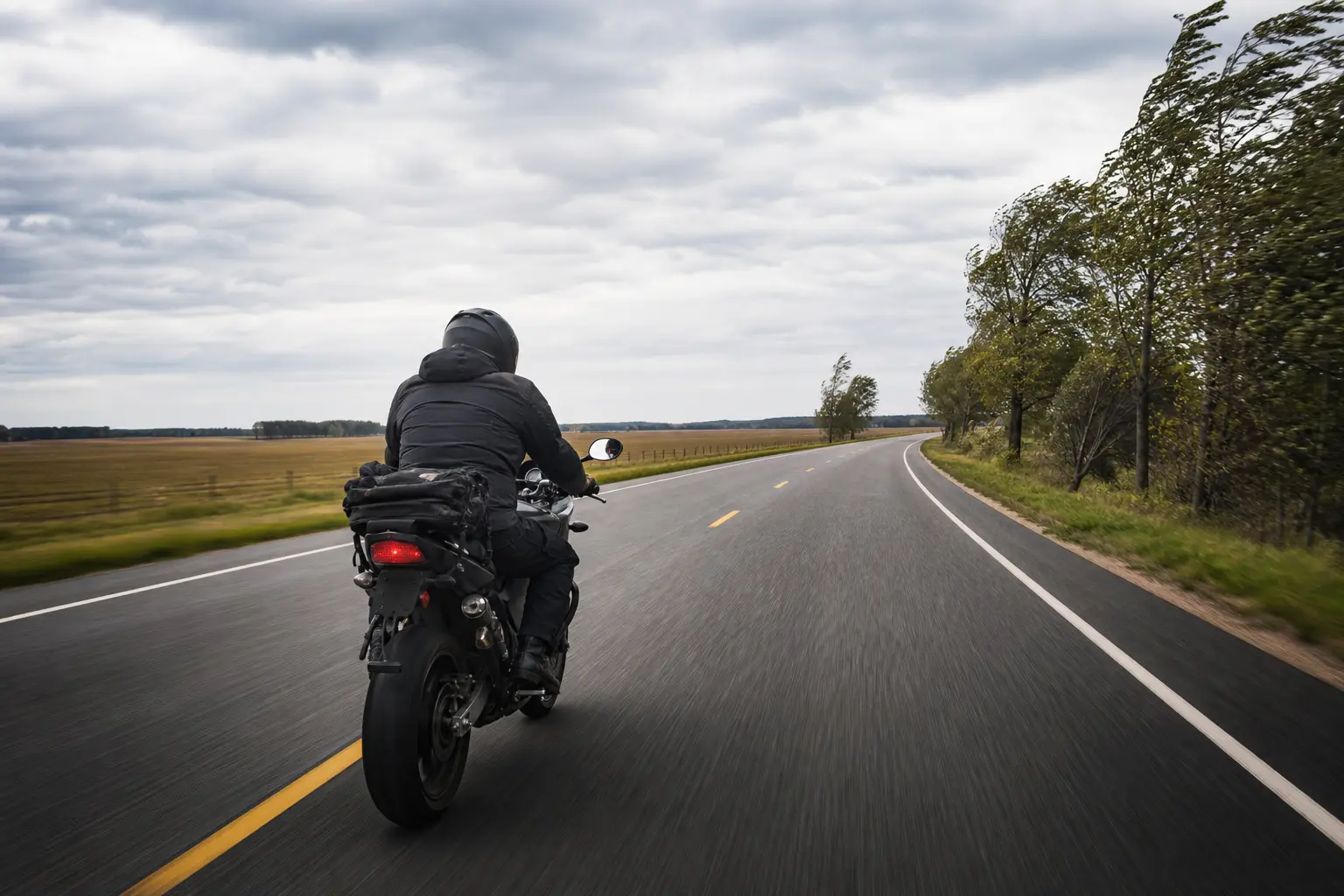
Think of lane position as a buffer, not a fixed stripe to occupy. When the wind comes from one side, leave more usable room on the other side. MSF specifically advises riding on the side of the lane the wind is coming from so a strong blast has space to move the motorcycle without immediately carrying it toward the lane edge. (msf-usa.org)
Use that idea with traffic, sightlines, pavement condition, and local lane rules—not as permission to crowd a line or another vehicle.
- Identify the windward side. If the wind is arriving from your left, begin with room available to your right; reverse that logic for wind from the right.
- Look well ahead for changing exposure. A protected stretch can feel manageable while an open section requires a fresh assessment. Do not let a calm moment convince you the wind has disappeared.
- Keep your inputs smooth. Hold a relaxed, purposeful posture and make small corrections rather than reacting with abrupt steering, braking, or acceleration.
- Protect an escape margin. Do not use the entire lane as though the wind will remain steady. Keep space for an unexpected drift and for normal traffic hazards.
- Reassess around complex traffic. If high-speed traffic, large vehicles, merges, curves, or limited shoulders leave you with little room to absorb a gust, reduce the demand: slow the plan, change routes, or stop.
The aim is not to “win” against the wind. It is to place the motorcycle where a normal gust is less likely to use up all of your lane margin.
Passenger, Load, and Fatigue: Raise the Bar
A passenger is not a minor detail on a windy day. MSF says extra weight and a passenger’s independent movement change handling, and it specifically identifies side-wind effects as potentially more pronounced. It also directs riders to review the owner’s manual for setup guidance and weight limits. (msf-usa.org)
For a two-up or loaded ride:
- Confirm that the motorcycle is designed and equipped to carry the passenger.
- Follow the exact manual for load, tire, and setup information rather than copying settings from another bike.
- Brief the passenger to remain seated correctly, keep feet on the footrests, avoid sudden movements, and look through turns with you.
- Choose an easier route and leave more time than you would for a solo ride.
- Treat early fatigue, repeated lane corrections, or passenger discomfort as a reason to stop and reconsider.
MSF also recommends riders use time and space deliberately, avoid riding when tired, and operate within both skill and situational limits. (msf-usa.org) In high wind, those limits may arrive much sooner than expected.
Strong-Wind Motorcycle Riding Checklist

Before departure
- Read the forecast as a planning signal, then identify whether the route includes exposed roads, bridges, open terrain, or sustained high-speed sections.
- Check the owner’s manual for motorcycle-specific passenger, cargo, tire, and setup requirements.
- Complete a normal pre-ride check; use the Motorcycle Maintenance Guide if you need a broader routine.
- Wear secure protective gear and eye protection; avoid loose items that can distract or flap excessively.
- Choose a shorter or more sheltered alternative route before you need it.
- Decide in advance where you can pause, turn around, or wait out worsening conditions.
While riding
- Start with an intentionally conservative pace and reassess at the first exposed section.
- Hold a windward lane position while preserving space in the direction a gust may move you.
- Scan ahead for changing traffic, surface, and exposure—not only the wind itself.
- Use smooth, modest control inputs and avoid turning every gust into an emergency.
- Increase the margin if carrying a passenger or load.
- Stop safely and revise the plan if your line, focus, or confidence is no longer predictable.
When Training Is the Better Answer
Wind management uses the same foundation as other street-riding skills: looking ahead, maintaining a stable path, managing space, and making calm decisions before a problem becomes urgent. If gusts consistently make you tense or unpredictable, do not use public roads as the practice area.
A hands-on rider course or refresher gives you a controlled place to improve core control skills. MSF advises formal training and refresher courses, and emphasizes knowing how to operate in adverse conditions, including high winds. (msf-usa.org)
FAQ
Should I cancel a motorcycle ride because of wind?
Cancel, delay, or reroute when the conditions exceed your ability to keep a calm, repeatable path with lane margin and attention left for traffic. Gusty wind, fatigue, a passenger, cargo, rain, and an exposed route are reasons to make that threshold more conservative.
Where should I ride in the lane in a crosswind?
Use the windward side of the lane while leaving room in the downwind direction. MSF recommends this approach so a strong gust has room to move the motorcycle without immediately pushing it toward the lane edge. (msf-usa.org)
Is gusty wind worse than a steady crosswind?
Usually, gusts demand more caution because they are less predictable. A steady wind can still require a sustained lean and lane-position plan, but gusts make it more important to retain unused lane margin and reassess frequently.
Does a passenger make riding in wind harder?
It can. MSF states that a passenger changes motorcycle handling through added weight and independent movement, and that side-wind effects may be more pronounced. Follow the motorcycle manufacturer’s passenger and load guidance, then choose a more conservative route and pace. (msf-usa.org)
What should I do if wind is making me work too hard to stay in my lane?
Do not try to muscle through the entire ride. When safe, exit the situation, stop in a secure location, and choose a sheltered route, wait for conditions to improve, or end the ride. Preserving a safe decision margin matters more than reaching the destination on schedule.
How Vojo Helps
Before a windy ride, create a ride note in Vojo that records the route, passenger or luggage status, planned stop points, and your personal no-go trigger. Afterward, log what exposure and lane-position plan felt manageable in the Motorcycle Ride App, then use that record to make the next wind decision from experience rather than memory.
Quick answers
Frequently asked questions
Should I cancel a motorcycle ride because of wind?
Cancel, delay, or reroute when you cannot confidently keep a predictable path with lane margin and attention left for traffic. Make the threshold more conservative when gusts combine with fatigue, rain, a passenger, cargo, or exposed roads.
Where should I ride in the lane in a crosswind?
Use the windward side of the lane while preserving room in the direction a gust may move the motorcycle. This follows MSF guidance intended to retain space if a strong blast shifts the bike.
Is gusty wind worse than a steady crosswind?
Gusts generally call for more caution because they are less predictable. Preserve extra lane margin, avoid abrupt reactions, and reassess the plan frequently.
Does a passenger make riding in wind harder?
Yes, it can. MSF says a passenger changes handling through extra weight and independent movement, and notes that side-wind effects may be more pronounced. Check the owner’s manual and use a more conservative plan.
What should I do if wind is making me work too hard to stay in my lane?
When safe, leave the exposed situation and stop in a secure place. Change to a more sheltered route, wait for conditions to improve, or end the ride rather than trying to force the original plan.