
Riding Near Semi-Trucks on a Motorcycle: Blind Spots, Turbulence, Passing, and Escape Margins
Use a conservative plan for motorcycle riding near semi-trucks: reduce blind-spot exposure, manage turbulence, pass deliberately, and preserve escape margins.
Fact-checked against cited official documentation
Reviewed against Fact-checked against Motorcycle Safety Foundation guidance on blind spots, lane position, escape routes, scanning, pre-ride checks, and skill practice, plus Harley-Davidson Insurance guidance on traffic, large vehicles, blind-spot exposure, and turbulence..
Last updated October 12, 2026
Large trucks deserve a different level of attention from motorcycles. The issue is not that every semi-truck driver will make an unsafe move, or that every encounter will produce a dramatic gust. The issue is that a tractor-trailer creates several risks at once: a much larger blind-spot footprint, obstructed sightlines, changing traffic around it, a long vehicle to pass, and disturbed air that can arrive when you have little room to spare.
A productive goal is not to “out-ride” the truck. It is to minimize the time you are exposed to the truck’s uncertain space while keeping enough room to slow, change lane position, or leave the situation entirely. That means avoiding long periods beside the trailer, not treating a mirror check as a guarantee of being seen, and refusing a pass when the next safe place to go is unclear.
The Motorcycle Safety Foundation advises riders to avoid the blind spots of cars and trucks, use lane position to see and be seen, give themselves time and space, and keep an escape route in mind.1 Harley-Davidson Insurance similarly emphasizes avoiding lingering beside larger vehicles, limiting blind-spot exposure, planning exits, and not riding close enough to a large truck for turbulence to become an unnecessary added risk.2
This guide turns those broad principles into a practical riding plan. It is not a substitute for your local traffic law, professional instruction, or the judgment to delay a maneuver when conditions are deteriorating.
Why semi-trucks change the risk picture
A truck is not merely a larger car. Its length changes how long you may be beside it. Its height can block your view of traffic, road debris, construction changes, and brake lights ahead. Its trailer can also conceal your motorcycle from adjacent traffic and from vehicles entering the roadway. Meanwhile, the lane next to the truck can become a place where you have little space to react if the truck changes lane, drifts with wind, slows unexpectedly, or is forced to avoid something ahead.
For a rider, the key danger is often prolonged uncertainty. You may be technically within your lane and riding legally, but still be spending too long in a place where:
- the driver may not be able to see you;
- you cannot see far enough beyond the truck to read the traffic pattern;
- a following vehicle may be focused on the trailer rather than your motorcycle;
- wind movement or air disturbance may upset your line just as you need precision; and
- your options shrink because traffic is alongside, ahead, and behind you.
This does not call for panic. It calls for a more selective approach. Before riding beside a truck, ask: What am I trying to accomplish, where will I end up, and what will I do if the truck moves toward me? If the answer is vague, staying back or changing position is usually the more conservative choice.
The core rule: do not live beside the trailer
There are moments when a motorcycle must be next to a trailer: traffic compresses, lanes merge, a truck overtakes, or the road design leaves little choice. The aim is not perfection. The aim is to avoid making that position your default cruising location.
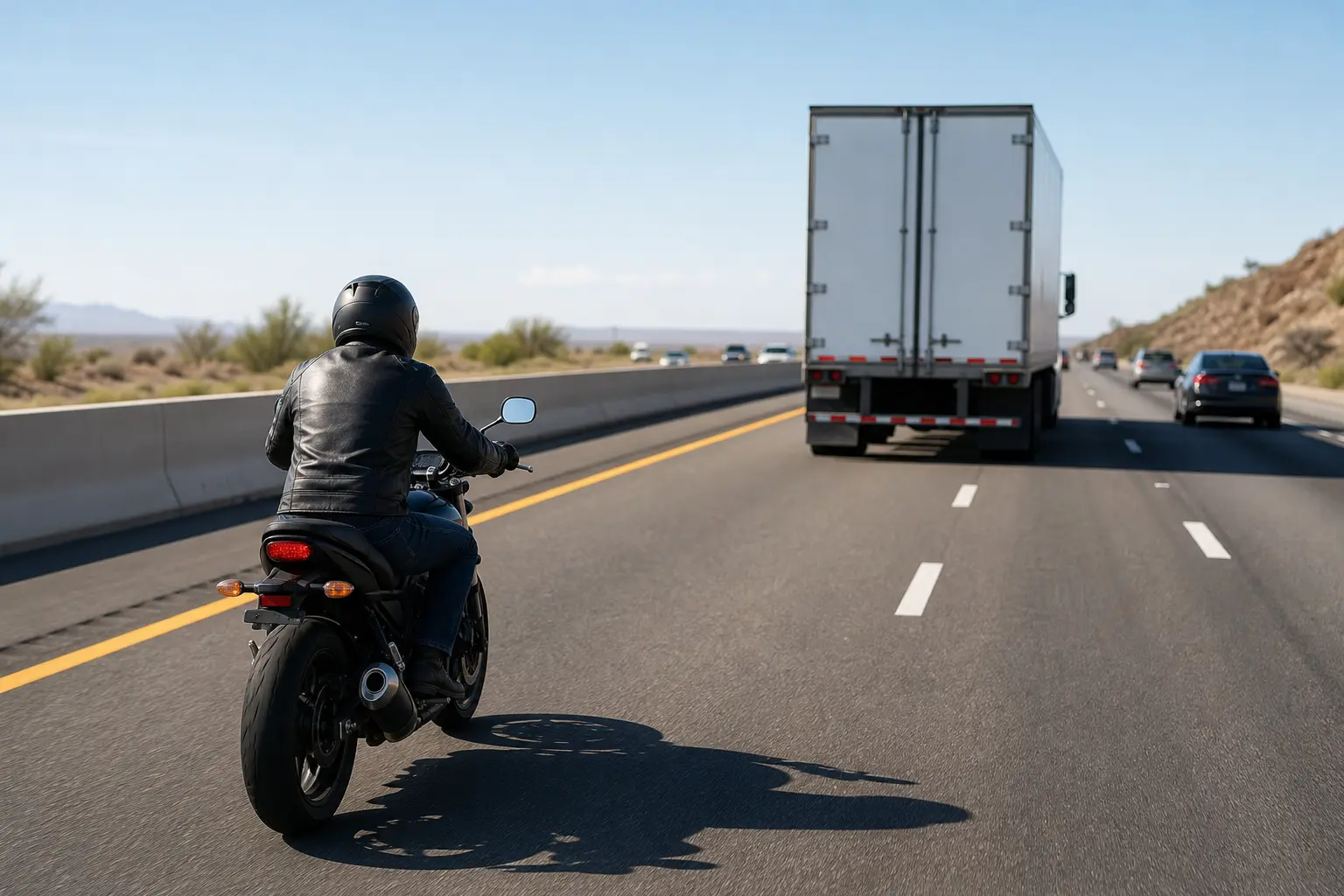
Treat the area beside a trailer as a transition zone, not a comfortable place to match speed. If you are passing, complete the pass only when it can be done within the available sightline and without exceeding your legal or personal limits. If the truck is passing you, hold a predictable course, keep your attention forward and in your mirrors, and let the truck create separation rather than trying to pace its trailer.
Being next to a truck feels tempting when traffic is slow because it can seem like a protected lane of open pavement. In reality, it may be the least forgiving place to be. You can be hidden from the driver, shielded from other drivers by the trailer, and boxed in by a vehicle that occupies a large amount of road space.
A useful exposure test
When you find yourself near a truck, mentally classify your position:
| Position relative to the truck | Main concern | Conservative rider objective |
|---|---|---|
| Following directly behind | Trailer blocks your forward view; sudden slowing may be harder to read | Increase your view and preserve time to respond without tailgating |
| Beside the rear portion of the trailer | High likelihood of extended blind-spot exposure and limited escape room | Move through only when a safe, legal exit is already available |
| Beside the tractor or cab area | Driver movement, mirrors, lane changes, and merging decisions can become immediate | Avoid lingering; either establish separation ahead or fall back deliberately |
| Ahead of the truck | Cutting in too closely can remove the driver’s time and your own escape margin | Merge only after creating a meaningful buffer and checking what is behind you |
| Being overtaken by the truck | Turbulence, noise, and perceived pressure can prompt abrupt inputs | Hold a smooth, predictable line and let the truck pass without racing it |
The table is not a map of “safe zones.” Every location around a large vehicle can become risky. It is a reminder that each position has a different problem to manage.
Blind spots are more than a mirror problem
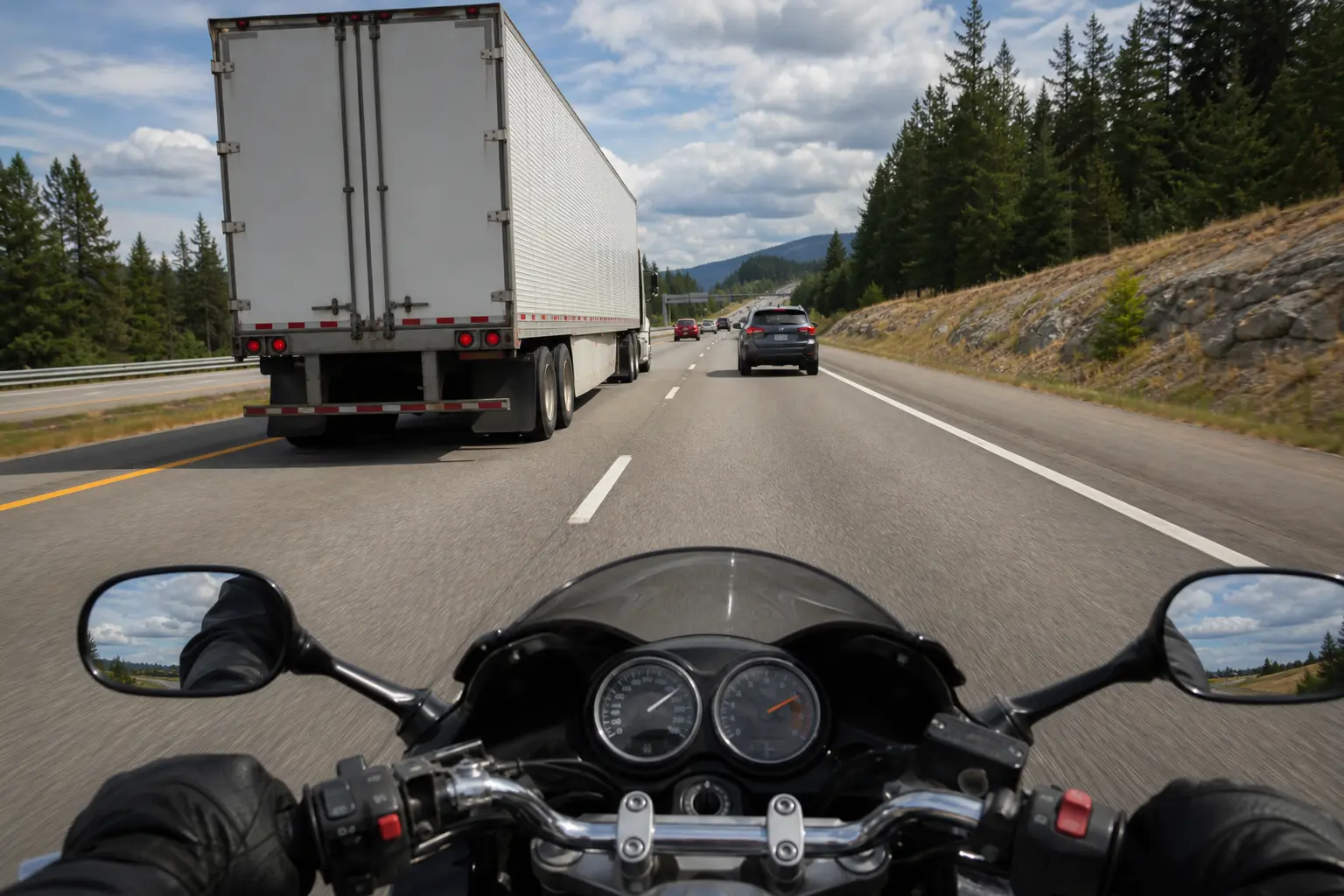
Riders often hear a simple mirror rule: if you can see the truck driver in a mirror, the driver may be able to see you. This can be a useful prompt to think about visibility, but it is not proof that the driver has recognized your motorcycle, intends to remain in lane, or has a clear view at that instant. Mirror angle, road curvature, vibration, glare, cab movement, and the driver’s attention can all change the situation quickly.
Use visibility as one layer of protection, not permission to stay beside the truck.
A better strategy is to build three layers:
- Position for a view. Choose a lane position that gives you the best reasonable look past the truck, toward its mirrors, and at the road surface ahead. Do not fixate on the truck’s wheels or trailer side; keep scanning farther down the roadway.
- Make your intentions readable. Signal early for lane changes and avoid sudden movements that leave other road users guessing. MSF recommends using turn signals for turns and lane changes and positioning to see and be seen.1
- Keep an exit. If you cannot move forward, can you reduce speed and return behind the truck? If you cannot move back, is there enough open lane space to move away from the trailer? If neither option exists, it is a sign that you should avoid entering or remaining in that pocket when a safer gap appears.
Blind-spot management is therefore less about finding the magic place where the driver definitely sees you. It is about avoiding the places where you have no independent margin if the driver does not.
Following a truck without surrendering your sightline
Following directly behind a trailer can create a false sense of calm: you are not beside it, so you may feel clear of its blind spots. But the trailer can hide the most important information on the road—stopped traffic, lane closures, changing signal phases, loose material, and sudden braking patterns.
The answer is not to crowd one side of the lane or ride in a position that puts you at risk from adjacent traffic. Instead, use the available lane space to improve your view while still leaving room to react. Keep scanning through, around, and beyond the truck whenever a sightline opens. Watch the traffic behavior in neighboring lanes, gaps forming ahead, brake lights farther up the line, and changes in the truck’s own speed or lane position.
If the truck is following another large vehicle, the visibility problem compounds. You may be looking at a solid wall with little warning of what is happening ahead. In that situation, your safest choice may simply be to create more following room, change lanes when it can be done calmly, or accept a slower pace until the road opens.
Do not use the trailer as a shield from weather, glare, or wind. A temporary reduction in wind exposure is not worth losing forward information and an escape route.
Turbulence: manage the surprise, not the physics
Large trucks can disturb the air around them. Riders may notice a push, pull, buffeting, or changing pressure as they approach, travel alongside, and move past a trailer. The exact feeling varies with the truck, road geometry, wind, speed, surrounding traffic, and the motorcycle itself. You do not need to diagnose the airflow to respond well.
The practical issue is that turbulence can coincide with a tight space: a narrow lane, nearby barriers, an uneven road surface, or a car crowding the other side. Harley-Davidson Insurance specifically advises riders not to travel too close to large trucks because they may create strong air turbulence.2
A conservative response is to prepare before the disturbance arrives:
- Look well ahead rather than staring at the trailer.
- Keep your hands relaxed enough to avoid transmitting every gust into the steering.
- Maintain a smooth, steady course rather than making abrupt corrections.
- Avoid beginning a lane change exactly as you draw alongside the trailer if the road, wind, or traffic is already unsettled.
- Give yourself lateral room when possible; a little more space can matter more than trying to hold a precise parallel position close to the trailer.
- If crosswinds are already demanding your attention, regard every truck encounter as a higher-workload event and raise your threshold for passing.
The dangerous part is often the rider’s reaction: a startled grip, a sharp lean correction, an abrupt roll-off, or a rush to get away with no destination gap. Your goal is to make the truck’s air movement unsurprising by keeping your attention and room available.
Passing a semi-truck: decide before you draw alongside
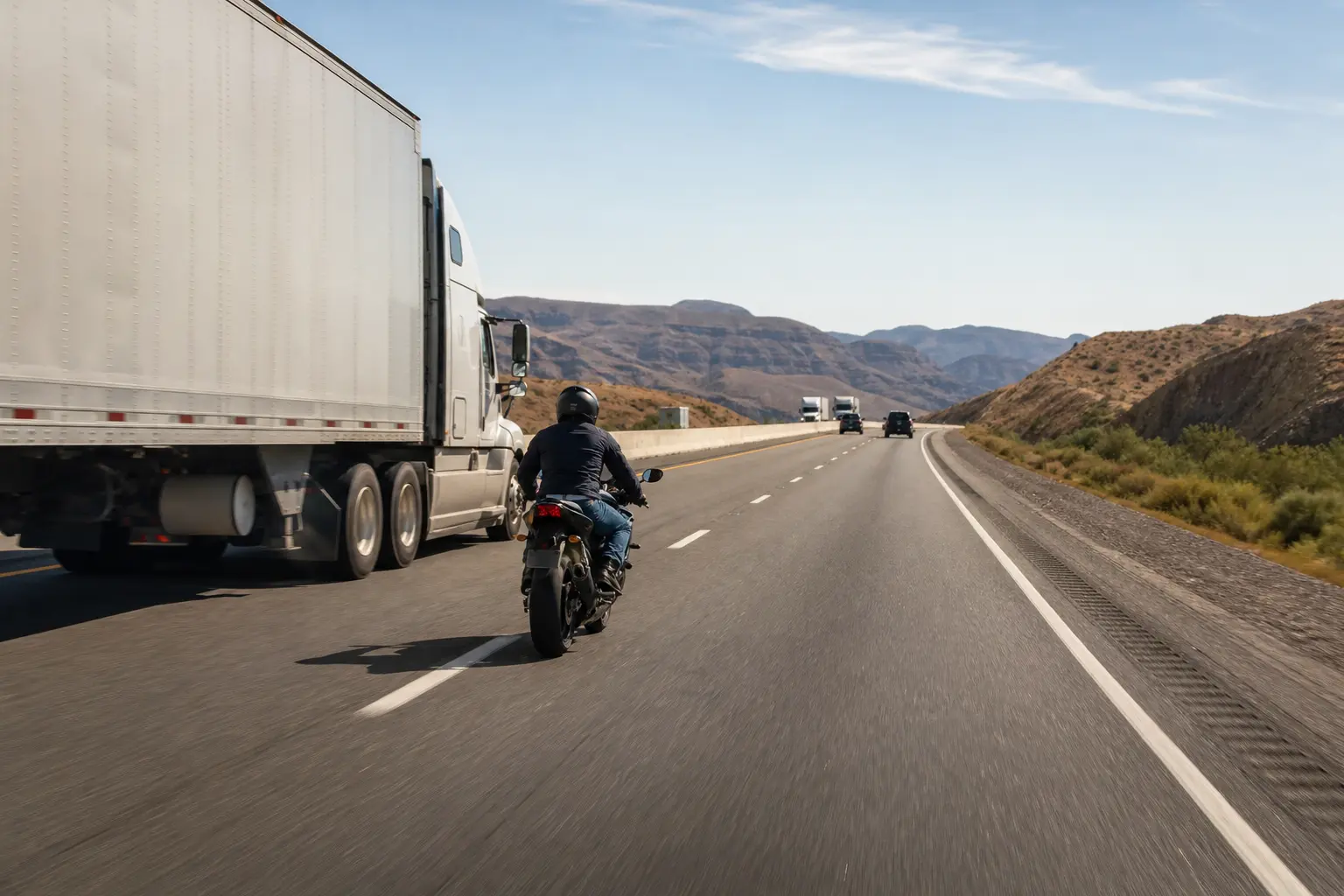
Passing is the period when you voluntarily enter the truck’s side area. It should be a deliberate decision rather than a response to impatience, tailgating pressure, or the feeling that the truck is “in the way.”
Before starting, check that the passing lane is legal and open, and that you can see a usable place ahead of the truck—not just empty pavement next to its cab. A car in front of the truck may be slowing. Another driver may be preparing to merge into your lane. A hill crest, curve, work zone, or dense pack of traffic may make the apparent opening disappear before you complete the maneuver.
A conservative passing sequence
First, set up from behind. Give yourself enough space to see the road pattern and to build a calm decision. Check mirrors and traffic around you. Signal according to the law and conditions.
Second, commit only when the destination is clear. The destination is the open space ahead where you can re-establish a buffer. If that space is not visible or is likely to vanish, wait.
Third, pass with purpose, not aggression. Avoid pacing the trailer. At the same time, do not turn the pass into a rush that exceeds legal limits or your ability to read the road. The point is controlled exposure: moving through the side area without lingering.
Fourth, do not cut back immediately. Once ahead, create space before returning to the truck’s lane. A sudden merge close in front of a truck reduces the driver’s time to react and can leave you with no room if traffic stops. Wait until your mirrors and the roadway support a clear, comfortable return.
Fifth, reassess after the pass. Passing the truck may reveal a completely different traffic problem: a slowing queue, an exit lane, bridge joints, road debris, or a line of vehicles that were hidden. The pass is not finished until you have regained a stable lane position, forward view, and escape option.
If a truck begins changing lanes while you are approaching or alongside it, do not try to “win” the space. Roll off as needed, move toward your available exit, and let distance—not horn use or eye contact—be your primary protection. Horns and lights may help alert another road user, but they cannot guarantee a response.
When the truck is passing you
You do not always choose the truck encounter. On multi-lane roads, a semi may overtake you, sometimes when wind, traffic, or a road feature already has your attention.
Your job is to remain predictable. Avoid speeding up simply because the truck is moving beside you. Avoid drifting toward it to see around it. Maintain a smooth line within your lane, keep scanning ahead, and use your mirrors enough to understand the truck’s progress without staring at it.
If conditions allow, avoid staying beside the trailer after it has moved forward. Either let it establish a larger gap ahead or reduce speed slightly when that can be done without creating a problem behind you. Do not re-enter the truck’s blind-spot area just because the truck has passed; re-evaluate the new traffic picture.
A truck passing on a narrow, windy, or two-lane road is a cue to simplify your inputs. The noise and airflow can make the moment feel urgent, but urgency does not require abrupt control movements. Preserve your lane, sightline, and attention until the vehicle has cleared and the air settles.
Merges, exits, and construction zones deserve extra margin
Truck risk increases when the road asks everyone to choose a lane. Interchanges, lane drops, entrance ramps, toll approaches, urban delivery corridors, and work zones can funnel traffic into the same limited space. A truck may need room to follow its route, and drivers around it may make last-second moves to avoid being behind it.
For a rider, these areas are less about holding the ideal lane position and more about retaining options. Avoid entering the space between a truck and an obvious merge point. Be skeptical of gaps beside a truck when the lane ahead is ending. Avoid assuming the truck will remain centered, maintain speed, or yield to a motorcycle it may not see.
If you need an exit and a truck occupies the lane or blocks your view, it is usually better to miss the exit than to force a late move across an uncertain space. Routes can be corrected; a compressed lane change beside a trailer offers very little room for error.
Construction zones can add uneven pavement, narrowed lanes, temporary barriers, workers, trucks entering and leaving work areas, and unclear sightlines. If a large truck is involved, reduce the complexity further: slow early when safe, avoid sitting beside it, and use extra patience rather than trying to preserve your usual pace.
A motorcycle riding near semi-trucks safety checklist
Use this checklist before a highway commute, freight-corridor ride, or any day when large vehicles will be common.
Before entering heavy truck traffic
- Confirm your headlight, brake light, turn signals, tires, and controls are ready for traffic; MSF recommends studying your owner’s manual and making pre-ride checks a habit.1
- Choose gear that supports clear vision, weather comfort, and reliable control feel.
- Review the route for construction, major merges, dense urban freight areas, and long bridge or open-road sections where wind may be more demanding.
- Decide in advance that a missed exit, delayed pass, or slower pace is acceptable.
- If you feel fatigued, rushed, distracted, or uneasy about conditions, shorten the route, delay departure, or choose another mode of travel.
While approaching a truck
- Identify whether you are gaining on the truck, being overtaken, or becoming trapped in parallel traffic.
- Look beyond the trailer for traffic flow, brake lights, road changes, and a possible place to go next.
- Avoid following so closely that the trailer becomes your entire field of view.
- Check mirrors and neighboring lanes before changing position.
- Ask where your escape is if the truck slows, moves toward your lane, or reveals stopped traffic.
While beside a truck
- Treat the position as temporary.
- Keep a smooth line and avoid abrupt reactions to airflow or noise.
- Do not assume mirror visibility means the driver has seen and understood your position.
- Do not match the trailer’s speed for convenience.
- If the lane ahead, adjacent lane, or shoulder area is constrained, reduce your exposure by falling back when safe rather than pressing forward into a closed pocket.
After passing or being passed
- Rebuild a buffer before merging in front of the truck.
- Scan for traffic that was hidden by the truck.
- Recheck mirrors for faster traffic approaching from behind.
- Reset your attention; do not let relief from completing the pass become complacency.
- If the encounter felt difficult, take that as useful information: more wind, traffic, fatigue, or skill practice may be needed before the next similar situation.
Skills that make truck encounters less stressful
The best time to learn emergency control is not while a trailer occupies the next lane. MSF encourages riders to develop riding techniques before venturing into traffic, including emergency braking and swerving, and to practice often.1 That is a strong reason to separate skill-building from the commute.
Use an empty, permitted practice area or formal training environment to refresh smooth braking, obstacle avoidance, head-and-eye discipline, mirror checks, and lane changes. Keep the practice conservative and within your experience. The goal is not to create dramatic drills. It is to make calm inputs more available when roadway conditions suddenly become crowded.
You can also rehearse the mental side of truck riding without a truck present. On ordinary rides, make a habit of asking:
- What can I see beyond the vehicle ahead?
- Which side of my lane offers the better view right now?
- What space could I move into if the vehicle ahead stops or changes direction?
- Is my planned lane change taking me toward more options or fewer?
This is aligned with MSF’s Search-Evaluate-Execute approach: continually search for changing conditions, evaluate the developing hazard, and act before the situation demands an emergency reaction.1
When to stop trying to make progress
Sometimes the safest truck strategy is to stop treating the truck as the problem to solve. If traffic is dense, wind is strong, visibility is poor, pavement is wet, or you are carrying a passenger or unfamiliar load, your passing threshold should become more conservative.
Choose patience when:
- a truck blocks your forward view and no clear passing destination is visible;
- several trucks and cars are compressing around an interchange;
- road spray, glare, darkness, or fog make it difficult to see lane markings and traffic behavior;
- gusts are already moving the motorcycle enough that you are devoting significant attention to maintaining your line;
- another driver is pressuring you from behind to pass; or
- your mental workload is high enough that you are reacting late rather than planning ahead.
Pulling off at a safe location, taking a break, rerouting, or allowing traffic to thin can be a sound risk-management choice. It is not a failure to be assertive. It is the decision to restore the time and space that defensive riding requires.
For broader routines that keep the motorcycle itself ready for demanding traffic, see the Motorcycle Maintenance Guide. A motorcycle in sound operating condition cannot remove the risks around a semi-truck, but dependable lights, tires, brakes, and controls support clearer decisions when traffic becomes complicated.
How Vojo Helps
Use Vojo to turn this guidance into a repeatable heavy-traffic workflow: before a route that includes highways or freight corridors, open your motorcycle profile in the motorcycle ride app, add a short ride note such as “truck traffic, wind, merge points, or difficult passes,” then review the note after you park. If a pattern appears—such as repeated discomfort on a specific interchange, declining concentration late in the ride, or a recurring wind-exposure issue—you can plan a different departure time, route, rest stop, or skills refresher before the next ride.
Download Vojo on the App Store
Final perspective
Riding near semi-trucks is not about memorizing a single blind-spot diagram or proving that you can pass quickly. It is about consistently preserving margins: a view past the trailer, enough time to interpret what traffic is doing, a lane position that supports awareness, and a way out if another road user does not see you.
The conservative rider does not linger beside the trailer, does not force a pass with no destination, does not cut in close after overtaking, and does not let turbulence turn into abrupt control inputs. Instead, they scan, create room, choose predictable movements, and accept delay when the road does not offer a clean answer. That is the practical meaning of riding as if you may not be seen while still giving yourself a path to respond.
Sources
1 Motorcycle Safety Foundation, If You Ride A Motorcycle.
2 Harley-Davidson Insurance, Riding a Motorcycle in Heavy Traffic: Essential Safety Tips.
Quick answers
Frequently asked questions
Where should a motorcycle ride around a semi-truck?
There is no permanently safe position around a moving semi-truck. Avoid prolonged time beside the trailer, avoid following so closely that the trailer hides the road ahead, and seek a position that improves your view while preserving a way to slow or move away.
Should I pass a semi-truck quickly on a motorcycle?
Pass with purpose, not aggression. Begin only when passing is legal, the road and destination gap ahead are clear, and you can complete the maneuver without rushing beyond the conditions or your limits. Do not pace beside the trailer.
Why does a truck seem to push or pull a motorcycle?
A large vehicle can disturb the air around it, and riders may notice buffeting or changing pressure while approaching, passing, or being passed. Prepare with smooth inputs, a forward visual focus, and added lateral room when available instead of making abrupt corrections.
Can I rely on seeing the truck driver in a mirror?
No. Seeing the driver can be a useful visibility cue, but it is not proof that the driver has noticed your motorcycle or will not change position. Keep your own escape margin and avoid lingering in the truck’s side area.
What should I do if a semi-truck begins moving into my lane?
Prioritize space over position. Use your available escape route, reduce speed or change position when safe, and avoid trying to hold space beside the trailer. Do not depend on a horn or eye contact as a guarantee that the driver will respond.
Is it safer to follow behind a truck than to pass it?
Following avoids being alongside the truck, but a trailer can severely reduce your view of traffic and road hazards ahead. Maintain enough space and lane position to improve your sightline, and wait for a clear, legal opportunity if passing would improve your options.