
Motorcycle Wobble After Loading: A Conservative Check Before the Next Ride
Motorcycle wobble after luggage, an accessory, or a passenger calls for a cautious pause. Check load placement, tire pressure, clearances, and security first.

Fact-checked against cited official documentation
Reviewed against Fact-checked against Motorcycle Safety Foundation guidance on wobble contributors, correct loading, tire pressure, pre-ride checks, and avoiding equipment interference with controls..
Last updated October 28, 2026
A motorcycle that begins to wobble after luggage, a rack, an accessory, or a passenger is added should be treated as a safety decision before it becomes a troubleshooting project. The important first question is not, “What part has failed?” It is, “Is this motorcycle in a condition that should be ridden at all?”
A changed load can alter how a motorcycle responds to road irregularities, steering input, braking, and acceleration. It can also uncover a problem that was less noticeable before the motorcycle was carrying more mass. From the rider’s seat, an incorrectly loaded bag, unsuitable tire pressure, an accessory touching part of the motorcycle, a loose mount, or a separate wheel or steering concern may all feel like an unfamiliar weave, shake, drift, or oscillation.
The Motorcycle Safety Foundation identifies improper loading, unsuitable accessories, and incorrect tire pressure among factors that can contribute to wobble. Its guidance supports a conservative response: reduce or relocate weight where appropriate, verify the relevant settings, and do not continue as though a new handling symptom is merely part of loaded riding. See the Motorcycle Safety Foundation operator manual.
This article is not a diagnosis or a repair instruction. It is a practical way to pause, inspect what is visible, compare the setup with the motorcycle manufacturer’s instructions, and decide when qualified help is the safer next step. Your owner’s manual, load labels, and accessory instructions control the specifications for your motorcycle.
Motorcycle Wobble After Adding Luggage: Why the Load Matters
Loading a motorcycle is not just a question of total weight. Where mass sits, whether it is held securely, and whether it remains stable all matter. A bag placed high, far aft, or unevenly across the motorcycle may change the way the bike feels compared with the same items stored lower and closer to the intended mounting area. A passenger adds a different kind of variable because their position can change during braking, cornering, and normal riding.
That does not mean every handling difference is dangerous. A properly configured motorcycle may feel different when it carries a passenger or approved cargo. But a wobble is not simply another word for “different.” If the motorcycle begins making an unwanted movement that was absent before, treat that change as meaningful until the configuration and the motorcycle’s condition have been checked.
There are several reasons a new load deserves close attention:
- A case, bag, or rack may not be fully seated or secured.
- A strap, cord, cover, or loose item may reach an area where it can rub, snag, heat up, or interfere with normal movement.
- The overall load may be outside the motorcycle’s documented limits, or those limits may be unknown.
- Tire pressure may not match the motorcycle manufacturer’s instructions for the current riding condition.
- An added accessory may alter clearance around the controls, steering, suspension, lighting, or rider position.
- The timing may be coincidental: a pre-existing concern might have become more apparent once the handling balance changed.
The MSF’s riding guidance also emphasizes correct loading and ensuring equipment does not interfere with steering or control. That makes an interference check as important as looking at the luggage itself. Review the MSF riding tips along with the instructions for your motorcycle and fitted equipment.
A passenger should not be considered equivalent to a secured item of cargo. A passenger affects the motorcycle’s balance and changes the demands on the rider during starts, stops, turns, and braking. If the wobble began only when carrying someone, do not ask them to remain unusually rigid while you conduct a road experiment. Pause the ride and confirm that the motorcycle, passenger equipment, tire settings, and loading arrangement are all appropriate.
Decide First: Park It or Continue?
When a wobble happens away from home, the practical pressure to continue can be strong. You may be near a destination, on a group ride, or carrying gear needed for the day. None of that makes an uncertain handling symptom less important.
If you are already moving, focus on getting to a safer place without abrupt steering, braking, or acceleration. Once stopped, avoid turning the situation into a repeated test ride. A motorcycle that feels unstable at speed can leave very little room for recovery, and another pass does not reliably reveal the cause.
Choose not to ride further and seek qualified assessment or transport when any of the following applies:
- The movement was sudden, substantial, worsening, or hard to manage.
- The steering response, braking feel, wheel tracking, or throttle response seems abnormal.
- A tire looks low, damaged, misshapen, or otherwise unusual.
- You see a leak, broken securing item, scrape, displaced component, or fresh contact mark.
- A rack, luggage mount, case, wheel area, or visible steering-related part appears loose or damaged.
- You do not know whether the motorcycle remains within its approved load limits.
- The wobble continues after the added load is taken off.
- The motorcycle was recently dropped, hit an obstacle, or experienced another event that could have caused damage.
- You cannot confidently confirm that straps, bags, and accessories are clear of moving parts and controls.
A modest symptom still merits attention. “It only does it a little” is not a safety clearance. A mild weave may be difficult to describe, but it can be the first sign that the setup is not as intended. The lower-risk choice is to inspect while parked and escalate to professional help when the answer is not clear.
Motorcycle Wobble, Load, and Tire Pressure: What to Compare
Do not assign one cause just because the wobble appeared after packing. Instead, compare the known facts: what changed, what the motorcycle manufacturer permits, and what you can see without dismantling safety-critical components.
| What changed or appeared | What to verify while parked | Conservative response if uncertain |
|---|---|---|
| Rear luggage, top case, or side bags added | Approved load information, attachment security, balance, and visible clearance | Remove the uncertain setup if safe to do so; do not ride until its fit is confirmed |
| Passenger added | Passenger approval, total load guidance, riding position, and applicable tire information | Postpone the ride if the documented configuration cannot be confirmed |
| Tire pressure has not been checked recently | Manufacturer-specified checking condition and the pressure information for the current load | Check according to the manual; do not invent a pressure change |
| New rack, mount, or accessory fitted | Installation instructions, visible seating, fasteners, steering and control clearance | Have the installation assessed if there is movement, contact, or uncertainty |
| Wobble remains after unloading | Whether the symptom is now independent of the luggage setup | Keep the motorcycle parked and arrange a qualified inspection |
| Fresh rubbing, heat marks, or a loose strap is found | Possible contact with a wheel, suspension, controls, or hot component | Do not simply reposition it and assume the concern is resolved |
The table is a triage tool, not an authorization to ride. A single finding can be enough to end the ride for the day. For example, a bag may look secure at rest while its mount, strap path, or clearance remains questionable. Likewise, a correct-looking tire may still require professional attention if pressure has been lost or the motorcycle’s behavior changed abruptly.
A Parked Check for Luggage, Accessories, and Controls

Use a stable parking area and give yourself enough time to look carefully. Avoid rushing because someone is waiting or because weather is changing. This check is observational: it helps you capture useful information and identify obvious reasons not to continue. It is not an exact repair process.
Start with the timeline
Write down the changes made before the symptom appeared. Include bags and their contents, hard cases, a passenger, a rack, a tank bag, a navigation or phone mount, straps, bungees, a tool roll, a cover, or any other accessory. Note the general riding situation in which you first felt the movement, such as while slowing, accelerating, cruising, cornering, or after encountering a bump.
Do not deliberately recreate the symptom to improve your notes. A clear description is more valuable than a risky test. “Wobble began after fitting the top case and carrying a full bag” gives a technician a useful starting point without claiming that the case is definitely the fault.
Confirm documented loading limits
Find the owner’s manual and any labels or instructions relevant to luggage, passenger use, accessories, and total load. Check the equipment maker’s instructions too. The physical size of a case is not proof that the motorcycle can safely carry it full, and another rider’s successful setup is not a specification for your bike.
Account for the equipment itself as well as what it holds. Cases, mounts, racks, locks, tools, and other added hardware all contribute to the configuration. If the limit cannot be determined, the sensible conclusion is not to estimate. Delay the ride until you can verify the information with the manufacturer or a qualified service provider.
Look at position and security as a complete system
Check whether the arrangement is centered as intended. Consider whether one side contains substantially more weight than the other and whether heavy items are stored in locations allowed by the motorcycle and luggage instructions. Avoid treating unused space high behind the rider as automatically suitable storage.
Then inspect the complete attachment system. A closed lid or clicked latch does not confirm that the case is correctly seated on its mount. Look at the rack, mounting interface, straps, attachment points, and any part that appears to carry the load. Observe whether a bag can shift, whether a strap tail can move, and whether any item is resting against an unsuitable surface.
Do not make a judgment based on one quick pull. Look from more than one angle, particularly near the rear wheel, the suspension area, and hot components. If an item has moved enough to leave a mark, melted material, or abrasion, do not ignore that evidence simply because it is currently quiet and still.
Check steering and rider-control clearance
With the motorcycle stationary, move the handlebars through their normal parked range without forcing anything. Watch for a tank bag, cable, mount, strap, or other object that alters the movement, touches a control, or restricts access to normal rider inputs. Confirm that luggage does not obstruct your feet, seating position, or ability to use controls in the usual way.
Also inspect visible areas where luggage or loose equipment could contact the wheel, suspension, drivetrain area, lighting, exhaust, or bodywork. The goal is not to prove perfect clearance under every riding condition; it is to identify obvious interference, evidence of contact, or uncertainty that makes riding inappropriate.
If you find interference, do not accept reduced movement as a temporary compromise. Follow the motorcycle and accessory manufacturer’s instructions, or have a qualified professional evaluate the installation.
Tire Pressure and Visible Tire Condition After Loading
Tire pressure should be checked using the motorcycle manufacturer’s information, including the required checking condition and any instructions that apply when carrying a passenger or cargo. The MSF operator manual identifies incorrect tire pressure as a possible wobble contributor, but that does not justify choosing a number by instinct.
Do not substitute a tire-sidewall marking for the motorcycle manufacturer’s operating recommendation. The correct reference is the motorcycle’s owner documentation or manufacturer label, used as directed for your riding condition. If the manual provides different guidance for a passenger or load, use that information rather than a generic online rule.
Record three things: the reading you obtained, the manufacturer information you consulted, and the motorcycle’s loaded state at the time. This record makes it easier to have a productive service conversation later. It also prevents a common mistake: changing pressure repeatedly without being able to identify which configuration was actually used.
For broader context on measurement conditions and loaded recommendations, read Motorcycle Tire Pressure: Why “Cold” Readings and Loaded Settings Matter.
While you are at the tires, carry out a visual scan. Look for apparent low inflation, embedded objects, cuts, cracking, bulges, unusual wear, or an abnormal shape. Look around the visible wheel area for signs of a recent impact or obvious distortion. This is a screen, not proof that every internal condition is sound.
Do not assume that visible tread settles the matter. A tire can have tread remaining while another concern requires attention. If there is tire damage, pressure loss, a new unusual wear observation, or a wobble that has no clear explanation, stop guessing and arrange qualified inspection rather than riding to “see if it improves.”
Clearly Titled Checklist: Before Riding a Loaded Motorcycle Again
Keep the owner’s manual available during this checklist. Its instructions take precedence over generic advice.
Motorcycle wobble after loading checklist
- Record every recent change: luggage, contents, passenger, mount, rack, straps, and accessories.
- Confirm the motorcycle’s applicable rider, passenger, luggage, accessory, and total-load guidance.
- Confirm the luggage or accessory instructions match the way it is installed and used.
- Check that the load is positioned and balanced as directed, without improvised high or rearward storage.
- Inspect cases, bags, racks, mounts, and attachment points for visible movement, damage, or incomplete seating.
- Check that no strap, cord, loose item, or bag can interfere with a wheel, steering, suspension, control, or hot part.
- Move the handlebars through their normal parked range and look for contact or restricted movement.
- Confirm that the rider and passenger positions are not compromised by the equipment.
- Check tire pressure using the motorcycle manufacturer’s specified method and load-related information.
- Inspect visible tire and wheel condition for damage, low inflation, rubbing, impact evidence, or unusual wear.
- Treat fresh marks, leaks, shifted hardware, or unexplained noise as reasons for further assessment.
- Keep the motorcycle parked if the wobble persists, if a safety-related item is uncertain, or if the documented setup cannot be confirmed.
This checklist intentionally favors caution. The cost of delaying a trip is usually smaller than the consequence of discovering an unresolved handling concern at speed.
What Symptom Timing Can Tell a Technician
The point at which you feel the movement can help describe the problem, but it cannot safely confirm the source. Avoid labels such as “definitely a steering fault” or “definitely bad tires” unless a qualified inspection has established that conclusion.
A wobble noticed only with a rear load makes the loading arrangement, tire information, mounting security, and clearance especially relevant. A symptom that remains after the luggage has been removed suggests the concern is not limited to the cargo arrangement. A change that appears during braking, acceleration, or after an impact deserves additional caution because more than one system could be involved.
Good notes are factual and brief:
- “Movement first noticed after panniers and a full rear bag were added.”
- “No change in steering clearance observed while parked, but a strap had a fresh abrasion mark.”
- “Symptom was still present after luggage removal.”
- “Pressure reading was checked against the owner’s manual guidance for the loaded condition.”
Those observations are more useful than a theory. They help a dealer or technician understand the order of events, the configuration involved, and the checks already completed without biasing the inspection toward a guessed cause.
When to Use Qualified Service Instead of More Testing
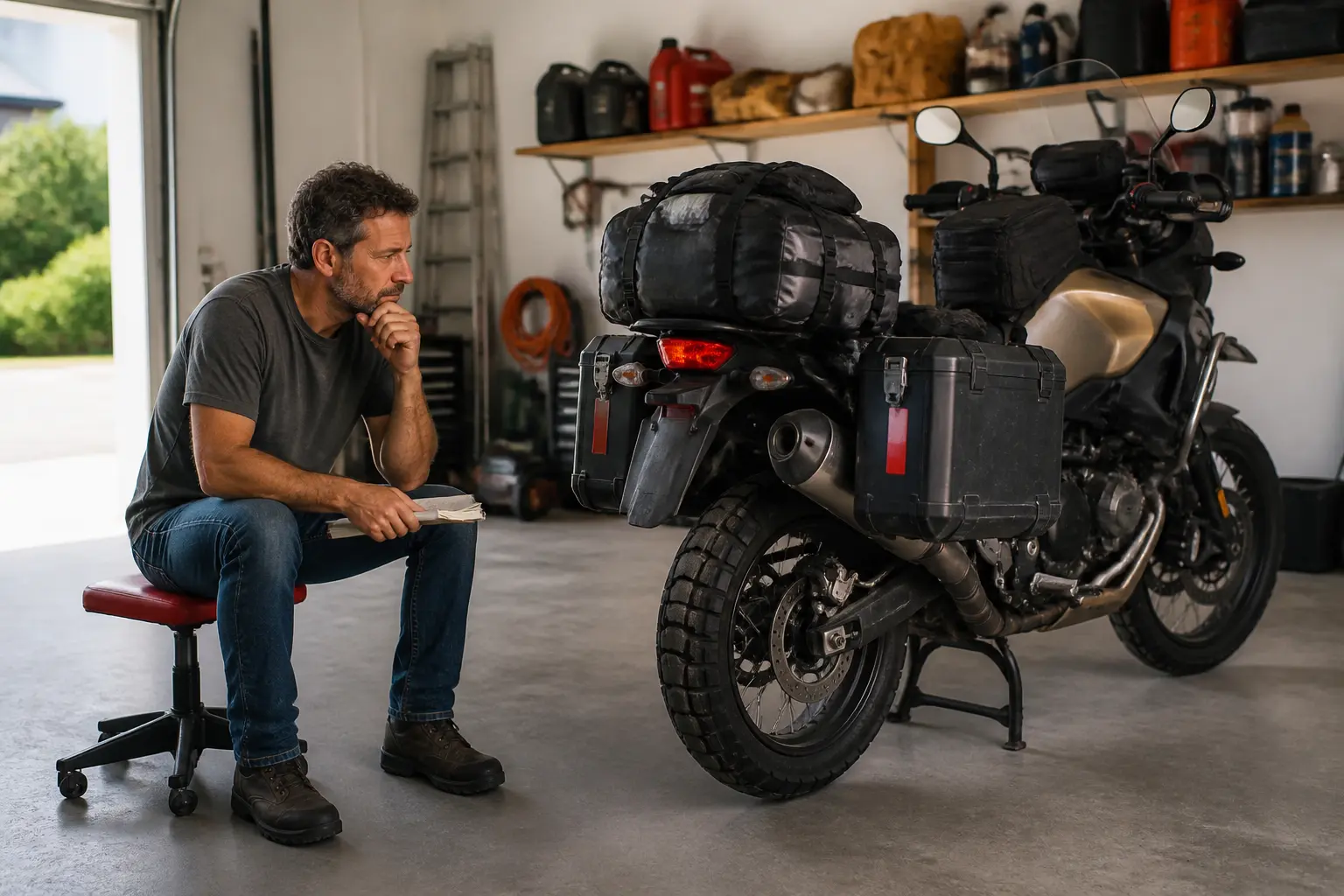
Professional help is the right next step when the cause is not obvious, when the wobble does not disappear from concern after a parked review, or when tires, wheels, steering, braking, luggage mounts, or other safety-critical areas may be involved. Transport may be preferable to riding to a workshop if the motorcycle’s stability is in doubt.
Bring your notes, the owner’s manual if available, and information about every fitted accessory. Explain what changed before the symptom began, whether the bike had a passenger or cargo, what pressure information was used, and whether the issue remained after unloading. Mention impacts, drops, or contact events even if the motorcycle appears largely undamaged.
Manufacturer-first guidance matters throughout this decision. The motorcycle manufacturer defines the applicable operating limits and settings. The accessory manufacturer defines its intended fit and use. If either document conflicts with a generic recommendation, stop and resolve the discrepancy with the manufacturer or a qualified professional.
Avoid these shortcuts:
Guessing at a pressure increase. More air is not a universal answer to cargo. Follow the motorcycle manufacturer’s instructions for the actual load condition.
Assuming the luggage is fine because it worked once before. A changed cargo weight, a different strap path, wear in the mount, or an incomplete attachment can change the situation.
Using high speed as a diagnostic tool. Faster riding can increase the consequence of the symptom and gives you less time to respond.
Removing a bag and declaring the problem solved. The result is useful information, not a complete safety finding. Determine why the loaded condition produced the change before reinstalling it.
Borrowing settings from another motorcycle. Different motorcycles may have different load limits, accessory designs, tire recommendations, and handling characteristics.
How Vojo Helps
Use Vojo to create a before-and-after record whenever you change a luggage or passenger setup. In the Motorcycle Service History, add a note before departure listing the luggage configuration, the relevant manufacturer load guidance, and the tire-pressure reference you used. After the parked check, add the observed readings, photos of non-sensitive visible concerns if helpful, and a short symptom timeline.
If a wobble occurs, that record gives a technician a clear sequence of changes instead of a vague memory from the roadside. You can also compare the entry with your regular inspection planning in the Motorcycle Maintenance Guide, making it easier to keep recurring load-related checks visible before future trips.
Quick answers
Frequently asked questions
Is motorcycle wobble after adding luggage always a tire-pressure problem?
No. Incorrect tire pressure is one possible contributor, but load placement, an unsecured bag or mount, accessory interference, tire or wheel condition, and unrelated mechanical concerns can also be involved. Check the complete configuration and use the motorcycle manufacturer’s pressure guidance.
Can I ride if the wobble disappears when I remove the luggage?
Do not assume that removing the luggage completely resolves the risk. That result points to the loaded setup as an important clue, but you still need to confirm load limits, placement, mounting security, clearances, and applicable tire information before reinstalling or riding with the equipment.
Should I use the pressure printed on the tire sidewall when carrying cargo?
No. Use the motorcycle manufacturer’s operating recommendation and its stated checking conditions. A tire-sidewall marking is not a replacement for the pressure information specified for your motorcycle and its current load configuration.
What if the motorcycle still wobbles after the bags are removed?
Keep it parked and arrange qualified inspection or transport. A symptom that remains without the added luggage should not be treated solely as a packing issue, and a road test is not a safe way to identify the cause.
Does a passenger require the same check as luggage?
A passenger requires a careful review, but they are not the same as fixed cargo. Confirm the motorcycle is configured within its documented passenger and total-load guidance, use the applicable tire information, and make sure the passenger arrangement does not create control or clearance concerns.