
Motorcycle TPMS Warnings: What the Light Can Tell You—and What It Cannot
A motorcycle TPMS warning calls for a gauge reading and tire inspection. Learn what the alert can indicate, its limits, and when to stop riding.

Fact-checked against cited official documentation
Reviewed against Fact-checked against Motorcycle Safety Foundation guidance on tire condition, proper inflation, accurate gauge use, and cold-pressure checking considerations..
Last updated October 31, 2026
A motorcycle TPMS warning light is valuable because it asks for attention before a tire concern becomes easier to ignore. But an alert is not a full diagnosis, and it is not proof that a tire is safe merely because the display later looks normal.
The practical rule is straightforward: when a motorcycle TPMS warning light appears, check pressure with an accurate gauge and inspect the tire before treating the alert as resolved. Start with the motorcycle manufacturer’s owner’s manual, because symbols, alert logic, pressure targets, load instructions, and system functions differ by model.
The Motorcycle Safety Foundation (MSF) emphasizes that inflation and tire condition matter to the small contact areas through which a motorcycle steers, brakes, and accelerates. MSF guidance also makes clear that a TPMS does not eliminate the need to carry and use a dependable pressure gauge. See the Motorcycle Tire Guide and MSF’s Tire Pressures.
Think of the warning as the beginning of a decision process, not the answer. It may draw attention to a pressure change or a monitoring-system issue. It cannot independently judge tread damage, a damaged sidewall, wheel condition, valve condition, or every reason a motorcycle might feel different on the road.
Motorcycle TPMS warning light: check pressure with a gauge first
A tire can appear reasonably round and still be at an unsuitable pressure. Looking at it, squeezing it, or kicking it cannot replace measurement. That is why the gauge should be your first verification tool once the motorcycle is parked in a safe location.
Before comparing any reading, find the motorcycle maker’s recommended pressure information for the current situation. Use the owner’s manual or the manufacturer’s designated label or information source. Confirm whether the motorcycle has different guidance for its normal load and a passenger or luggage load. Do not substitute a figure from another bike, an online discussion, or the number molded on a tire sidewall.
The sidewall marking is not automatically the motorcycle’s everyday target pressure. The motorcycle manufacturer specifies operating pressures as part of the complete machine, including its intended tires, weight distribution, and load limits. Manufacturer-first guidance is particularly important when a warning occurs after adding cargo, a passenger, or accessories.
A useful gauge check answers several separate questions:
- What is the front tire pressure at this moment?
- What is the rear tire pressure at this moment?
- Were the tires checked under the temperature conditions specified by the manufacturer?
- Does either measured value conflict with the TPMS display?
- Does the pressure seem consistent with the tire’s appearance and the motorcycle’s recent history?
Write down the readings rather than relying on memory. A single number may not explain a problem, but a record of readings can reveal that one tire is repeatedly losing air or that an alert occurs under similar circumstances.
If the tires have just been ridden, resist the urge to force their readings back to a cold specification by releasing air. Tire pressure changes as the tire warms in use. Follow the owner’s manual for the correct method and timing of a check. If you are uncertain whether a post-ride reading is suitable for adjustment, allow the tires to cool and reassess under the manufacturer’s stated conditions.
What a TPMS warning can tell you
A TPMS alert can tell you that the motorcycle has detected something its system considers worth reporting. Depending on the motorcycle, that could relate to pressure, a sensor signal, or a system condition. The exact meaning is model-specific, so use the owner’s manual to distinguish a low-pressure warning from a communication, sensor, or system warning.
The light can be especially helpful because it interrupts routine. It encourages the rider to pause and ask whether something has changed since the last proper check. For example, the alert may prompt you to consider whether the motorcycle has been parked for a long period, has encountered an impact, has recently had wheel or tire work, or is now carrying a different load.
It can also help you establish urgency. A warning that appears during a ride, especially alongside a noticeable handling change, deserves a prompt and cautious response. A warning before departure gives you an opportunity to verify both tires and inspect them without road pressure.
What the system reports may be useful evidence, but it should be considered alongside the gauge, your inspection, and the manual. A display showing a figure is still not the same as confirming that the reading was taken under the proper conditions or that the tire has no damage.
The most productive question is not, “Can I make the light disappear?” Instead ask, “What does the warning require me to verify before I ride?” That change in approach prevents the dashboard from becoming the sole authority on tire condition.
What a TPMS warning cannot tell you
TPMS is not a tire health inspection. It cannot fully assess the rubber, carcass, tread, sidewalls, wheel, or valve area. It also cannot certify that a puncture has not occurred simply because the displayed pressure looks plausible.
A warning cannot reliably identify the cause of a pressure concern. A change might be associated with a slow air loss, an object in the tread, damage around the valve area, wheel damage, changing ambient conditions, or a monitoring-system fault. The correct next action depends on facts that the alert alone cannot supply.
Likewise, no warning does not equal a clean bill of health. A tire can have a foreign object embedded in its tread, a cut, visible cracking, a bulge, or another concern that an electronic pressure monitor is not designed to evaluate. A motorcycle may also handle poorly for reasons outside the TPMS system’s scope.
Do not let an apparently normal display override a real-world symptom. New wobble, pulling, vibration, unusual steering response, or an unfamiliar sensation from a tire warrants a conservative stop-and-assess decision. If the motorcycle has visible tire damage, a possible wheel impact, or a pressure reading that will not remain stable, a dashboard value is not sufficient reassurance.
A TPMS reading also does not replace manufacturer direction after tire service. Sensor pairing, initialization, resets, and alert behavior vary. Avoid using a generic online sequence to reset or reconfigure the system. Consult the owner’s manual first, then use qualified service when the manual does not clearly address the situation.
If the TPMS warning appears while riding
A warning that appears in motion is not a reason for abrupt braking, sudden steering, or trying to diagnose the problem while moving. Your immediate priorities are control, space, and a safe stopping place.
Keep your movements smooth. Reduce speed progressively, avoid sharp inputs, and look for a location away from the active traffic stream where you can stop without creating another hazard. If the motorcycle feels unstable, treat that change seriously and prioritize stopping as safely as circumstances allow.
Once stopped, take a measured look rather than rushing into action. Check whether either tire appears visibly low. Look for an object in the tread, damage to a sidewall, obvious trouble around a valve, or signs of a recent strike. Consider whether the warning followed a pothole, curb contact, road debris, recent tire service, or a significant load change.
Do not work beside moving traffic or place yourself in a dangerous roadside position for the sake of a closer inspection. If the location is unsafe, the appropriate response may be to arrange assistance rather than attempting a roadside diagnosis.
Treat the following as strong reasons to stop riding and seek qualified help or transportation:
- The tire is visibly deflated or rapidly losing pressure.
- A cut, bulge, exposed damage, or embedded object is visible.
- The motorcycle develops wobble, pulling, vibration, or unusual steering behavior.
- You suspect the wheel suffered a substantial impact.
- Pressure does not remain stable after it has been checked.
- You cannot safely assess the tire or accurately measure it.
A nearby destination is not a safety margin. A short ride can still add load, heat, traffic exposure, and consequences if a tire concern worsens.
How to check motorcycle tire pressure with a gauge after a warning
The objective is not to perform a repair at the roadside. It is to establish a trustworthy pressure reading, compare it with the manufacturer’s information, and determine whether the motorcycle needs further assessment before use.
Begin in a stable, safe place. Position the motorcycle as the owner’s manual directs for ordinary checks, and ensure you can reach the valves without standing in traffic or balancing awkwardly. Have an accurate gauge ready before removing the valve cap.
Next, identify the correct front and rear pressure specifications for the current load. Motorcycles commonly require separate readings for front and rear tires, so record them separately. Confirm that you are using the motorcycle manufacturer’s information—not the tire sidewall’s maximum marking and not a generic chart.
Apply the gauge squarely and briefly to the valve. A poor seal can make the process harder and can lead to uncertainty about the result. If a reading seems implausible, pause, inspect the gauge and valve area visually, and repeat the measurement carefully rather than making assumptions.
Then compare the measured result with the owner’s manual guidance and the TPMS information. The comparison is not a contest between electronic and manual tools. It is a way to identify whether the readings generally make sense or whether there is a discrepancy that deserves service attention.
After any manufacturer-approved pressure correction, check again with the gauge. Then complete a visual inspection. A pressure result on its own does not clear a tire that has an obvious cut, bulge, foreign object, or recurring air-loss concern.
MSF material distinguishes a proper pressure check from judging inflation by appearance. That matters because a tire may not look dramatically different even when its pressure needs attention. For the foundation’s tire-safety context and gauge guidance, review the Motorcycle Tire Guide and Tire Pressures.
The tire and wheel inspection TPMS cannot do

After verifying pressure, inspect the parts that a warning light cannot evaluate. This is a screening check, not a certification that a tire is fit for every circumstance.
Start with the tread. Look across the visible surface for an embedded object, cut, unusual distortion, or a section that looks unlike the surrounding rubber. Do not remove an embedded object simply to investigate it; disturbing it may alter the rate of air loss.
Move to the sidewalls. Look for cuts, bulges, cracks, abrasion, or impact evidence. Sidewall concerns deserve particular caution because the tire’s appearance may provide the only early clue available to a rider.
Check the valve area for visible damage, an abnormal angle, or anything that looks disturbed. Then inspect the visible rim and wheel surfaces for an obvious dent, bend, fresh scrape, or other evidence of an impact. You are not dismantling components or diagnosing their internal condition; you are looking for clear reasons to stop and arrange professional evaluation.
Context belongs in the inspection as well. A warning that follows a sharp pothole strike, curb contact, tire fitting, storage period, or repeated low readings has more information behind it than the light alone. Make a note of that history for the technician.
Use both forms of evidence together:
| Check | What it can contribute | What it cannot establish alone |
|---|---|---|
| TPMS alert or display | That the system has reported a pressure-related or monitoring concern | Complete tire, wheel, valve, or tread condition |
| Accurate pressure gauge | A measured pressure to compare with motorcycle manufacturer guidance | Whether damage is hidden or whether the tire is otherwise suitable to ride |
| Visual inspection | Obvious cuts, bulges, embedded objects, valve concerns, or impact clues | Internal condition or all sources of a slow leak |
| Rider observations | Changes in steering, vibration, stability, or the event preceding the alert | The precise mechanical cause |
| Qualified service assessment | A professional evaluation based on the tire, wheel, and manufacturer guidance | A reason to skip basic pre-ride checks later |
When evidence conflicts, choose the more cautious path. A quiet display does not erase visible damage, and a normal gauge reading does not make an unexplained handling change unimportant.
A checklist for a motorcycle TPMS warning light
Checklist: before deciding to ride
- Read the motorcycle owner’s manual for the meaning of the TPMS symbol or message.
- Park in a stable place away from moving traffic.
- Find the manufacturer’s correct front and rear pressure guidance for the current load.
- Check both tires with an accurate gauge under the appropriate conditions.
- Record front and rear readings separately.
- Compare the gauge results with the TPMS display without assuming either tool explains the cause.
- Look for objects, cuts, unusual wear, or distortion in the tread.
- Examine visible sidewalls for cuts, cracking, bulges, or impact marks.
- Inspect valve areas and visible rim surfaces for obvious damage.
- Consider recent impacts, storage, load changes, tire work, or recurring alerts.
- Do not continue riding if pressure is dropping, damage is visible, or handling has changed.
- Document the warning and readings if professional service is needed.
For a wider routine that puts tire checks alongside other pre-ride and ownership tasks, see the Motorcycle Maintenance Guide.
Interpreting common TPMS warning situations
The situation around an alert can help you choose a cautious next step, although it cannot replace the owner’s manual or a professional inspection.
| Situation | Sensible interpretation | Conservative next step |
|---|---|---|
| Warning appears before departure | A pressure or system issue needs verification | Use a gauge, inspect both tires, and consult the manual before riding |
| Warning appears during a ride and handling feels normal | A condition may have developed even without a strong physical symptom | Slow smoothly, stop safely, inspect, and obtain gauge readings |
| Warning appears with wobble, pull, vibration, or unusual steering | A tire, wheel, or other handling concern may be involved | Stop riding when safe and arrange assessment |
| Tire appears low or pressure is not near the manufacturer’s guidance | A meaningful inflation concern is present | Do not treat appearance or the dashboard as sufficient; seek appropriate help if the issue is not clearly resolved |
| Pressure repeatedly falls after correction | Air loss or another defect may be present | Avoid repeated inflate-and-ride cycles; obtain qualified tire service |
| TPMS display and gauge disagree repeatedly | The system, gauge, conditions, or process needs investigation | Follow manufacturer instructions and seek service rather than guessing |
| The light goes out but the cause is unknown | The indication may have changed without the underlying concern being explained | Record the event, recheck pressure, and follow the manual’s guidance |
| No alert, but visible damage is found | The system has not evaluated that physical damage | Do not use the absence of a warning as clearance to ride |
Common mistakes that make a TPMS alert less useful
Treating the alert as a diagnosis. A warning can identify that attention is needed, but not necessarily why. Avoid assuming that every alert means only low pressure or that every low-pressure reading has the same cause.
Trusting tire appearance. Visual appearance is not a pressure measurement. MSF guidance supports using an accurate gauge as part of responsible tire care.
Using a tire sidewall number as the default setting. Use the motorcycle manufacturer’s specified pressures and load guidance instead.
Clearing a warning before recording it. If the system allows a reset or recalibration, follow the manual. Before doing so, note the displayed information, gauge readings, date, and circumstances. That information can be useful if the alert returns.
Repeating inflation without investigating recurring loss. If a tire repeatedly needs air, the concern has not been solved by another top-up. Arrange qualified assessment rather than normalizing the pattern.
Ignoring handling feedback because the display seems acceptable. A motorcycle that feels different deserves attention. A TPMS system cannot account for every source of instability.
Assuming recent tire work rules out a problem. Recent service is relevant history, not proof that a subsequent alert can be dismissed. Return to the service provider or seek qualified inspection when appropriate.
When to use qualified tire or motorcycle service
Professional help is the right next step when you cannot confidently establish a safe, stable situation with a gauge check and visual screening. That includes repeated pressure loss, visible tire damage, possible wheel damage, recurring warnings, persistent disagreement between display and gauge, or any noticeable handling change.
Give the technician useful facts: when the warning appeared, whether the motorcycle had been ridden recently, the front and rear gauge readings, the current load, any impact or road event, recent tire work, and whether the motorcycle felt different. This is much more useful than reporting only that “the TPMS light came on.”
Avoid asking a dashboard indicator to decide whether a damaged tire should remain in service. Tire construction, damage location, wheel condition, and manufacturer guidance all matter. A qualified professional can assess matters that are outside a rider’s roadside check.
How Vojo Helps
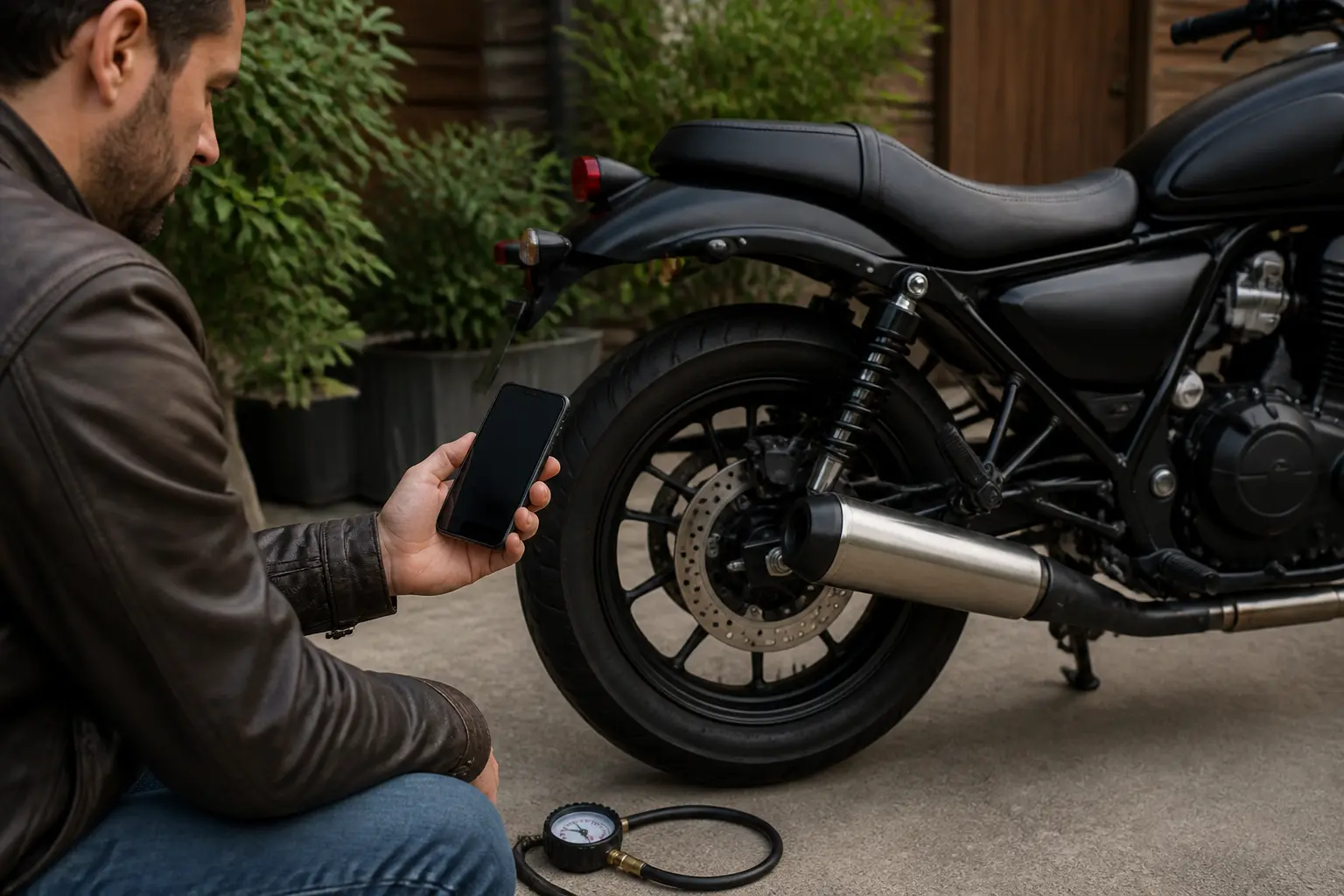
Use Vojo to turn a one-time TPMS warning into a clear service history. In the Motorcycle Maintenance Tracker, create a maintenance note immediately after the stop. Log the date and mileage, the front and rear gauge readings, whether the tires were cold or recently ridden, the dashboard behavior, and any visible observations such as a tread object, sidewall mark, or recent pothole impact.
If the warning returns, add the new readings to the same trail instead of relying on memory. Before a workshop visit, share the recorded timeline with the technician: it shows whether the concern repeats, follows a particular load, or appears after a service event. This workflow supports a calmer decision: verify, document, and escalate when the evidence says you should.
Quick answers
Frequently asked questions
Can I keep riding when my motorcycle TPMS warning light comes on?
Do not treat the light as permission to continue. Reduce speed smoothly, stop in a safe place, check both tires with a suitable gauge, and inspect for visible concerns. Do not continue if pressure is dropping, damage is visible, or the motorcycle’s handling has changed.
Does motorcycle TPMS replace a tire-pressure gauge?
No. MSF guidance treats an accurate gauge as necessary even when a motorcycle has tire-pressure monitoring. The TPMS can provide useful information, but a gauge is still needed to verify pressure against the motorcycle manufacturer’s instructions.
Why is the TPMS warning on when the tire looks normal?
Tire appearance is not a dependable way to judge pressure. The alert may also relate to a sensor or system condition. Check pressure with a gauge, inspect the tire and valve area, read the owner’s manual, and seek service if the warning or a reading discrepancy persists.
Should I lower tire pressure after riding if the reading is above the cold specification?
Do not automatically release air based on a hot reading. Follow the motorcycle manufacturer’s instructions for pressure checks. If you are uncertain, let the tires cool and check again under the conditions specified by the manufacturer.
What does it mean if the TPMS light goes away after I add air?
It may mean the system no longer detects the condition that triggered the alert, but it does not prove why the pressure changed. Recheck with a gauge, inspect the tire, and monitor for recurring loss or a returning warning. Repeated loss calls for qualified service.