
Motorcycle Tire Cupping and Uneven Wear: What the Pattern Can Suggest—and When to Stop Guessing
Learn what motorcycle tire cupping and uneven wear can suggest, how to screen the concern conservatively, and when a qualified inspection is safer.
Fact-checked against cited official documentation
Reviewed against Fact-checked against Harley-Davidson’s official tire-wear and pre-ride guidance, plus NHTSA’s motorcycle pre-ride tire-pressure and tread-depth advice..
Last updated October 13, 2026
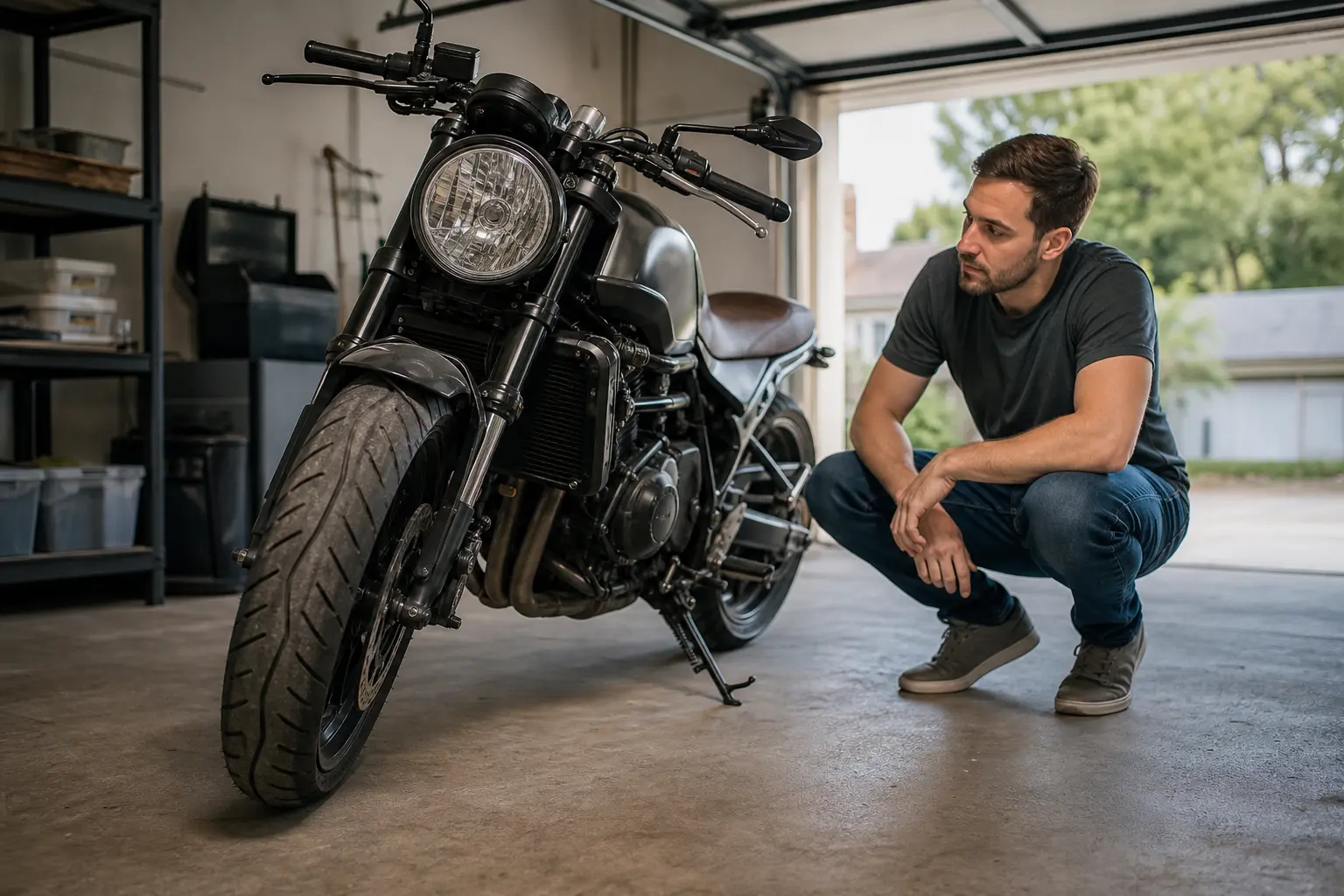
Motorcycle tire cupping and uneven wear causes are worth taking seriously—but the visible pattern is not a parts diagnosis. A tire can show scalloped, stepped, patchy, or one-sided wear for more than one reason. The right response is not to select a cause from a photo and begin adjusting components. It is to treat the tire as evidence, check the basics specified for your motorcycle, and decide whether the condition calls for a qualified inspection before the next ride.
That distinction matters because a motorcycle tire is both a wear item and part of the motorcycle’s handling system. Harley-Davidson’s official guidance says uneven tread can affect handling and create uncomfortable vibration. It also identifies several possible associated concerns: wheel balance, axle alignment, rim condition, wheel bearings, and incorrect tire pressure. That is a useful list of inspection leads—not a rule that any particular tread shape proves one of them. (harley-davidson.com)
This guide is deliberately conservative. It helps you recognize a pattern, record useful observations, make a safer ride/no-ride decision, and communicate clearly with a tire or motorcycle service professional. It does not tell you to correct wheel alignment, adjust bearings, alter suspension settings, or fit a different tire based on tread appearance alone.
For the broader routine around tires, controls, fluids, and chassis condition, start with our Motorcycle Maintenance Guide.
Start With the Right Idea: Wear Pattern Is Evidence, Not a Verdict
“Cupping” is commonly used for tread that no longer feels or looks smoothly uniform around the tire. Instead, parts of the tread may appear lower or higher than adjacent sections, creating a repeating scalloped or stepped impression. “Uneven wear” is wider: it can include a tire that is visibly more worn in one area, has isolated irregular sections, or has a surface that no longer looks consistent across its usable tread.
Those descriptions are useful because they encourage observation. They become unhelpful when they turn into certainty: “This pattern always means bad bearings,” “That edge wear always means pressure,” or “A new tire will automatically fix it.” Official manufacturer guidance does not support that kind of shortcut. It says uneven tread may indicate a range of concerns and that a professional technician can often use the tread condition to diagnose related problems. (harley-davidson.com)
A better mental model is this:
- The tire pattern tells you something has changed.
- The pattern alone cannot establish why it changed.
- The risk depends on tire condition, the motorcycle’s behavior, and whether other warning signs are present.
- The owner’s manual and a qualified inspection determine the model-specific next step.
This protects you from two expensive mistakes. The first is replacing a tire while overlooking a condition that could affect the replacement. The second is trying to “correct” a suspected chassis issue without confirming it, potentially creating a larger safety problem.
What Cupping and Uneven Wear Can Change for a Rider
A tire does not need to be bald to deserve attention. Harley-Davidson notes that worn, damaged, or aged motorcycle tires can compromise performance and safety, while uneven tread can influence handling and produce vibration. (harley-davidson.com)
In practical terms, the concern is not merely cosmetic. A rider may notice that the motorcycle no longer feels as settled as expected, that steering feel has changed, or that vibration has become noticeable. Those sensations do not identify a failed component by themselves. They do, however, raise the importance of pausing the usual “ride it and see” approach.
The condition of the rest of the tire matters too. A cupped pattern combined with a bulge, a cut, exposed internal material, a puncture concern, cracking, deformation, or a sudden handling change should not be treated as a routine wear question. Harley-Davidson advises professional examination for tire tears, cuts, and deformations, and its maintenance guidance includes looking for tread wear, bulging, and embedded objects during a pre-ride check. (harley-davidson.com)
The most useful question is therefore not, “Can I name this tread pattern?” It is: “Do I have a tire-only wear issue, a possible motorcycle condition behind it, or enough uncertainty that I should stop riding until it is assessed?”
A Conservative Pattern Guide: What You Can Observe Without Diagnosing
Use the table below to describe what you see. The “possible concern to rule out” column is intentionally broad. It is not an instruction to replace or adjust anything yourself.
| What you notice | What the observation can tell you | Possible concern to rule out professionally | Safer next step |
|---|---|---|---|
| Repeating scalloped or stepped tread blocks | The tread surface is not wearing uniformly around the tire | Wheel balance, axle alignment, rim condition, wheel-bearing condition, tire-pressure history, or another tire-related issue | Document it, verify manual-specified cold pressure, and arrange inspection if the pattern is clear or worsening |
| One area of the tread is substantially more worn than nearby areas | Wear is concentrated rather than uniform | Tire condition, wheel or chassis condition, and use history require context | Avoid assuming a single cause; ask for a tire-and-wheel assessment |
| Uneven wear plus a new vibration | The rider is feeling an operational change as well as seeing a visual one | The motorcycle and wheel assembly need closer assessment | Reduce uncertainty before riding further; seek qualified service promptly |
| Uneven wear plus a pull, instability, or unusual steering feel | Handling has changed, which raises the urgency | Tire, wheel, axle, bearing, rim, or other model-specific handling concern | Stop guessing; do not plan a normal ride until a qualified technician assesses it |
| Uneven wear with bulging, cracking, cuts, or deformation | There may be damage in addition to wear | Tire integrity is a primary concern | Do not rely on a visual theory; arrange professional evaluation before riding |
| Tread is near wear bars or otherwise near the service limit | The tire may no longer have meaningful remaining margin, regardless of the wear pattern | Replacement decision and any contributing issue | Use the owner’s manual and a tire professional; replace before the manufacturer’s limit is reached |
The table is not a diagnostic chart. It is a way to turn vague impressions—“the front looks weird” or “it feels buzzy”—into observations a technician can use.
Manufacturer-First Safety Guidance Before You Ride Again
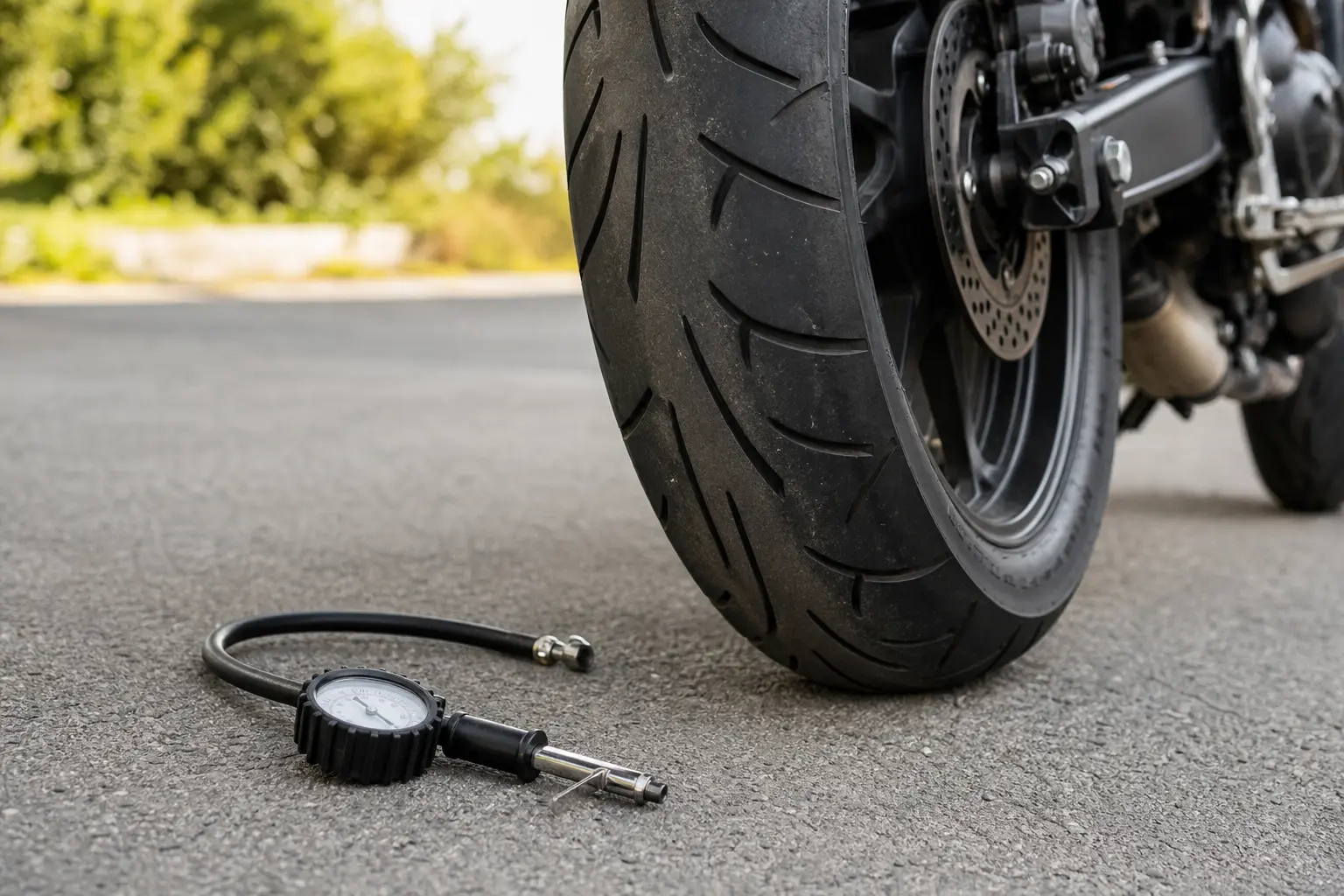
Start with the motorcycle manufacturer’s owner’s manual. It is the primary source for approved tire size, construction, load and speed requirements, pressure specifications, and any load-related settings for your exact motorcycle. Harley-Davidson’s guidance similarly says to refer to the owner’s manual for load ratings and inflation information, rather than relying on a generic number or the maximum pressure printed on a tire sidewall. (harley-davidson.com)
Then apply a conservative decision rule:
- Do not ride normally if the tire has visible damage, a bulge, a deformation, exposed material, or a condition that makes you uncertain about its integrity.
- Do not use a changed tread pattern to justify a long ride, fast ride, passenger ride, or heavily loaded ride. Extra speed, distance, load, and weather exposure reduce your margin when the cause is unconfirmed.
- Stop and arrange assessment if uneven wear appears alongside unusual vibration, instability, steering changes, or a concern about the wheel or tire.
- Use only manual-approved pressure information for the bike’s condition and load. Do not improvise with a universal pressure target.
- Keep the specified tire fitment at the center of the decision. Manufacturer guidance emphasizes that tire size, load rating, speed rating, and construction are integral to motorcycle performance. (harley-davidson.com)
NHTSA also advises riders to check tire pressure and tread depth before every ride. That is especially relevant after discovering an uneven pattern: the check is not a repair, but it helps avoid adding an easily verifiable issue to an already uncertain situation. (nhtsa.gov)
The Most Useful First Checks: Record, Compare, Verify
You can perform a limited parked-bike review without turning it into a home diagnosis. The goal is to gather accurate information, not to prove a theory.
1. Record the tire and motorcycle context
Note which tire is affected: front or rear. Record the current odometer reading, the approximate mileage since tire installation if known, and whether the wear seems new, stable, or rapidly more obvious. Include recent changes that could matter to a service conversation:
- A pothole, curb strike, rough-road impact, or debris encounter.
- A long loaded trip, passenger use, or a substantial change in luggage.
- A period of storage followed by return to riding.
- A history of low-pressure warnings or missed pressure checks.
- A tire replacement, wheel removal, or other recent service.
- A new vibration or a change in how the motorcycle steers.
These facts do not establish causation. They give the technician a timeline, which is more valuable than a confident but unsupported conclusion.
2. Look at the full tire, not only the most dramatic spot
With the motorcycle parked securely and the engine off, view the tread and sidewalls in good light. You are looking for pattern consistency, not trying to measure every block. Ask:
- Does the irregularity repeat around much of the tread, or is it local?
- Is the concern confined to the tread, or are there also cracks, cuts, bulges, punctures, or deformation?
- Is one tire affected while the other looks materially different?
- Is the tread approaching its wear indicators or the limit stated in the owner’s manual?
Harley-Davidson’s maintenance guidance calls for regular checks for tread wear, cracking, bulging, and embedded objects, and it warns that motorcycle tires can wear in irregular patterns. (harley-davidson.com)
3. Verify pressure the manufacturer’s way
Check the tire pressure only when the tire is at the “cold” condition defined by your motorcycle manufacturer. Use the motorcycle’s manual for the correct front and rear figures and for any passenger or cargo adjustments. Record what you find rather than repeatedly changing pressure in search of a tread-pattern fix.
Pressure is important because official guidance lists incorrect pressure as one possible contributor to uneven tread. But a correct reading today cannot reveal every prior riding condition, and it cannot clear the wheel, rim, axle, or bearings. It is one input to the inspection—not the whole answer. (harley-davidson.com)
4. Make a short note about ride behavior
If you have ridden since first noticing the pattern, write down only what you actually felt:
- No change in behavior.
- A vibration at some road speeds.
- A heavier or different steering feel.
- A pull, wander, instability, or other handling change.
- A change under load, with a passenger, or after a road impact.
Avoid filling gaps with assumptions. “Vibration noticed after uneven tread was found” is useful information. “The bearing is bad” is not, unless a qualified inspection has established it.
Why Pressure Is Important but Not a Complete Explanation
Riders often hear that tire pressure is the answer to every wear question. It is not. Proper inflation matters for tire wear and safe handling, and Harley-Davidson says riders should use the owner’s manual for the correct load and inflation information. (harley-davidson.com)
But pressure is one factor in a bigger system. Harley-Davidson’s tire-replacement guidance specifically lists incorrect pressure alongside potentially relevant wheel balance, axle alignment, rim, and bearing concerns when discussing cupping or uneven tread. (harley-davidson.com)
That means two things can be true at once:
- You should correct an out-of-specification pressure according to the owner’s manual before riding.
- You should not conclude that pressure correction alone has explained or resolved a pronounced irregular wear pattern.
A pressure check is therefore a baseline action. It reduces one immediate uncertainty. It does not authorize you to ignore vibration, visible deformation, handling changes, or clear tread irregularity.
Why “I’ll Just Replace the Tire” May Not Be Enough
A worn or unevenly worn tire may indeed need replacement. That is a normal maintenance outcome. Yet replacement should not end the investigation if the old tire’s condition suggested a possible wheel, axle, rim, bearing, or pressure-related concern.
Think of the removed tire as evidence. Before it is discarded, a technician may be able to learn something from its pattern in combination with the motorcycle’s wheel, fitment, and ride history. Harley-Davidson explicitly notes that a professional technician can often diagnose other problems by looking at uneven tread wear. (harley-davidson.com)
This is why it is sensible to say, “Please assess the tire pattern and check for related wheel-area concerns,” rather than simply requesting a tire change. You are not directing the diagnosis; you are making sure the symptom is not lost.
It is also a reason to avoid changing tire size, construction, load rating, or speed rating in response to uneven wear. A new, non-specified tire may introduce another variable instead of clarifying the first one. Follow the exact model documentation and consult a qualified tire professional if fitment is in question.
When to Stop Guessing and Book a Qualified Inspection
Book professional assessment soon when the tread pattern is distinct, when it has worsened, or when you do not know the tire’s maintenance or impact history. Escalate more urgently when the pattern is paired with any handling or structural warning sign.
Stop riding and arrange help before the next ride if:
- You see a bulge, deformation, cut, tear, exposed internal material, or other obvious tire damage.
- The motorcycle has a new instability, pull, wobble-like sensation, or steering change.
- You notice a new or substantial vibration together with irregular tread.
- The tire is at or beyond its wear indicator or the limit prescribed by the motorcycle manufacturer.
- You suspect wheel, rim, axle, or bearing damage after an impact.
- You cannot confirm the correct tire specification or pressure from the owner’s manual.
Arrange a prompt inspection if:
- The tire has a visible scalloped or stepped pattern but the motorcycle otherwise feels normal.
- The pressure was not checked consistently and the wear history is unclear.
- The motorcycle recently carried different loads, traveled on unusually rough roads, or returned from storage.
- A tire replacement is already due and you want the related condition assessed before fitting the replacement.
This is a cautious threshold, not an attempt to create fear around every imperfect tread surface. The objective is to reserve “keep riding and monitor it” for situations where tire condition and handling have been checked, the manual’s requirements are known, and there is no meaningful warning sign.
Checklist: Uneven Motorcycle Tire Wear Response Plan
Use this checklist after you spot possible cupping or uneven wear.
- Park the motorcycle securely; inspect only with the engine off.
- Identify whether the front, rear, or both tires show the concern.
- Photograph the tread in good light from several angles.
- Note odometer mileage, tire age if known, and approximate mileage on the tire.
- Record recent impacts, rough-road events, storage, loading changes, or service work.
- Look for cuts, cracking, bulges, deformation, punctures, and embedded objects.
- Check tread indicators and consult the owner’s manual for model-specific limits.
- Check cold tire pressure using the exact manual specification for the present load.
- Record any vibration, steering, stability, or handling change without attempting to diagnose it.
- Do not alter wheel, axle, bearing, or suspension settings based only on the pattern.
- Reduce risk: avoid high-speed, long-distance, passenger, or heavily loaded riding until uncertainty is resolved.
- Book a qualified tire/motorcycle inspection when the wear is clear, worsening, paired with symptoms, or otherwise uncertain.
What to Tell the Technician
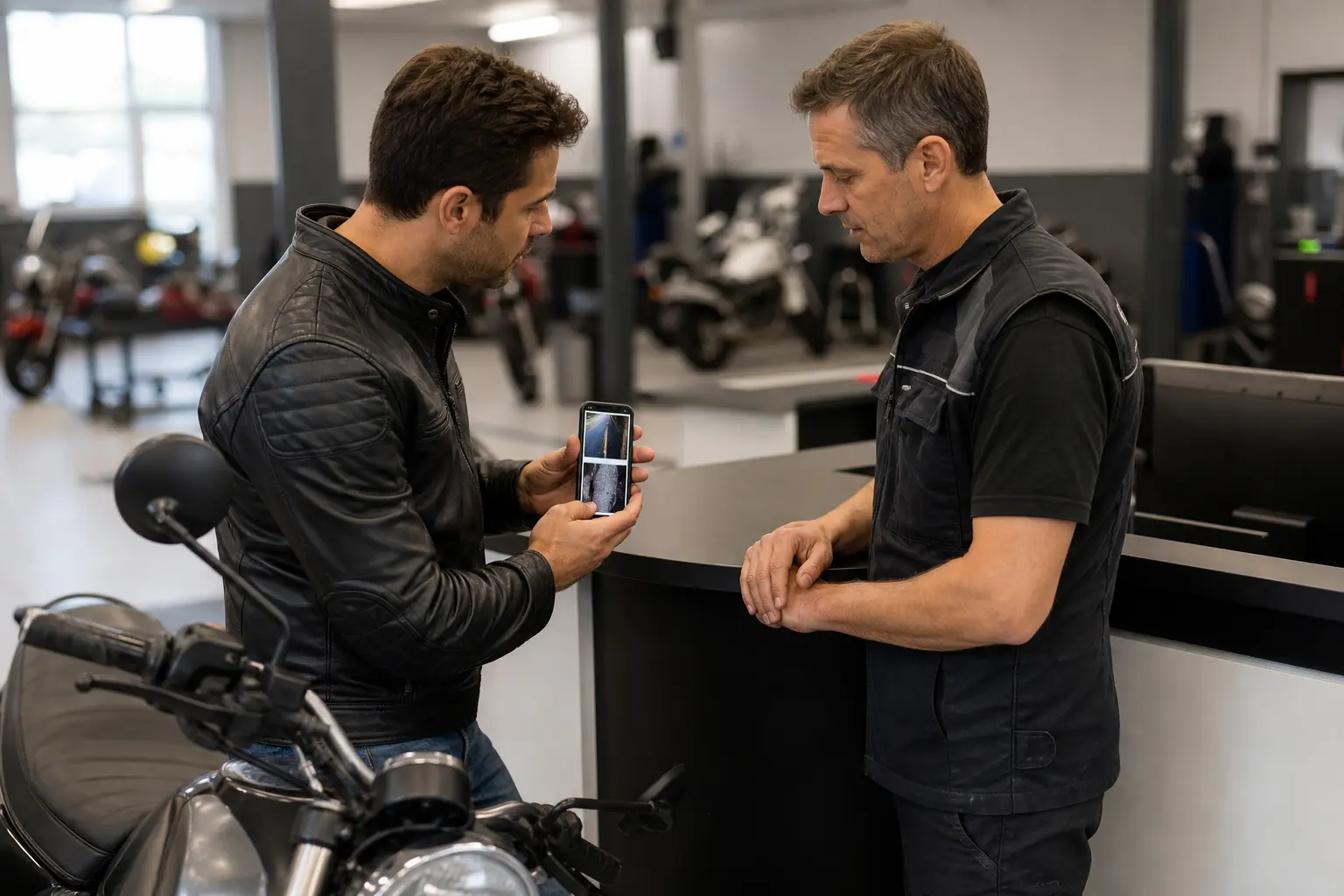
A concise, evidence-based description can make the appointment more productive. Consider sharing:
“I found irregular tread wear on the front/rear tire. I first noticed it at approximately odometer reading. The pressure was reading when checked cold against my manual. I have/have not noticed vibration or handling changes. Recent context includes impact, load change, storage, recent service, or unknown history. Please assess the tire pattern and any related wheel-area concerns before or during tire replacement.”
That statement avoids two unhelpful extremes: minimizing a valid concern and insisting on a particular repair before the motorcycle has been assessed.
Prevention Is Mostly About Repeatable Basics
Not every irregular pattern is preventable, and no rider can visually inspect a tire into perfect condition. Still, a consistent routine reduces avoidable uncertainty.
First, check pressure at the interval your manufacturer recommends and before rides when conditions or load have changed. Harley-Davidson recommends checking tire pressure before each ride during riding season, while NHTSA advises checking tire pressure and tread depth before every ride. (harley-davidson.com)
Second, include tires and wheels in the pre-ride walk-around. Look for wear, damage, bulges, and anything embedded in the tire; look at wheel condition as well. Harley-Davidson’s T-CLOCS-based guidance specifically places tires, wheels, and brakes at the start of that review. (harley-davidson.com)
Third, treat changed behavior as data. If the bike develops vibration, altered steering feel, or instability, investigate sooner rather than waiting for a tire to become obviously worn. A small log of pressure readings, tire changes, and service dates makes that investigation easier.
Finally, keep fitment conservative. Use the tire specification and load guidance for the exact motorcycle rather than choosing tires or settings based on appearance, internet anecdotes, or a desire to alter wear behavior. The manufacturer has designed the motorcycle as a system; tire dimensions, construction, and ratings are part of that system.
How Vojo Helps
Create a tire-condition entry in the Vojo motorcycle maintenance tracker as soon as you notice uneven wear. Add the odometer reading, cold-pressure reading from your owner’s manual, photos of the affected tread, and a short note about any vibration or recent impact. Then set a follow-up task for the service appointment and save the technician’s findings in the same history. This creates a clear before-and-after record for the current tire and gives you a practical baseline when you inspect the replacement later.
Download Vojo on the App Store
Bottom Line
Motorcycle tire cupping and uneven wear are signals to investigate, not labels that identify one failed part. Start with manufacturer-specified tire pressure and fitment, inspect for visible damage, document the tread pattern and ride symptoms, and let a qualified technician assess the tire alongside the wheel-area concerns that official guidance says can be associated with uneven wear.
If the motorcycle feels different, the tire looks damaged, or the pattern is pronounced, stop trying to solve it by theory. Preserving safety margin is more important than squeezing a few more rides from a questionable tire.
Quick answers
Frequently asked questions
What causes motorcycle tire cupping and uneven wear?
There is no single confirmed cause from the tread pattern alone. Official Harley-Davidson guidance says uneven tread may be associated with wheel balance, axle alignment, rim condition, wheel-bearing condition, or incorrect tire pressure. A qualified technician should assess the tire and motorcycle rather than relying on pattern-based guesses.
Is motorcycle tire cupping dangerous?
It can be a safety concern because uneven tread may affect handling and can cause vibration. The urgency rises if the tire also has damage, the motorcycle feels unstable or steers differently, or the tread is near its wear indicators. In those cases, do not continue normal riding while trying to diagnose it yourself.
Can low tire pressure cause cupping on a motorcycle tire?
Incorrect tire pressure is one possible factor listed in manufacturer guidance, but it is not the only possible explanation. Verify the cold pressure against your exact owner’s manual, then arrange assessment if the wear is pronounced, worsening, or paired with vibration or handling changes.
Will a new motorcycle tire fix uneven wear?
A worn tire may need replacement, but a replacement tire does not automatically explain why the previous tire wore irregularly. Ask the technician to evaluate the tire pattern and related wheel-area concerns before the old tire is discarded or while the replacement is being installed.
Can I keep riding on a cupped motorcycle tire?
That depends on the severity of wear, the tire’s overall condition, and how the motorcycle feels. Do not ride if there is damage, deformation, a major vibration, instability, or uncertainty about tire integrity. When in doubt, choose inspection before another ride.