
Motorcycle Tailgaters: Create Space Without Escalating the Risk
Use a motorcycle tailgater safety response that protects forward space, keeps your actions predictable, permits a safe pass, and helps you separate calmly.
Fact-checked against cited official documentation
Reviewed against Reviewed against MSF guidance on close following, extra blind-spot observations, time-and-space management, escape planning, and safe traffic separation..
Last updated October 26, 2026
A driver who follows too closely can change the feel of a ride in seconds. The vehicle may dominate your mirrors, pressure you toward a pace you did not choose, and make every slowing traffic queue seem more serious. That discomfort matters, but it does not mean you need to react quickly, prove a point, or somehow force the driver to behave better.
A useful motorcycle tailgater safety response has one purpose: keep as many safe choices available as possible. Instead of trying to manage the driver behind you, manage the road space you can influence. Look farther ahead, create a larger working gap in front, ride in a steady and understandable way, and look for a lawful opportunity to let the vehicle continue ahead or to end the interaction at a suitable location.
The Motorcycle Safety Foundation advises riders confronted by close following to increase their space ahead, adjust pace appropriately so a pass may become possible, and use a safe place to pull off rather than let the situation escalate. Its Motorcycle Operator Manual presents this as an option-management problem, not a contest with another road user.
The driver may be distracted, impatient, inexperienced around motorcycles, or deliberately hostile. From a moving motorcycle, guessing which explanation is true has little value. A conservative plan should work regardless of motive. Your priority is to avoid letting a close follower take over your attention, pace, or decision-making.
Motorcycle tailgater safety response: regain your decision margin
A tailgater becomes dangerous when their lack of room behind you combines with a problem ahead. Traffic might compress. A vehicle could turn across your path. A curve, crest, wet patch, or piece of debris may require a change of speed. The closer vehicle has left less time for its driver to recognize what is happening, while you may feel tempted to delay a needed response.
That is why the first answer is usually not to look backward longer. Make a brief, useful mirror check to establish that close following is continuing. Then put your primary visual attention where it belongs: the travel path, traffic patterns ahead, road surface, side streets, and places where the traffic arrangement could change.
Think of forward space as usable time. More room ahead can help you recognize a developing conflict earlier and respond with smoother, less urgent inputs. It may also give the following driver a clearer picture of your gradual reduction in pace if traffic begins to slow. This is not an instruction to travel below an appropriate pace merely to annoy someone. It is a decision to avoid being boxed into a last-second reaction.
MSF’s broader rider guidance emphasizes managing time and space, detecting threats early, and keeping an escape plan in mind. Those ideas are especially relevant when a vehicle crowds the rear of the motorcycle. Review If You Ride A Motorcycle for the official context on maintaining space and planning alternatives before a threat becomes immediate.
Signs that you should move from casual observation to an active separation plan include:
- The same vehicle remains very near through normal changes in traffic speed.
- Your eyes keep returning to the mirrors at the expense of looking ahead.
- You feel compelled to ride faster than your comfort, route, or conditions support.
- Your forward gap is shrinking, leaving less ability to respond progressively.
- A reasonable chance for the driver to make space or continue ahead has already passed without changing the behavior.
- Your own frustration is beginning to influence throttle, braking, lane choice, or attention.
The last point is important. Stress can make an ordinary traffic decision feel personal. Recognize that feeling as a reason to simplify: steady riding, earlier observations, more room ahead, and a clear plan to separate when a sound option appears.
A practical mental sequence is notice, stabilize, create, separate:
- Notice the close following with a brief mirror check.
- Stabilize your attention on the road and keep inputs ordinary and smooth.
- Create more room ahead whenever traffic and conditions permit.
- Separate by allowing a proper pass, taking an appropriate exit, or using a legitimate stopping place.
This sequence does not require you to diagnose the other driver. It keeps your actions centered on what can be seen and assessed from the motorcycle.
Motorcycle tailgater safety response: make your riding easy to read
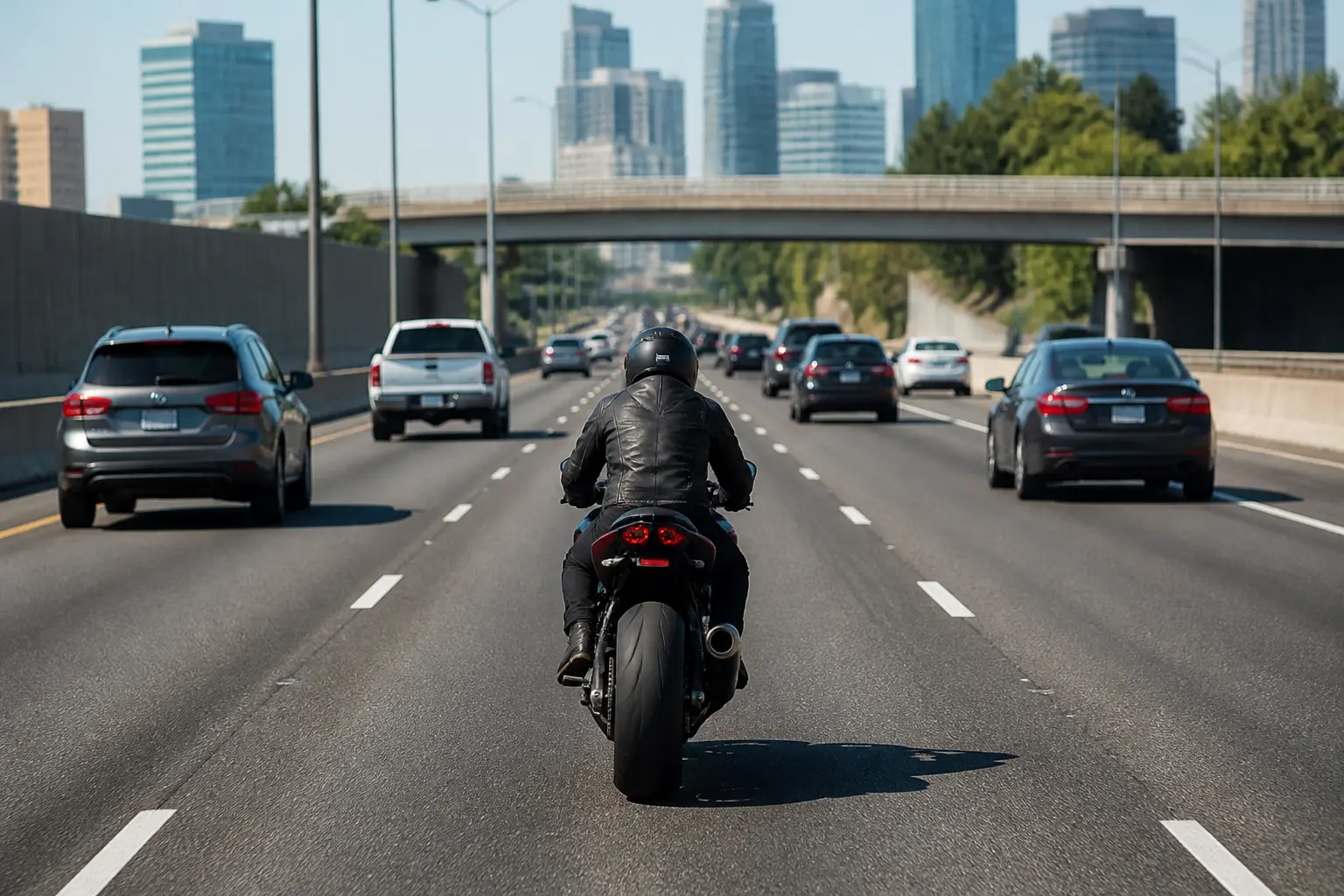
When another road user is already too close, surprise is not helpful. The goal is not to become passive; it is to make your next actions easier for others to recognize.
Keep a stable lane path suited to the road and surrounding traffic. Avoid drifting back and forth within the lane to express irritation. Do not repeatedly tap the brakes, flash signals, or make exaggerated body movements. Those actions may be misunderstood, can distract you from real hazards, and do not create reliable space.
If you need to slow for a genuine reason, do so as smoothly as the situation allows. Scan ahead early for slowing traffic, turns, intersections, and changing signal phases so you have the best chance to respond gradually rather than abruptly. A tailgater does not remove your responsibility to react to hazards, but preserving forward room can reduce the chance that a normal traffic adjustment becomes a sudden one.
Do not try to solve the problem by accelerating away. More speed may narrow the time available for curves, traffic changes, road imperfections, and route decisions. It can also turn a short-lived close-following event into a chase shaped by the other driver’s behavior. A manageable pace, clear observation, and a planned separation point are more useful than trying to outrun pressure.
The same principle applies to lane changes. A hasty move can place the motorcycle beside another vehicle, in an area that has not been checked, or on poor pavement. Change lanes only for a genuine, safe reason and only after assessing the space you intend to enter. Mirrors offer valuable information, but they do not show every nearby vehicle. MSF specifically encourages an additional visual check before moving because blind spots can conceal traffic; see Check Your Blind Spots — An Extra Look Can Save a Life.
Your motorcycle’s owner’s manual remains the first source for its controls, warnings, tires, load limits, braking-related systems, passenger provisions, and accessories. Do not test unfamiliar settings or depend on equipment you have not learned while dealing with traffic pressure. The separate readiness work—inspection, servicing, and understanding the motorcycle before departure—can be organized with the Motorcycle Maintenance Guide.
Let a tailgater get ahead when the road supports it
Allowing the close-following vehicle to continue ahead can be the cleanest solution, provided the roadway genuinely supports it. The rider does not need to direct the driver, invite an unsafe maneuver, or surrender control of the motorcycle. Your role is simply to remain predictable and avoid creating a new conflict.
On a road with more than one lane in your direction, an available lane may give the driver a straightforward way to go ahead. You do not have to make a rushed lane change merely because somebody is impatient. If a normal lane change is safe, lawful, and useful for your own route, make it deliberately. If not, maintain your path and let the driver use a lawful opportunity when one exists.
On a narrow two-way road, pressure to “make room” can be especially misleading. Moving onto an edge or shoulder may expose the motorcycle to debris, damaged pavement, drainage features, stopped vehicles, pedestrians, or an unsafe re-entry. The fact that another driver wants to pass says nothing about whether the surface beside you is appropriate. Do not convert uncertain pavement into an emergency escape route.
It is also unwise to wave a driver around when you cannot assess the full road scene. You cannot reliably judge what they can see, whether another vehicle is approaching, or whether they will interpret your gesture as permission for a maneuver that is unsafe. Keep your attention on your own position and decisions.
| Situation | Main objective | Avoid | Better response |
|---|---|---|---|
| Open road with room ahead | Build a larger forward buffer | Racing away from the vehicle | Ride smoothly and allow a lawful pass to develop |
| Multilane road | Remain visible and predictable | Abruptly changing lanes under pressure | Make only deliberate, fully observed lane moves |
| Narrow two-way road | Preserve pavement and control margin | Dropping onto an unknown edge | Continue to a turnout or a clearly suitable area |
| Congested traffic | Keep a manageable gap ahead | Fixating on the mirror or filling every opening | Scan ahead, use gradual inputs, reassess often |
| Driver stays close after passing opportunities | End the interaction safely | Riding while anger and stress accumulate | Select a proper stop or an alternate route |
| Conduct appears threatening | Reach people and assistance | Arguing, stopping in isolation, or going home | Proceed toward a visible public location and seek help if necessary |
The table cannot replace your judgment, traffic law, or the changing conditions in front of you. If the available choice is unclear, wait for a better one. A short delay is preferable to an improvised move with poor visibility or poor surface information.
What not to do when a motorcycle is being tailgated
Close following naturally triggers anger. But an anger-driven response often gives away the space, attention, and control you are trying to preserve.
Do not brake-check. Braking to punish or warn a driver can create an immediate impact risk. Brake because traffic, road conditions, or your route requires it—not as a communication tool. If a reduction is needed, use the smoothest response the circumstances allow.
Do not weave or use aggressive gestures. Weaving adds unnecessary movement to a tense situation. Gestures can be misread, may distract both parties, and can turn a spacing problem into a confrontation. Save your attention for traffic and your route out of the interaction.
Do not race the vehicle. Increasing speed does not reliably create safety. It may reduce the time you have for the next hazard and can invite more unpredictable behavior. The goal is separation, not victory.
Do not pull alongside to argue. Riding near the driver to make eye contact, shout, or challenge them removes the distance you need. Even if you believe the driver is merely careless, there is no benefit in creating a face-to-face conflict while both vehicles are mobile.
Do not treat every shoulder as an escape lane. A shoulder can be restricted, contaminated, uneven, occupied, or difficult to leave. Use it only when it is lawful and plainly appropriate—not because the vehicle behind has made you feel rushed.
Do not lead a suspected follower home. One turn in the same direction proves little, but persistent following after reasonable route changes deserves caution. Choose a visible, populated place where you can stop safely and seek assistance. Do not attempt to settle the issue at your residence or in a quiet, isolated location.
These are active safety decisions, not signs of weakness. Refusing to escalate keeps the rider’s attention available for the road and makes it easier to select a safe exit from the situation.
Choose a pull-off or new route before stress takes over
A deliberate stop or route change is often the best answer when close following persists. It replaces an ongoing, distracting situation with a controlled pause. The choice is not an admission that the tailgater was right; it is a decision to protect your concentration.
Look for places designed or suited for stopping: a parking area, service station, rest area, visible business, or another location that allows a safe entrance and departure. Favor places with good sightlines, room around the motorcycle, other people nearby, and a simple way to resume your route later.
Avoid stopping at a blind curve, just beyond a hill crest, in a narrow roadside gap, or wherever through traffic may have difficulty seeing you. A location can look convenient while still leaving little protection from traffic or little room to maneuver. If the location does not feel clearly suitable, continue to the next option.
An alternate route can be equally useful. Make the change as a normal route choice, not a sequence of sudden turns meant to determine whether the driver is following. Select a road or destination you can reach calmly. If the vehicle remains behind you and you believe there is an immediate threat, seek emergency assistance when you can do so from a safe position.
Passengers should not become traffic monitors or negotiators. Before a ride, it is reasonable to agree that traffic conditions may require a smooth pace change, a stop, or a route adjustment. During the event, keep the rider’s attention on control and observation; brief reassurance is more useful than trying to communicate with the tailgating driver.
Motorcycle tailgater response checklist
Before the ride
- Review the manufacturer guidance relevant to your motorcycle and its installed equipment.
- Leave enough time so another driver’s impatience does not set your pace.
- On unfamiliar routes, notice ordinary fuel stops, rest areas, and visible public locations.
- Carry a charged means of communication, to use only once safely stopped.
- Decide before departure that you will choose separation over confrontation.
When you notice close following
- Confirm it with a brief mirror check, then return your eyes to the road ahead.
- Scan farther ahead for slowing traffic, junctions, surface changes, and possible exits.
- Increase the room in front of the motorcycle where conditions allow.
- Keep lane placement, throttle, braking, and steering calm and consistent.
- Avoid gestures, brake-checking, weaving, and attempts to outrun the driver.
When a pass or separation point appears
- Assess signs, traffic, sightlines, pavement, and nearby road users.
- Look again before any lateral movement; do not rely on mirrors alone.
- Signal only for real maneuvers and avoid unnecessary course changes.
- Do not use an uncertain shoulder simply to satisfy an impatient driver.
- Choose a proper public stopping place or sensible route change if pressure continues.
After you have separated
- Pause long enough to restore focus before rejoining traffic.
- Record relevant details after stopping if the behavior was threatening or reportable.
- Consider whether traffic density, fatigue, timing, or route familiarity reduced your options.
- Use what you learned to improve a future departure time or route plan rather than replaying the conflict.
Manufacturer-first safety guidance
Manufacturer documentation comes before generalized riding advice. Consult your owner’s manual and official safety notices for model-specific information about controls, warnings, braking behavior, tires, loading, passenger use, lighting, and accessories. A close follower is not the time to discover how a feature works or whether added equipment affects the way you operate the motorcycle.
This matters when the motorcycle carries luggage, a passenger, communication equipment, navigation hardware, or other additions. Confirm approved use, fitment, and limits through the manufacturer or a qualified professional. If the motorcycle feels unfamiliar, behaves unexpectedly, or displays a warning, resolve that issue while safely parked.
The MSF sources support a deliberately conservative approach: preserve time and room, observe for alternatives, avoid abrupt escalation, and leave the interaction at a suitable place when necessary. No technique can guarantee that another driver will act responsibly. The practical aim is to make decisions that do not depend on that driver becoming cooperative.
How Vojo Helps
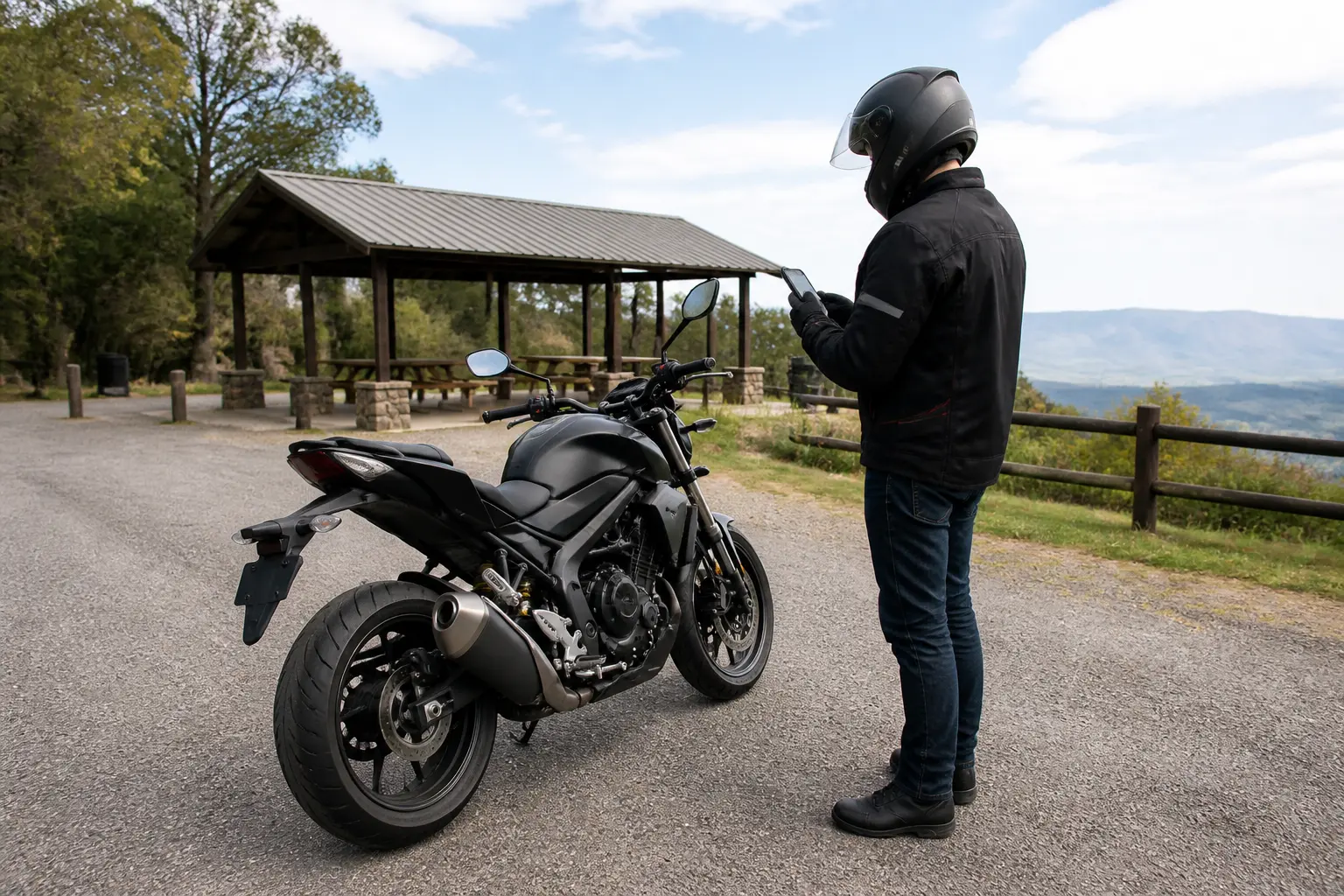
Use Vojo to turn a tailgater-response plan into a routine part of ride preparation. Before an unfamiliar or longer route, review your intended journey while parked and identify a few legitimate places where you could pause if traffic pressure becomes persistent: service areas, fuel stops, rest areas, or visible commercial locations. Add a short ride note such as, “Create forward room; take a safe separation option early.”
After a ride, add a factual note in the Motorcycle Service History about the road section, traffic conditions, time of day, and any route change you made. Over time, those notes can help you identify calmer departure windows, routes with better stopping options, and situations that tend to reduce your decision margin. Never interact with the app while moving; make notes and route changes only after stopping safely.
Download Vojo on the App Store
Frequently asked questions
Should I slow down when a tailgater is behind my motorcycle?
An appropriate, smooth pace adjustment may create more working room ahead and may make a safe pass possible. It should not be a sudden punishment maneuver. Continue to account for traffic, signs, pavement, visibility, and the space around the motorcycle.
Should I pull onto the shoulder to let a driver pass?
Only if the movement is lawful and the area is clearly suitable for entering, using, and leaving. If the shoulder is uncertain, uneven, obstructed, or poorly visible, stay on a predictable path and wait for a proper turnout or other safer option.
What if the driver follows me after I change direction?
Do not assume intent from a single turn, but do not lead a suspected follower home. Continue toward a visible public location where you can stop safely and seek assistance. If you believe there is an immediate threat, contact emergency services when it is safe to do so.
Is accelerating away a good motorcycle tailgater safety response?
Usually not. Riding faster under pressure can reduce the time available for road hazards, intersections, curves, and changing traffic. Prioritize a manageable pace, more space ahead, and a safe way to separate instead.
Should I signal or gesture for the driver to back off?
Avoid gestures intended to shame or confront the driver. They can be misinterpreted and may worsen the interaction. Use normal signals for genuine riding actions, then rely on predictable riding, a safe passing opportunity, or a planned stop to create distance.
Quick answers
Frequently asked questions
Should I slow down when a tailgater is behind my motorcycle?
A smooth, appropriate pace adjustment may build more usable room ahead and can make a safe pass possible. Do not use abrupt braking as a punishment or signal.
Should I pull onto the shoulder to let a driver pass?
Only when it is lawful and clearly suitable for entering, using, and exiting. If the surface or visibility is uncertain, continue predictably until a proper option appears.
What if the driver follows me after I change direction?
Do not go home or stop to confront the driver. Continue toward a visible public location where you can safely stop and seek assistance if necessary.
Is accelerating away a good motorcycle tailgater safety response?
Usually not. More speed can reduce your time for traffic changes, curves, junctions, and surface hazards. Focus on forward space and safe separation.
Should I signal or gesture for the driver to back off?
Avoid confrontational gestures. Use standard signals only for actual maneuvers, then create distance through steady riding, a safe pass opportunity, or a planned stop.