
Stopped at a Red Light on a Motorcycle: A Mirror, Space, and Escape-Route Routine
Use a practical motorcycle red-light routine for mirror checks, braking communication, space ahead, and escape-route awareness without assuming every risk is controllable.
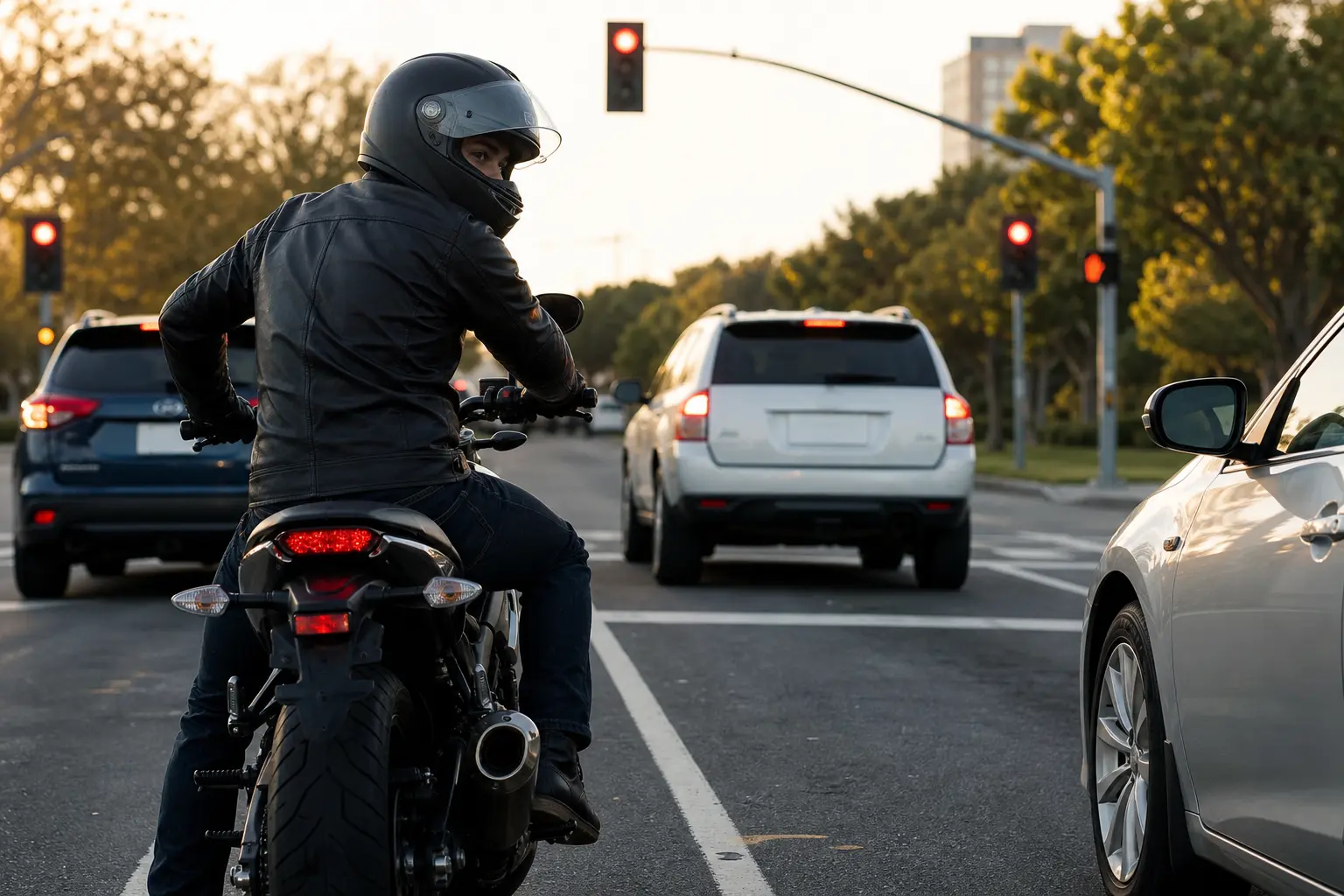
Fact-checked against cited official documentation
Reviewed against Fact-checked against MSF guidance on visibility, brake-light communication, escape paths, lane positioning, time and space, rider preparation, and the Search-Evaluate-Execute strategy..
Last updated October 9, 2026
A motorcycle safety stopped at red light routine is not about finding one perfect lane position or memorizing a dramatic last-second maneuver. It is about staying involved in the traffic situation after you decide to stop.
At a red light, your motorcycle is stationary while the scene keeps moving. A driver may still be closing from behind. A vehicle beside you may change position. A pedestrian, cyclist, or turning vehicle can occupy the open pavement you noticed moments earlier. The signal may be red, but the riding task is not paused.
A useful routine has three connected priorities:
- Keep gathering information behind you.
- Avoid giving away all of your room ahead when conditions allow.
- Identify whether any lawful, verified direction remains available if the situation changes.
The Motorcycle Safety Foundation (MSF) advises riders to make themselves more noticeable while slowing when practical, maintain an escape path, use lane position to improve seeing and being seen, and give themselves time and space to recognize developing traps. 1 Its SEE strategy—Search, Evaluate, Execute—offers a practical way to organize those decisions rather than reacting only after a problem becomes urgent. 2
None of this guarantees that a following driver will stop, that a gap will remain open, or that every hazard can be avoided. The purpose is more modest and more useful: arrive at the stop with current information, retain reasonable options where they exist, and avoid treating a red light as a distraction break.
Motorcycle safety stopped at a red light: why the routine starts before you stop
The highest-value decisions often happen during the approach, not after both feet are down. While rolling at a controlled speed, you can observe the queue, choose a deliberate stopping location, and notice whether traffic behind is responding to your reduction in speed.
That does not require staring into a mirror or trying to predict another driver’s intentions. It means taking short, repeated looks that build a more complete picture. Is the vehicle behind clearly slowing? Does it appear to be closing much faster than the traffic pattern suggests? Is it partly hidden by a larger vehicle? Is another vehicle following it closely? Has the driver behind already moved into a different lane?
At the same time, look through and around the stopped traffic ahead. The vehicle directly in front of you matters, but so do the conditions around it: lane edges, pavement markings, crosswalks, people waiting to cross, bicycles, turn lanes, parked vehicles, road damage, drainage features, and nearby large vehicles. A space that appears available from a distance can be unusable when you arrive.
Think of the approach as a transition through four questions:
- What is the traffic queue doing ahead?
- Is the vehicle behind me settling into the stop?
- Where can I stop without unnecessarily boxing myself in?
- If the picture changes, what space is genuinely clear—not merely visible from one angle?
This approach avoids two unhelpful extremes. One is stopping so close to the vehicle ahead that there is no remaining buffer. The other is treating every gap as a guaranteed exit. A good stopped-at-a-light routine recognizes that space is temporary, shared, and dependent on the immediate traffic picture.
Start with the motorcycle and its manufacturer guidance
Defensive-riding habits work best when the motorcycle is ready for normal road use. Before relying on lighting, braking feel, steering control, or predictable response in traffic, begin with the owner’s manual for your exact motorcycle. The manufacturer’s documentation is the correct authority for warning indicators, controls, required inspections, tire information, load limits, and maintenance requirements.
MSF also recommends studying the owner’s manual and making pre-ride checks a habit. 1 That matters here because a red-light routine cannot compensate for a known issue with lighting, brakes, tires, steering, or controls.
Keep the preparation practical:
- Use your model-specific manual to understand the normal operation of its controls and warning indicators.
- Include lighting and signal function in your regular pre-ride awareness, rather than discovering a concern when traffic is already approaching.
- Do not ride on a mechanical concern that makes the motorcycle difficult to control, signal, or stop predictably.
- If a warning or handling issue appears, take the conservative path: get out of traffic safely when possible and arrange qualified inspection instead of attempting an improvised repair roadside.
For a broader manufacturer-first approach to everyday checks and service records, see the Motorcycle Maintenance Guide.
The mirror-space-escape routine on the approach
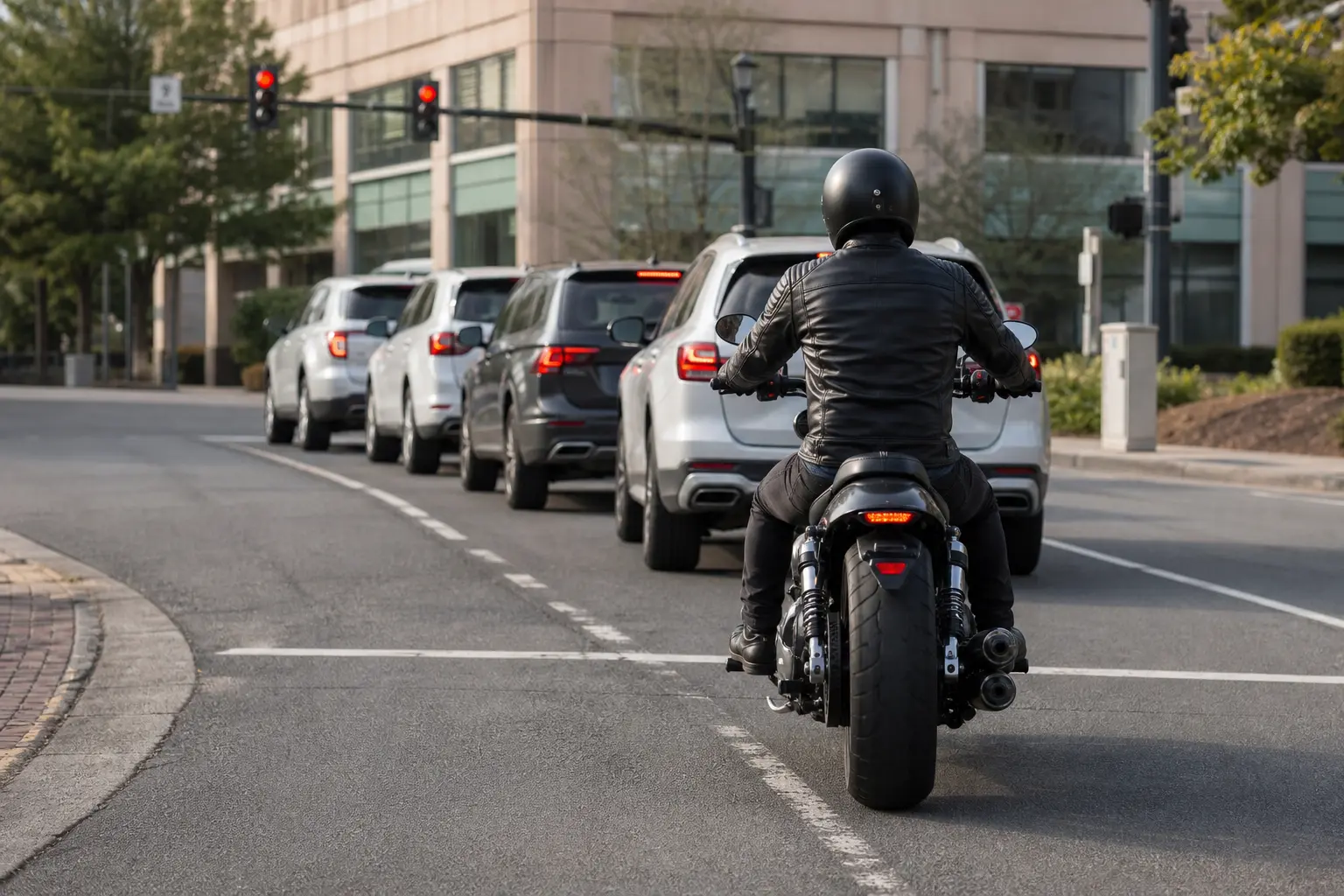
The following sequence is not a command to make a particular maneuver. It is a way to manage attention as you approach stopped traffic. Adapt it to the road, your training, your motorcycle, and the space that is actually present.
First: search the entire stop, not only the signal
A red signal provides one piece of information: you are likely to stop. It does not tell you whether a driver behind has noticed the queue, whether a vehicle will move into your lane, or whether the pavement beside the vehicle ahead is safe and open.
Begin with a broad scan. Notice the traffic signal and the length of the queue. Look for changes in lane direction, vehicles preparing to turn, pedestrians near the crossing, cyclists, buses, trucks, and roadway features that reduce usable pavement. Then incorporate the mirrors as part of the same scan.
A mirror check is most useful when it answers a question. Instead of glancing behind out of habit, ask: Is the traffic behind responding to my slowing? A vehicle that is already braking smoothly may require only normal observation. A vehicle that continues to close while you approach a queue deserves more of your attention and may affect where you choose to stop.
The key is to keep the scan moving. Looking behind does not remove the need to look ahead. Looking at the signal does not remove the need to notice a pedestrian. Searching is active, not fixed on one object.
Second: make your slowing understandable, but do not depend on it
MSF advises riders, when possible, to flash the brake light while slowing or before coming to a stop. 1 In practical terms, this can be one communication layer when a motorcycle is approaching stopped traffic.
Communication is helpful, but it is not control over another road user. A brake light cannot ensure that a driver is looking, understands the closing speed, has enough room to stop, or reacts appropriately. Treat it as a signal that supports your broader strategy—not as proof that the threat behind you is resolved.
Keep the rest of the arrival controlled. Avoid deliberately creating abrupt drama merely to get attention. Smooth, deliberate slowing gives you more time to observe and gives other road users a clearer change to interpret. If a rapid speed reduction is genuinely required by the situation, maintaining control comes first; high-pressure braking and avoidance skills belong in formal instruction and planned practice, not in an improvised red-light experiment.
Third: choose a position based on conditions, not superstition
There is no universal lane spot that acts as a shield at every light. A position can be useful at one intersection and poor at the next because the road, traffic, sightlines, surface, and adjacent users are different.
Instead of asking, “Which lane third is always safest?” ask these questions:
- Can I see approaching traffic well enough to keep updating the situation?
- Is my motorcycle reasonably visible to the traffic around me?
- Is the pavement beneath and immediately around me suitable for a controlled stop?
- Am I beside a large vehicle or in an area where its movement could affect me?
- Is any apparent route ahead actually clear, lawful, and usable?
A position near one side of the lane may improve your view in a particular situation but create another concern if an adjacent vehicle is moving toward that space. A gap alongside the vehicle ahead may be part of a crosswalk, bicycle lane, turn path, shoulder, or curb area. Road markings, debris, wet paint, uneven pavement, and changing traffic can all matter more than a habitual position.
The practical goal is not perfect placement. It is deliberate placement followed by reassessment.
Fourth: stop with room that has a purpose
When conditions permit, do not stop so close to the vehicle ahead that you immediately surrender every bit of forward room. Leave a buffer that has a reason: it may preserve room to reposition if the rear situation becomes concerning, or it may simply avoid locking your front wheel against another vehicle’s rear bumper if traffic compresses.
Do not turn this into a fixed measurement. The useful amount of space changes with lane width, slope, surface grip, traffic density, vehicle size, weather, and whether the space ahead is occupied or likely to be occupied. A painted crosswalk, a pedestrian, a bicycle, or an adjacent vehicle may mean that a visually large gap is not a route at all.
The better test is this: Can you explain what the buffer is for, and is it still usable right now? If the answer is no, continue monitoring rather than assuming the gap is reserved for you.
Red-light mirror, space, and escape-route checklist
Use this checklist as an attention guide during the approach and first moments of the stop. It is not permission to cross a stop line, use a sidewalk or shoulder, enter a crosswalk, disregard local traffic rules, or move into an area you have not verified.
| Moment | What to observe | Practical purpose |
|---|---|---|
| When the queue first becomes visible | Signal phase, traffic buildup, lane geometry, surface changes | Start planning before the final few seconds of braking |
| During deceleration | Mirror picture and the behavior of approaching traffic | Notice whether the rear vehicle is reducing speed in a controlled way |
| As you select a stopping position | Nearby vehicles, pavement condition, lane boundaries, crosswalks | Avoid choosing a location by habit alone |
| At the stop | Space ahead and the area beside the motorcycle | Keep any apparent option grounded in what is truly open |
| Before the rear vehicle settles | Mirrors plus forward hazards | Stay alert during the period of greatest rear-approach uncertainty |
| While waiting for green | Pedestrians, cyclists, turning vehicles, lane changes, new arrivals | Refresh the plan as the traffic scene changes |
| When traffic begins moving | Cross traffic and late-moving road users | Resume full intersection scanning before proceeding |
Clearly titled checklist: motorcycle safety when stopped at a red light
- Scan the queue early. Look beyond the motorcycle or vehicle immediately ahead and include lane edges, crossings, surface changes, and traffic movement around the intersection.
- Check the mirrors while slowing. Build a current picture of vehicles behind rather than assuming they are stopping because you are.
- Use normal, controlled brake application. When conditions allow, make your slowing more noticeable in line with MSF guidance, but never rely on that signal as a guarantee. 1
- Choose your stopping place intentionally. Consider visibility, surrounding traffic, pavement, and whether nearby space could realistically remain usable.
- Keep a purposeful buffer ahead where conditions allow. The objective is retained room, not an arbitrary distance or an invitation for another vehicle to fill the space.
- Identify one possible direction, then verify it. A route only counts if it is presently open, lawful, compatible with the surface, and within your trained ability.
- Watch rear traffic until it has clearly settled. The red light is not the point to disengage from the mirrors while a vehicle is still closing.
- Do not force an exit. If no route exists, recognize that honestly; avoid turning uncertainty into a risky movement.
- Refresh the scan when anything changes. A vehicle merging, a pedestrian stepping forward, a cyclist filtering through traffic, or a truck arriving beside you can remove the option you had identified.
- Leave the intersection with the same discipline. A green light changes right-of-way conditions, not the need to search for late cross traffic and changing hazards.
What counts as an escape route at a red light?
An escape route is not a promise that there will always be a clear place to go. It is not an instruction to accelerate around traffic or to use areas meant for pedestrians and other road users. It is an awareness habit: before you become fully trapped between traffic ahead and traffic behind, look for whether there is a lawful, open direction in which you could safely reposition if conditions demanded it.
Sometimes that may be a small, verified movement within the lane. Sometimes there may be room forward and slightly to one side, subject to what is actually there. At other stops, there may be no reliable direction at all. A curb, occupied adjacent lane, pedestrian crossing, large vehicle, or poor surface can remove every reasonable option.
Recognizing that no route exists is still useful. It prevents false confidence and keeps your priorities focused on the parts of the situation you can influence: your observation, your stopping space where available, your visibility, and your readiness to make only a controlled decision.
This is consistent with MSF’s broader guidance to keep an escape path in mind and give yourself time and space to search for hazards. 1 The phrase “keep in mind” is important. The plan must be revisited, not chosen once and treated as permanent.
A route can disappear quickly when:
- a vehicle in the neighboring lane moves toward the same gap;
- a person enters the crosswalk;
- a cyclist rides into the edge space;
- a turning vehicle cuts across the available pavement;
- another motorcycle arrives beside you;
- the road surface is revealed to be contaminated, uneven, painted, or otherwise unsuitable;
- a large vehicle blocks sightlines or shifts position.
For that reason, the safest mental language is usually not “I have an escape route.” It is “I may have this direction available right now, and I will recheck it before acting.”
Using SEE while you are stopped at a red light
MSF describes SEE as Search, Evaluate, Execute: scan for factors that can raise risk, consider how those factors may interact, then apply the physical response appropriate to the situation. 2 At a red light, the framework can keep a rider from becoming passive without turning the stop into an anxious exercise.
Search: notice what can change your stop
Search includes the vehicle ahead, the vehicle behind, adjacent-lane traffic, pedestrians, cyclists, signal changes, and pavement conditions. It also includes less obvious developments: a driver looking down, brake lights that do not appear, a vehicle moving faster than the queue, or a large truck obscuring your view.
The task is to seek information, not to decide that one cue proves another driver’s intent. A glance down inside a car is not certainty that the driver will fail to stop. It is simply a reason to remain engaged and to preserve options where possible.
Evaluate: decide what matters most now
Evaluation is where the raw observations become priorities. If rear traffic is already settled and a pedestrian is stepping into the crosswalk, the pedestrian and departure path may deserve more attention. If a vehicle is still closing from behind while you have limited room ahead, the rear approach becomes more immediate.
Evaluation also means rejecting imaginary options. A gap next to the vehicle ahead is not useful if it leads directly into a person, curb, blocked lane, or poor surface. An option must be based on the actual scene rather than on what you hope will happen.
Execute: respond only within the space and skills available
Execution does not always mean moving. It may mean maintaining position, continuing mirror observation, keeping your motorcycle controlled, or declining to make a questionable maneuver. If you do need to reposition, any movement should be lawful, verified, and within your ability.
This is why formal rider training matters. MSF recommends developing riding techniques before entering traffic and keeping skills current through practice and refresher training. 1 A busy intersection is not the place to discover the limits of your braking, low-speed balance, steering, or visual attention.
When the vehicle behind you has not stopped yet
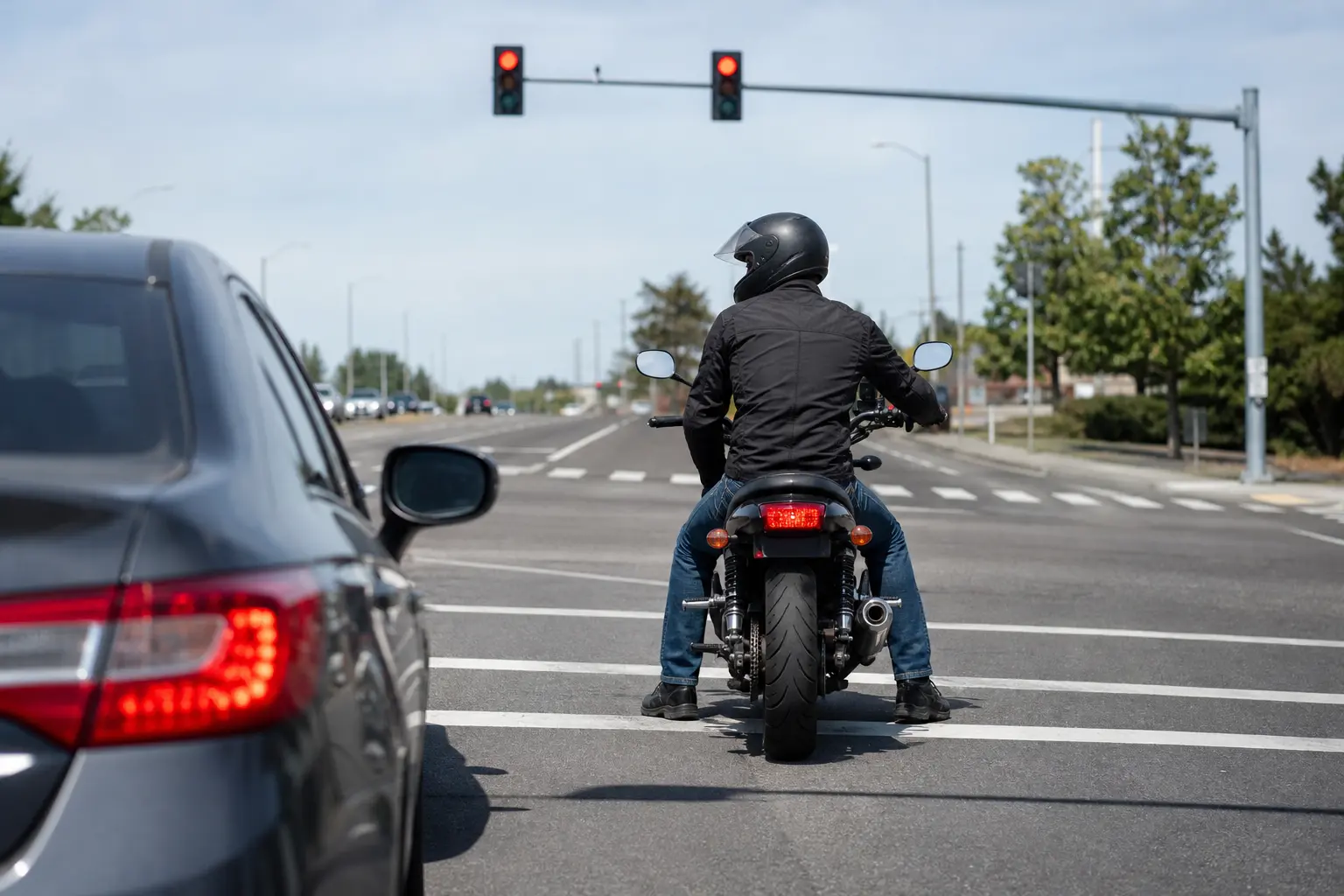
The period after you stop—but before the rear vehicle has clearly stopped—is a distinct phase of the routine. It is where a rider benefits most from keeping the mirrors in the traffic scan.
Do not stare backward so long that you lose awareness of the area ahead. Instead, alternate your attention. Keep the motorcycle under control, retain your forward view, and take short mirror checks that tell you whether the following vehicle is continuing to close or has settled.
If the vehicle behind stops in a controlled manner, the immediate concern changes. It does not mean the whole situation is safe forever; another vehicle may approach behind it, and intersection traffic may still change. But it is reasonable to broaden your attention again to include the signal, side traffic, pedestrians, cyclists, and the route you will take when traffic moves.
If you remain uncertain about whether the driver behind has recognized the stop, do not turn that uncertainty into panic. Return to the basics:
- keep monitoring the full scene;
- preserve any sensible buffer ahead if it is available;
- avoid squeezing into a position that removes your options;
- do not move into a space that is not visibly clear;
- make no response that exceeds your skill, traction, or legal room to operate.
The aim is readiness, not a reflexive launch.
Habits that quietly reduce your safety margin
Some red-light habits feel natural because the stop seems routine. They can still remove time, space, or useful information.
Stopping with no forward buffer. Crowding the vehicle ahead may eliminate the room that could otherwise help you reposition if traffic compresses from behind. The right buffer is situational, but a bumper-to-tire stop rarely leaves much flexibility.
Watching only the signal. The signal is relevant, but it cannot tell you whether the driver behind is braking or whether someone is entering the area in front of you.
Treating one lane position as a universal answer. Position should change with sightlines, road surface, vehicle movement, lane width, and conflict areas. Habit is not analysis.
Assuming your brake light has solved the problem. A signal can improve communication. It does not guarantee attention or braking by someone else.
Calling every visible gap an escape route. A route must be open at the moment of action. Crosswalks, bike lanes, shoulders, lane edges, and adjacent traffic deserve the same level of verification as the space directly ahead.
Using the stop to look down. Navigation adjustments, messages, music controls, and other distractions can wait until you are parked. A short delay in attention matters most while traffic behind is still arriving.
Trying to build emergency skills in traffic. If mirror checks, braking, looking ahead, and low-speed control feel overwhelming together, reduce the complexity of the riding environment and seek structured training. Honest skill assessment is part of defensive riding.
Build the routine on lower-pressure rides
A red-light routine becomes natural through small repetitions, not by trying to run a long mental script at every stop. Pick one element to improve on a familiar, lower-pressure route.
On one ride, focus on noticing rear traffic earlier during deceleration. On another, evaluate whether the space you left ahead remained usable once you were stopped. On another, identify the specific thing that would close an apparent route: a crosswalk, a parked vehicle, a bicycle lane, a curb, an approaching car, or poor pavement.
The goal is not to make every ride exhausting. It is to make the core sequence easier to perform calmly:
- Search the environment.
- Decide what has the most immediate effect on your margin.
- Use only the response that the space, law, and your skill level support.
Over time, this can replace vague concern with clearer observation. Instead of thinking, “That stop felt bad,” you may be able to identify the useful detail: “I did not check the closing vehicle until I had already committed to a tight stop,” or “The space beside the car ahead was a crosswalk, not an option.” Those are specific lessons that can improve the next approach.
How Vojo Helps
After a ride, use the Motorcycle Ride App to record one red-light observation while it is still fresh. Add a brief ride note describing the stop location or condition—such as rain, dusk, heavy traffic, an unfamiliar intersection, or a large vehicle behind—then write what you noticed in the mirrors, whether you left usable space ahead, and what changed before the light turned green. Review similar notes before future rides to spot recurring situations and choose one focused practice goal, such as earlier rear-traffic checks or more deliberate stop planning.
Download Vojo on the App Store
Bottom line: stay active until the traffic picture settles
Motorcycle safety stopped at a red light is less about a single trick than about refusing to let the stop become passive. Scan the queue while you approach. Use brake-light communication as one layer when appropriate. Pick a location based on the actual pavement and traffic around you. Leave purposeful room ahead when conditions make that possible. Keep watching the rear situation until it has clearly settled.
Most importantly, treat an escape route as a temporary, verified possibility—not a guaranteed path. Search for changes, evaluate what threatens your margin, and execute only what is clear, lawful, and within your practiced ability. That routine cannot control the actions of other road users, but it can help you retain attention and options during one of the ride’s most easily underestimated moments.
Sources used for this guide
1 Motorcycle Safety Foundation, If You Ride A Motorcycle.
2 Motorcycle Safety Foundation, Why it Helps to SEE.
Quick answers
Frequently asked questions
Where should I stop in the lane at a red light on a motorcycle?
There is no single lane position that is correct for every stop. Choose a location after considering pavement condition, surrounding vehicles, lane width, sightlines, crosswalks, and whether any nearby space is actually open. Reassess as traffic changes.
Should I look in my mirrors after my motorcycle has stopped at a red light?
Yes. Continue including the mirrors in your scan until the vehicle behind has clearly slowed and stopped. Then return to broad intersection awareness, because new vehicles may still approach and traffic around you can change.
How much room should I leave in front of my motorcycle at a red light?
Leave a purposeful buffer when conditions allow, rather than using a universal measurement. The space should support a realistic response if traffic compresses, but it must be judged against the lane, surface, nearby people, and vehicles that could occupy it.
Should I flash my brake light before stopping?
MSF advises riders to flash the brake light when slowing or before stopping if possible. Treat that as a communication aid, not proof that a following driver has seen you or will stop in time.
What does an escape route mean when stopped at a motorcycle red light?
It means being aware of a currently open and lawful direction where you could reposition if circumstances require it. It is not permission to use a crosswalk, shoulder, sidewalk, curb, or occupied space, and it must be checked again before any movement.
What should I do if there is no safe escape route at the light?
Do not invent one or force a movement into uncertain space. Keep monitoring rear traffic, maintain any sensible room ahead, stay alert to changes around the motorcycle, and make only controlled decisions that fit the space and your skill level.