
Motorcycle Suspension Preload for Luggage: What to Change Before a Loaded Trip
Use this motorcycle preload checklist to prepare for luggage or a passenger, verify model-specific limits, inspect the bike, and test the load conservatively.

Fact-checked against cited official documentation
Reviewed against Fact-checked against Yamaha guidance that suspension options vary by model and the MSF T-CLOCS framework for tires, controls, electrics, fluids, chassis, and stands..
Last updated November 6, 2026
A luggage-and-passenger trip begins before the engine starts. Extra equipment, a passenger, and trip supplies can alter how a motorcycle sits, how manageable it feels at a stop, and how much attention its load security needs. Preload may be part of the preparation, but it is not a shortcut around load limits, tire checks, secure packing, or a proper inspection.
For a motorcycle suspension preload luggage passenger load setup, the safest first question is not, “How many clicks should I add?” Instead ask: What load condition does this motorcycle’s documentation cover, what does the manufacturer permit, and is the entire loaded motorcycle ready for a short conservative evaluation ride?
There is no responsible universal preload number. Yamaha’s suspension guidance makes clear that selectable settings and available adjustment scope differ between motorcycle models, and it directs riders back to their own instruction manual. SUS Settings: Y-Connect - Motorcycle is a useful reminder that a dashboard preset, hand-adjusted control, or model-specific menu must be interpreted through the documentation for that motorcycle—not advice borrowed from a similarly sized bike.
This article provides a decision process rather than an adjustment recipe. It helps you identify what to confirm, when to stop, and how to assess the loaded bike without trying to turn a generic article into a substitute for its manual. For the wider care routine around a trip, see the Motorcycle Maintenance Guide.
Motorcycle Suspension Preload for Luggage: Start With the Manual
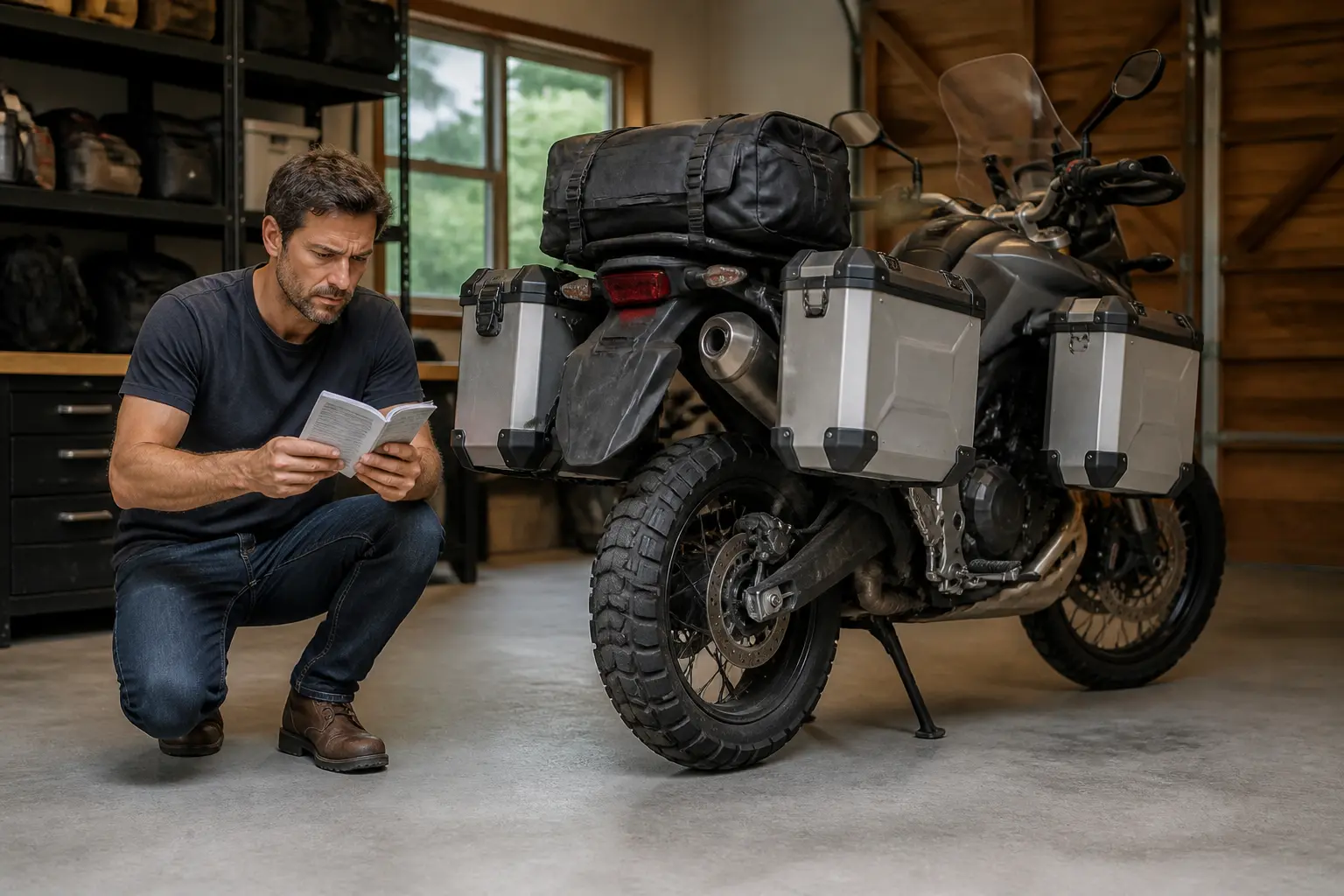
“Preload” is often used as if it means every aspect of suspension setup. For a rider preparing to carry luggage or a passenger, it is better understood as one available load-related setting within the motorcycle’s own suspension system. Its controls, labels, positions, and interaction with other settings are model dependent.
One motorcycle may offer a simple manual adjustment. Another may have a small number of defined positions. A third may present load choices through electronic controls. Some motorcycles may have no convenient rider adjustment at all. These differences matter because the manufacturer, not a general chart, defines what the control does and which conditions it is intended to address.
Before touching anything, locate the owner’s manual and look specifically for:
- The motorcycle’s maximum permitted load and any passenger restrictions.
- Limits for fitted cases, racks, mounts, seats, or other accessories.
- The suspension controls available on that exact motorcycle.
- The manufacturer’s descriptions of solo, luggage, passenger, or combined-load selections.
- Any stated tire-pressure guidance for the planned use.
- Warnings, tools, stand position, or service requirements associated with an adjustment.
- The meaning of displayed suspension icons or ride-mode wording, where fitted.
Treat this as a compatibility check, not an exercise in finding the most aggressive setting. A manual that lists separate conditions does not automatically mean every possible combination is approved. For example, a setting labelled for luggage is not proof that the bike may also carry a passenger and maximum luggage. Confirm the total permitted arrangement before departure.
If the manual does not address your intended combination, its wording is ambiguous, or the installed luggage is not clearly covered, pause the plan. An authorized dealer or qualified suspension professional can assess the question with the motorcycle’s documentation and the actual equipment present. Guessing from online photos, another owner’s setting, or an accessory’s appearance adds uncertainty precisely when the motorcycle is carrying more consequence.
Also record the current setting before any permitted change. A dated note is more dependable than memory after several weeks of solo riding. It gives you a way to identify the previous documented configuration later, rather than cycling through positions while trying to remember where you began.
Motorcycle Passenger and Luggage Load Setup Is More Than Preload
A loaded motorcycle is a complete system: rider, passenger, luggage, tires, chassis, controls, stands, and route plan. Preload may have a place in the manufacturer’s load guidance, but it does not authorize excess mass or correct a poorly secured item.
Start by listing everything that will travel with the motorcycle. Include the rider and passenger, riding gear that remains on the bike, cases, inner bags, tools, water, camping equipment, accessory mounts, and cargo in a rear bag. The objective is an honest plan, not a rough estimate designed to make the trip sound lighter.
Then check each relevant limit separately. The motorcycle’s overall load limit, a rack’s permitted carrying capacity, a case’s capacity, and passenger approval are different questions. Staying under one figure does not establish that every individual part of the arrangement is suitable. Where documentation is unavailable, reduce uncertainty rather than assuming a component can support the proposed cargo.
Packing decisions deserve the same care as suspension choices. Keep items contained, close cases completely, and avoid arrangements that can move, hang loose, or interfere with ordinary operation. If the luggage system’s instructions allow it, place denser items in the lower, more central available storage rather than building a high, rear-heavy stack. Aim for a left-to-right balance that is practical for the cases and contents you have.
A passenger adds another layer. They need an approved place to sit and hold on, proper protective equipment, and a clear routine for getting on or off. Agree that they will wait for your signal before mounting or dismounting. Discuss communication before the motorcycle moves, and choose a simple first stop where either person can raise a concern without pressure to continue.
The Motorcycle Safety Foundation’s T-CLOCS Pre-Ride Inspection Checklist organizes a pre-ride check around Tires and Wheels, Controls, Lights and Electrics, Oil and Other Fluids, Chassis, and Stands. That framework is especially useful for a loaded departure: it prevents a rider from concentrating on one suspension control while overlooking tires, visible leaks, controls, chassis condition, or stand operation.
| Planned condition | Confirm before selecting a documented setting | Conservative departure decision |
|---|---|---|
| Rider only | Current manual guidance, tire condition, normal load | Use the documented solo configuration if applicable. |
| Rider with light luggage | Total cargo, case and mount limits, secure attachment | Use only the nearest manufacturer-described luggage condition. |
| Rider with substantial luggage | Overall load, each accessory limit, packing balance, clearance | Repack or remove items if the arrangement is not clearly permitted. |
| Rider with passenger | Passenger approval, seating, passenger briefing, combined load | Use documented passenger guidance where provided. |
| Rider, passenger, and luggage | Every relevant limit and whether the exact combination is covered | Seek model-specific help when documentation does not resolve the combination. |
| Any condition with a concern | Damage, loose luggage, warning indication, unclear adjustment | Do not begin the trip until the issue is resolved. |
This table is a planning aid, not a setup chart. The only settings worth selecting are the ones the motorcycle manufacturer documents for the machine and load condition in front of you.
Motorcycle Suspension Preload Luggage Checklist Before Adjustment
Use this checklist with the owner’s manual open. Complete it while the motorcycle is parked securely on a stable surface and before a passenger gets aboard. Do not treat a checkmark as a substitute for physically looking at the motorcycle.
Documentation and load plan
- Confirm the motorcycle’s permitted total load in the owner’s documentation.
- Confirm whether the motorcycle is approved for passenger use.
- Check limits for each fitted luggage case, rack, mount, and accessory.
- List rider, passenger, installed accessories, and planned cargo realistically.
- Confirm the intended rider-passenger-luggage combination is permitted.
- Read the model-specific suspension instructions for that condition.
- Note the current suspension selection or setting before any change.
- Identify the documented loaded setting, if the manual provides one.
- Stop and ask a dealer or suspension specialist if the documentation does not cover the plan.
Packing, attachment, and clearance
- Close, latch, and lock cases as their manufacturers instruct.
- Secure loose items inside each bag so they cannot shift during the ride.
- Balance side luggage as reasonably as the trip allows.
- Keep straps, cords, and bag material away from hot, moving, or control-related parts.
- Check mounting points and visible fasteners for damage or looseness.
- Confirm luggage does not obstruct required lights, the rider, or the passenger.
- Look around the rear wheel and visible suspension area for possible interference.
- Check that the passenger has suitable space and access to passenger footrests where applicable.
Whole-motorcycle pre-ride inspection
- Check tire condition and cold inflation guidance in the motorcycle documentation.
- Inspect wheels and tires for visible concerns before rolling away.
- Check the controls for normal movement and feel.
- Check lights, electrical indicators, and mirrors.
- Look for visible fluid leaks or damaged components.
- Inspect the visible chassis and suspension area for obvious damage or loose parts.
- Confirm the side stand and, if fitted, center stand operate normally with the planned load.
- Recheck the load after moving the motorcycle slightly, if safe to do so.
Passenger and route readiness
- Agree on an easy mounting and dismounting routine.
- Agree on a communication method before starting.
- Explain that unexpected movement can make slow-speed control more difficult.
- Select a short first route with a safe place to stop.
- Avoid making the first loaded ride a fast road, difficult surface, or tight schedule.
- Build extra time into the day for a second inspection and route changes.
The checklist deliberately puts documentation first. A preload setting should follow a confirmed load plan; it should not be used to justify one.
Choosing a Documented Preload Setting for the Planned Load
Once the load is permitted, packed, and inspected, use only the adjustment method the manual describes. If the manual assigns a passenger or luggage setting, begin there rather than adapting a preference from solo riding. If it presents multiple named load options, read their wording carefully and choose only the option that matches the documented condition.
For motorcycles with electronic suspension choices, confirm the display after selection and compare the wording with the manual. A label that sounds similar is not necessarily equivalent. “Luggage,” “passenger,” and a combined passenger-and-luggage condition can represent different defined choices on a particular motorcycle.
For motorcycles with a physical adjuster, do not force a part that resists movement, appears damaged, leaks, is heavily corroded, or has unclear markings. Do not use an improvised procedure or exceed a marked range. This is not merely a matter of preserving a setting; a difficult or questionable component is a reason to obtain qualified assistance before loading the bike further.
Avoid adjusting multiple unrelated variables at the same time. A new luggage configuration, a passenger, a tire concern, and an unfamiliar ride mode can each affect your impression of the motorcycle. When the manual permits a preload change, apply the documented load setting, verify the rest of the bike, and assess it on an uncomplicated short ride. That makes the result easier to evaluate and helps avoid responding to uncertainty with random changes.
It is also important to know what preload is not for. It does not raise the motorcycle’s approved carrying limit. It does not make a rack stronger, prevent an inner bag from moving, replace tire inspection, or correct a mechanical problem. It cannot make an unapproved passenger arrangement acceptable. If the plan exceeds a limit or creates an unresolved clearance concern, reduce the load or choose a different travel arrangement.
A suspension specialist is a sensible next step when you routinely travel with a passenger, use nonstandard luggage, have modified suspension components, or cannot find a clearly documented condition for the load. Bring the manual, the list of equipment, and a concise description of what you observed. That is more useful than asking for a universal number.
Test Ride a Loaded Motorcycle Before the Main Trip

The first few miles with a new load are a verification stage, not a performance test. Pick a familiar, low-demand route where you can stop without creating additional risk. If a passenger is joining the trip, make this ride short and calm. The goal is to discover a problem early, when turning back or repacking is straightforward.
Before moving, take another look at the motorcycle from each side. Check that cases are shut, straps are contained, and nothing is visibly close to a wheel, exhaust, drivetrain area, suspension component, or control. Confirm that the passenger is settled and knows the agreed routine.
Begin with simple starts and stops at low speed. Notice whether the load remains secure and whether you can manage the motorcycle comfortably when stationary. Do not dismiss an awkward stop as something that will naturally disappear at speed. A loaded motorcycle requires more planning at junctions, fuel stops, uneven parking areas, and turnarounds.
Build speed gradually only when the motorcycle feels predictable. Use smooth acceleration, gentle braking, and generous space. There is no benefit in deliberately seeking sharp bumps, abrupt direction changes, or high-speed roads to “prove” the setup. The useful observations are simple: does the luggage remain in place, do controls feel normal, and does the motorcycle behave in a way that gives you confidence to continue conservatively?
At the first safe stop, inspect again. Touch nothing hot and do not attempt roadside diagnosis. Look at the luggage mounts, case closures, straps, tires, visible suspension area, and any part that seemed close before departure. Ask the passenger direct questions: Do they feel secure? Is a bag crowding their position? Are they repeatedly needing to shift? Is the agreed communication method working?
End the ride and seek qualified advice rather than continuing if you find any of the following:
- Luggage movement, an open case, a loosening strap, or unclear mounting security.
- Contact, rubbing, or a component that appears too close to another part.
- A visible leak, damaged suspension part, or loose chassis-related hardware.
- An unexpected warning indication or a selected setting that does not match the manual.
- A tire, wheel, brake, control, or stand concern.
- Handling that feels persistently abnormal or leaves you unable to ride with a comfortable margin.
- A passenger position that is insecure, cramped, or not manageable for both people.
You do not need to diagnose the source on the roadside. The productive decision is to stop, document what you observed, and arrange professional assessment when the concern is beyond a straightforward packing correction.
Riding Margins After a Luggage or Passenger Setup Change
A correctly documented setup still calls for a different riding mindset from an unloaded local ride. Give yourself more distance, more time, and more opportunities to stop. The route should support the motorcycle’s current condition rather than demand that you adapt instantly to it.
Plan early for braking, turns, fuel stops, and parking. Reduce speed before a bend rather than relying on a last-minute correction. Choose a pace that lets you remain smooth and gives the passenger time to move naturally with the motorcycle. Avoid pressure from a schedule, a group, or the expectation that a familiar road must be ridden at a familiar pace.
Use the early stops in the trip as repeat inspections. Road vibration can reveal a case closure that was not fully seated or cargo that settled differently than expected. Make the review routine: look at luggage security, visible clearances, tires, and the passenger’s comfort. Recheck after rough roads, a long fuel stop, or any event that makes you wonder whether something changed.
Conditions can change the decision as well. Rain, strong wind, darkness, fatigue, traffic, or a rough route each reduce available margin. With luggage and a passenger, the conservative response may be to slow down, change the route, stop earlier, or postpone the next leg. Completing the original itinerary is never more important than retaining control and an easy exit from the situation.
How Vojo Helps
Create one repeatable loaded-trip workflow in Vojo before your next tour. In a motorcycle record, save the manual’s documented solo and permitted loaded settings as reference notes, along with accessory limits and the date of the last pre-ride inspection. Then build a trip checklist from this article: load confirmation, luggage attachment, T-CLOCS-style inspection, passenger briefing, and short test ride. Mark items only after checking the actual motorcycle, and add a post-test note describing whether the luggage remained secure and whether any concern needs follow-up.
Use the Motorcycle Maintenance Tracker to retain those notes with the motorcycle instead of trying to remember a past configuration. On the next passenger or luggage trip, reuse the checklist while confirming that the new load still matches the manual; a previous successful outing is a reference, not permission to ignore changed equipment or conditions.
Quick answers
Frequently asked questions
Should I change motorcycle preload when I add luggage?
Use the motorcycle’s owner manual as the decision point. If it gives a luggage condition or setting, follow that model-specific guidance after confirming the luggage and total load are permitted. Do not use a generic click count from another motorcycle.
Do passenger and luggage require the same preload setting?
Not necessarily. Yamaha notes that available suspension settings differ by model, so the exact labels and choices depend on the motorcycle. Check whether the manual addresses the combined passenger-and-luggage condition rather than assuming separate settings can be combined.
Can more preload make an overloaded motorcycle safe?
No. A suspension selection does not change maximum load limits or accessory limits. If the motorcycle, rack, case, or passenger arrangement is outside documented limits, remove weight or change the travel plan.
What should I inspect after setting up a loaded motorcycle?
Use a whole-bike inspection. The MSF T-CLOCS framework includes tires and wheels, controls, lights and electrics, fluids, chassis, and stands. Also inspect luggage closures, mounts, straps, visible clearance, and passenger seating before a short test ride.
When should I stop and ask a specialist for help?
Stop when the manual does not cover the intended load, an adjuster or suspension component appears damaged, luggage cannot be secured, a warning is unclear, or the motorcycle does not feel predictably controllable on a conservative test ride. A qualified professional can assess the bike and documented load condition.