
Motorcycle Smells Like Gas or Has a Fuel Leak: A Conservative No-Ride Decision Guide
Motorcycle smells like gas—can you ride? Use this conservative guide to separate a possible spill from a fuel-leak warning and choose a safer next step.

Fact-checked against cited official documentation
Reviewed against Harley-Davidson fuel-system service material requiring leak/seepage checks after work and its maintenance schedule for inspecting fuel lines and fittings for leaks, contact, and abrasion..
Last updated October 15, 2026
A motorcycle that smells like gasoline is not a problem to dismiss with “it probably spilled a little.” Gasoline odor can come from a recent fill-up, but it can also be the first noticeable sign of a fuel-system problem. Because liquid fuel and fuel vapor can reach hot parts, electrical equipment, or other ignition sources, the safest default is simple: a persistent or unexplained gasoline smell means pause the ride and investigate only from a safe, parked position.
So, motorcycle smells like gas—can I ride? If you can see fresh wetness, a drip, a puddle, a strong ongoing odor, fuel on your clothing, or any sign the smell grows when the bike is moved or started, the conservative answer is no. Do not start it “just to see,” do not ride it home, and do not assume a short route makes the risk acceptable.
Manufacturer maintenance material treats fuel lines and fittings as recurring inspection items for leaks, contact, and abrasion. That is an important clue about how to think: the concern is not only an obvious hole in a hose. A line that rubs another part, a fitting that seeps, or a component that has been disturbed can become a safety issue before it turns into a large puddle.1 Harley-Davidson service material also calls for checking for leaks or seepage after fuel-system work and warns that incorrect installation can affect rider and passenger safety.2
This is a decision guide, not a repair manual. It helps you decide whether you may have simple external residue to clean and monitor, whether the motorcycle needs a qualified inspection before its next ride, or whether it should be left off and transported.
Start With a Conservative Answer: Do Not Create More Exposure
Before trying to identify the source, prevent the situation from getting worse.
If the motorcycle is already running and you notice a strong gasoline odor or visible fuel, stop in a place away from traffic as safely as conditions allow, switch the engine off, and move yourself away from the motorcycle. Do not keep idling while you look. Do not restart it after it has “aired out” unless you have positively confirmed—using the model-specific owner’s or service documentation—that the odor was only a minor spill and there is no wetness, seepage, damage, or unresolved concern.
If the bike is parked, leave the engine off. Avoid smoking, flames, sparks, grinding, battery charging nearby, and any other potential ignition source. Keep other people away from the area, especially if fuel is visibly pooling or flowing. A strong smell in an enclosed garage deserves more caution, not less: ventilate only if you can do so without operating equipment that could create a spark, and seek local emergency assistance if there is a substantial spill, fire, or immediate danger.
Do not make the following common judgment errors:
- Do not use a lighter or flame to “find” a leak.
- Do not touch a suspected wet area and then operate switches, connectors, or the starter.
- Do not take a quick ride to evaporate the smell. Airflow does not make an active fuel leak safe.
- Do not park over a suspected puddle and walk away without addressing the situation.
- Do not tighten, disconnect, bypass, patch, or reroute fuel-system parts by guesswork. A small mistake can create a larger leak or leave a connection insecure.
- Do not assume fuel only leaks while the engine is running. Some conditions may show up while parked, after a fill-up, with heat, or when the motorcycle is moved.
The goal is not to diagnose every possible failure in your driveway. The goal is to avoid converting an uncertain warning into a fire, a loss of control, or a stranded roadside situation.
Why the Smell Alone Is Not a Ride Clearance
Gasoline has a noticeable odor, and one brief smell after refueling does not automatically prove the motorcycle has a component failure. A splash on the outside of the tank, filler area, glove, boot, or luggage can leave a temporary smell. But smell by itself also cannot prove that the motorcycle is safe to ride.
Treat odor as a screening signal. Its meaning depends on context:
| What you notice | Conservative interpretation | Safer next step |
|---|---|---|
| A faint smell immediately after a spill at the pump, with no wetness or drip found | External residue may be present, but it is not yet a ride clearance | Keep the engine off, allow the area to air out, clean only external residue as directed by the owner’s manual, then recheck for returning odor or wetness |
| A strong smell that remains after time away from the fuel station | Possible leak, seepage, or vapor release | Do not ride; inspect visually only when cool and arrange service if the cause is not plainly resolved |
| Fresh wetness around a fuel-system component | Possible active seepage or leak | No ride; avoid starting and arrange qualified inspection or transport |
| A drip, puddle, or fuel running down a surface | Active fuel leak | No ride; keep ignition sources away and arrange recovery or emergency help as appropriate |
| Fuel smell after recent service, accessory work, a tip-over, or impact | A disturbed connection, damaged part, or routing issue is possible | No ride until the work and affected area have been inspected by a qualified technician |
| Odor that becomes stronger after starting, moving, or parking in warmth | The condition may be active or pressure/temperature related | Shut down if running; do not repeat the test; arrange inspection |
The safest distinction is not “small smell versus large smell.” It is explained, resolved external residue versus an odor that is unexplained, persistent, returning, or accompanied by any physical evidence. When you cannot confidently place the smell in the first category, treat it as the second.
A rider may be tempted to reason that no dripping fuel means no danger. That is too optimistic. Seepage can leave only a sheen, damp dust, staining, or a localized smell. Vapor can be noticeable before you find liquid. Conversely, a dry-looking exterior does not prove that every line, connector, seal, or tank-area component is sound. That is why the sensible outcome of an unresolved smell is service—not a longer or more aggressive home inspection.
Parked-Bike Fuel-Smell Checklist
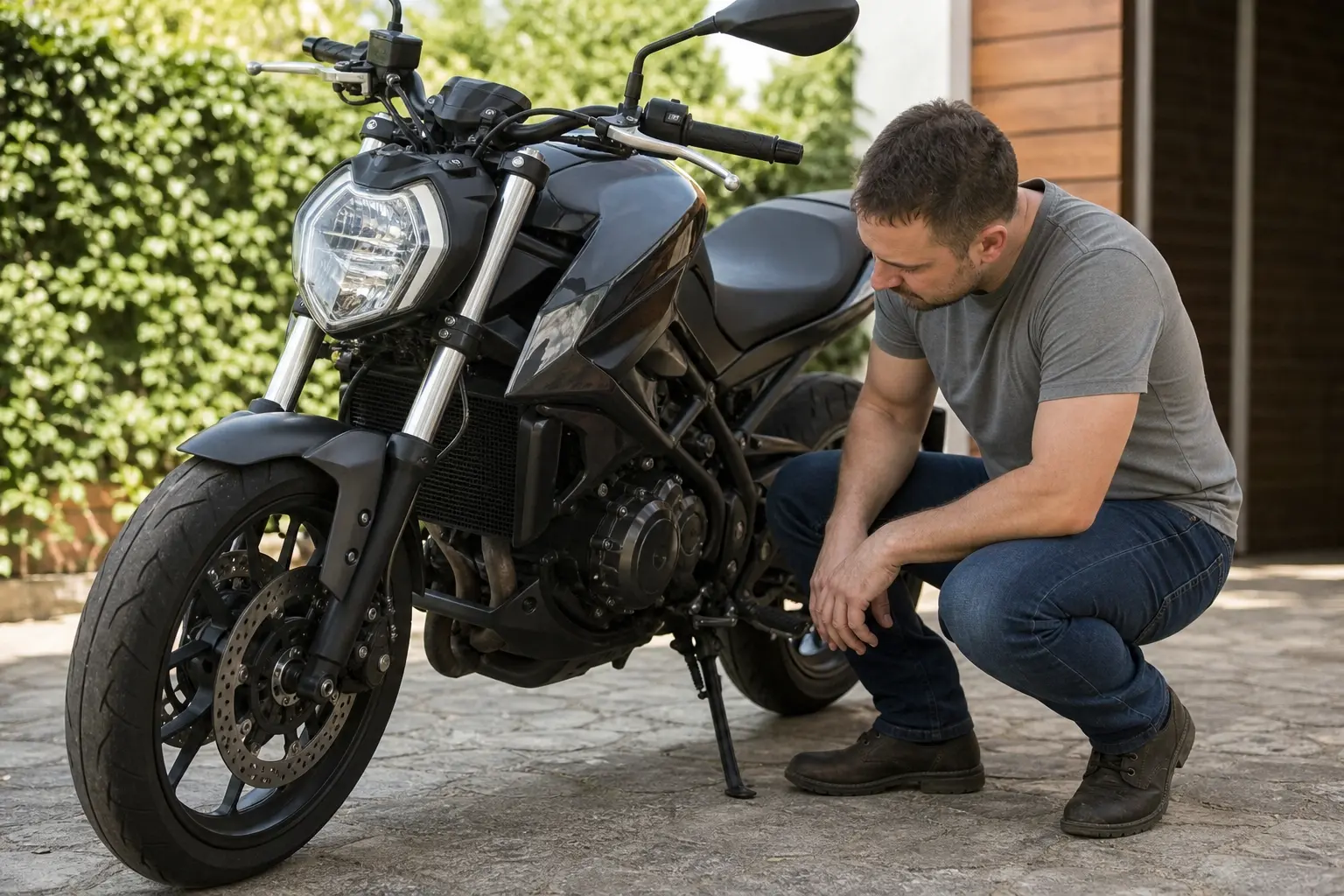
Use this checklist only with the motorcycle parked, switched off, stable, and cool enough to avoid contact with hot components. You are looking for clear stop-riding evidence, not attempting to repair the motorcycle.
Checklist: what to look for without disassembly
- Move away from ignition sources first. No smoking, open flames, charging equipment, power tools, or unnecessary electrical switching nearby.
- Look at the ground before touching the motorcycle. Note any fresh drop, darkened patch, rainbow sheen, or puddle below the tank and engine area.
- Check for a visible fuel trail. Look for wet streaks, shiny residue, fresh staining, or liquid collecting on painted surfaces, covers, hoses, or brackets.
- Look around the filler area from the outside. Confirm the cap appears closed and that the surrounding exterior is not visibly wet. Do not pry, modify, or force the cap.
- Scan the visible fuel-path area without removing parts. Pay attention to exposed lines, fittings, clamps, tank-adjacent areas, and anything that appears damp or stained.
- Look for rubbing or pinching clues. A hose or line pressed against a sharp edge, trapped under an added accessory, or showing scuffed outer material is a no-ride concern. Manufacturer schedules specifically call out leaks, contact, and abrasion when inspecting fuel lines and fittings.1
- Check for recent changes. Think about a recent service visit, tank lift, accessory installation, crash bar fitment, tip-over, transport, or other event that could have disturbed routing or a connection.
- Notice whether the odor is local or general. A concentrated smell in one area can help a technician, but it is not permission to start the bike for confirmation.
- Check your gear and hands. Fuel on gloves, pants, boots, luggage, or a cover can explain an odor, but it also means you should avoid transferring fuel to controls, seats, or hot parts.
- Record what you found. Take clear photos from a safe distance, write down when the smell appeared, whether the bike had been refueled, and whether you saw wetness or a drip.
Stop the check immediately if you discover active dripping, pooling, a rapidly spreading wet area, or a strong concentration of vapor. At that point, more searching does not improve the decision: leave the motorcycle off and focus on keeping people and ignition sources away.
What not to inspect yourself
Do not remove the fuel tank, disconnect a quick-connect fitting, pull hoses free, loosen clamps, probe around electrical connectors, or pressurize the system to hunt for a leak. Those actions can create fuel release and can turn a marginal connection into an active failure. They may also conflict with the required method for your particular motorcycle.
This limit matters especially after service. The fact that a line or connector was recently touched does not mean the rider should re-do the work. Factory documentation often assumes special procedures, model knowledge, and safety precautions. Your useful contribution is to stop riding, document the evidence, provide the motorcycle’s model and VIN to the service provider, and explain exactly when the smell began.
No-Ride Signals That Override Convenience
A gasoline smell becomes a firm no-ride decision when any of the following applies:
- You see liquid fuel, a drip, or a puddle. This is the clearest reason not to start or ride.
- The odor is strong, persistent, or returns after the motorcycle has sat. An unresolved odor is not a condition to test under load.
- There is wetness or staining at a visible fuel line, fitting, tank seam, filler area, or component near the tank. Even if the amount seems small, the source must be identified.
- A line or fitting appears rubbed, pinched, abraded, loose, or improperly routed. Contact and abrasion are manufacturer-recognized inspection concerns.1
- The smell appeared after a crash, tip-over, drop, towing event, transport, or impact. Damage may not be obvious from one angle.
- The smell began after fuel-system work or work near the tank. Service documentation emphasizes leak and seepage checks after fuel-system work.2
- The odor gets stronger with heat, after filling the tank, or when the bike is moved. Do not repeat tests to gather more proof.
- Fuel has contacted a tire, brake component, control, rider gear, or a surface you cannot safely clean and verify. The motorcycle and affected equipment need appropriate attention before use.
- You cannot identify an innocent external source with confidence. Uncertainty is enough reason to delay the ride.
A no-ride decision is not an accusation that the motorcycle is severely damaged. It is a risk-control choice: you are declining to add engine heat, vibration, motion, and traffic exposure to a possible fuel leak.
When a Recent Fill-Up May Be the Explanation—And Why Caution Still Applies
The most benign explanation is usually a small external spill during refueling. It can happen when the nozzle drips, the tank is filled too aggressively, or fuel lands on the cap area, tank paint, gloves, or gear. Still, it is important to separate “possible spill” from “confirmed harmless condition.”
Use this conservative thought process:
- Did the smell begin immediately after fueling, rather than during a ride or after the motorcycle had been parked for some time?
- Can you see a small amount of residue only on an exposed outer surface, with no dampness around visible lines or fittings and no fuel on the ground?
- Does the odor diminish after the outside has been handled according to the owner’s manual and the motorcycle has remained off?
- Does it remain absent during a later parked recheck, rather than returning without another spill?
If every answer is clearly reassuring, the odor may have been an external spill. But if you are guessing about any answer, choose the no-ride path. A rider cannot reliably clear an active leak merely because the odor seems weaker a few minutes later.
Do not deliberately overfill the tank or add fuel to the filler area to reproduce the smell. Do not shake the motorcycle, lean it aggressively, or start it as an experiment. A motorcycle’s tank, filler arrangement, venting design, fuel delivery layout, and service precautions vary by model. Your owner’s manual is the correct authority for normal refueling practice and any model-specific cautions.
Heat, Vapor, and Ignition Sources Change the Risk Picture
Fuel problems deserve a different level of caution from a cosmetic oil stain or a dusty hose because gasoline can release flammable vapor. The practical implication is straightforward: a rider should think beyond the apparent leak point.
A wet area near the tank may be above hot engine or exhaust components. Fuel can travel along a hose, frame member, wiring loom, or cover before it drips, so the lowest wet spot is not necessarily the source. A smell may be more obvious in a garage or another still-air location than outside. And an active leak can be intermittent, which makes “I checked once and it was dry” weak evidence.
That does not mean you need to panic over every fuel odor. It means you should use a higher decision standard. Keep the motorcycle off, do not introduce ignition sources, and arrange help when there is a reasonable possibility of leakage.
If the motorcycle is in an attached garage or other enclosed space and you see substantial liquid fuel, smell an overwhelming concentration of vapor, or are concerned about an immediate fire hazard, prioritize people and emergency guidance over motorcycle troubleshooting. Do not remain in an unsafe area to take photos or trace the source.
Choosing Service, Transport, and Recall Checks

Once you decide not to ride, the next question is how to get the problem handled without creating a second hazard.
Arrange qualified inspection when the source is uncertain
Tell the shop or dealer that the motorcycle has a gasoline odor and describe the evidence in plain terms: “strong smell after parking,” “fresh wetness below the left side of the tank,” “drip after refueling,” or “odor began after accessory installation.” Mention the date, fuel level if relevant, recent work, tip-overs, and whether you started the engine. Photos can help a technician understand what happened before fluid evaporated or spread.
Avoid making a diagnosis for them. “Fuel pump failure” or “bad hose” may be a guess. Describe what you actually observed and let the technician follow the model-specific documentation.
Prefer transport over riding to the appointment
If the condition is unresolved, towing or another appropriate transport option is the safer choice. The reasoning is not that every gasoline smell will cause a fire. It is that riding adds heat, vibration, movement, road debris, traffic delays, and the possibility of fuel reaching an ignition source. It also moves the issue from a controllable parked setting to public roads.
Ask the recovery provider about their instructions for a motorcycle with a suspected fuel leak. Do not conceal the issue. Transport crews need to know about leaks so they can make safe loading decisions.
Check recalls by VIN, but do not wait to make the no-ride decision
A recall may be relevant to a fuel-system concern, especially for a known model-specific defect, but recall status cannot clear a motorcycle that presently smells of fuel or shows leakage. Use the official NHTSA recall search with the motorcycle’s VIN and contact the manufacturer or authorized dealer if a campaign applies.3
The order matters:
- Respond safely to the current odor or leak.
- Arrange inspection or transport.
- Check recall status and share the result with the dealer.
A clean recall result means only that no open recall was found for that VIN; it does not diagnose the present condition.
Preventing Repeat Fuel-Smell Surprises
You cannot prevent every seal, line, or fitting problem, but you can make early warning signs easier to spot.
First, build a pre-ride habit that includes a glance at the ground beneath the motorcycle, the tank area, and the visible lines or fittings you can inspect without disassembly. A new smell, fresh stain, or unexpected wet patch is easier to recognize when you know what “normal” looks like. For a broader routine, use the Motorcycle Maintenance Guide alongside your exact owner’s manual.
Second, treat changes after work as a reason for extra observation. That includes dealer service, home maintenance performed by a qualified person, accessory installation, tank removal, storage preparation, and transport. The appropriate response is not to second-guess every component; it is to be alert for changed smells, dampness, contact points, or abrasion clues before the next ride.
Third, avoid adding routing hazards. If you install luggage, electronic accessories, guards, covers, or other equipment near the tank or frame, verify that nothing presses, traps, or rubs visible fuel-system parts. Do not modify fuel-line routing based on general internet advice. Fitment and clearance are model-specific.
Finally, follow the maintenance schedule for your exact motorcycle rather than assuming that visual checks replace scheduled work. Official maintenance documentation may specify fuel-line and fitting inspections for leaks, contact, and abrasion at regular intervals.1 That is preventive work, not a substitute for responding immediately when you smell fuel today.
How Vojo Helps
Use Vojo to turn a one-time concern into a clear service record. In the Motorcycle Maintenance Tracker, create a “Fuel odor / possible leak” entry before contacting a shop. Add the date, odometer reading, whether the motorcycle had just been fueled, where the odor was strongest, whether you saw wetness or a drip, recent maintenance or accessory work, and safely captured photos. Mark the motorcycle as not ready to ride until the inspection is complete, then save the technician’s finding and the completed repair as part of the bike’s ongoing history. That record makes future changes easier to spot and gives the next technician useful context.
Quick answers
Frequently asked questions
My motorcycle smells like gas but I cannot see a leak. Can I ride it?
Not as a default. A persistent or unexplained gasoline smell can indicate seepage or vapor release even when no drip is obvious. Keep the motorcycle off, make a parked visual check for wetness or damage, and arrange qualified inspection if the odor is not clearly explained by a minor external spill that has fully resolved.
Can I start the motorcycle briefly to find where the gas smell comes from?
No. Starting the engine adds heat, vibration, electrical activity, and potential ignition sources. If a fuel smell is unexplained or strong, do not create a test condition. Leave the motorcycle off and have the fuel system assessed using the correct model-specific procedure.
Is a small drip after filling the motorcycle always a spill from the gas station?
No. A drip after filling may be external residue, but it may also point to a problem around the filler, tank, venting system, or another fuel-system component. If fuel continues to appear, the smell returns, or you cannot confidently identify and resolve external residue, do not ride.
What should I tell a motorcycle shop about a suspected fuel leak?
Describe observations rather than guessing at the failed part. Include when the smell began, whether the engine was running, whether the bike had recently been refueled or serviced, the location of any wetness or drip, recent impacts or tip-overs, and photos taken safely while parked.
Can a motorcycle fuel leak be related to a recall?
It can be, but an open recall is only one possible explanation. Check the motorcycle’s VIN through the official NHTSA recall search and contact the manufacturer or authorized dealer if a campaign applies. Regardless of recall status, visible fuel or an unresolved gasoline smell is a reason not to ride until inspected.