
Low Motorcycle Coolant: What a Reservoir Check Can Tell You—and When a Leak Means Do Not Ride
A low motorcycle coolant reservoir can be an early warning, not a diagnosis. Learn how to check it cold, spot leak clues, and choose a safer next step.
Fact-checked against cited official documentation
Reviewed against MSF T-CLOCS guidance for cool-only reservoir checks and visible coolant-leak areas, plus the MSF Operator Manual’s weekly coolant-check recommendation..
Last updated October 10, 2026
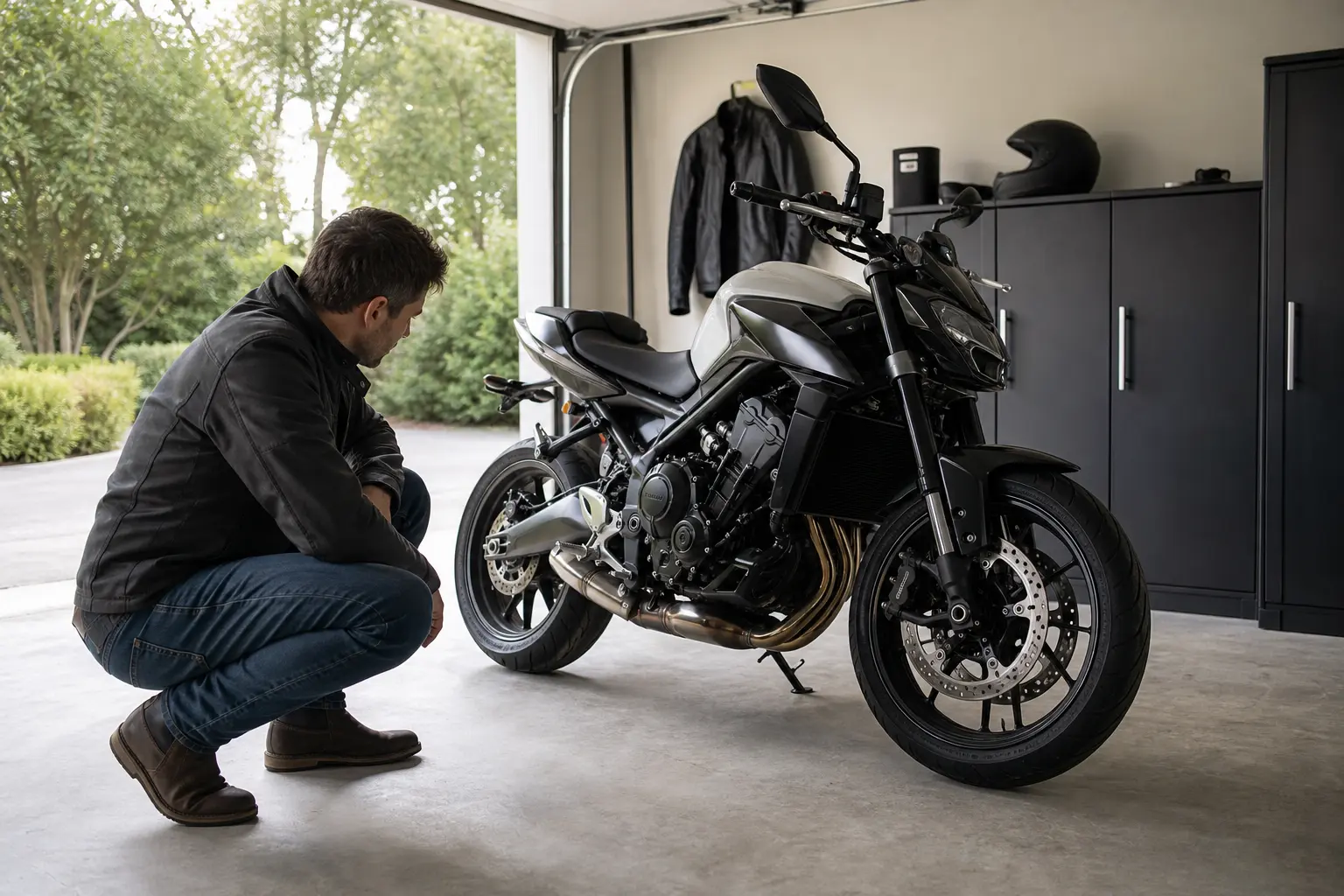
A motorcycle coolant level low reading is worth taking seriously, but it is not a diagnosis by itself. The visible reservoir is a useful observation point: it can tell you that the level is below the range your motorcycle specifies, or that the level has changed since your last check. It cannot, on its own, tell you exactly why that happened, whether the cooling system is full everywhere it needs to be, or whether adding fluid would make the motorcycle ready to ride.
That distinction matters. A rider who sees a low reservoir may be tempted to treat the tank as a simple “top it off and go” indicator. On a liquid-cooled motorcycle, the safer approach is to slow down, check the condition only when the motorcycle is cool, use the owner’s manual as the authority for the correct fluid and procedure, and look for visible signs that turn a maintenance observation into a no-ride decision.
The Motorcycle Safety Foundation’s T-CLOCS inspection guidance specifically places coolant under fluid-level checks and says to inspect the reservoir or recovery tank only when cool. It also directs riders to look at the radiator, hoses, tanks, fittings, and pipes for coolant leaks.1 That gives a useful framework: observe the level, look for external evidence, then decide whether the motorcycle is suitable to ride or needs service.
This article is deliberately conservative. It does not provide an improvised cooling-system repair or a substitute fill procedure. Coolant chemistry, access points, level marks, bleed requirements, service intervals, and warning-light logic are model-specific. Your exact owner’s manual and, when needed, a qualified motorcycle technician take priority.
Start With the Right Question: What Did You Actually See?
“Low coolant” can mean several different things in everyday conversation. Separate them before deciding what to do:
- You saw fluid below a marked lower line in a translucent reservoir.
- You saw fluid that is present but hard to read because of dirt, poor light, an awkward viewing angle, or an opaque container.
- You found dried residue, wetness, or a puddle near cooling-system parts.
- A temperature-related indicator, warning message, steam, unusual smell, or loss of normal running behavior made you suspect an overheating problem.
- You do not know whether your motorcycle is liquid-cooled, where its reservoir is, or what its manual calls the component.
Only the first of those is a straightforward low-level observation. The others may be more urgent, less certain, or unrelated to the reservoir level. Treating every clue as the same problem can lead to a poor decision—either riding a motorcycle that should be parked or performing unnecessary work on one that needs only a correct manual-guided inspection.
The practical goal is not to diagnose the internal condition of the cooling system in a driveway. The goal is to answer three rider-level questions:
- Is the motorcycle cool enough to inspect safely and accurately?
- Is there visible evidence of a leak, damage, or an active warning condition?
- Does the owner’s manual support a simple next step, or is service the appropriate next step?
Why a Reservoir Check Is a Cold-Engine Task
A coolant reservoir is part of a system that operates through changing temperatures. That is exactly why a level observation must be made under the conditions specified by the motorcycle manufacturer rather than whenever you happen to stop.
MSF’s T-CLOCS checklist is direct on this point: check a coolant reservoir or recovery tank only when cool.1 This is a safety rule and an accuracy rule. Checking at the wrong time can make a normal comparison to the reservoir marks unreliable, and it can place you close to hot parts when the motorcycle needs time to cool.
“Cool” should be treated as a condition, not a shortcut. If the motorcycle was recently ridden, idled, parked in hot sun after use, or showed any temperature concern, do not rush the inspection because you want to leave. Park it securely, keep the area clear, and wait until it is fully cool according to the practical guidance in your owner’s manual.
Do not turn a routine check into a hands-on exploration of unfamiliar parts. You do not need to disconnect hoses, loosen fittings, or open components simply to decide that the reservoir reading deserves attention. The owner’s manual should identify the approved inspection location, the motorcycle position if relevant, the acceptable level range, the specified coolant, and any cautions unique to that model.
What the Reservoir Can Tell You—and What It Cannot
A reservoir check is valuable because it gives you a repeatable external observation. Use it as a trend tool rather than as a stand-alone verdict.
| What you observe when the motorcycle is cool | What it may reasonably tell you | What it does not prove | Safer next step |
|---|---|---|---|
| Level is within the manual’s marked range | The visible reservoir level is presently within the specified range | That every cooling-system component is problem-free | Record the check and continue normal manual-based inspections |
| Level is below the manual’s lower mark | The reservoir level needs attention under the manual’s guidance | The exact cause, leak location, or whether the system can simply be topped up | Check for visible leak clues; consult the exact manual before adding anything |
| Level is difficult to see | You do not yet have a dependable reading | That the level is low or acceptable | Improve lighting and viewing angle; use the manual to confirm the proper inspection point |
| Fresh wetness, drips, puddle, or repeated residue is present | There may be an external fluid loss or another condition needing inspection | The source or severity without qualified diagnosis | Do not assume a refill solves it; arrange inspection before riding when the concern is unresolved |
| Low level appears with a temperature warning or overheating signs | The situation is more than a routine fluid check | That a particular component has failed | Stop riding when safe, allow the motorcycle to cool, and follow the owner’s manual or obtain qualified service |
The most useful result of a reservoir check is often not a number. It is a change. If you have recorded several cold checks and the level has moved downward, that is meaningful information to bring to a technician even if you cannot see a drip. Conversely, one uncertain look through a dirty or poorly lit reservoir is not enough evidence to make a confident claim that the motorcycle is losing coolant.
A low reservoir therefore belongs in the category of “inspect and verify,” not “guess and compensate.” Avoid adding a random fluid because its color seems similar, because another rider uses it, or because an online post calls it universal. The manufacturer’s coolant specification and fill procedure control.
Visible Leak Clues That Change the Decision
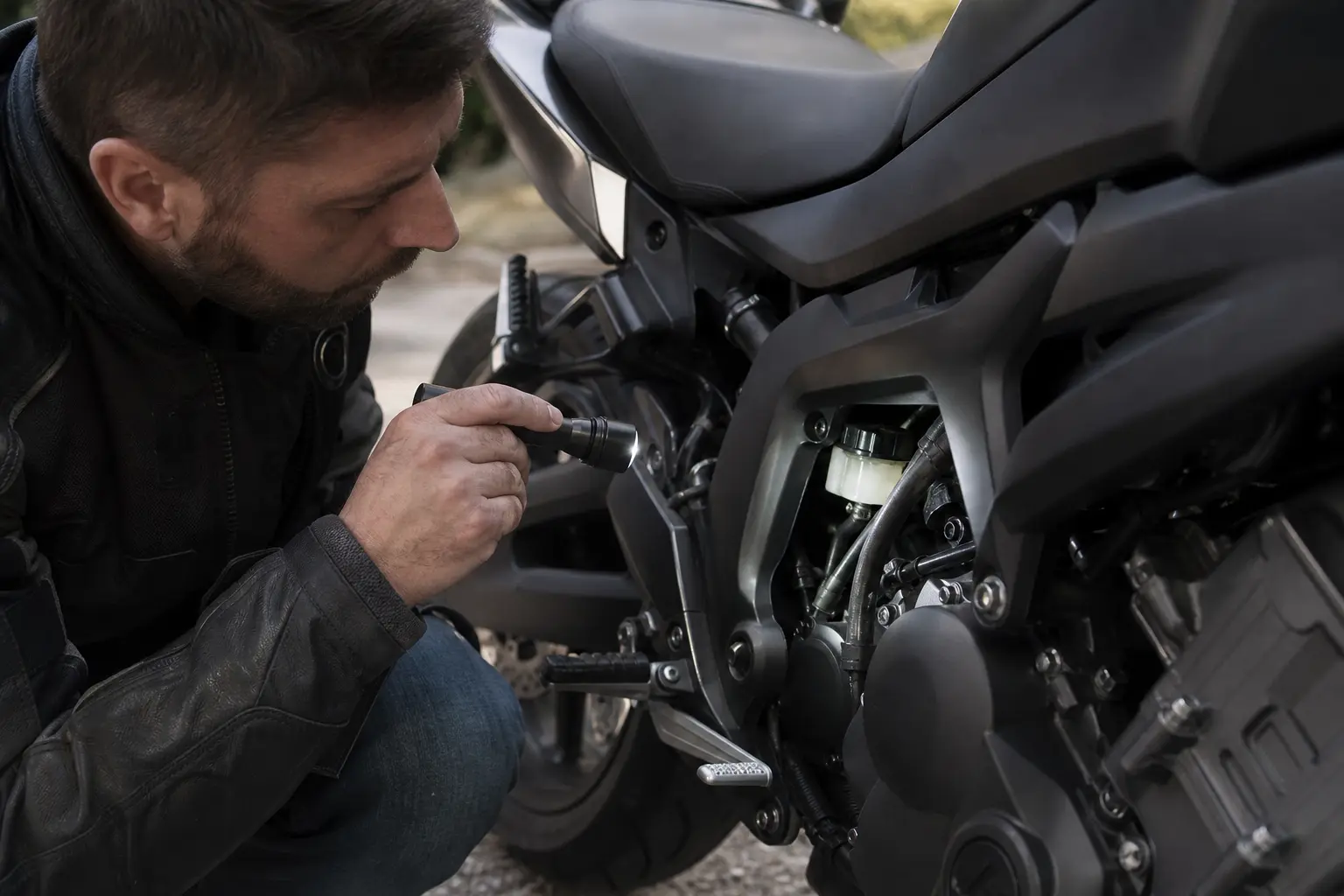
The MSF checklist gives riders a sensible visual map for coolant-leak checks: radiator, hoses, tanks, fittings, and pipes.1 You are not trying to identify the failed part. You are looking for credible signs that the system is not simply asking for a scheduled, manual-directed check.
Look with the engine cool, the motorcycle stable, and sufficient light. Start broad rather than touching parts:
- Look beneath the parked motorcycle for fresh liquid or a new damp area.
- Trace your eyes upward toward the visible cooling-system area rather than reaching into crowded components.
- Look for obvious wetness around accessible hoses, connections, the radiator area, or the reservoir area.
- Notice crusty or stained residue that was not present before, especially if it appears near a connection or beneath the motorcycle.
- Check whether a hose appears visibly cut, swollen, chafed, kinked, or poorly supported.
- Consider whether the level observation and the external clue appeared together after a ride, a long storage period, impact, tip-over, or recent service.
These are observations, not diagnoses. A stain can have more than one origin. A wet patch can be water, road contamination, another vehicle fluid, or something from your motorcycle. A clean-looking motorcycle can still require inspection if the reservoir is repeatedly low. Your job is to collect the right information and avoid overriding a warning with optimism.
A practical rule is this: a reservoir level that is low without any other concern may call for a manual-guided next step; a low level plus visible leakage, damage, warning indication, or abnormal heat concern calls for a more conservative decision.
Do not wipe away all evidence before you have documented what you saw. A photo taken from a safe distance, the approximate location of a puddle, whether the motorcycle was cold or recently ridden, and the date can make a later inspection much more productive.
When Low Coolant Means Do Not Ride
No article can replace the limits and warnings in your exact owner’s manual. Still, there are clear situations where continuing a ride is a poor risk decision because a simple reservoir observation has become part of a broader problem.
Choose do not ride; arrange qualified assessment when any of the following applies:
- You see an active drip, a fresh puddle that appears to be coming from the motorcycle, or obvious wetness at a cooling-system component.
- A hose, fitting, tank, radiator area, or related visible part appears damaged, displaced, badly chafed, or otherwise abnormal.
- The motorcycle gives a temperature-related warning, shows signs you reasonably associate with overheating, or behaves abnormally alongside the coolant concern.
- The reservoir appears low again after you previously corrected it using the exact manual’s approved method.
- You cannot identify the correct coolant specification, the correct inspection condition, or the approved fill process for your motorcycle.
- The motorcycle has a coolant concern after crash damage, a significant impact, a tip-over that damaged bodywork or plumbing, or recent work that makes the source uncertain.
- You are far from home, riding in traffic, or facing conditions where an uncertain cooling-system issue could leave you stranded in a hazardous place.
This is not alarmism. It is a recognition that a cooling-system problem can become more consequential while the motorcycle is in use. The safest response is often to preserve the evidence, avoid further heat exposure, and get a model-aware inspection rather than attempting a roadside fix.
If you are already riding and a temperature warning or strong overheating concern appears, prioritize getting safely out of traffic. Avoid treating the roadside as a workshop. Once parked safely, let the motorcycle cool and use the manual’s instructions and available qualified support to decide what happens next.
Manufacturer-First Guidance Before You Add Any Coolant
The phrase “motorcycle coolant” hides important differences among motorcycles. Two liquid-cooled bikes can have different approved fluids, different reservoir locations, different access arrangements, different minimum and maximum marks, and different instructions for checking or correcting the level. Some motorcycles do not use liquid coolant at all.
Before you add anything, confirm all of the following in the manual written for your exact motorcycle:
- Your motorcycle uses liquid coolant. Do not assume based on engine size, radiator-like appearance, or a similar model.
- The correct inspection point. The manual may distinguish between a reservoir, recovery tank, radiator, or another component.
- The required condition for checking. Follow its guidance on engine temperature, motorcycle position, and level surface.
- The acceptable range. Use the marks and method specified for your motorcycle, not a generic amount or an internet estimate.
- The approved coolant specification. Do not choose by color alone and do not substitute a fluid because it is marketed broadly.
- The specified correction process. If the manual calls for a particular sequence, service interval, or professional work, follow that direction.
- The warning and service instructions. Treat the manual’s warning indicators, stop-riding cautions, and dealer-service advice as controlling.
This manufacturer-first approach is especially important if the coolant level is substantially below the lower marking, if you do not know the service history, or if the motorcycle has shown a warning. Adding fluid without knowing why the level is low can hide the evidence temporarily while leaving the underlying concern unaddressed.
For a broader routine that puts fluids in context with tires, controls, lights, chassis, and stands, see the Motorcycle Maintenance Guide. A good maintenance habit is not just checking a reservoir; it is creating a repeatable inspection system that makes changes easier to notice.
A Calm, Repeatable Coolant Check Routine
Use this process as a rider-level inspection routine. It is not a repair procedure and does not override your manual.
Coolant Reservoir Safety Checklist
- Confirm that your motorcycle is liquid-cooled and identify the correct owner’s manual.
- Park on stable, level ground as directed by the manual and secure the motorcycle before inspecting.
- Wait until the motorcycle is cool; do not judge the reservoir immediately after riding.
- Locate the reservoir or recovery tank identified by the manual—do not guess based on an unfamiliar cap or container.
- Use good light and read the level without disassembling or disturbing cooling-system parts.
- Compare what you see with the manual’s specified range and inspection conditions.
- Look beneath the motorcycle and around visible radiator, hose, tank, fitting, and pipe areas for wetness, residue, or damage.
- Check the instrument display for any temperature-related notice or warning that occurred during the last ride.
- If the reading is low, verify the approved coolant type and exact manual procedure before adding anything.
- Do not ride if you see a likely leak, visible damage, an unresolved warning, repeated level loss, or any condition you cannot confidently assess.
- Record the date, cold-engine level observation, mileage or hours, warning indicators, and any visible evidence.
The MSF Motorcycle Operator Manual recommends checking coolant level weekly when the motorcycle is equipped with it, alongside brake hydraulic fluid, as part of routine care.2 Weekly is a helpful baseline for a normally used machine, but your own owner’s manual can specify a different schedule or additional checks. Check more deliberately after a known change: long storage, recent service, a warning event, an impact, or a new stain under the motorcycle.
Avoid These Common Low-Coolant Mistakes
Mistake 1: Reading the level after a ride and calling it a diagnosis
The low reading may be real, but the observation conditions are wrong if the motorcycle is not cool. Do not build a repair plan from a hurried hot-engine glance. Let the motorcycle cool, then inspect as the manual directs.
Mistake 2: Using coolant color as the specification
Color is not a reliable substitute for the manufacturer’s stated product requirements. If the container in your garage is not explicitly confirmed by the manual for your motorcycle, it is not verified merely because the color appears to match.
Mistake 3: Treating the reservoir as proof that the whole system is fine
A level in range is good information, but it does not replace checking for leaks, warnings, or abnormal behavior. A low level is also not a license to assume a particular hose, cap, pump, or radiator is at fault.
Mistake 4: Clearing the symptom without recording it
If you see a questionable level or residue, write down what happened before memory turns it into a vague story. Record whether the engine was cold, where the motorcycle was parked, the observed level relative to the marks, and any warning light or message. This supports a much better service conversation.
Mistake 5: Riding “just to see if it settles down”
A cooling concern does not need to become a test ride. If a warning, visible leak, or repeated loss is involved, more riding can add heat and distance while reducing your options. Park it and obtain guidance.
Mistake 6: Following a generic fill or bleeding tutorial
Even well-intended instructions can be wrong for your exact motorcycle. The correct fluid, access method, fill point, and procedure are model-specific. This article intentionally does not provide a universal repair sequence.
Make the Observation Useful at a Service Visit
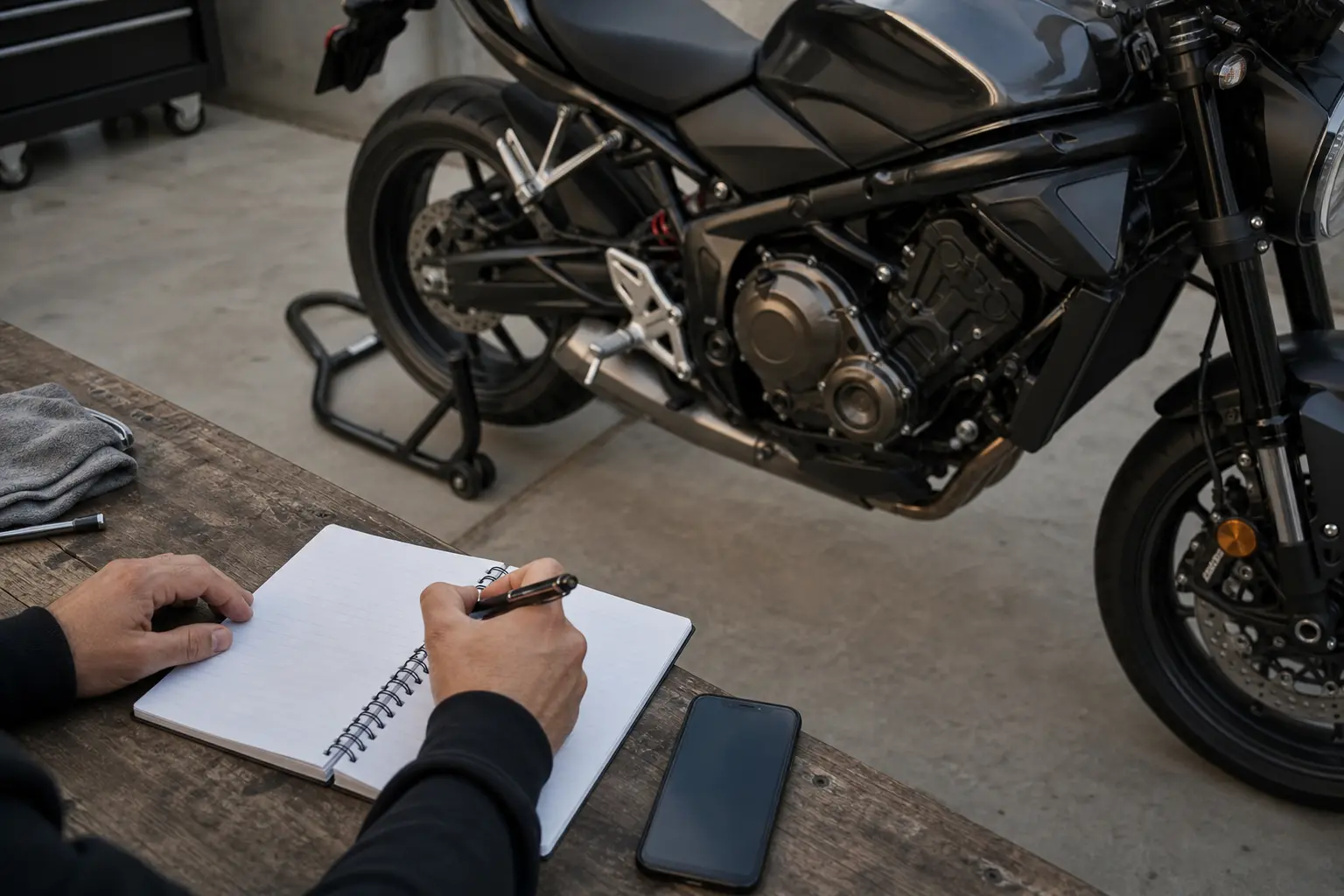
Qualified service is easier when you arrive with a clear description rather than “it seemed low.” You do not need technical vocabulary. A short record is enough:
- Motorcycle make, model, model year, and current mileage or operating hours.
- Date and approximate time of the observation.
- Whether the engine was fully cool.
- The level relative to the marks shown on the reservoir.
- Whether you noticed a puddle, wetness, residue, odor, warning, or unusual running condition.
- Where on the motorcycle or ground you saw the clue.
- Whether the motorcycle was recently stored, serviced, dropped, struck, or ridden in unusual conditions.
- A clear photo of the reservoir and any external evidence, if safely obtainable.
This does not replace diagnosis, but it prevents the situation from being reduced to guesswork. It also creates a baseline. If service finds no urgent defect, you will know what to monitor later using the same cold-check conditions.
How Vojo Helps
Create a recurring weekly coolant check in the Vojo motorcycle maintenance tracker, then log the cold-engine reservoir reading as “within range,” “below range,” or “unable to verify.” Attach a photo only when there is a visible change, and add notes for a warning indicator, wetness, residue, recent service, or a no-ride decision. If the same observation returns, your timeline gives you a clear record to compare before booking service rather than relying on memory.
Download Vojo on the App Store
Bottom Line
A low motorcycle coolant reservoir is a signal to inspect carefully, not an invitation to improvise. Check the reservoir only when the motorcycle is cool. Use the owner’s manual to identify the proper level, approved coolant, and model-specific process. Look for visible leaks around the radiator, hoses, tanks, fittings, and pipes. If the low level comes with a warning, visible leakage, damage, repeated loss, or uncertainty about the correct procedure, choose the conservative path: do not ride until the issue has been properly assessed.
The best outcome is not merely bringing a line back into range. It is knowing why the observation occurred, preserving your motorcycle’s reliability, and avoiding a cooling-system concern that grows into a roadside problem.
FAQ
Is it safe to ride with a low motorcycle coolant level?
It depends on the exact motorcycle, how low the level is, whether there are warnings or leak clues, and what the owner’s manual says. Do not treat a low reservoir as automatically safe to ride. If you see active leakage, damage, a temperature warning, abnormal heat concerns, repeated level loss, or you cannot verify the approved next step, do not ride and arrange qualified assessment.
Should I check motorcycle coolant hot or cold?
Check the reservoir or recovery tank only when the motorcycle is cool. That is the MSF T-CLOCS guidance, and your owner’s manual should provide the model-specific inspection conditions.1
Can I add water instead of motorcycle coolant?
Do not make that substitution based on generic advice. Use only the fluid specification and correction process stated in the owner’s manual for your exact motorcycle. If you cannot verify the correct product or procedure, pause and obtain manufacturer or qualified-service guidance.
Why is my coolant reservoir low but I do not see a leak?
A reservoir observation alone cannot identify the cause. The absence of an obvious drip does not prove there is no issue, and a low reading does not prove a specific component has failed. Recheck only under the proper cold conditions, record the observation, consult the manual, and seek qualified inspection if the low level is repeated or paired with warnings or abnormal behavior.
How often should I check motorcycle coolant?
The MSF Motorcycle Operator Manual lists a weekly coolant-level check for motorcycles equipped with coolant as part of routine inspection. Your motorcycle’s owner’s manual remains the authority for its exact schedule and procedure.2
Does a low coolant level mean the motorcycle is overheating?
Not necessarily. A low reservoir observation and an overheating condition are not the same diagnosis. But if low coolant appears alongside a temperature warning or other overheating concern, treat that combination as more serious and avoid continuing to ride until you have followed the manual’s guidance or obtained qualified help.
Quick answers
Frequently asked questions
Is it safe to ride with a low motorcycle coolant level?
Not automatically. Follow the owner’s manual, and do not ride if the low level is paired with visible leakage, damage, temperature warnings, repeated loss, or uncertainty about the approved next step.
Should I check motorcycle coolant hot or cold?
Check the reservoir or recovery tank only when the motorcycle is cool. Confirm the exact inspection conditions in your owner’s manual.
Can I add water instead of motorcycle coolant?
Do not substitute fluid based on generic advice. Use only the coolant specification and process stated for your exact motorcycle, or obtain qualified guidance.
Why is my coolant reservoir low but I do not see a leak?
A reservoir reading alone cannot identify the cause. Recheck under the proper cold conditions, document the observation, and arrange assessment if it repeats or accompanies warnings or abnormal behavior.
How often should I check motorcycle coolant?
MSF includes weekly coolant-level checks for equipped motorcycles in routine inspection guidance. Your model’s owner’s manual remains the controlling source for interval and method.