
After a Motorcycle Tip-Over: A Conservative Damage Check Before You Decide to Ride
Motorcycle dropped? Use a safety-first inspection of leaks, controls, wheels, brakes, lights, chassis, and stands before choosing to ride or arrange help.
Fact-checked against cited official documentation
Reviewed against Fact-checked against official Harley-Davidson fallen-motorcycle safety guidance and MSF T-CLOCS checks for tires, controls, lighting, fluids, chassis, and stands..
Last updated October 11, 2026
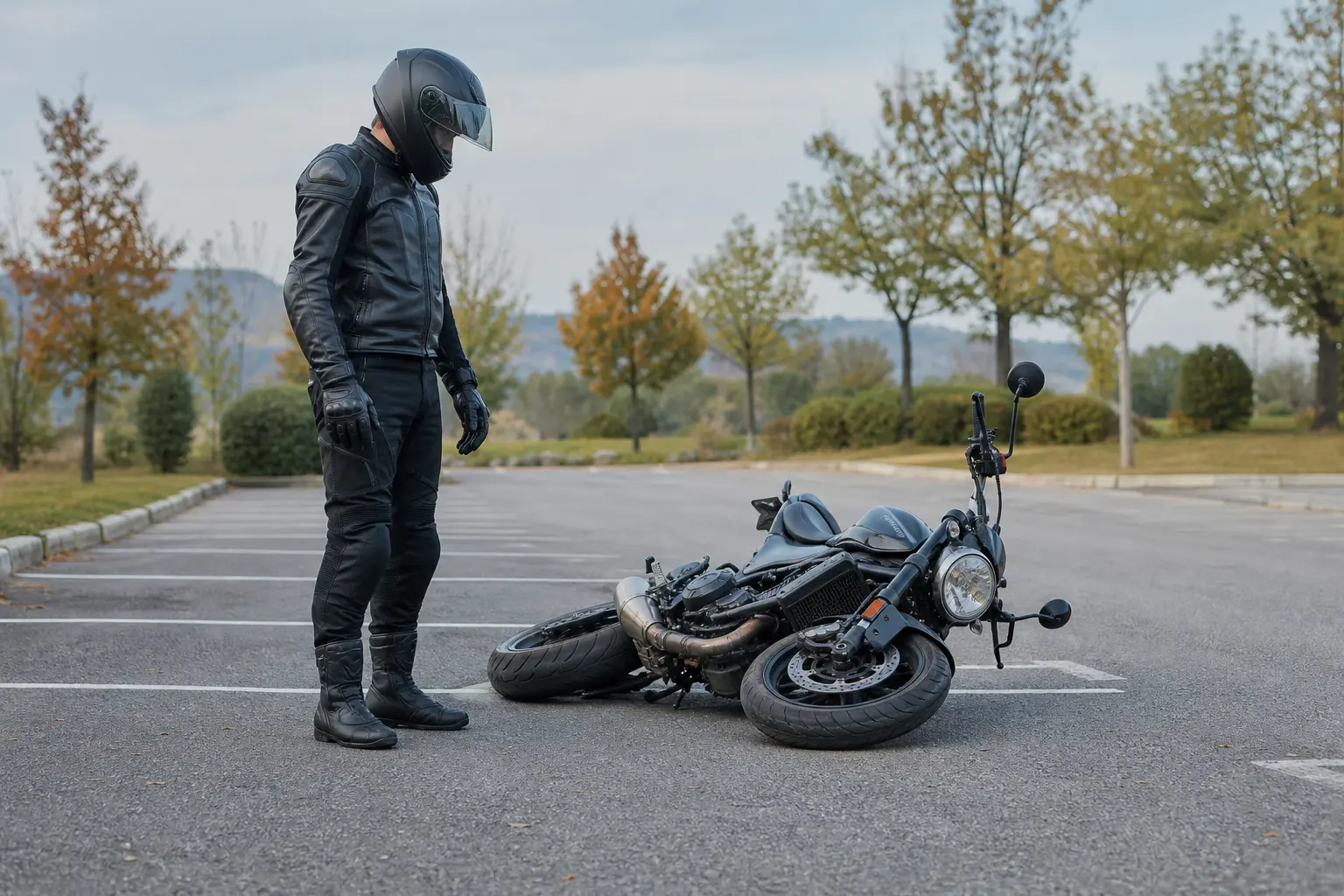
A motorcycle that has fallen over can look reassuringly normal once it is upright. It may start, idle, and show only a scraped bar end, cover, mirror, luggage case, or footpeg. None of those things, by themselves, answer the real rider question: motorcycle dropped—can I ride after inspection?
Sometimes the answer will be yes. A gentle stationary tip-over with no damage beyond a superficial mark can leave the motorcycle suitable for a cautious return. But that decision should come after a calm, systematic check—not after a fast restart or a hopeful glance at the side that touched down.
A fall can affect the parts that make a motorcycle predictable: the controls used to steer and brake, the throttle and its routing, the tire and wheel nearest the impact, a brake line, an electrical connector, a stand, or a mounting point. It can also expose an issue that was already developing. The practical goal is not to prove that everything is perfect on the roadside. It is to find clear reasons not to ride and to recognize when the remaining uncertainty deserves transport or a qualified inspection.
This guide is intentionally conservative. It does not provide a repair procedure, alignment method, or workaround for damaged parts. Your exact owner’s manual remains the authority for model-specific warning lights, fluid-check methods, tire pressures, control operation, and service requirements. Use this article to make a safer go/no-go choice first.
Motorcycle Dropped: Can I Ride After Inspection?
The short answer is: only if the incident was minor, you are uninjured, the scene is safe, and a focused post-tip-over check finds no concern in the systems needed to control and operate the motorcycle. Starting the engine is not enough. A motorcycle can run while a brake component, throttle cable, stand, wheel, light, or steering-related part is no longer dependable.
Use a stricter standard when any of the following is true:
- The motorcycle was moving before it went down rather than simply falling while stopped.
- It hit a curb, barrier, vehicle, pothole, rock, or another fixed object.
- It slid, tumbled, landed hard, or was trapped under another object.
- You cannot say exactly what made contact with the ground.
- You feel pain, dizziness, shock, fatigue, or pressure to leave before you can think clearly.
- Traffic, darkness, rain, a poor shoulder, loose ground, or a remote route would make a second stop especially risky.
Harley-Davidson’s guidance for a fallen motorcycle begins with the surroundings and the people involved, then calls attention to possible leaks, sharp damage, hot parts, and whether the motorcycle can be supported securely once upright. That order is useful because a rider’s urge to get moving can otherwise overwhelm the more important decision: whether it is safe to handle, inspect, or leave the motorcycle at all. Harley-Davidson’s fallen-motorcycle guidance supports this scene-first approach.
The Motorcycle Safety Foundation’s T-CLOCS framework gives the inspection a useful sequence: tires and wheels, controls, lights and electrics, oil and other fluids, chassis, and stands. After a drop, that structure helps you look beyond the scrape that first caught your eye. MSF’s T-CLOCS pre-ride checklist includes checks across each of those areas.
The correct answer is therefore not based on embarrassment, trip plans, or how close home is. It is based on evidence. If a safety-critical item is visibly damaged, behaves differently, leaks, binds, feels loose, or cannot be assessed confidently, the answer is do not ride.
First: Protect Yourself and Stabilize the Situation
Before assessing the motorcycle, assess the event. A low-speed fall in a quiet parking lot and a fall on the edge of a high-speed road are not the same problem. Even a mechanically minor incident can become dangerous if you are crouched beside the bike near traffic, standing on loose gravel, or trying to work while shaken.
Start with yourself and anyone else involved. If there was contact with another vehicle, a hard impact, a head strike, pain, confusion, weakness, or other injury concern, prioritize medical care and scene safety. Do not let the condition of the motorcycle distract from the condition of the rider or passenger.
Next, make the area safer before giving the motorcycle your full attention. Keep clear of moving traffic and avoid standing downhill of the bike on a slope. Watch for fuel odor, liquid on the pavement, smoke, steam, sharp protrusions, or hot engine and exhaust parts. A wet patch may be water or road contamination, but it may also be a fluid leak. Treat an unexplained fresh liquid as a reason to slow down and investigate rather than as proof of harmlessness.
If the motorcycle is still down, do not rush the lift merely because people are watching. Turn the engine off if it is running, create space around the motorcycle, and make sure the ground gives you secure footing. If you cannot safely recover it where it lies, ask for help or call for assistance. The decision to ride comes later.
Once the motorcycle is upright, place it on a stable, appropriate support surface if possible. Take a pause before touching the controls or starting the engine. That pause is useful: fresh fluid can become visible, a loose part may settle into view, and your own breathing and decision-making may improve.
A Simple Decision Table Before You Continue
| Finding after the tip-over | Conservative decision | Why it changes the decision |
|---|---|---|
| Active drip, puddle, persistent fuel smell, smoke, steam, or an unexplained wet area | Do not ride | Fluid containment, fire risk, cooling, lubrication, and hydraulic braking cannot be assumed safe. |
| Damaged, low, cut, bulged, or unseated tire; bent, cracked, or questionable wheel; brake part that looks displaced | Do not ride | Tire, wheel, and brake concerns can affect the motorcycle’s stability and stopping ability. |
| Throttle fails to close normally; steering binds; a lever, pedal, grip, or bar is cracked, loose, or interferes with movement | Do not ride | Predictable control inputs are essential before joining traffic. |
| Side stand or center stand is bent, cracked, loose, or will not stay in position | Do not ride until assessed | The motorcycle may fall again while parked or during preparation to depart. |
| New warning indicator, damaged lighting, broken lens, loose electrical part, or pinched wiring | Inspect against the owner’s manual; do not ride if function is impaired or uncertain | A fall can damage mounts, wiring, switches, and safety-related lighting as well as the visible component. |
| Only minor cosmetic marking, with every inspection area normal and no uncertainty | A cautious, limited ride may be reasonable | This is the narrow case in which observable evidence supports riding. |
| You cannot confidently judge a contacted part or its mounting point | Arrange transport or qualified inspection | Lack of evidence is not a clearance to ride. |
This table is not an invitation to bargain with a defect. A short route can still contain fast traffic, poor visibility, curves, bumps, or nowhere safe to stop. “I only need to get home” does not reduce the importance of steering, braking, tire condition, or fluid containment.
Post-Tip-Over Checklist: Work From the Ground Up
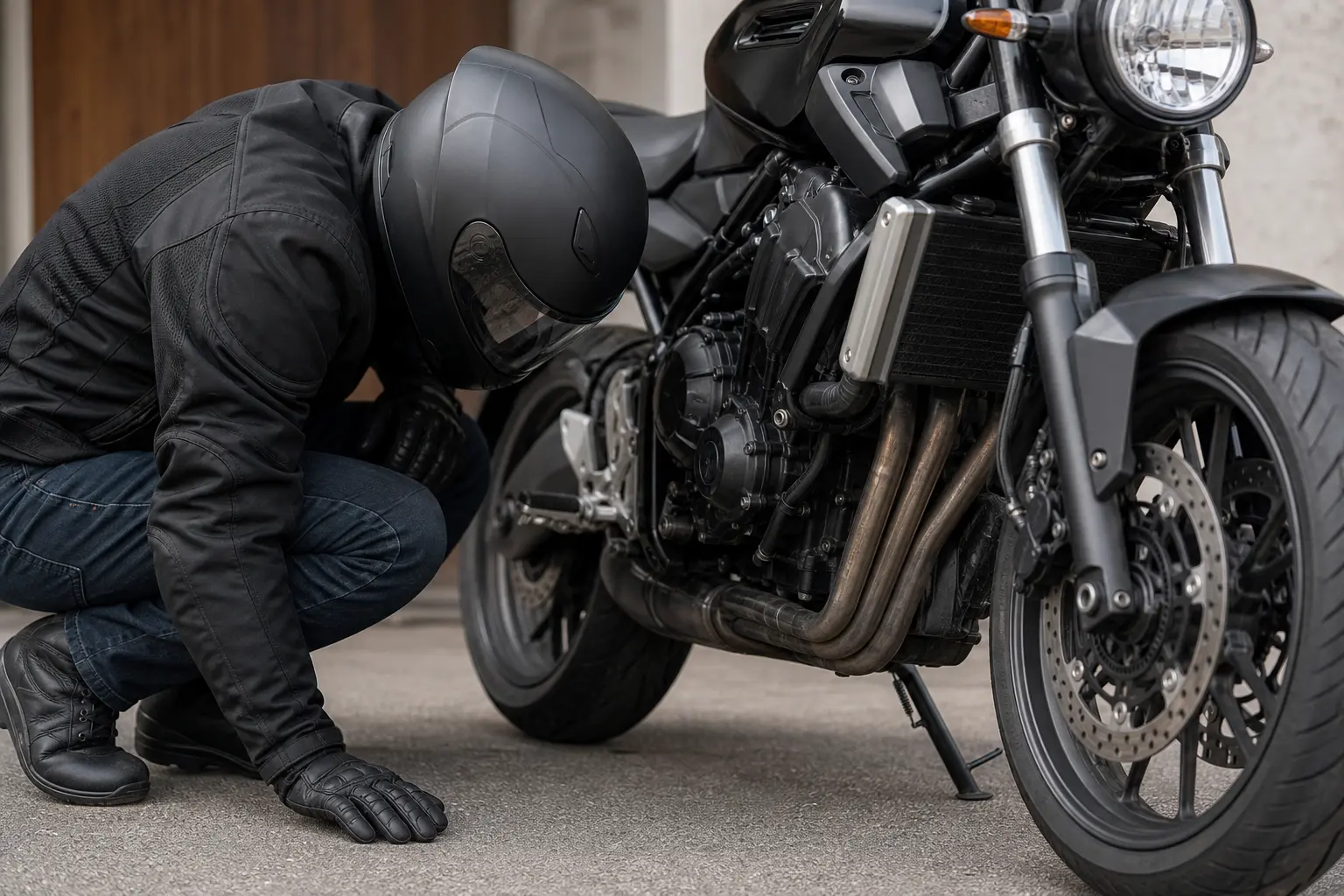
Use this checklist only when the motorcycle is upright, stable, and in a place where you can inspect it without creating a new roadside hazard. Good light helps. If you have a calm, experienced riding partner, a second set of eyes can help spot changes—but it should not replace your own review or your owner’s manual.
1. Check the ground and the support points
Look beneath the motorcycle and around the side that contacted the surface. Note any new drip, puddle, slick patch, smell, or residue. Then inspect the side stand or center stand visually for a changed shape, crack, missing-looking retention hardware, abnormal lean angle, or unusual looseness.
The MSF checklist specifically includes stand condition and spring retention. That matters after a fall because support hardware is often close to the ground and can be loaded directly or indirectly. A stand that appears to work once is not automatically reliable. If it does not deploy, retract, or hold position as it normally does, leave the motorcycle parked safely and arrange assessment.
Also look at lower-mounted items that may have taken contact: footpegs, brackets, exhaust shields, guards, cases, crash protection, and accessory mounts. Their visible condition can identify where force went, but they do not prove that adjacent components escaped load. A gouged guard beside a shifted foot-control bracket, for example, is not merely cosmetic.
2. Look for fluid and hose concerns before starting
Do a slow visual scan of accessible fluid-containing areas. Depending on the motorcycle, this includes the engine, fuel tank and lines, cooling-system components, brake and clutch hydraulic components where fitted, fork area, and final-drive area. You are not diagnosing a leak source or carrying out a roadside repair. You are screening for evidence that fluid containment may no longer be intact.
The T-CLOCS checklist covers fluid levels and leak checks for engine oil, drivetrain fluids, hydraulic systems, coolant, and fuel. It also calls for looking at hose condition and routing. After a tip-over, pay particular attention to crushed, chafed, pulled, or sharply bent hoses and lines, as well as fittings that look newly wet or out of place.
Do not open a hot cooling-system component. Do not assume a fluid is harmless because its color is unclear. Do not use a wipe-down as proof that the problem is solved. An active drip, persistent smell, spray pattern, damaged line, or unexplained wet area is a stop-riding finding.
3. Inspect the tires, wheels, and braking areas
A fall can contact the wheel directly, push another component toward the tire, or damage a brake-area part. Inspect both ends of the motorcycle, not only the side that was down. The front wheel can be affected by bar, fork, or curb contact; the rear can be affected by a side case, exhaust, drive-side component, or impact after the initial fall.
Look for obvious tire concerns: a cut, bulge, embedded object, separated-looking bead, severe scrape, or tire that appears low. Check for items rubbing the tire or sitting unusually close to it. Examine rims for cracks, dents, and clear signs of deformation; on a spoked wheel, look for visibly missing, broken, or damaged spokes. Avoid trying to judge model-specific limits by eye.
Then scan the brake-related parts you can safely see. Look for fresh fluid around a hose, reservoir, caliper, or master-cylinder area; a brake disc that appears badly struck; or a caliper, sensor, hose, or mounting point that looks displaced. The MSF checklist includes tire condition, cold tire pressure, wheel condition, and a check that each brake can keep the motorcycle from rolling. Follow your model manual for the correct pressure and checking method; a visual glance cannot verify pressure.
If the tire, wheel, brake system, or anything close to them is questionable, do not turn the trip home into the test. Transport is the prudent option.
4. Check steering, throttle, and rider controls
Tip-overs frequently involve controls because handlebars, levers, mirrors, guards, and foot controls sit at the outer edges of the motorcycle. A break may be obvious, but subtler changes matter too: a lever that no longer sits correctly, a loose housing, a pedal with altered travel, a cable pulled tight at full steering lock, or a control that touches a fairing or accessory.
With the motorcycle steady, observe the handlebar, grips, bar ends, mirrors, levers, switch housings, rear-brake pedal, shift lever, footpegs, and visible control linkages. Compare their position with what you know to be normal. Check for cracks, unusual bends, looseness, missing-looking pieces, and contact with other parts.
Move the handlebars through their ordinary range while stationary. You are looking for smooth, unobstructed travel and for cables, hoses, and wiring that do not become taut, trapped, or dragged. The MSF checklist calls for handlebars that turn freely, secure controls, correctly routed cables and hoses, and a throttle that operates freely and closes normally without changing engine behavior when the handlebars are turned.
A throttle that sticks, drags, or fails to return normally is a no-ride condition. So are steering restriction, a cracked or insecure lever, a pedal that binds, a control that contacts another component, or wiring and hoses that are pinched or pulled during steering movement. Do not attempt to bend parts back into shape on the roadside and treat the result as a safety sign-off.
5. Confirm lights, signals, mirrors, and electrical condition
A functioning starter motor does not clear the electrical system. A fall can crack a lens, loosen a lamp mount, pull a connector, trap a wire under a panel, or damage a switch. Before entering traffic, check the lighting and signaling functions you rely on: headlamp, tail lamp, brake lamp from both brake controls, turn signals, and relevant switches.
Look for broken or loose lenses, hanging housings, exposed conductors, pinched wire looms, and wiring that could interfere with steering or suspension movement. Check mirrors while seated. You should be able to position them securely for a usable rearward view; a mirror that repeatedly moves or cannot be set is not a detail to ignore.
T-CLOCS includes lighting operation, brake-light activation from both brake controls, signal function, mirror condition, switch operation, and wiring condition and routing. If a new warning light remains illuminated, a message appears, or a fuse issue follows the fall, consult your exact owner’s manual. If that guidance does not clearly resolve the concern, do not guess your way into traffic.
6. Scan the chassis, suspension, drive, and fasteners
A parked-bike tip-over may leave only light external damage. A moving fall, impact, or slide creates a different level of uncertainty. In that case, a rider’s visual inspection should be used to identify obvious no-ride evidence, not to certify the motorcycle as structurally sound.
From both sides, look over accessible frame areas, steering-head surroundings, fork legs, suspension components, swingarm area, visible engine mounts, exhaust mounts, and drive components. Look for cracks, fresh distortion, lifted paint around joints, loose or missing-looking fasteners, contact between parts that should be separated, and anything sitting at an unfamiliar angle.
The MSF checklist includes frame, suspension, drive component, and fastener checks. Its purpose here is to keep the review broad. It does not mean that hidden damage, wheel alignment, or internal component condition can be ruled out by a roadside glance.
Treat a hard landing, curb strike, collision, slide, pothole impact, or high-energy incident as a strong reason to use transport and arrange a professional inspection, even if the motorcycle seems to track normally in the parking space. A motorcycle may conceal meaningful damage behind bodywork, under guards, or inside assemblies that should not be assessed through improvised testing.
Decide Between Riding, Transport, and Professional Inspection
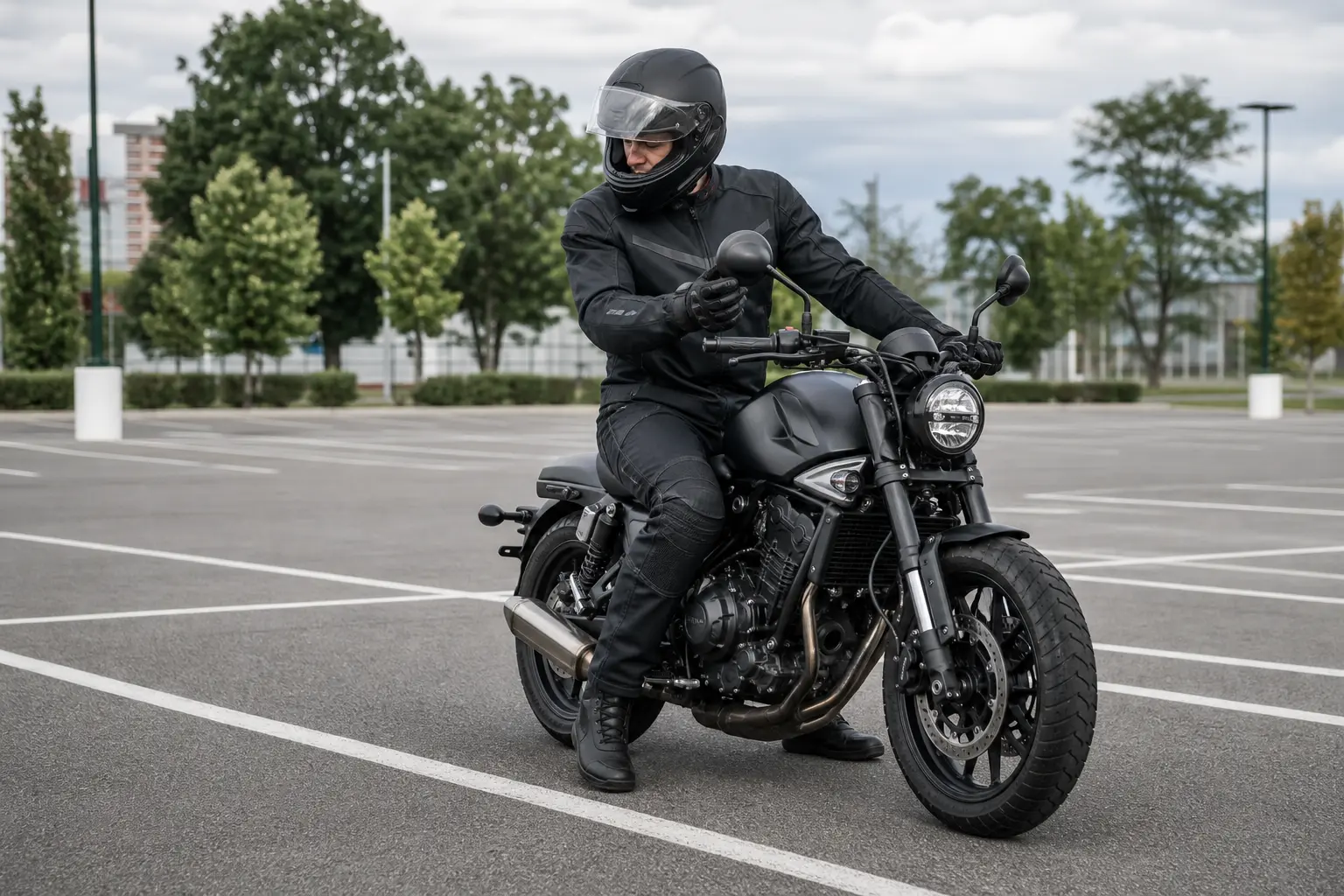
The right decision is not “does it move?” The right decision is whether the motorcycle can be controlled predictably for the whole route ahead, including stops, turns, surface changes, traffic interactions, and parking at the destination.
A cautious ride is only worth considering when all of these statements are true:
- You and any passenger are uninjured enough to make sound decisions, and the surrounding scene is safe.
- The motorcycle is supported normally and its stand condition gives no cause for concern.
- There is no leak, no persistent fuel or hot-fluid smell, no smoke, and no steam.
- Tires, wheels, brakes, controls, steering movement, lights, mirrors, wiring, chassis areas, and drive areas show no concerning change.
- The throttle returns normally, controls operate freely, and nothing pulls or binds through the steering range.
- No new warning indication or manual-directed restriction remains unresolved.
- You understand the fall as a genuinely minor event rather than an impact you cannot fully account for.
- You can choose a short, familiar, low-demand route with practical places to stop if something changes.
Even then, riding away is not an opportunity to “see what happens.” Keep the first return conservative. Avoid carrying a passenger or load if that would add complexity, and stop immediately if you notice a new smell, vibration, handling change, warning indication, noise, control issue, or fluid evidence.
Choose transport or a qualified inspection when the event was more than a static tip-over, a part is damaged or ambiguous, the fall involved an impact, or you simply do not have enough confidence in the result. That choice is not overreacting. It is acknowledging that safety-critical systems deserve a higher threshold than cosmetic appearance.
For future rides, a regular baseline inspection makes post-event changes easier to recognize. The Motorcycle Maintenance Guide can help you build that broader, manual-first routine.
What Not to Use as Your Safety Test
Several common reactions can create false confidence after a drop:
- “It started right up.” Starting only confirms that some electrical and fuel functions are working at that moment.
- “The damage is only on the left/right side.” The bike may have rotated, slid, or transferred load to components away from the first contact point.
- “The lever is still there.” Presence is not the same as secure mounting, normal travel, or reliable operation.
- “The tire looks fine.” A tire can require a pressure check and closer examination even when no issue is obvious from standing height.
- “I can bend it back later.” A damaged control, stand, bracket, or mount should not be treated as safe simply because it can be moved visually closer to its old position.
- “It is only a few miles.” The difficulty of the route is determined by traffic, speed, weather, road surface, and available stopping space—not mileage alone.
A conservative response protects more than the motorcycle. It reduces the chance of turning a recoverable low-speed tip-over into a crash caused by impaired steering, braking, throttle control, visibility, or support hardware.
How Vojo Helps
Once the motorcycle is in a safe place, use the Motorcycle Service History to create a post-tip-over entry before the details fade. Record the date, approximate location, which side went down, what contacted the ground, any fluid or warning-light observations, and photos of the affected areas. Then create follow-up tasks for any item you could not verify—such as a technician inspection, replacement-part assessment, or a later manual-guided pre-ride review.
Before the next ride, open that entry and compare its unresolved tasks with your normal checklist. This gives you a clear decision trail rather than relying on memory after a stressful moment. It also gives a technician useful context if a concern appears later.
Download Vojo on the App Store
Conservative Bottom Line
A dropped motorcycle is not automatically unsafe, and it is not automatically ready to ride. The safe answer comes from the incident details and what you can verify afterward. Start with people and the scene. Then inspect for leaks, tire and wheel damage, braking concerns, control and throttle problems, lighting and wiring issues, chassis or drive clues, and stand damage.
If every relevant area is normal, the event was truly minor, and your model-specific manual offers no unresolved concern, a cautious limited ride may be appropriate. If you find a leak, damaged wheel or tire, brake concern, binding steering, abnormal throttle behavior, broken or loose control, compromised stand, impaired lighting, unexplained warning, or any uncertainty you cannot resolve, do not ride. Choose transport and qualified assessment instead.
References
Quick answers
Frequently asked questions
Can I ride after dropping my motorcycle at a stop?
Possibly, but only if it was a genuinely minor tip-over and a calm inspection finds no leaks, tire or wheel concerns, brake issues, control interference, lighting problems, stand damage, or chassis concerns. A motorcycle that starts is not automatically safe to ride.
What means I should not ride a dropped motorcycle?
Do not ride if you find a fluid leak, persistent fuel smell, smoke or steam, tire or wheel damage, brake-fluid evidence, restricted steering, a throttle that does not return normally, cracked or loose controls, a compromised stand, impaired lights, damaged wiring, a new unexplained warning, or any condition you cannot assess confidently.
Should I start the motorcycle right after lifting it?
No. First stabilize it and inspect the ground, support points, and contacted side for leaks, sharp damage, hot parts, and displaced components. Starting the engine cannot verify the condition of the brakes, steering, controls, wheels, lights, or chassis.
Can I straighten a bent lever or foot control and ride home?
Do not use a roadside bend-back as safety clearance. The part, its mount, or an adjacent component may be weakened, cracked, misaligned, or interfering with normal operation. If the control is not clearly normal and secure, arrange inspection or transport.
How can I tell if the side stand was damaged in a tip-over?
Look for obvious bending or cracking, an unusual parked lean angle, loose-looking parts, and abnormal deployment, retraction, or retention. If the stand cannot be trusted to support the motorcycle normally, do not rely on it or continue riding until it is assessed.