
When Should an Active Rider Take a Formal Motorcycle Skills Refresher Instead of Self-Coaching?
Compare solo practice, a formal motorcycle skills refresher course, and advanced training so active riders can choose the right next step for real riding risks.
Fact-checked against cited official documentation
Reviewed against MSF ARC and Harley-Davidson Advanced Rider Course pages for experienced-rider audience, structured course scope, risk-awareness focus, range topics, and current preparation expectations..
Last updated October 17, 2026
You can be an active, licensed rider and still reach a point where a motorcycle skills refresher course for experienced riders is a better investment than another solo parking-lot session. That is not a verdict on your ability. It is a practical decision about the kind of feedback, environment, and accountability a specific skill gap requires.
Active riders often continue to accumulate miles while their riding changes around them. A new motorcycle may feel heavier, taller, quicker, or less familiar at walking pace. A move may replace open roads with dense traffic. A passenger, luggage, night riding, rain, mountain routes, or faster group rides may add demands that were not part of last season’s routine. Sometimes the change is subtler: braking feels hesitant, tight turns are avoided, or a favorite road produces more tension than enjoyment.
Self-coaching can be valuable. A quiet, legal practice area and a modest, repeatable plan can help an otherwise current rider reconnect with basic control feel. But independent practice has limits. It cannot reliably show you the habit you do not notice, confirm whether your decision-making changes under pressure, or create the same structured progression and outside observation as a formal course.
The useful question is therefore not, “Am I experienced enough to skip training?” Ask instead: “Does my next riding goal depend mainly on time and repetition, or on objective feedback and better risk decisions?”
Formal experienced-rider programs are designed for more than people returning after a long layoff. The Motorcycle Safety Foundation’s Advanced RiderCourse is a one-day program that builds on basic skills while addressing personal risk assessment, perception, hazard awareness, braking, cornering, and crash-avoidance capability. Harley-Davidson describes its Advanced Rider Course as training for active, licensed riders, with work on safety awareness, handling, emergency maneuvering, higher-speed braking, cornering, swerving, and self-assessment. [1]2
That scope gives an active rider a useful comparison point: choose self-coaching when the objective is modest, controlled, and already well understood; choose a formal refresher when the issue involves judgment, consistency, unknown habits, rising consequence, or a need to be assessed rather than merely reassured.
Start with the riding change, not your mileage
Mileage is imperfect evidence of readiness. A rider can cover many uncomplicated highway miles yet rarely face a tight turnaround, an urgent stop in traffic, a changing-radius corner, or a loaded motorcycle at low speed. Another rider may have fewer annual miles but regularly manage city streets, weather, elevation changes, and unfamiliar routes. Neither number alone tells you what needs refreshing.
Instead, identify the change in your operating environment. Your best next step should match the situation that has become more demanding.
Examples include:
- You changed from a lighter motorcycle to one that feels more challenging at stops, in parking areas, or with a full tank.
- You now ride with a passenger or luggage and want more confidence before a trip.
- Your routes have shifted toward hills, curves, traffic, construction zones, bridges, or frequent interstate merges.
- You plan to join a group whose pace or route complexity exceeds your usual solo riding.
- You have begun avoiding a recurring situation, such as a confined U-turn area, a steep parking exit, night traffic, or a wet commute.
- You want to reduce a pattern of rushed decisions rather than simply make the motorcycle turn or stop more sharply.
The distinction matters because some goals are primarily control-familiarity goals. Others are risk-management goals. Familiarity can often improve through measured repetition. Risk management benefits more from coaching because it includes what you see, choose, anticipate, and decline before a maneuver becomes urgent.
A course is not a promise that every road situation will become easy. It is a structured opportunity to identify margins, improve a limited set of skills, and carry a more deliberate decision process back to ordinary rides. Treat it as part of a larger safety system that includes motorcycle condition, appropriate gear, route choices, rest, weather judgment, and a willingness to slow down or stop.
The three choices: self-coaching, refresher, or advanced training
There is no single “right” option for every rider. The following comparison helps separate the choices without treating them as a ladder of personal worth.
| Option | Best fit | What it can do well | What it cannot reliably replace | Safer decision rule |
|---|---|---|---|---|
| Self-coaching | You have a narrow, low-pressure objective and a legal controlled space | Restores familiarity, reveals whether a skill feels rusty, and supports calm repetition | Professional observation, individualized correction, and a structured assessment of habits | Use it only when you can keep the pace low, the goal simple, and the consequences limited |
| Formal skills refresher | You are active but want a broader reset or outside feedback | Combines coached range work with risk awareness, self-assessment, and a planned course structure | Specialized training for a very specific discipline or environment | Choose it when uncertainty involves both control and judgment |
| Advanced or specialty training | Your riding goals now include more demanding conditions or a defined discipline | Can focus practice on the context you intend to ride, within the provider’s stated course scope | A substitute for maintenance, legal compliance, protective equipment, or conservative choices on public roads | Select a program only after confirming its prerequisites, motorcycle requirements, and relevance to your goal |
The labels vary by provider. Do not select a course based only on the word “advanced.” Read the current course description, learner prerequisites, motorcycle requirements, protective-equipment requirements, and provider instructions. A course that is excellent for an active street rider may not address off-pavement riding, track use, passenger handling, or the particular road environment you have in mind.
Also avoid the opposite mistake: assuming a course must be unnecessary because you already have a license. Licensing establishes legal permission; it does not permanently answer whether your current skills, habits, motorcycle, and intended rides are well matched.
When self-coaching is the better first choice
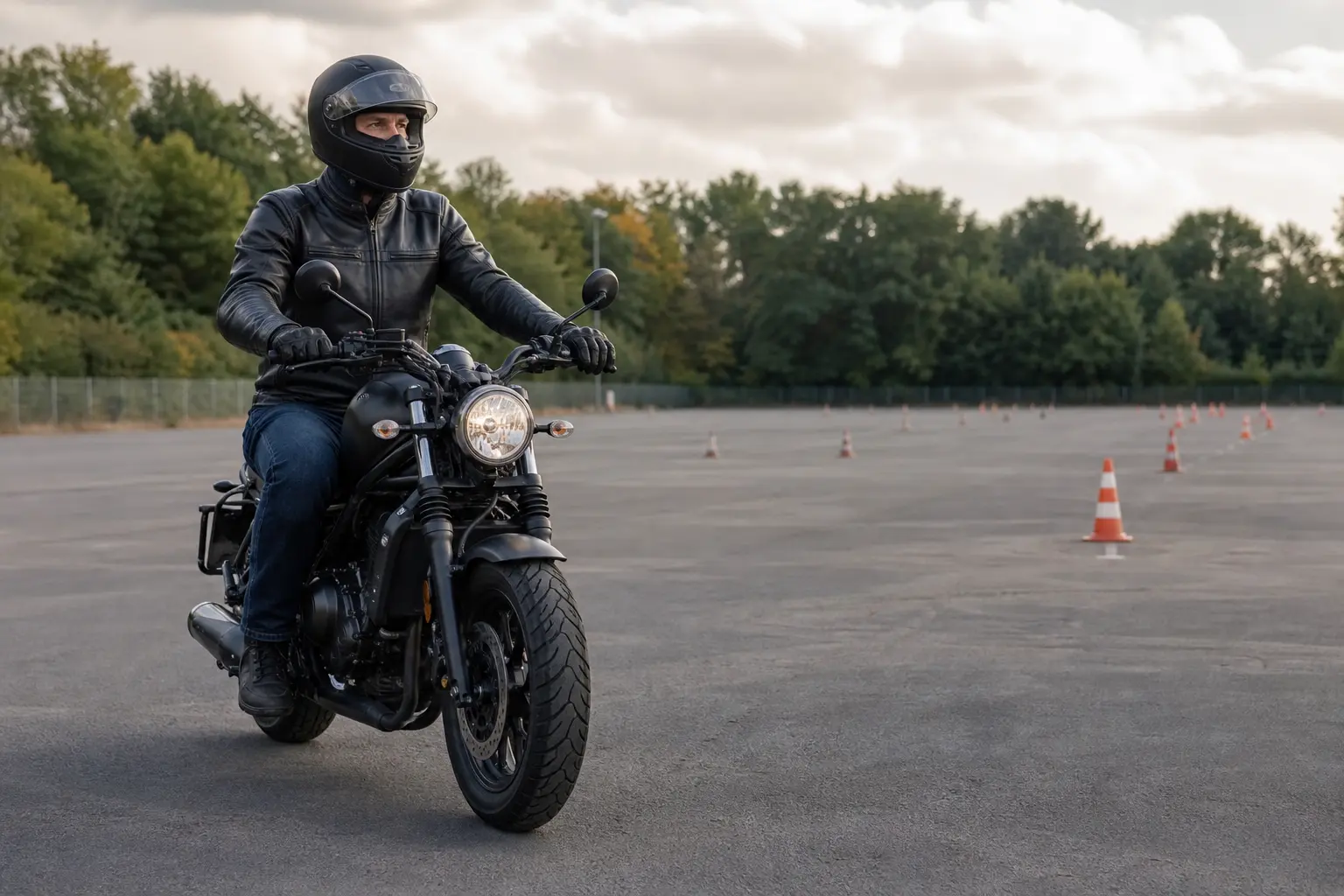
Self-coaching is reasonable when you can define the problem clearly and keep practice within a conservative envelope. The aim is not to prove courage or chase a personal best. It is to regain smoothness, attention, and repeatability before the skill is required in normal traffic.
A good self-coaching candidate usually has four qualities.
First, the objective is specific. “I want my motorcycle to feel less unfamiliar after changing seats” is vague. “I want to become comfortable with the clutch, brake, balance, and steering feel at a calm walking pace before a local ride” is more useful. Specific objectives make it easier to stop before the practice turns into unstructured experimentation.
Second, the environment is controlled. A public road, an active parking area, a driveway shared with vehicles, or a place with unpredictable pedestrians is not a substitute for a deliberately chosen legal practice space. The goal is to lower external pressure, not introduce more of it.
Third, you already understand the basic task. You are refreshing familiar capability, not teaching yourself an unknown technique from fragments of online advice. If you cannot explain what success looks like, what your limits are, or what will cause you to stop, a coached setting is generally the sounder choice.
Fourth, there is no escalating consequence attached to the gap. If the concern is simply that a motorcycle feels different after storage and you can postpone more complex riding, brief controlled practice may be enough. If the concern is braking confidence before a long trip, an upcoming group event, a passenger ride, or a demanding mountain route, relying on solo repetition alone is less persuasive.
Keep your practice modest. Inspect the motorcycle first according to its owner’s manual and current condition. Wear the protective equipment appropriate to the ride. Set a short session with a single purpose. Pause if your attention, energy, weather, surface, or equipment condition is not supporting a calm session. Do not make public-road riding the place where you discover the outer edge of your skill.
A self-coached session can also act as an honest screen. If simple work feels unexpectedly difficult, if you repeatedly cannot tell why an attempt went poorly, or if tension rises rather than settles, that is useful information. It does not mean you failed. It means the next productive step is likely outside feedback.
Signs a formal refresher is the safer choice
A formal course becomes especially valuable when the problem is no longer just lack of repetition. The strongest indicators are uncertainty, inconsistency, and consequences that exceed what you can sensibly manage alone.
You cannot diagnose the habit yourself
A rider may feel that cornering, slowing, or maneuvering is “off” without knowing whether the issue is vision, timing, posture, control inputs, fixation, pace selection, fatigue, or something unrelated to technique. Guessing can cement an unhelpful pattern. In a course, instructors can observe the rider from outside the helmet and offer structured feedback tied to the course exercise.
That external view is the core advantage. You may be able to tell that a result was uncomfortable; a coach may help distinguish discomfort caused by normal learning from discomfort caused by a pattern worth changing.
Your concern includes emergency response
If the question involves hard braking, swerving, sudden hazards, or reacting under time pressure, favor formal training over a self-designed escalation plan. These are high-consequence topics. The point is not to recreate a road emergency in a parking area. It is to learn within a provider’s controlled curriculum, with clear instructions, an organized space, and supervision.
Both official course descriptions in the research for this article include emergency or crash-avoidance elements alongside braking, cornering, and risk awareness. That combination matters: the rider is not merely repeating a physical maneuver but connecting it to perception and decision-making. [1]2
You are about to expand your risk exposure
Take a refresher before—not during—the change. Examples include a multi-day trip, a passenger season, a move to unfamiliar terrain, a new commute with heavier traffic, or a plan to ride with faster companions. You do not need to wait for a close call to justify training. A course is often most useful when you still have time to absorb the lessons without a deadline.
This is also a helpful antidote to group pressure. Rather than trying to “keep up” while learning on the road, complete a course or create a conservative independent plan first. Then choose rides whose pace, route, weather, and stops allow you to use what you refreshed.
Your confidence and your choices no longer agree
Overconfidence can be risky, but so can confidence that is low enough to cause rushed or frozen decisions. Look for mismatch:
- You tell yourself a route is routine but feel compelled to follow another rider’s pace.
- You have no major incident history but increasingly avoid normal maneuvers.
- You can complete a task once but cannot repeat it calmly.
- You are comfortable in ideal conditions but have no plan for reduced visibility, lower grip, fatigue, or traffic pressure.
- You feel fine while moving but become anxious at stops, in tight spaces, or during route changes.
A refresher can help put the discussion back on observable decisions rather than labels like “confident” or “advanced.”
You want coaching on judgment, not only motorcycle control
Experienced-rider education commonly includes risk awareness and self-assessment, not only range exercises. The MSF says its ARC includes interactive activities focused on perception and hazard awareness as well as personal risk assessment. Harley-Davidson similarly describes classroom attention to behavioral aspects, self-assessment, and risk management. [1]2
This is important for active riders because many real-world errors begin before the motorcycle needs an emergency maneuver. A course can prompt better questions: Was I entering with enough margin? Did I leave an escape option? Was I trying to make a late decision work? Was I riding tired, rushed, overloaded, or into conditions I could have avoided?
What a formal course adds that solo practice cannot
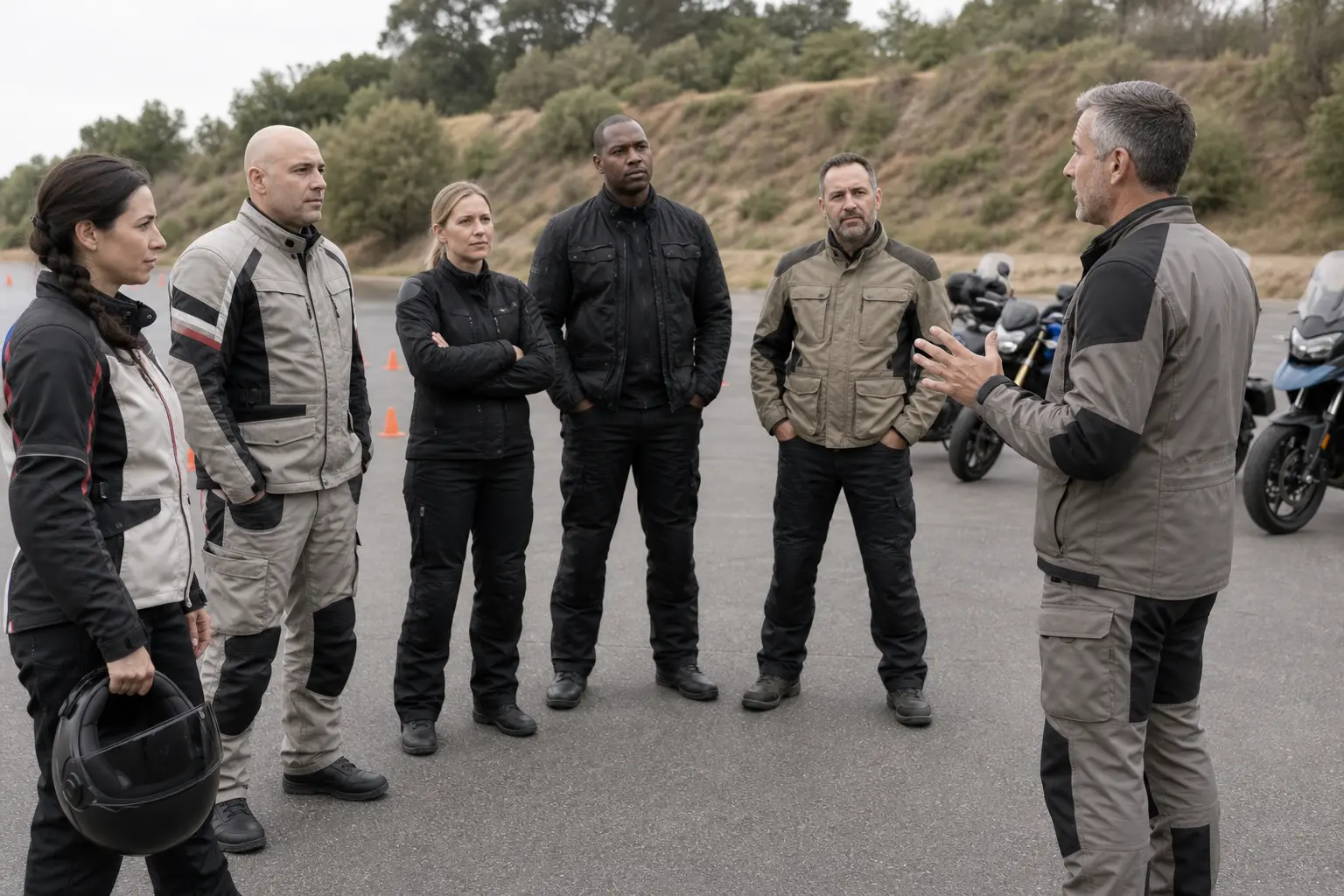
It is possible to learn through careful repetition. But formal training offers a different type of value: a designed learning environment rather than a series of personal experiments.
A progression. In a well-run course, exercises have an order, stated purpose, boundaries, demonstrations, and coaching. Harley-Davidson describes instructors explaining layouts, objectives, and instructions before riders take their turn. That structure can lower the urge to jump ahead or repeat an activity after fatigue has undermined concentration. 2
Observation. The rider’s internal experience is incomplete data. You may feel smooth while being inconsistent, feel slow while actually carrying unnecessary urgency, or mistake a motorcycle setup issue for a personal skill issue. An instructor does not eliminate all uncertainty, but provides another informed perspective.
A practice culture. A course makes it normal to work on fundamentals after licensing. This is useful for active riders who assume that training is only for beginners. Repeating foundational skills in a deliberate setting is not regression; it is maintenance of a complex activity.
A risk-management frame. The most valuable takeaway may be an earlier decision rather than a sharper maneuver. If training helps you identify when to slow, leave more space, choose another route, skip a group ride, take a break, or stop for weather, it has improved more than range performance.
A clean separation from public roads. Skill development belongs in a setting intentionally organized for it. Public roads add traffic, surface changes, sightline limits, law-enforcement concerns, pedestrians, fixed objects, and social pressure. A course does not make risk disappear, but it places practice in a more purposeful environment.
No formal class should be treated as certification to take larger risks afterward. The safer interpretation is the opposite: training gives you better reasons to preserve margin. Improvement is demonstrated by earlier, calmer decisions as much as by cleaner execution.
Choose a course by scope, not by marketing language
Before enrolling, match the course to your actual question. A rider seeking a broad street-riding refresher does not necessarily need a highly specialized program. A rider preparing for a different riding environment should not assume a general course covers that environment.
Start with these course-selection questions:
- Who is the course designed for? Look for active, licensed, experienced, returning, or other stated audience language. Confirm that your present experience matches the provider’s prerequisites.
- What motorcycle is required or permitted? Use the provider’s current information. Harley-Davidson’s course page, for example, says riders train on their own well-maintained, street-legal, single-track two-wheel motorcycle and should verify program details with the dealer. 2
- What does the curriculum explicitly include? Seek a plain explanation of whether it addresses basic refreshers, cornering, braking, swerving, emergency maneuvering, hazard awareness, self-assessment, or another defined focus.
- What preparation is expected? Confirm licensing, insurance, protective equipment, weather expectations, and motorcycle-condition requirements well before the class date.
- What is outside the course scope? If your goal concerns a passenger, unpaved terrain, track riding, a three-wheel vehicle, or another specialized situation, ask whether the program addresses it rather than assuming.
Do not select based solely on the instructor-to-rider ratio, course title, distance from home, or a friend’s experience years ago. Provider practices and schedules can change. Read the current official description and contact the provider for unresolved questions.
Manufacturer-first preparation before any practice or course
Before treating a handling concern as a skills concern, make sure the motorcycle is appropriate to ride. Begin with the owner’s manual for your exact model and follow its instructions for tires, loading, controls, fluids, warnings, and scheduled maintenance. If a warning light remains on, a control does not operate normally, fluid is leaking, a tire condition is in doubt, or steering and braking feel abnormal, postpone practice and arrange qualified inspection rather than trying to ride through uncertainty.
For a course, follow the provider’s stated preparation requirements in addition to your manual. Harley-Davidson lists a pre-ride review that includes tires, controls, lights and mirrors, oil and fluids, chassis and final drive, and stands; it also tells riders to use owner-manual tire-pressure recommendations. 2 Those items are not a universal substitute for your model’s manual, but they are a useful reminder that rider readiness and motorcycle readiness belong together.
Your protective equipment should meet the course provider’s requirements and suit the conditions. Harley-Davidson specifies a properly fitting DOT-approved helmet, eye protection, full-fingered gloves, long sleeves, sturdy pants, and over-the-ankle footwear for its course. 2 Check your chosen provider’s current policy rather than assuming every program uses the same list.
For a broader model-first approach to recurring service needs, records, and pre-ride organization, see the Motorcycle Maintenance Guide.
Checklist: Choose your next skills step
Use this checklist before deciding that another solo session—or a formal course—is the best answer.
- I can name the riding situation I want to improve, not just say that I want “more confidence.”
- I have separated a motorcycle-condition concern from a rider-skill concern using my exact owner’s manual and a conservative inspection.
- I can postpone higher-demand riding until I have refreshed the relevant skill or obtained coaching.
- My goal is narrow, familiar, and low-pressure enough for controlled self-coaching—or I recognize that it is not.
- I have a legal, low-distraction space if I plan to practice independently.
- I have decided in advance what would make me stop the practice session: fatigue, poor weather, surface concerns, equipment concerns, rising frustration, or uncertainty.
- I will not use public traffic, a group pace, or a trip deadline as the place to test my limits.
- If I need feedback on habits, emergency response, or risk choices, I will look for a structured experienced-rider course.
- I have read the provider’s current prerequisites, motorcycle requirements, equipment requirements, and course scope.
- I will treat course completion as a reason to preserve more margin, not as permission to take bigger risks.
Build a practical decision from your answer
If most of your answers point toward a simple familiarity issue, choose a brief self-coaching block and reassess afterward. Keep the next ride easy. Do not stack a new bike, a passenger, bad weather, a demanding route, and a social deadline onto the same day.
If your answers reveal uncertainty about braking, avoidance, corners, low-speed control under pressure, or recurring decision errors, select a formal refresher. The extra value is not just instruction. It is a structured reset that can make your next months of riding more intentional.
If you have completed a refresher and now have a distinct goal beyond its scope, research a specialty program that directly states it serves that goal. Be equally willing to decide that the goal can wait. Choosing a lower-demand route or declining a ride that exceeds your current margin is an experienced-rider decision, not a missed opportunity.
The best measure of success is not whether you feel fearless immediately afterward. It is whether you can identify risks earlier, prepare the motorcycle and yourself more deliberately, maintain space and time margins, and make fewer rushed choices when the ride changes.
How Vojo Helps
Use Vojo to turn a vague feeling—such as “tight turns have felt awkward lately”—into a documented decision workflow. After each ride, log the route conditions and the specific situations that felt demanding. In your motorcycle service history, record any motorcycle-condition question separately from the riding observation, then add a target date for a controlled practice session or a formal course. Before the next higher-demand ride, review those notes alongside your maintenance status so you do not confuse an unresolved bike issue with a skills issue. After training, log the course date, the habits you intend to carry forward, and a conservative follow-up ride plan.
Download Vojo on the App Store
FAQ
Is a motorcycle skills refresher course only for riders who have been away for years?
No. An active rider may benefit when their motorcycle, routes, riding plans, confidence, or risk exposure changes. Formal experienced-rider courses are specifically described by MSF and Harley-Davidson as programs that build on existing basic skills and are intended for licensed or seasoned riders. [1]2
Can I improve enough through solo practice instead of taking a course?
Sometimes. Solo practice can be appropriate for a limited, familiar objective in a legal, controlled setting. It is less suitable when you cannot identify the cause of a problem, need feedback on habits, are concerned about emergency responses, or are preparing for conditions with greater consequences.
Does an advanced course mean I should ride faster afterward?
No. Training should improve judgment and margin management, not create pressure to increase pace. A safer outcome is earlier recognition of limits, better route and condition choices, and more willingness to slow, stop, or opt out.
What should I check before bringing my motorcycle to a course?
Read the current provider instructions and your exact owner’s manual first. Harley-Davidson’s course information calls for a properly operating, well-maintained street motorcycle and highlights tires, controls, lighting, mirrors, fluids, chassis or final-drive condition, and stands as pre-ride considerations. 2
Should I take a refresher before a long trip or group ride?
It can be a sensible choice if the trip adds unfamiliar roads, fatigue, luggage, passenger use, faster companions, or other demands that exceed your normal riding. Schedule it early enough to absorb the learning and follow it with lower-pressure rides, rather than treating the class as last-minute clearance for a demanding itinerary.
Sources
1 Motorcycle Safety Foundation, “Advanced RiderCourse (ARC).”
2 Harley-Davidson, “Advanced Rider Course: Harley-Davidson Training for Experienced Riders.”
Quick answers
Frequently asked questions
Is a motorcycle skills refresher course only for riders who have been away for years?
No. Active riders can benefit when their bike, routes, riding plans, confidence, or risk exposure changes. Formal experienced-rider courses are designed to build on existing skills, not only to restart riders after a long break.
Can solo practice replace a formal rider course?
It can help with a narrow, familiar objective in a legal, controlled setting. It is not a like-for-like substitute when the rider needs outside feedback, wants to address emergency-response concerns, or cannot identify the cause of an inconsistent habit.
Does completing an advanced course mean I should increase my pace?
No. The safer result is better judgment, earlier risk recognition, and stronger margin management. Treat new skills as support for more deliberate decisions, not as permission to accept greater risk.
What should I confirm before taking my motorcycle to a course?
Follow the provider’s current requirements and your exact owner’s manual. Confirm motorcycle condition, required documents, permitted motorcycle type, protective equipment, and the course’s stated scope before the class date.
Should I take a refresher before a long trip or group ride?
Consider it when the ride adds unfamiliar roads, luggage, passengers, fatigue, faster companions, or conditions beyond your normal routine. Take the course early enough to follow it with calm, lower-demand rides.