
Motorcycle SEE Strategy: A Hazard-Scanning Routine for Busy Traffic
Learn a repeatable motorcycle SEE strategy for scanning busy traffic, judging changing hazards, protecting space, and choosing calmer responses.
Fact-checked against cited official documentation
Reviewed against Fact-checked against Motorcycle Safety Foundation materials on SEE, active scanning, space management, lane positioning, escape options, intersections, and blind spots..
Last updated November 9, 2026
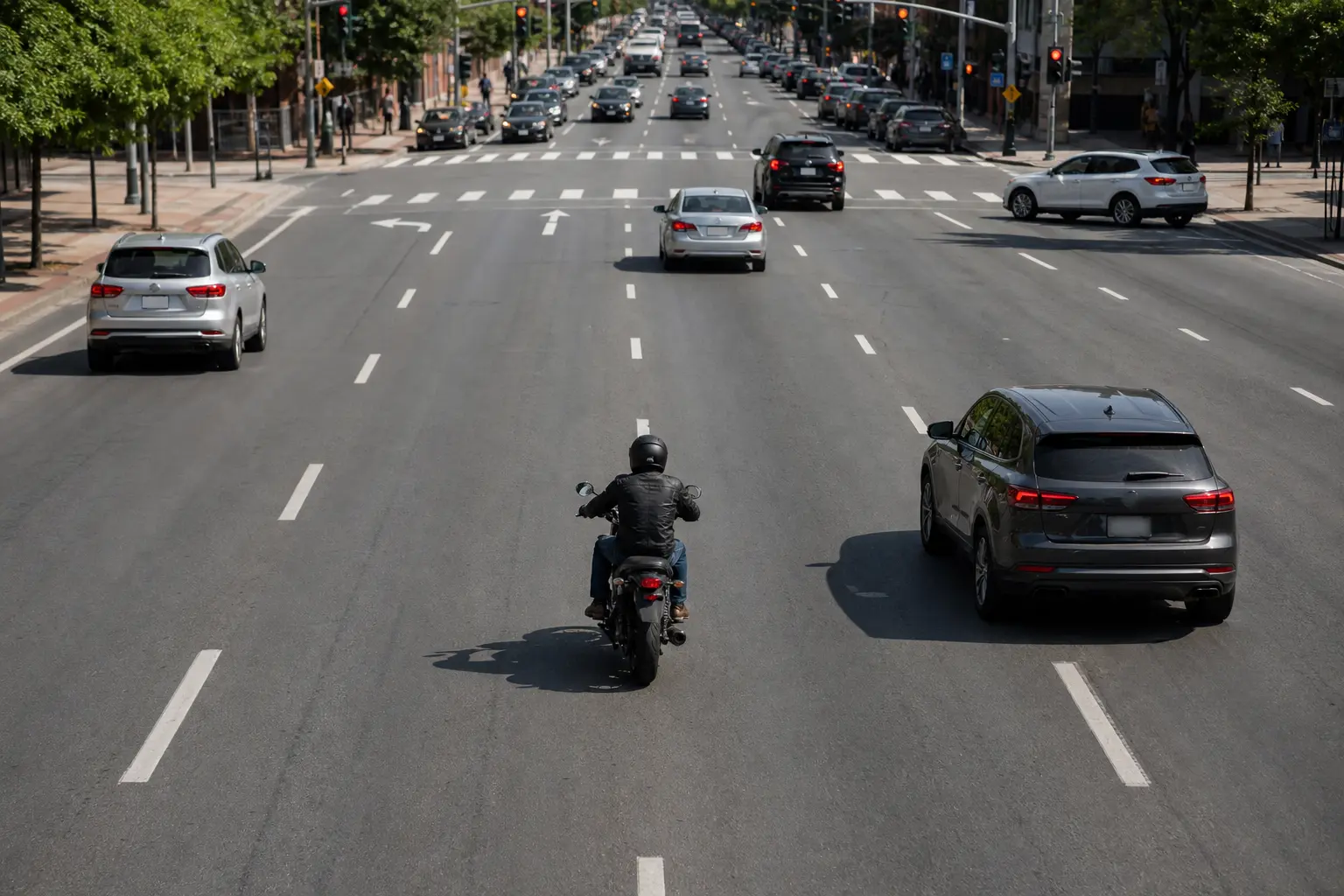
Traffic rarely presents one neatly isolated problem. A rider may be closing on slowing vehicles while a car waits at a driveway, another vehicle occupies the adjacent lane, and a large truck hides the next intersection. The challenge is not simply seeing all of those things. It is deciding which changes matter first, preserving room to respond, and avoiding the urge to solve every uncertainty with a sudden maneuver.
The motorcycle SEE strategy for hazard scanning in traffic gives that decision-making process a repeatable shape. SEE stands for Search, Evaluate, Execute. The Motorcycle Safety Foundation describes SEE as a system connecting observation, risk assessment, riding action, and the space a rider maintains around the motorcycle. Its Why it Helps to SEE overview is the official foundation for the framework.
Think of SEE as a continuous loop, not three boxes completed one after another. You search for information, judge what it could mean, make a measured choice, then immediately update your picture because your action and everyone else’s movement have changed the situation.
Start manufacturer-first. Follow the owner’s manual for your specific motorcycle, including warnings, operating limits, loading guidance, and pre-ride requirements. If the motorcycle’s condition is uncertain, resolve that before relying on it in dense traffic. This Motorcycle Maintenance Guide can help organize the broader maintenance side of ride readiness. Rider training and local traffic law remain essential; SEE is an awareness method, not a replacement for either.
Motorcycle SEE Strategy: Search, Evaluate, Execute
The value of SEE is that it gives separate jobs to attention, judgment, and action. Riders can spot a potential conflict yet fail to decide what it means. They can also decide too late because they waited until every option had narrowed. A named process can interrupt both patterns.
| SEE step | Core question | Practical purpose in traffic |
|---|---|---|
| Search | What is moving, concealed, slowing, or likely to alter my path? | Builds a current picture beyond the vehicle directly ahead. |
| Evaluate | Which development could affect me soonest, and what room remains? | Helps sort important risks from background activity. |
| Execute | What legal, smooth choice improves my margin now? | Turns awareness into an early, controlled response. |
The Motorcycle Safety Foundation encourages riders to look actively for changing conditions, maintain time and space, use lane position with purpose, and identify possible escape options. Its If You Ride A Motorcycle guidance also emphasizes riding within personal ability and the conditions present.
SEE is not about predicting another person’s exact intention. No rider can do that reliably. The practical aim is simpler: recognize uncertainty while there is still enough time and room to take an ordinary-looking action. Often, the best response is not dramatic. It may be allowing a larger gap, postponing a lane change, reducing pace gradually, or declining to enter a crowded space.
Search for Changes in the Traffic Picture
Searching is more than looking forward. It is deliberately collecting the information that could change your route, sightline, or available space. A parked van matters because it may hide a person or vehicle. A brake light matters because it may signal a growing slowdown. A car near a lane divider matters because its path may soon overlap yours.
Avoid letting your eyes settle on one vehicle for too long. When conditions permit, alternate between the road farther ahead, the immediate travel surface, adjacent traffic, mirrors, and areas with limited visibility. The rhythm will differ with speed, rain, darkness, road layout, and congestion. The objective is not a fixed scanning pattern; it is keeping the picture current.
Search beyond the vehicle immediately ahead
The nearest vehicle deserves attention, but it should not consume all of it. Look through available gaps toward the wider traffic pattern. A queue forming at a signal, brake lights farther ahead, or vehicles turning into a commercial entrance can offer an earlier explanation for what the vehicle in front may do next.
That wider view can reduce surprise. If traffic ahead is clearly compressing, you may be able to ease off before the nearest vehicle requires a sharp response. But distant observation should never displace attention from the pavement, immediate following space, or hazards close to the front wheel.
Read uncertainty, not certainty
Most traffic clues are not proof. A vehicle angled toward a side street may turn, continue, or correct its position. A person beside a parked car may remain on the curb or step toward the road. Treat such details as reasons to refresh your assessment rather than as guarantees that one event will happen.
Common prompts for a more active scan include:
- A vehicle approaching an intersection, driveway, parking-lot exit, or opening in queued traffic.
- Brake lights spreading upstream through several lanes.
- A car drifting near a lane marking or leaving an unusually large gap ahead.
- A cyclist, pedestrian, or scooter user near a possible crossing point.
- A bus, delivery vehicle, truck, landscaping, glare, or parked vehicle obstructing the view.
- Traffic approaching a merge, lane reduction, turn lane, or signal change.
The useful response to these clues is not automatic fear. It is earlier attention and a willingness to preserve options.
Include mirrors without overtrusting them
Mirrors contribute important information about approaching traffic and help before slowing or changing lanes. They do not show every space around a motorcycle. A glance in a mirror is one part of situational awareness, not confirmation that an adjacent area is vacant.
MSF’s Check Your Blind Spots — An Extra Look Can Save a Life specifically highlights the importance of extra blind-spot awareness in traffic contexts. Use the observation methods taught in your rider training and required by local law for the maneuver at hand. If the space cannot be confirmed with sufficient confidence, wait rather than treating a partial view as a clear invitation.
Evaluate Motorcycle Traffic Hazards by Time and Space
Busy roads supply more information than anyone can give equal weight. Evaluation means ranking it. Ask which uncertainty could interfere with your travel path soonest, which one might remove your choices, and what information is still missing.
A simple four-part evaluation can keep the task manageable:
- Time: How soon could this reach, cross, or restrict my path?
- Space: What usable room is ahead, alongside, and behind the motorcycle?
- Visibility: What can I actually see, and what remains hidden?
- Options: What controlled, legal alternatives remain if the expected route changes?
The word “usable” is important. An empty-looking area is not necessarily a safe option. It may be outside the lawful roadway, contaminated, blocked farther ahead, occupied in a blind area, or too demanding for the available surface and your skill. Do not casually treat a shoulder, painted divider, or narrow gap as an escape route.
Rank the nearest meaningful conflict
A distant vehicle may be behaving unpredictably, but a partly hidden vehicle about to cross your route generally needs attention first. Likewise, a stationary object well outside your line may matter less than traffic beginning to compress directly ahead.
Ranking does not mean forgetting the rest of the environment. It means holding the most immediate problem in focus while continuing to scan. If it resolves, deliberately identify the next developing issue instead of assuming the road is now uncomplicated.
Preserve a changing buffer
A rider’s buffer is the reserve of time and distance available for observation and response. It shrinks when speed rises, following space closes, visibility deteriorates, vehicles surround the motorcycle, or the road surface becomes uncertain. Fatigue, distraction, stress, and unfamiliar streets can reduce the quality of decisions even if the physical gap has not changed.
Treat the buffer as something that must be renewed. A clear area beside you may disappear when another road user moves over. A comfortable following gap can vanish when traffic bunches. A location that looked like an alternative route may no longer be available a moment later. Each significant change requires another evaluation.
Evaluate your own readiness
The rider is part of the traffic picture. If you are hurried, too warm or cold, mentally distracted, unfamiliar with the route, or struggling to process ordinary movement, the situation has become more demanding even when traffic has not objectively worsened.
A strong decision can be to reduce complexity: select a simpler route, stop at an appropriate safe location, allow impatient traffic to pass when lawful and safe, or end the ride earlier. SEE should make a rider more willing to recognize limits, not more determined to force a difficult situation to work.
Execute a Calm Response to Traffic Hazards
Execution is the choice you make with the controls and your road position. In routine traffic, effective execution is often quiet and early. It might be a gradual speed adjustment, a more useful lane position, a larger following margin, or a decision to let an uncertain opportunity pass.
Choose actions that are lawful, measured, and understandable to other road users. Sudden movements can create a new problem even when the original concern was real. Before acting, distinguish between an immediate conflict, a developing conflict, and an unresolved possibility. Then choose the smallest response that creates a meaningful improvement in time or space.
Use pace to create decision time
When sightlines are limited or several routes may intersect, a controlled reduction in pace can give the rider more time to see what develops. It can also increase the room available for a later decision.
This does not mean abrupt braking whenever something looks uncertain. Fast changes in speed may surprise following traffic, and acceleration can bring the motorcycle to a conflict sooner. Use the whole environment, your trained skills, road conditions, and legal responsibilities to select an appropriate response.
Use lane position as a tool, not a promise
Lane position may improve sightlines or increase separation from a particular hazard, but no lane position is permanently safest. The useful choice changes with vehicle movement, turning traffic, pavement condition, lane width, and the space available around you.
Do not confuse being visible with being protected. Another road user may still fail to detect or correctly judge a motorcycle. Positioning works best when it supports continuing observation and leaves a rider with more options rather than committing the motorcycle to a narrow space.
Let patience be an active decision
A rider does not have to complete a maneuver merely because it was considered. You can remain in the current lane while a questionable blind area clears, wait for a turning vehicle to finish, skip a late lane change, or take a simpler path through a confusing junction.
Waiting should be deliberate and predictable, not passive drifting. If the situation continues to tighten, look for a safe place to reset your plan rather than persisting until the only remaining choices are rushed ones.
Motorcycle SEE Strategy for Intersections
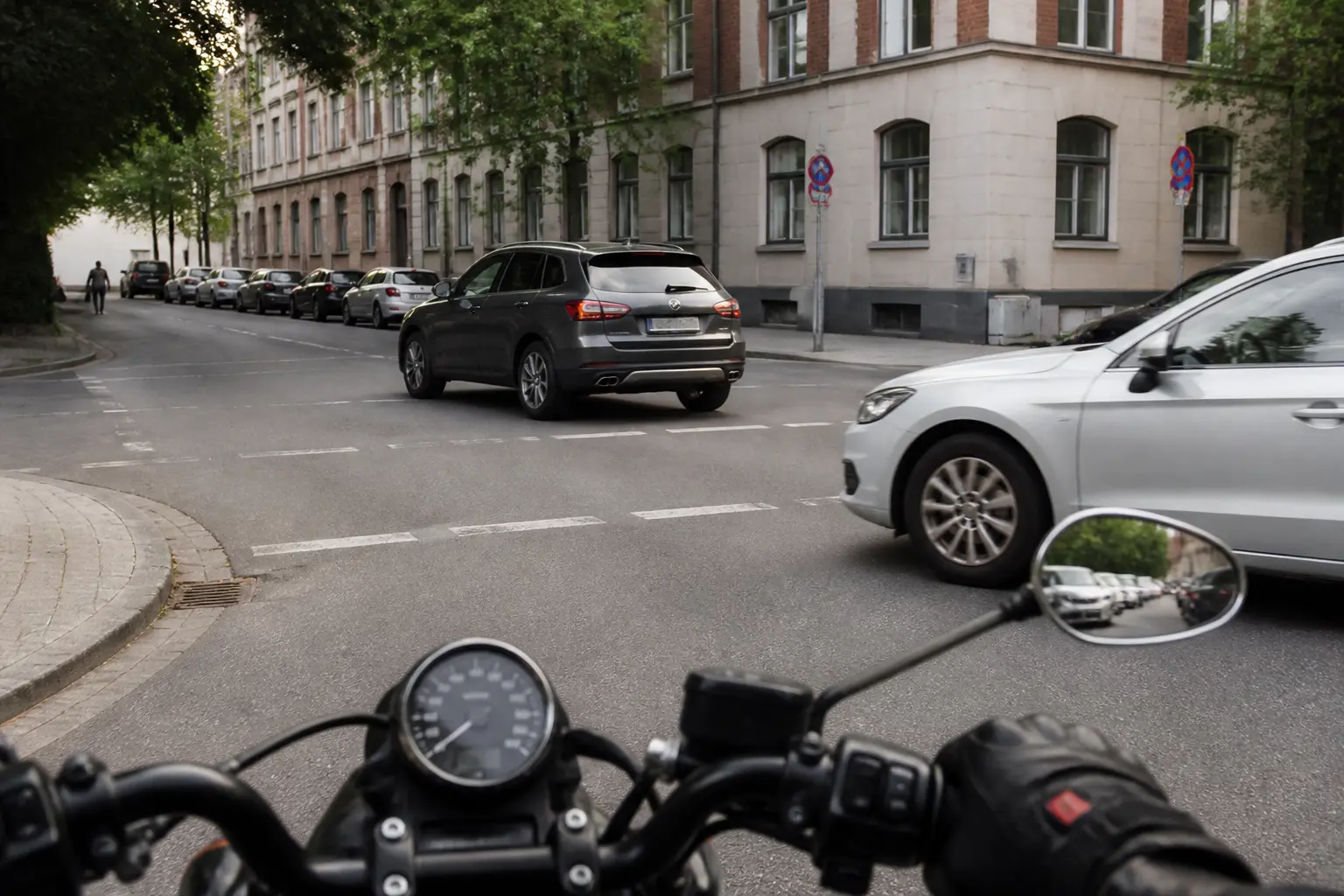
Intersections combine many potential paths: vehicles turning, cross traffic, people crossing, bicycles, changing signals, queues, and large vehicles that hide parts of the approach. They are a useful place to apply the full SEE cycle before the motorcycle reaches the conflict area.
Search: Begin before entry. Look for vehicles waiting to turn, road users approaching from the sides, blocked views, gaps in traffic that may invite movement, and congestion on the far side. A green signal or apparent priority does not remove the need to observe.
Evaluate: Consider whether your view is adequate, whether the exit space is genuinely open, and which vehicle could enter your path first. Notice what room would remain if the expected movement changes. A blocked exit can turn a normal crossing into a place with little flexibility.
Execute: Enter only with a calm plan. Keep inputs smooth, maintain the attention needed to reassess, and avoid treating right of way as a guarantee that others will yield correctly. The goal is to pass through with options, not to prove entitlement to the lane.
For a focused companion read on visibility and space at crossing points, see motorcycle intersection visibility safety.
Motorcycle SEE Strategy for Lane Changes and Blind Spots
A lane change should be assessed before the motorcycle begins moving sideways. Search the destination lane, the space beside the motorcycle, approaching traffic behind, and the road ahead in the lane you intend to enter. Consider whether another driver may be aiming for the same opening.
Evaluate whether the gap is likely to stay usable through the entire maneuver. A space can appear available at one instant and close when a vehicle changes pace or direction. If you cannot establish a sufficient margin using the checks appropriate to your training and local requirements, the sound decision is to delay.
Execute smoothly and predictably after making the necessary observations and signals. Once established in the new lane, restart the search. Your relationship to the traffic ahead, beside, and behind has changed, so any previous escape space or following margin may need to be rebuilt.
Avoid remaining beside large vehicles or in ambiguous adjacent spaces longer than necessary. That does not call for impulsive acceleration. It calls for planning so you are less likely to become boxed in between uncertain movements.
Motorcycle SEE Strategy in Slow, Dense Traffic
Low speed does not make traffic simple. Stop-and-go conditions can include sudden braking, vehicles moving toward small gaps, doors opening, pedestrians appearing between vehicles, and motorists approaching a stopped queue from behind.
Search for the broader pattern rather than staring only at the rear of the next car. Brake-light waves, wheel angles, gaps opening in a queue, and restricted views between larger vehicles can all signal that conditions are about to change. Keep rearward awareness in the routine as you approach a stop.
Evaluate whether you have enough room ahead to remain composed if traffic pauses again. Also reconsider any side space as neighboring vehicles creep forward; an opening available while moving may vanish once the queue settles.
Execute without turning pressure into competition. If a driver follows too closely, keep your focus on a lawful, calm way to restore separation when circumstances allow. Avoid retaliation, racing, or abrupt gestures. For a more specific approach, read motorcycle tailgater safety.
Keep an Escape-Path Awareness Habit
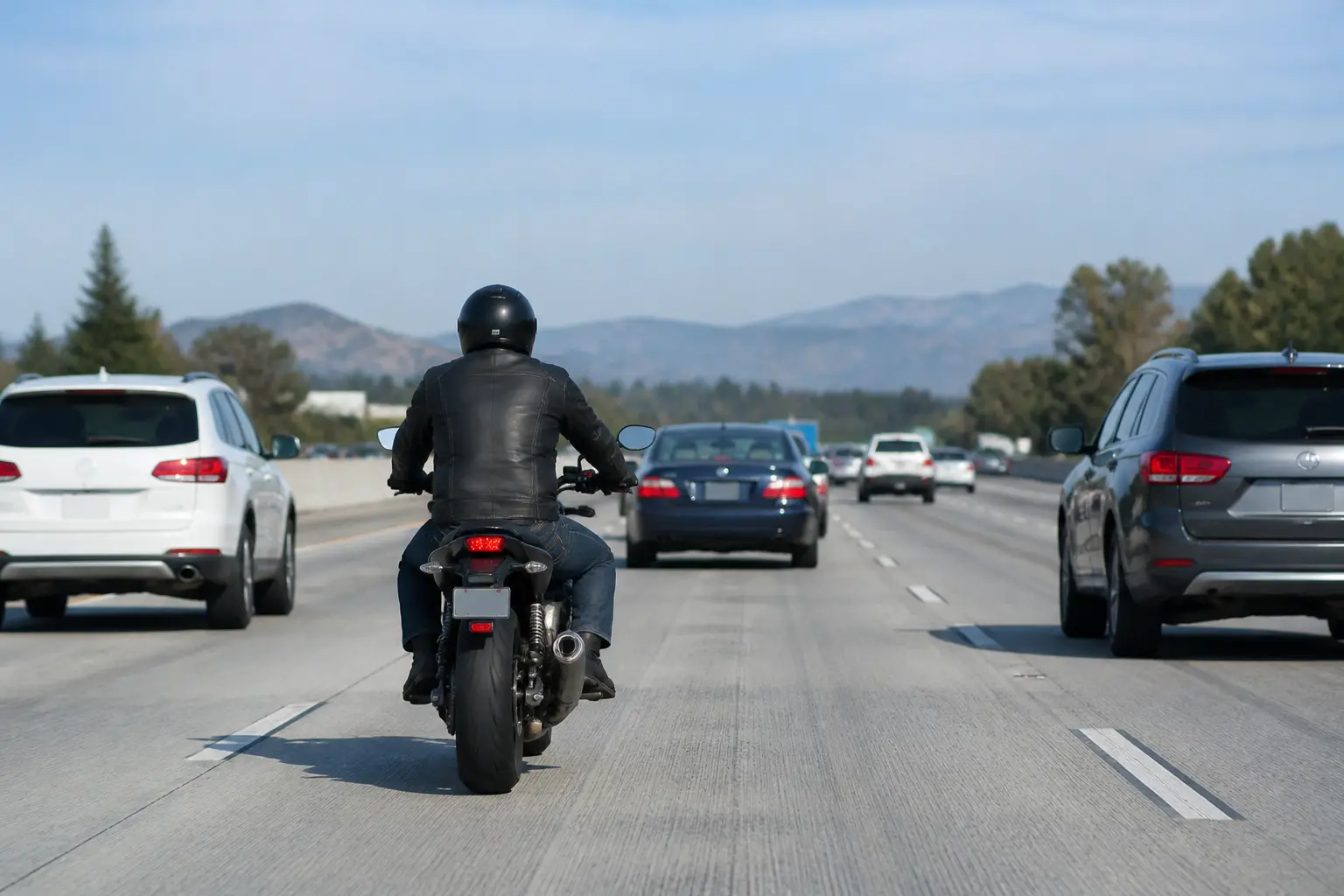
An escape path is not a preplanned swerve or a promise that a gap will remain open. It is a mental habit of noticing where additional separation may be available if the normal travel path is compromised.
For any alternative to be meaningful, it must be available at the moment it is needed, reachable with control, lawful, and appropriate for the surface and your ability. A space beside the motorcycle may contain a vehicle outside your view. A shoulder may be narrow, obstructed, or unsuitable. A lane can end immediately after it appears open.
Use a layered view of your options:
- Normal path: where you expect to travel if traffic continues conventionally.
- Slow-or-stop margin: room that may support a controlled reduction in speed.
- Separation possibility: a nearby area that could increase distance from a conflict.
- Reset location: a safe place to pause, reconsider the route, or end the ride.
The layers must be updated continuously. An option is useful only while it is still real, not because it was open several seconds ago.
Motorcycle SEE Strategy Checklist for Busy Traffic
This checklist is a mental prompt, not a substitute for the owner’s manual, professional instruction, or local law.
Before entering complex traffic
- I am alert enough to make patient decisions and change plans if needed.
- The motorcycle has received the checks required by its manufacturer.
- My intended pace fits visibility, weather, surface conditions, traffic, and my skill.
- I have identified likely pressure points, such as merges, busy intersections, or restricted sightlines.
- I am prepared to skip a maneuver when the available space is uncertain.
During the ride
- I look beyond the nearest vehicle whenever sightlines allow.
- I include mirrors in my scan while remembering their limitations.
- I note what vehicles, glare, roadside objects, or traffic queues may conceal.
- I identify the changing condition most likely to affect my path next.
- I retain usable time and space instead of giving it away unnecessarily.
- I choose responses that are smooth, lawful, and predictable.
- I restart the scan after each lane change, stop, turn, or major speed adjustment.
When the workload rises
- Can I simplify the situation with a measured pace or position change?
- Is waiting safer than forcing the intended maneuver?
- Is my planned alternative truly clear, lawful, and usable now?
- Would a safe stop, route change, or earlier finish restore my margin?
Practice the SEE Routine Without Creating Risk
SEE can become more natural through ordinary observation, not by manufacturing emergencies in live traffic. On a familiar, manageable ride, quietly identify what blocks your view, where vehicles may enter your path, and how your available space changes at signals or merges. The exercise is to notice earlier, not to push closer to uncertainty.
Do not use public roads to discover the limits of braking, swerving, or other emergency skills. Develop physical techniques through qualified instruction and in an appropriate controlled environment. On the road, apply trained skills conservatively and leave room for incomplete information.
After a ride, review one meaningful moment. What was the first clue? Which detail made the situation uncertain? Did you retain enough room to make a calm choice? What would you notice earlier next time? A short, honest review develops the evaluation part of SEE without turning every ride into a stressful replay.
How Vojo Helps
Use Vojo as a simple SEE review workflow. Before a demanding ride, open the route in the motorcycle ride app and add brief prompts at known high-workload locations, such as a busy interchange, a multi-lane intersection, or a road with obstructed views. Keep each note action-oriented: “check exit space,” “scan side traffic,” or “wait for a confirmed gap.”
After the ride, record one traffic decision while it is fresh: what you noticed, what made the scene uncertain, what response you chose, and whether that choice increased or reduced your options. Over several rides, those notes can reveal patterns worth addressing, such as rushing lane changes, entering queues with too little space, or selecting routes that routinely exceed your current comfort margin.
Quick answers
Frequently asked questions
What does SEE mean in motorcycle riding?
SEE means Search, Evaluate, Execute. It is a repeatable way to observe changing conditions, judge which hazards matter most, choose a controlled response, and then scan again as the traffic picture changes.
Is the motorcycle SEE strategy useful outside city traffic?
Yes. The routine applies anywhere conditions change, including rural roads, highways, merges, and unfamiliar routes. Busy urban traffic simply creates more frequent reasons to update the search, evaluation, and execution cycle.
How does SEE help with motorcycle blind spots?
SEE discourages reliance on a single mirror glance. It prompts the rider to assess the intended lane, adjacent blind areas, approaching traffic, and whether a gap will remain usable before deciding whether to move.
Should I always slow down when I identify a hazard?
No. A controlled pace reduction may create time, but it is not the only response and abrupt braking can create another problem. Evaluate the full situation and choose a legal, smooth action that improves your available options.
What is an escape path for a motorcycle rider?
It is a potentially usable area that could provide additional separation if the normal path becomes compromised. It must still be clear, lawful, reachable with control, and suitable for the conditions when it is needed.
Can I learn SEE without practicing emergency maneuvers in traffic?
Yes. Practice the mental routine by noticing sightline limits, changing traffic patterns, and available space on manageable rides. Build physical emergency skills through qualified training in an appropriate controlled setting.