
Motorcycle Mirror Adjustment: A Seated Setup and Head-Check Routine for Real Blind Spots
Learn how to adjust motorcycle mirrors while seated, understand convex-mirror distance limits, and use a deliberate head check before changing lanes.

Fact-checked against cited official documentation
Reviewed against Fact-checked against MSF guidance on seated mirror inspection, mirror aim, convex-mirror distance distortion, frequent scanning, and mandatory head checks before lane changes..
Last updated October 15, 2026
Mirrors are an important part of a motorcycle rider’s traffic scan, but they are not a complete view of the space around the bike. The practical goal is not to eliminate every blind spot with mirror angle alone. It is to aim clean, stable mirrors from your normal riding position, learn what their images mean, and make a deliberate head check part of every lane-change decision.
That distinction matters. A mirror can show useful information behind and beside you without showing every vehicle that may be moving toward the same opening. A rider who chases a perfect all-around mirror view may over-adjust, lose useful rearward reference, or begin treating the mirror as a substitute for looking. A better system is layered: mirror setup before the ride, frequent mirror use during the ride, and a final head check before lateral movement.
The Motorcycle Safety Foundation (MSF) directs riders to clean and adjust mirrors before starting, with each aimed to show the lane behind and the lane alongside. Its T-CLOCS checklist also calls for mirrors to be clean, securely mounted, and adjusted while the rider is seated on the motorcycle. (msf-usa.org)
This article gives you a repeatable parked-bike setup and a lane-change routine. It is intentionally not a repair guide. If a mirror mount is loose, cracked, damaged after a drop, or will not hold its position, pause the ride and consult your motorcycle’s owner’s manual or arrange qualified service rather than trying to compensate with a rushed adjustment.
What “Good” Motorcycle Mirror Adjustment Actually Means
A useful motorcycle mirror setup does three jobs:
- It gives you a fast rearward reference. You should be able to identify traffic approaching from behind without taking your eyes away from the road ahead for long.
- It gives you a side-lane reference. You should be able to check whether a vehicle is beside you, beginning to overtake, or occupying space near your intended lane change.
- It supports—not replaces—your head check. The last visual confirmation comes from turning your head briefly toward the side you intend to move.
That third point is the one riders should protect most carefully. The MSF Motorcycle Operator Manual says that frequent mirror checks belong in a normal searching routine, especially before changing lanes. It also states that motorcycles have blind spots and directs riders to turn their heads and look to the side before a lane change. (msf-usa.org)
A good setup therefore is not judged by whether you can see your entire arms, shoulders, luggage, or the motorcycle’s tail. Those can be useful reference points in small amounts, but the priority is the road environment. If most of the mirror is filled by your jacket or elbow, you have dedicated too much of a limited viewing area to the motorcycle itself. If you angle the mirror so far outward that you lose meaningful awareness of vehicles directly behind, you have traded one useful field for another.
Think in zones rather than perfection:
| View zone | What the mirror should help you notice | What it cannot guarantee | Rider response |
|---|---|---|---|
| Directly behind | Approaching traffic, following distance, braking or overtaking cues | Every vehicle offset behind either side of you | Check regularly, especially before slowing or stopping |
| Near the adjacent lane | A vehicle alongside, beginning to pass, or occupying nearby space | A vehicle hidden in the remaining blind zone | Use the mirror as an early warning, then head-check before moving |
| Farther rearward traffic | General traffic flow and closing vehicles | Reliable distance judgment in a convex mirror | Leave more margin and avoid forcing a lane change |
| Your shoulder or arm edge | A repeatable reference that helps confirm mirror aim | A safety benefit by itself | Keep it minimal; prioritize the road scene |
The exact image will differ by motorcycle. Bar position, handlebar width, rider posture, wind protection, luggage, passenger load, mirror-stalk design, and helmet shape can all change what you see. That is why the seated position matters: adjustment done while standing beside the motorcycle may not match the rider’s actual eye line once seated.
Start With a Parked-Bike, Seated Setup
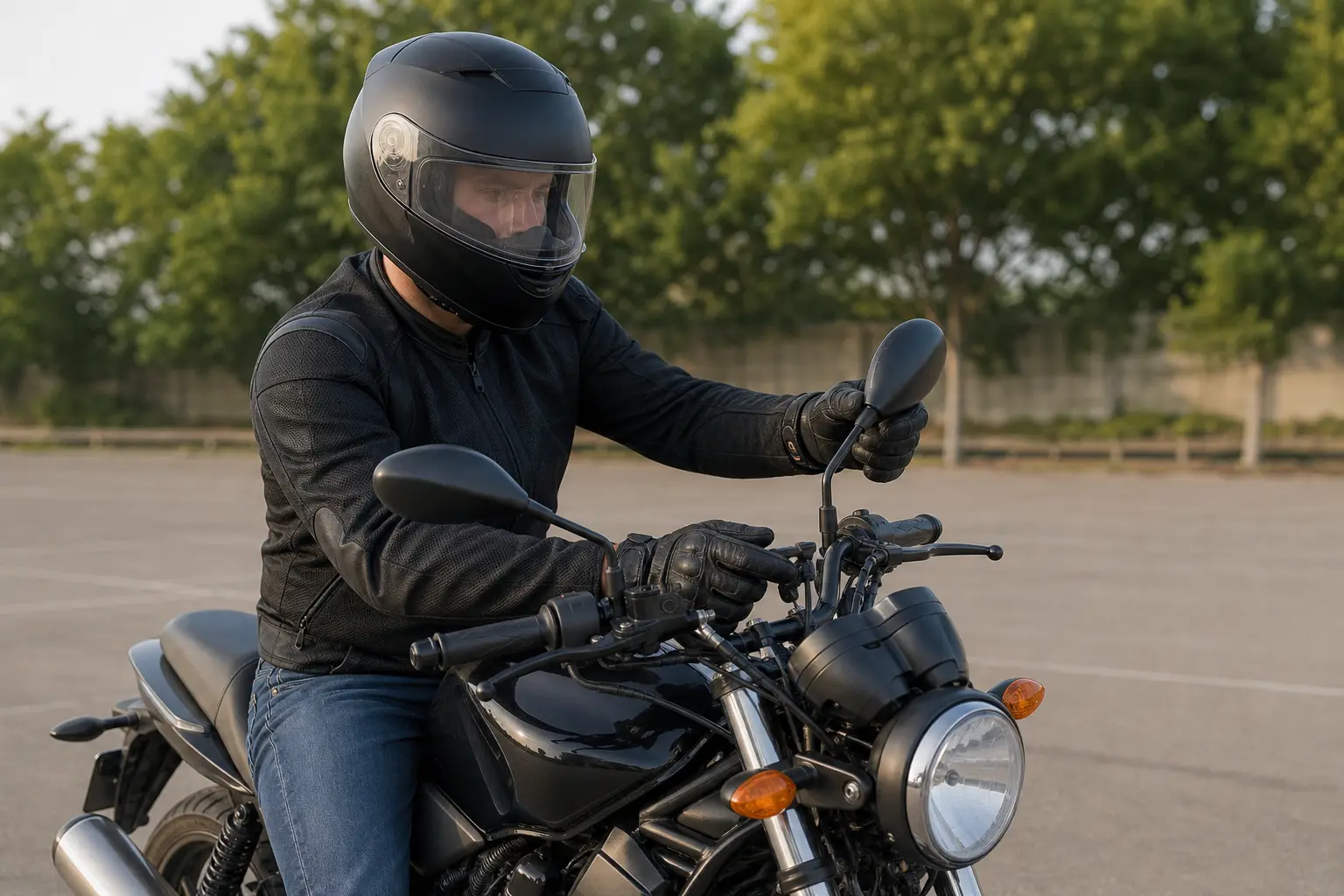
Set mirrors before entering traffic, on stable ground, with the motorcycle secure and the engine off unless your owner’s manual says otherwise. The MSF specifically advises adjustment before starting because adjusting a mirror while trying to ride leaves you managing the handlebar with one hand. (msf-usa.org)
Before touching mirror position, first confirm the basic condition:
- The glass is clean enough to give an undistorted image.
- The housing and stalk appear intact.
- The mount and swivel area hold the mirror in place rather than sagging under vibration or normal handling.
- The mirror does not interfere with your view of critical controls or require an awkward riding posture.
- Your helmet, visor, and eye protection are in the configuration you normally use on the road.
The condition check is not busywork. The T-CLOCS checklist lists cracks, cleanliness, tight mounts, and swivel joints as mirror inspection points, then says to aim the mirrors while seated on the bike. (msf-usa.org)
Once that is covered, sit exactly as you expect to ride. Place both hands where you would normally hold the grips. Put your feet where they will be while stopped. Relax into your ordinary posture rather than stretching tall, leaning to one side, or craning your neck. If you set mirrors from an exaggerated posture, the view will be wrong as soon as your body returns to its normal position.
Use this simple sequence:
- Settle your posture first. Head level, shoulders relaxed, hands on the grips.
- Aim one mirror for the lane behind and lane beside you. The MSF describes these as the important areas to see.
- Allow only a small edge of your arm or shoulder if it helps you repeat the setup. Do not make your own body the main subject of the mirror.
- Repeat on the other side from the same posture. Avoid leaning across the seat to reach a mirror and then judging the view from that leaned position.
- Look straight ahead, then glance naturally into each mirror. The useful view should appear with a short eye movement, not a major head turn.
- Recheck after putting on a different helmet, adding a passenger, fitting luggage, changing handlebar position, or riding an unfamiliar motorcycle. Any meaningful change to your seating position or rearward sightline deserves a new parked-bike check.
Do not treat symmetry as the goal. Your left and right mirrors may not show identical slices of road, particularly if your riding position is not perfectly centered or a component blocks one side more than the other. The goal is functional coverage that you understand and can use consistently.
The Convex-Mirror Distance Trap
Many motorcycle mirrors are convex: their curved glass broadens the apparent field behind you. That expanded view is useful, but it changes how distance looks. The MSF notes that convex mirrors make vehicles appear farther away than they actually are and advises riders to become familiar with that effect while stopped, then allow extra distance before changing lanes. (msf-usa.org)
The safest response is not to memorize a universal distance correction. There is no reliable one-size-fits-all number because mirror curvature, vehicle speed, road geometry, weather, rider experience, and the behavior of other traffic all matter. Instead, build practical familiarity with your mirrors.
A low-pressure exercise is to use a stationary reference in a safe parking area. From the seated riding position, look at a parked vehicle or fixed object in your mirror. Form a rough impression of how far away it appears. Then turn and look directly at it without moving the motorcycle. Repeat this at different apparent distances over time. The point is not precision; it is to learn that the image can make a closing vehicle look less immediate than it is.
On the road, apply that lesson conservatively:
- If a vehicle seems to be approaching quickly in the mirror, assume it may be closer than the image feels.
- If you cannot confidently judge its speed or distance, do not hurry into the lane change.
- If the available gap depends on optimistic interpretation of a convex image, keep your lane and wait.
- At night, in rain, in glare, or amid dense traffic, increase your caution. Those conditions can further reduce reliable visual judgment.
A mirror is especially poor at answering the question, “Can I safely move now?” when traffic is closing from behind at a large speed difference. It can alert you to that traffic. It cannot remove the need to judge the situation over time, check the adjacent space directly, signal clearly, and retain the option to stay put.
Why Mirror Aim Cannot Remove Blind Spots
A blind spot is not proof that your mirrors are badly adjusted. It is a normal limit of any rearward viewing system. Motorcycle mirrors sit ahead of the rider’s eyes, cover a finite angle, and are affected by your body, helmet, mirror shape, vibration, and the position of surrounding vehicles.
A rider may be tempted to rotate both mirrors farther outward until their shoulders disappear completely. In some cases, that may expand the side view. In others, it may create a gap in rearward awareness or produce an unfamiliar picture that is hard to scan quickly. The right question is not, “Can I make every vehicle visible in the glass?” It is, “Can I use these mirrors to track relevant traffic and then confirm the target space with a head check?”
That two-step model is important because traffic is dynamic. A vehicle can move from visible to hidden, accelerate into your blind zone, or start changing lanes toward the same opening between your earlier glance and your maneuver. A mirror adjustment made at home does not solve a problem created by changing relative speed and direction on the road.
The MSF’s broader blind-spot guidance tells riders to avoid riding in other vehicles’ blind spots and to keep actively searching for changing conditions. It also encourages a mindset that does not assume other road users have seen the motorcycle. (msf-usa.org)
That is manufacturer-first safety guidance in practice: follow the owner’s manual for your motorcycle’s equipment and intended adjustment provisions, keep mirrors clean and secure, and use the mirrors as only one layer in a wider visibility strategy. Do not rely on a particular mirror accessory, a blind-spot warning feature on someone else’s vehicle, or eye contact with a driver as a promise that the space is protected.
A Lane-Change Routine That Uses Mirrors and a Head Check
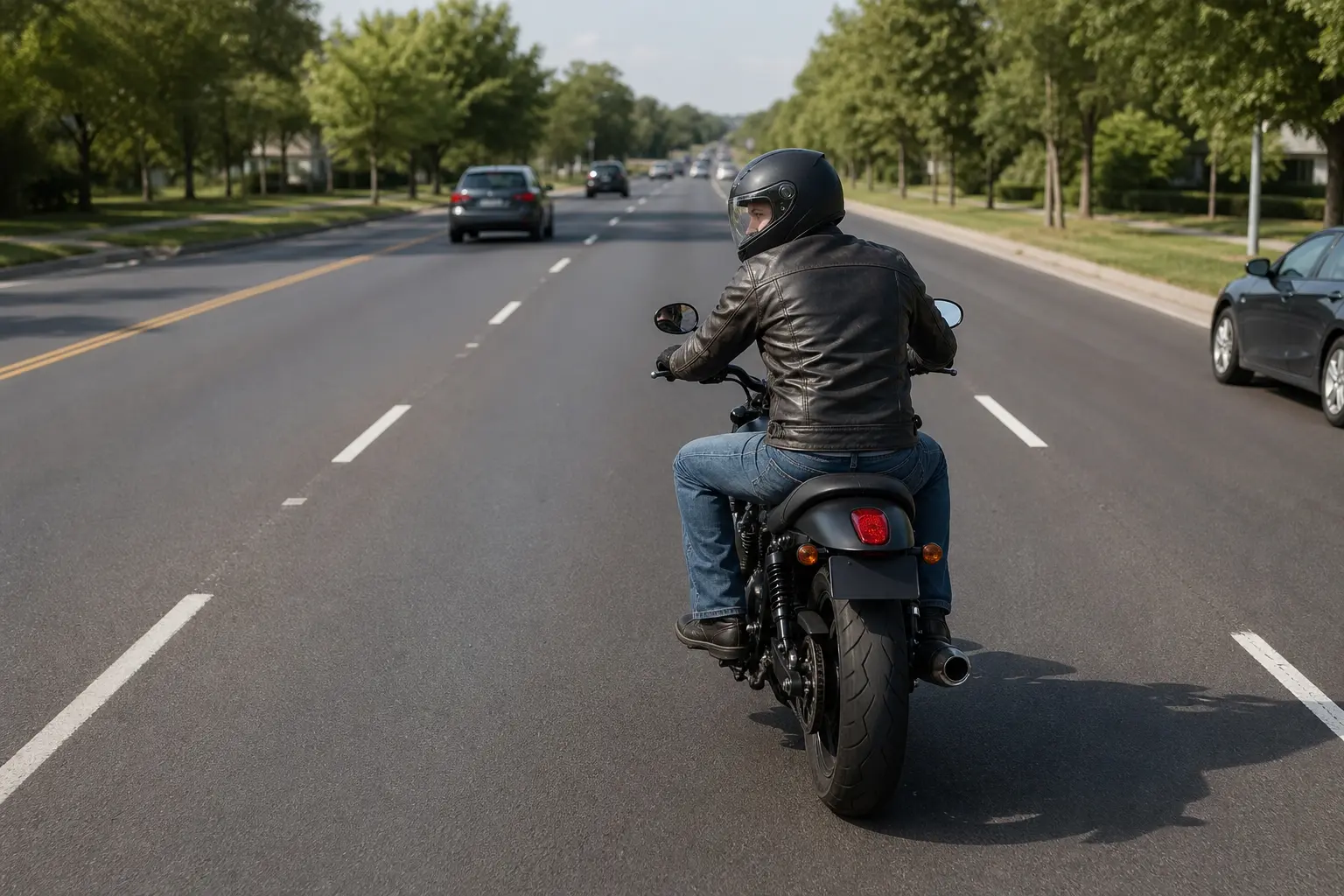
A lane change is not one look followed by one steering input. It is a short sequence that begins before the motorcycle crosses the lane line. The exact timing changes with speed, traffic density, roadway design, and local law, but the decision framework stays consistent.
1. Build a reason to move, not just an urge
Ask why you need the lane change now. Is there an upcoming turn, a hazard, a slower vehicle, or a planned route position? If the answer is only impatience, the safest choice is often to maintain your lane. A rider with no urgent reason to move is less likely to force a narrow gap.
2. Scan the path ahead before looking back
Keep primary attention where the motorcycle is going. A quick rearward check should not come at the expense of missing slowing traffic, debris, a curve, or an emerging conflict ahead. Mirrors are part of a continuing scan, not an invitation to stare behind.
3. Check the relevant mirror early
Look in the mirror on the side you may move toward. Notice whether a vehicle is already adjacent, moving up from behind, or approaching rapidly. Also use the other mirror as context: a vehicle in the farther lane may be setting up to enter the same lane you want.
4. Signal your intention according to applicable law and conditions
A turn signal communicates an intended maneuver; it does not reserve space or compel another road user to yield. Keep monitoring rather than assuming that signaling has made the lane change safe.
5. Check mirrors again as the decision becomes immediate
Traffic can change in a few seconds. A second brief mirror look helps update the picture, particularly after you have signaled and waited for a usable opening.
6. Make a brief, purposeful head check toward the target side
Turn your head enough to inspect the blind zone and adjacent lane, then bring your vision back to the travel path. The MSF explicitly says mirrors alone are not enough and directs a head check before changing lanes. (msf-usa.org)
A head check is not a prolonged look away from the road. Do not linger with your head turned, weave toward the lane line while checking, or use it as an excuse to stop scanning ahead. The objective is a concise confirmation before lateral movement.
7. Move only if the space remains clearly open
Make a smooth, deliberate lane change rather than drifting. Continue looking well ahead, retain spacing, and avoid immediately stacking another maneuver on top of the first one.
8. Cancel without drama when the picture changes
If a vehicle appears, a gap closes, your view is uncertain, or the road ahead demands attention, remain in your lane. A missed turn or delayed pass is usually manageable; a forced move into uncertain space is not.
Mirror and Head-Check Checklist Before You Ride
Use this as a short pre-ride and lane-change refresher. It works best when it becomes routine rather than something saved for difficult traffic.
Parked-bike mirror setup
- Read your owner’s manual for model-specific mirror equipment guidance and any restrictions related to accessories or replacement parts.
- Inspect both mirrors for clean glass, visible cracks, stable mounts, and secure swivel joints.
- Sit on the motorcycle in your normal riding posture before judging the view.
- Aim each mirror toward the lane behind and the lane next to you.
- Keep only a small edge of shoulder or arm in view if it helps you recreate the position.
- Confirm you can glance into each mirror without adopting an awkward posture.
- Recheck the setup after a drop, transport, service visit, changed gear, passenger, luggage, or an unfamiliar motorcycle.
- Do not ride until a mirror that will not stay positioned is assessed and corrected appropriately.
On-road lane-change routine
- Keep scanning ahead; do not fixate on the mirrors.
- Check the relevant mirror early for adjacent and closing traffic.
- Remember that convex mirrors can make traffic look farther away.
- Signal in accordance with road rules and conditions.
- Recheck the mirror as the maneuver approaches.
- Perform a short head check toward the target lane.
- Confirm the space is open and that no farther-lane vehicle is converging on it.
- Move smoothly only when the view is clear.
- Stay in your lane if anything is uncertain.
Common Mirror Habits That Create False Confidence
Setting mirrors while standing beside the motorcycle
This is common because it is convenient, but it can produce a misleading view. Your eyes are in a different location once seated, and your helmet, shoulders, and grip position may block or shift the image. Set the final angle while seated, as the MSF checklist recommends. (msf-usa.org)
Adjusting only for a view of your own body
Seeing your shoulders or elbows may be comforting because it confirms where the motorcycle is. But too much bodywork in the mirror reduces the space available for traffic information. Use only a narrow reference edge if it helps; give the road most of the mirror.
Treating a convex image as a reliable distance gauge
Wide-angle coverage does not equal accurate distance perception. If the image makes a car look comfortably distant but its closing speed is unclear, choose the conservative interpretation and wait.
Looking once, then waiting too long to move
A mirror check can be correct when made and outdated when acted upon. Check again near the actual maneuver, then complete the head check.
Head-checking after the motorcycle has begun drifting
The head check belongs before the lateral move, not during a gradual uncontrolled migration across the lane line. Establish your decision first, then make a smooth change when the road and traffic picture remain clear.
Believing another driver’s visibility system protects you
Other vehicles may have sensors, alerts, cameras, or mirrors. None changes your responsibility to choose a visible position, scan continuously, and preserve space. The MSF warns that blind-spot detection is not fail-safe and urges road users to look actively before maneuvering. (msf-usa.org)
When to Pause Rather Than “Make Do”
Not every mirror concern calls for the same response, but certain signs should end the casual adjustment session and prompt a more conservative choice. Do not rely on a temporary workaround if a mirror is cracked enough to distort the view, loose enough to move unpredictably, damaged after a crash or tip-over, or obstructed in a way that prevents practical rearward awareness.
Likewise, do not treat a difficult traffic environment as a mirror problem alone. Heavy rain, darkness, glare, strong crosswinds, fatigue, a passenger, unfamiliar controls, dense multi-lane traffic, or a route with frequent exits all increase workload. In those conditions, make fewer discretionary lane changes, create more time, and accept the option to continue straight and reroute.
If lane-change decisions, head checks, or maintaining a stable line feel inconsistent, additional supervised rider training is a better answer than experimenting in active traffic. The MSF operator manual emphasizes that physical riding skills are learned through practice and recommends formal instruction. (msf-usa.org)
How Vojo Helps
Create a recurring pre-ride item in Vojo called “Mirrors: clean, secure, seated aim” and attach it to the motorcycle you are riding. Before a commute, group ride, passenger trip, or unfamiliar-route day, open the item, confirm the mirror condition and seated view, and log anything that changed—such as new luggage, a different helmet, a loose mount, or a post-drop concern. If the mirror needs attention, add a note and hold the ride decision until you have checked the owner’s manual or arranged appropriate service. This turns a vague visual habit into a documented part of your Motorcycle Maintenance Guide and ongoing motorcycle maintenance tracker workflow.
Download Vojo on the App Store
Final Takeaway
The answer to how to adjust motorcycle mirrors for blind spots is not a magic outward angle. Set clean, secure mirrors while seated so they show useful roadway information behind and beside you. Learn the distance distortion of convex glass. Scan mirrors frequently, especially before changing lanes and slowing. Then protect the essential final step: a brief head check toward the space you plan to enter.
Mirrors improve your awareness. They do not certify that a lane is open. A rider who combines proper setup, conservative distance judgment, a clear signal, a current mirror check, and a head check has a stronger routine than a rider trying to solve every blind zone with mirror position alone.
Quick answers
Frequently asked questions
How should I adjust motorcycle mirrors to reduce blind spots?
Sit on the parked motorcycle in your normal riding posture, then aim each clean and secure mirror to show the lane behind and the lane beside you. Keep only a small edge of your shoulder or arm as a reference if helpful. Do not expect mirror angle alone to eliminate blind spots; make a head check before changing lanes.
Should I see my shoulders in motorcycle mirrors?
A small edge of shoulder or arm can help you repeat a familiar setup, but it should not occupy most of the mirror. Prioritize the road behind and beside the motorcycle.
Why do vehicles look far away in my motorcycle mirrors?
Many motorcycle mirrors are convex, which broadens the field of view but can make vehicles appear farther away than they are. Learn your mirrors while stopped and leave extra space before changing lanes. ([msf-usa.org](https://msf-usa.org/wp-content/uploads/2023/02/motorcycle-operator-manual.pdf))
Do I need to head-check if my mirrors are adjusted correctly?
Yes. Correct mirror adjustment improves information gathering, but it does not remove all blind spots. The MSF directs riders to turn their heads and look to the side before changing lanes. ([msf-usa.org](https://msf-usa.org/wp-content/uploads/2023/02/motorcycle-operator-manual.pdf))
When should I readjust my motorcycle mirrors?
Check them before rides and readjust whenever your riding position or view changes, including after transport, a tip-over, a service visit, changed gear, added luggage, a passenger, or riding an unfamiliar motorcycle. Also pause if a mirror is damaged or will not hold its position.