
Loose Motorcycle Spokes and Bent Rims: What a Parked-Bike Inspection Can Catch
Learn motorcycle loose spokes symptoms and rim inspection clues to screen for while parked, recognize no-ride warnings, and document concerns for service.

Fact-checked against cited official documentation
Reviewed against Fact-checked against MSF T-CLOCS wheel checks and MSF off-highway pre-ride guidance; model-specific wheel limits, spoke service, and repairs are deferred to the owner’s manual and qualified service..
Last updated October 11, 2026
Motorcycle loose spokes symptoms: start with a parked-bike decision
A motorcycle wheel does not need to look dramatically damaged to deserve attention. One unusual spoke, a dent at the rim edge, a new mark near the hub, or a wheel that appears to move unevenly as it turns can be enough to pause before riding. The purpose of a parked-bike inspection is not to prove that a wheel is roadworthy or to decide which repair it needs. It is to find visible evidence that says, do not guess—check the manufacturer’s information or arrange a qualified assessment first.
This matters because a wheel is not just a round place to mount a tire. It is part of the motorcycle’s steering, braking, suspension, and load-carrying system. A wheel concern can also overlap with tire damage, brake interference, axle-area damage, or a problem that began with an impact. Looking only at one spoke or one rim mark can miss that larger picture.
The Motorcycle Safety Foundation’s T-CLOCS checklist puts tires and wheels in the pre-ride routine. Its wheel section specifically identifies bent, broken, missing, and loose spokes; cracks and dents in cast wheels; and rim shape or tracking concerns as items riders should screen before riding. (msf-usa.org)
Use this article as a conservative observation guide for motorcycle loose spokes symptoms rim inspection. It deliberately does not provide spoke-tension targets, torque values, truing methods, rim-straightening steps, or a repair sequence. Those details are specific to the motorcycle and wheel. The exact owner’s manual and service documentation should lead whenever they provide an inspection method, permitted limit, support method, or service instruction.
For a wider routine that also covers controls, fluids, lights, brakes, drivetrain, and chassis condition, see the Motorcycle Maintenance Guide.
Why a spoke or rim clue deserves a broader look
A wheel can continue turning even when its condition has changed. That is why “it rolled into the garage normally” is not a useful clearance test. A rider may not feel an early concern at low speed, may mistake a new vibration for road texture, or may notice nothing at all until a close walkaround. The safer approach is to let the inspection result determine whether the ride plan continues.
On a spoked wheel, the rim, hub, spokes, and nipples work as an assembly. A visible change in one part may be isolated, but it may also be connected to an impact, corrosion, movement at an interface, or a rim that is no longer following the same path around its circumference. On a cast wheel, there are no spokes to compare, but the rim, web areas, and hub region still need scrutiny for dents, cracks, or impact evidence.
A parked inspection cannot answer every question. It cannot reliably establish internal damage, confirm the correct spoke tension, determine whether a suspected crack is superficial or structural, or replace a model-specific measurement. It can, however, reveal enough to make riding an unnecessary gamble.
Treat the following circumstances as reasons to slow down and inspect rather than dismiss a clue:
- A pothole, curb, rock, road debris, or other direct wheel strike.
- A tip-over or crash on the same side as the suspicious wheel.
- A recent trail ride, especially if the wheel was exposed to rocks, ruts, mud, or repeated sharp impacts.
- Transport on a trailer, carrier, or truck where a wheel or spoke area may have been contacted.
- A new noise, vibration, pulsing sensation, steering change, or apparent rubbing sound.
- Pressure loss, a fresh tire mark, an uneven-looking tire bead, or a visible tire bulge.
- A motorcycle that has been stored, left outdoors, or simply not inspected closely for an extended period.
The off-highway MSF guide also directs riders to inspect wheels for loose or broken spokes and for cracks in the hub or rim, while emphasizing the owner’s manual for the particular machine. That makes an extra wheel check sensible after rough-terrain use rather than waiting for the next routine service date. (msf-usa.org)
Motorcycle loose spokes symptoms you can screen for while parked
A loose-spoke concern does not always announce itself through obvious handling problems. In fact, the most useful early clue may be a difference you see or hear during a calm inspection. The key word is difference: compare a suspect area with neighboring components rather than deciding that any single mark, sound, or bit of dirt is a diagnosis.
A spoke that looks unlike the rest
Begin with a visual scan around both sides of the wheel where access allows. You are looking for a spoke that is missing, broken, markedly bent, displaced, heavily corroded, or visibly unlike adjacent spokes. Also inspect where the spoke meets the rim and where it reaches the hub. A nipple that looks split, deformed, unusually proud, damaged, or out of line with nearby nipples is worth recording.
Do not confuse surface grime with damage. Dried mud, brake dust, chain lubricant, water spotting, and road salt can make one portion of a wheel look worse than another. Clean enough of the suspected area to see the metal and its interfaces. If cleaning reveals a fracture, missing material, a distorted connection, or an unexplained gap, the inspection should stop being casual.
A comparison works better than a single glance. Look at the spoke’s angle, its apparent straightness, its path through the crossing pattern, and the appearance of its rim-end fitting. Then compare it with a similar spoke nearby. A genuine inconsistency is more meaningful than a vague impression that the wheel “looks off.”
A noticeably different response in a gentle comparison
MSF’s T-CLOCS material includes a simple sound-based spoke screen: it distinguishes a clearer ringing response from a duller response that can indicate a loose spoke. (msf-usa.org) The important limitation is that this is a comparison clue, not a tension specification and not a permission slip to adjust anything.
If you use a gentle comparison, listen for whether one spoke or a small cluster responds distinctly differently from nearby spokes checked in the same manner. Wheel design, contamination, lighting, hearing conditions, and support position can all affect what you notice. Therefore, do not translate a sound into a conclusion such as “this needs one turn” or “the wheel is safe because it rings.”
The prudent result is simpler: a clearly different spoke deserves further evaluation, particularly when it appears alongside impact marks, rim distortion, a broken component, or a new riding symptom. Avoid forceful probing, hard striking, or any attempt to make the wheel pass an improvised test.
A change linked to a particular event
History helps establish urgency. A questionable spoke found after a hard impact is not the same as a faintly different-looking spoke discovered during normal cleaning with no known event. Before making a riding decision, write down what changed and when.
Ask these practical questions:
- Which wheel was involved, front or rear?
- Was there a known impact or fall?
- Did the symptom begin immediately, or was it noticed later?
- Is the concern near an identifiable reference point, such as the valve stem or brake disc?
- Did the tire lose pressure or receive visible damage at the same time?
- Is there a new sensation when riding, such as vibration, wandering, pulsing, or a noise that repeats with wheel rotation?
You do not need to diagnose the relationship between these clues. A clear record helps a manufacturer-trained technician or qualified wheel specialist investigate the correct area without relying solely on memory.
What a loose-spoke clue cannot tell you
One suspect spoke cannot provide an approved tension value. It cannot confirm whether the rim is true, whether the hub is undamaged, or whether another spoke has compensated for a change elsewhere in the wheel. Likewise, a wheel with every spoke visibly present is not automatically cleared.
Do not tighten a spoke because it looks different or sounds dull. Do not assume a spoke is harmless because it is not broken. And do not use an internet value, a friend’s method, or the feel of a hand tool to substitute for model-specific wheel service guidance. The right next step depends on the wheel construction, the motorcycle, the finding, and the manufacturer’s instructions.
Motorcycle rim inspection: clues to look for without measuring or repairing
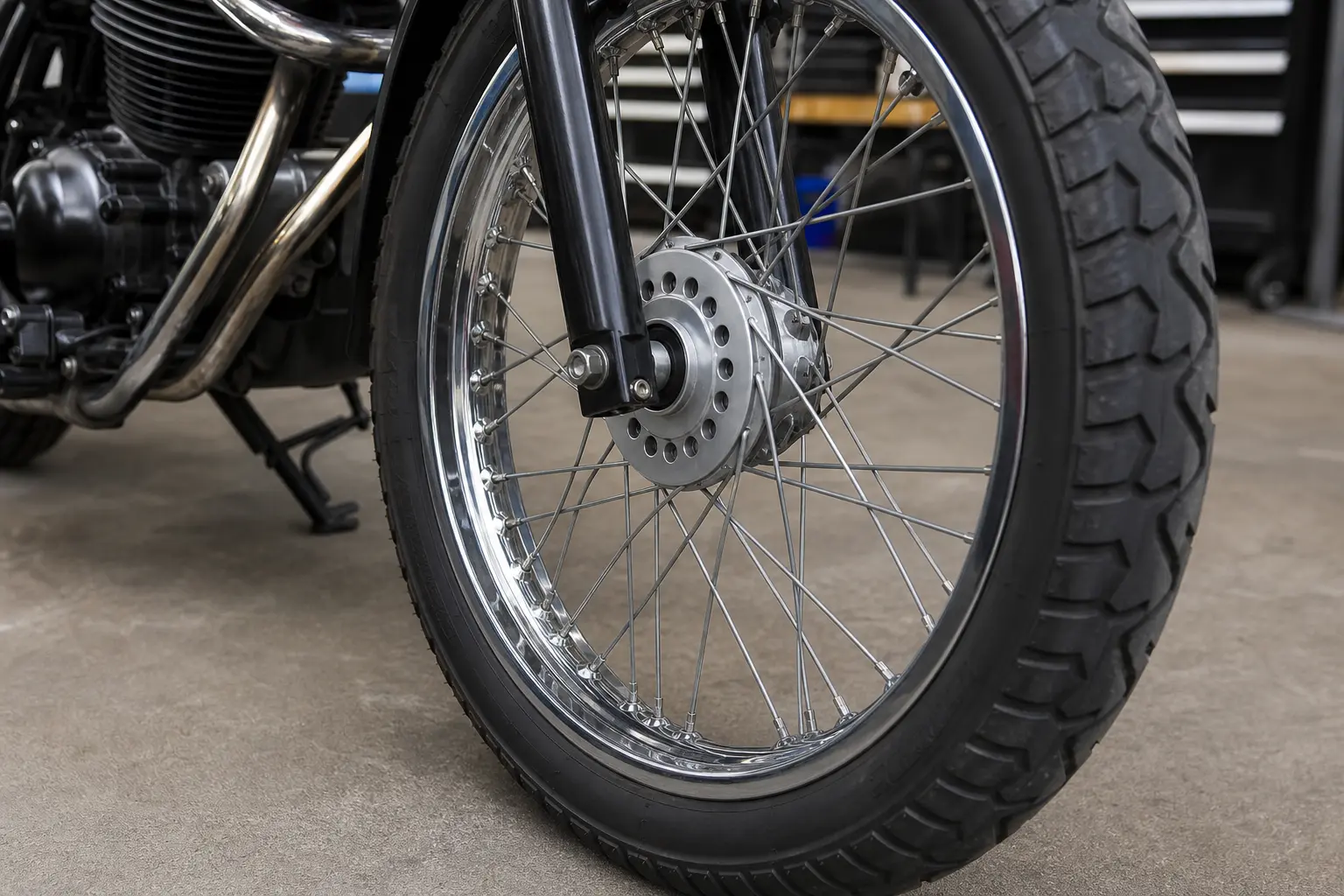
A bent rim can be subtle. It may show as a short damaged section at the outer edge, a change in the rim’s profile near the bead area, a repeated movement as the wheel turns, or a fresh impact scrape that seems minor until it is viewed from another angle. A careful rim inspection should include the tire because the same event can affect both parts.
The T-CLOCS checklist calls attention to cracks and dents in cast wheels and directs riders to observe rim roundness or trueness by rotating the wheel against a stationary reference. (msf-usa.org) That is valuable as an observational method, but it does not replace the measurement limits or service process specified for a particular motorcycle.
Rim-edge and bead-area changes
With the engine off and the motorcycle stable, inspect the accessible rim edge around the full wheel. Change your viewing angle. Side lighting from a flashlight can help reveal an interruption in a normally smooth line, but reflections can also imitate damage, so compare from more than one direction.
Look for:
- An obvious dent, flattened segment, split, crack, or abrupt shape change.
- Chipped coating or a scrape that coincides with a distorted rim profile.
- Damage around a spoke-hole area on a spoked rim.
- A crack, dent, or unusual mark in the web or outer structure of a cast wheel.
- Tire seating that looks inconsistent around the rim.
- A fresh scuff, cut, bulge, or other tire evidence near the suspected impact area.
A scratch alone may be cosmetic. A scratch combined with altered shape, pressure loss, tire damage, or a new handling symptom should not be written off as cosmetic. Appearance alone cannot establish structural condition.
An irregular path during safe hand rotation
Only rotate a wheel by hand if the motorcycle is supported securely in the manner allowed by its owner’s manual. Do not improvise with unstable objects, unsupported lifting points, or a stand arrangement you are not confident using. Keep the engine off, and keep hands, clothing, and loose items clear of brake discs, chain and sprockets, pinch points, and moving wheel parts.
The observation is simple: choose a fixed, non-contact visual reference and watch whether the rim keeps a broadly consistent relationship to it as the wheel turns. You may notice movement side to side, up and down, or both. If the same spot produces the apparent change every rotation, note its location using a harmless reference such as the valve stem or a rim marking.
Do not turn this into a home truing procedure. Do not use a generic tolerance as a pass-or-fail rule for every motorcycle. MSF gives a general pre-ride screening framework, while the manufacturer’s documentation governs the applicable specification and service decision for the actual wheel. (msf-usa.org)
Related tire and brake observations
A wheel concern may coexist with a tire concern. Check whether the tire appears evenly seated and inspect for cuts, bulges, embedded objects, heavy weathering, or signs of air loss. MSF includes these tire-condition checks alongside wheel checks in its pre-ride guidance. (msf-usa.org)
Also look through the brake area without disassembling anything. A fresh scrape, unexpected contact mark, or audible rub during hand rotation is useful evidence. It does not identify the failed part. It does mean the wheel, brake, axle, tire, and surrounding clearances may need a broader assessment before the bike returns to traffic.
Parked-bike checklist for loose spokes and rim inspection
Use this checklist as an observation and decision tool, not as a repair plan. If the motorcycle cannot be parked securely or the wheel cannot be accessed safely, stop rather than trying to create a makeshift inspection setup.
Checklist: wheel walkaround before deciding to ride
- Park on firm, level ground and switch the engine off.
- Let hot brake and exhaust parts cool before working near them.
- Review the owner’s manual for approved support methods and wheel-related warnings.
- Check the tire for visible cuts, bulges, embedded objects, uneven seating, and signs of pressure loss.
- Inspect the outer rim edge and visible bead area around the entire wheel.
- On spoked wheels, confirm every spoke is present and look for bent, broken, displaced, or visibly unusual spokes.
- Compare nipple appearance around the wheel for damage, cracking, distortion, or an obvious position difference.
- Examine visible hub and spoke-hole areas for cracks, missing material, impact marks, or corrosion that hides the surface.
- On cast wheels, inspect the rim and web areas for cracks, dents, and unusual damage.
- If the wheel can be rotated safely by hand, watch the rim against a fixed non-contact reference for a repeating irregularity.
- Look for new rubbing, scrape marks, or inadequate clearance around the brake, fork, swingarm, fender, and drive-side areas.
- Record the wheel location, event history, and any repeated clue before seeking manual-based or professional guidance.
The most important checklist item is the decision at the end: if you find a broken or missing spoke, a crack or suspected crack, obvious rim deformation, a damaged tire, or clear interference, do not ride simply to see what happens.
A comparison table for parked wheel observations
| Area to inspect | What you can observe | What the finding may mean | Conservative next step |
|---|---|---|---|
| Spokes | Missing, broken, bent, displaced, or clearly different-looking spoke | The wheel assembly may have damage or altered spoke condition | Do not adjust by feel; consult the manual and arrange inspection before riding if damage is visible |
| Spoke nipples | Split, distorted, damaged, corroded, or noticeably unlike adjacent nipples | The spoke-to-rim connection needs closer model-specific evaluation | Photograph the area and seek qualified advice if condition is uncertain |
| Rim edge | Dent, flattened area, crack, split, abrupt profile change, or impact scrape | The rim may have suffered more than a surface mark | Inspect the tire at the same location and avoid riding on an obviously damaged wheel |
| Hub and rim interfaces | Cracks, missing material, unusual impact marks, or hidden areas exposed after cleaning | Damage may involve more than the visible spoke | Stop and arrange assessment for any suspected crack |
| Wheel rotation | A repeatable side-to-side or up-and-down irregularity against a stationary reference | The rim may not be tracking consistently | Record the location; have the wheel checked to manufacturer criteria |
| Tire | Bulge, cut, uneven bead appearance, pressure loss, or impact mark | Tire damage may accompany a rim or wheel strike | Follow tire and motorcycle manufacturer guidance; do not assume inflation resolves it |
| Brake and clearance area | New scrape, rub, or apparent contact while the wheel is turned by hand | A related component may be affected | Do not ride until the source is evaluated if interference is evident |
When motorcycle loose spokes or a bent rim become a no-ride issue
A rider should not be expected to judge structural integrity from a driveway. When the evidence is obvious or the uncertainty is significant, the safe call is to leave the motorcycle parked and arrange an appropriate assessment.
Do not ride if you find any of these conditions:
- A spoke that is broken, absent, or severely bent.
- A crack or suspected crack in a rim, hub, cast-wheel structure, or spoke-hole area.
- An unmistakable rim dent, split, deformation, or sharply altered profile.
- A tire bulge, damaged bead area, fresh cut, rapid pressure loss, or other tire damage associated with an impact.
- Contact between the wheel and the brake, fork, swingarm, fender, or another nearby component.
- A recurring hop or wobble that is plainly visible during a careful parked rotation check.
- A wheel concern following an impact together with new vibration, unusual handling, or braking changes.
- Any situation where the motorcycle cannot be inspected or supported safely.
There is also an important middle category: not proven safe, not obviously catastrophic, but concerning enough to pause. A single spoke that differs clearly from its neighbors, a rim mark whose depth cannot be judged, or a repeating movement you cannot confidently interpret belongs in that category. Do not add road speed, braking force, cornering load, and traffic risk to investigate an unanswered wheel question.
Manufacturer-first guidance matters here. Use the owner’s manual to verify approved tire pressures, loading conditions, support points, inspection instructions, and scheduled maintenance. If the manual conflicts with broad guidance in this article, the model documentation wins. For a possible damaged wheel, a qualified technician can apply the correct inspection method and determine whether service, replacement, or another response is appropriate.
What not to do with a suspicious spoke or rim
The urge to make a quick correction is understandable, especially before a planned ride. But a wheel is not the place for a guessed adjustment or a short test ride designed to gather more evidence.
Avoid these responses:
- Do not tighten a spoke to match a sound or feel. A sound difference is a screening clue, not a service specification.
- Do not bend a rim back by hand, with leverage, or with improvised equipment. A more circular appearance does not prove correct structure or alignment.
- Do not use a generic runout figure as your motorcycle’s permitted limit. The approved value and measuring approach, if published, are model-specific.
- Do not assume a tire is undamaged because it still holds air. Tire and rim damage can occur together after an impact.
- Do not ride at highway speed to confirm a new vibration. A new wheel clue plus a riding symptom is a reason to stop, not to experiment.
- Do not overlook nearby parts. A hard strike can affect the brake area, axle region, suspension, fender clearance, or drive-side components as well as the rim.
If transport is needed, use equipment and securement methods consistent with the motorcycle and transport equipment guidance. Where there is concern that a wheel is already compromised, avoid arrangements that could add load to the suspicious area. If safe transport is uncertain, contact a service provider.
After potholes, off-road rides, transport, and storage
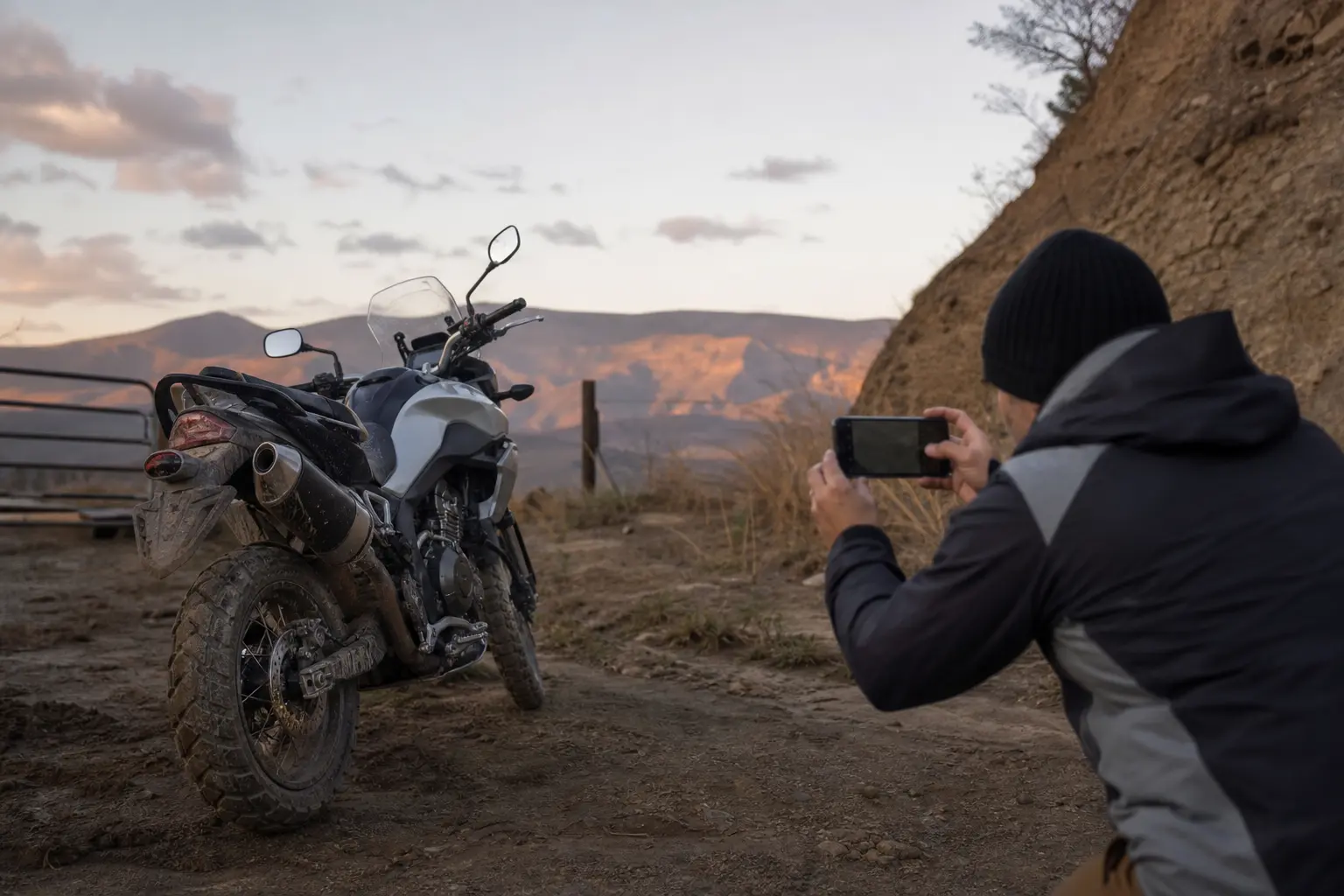
The best trigger for a wheel inspection is often an event, not a mileage number. You do not need to wait until a scheduled service interval to inspect after something changes.
After a pothole or debris impact, stop at a safe location if the motorcycle feels different, loses pressure, makes a new noise, or shows a fresh wheel mark. Once parked, inspect the tire and wheel without rushing. A severe impact followed by any new vibration, handling change, or brake concern warrants a more conservative decision.
After off-road use, remove enough dirt and debris to see the wheel rather than assuming mud has only cosmetic consequences. The MSF off-highway guide emphasizes a pre-ride inspection and specifically includes broken or loose spokes and hub or rim cracks among its wheel checks. (msf-usa.org) Pay special attention to spoke crossings, nipple areas, the rim edge, and the hub where packed mud can obscure damage.
After transport, inspect the wheel if straps, chocks, or a carrier may have contacted it. The goal is not to assume transport caused a problem; it is to verify that a pre-existing mark has not changed and that no new damage or rubbing is present.
After storage, take the time to inspect the tire, wheel, brake area, and supports before the first ride. Storage does not automatically create a loose spoke or bent rim, but time, moisture, unnoticed corrosion, and an extended gap between inspections all make a deliberate walkaround worthwhile.
How Vojo Helps
Create a recurring Wheel and Tire Condition task in the Vojo motorcycle maintenance tracker, then duplicate it after a pothole strike, trail ride, tip-over, or transport event. In the task, log which wheel you inspected, the event date, the exact area that looked different, whether the tire or brake area showed related clues, and photos taken from the same angle. Keep the task open when the finding needs manual review or a service appointment; close it only after the concern has been resolved using manufacturer guidance or qualified inspection. That creates a clear history if the same wheel later develops a repeat symptom.
Download Vojo on the App Store
What to document before a service appointment
A useful service note describes what you observed without trying to prescribe a repair. It gives the person inspecting the motorcycle a better starting point and protects you from relying on a vague memory days later.
Include the following:
- Motorcycle make, model, model year, and current odometer reading if available.
- Front or rear wheel, plus the side of the motorcycle where the concern is visible.
- The event that happened before the concern: pothole, rock strike, fall, transport, storage, or unknown.
- Whether the observation is visual, audible, or felt while riding.
- A reference point, such as the valve stem, a rim marking, or the brake disc, that identifies the area.
- Whether the tire changed pressure or shows a mark, bulge, cut, or uneven seating.
- Whether an irregularity seemed to repeat at the same point during hand rotation.
- Clear photographs taken in good light from more than one angle.
For example, “rear wheel, irregular rim movement appears near valve stem during hand rotation after pothole impact” is better information than “rim needs straightening.” The first reports evidence. The second assumes a solution before the actual condition has been verified.
The practical takeaway
A parked-bike inspection can catch important motorcycle loose spokes symptoms and rim inspection clues before the next ride: visibly damaged or missing spokes, suspect nipple or hub areas, a rim that no longer looks consistent, cast-wheel dents or cracks, tire damage, and clearance problems around the wheel. MSF’s pre-ride materials support treating these wheel observations as safety items, while the off-highway guide reinforces checking spokes, hubs, and rims after the kind of use that can expose a wheel to repeated impacts. (msf-usa.org)
The right home task is not to diagnose tension or reshape a wheel. It is to compare, observe, document, and make a cautious riding decision. Broken or missing spokes, cracks, obvious deformation, tire damage, interference, and clear repeated wheel irregularity are stop-riding signals. Less obvious clues still deserve a pause when you cannot confidently clear them using the owner’s manual and qualified model-specific evaluation.
Quick answers
Frequently asked questions
Can I ride with one motorcycle spoke that sounds different from the others?
A different sound can be a useful comparison clue, but it does not establish correct tension or wheel safety. Do not adjust it based on sound. If the spoke is visibly damaged, markedly different, linked to an impact, or accompanied by rim, tire, or handling concerns, leave the motorcycle parked and arrange model-specific assessment.
How can I inspect a motorcycle rim for a bend while parked?
Look around the full rim for dents, cracks, abrupt profile changes, fresh impact marks, and uneven tire seating. If the motorcycle can be supported safely according to its owner’s manual, rotate the wheel by hand and watch whether the rim shows a repeated irregularity against a fixed non-contact reference. This is a screening observation, not a repair measurement.
Do loose spokes always cause vibration?
No. A rider may find a spoke concern visually or during a careful comparison before noticing a riding symptom. Conversely, vibration can have causes beyond spokes or the rim. Treat either observation as evidence to investigate rather than a complete diagnosis.
Can a bent motorcycle rim make a tire lose air?
An impact can affect the tire and rim at the same time, but a parked inspection cannot prove which part caused pressure loss. If there is air loss, a bulge, bead-area damage, a cut, or visible wheel deformation, do not ride until the tire-and-wheel assembly is assessed.
Should cast motorcycle wheels be inspected differently from spoked wheels?
The safety goal is the same, but the visual focus changes. Spoked wheels need inspection of spokes, nipples, rim, and hub areas. Cast wheels should be checked for cracks and dents in the wheel structure, along with rim condition, tire clues, and apparent irregularity during safe hand rotation.