
Motorcycle Long-Trip Shakedown Ride: Test the Bike, Load, and Rider Before Departure
Use a motorcycle shakedown ride before a long trip to test luggage, comfort, controls, fuel planning, and rider readiness before the real departure.
Fact-checked against cited official documentation
Reviewed against Fact-checked against MSF travel guidance on shorter test rides, fuel planning, and avoiding major last-minute changes, plus the MSF T-CLOCS inspection categories..
Last updated October 27, 2026
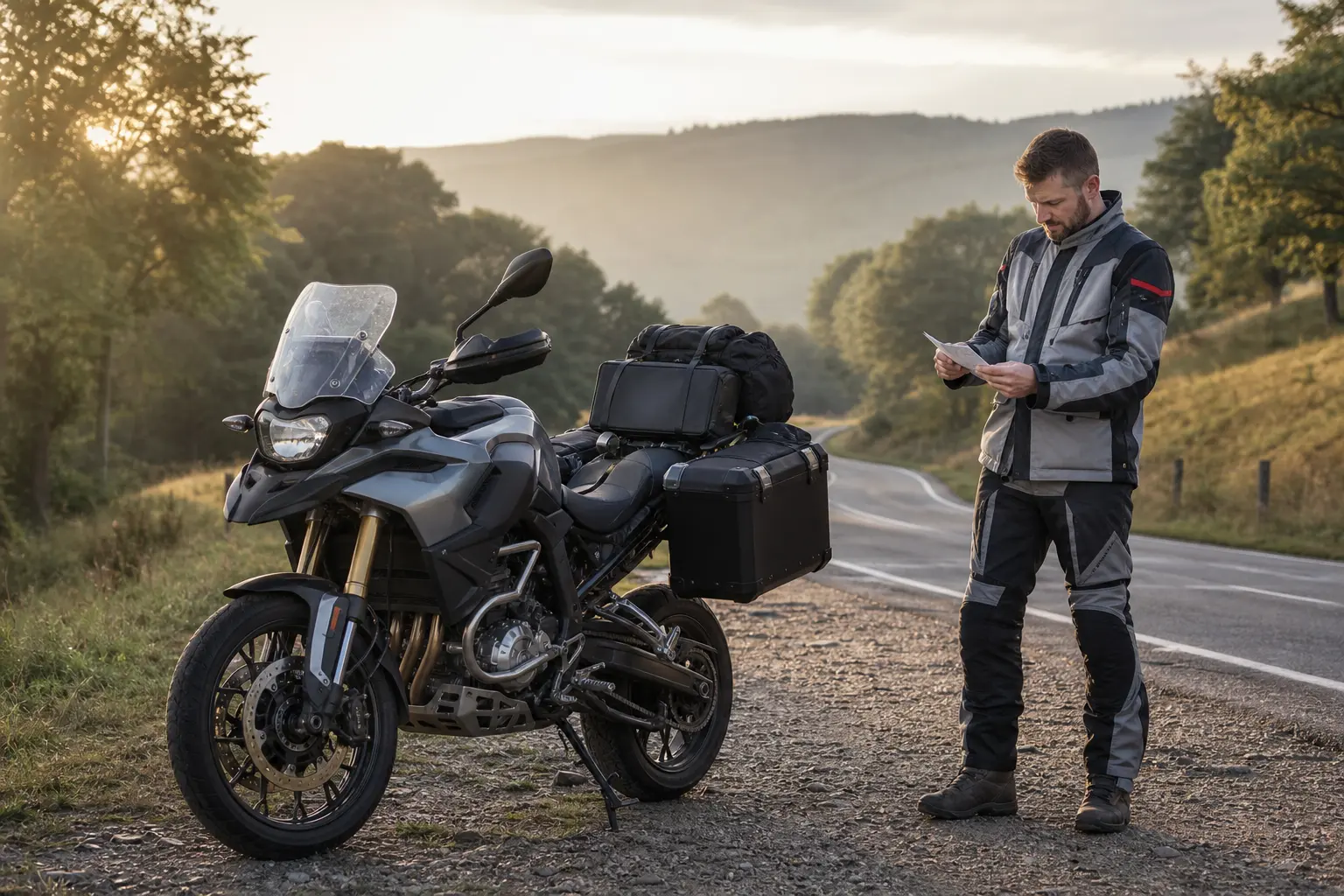
A long motorcycle trip should not begin with a fully loaded bike, unfamiliar equipment, and a route that leaves no room for learning. Before departure, arrange a motorcycle shakedown ride before your long trip: a deliberately short, local ride that tests the complete setup in realistic conditions.
The goal is not to prove that you can ride a certain distance. It is to discover what needs changing while you are still close to home, tools, replacement equipment, support, and a bed. A shakedown can expose a loose-feeling load, irritating wind noise, awkward controls, uncomfortable clothing, unreliable navigation habits, unrealistic fuel assumptions, or a rider who needs more rest than the itinerary allows.
This is different from a normal pre-ride check. A pre-ride inspection asks whether the motorcycle appears ready to operate. A shakedown asks whether the motorcycle, luggage, clothing, electronics, route plan, and rider work together as one system.
Use the motorcycle’s owner’s manual and manufacturer instructions first for model-specific limits, adjustment guidance, tire information, service requirements, luggage restrictions, and warnings. The Motorcycle Maintenance Guide can help organize general maintenance questions, but it does not replace those documents.
What a Shakedown Ride Should Prove
A useful shakedown has a clear question: “Can I safely and comfortably use this exact setup for the planned trip?” That means using the same motorcycle, luggage, riding equipment, communication devices, navigation method, and approximate load you expect to take.
It does not need to imitate every road on the journey. A local loop with a mixture of ordinary streets, slower roads, hills, stops, and a planned break is usually more useful than a dramatic high-speed test. Choose a route where you can return easily if something is wrong. Keep the first test short enough that discomfort becomes noticeable before fatigue makes your decisions worse.
A shakedown should help you evaluate five areas:
| Area | What to test | Warning sign to take seriously |
|---|---|---|
| Motorcycle | Starting, steering, braking feel, controls, lights, stands, and visible leaks | A new noise, changed control feel, warning light, leak, or instability |
| Load | Security, balance, clearance, access, and resistance to movement | Luggage shifts, rubs, opens, contacts hot or moving parts, or changes handling |
| Rider | Seating, reach, clothing, helmet, gloves, hearing comfort, and hydration | Numbness, pressure points, distraction, restricted movement, or declining focus |
| Trip systems | Navigation, charging, communication, documents, and fuel planning | Battery loss, confusing prompts, missing information, or unrealistic range assumptions |
| Itinerary | Pace, breaks, stopping places, and recovery options | The schedule encourages rushing, skipped breaks, or riding while tired |
The ride is successful when it gives you useful information. It is not a failure if you turn around after a few miles because a problem needs attention.
Start With a Manufacturer-First Inspection
Before loading the motorcycle, read the relevant owner’s manual sections and any luggage, accessory, tire, or electronic-device instructions supplied for your model. Manufacturer guidance takes priority over generic travel advice. Pay particular attention to maximum loads, approved mounting points, passenger or luggage restrictions, tire requirements, and warnings about accessories.
Then use a consistent visual inspection. The Motorcycle Safety Foundation’s T-CLOCS checklist provides a practical structure covering tires and wheels, controls, lights and electrical equipment, oil and other fluids, chassis, chain or belt, fasteners, and stands. It is a checklist framework, not permission to ignore a model-specific procedure or service interval. Motorcycle Safety Foundation T-CLOCS checklist
Look for conditions that should stop the ride rather than become an experiment. Examples include a tire that appears damaged or improperly inflated, a control that does not operate normally, a light that is not working, a visible fluid leak, a stand that does not behave as expected, a loose component, or a warning indication you do not understand. Do not use a shakedown ride to diagnose a safety-critical problem at the roadside.
If the motorcycle is due for service, has recently been repaired, or has received a major accessory change, allow time for a qualified technician or the manufacturer’s service instructions to address it. A short ride cannot validate work that has not been properly inspected.
Build the Exact Travel Load

Pack the items you will actually carry, not an optimistic version of the trip. Include clothing layers, rain gear, water, tools or roadside supplies, chargers, documents, locks, medication, camera equipment, and any personal item that affects weight or space. If a passenger is coming, account for the passenger and passenger equipment according to the motorcycle and manufacturer limits.
Do not assume that a familiar empty motorcycle will behave the same way when loaded. Added mass can change how the bike feels when moving away from a stop, when slowing, during a low-speed turn, and when being placed on or taken off its stand. The purpose of the ride is to notice those changes in a controlled environment—not to discover them on a crowded road after several hours.
Before leaving, inspect the load from several angles:
- Nothing should be able to fall into the road.
- Nothing should interfere with steering, controls, suspension movement, wheels, chain or belt, exhaust components, lights, or stands.
- Straps and fasteners should be secured according to the luggage maker’s instructions.
- Frequently needed items should be accessible without unpacking everything.
- Heavy items should be arranged in accordance with the motorcycle and luggage manufacturer’s guidance.
- Waterproofing should be treated as a separate question from physical securement.
- Soft luggage should not be allowed to sag into areas that can become hot or move.
Do not invent a weight limit by guessing from how the motorcycle feels. Confirm the applicable limit in the owner’s manual, luggage instructions, or other manufacturer documentation. If the limits conflict or are unclear, ask the manufacturer, dealer, or a qualified technician before traveling.
The Motorcycle Safety Foundation’s travel guidance specifically supports taking a shorter ride to verify that the motorcycle, clothing, and packing arrangement work before a larger journey. It also cautions against making major last-minute maintenance or equipment changes immediately before a trip. Read MSF travel guidance
Run the First Ride as a Controlled Test
Choose a day with reasonable weather and a route that offers safe places to stop. Avoid making the first loaded test a night ride, a remote mountain road, or a tightly timed journey. You want enough attention available to notice small problems.
A useful sequence is:
- Begin with a slow local loop. Check that the motorcycle feels predictable during starts, stops, turns, and ordinary road transitions.
- Stop early. After the first short section, inspect the luggage, straps, visible clearances, controls, and any equipment that has moved.
- Continue on a varied but familiar route. Include the types of roads you expect to use, without treating public roads as a test track.
- Take a planned break. Remove the helmet if appropriate, drink water, check your body position, and record observations before they blur together.
- Return with reserve. Do not extend the ride simply to reach a target distance if the setup is becoming uncomfortable or distracting.
- Inspect again at home. Compare the motorcycle and luggage with their pre-ride condition and write down every change.
Do not deliberately provoke instability, exceed posted limits, test emergency maneuvers in traffic, or ride faster to “see what happens.” A shakedown is a conservative information-gathering ride. If you need to refresh braking, cornering, or low-speed skills, use an appropriate training environment and qualified instruction rather than combining skills practice with a loaded travel test.
Check the Motorcycle During and After the Ride
Some issues only become apparent after the motorcycle has moved and warmed up. At each planned stop, use a brief observation routine rather than relying on memory.
Motorcycle observation checklist
- Are the controls operating normally and consistently?
- Do the throttle, clutch, brake, and gear controls feel as expected for this motorcycle?
- Are there new noises, smells, vibrations, warning indicators, or changes in response?
- Are lights and signals still functioning?
- Does the motorcycle track and steer as expected for the rider and load?
- Has any luggage, strap, mount, or accessory shifted?
- Is anything rubbing, contacting a hot area, or approaching a moving part?
- Are there visible leaks or fresh marks that were not present before departure?
- Are stands and other frequently used components behaving normally?
These observations are not a substitute for the T-CLOCS inspection or the manufacturer’s maintenance instructions. They are prompts to notice change. If something is abnormal, stop in a safe place and make a conservative decision. A strange sound or changed control feel is a reason to stop assessing the trip and start assessing the motorcycle.
Do not perform an exact repair procedure based on a general article. If a problem involves a safety-critical system, an unfamiliar component, a torque value, a fluid, a tire, or a manufacturer-specific adjustment, consult the owner’s manual or a qualified professional. When the correct answer is uncertain, postpone the trip.
Test the Rider, Not Just the Motorcycle

Many failed travel plans are not mechanical failures. They are human-fit failures: a helmet becomes painful, gloves create pressure, a jacket restricts movement, boots become distracting, or a riding position makes concentration deteriorate. These problems may seem minor at home and become serious after repeated hours.
Notice where discomfort begins and whether it changes your riding. A little soreness may be manageable; numbness, sharp pain, restricted movement, blurred attention, persistent distraction, or the urge to keep adjusting equipment while moving are reasons to stop and change the setup.
Test the clothing you will actually use. If weather may change, include the layers and rain gear rather than assuming you can add them later. Check whether pockets, straps, vents, and closures interfere with controls or seating. Make sure you can reach water and essential communication items without creating a new distraction.
Evaluate your mental state as well. Can you maintain a calm pace without feeling pressured by the clock? Do you notice signs that you are rushing? Are you taking breaks before concentration drops? A route plan that only works when everything is perfect is not a robust plan.
If this is your first long trip, treat the shakedown as a way to calibrate expectations. Your comfortable distance may be less than the distance suggested by a map. That is useful information. Reduce daily mileage, add a rest day, choose more frequent stops, or create an easy exit rather than planning to “push through” on the real trip.
Validate Navigation, Charging, and Communication
Navigation should be tested as a system, not merely switched on in the driveway. Mount the device where it does not obstruct the view or interfere with controls. Confirm that you can understand prompts without staring at the screen. Test the route-planning method, charging arrangement, waterproofing, and offline or low-signal contingencies that apply to your equipment.
Do not let navigation repeatedly redirect you into a rushed or unsuitable route. A planned stop is a chance to review the next section while stationary. Save the accommodation address, emergency contacts, fuel stops, and alternate stopping points in a format you can access if the primary device fails.
Communication equipment also deserves a realistic test. If you ride with others, verify that the group understands the meeting plan and what happens when someone misses a turn or needs to stop. Do not make continuous conversation a requirement for safe riding. The rider should be able to ignore a nonessential message and focus on the road.
Check charging leads and mounts for movement, heat, interference, and accidental disconnection. Keep a backup plan for essential information. A phone with a full battery at departure is not the same as a reliable navigation plan for a full day.
Test Fuel and Break Assumptions Conservatively
A route planner may show a distance that looks comfortable, but real travel includes traffic, weather, detours, slower sections, stops, and the rider’s personal comfort margin. Plan fuel stops before the tank feels urgent. MSF travel guidance recommends planning fuel stops as part of motorcycle travel preparation.
Use the shakedown to compare your planned stopping pattern with reality. Did you want a break before the planned fuel stop? Was the station accessible and open? Did the route make you uncomfortable? Were you able to find a safe place to stop without rushing?
Do not convert one favorable ride into a guaranteed range figure. Fuel consumption varies with speed, load, conditions, terrain, and the motorcycle. Follow the owner’s manual and your own conservative experience. When traveling through sparse areas, identify alternatives and avoid planning to arrive with no practical reserve.
Breaks should include more than refueling. Give yourself time to drink, eat appropriately, check clothing, review the route, and notice whether your focus is declining. If you are tired, stop riding. No schedule is improved by turning fatigue into a roadside emergency.
Review the Results Before Making Changes
After the ride, write down observations while they are fresh. Separate them into four categories:
- Stop immediately: anything abnormal, damaged, loose, leaking, warning-related, or safety-critical.
- Change before the next test: luggage arrangement, clothing, navigation placement, route timing, charging, or comfort problems.
- Monitor: minor issues that need a specific observation on the next ride, provided they are not safety-critical.
- Accept: normal characteristics that do not reduce control, comfort, or attention.
Change one or two things at a time when possible. If you replace the luggage, alter the route, add a new device, and change your clothing simultaneously, it becomes difficult to identify what solved or created a problem. After a meaningful change, repeat a shorter test rather than assuming the first ride validates the new arrangement.
Avoid major last-minute maintenance or equipment changes just before departure. The point of a shakedown is to create time for thoughtful correction. If the bike needs substantial work, or the correct solution is unavailable, delay the trip or use another safe plan.
A practical go/no-go decision can be based on these questions:
- Is the motorcycle’s condition understood and consistent with manufacturer guidance?
- Is the complete load within confirmed limits and secure throughout the ride?
- Can the rider operate comfortably without persistent distraction or pain?
- Does the route allow realistic fuel, food, hydration, and rest stops?
- Is there a safe response if weather, fatigue, equipment, or the motorcycle changes the plan?
- Have abnormal findings been resolved by the appropriate source rather than guessed at?
If any answer is no, the right next step may be another test, professional help, a shorter trip, or postponement.
A Repeatable Shakedown Checklist
Use this checklist the day before and during the test. Adapt it to the motorcycle’s manual and the exact trip.
Before loading
- Read relevant manufacturer instructions and confirm model-specific limits.
- Perform a structured T-CLOCS-style inspection.
- Confirm tires, controls, lights, fluids, chassis, drive components, fasteners, and stands appear as expected.
- Resolve warning lights, leaks, damage, unusual wear, or abnormal control feel before riding.
- Confirm luggage and accessory instructions.
- Pack the complete expected travel load.
- Keep essential documents, medication, water, communication, and recovery information accessible.
- Charge devices and test mounts, cables, navigation, and communication.
- Choose a short route with safe stopping options and an easy return.
At the first stop
- Check whether the load has shifted.
- Look for rubbing, heat exposure, contact with moving parts, or blocked lights and controls.
- Notice pressure points, restricted movement, hearing discomfort, or distraction.
- Confirm the route and next stopping opportunity while stationary.
- Decide whether continuing provides useful information or merely adds risk.
During the ride
- Use a calm pace and normal traffic behavior.
- Test starts, stops, turns, hills, and ordinary road surfaces without deliberate provocation.
- Observe changes in control feel, steering, braking, noise, vibration, smell, or warning indications.
- Take breaks before fatigue becomes a problem.
- Check fuel assumptions without treating one ride as a guaranteed range.
- Stop riding if the motorcycle or rider does not feel right.
After returning
- Inspect the motorcycle and luggage again.
- Record every problem, discomfort, delay, and successful part of the plan.
- Classify issues as stop, change, monitor, or accept.
- Consult the owner’s manual, manufacturer, dealer, or qualified technician where appropriate.
- Repeat a shorter test after meaningful changes.
- Reconsider distance, timing, rest days, and alternate plans before departure.
How Vojo Helps
Use Vojo as the record between shakedown rides: after returning, open your motorcycle’s maintenance and service record, log the inspection date and mileage, and add notes such as “left pannier strap shifted” or “helmet pressure after 90 minutes.” Before the next test, review those notes alongside upcoming maintenance so the unresolved item is visible instead of remaining in memory. The Motorcycle Service History workflow gives you a place to keep that record connected to the bike.
Quick answers
Frequently asked questions
How long should a motorcycle shakedown ride be before a long trip?
There is no universal distance. Start with a short local loop, stop to inspect the setup, and extend only if the motorcycle, load, equipment, and rider remain comfortable and predictable. Repeat after meaningful changes.
Should I use the full luggage load on the shakedown ride?
Yes, use the closest practical version of the real load, including clothing, electronics, water, and personal equipment. Confirm all weight and mounting limits through the motorcycle and luggage manufacturers first.
What should I do if the motorcycle feels different when loaded?
Stop and identify whether the change is expected, documented, and manageable. Check the load and consult the owner’s manual or a qualified professional for model-specific questions. Do not continue trying to diagnose a safety-critical issue in traffic.
Is a pre-ride inspection the same as a shakedown ride?
No. An inspection looks for visible or known condition issues before riding. A shakedown evaluates the complete travel system in motion, including luggage behavior, comfort, navigation, fuel planning, stopping rhythm, and rider fatigue.
Should I make equipment changes immediately before departure?
Avoid major last-minute changes when possible. Test new luggage, accessories, clothing, or electronics early enough to repeat the ride and confirm that the revised setup works.
When should I cancel or postpone the trip?
Postpone when an abnormal motorcycle condition is unresolved, the load cannot be secured within confirmed limits, the rider is uncomfortable or fatigued, or the itinerary only works with rushed decisions and skipped breaks.