
What Belongs in a Motorcycle Roadside Kit? Pack for a Safe Wait, Not a Roadside Repair Project
Build a motorcycle roadside emergency kit that prioritizes communication, visibility, water, medical details, documents, and a safe recovery plan.
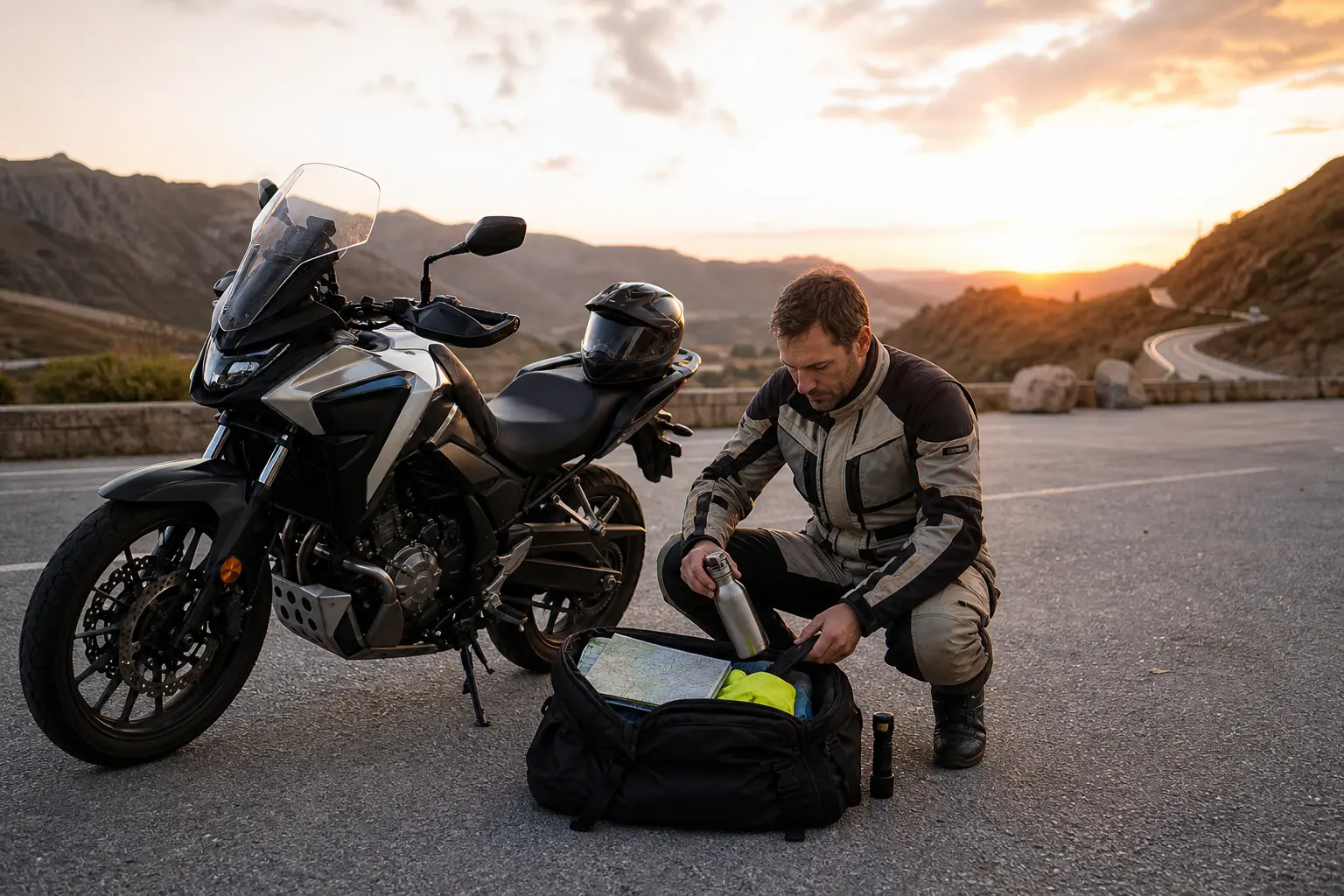
Fact-checked against cited official documentation
Reviewed against Fact-checked against official Harley-Davidson trip-planning and roadside-assistance guidance covering pre-ride preparation, communication, documents, light, hydration, first aid, and model-appropriate items..
Last updated October 17, 2026
A useful motorcycle roadside emergency kit checklist is not a miniature workshop. It is a compact system for getting you, your passenger, and your motorcycle through an unexpected stop with less exposure to traffic, weather, confusion, and bad decisions.
That distinction matters. A shoulder is not a garage. You may be tired, overheated, wet, shaken after a near miss, surrounded by fast-moving traffic, or unable to confirm what is actually wrong. In that setting, the best kit does not encourage you to dismantle the motorcycle or attempt a repair beyond your training. It helps you communicate, stay visible, protect basic wellbeing, find the correct information, and arrange a safer next step.
Start with the manufacturer’s guidance for your exact motorcycle. Its owner’s manual identifies the equipment, warning indications, service requirements, and limits that apply to your machine. Before a longer ride, Harley-Davidson’s trip-planning guidance similarly emphasizes an inspection, model-appropriate basic tools, a pressure gauge, phone charging, first aid, water, snacks, and required documents. 1 Motorcycle-specific roadside-assistance guidance also highlights a phone and charger, a utility light, emergency contacts, medical or medication information, the manual, registration, and insurance details. 2
The framework below takes those useful categories and puts them in a safety-first order: make the scene safer, make contact, maintain yourself, identify the motorcycle, then decide whether to wait for help or move only when it is clearly appropriate.
The core idea: pack for the wait
Many riders begin with tools because tools feel practical. But a breakdown rarely begins as a clear, low-risk task with perfect weather and a clean workbench. It begins as uncertainty. The bike loses power, a warning appears, a tire concern develops, a control feels wrong, fuel is smelled, or the engine simply will not restart after a stop.
The first problem is usually not a missing wrench. It is that the rider has to make safe decisions under pressure.
A roadside kit should therefore answer five questions:
- Can I call for help and tell someone where I am?
- Can other road users see me and the stopped motorcycle?
- Can I stay reasonably warm, dry, hydrated, and medically prepared while waiting?
- Can I give a responder the right identity, location, coverage, and motorcycle information?
- Do I have only the model-appropriate items I can use safely without turning the stop into an improvised repair project?
That order is not anti-tool. It is pro-priorities. A small tool pouch may still belong in the kit, especially when it contains the original equipment supplied with the motorcycle or items you know how to use. But it should occupy the final layer, not define the whole plan.
There is also a useful mental shift here: a roadside kit is not a promise that you will solve every interruption independently. It is a way to reduce the consequences of needing assistance. Calling for a tow, asking a riding partner to meet you, stopping for weather, or arranging professional inspection can be a successful outcome—not evidence that you packed badly.
What belongs in the kit: a priority table
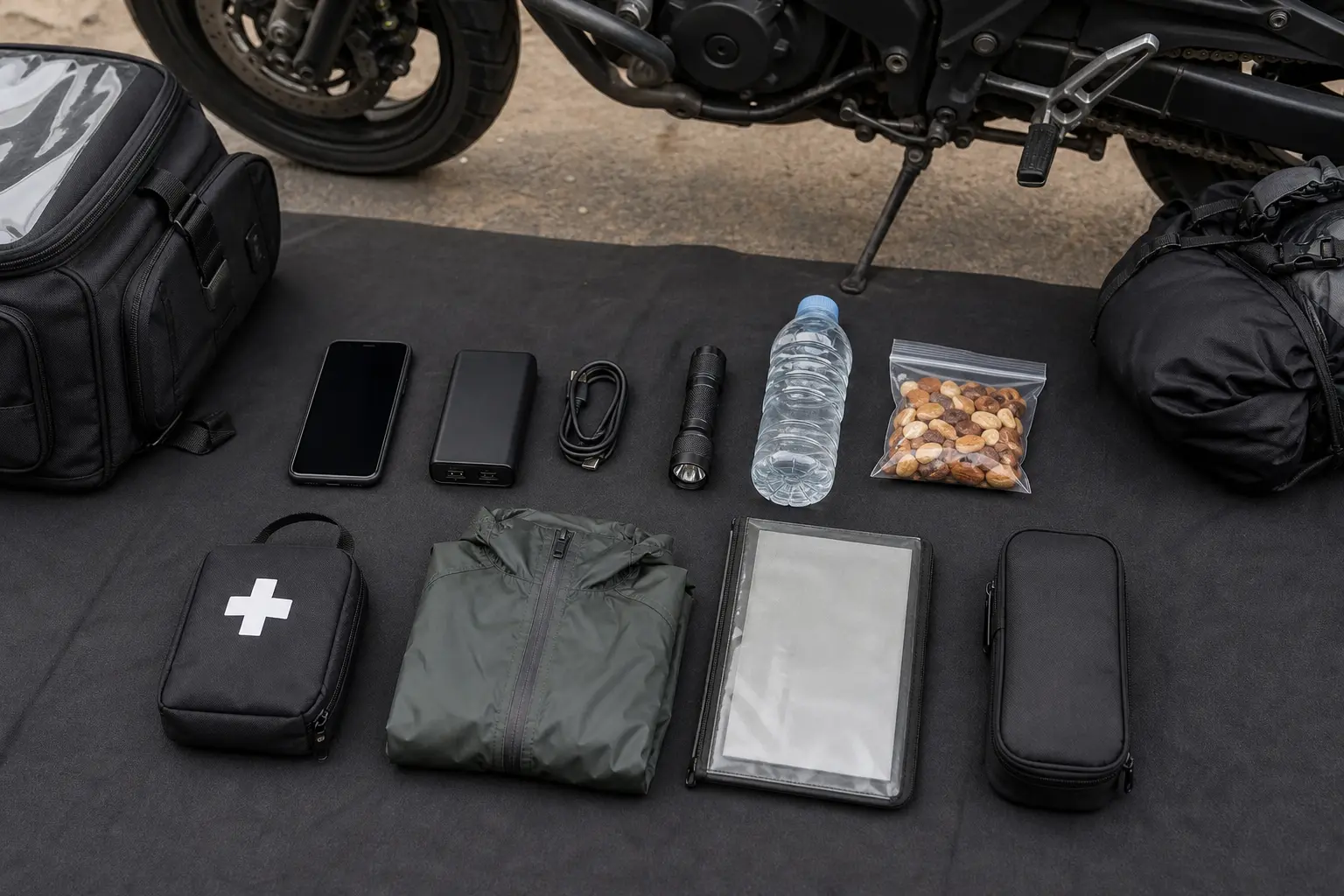
Use this table as a packing filter rather than a compulsory shopping list. The right kit changes with your route, weather, passenger status, available luggage, cellular coverage, and motorcycle. A short daytime ride near home needs less contingency capacity than a remote all-day route with temperature swings.
| Priority layer | Pack these items | Why they earn space | Keep the boundary clear |
|---|---|---|---|
| Communication | Charged phone, charging cable, compact power bank, roadside-assistance contact, emergency contacts | Lets you call, share location, receive updates, and keep navigation available | Do not assume a phone alone provides coverage everywhere; plan the route and meeting points accordingly |
| Visibility and light | High-visibility outer layer or vest, compact flashlight or utility light, reflective item | Helps you be seen and lets you work through basic information after dark | Visibility gear does not make a traffic lane or narrow shoulder safe to occupy |
| Personal wellbeing | Drinking water, shelf-stable snack, weather layer, rain layer, sunscreen as conditions require | Supports alertness and comfort during an extended wait | These items do not replace the decision to stop early when heat, cold, fatigue, or illness affects you |
| Medical information | Personal medications, medication list, allergy information, basic first-aid supplies | Gives you and responders essential context if a medical issue arises | Carry only supplies you understand; seek emergency help for serious injury or illness |
| Documents and identification | License, registration, insurance information, roadside plan details, motorcycle manual access | Reduces friction when dealing with law enforcement, a towing provider, a shop, or an insurer | Protect paper copies from rain and keep sensitive data secure |
| Motorcycle-specific basics | Factory tool kit where supplied, tire-pressure gauge, approved spare fuses or other manual-supported items, small securing materials | Supports limited checks or securement needs when you understand the item and the situation | Do not use the kit as permission to bypass warnings, defeat safety systems, or attempt uncertain repairs |
| Route resilience | Offline map or paper backup, destination and lodging details, cash or backup payment method | Helps when charging, signal, navigation, or payment access becomes unreliable | A backup map is navigation support, not a reason to continue into deteriorating conditions |
The first five rows are the foundation. They protect the rider’s ability to wait and coordinate. The final two rows are useful additions, but their value depends strongly on the trip and the motorcycle.
Communication is the most important tool
A fully charged phone is valuable, but a phone plan is better. Before departure, make sure you can quickly access the information a helper will ask for:
- your name and callback number;
- the motorcycle’s make, model, color, and plate number if required by your provider;
- the roadside-assistance membership or insurer details;
- emergency contacts;
- your destination or planned overnight stop;
- any medication, allergy, or medical information that could matter in an emergency;
- a way to identify your location beyond “somewhere on the highway.”
Roadside assistance is most effective when the rider can communicate a reliable location, describe whether the motorcycle is safely off the travel lane, and say what happened without trying to diagnose it. “The motorcycle is stopped at a fuel station entrance near the junction shown on my map, it will not restart, and I am safely away from traffic” is more useful than a confident but unverified mechanical theory.
Put the critical contact information somewhere reachable when the phone is locked or out of battery. A laminated card, a note in a wallet, and an offline note on the phone create redundancy without adding much bulk. If you ride with a passenger, both people should know where that information lives.
Charging matters because a delay can turn a partially depleted phone into a navigation and communication failure. Pack the cable that fits your phone, not a cable you hope fits. A compact power bank is helpful only if it is charged before the ride. Add that check to your pre-departure routine rather than discovering the problem during a wait.
For areas where mobile coverage may be unreliable, plan before you leave. Download offline route information where appropriate, share your general route and expected arrival with a trusted person, and establish a sensible check-in expectation. The goal is not constant tracking; it is avoiding a situation where nobody knows whether a missed arrival is a simple delay or a reason to start looking.
Visibility and location: reduce the roadside problem first
A roadside kit cannot make every stopping place safe. Your most valuable action is to avoid creating an additional hazard if the motorcycle begins to feel wrong.
When practical, move toward a safer stopping area such as a parking lot, fuel station, rest area, wide turnout, or other place separated from active traffic. Do not continue riding simply because an inconvenient stop feels embarrassing. A worsening tire issue, fuel smell, smoke, damaged control, serious warning indication, unstable steering, brake concern, or other clear no-ride signal deserves a conservative response. Stop, assess only from a safe place, and arrange appropriate assistance.
Once stopped, make yourself easier to detect without standing where traffic can strike you. A high-visibility outer layer is useful because it can be put on over normal riding gear when the situation changes. A small utility light helps in darkness, under luggage, or while reading a card or map. It also avoids draining the phone battery just to use its flashlight.
Think of visibility equipment as a way to improve recognition, not as protective force. It does not change the speed of traffic, widen the shoulder, eliminate poor sightlines, or make it wise to work next to a live lane. If the location is unsafe, distance yourself from the motorcycle only when doing so is safe and follow local emergency guidance.
A compact rain layer and a warm layer deserve a place in this category too. Weather discomfort can turn into impaired judgment surprisingly quickly, especially after a long day. If rain, wind, or falling temperature makes you shiver, rush, or lose dexterity, the safest “tool” may be the one that lets you wait calmly rather than forcing an immediate decision.
Hydration, food, and medical details are not optional luxuries
Riders often treat water and food as touring comfort items. They are also decision-quality items. A long wait after riding in heat, heavy gear, wind, rain, or cold can leave you less able to think clearly and communicate patiently. Harley-Davidson’s travel guidance specifically includes water, snacks, basic first aid, and needed medications or prescriptions among trip essentials. 1
Pack drinking water in a container that suits your luggage and expected temperature. The amount is route-dependent, so avoid pretending that one universal quantity fits every trip. Instead, ask: If I am delayed, do I have enough to stay composed until I reach assistance or a known stop? Increase your margin for hot weather, remote roads, a passenger, and routes with sparse services.
Choose a simple shelf-stable snack you will actually eat. The point is not to carry a full meal. It is to avoid making an already stressful delay worse because you skipped food for hours and now feel shaky, distracted, or impatient.
Your medical portion should be personal rather than elaborate:
- required medications in their original or clearly labeled form where possible;
- a short medication and allergy list;
- emergency-contact details;
- a basic first-aid kit suitable for minor needs;
- any personal accessibility or health item you rely on during a normal day.
Do not make a kit a substitute for medical training or emergency services. Serious injuries, heat illness, chest pain, loss of consciousness, suspected concussion, severe bleeding, or symptoms that make travel unsafe are not roadside self-management problems. Seek emergency help.
If you regularly ride with someone else, exchange emergency-contact and medical-information locations before the trip. A passenger may be the person speaking to dispatch; a riding partner may be the person opening your luggage. Information that only you can find is not fully prepared information.
Documents and motorcycle information: make assistance easier
The low-glamour part of a kit is often the part that saves the most time. Keep necessary documents protected from water and separated from items you are likely to leave on a picnic table, hotel counter, or fuel-pump shelf.
Your document packet can include:
- rider license and identification;
- current registration and proof of insurance as required in your jurisdiction;
- roadside-assistance membership or policy information;
- a concise emergency-contact card;
- the motorcycle identification details that may be needed by a provider;
- relevant manual access, either the physical manual where practical or a downloaded copy you can open offline;
- trip reservations, lodging address, and a backup payment method.
The owner’s manual is particularly useful because it keeps your response model-specific. Different motorcycles have different warning systems, fuse arrangements, tire specifications, service instructions, accessory loads, and procedures. Do not infer a solution from another bike’s forum post, a video, or a generic checklist. If your motorcycle signals a problem you do not understand, the manual and qualified support are more reliable than improvisation.
Keep sensitive details private. A roadside provider may need certain information, but your entire address book, financial data, and account passwords do not belong in an easily accessible pouch. Secure digital copies with your device protections, and keep paper copies limited to what you can safely share when assistance is being arranged.
The model-appropriate tool pouch: deliberately small
A minimalist tool pouch can be sensible. The key is to select it from the motorcycle outward, not from a generic online shopping list inward.
Begin with the original equipment supplied with the motorcycle, if any, and the operator’s manual. Then consider only additions that meet all three tests:
- They are appropriate for your specific motorcycle and trip.
- You have practiced using them in a calm, controlled setting—or they are solely for a qualified helper.
- Using them beside the road would not require you to expose yourself to traffic, heat, moving parts, fuel, or an uncertain diagnosis.
A tire-pressure gauge is a good example of a compact item that can help you gather information before deciding on a next step. It does not authorize riding on a damaged or rapidly losing tire. Likewise, a flashlight, spare fuses specified for the motorcycle, small zip ties, and a modest amount of tape may have a place for a rider who understands their limited role. The manufacturer’s trip guidance lists basic model-appropriate tools alongside a gauge, jumper cables, spare fuses, a portable battery pack, a flashlight, zip ties, and tape. 1
What should generally stay out of a street-roadside kit? Large assortments of tools you have never used, fluids you cannot safely handle, parts selected only because “they fit most bikes,” and equipment that turns a stranded moment into a lengthy roadside operation. More gear can create more weight, more clutter, and more temptation to continue after a concern that deserves professional attention.
If you carry a tire-mobility item, learn its limitations before the trip and follow the tire manufacturer’s, motorcycle manufacturer’s, and service professional’s guidance. Treat it as an option for managing a specific situation, not a blanket permission to resume normal travel. If there is doubt about damage, pressure retention, wheel condition, or safe operation, arrange recovery.
Clearly titled checklist: pack, verify, and rehearse
Motorcycle Roadside Emergency Kit Checklist
Communication and coordination
- Charged phone
- Correct charging cable
- Charged compact power bank
- Roadside-assistance or insurer contact saved and written down
- Emergency contacts available without relying on memory
- Offline map, paper map, or route backup appropriate to the trip
- Destination, lodging, and check-in details shared with a trusted person when the route warrants it
Visibility and comfort while waiting
- High-visibility outer layer or compact reflective item
- Utility light or flashlight
- Weather layer suited to the forecast and elevation changes
- Rain layer
- Drinking water
- Shelf-stable snack
- Personal sun, cold, or insect protection as conditions require
Medical and personal information
- Needed medications
- Medication and allergy list
- Basic first-aid supplies
- Emergency-contact card
- Any personal health or accessibility item required for a longer delay
Documents and motorcycle identity
- License and identification
- Registration and insurance information
- Roadside-plan or membership information
- Owner’s manual access
- Motorcycle identification details needed by your provider
- Backup payment option
Model-specific essentials
- Original tool kit, if supplied and appropriate
- Tire-pressure gauge
- Only manual-supported, motorcycle-appropriate spare items
- Small securing materials only if you understand their limited use
- A clear personal rule: stop and call for help when the fault, risk, or repair is uncertain
Before every longer ride
- Confirm the phone and power bank are charged
- Confirm the kit has been returned after its last use
- Check that documents are current
- Review the route for fuel, weather, service gaps, and likely rest points
- Complete a normal pre-ride inspection and address concerns before departure
- Reconfirm that luggage is secure and does not interfere with controls, lighting, passenger space, or motorcycle operation
What not to pack—or what not to rely on
The best packing advice includes restraint. Avoid building a kit around the fantasy that every mechanical issue can be solved beside the road. That mindset can create a false sense of control and lead to rushed decisions.
Do not rely on:
- a vague collection of bolts, wire, adhesives, and tools with no relationship to your motorcycle;
- a repair video you have never verified against the owner’s manual;
- a phone battery that was already low when the ride began;
- a bright vest as a substitute for choosing a safer stopping place;
- a riding partner as a substitute for every rider carrying their own identification, water, and emergency information;
- a roadside patch, temporary workaround, or reset as proof that the motorcycle is safe for normal riding;
- “I am almost home” as a reason to ride with a serious warning sign or changed handling.
The same applies to carrying fuel. If a route truly requires extra range, use an appropriate container and follow the applicable product and motorcycle guidance. Do not treat improvised containers or loose fuel storage as routine kit items. Often, better route planning and more conservative fuel stops are the safer solution.
Weight and placement matter too. An overloaded tail bag can change how the motorcycle handles, obscure access to needed gear, or make a simple stop feel chaotic. Keep the immediate-response items—phone power, documents, light, water, and visibility layer—easy to reach. Put less urgent equipment deeper in the luggage. Review the motorcycle’s loading instructions and limits in the owner’s manual before adding travel equipment. For a broader before-you-leave process, use the Motorcycle Maintenance Guide.
Build three kit sizes instead of one overloaded bag
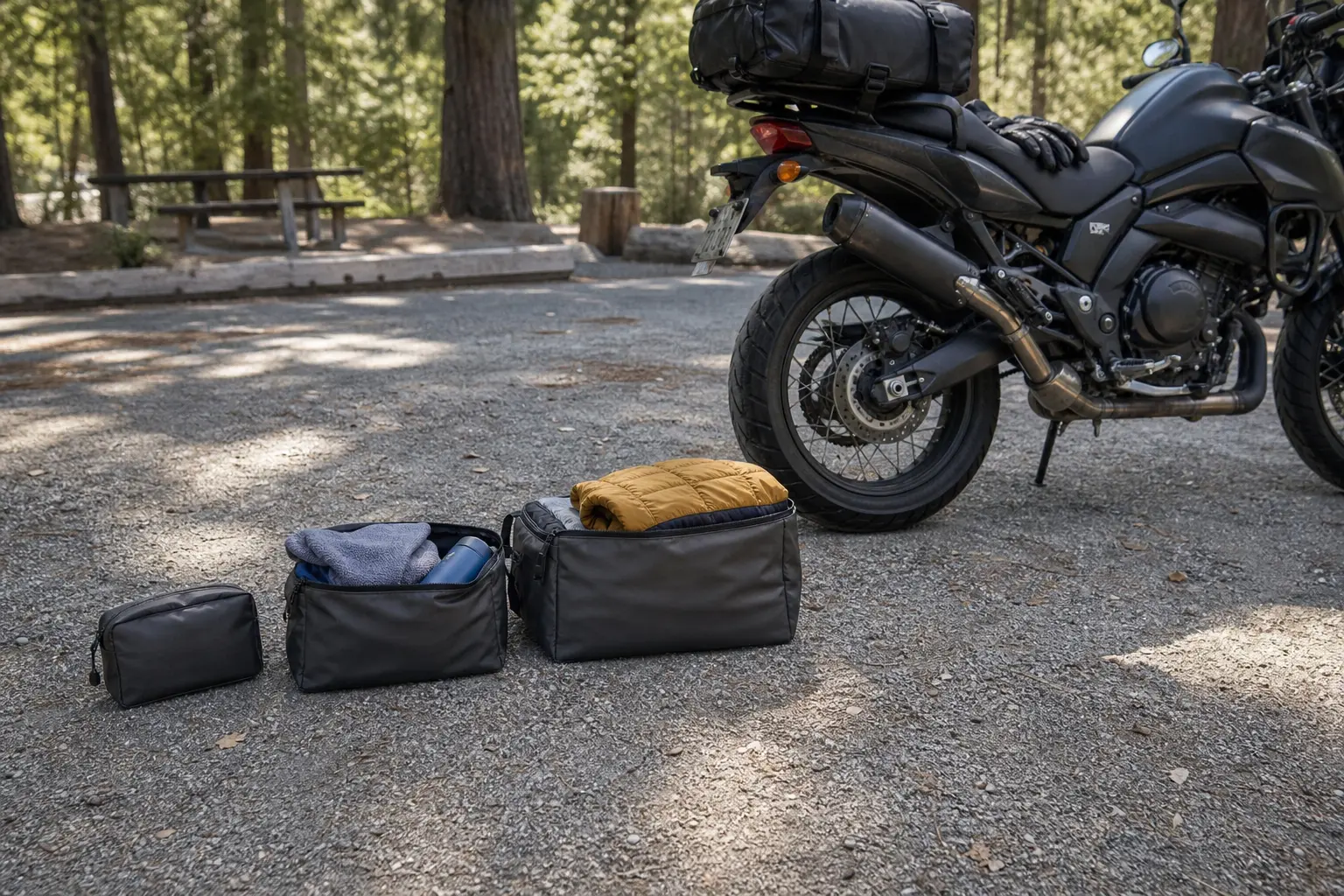
A practical way to avoid both underpacking and overpacking is to divide your kit into three levels.
Every-ride pocket kit: phone, payment method, identification, emergency contact information, basic roadside contact, and a compact light. This stays with you or in a small, consistent location.
Day-ride bag: pocket kit plus water, snack, weather layer, charging cable, power bank, first-aid basics, and motorcycle documents. This works for commuting, weekend loops, and unfamiliar local routes.
Remote or overnight kit: day-ride bag plus offline navigation support, expanded water and food margin, reservations and route notes, medication contingency, more weather capacity, and the exact model-appropriate items justified by the route and manual.
This structure is more useful than buying three separate kits. You are adding layers to the same dependable core. It also makes packing faster: grab the day-ride bag, then add the remote layer only when the route actually calls for it.
A passenger changes the calculation. Pack extra water, make sure both people have access to communication and documents, and agree on where to stand or wait if a stop becomes necessary. Do not assume the passenger knows the assistance provider, route plan, or emergency contact. A two-minute conversation before departure can prevent a confused hour beside the road.
When the right answer is recovery, not repair
There is a valuable boundary between a minor inconvenience and a no-ride problem. You do not need to diagnose every issue perfectly to choose the conservative option.
Stop riding and seek qualified help when there is a fuel leak or persistent fuel smell, smoke, a brake-control concern, unusual steering behavior, a tire problem that affects pressure or condition, a throttle or control problem, visible damage after impact, a serious warning indication you cannot interpret, or any condition that makes you doubt the motorcycle’s predictable operation.
This is especially important after a tip-over, debris strike, puncture, or sudden change in handling. A kit may help you communicate and wait; it cannot inspect every consequence of an impact or confirm that a safety-critical system is sound.
If the motorcycle simply will not start but is safely parked, resist the urge to repeatedly force the issue without understanding it. Check the manual for the relevant warning or normal-use information, preserve phone battery, and consider whether assistance or professional diagnosis is the better route. You are not required to turn a vacation, commute, or group ride into a troubleshooting session.
The safest kit supports a calm escalation ladder:
- Get to a safer location if that can be done without ignoring a serious hazard.
- Make yourself visible and protect your personal wellbeing.
- Communicate your exact location and the basic symptom.
- Consult your manual only for information you can use safely.
- Choose towing, assistance, or inspection when the condition is uncertain or safety-related.
- Record what happened so the eventual technician receives a clearer history.
That last point is easy to overlook. Note the time, conditions, warning lights, smells, sounds, and changes in behavior while they are fresh. A concise record is more useful than a speculative diagnosis.
How Vojo Helps
Before a longer ride, create a trip-prep entry in Vojo: add your motorcycle, log the pre-ride inspection and tire-pressure check from your exact manual, then save a checklist named “Roadside Kit Restock.” After any stop or assistance call, record the symptom, location context, photos if safe, and the recovery outcome in your motorcycle service history. That turns an anxious roadside memory into usable information for the next inspection or service conversation.
Download Vojo on the App Store
Final takeaway
The strongest motorcycle roadside kit is modest, organized, and honest about what it can do. It should help you call for assistance, remain visible, manage weather and hydration, provide medical and document information, and use only the motorcycle-specific items you understand.
Pack for a safe wait first. Pack for a roadside repair only when the manual, the conditions, your training, and the risk all support it. Most of the time, a rider who can communicate clearly, stay comfortable, be seen, and choose recovery early is better prepared than one carrying a heavy bag of tools with no safe plan for using them.
Sources
1 Harley-Davidson, Plan a Motorcycle Road Trip in 5 Steps.
2 Harley-Davidson Insurance, Motorcycle Roadside Assistance: Expect the Unexpected.
Quick answers
Frequently asked questions
What is the most important item in a motorcycle roadside emergency kit?
A charged phone with a working charging plan is the highest-priority item because it supports emergency calls, location sharing, navigation, roadside assistance, and coordination with trusted contacts. Keep roadside-plan details and emergency contacts available even if the phone battery is low or the device is locked.
Should I carry a large motorcycle tool kit on every ride?
Usually no. Start with the original tool kit and your owner’s manual, then carry only items that are appropriate for your motorcycle and that you understand how to use safely. The primary job of a roadside kit is to help you wait and arrange assistance, not to encourage uncertain repairs beside traffic.
Should a motorcycle roadside kit include a tire repair kit?
It can be an optional, route-dependent item, particularly where a rider has appropriate training and understands the product and motorcycle guidance. It should never be treated as automatic permission to continue riding normally after tire damage or pressure loss. When in doubt, arrange recovery and qualified tire service.
What documents should I keep with my motorcycle emergency kit?
Carry or securely access identification, license, registration, insurance information, roadside-assistance details, emergency contacts, relevant medical information, and your owner’s manual. Protect paper copies from water and keep sensitive account information secure.
How should I pack a roadside kit on a motorcycle?
Keep immediate essentials such as communication power, documents, water, light, and visibility gear easy to reach. Pack heavier or less urgent items lower and more securely, then follow your owner’s manual for luggage, loading, and passenger-related limits.