
Motorcycle Lane Changes: A Mirror, Blind-Spot, Signal, and Space Routine
Use a repeatable motorcycle lane-change routine built around mirrors, a head check, signaling, space, lane position, and an escape path.
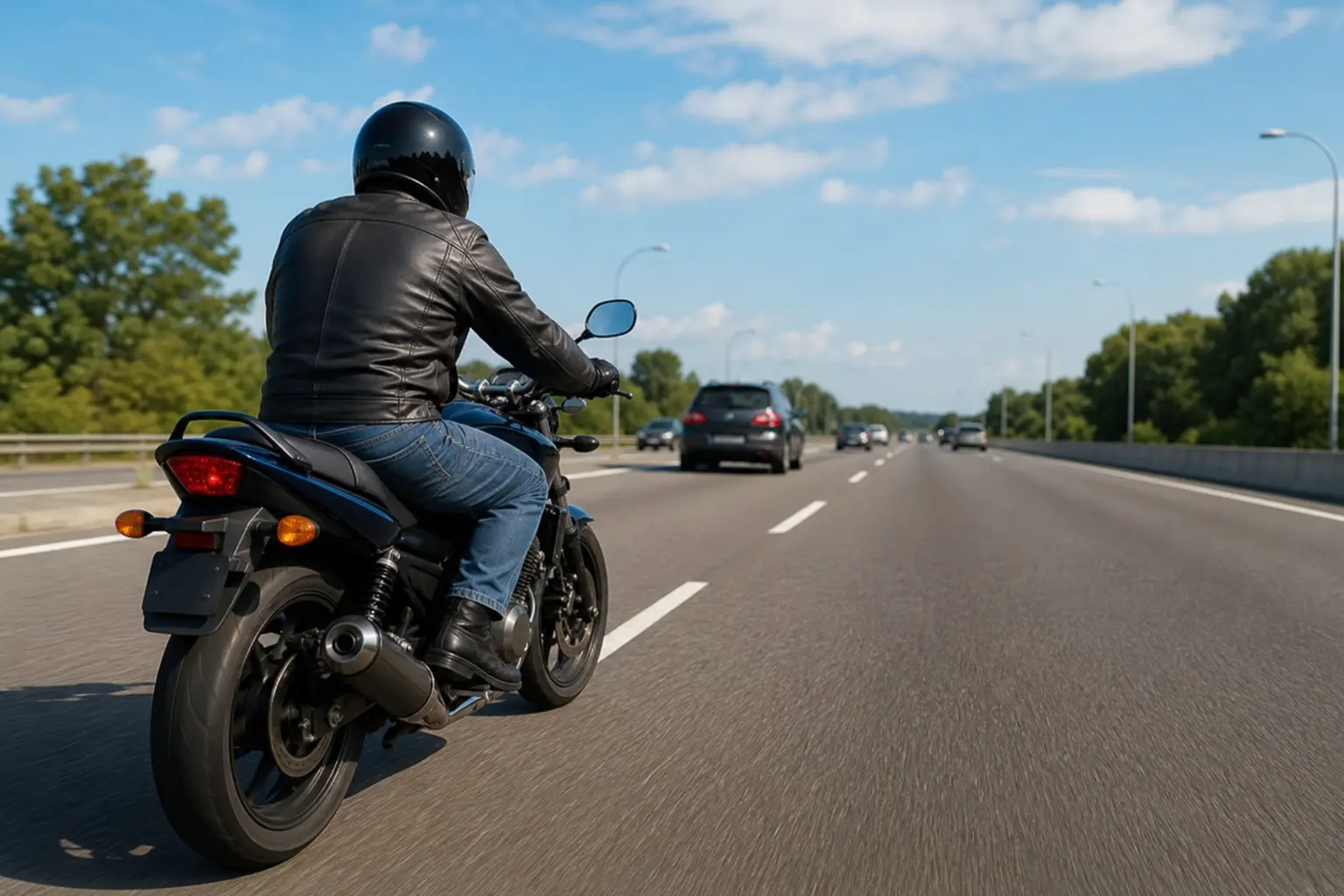
Fact-checked against cited official documentation
Reviewed against Fact-checked against the Motorcycle Safety Foundation’s Motorcycle Operator Manual and If You Ride A Motorcycle guidance on lane position, signaling, blind spots, space, and escape paths..
Last updated November 11, 2026
Changing lanes on a motorcycle is not one action. It is a short decision sequence performed while the motorcycle is moving, traffic is changing, and another driver may not notice you. A turn signal announces an intention, but it does not create a safe gap. A mirror shows only part of the area behind you. A head check can reveal traffic that the mirror misses, but it still does not replace judging speed, distance, and escape space.
A useful way to organize the task is mirror, signal, space, head check, move, and cancel. The order may need to flex with traffic, road layout, and the motorcycle’s controls, but the principles remain consistent: know what is around you, communicate early, make the move only when the gap is adequate, and keep an option if another road user behaves unexpectedly.
This is a riding habit, not a substitute for your motorcycle’s owner’s manual, local traffic law, or formal training. The Motorcycle Safety Foundation’s Motorcycle Operator Manual discusses lane positioning, blind spots, signaling, space cushions, and changing lanes only when it is safe. Its If You Ride A Motorcycle material also emphasizes being seen, maintaining an escape path, and preserving time to respond.
Why a Motorcycle Lane Change Needs a Routine
A car driver may expect a vehicle to occupy most of a lane and may not recognize a motorcycle’s position within it. A motorcycle can also disappear beside a vehicle, enter a vehicle’s blind area, or be hidden by a mirror’s limited view. At the same time, the rider has less physical protection and usually less room to absorb a sudden correction.
That makes lane changing a problem of uncertainty management. You are trying to answer several questions before crossing the lane line:
- Is the destination lane actually open?
- Is someone approaching from behind faster than it appears?
- Is a vehicle beside me, slightly behind me, or hidden from my mirrors?
- Will the gap remain open long enough for the motorcycle to move through it?
- Where can I go if a driver drifts, accelerates, or brakes?
- Can I complete the move smoothly without rushing the controls?
The routine helps prevent a common error: treating one reassuring observation as proof that the whole maneuver is safe. A clear mirror is not proof that the blind spot is clear. A visible gap is not proof that a fast vehicle is not approaching. A flashing signal is not permission to move.
The goal is not to stare at every possible hazard or make a dramatic shoulder movement. The goal is to build a brief, repeatable scan that leaves attention available for the road ahead.
The Mirror, Blind-Spot, Signal, Space Routine
Use the following sequence whenever traffic, road markings, and your planned route require a lane change. At low speeds or in dense traffic, the timing may be compressed. At higher speeds, begin earlier and allow more time for closing traffic to reveal itself.
1. Stabilize the motorcycle and read ahead
Before checking behind, keep the motorcycle stable and look far enough ahead to identify what could interrupt the maneuver: braking traffic, a narrowing lane, a blocked shoulder, a changing signal, debris, a merge, or a vehicle entering from a side road.
Do not begin the scan while already drifting toward the lane line. First establish a predictable path in your current lane. A driver behind you should be able to understand what you are doing from your position and speed.
If the road ahead is demanding most of your attention, postpone the lane change. Missing an exit or remaining in the current lane for another moment is usually preferable to forcing a maneuver while overloaded.
2. Check the destination lane in the mirror
Look at the mirror on the side toward which you intend to move. Check for vehicles already in the lane, vehicles approaching from behind, and a vehicle whose front may be hidden by your motorcycle’s position.
Use both mirrors when the situation calls for it. A vehicle may be changing lanes toward you from the opposite side, or traffic behind may affect the gap even if the destination lane looks open. Mirror checks should be quick and purposeful rather than a long stare.
Mirror adjustment matters before the ride. Set the mirrors while seated in your normal riding position, with the motorcycle stationary. If the mirror is aimed too far inward, you may see too much of your own shoulder and too little of the adjacent lane. If it is aimed too far outward, you may lose useful context directly behind you. Even a well-adjusted mirror cannot show every area beside and behind the motorcycle.
3. Signal early enough to communicate
Activate the turn signal before the lane change, following local law and the motorcycle manufacturer’s control guidance. The signal tells other road users what you intend; it does not establish priority or guarantee that they have seen you.
Use the signal as part of the scan, not as the beginning and end of the decision. Some drivers may speed up, slow down, or move into the gap after seeing it. Watch the traffic response rather than assuming the signal has made the maneuver safe.
If your motorcycle has self-cancelling indicators, verify that the signal has actually cancelled after the move. If it does not, cancel it deliberately. An unintended continuing signal can communicate the wrong plan to drivers around you.
4. Recheck the space and compare speeds
Do not judge a gap only by its apparent size. Ask how quickly the traffic around it is moving and whether the gap is opening or closing. A large-looking space can disappear quickly when a vehicle is approaching at a higher speed.
Look for the vehicle behind the gap as well as the gap itself. If you cannot confidently identify the traffic that will occupy the space in the next few seconds, wait. Give yourself more time rather than trying to estimate from one glance.
A safe gap also needs room for the motorcycle’s path, not just its front wheel. Consider your body position, luggage, passenger, road surface, and the possibility that you may need to adjust your line without crossing into the next vehicle’s path.
5. Perform a brief head check
After the mirror and signal checks, turn your head briefly toward the destination lane to inspect the blind area. Keep the motorcycle’s direction controlled and avoid holding the head turn so long that you lose awareness of traffic ahead.
The head check should be a confirmation, not a substitute for the earlier scan. If your view is blocked by a vehicle, a shoulder check reveals an uncertain result, or the traffic situation changes during the check, do not move. Return your attention forward, stabilize, and reassess.
A head check can also be useful when a lane appears clear but a vehicle may be traveling alongside you. The precise movement depends on the motorcycle, your riding position, and training. Keep it deliberate and brief rather than exaggerated.
6. Move smoothly into the available space
Once the path is clear and the gap is adequate, move across with a steady, predictable line. Avoid an abrupt swerve caused by waiting until the last moment. Avoid lingering on the lane line, where you may occupy an ambiguous position between traffic streams.
Maintain enough speed to complete the maneuver without creating an unnecessary closing problem, while remaining within the conditions, speed limit, and your ability to control the motorcycle. Do not accelerate simply because another driver appears impatient. If the space is no longer adequate, remain in the current lane or return only when that movement is also clearly safe.
After entering the lane, establish a useful lane position. Avoid settling immediately beside another vehicle, especially where you remain in its blind area. Create separation and continue scanning ahead and behind.
7. Cancel the signal and rebuild your scan
Cancel the turn signal and check the new traffic picture. The lane change is not finished when the tires cross the line. You may now be closer to a vehicle ahead, approaching a stopped queue, or positioned where another driver could attempt a merge.
Rebuild your following distance and identify an escape path. An escape path is not necessarily a route you intend to take; it is space you can use if traffic changes suddenly. The available option may be a clear portion of the lane, an open adjacent area, or simply enough distance to brake in a controlled way.
Routine at a Glance
| Stage | Rider question | Common mistake to avoid |
|---|---|---|
| Stabilize | Is the road ahead manageable right now? | Starting the scan while drifting |
| Mirror | What traffic is visible behind and beside me? | Treating the mirror as a complete view |
| Signal | Have I communicated my intention? | Assuming the signal gives permission |
| Space | Is the gap open, large enough, and staying open? | Judging distance without comparing speeds |
| Head check | Is anything hidden in the blind area? | Holding the glance so long that the path wanders |
| Move | Can I cross smoothly and predictably? | Rushing or lingering on the line |
| Reset | Is the signal off and my escape space preserved? | Failing to scan again after moving |
Lane Position Helps You See and Be Seen
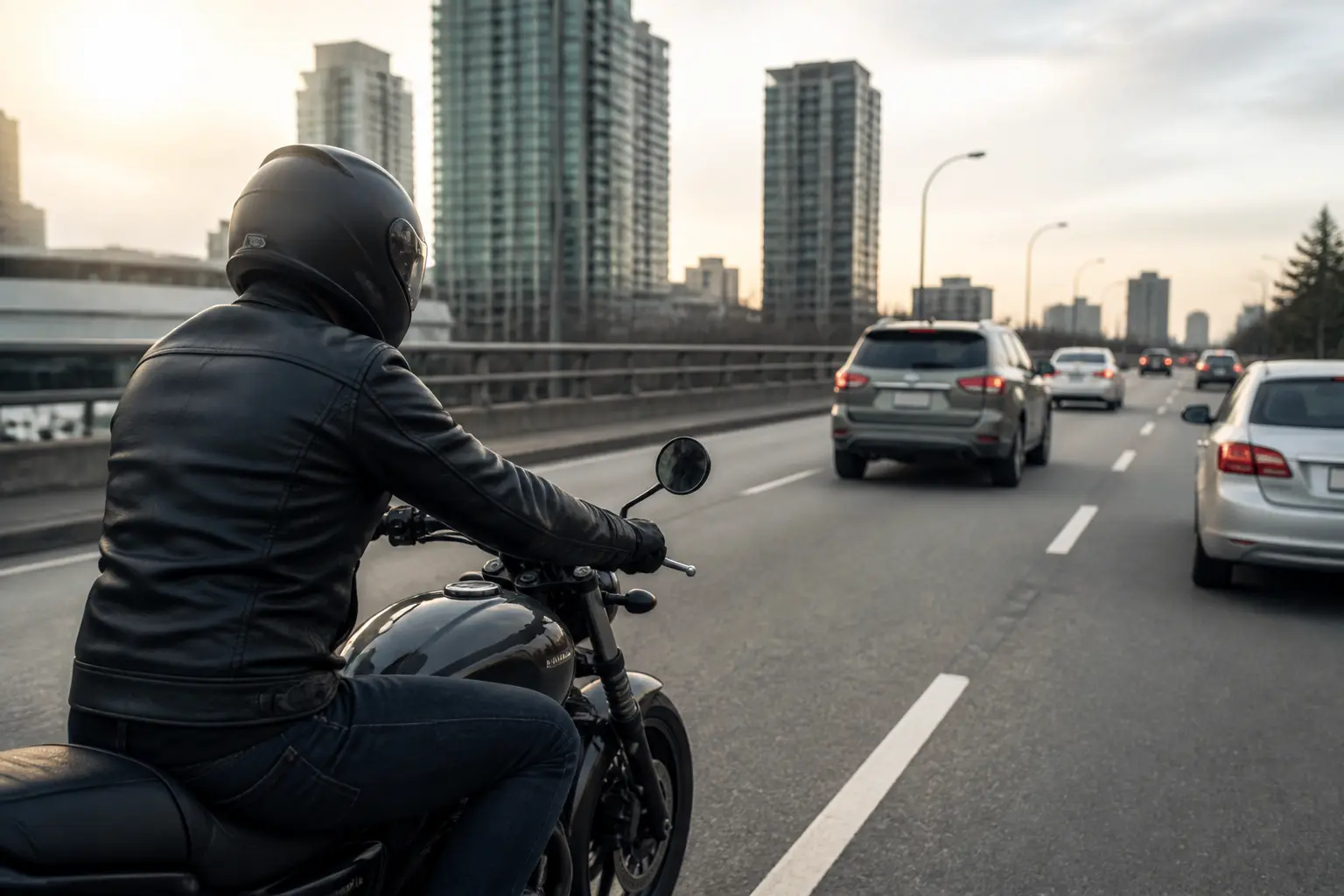
Lane position is part of the lane-change routine before you ever signal. A position that gives you a useful view of surrounding traffic may also help other road users notice you. The best position is not a permanent left, center, or right rule. It changes with traffic, road surface, curves, parked vehicles, lane width, visibility, and the hazards around you.
Avoid riding for an extended time beside another vehicle when you can create a safer separation. If a vehicle is near your rear quarter, adjust speed or position only when doing so remains lawful and controlled. The aim is to avoid remaining hidden, not to compete for space.
Be especially cautious around large vehicles. Their mirrors, bodywork, and position can block your view of traffic ahead and may create larger areas you cannot see. Do not assume that being visible in one mirror means the driver has actually noticed you. Give the vehicle room, avoid lingering beside it, and plan lane changes well before a required exit or lane reduction.
Road markings also deserve attention. A broken line may indicate that a lane change is permitted under local rules, but it does not tell you that the space is safe. A solid line, a gore area, a shoulder, or a narrowing lane may change what movement is legal or prudent. Follow the markings and signs where you ride, and do not use a late route decision as a reason to force a gap.
What to Do When the Gap Is Uncertain
Uncertainty is a result, not a challenge to overcome. If you cannot see far enough, cannot judge the closing speed, or cannot tell whether a vehicle is beside you, wait.
You have several conservative choices:
- Continue in the current lane and reassess.
- Increase following distance so the next scan is less hurried.
- Reduce speed smoothly if traffic conditions allow it.
- Let a faster vehicle pass before planning the change.
- Take the next legal route opportunity rather than crossing several lanes at once.
- Pull over only where it is legal and safe if you are confused, fatigued, or overloaded.
Do not use a shoulder, gore, or emergency area as an improvised passing or escape route unless an actual emergency and local law make that appropriate. An escape path is something you identify in advance; it is not an invitation to make an aggressive move.
If another driver begins moving into your destination lane, give that driver priority over your plan. A horn or other attention-getting method may be appropriate when needed, but it should not be treated as a substitute for space. Brake or alter your path only in a controlled way, and avoid making a sudden move into a second hazard.
Special Situations That Change the Routine
Heavy traffic
In slow, dense traffic, mirrors and head checks remain important because vehicles can change position with little warning. Keep the motorcycle predictable and avoid assuming that a gap remains available simply because it was open a moment earlier. Watch for doors, wheels, pedestrians, and vehicles emerging from queues.
Multiple-lane moves
Crossing more than one lane in one continuous movement increases the amount of traffic you must evaluate. A safer plan is generally to make one lane change at a time, stabilize, rescan, and then decide whether another move is necessary and legal. This also gives other drivers clearer information about your path.
Night, rain, or glare
Reduced visibility makes distance and speed harder to judge. Clean, correctly fitted eye protection and a clear view through the windscreen or visor matter, but no equipment removes blind spots. Increase the time available for decisions and postpone a move when glare, spray, darkness, or reflections prevent a reliable check.
Curves, hills, and lane reductions
A curve or crest can hide approaching traffic. A lane reduction can cause drivers to accelerate, brake, or merge unpredictably. Begin planning early, preserve space, and do not let a navigation instruction force a last-second move.
Passenger or luggage
A passenger and luggage can change the motorcycle’s feel and your available space. Confirm the load is secure and ride within the manufacturer’s guidance. Give yourself extra time to settle the motorcycle and make deliberate observations before changing lanes.
Pre-Ride Setup for Better Lane Changes
The routine works best when the motorcycle and rider are prepared before entering traffic. Use this short setup:
- Adjust both mirrors while seated in the normal riding posture.
- Confirm the turn-signal control is familiar and functioning as expected.
- Make sure your visor or eye protection gives you a clear view.
- Check that luggage, straps, and other carried items cannot interfere with control movement.
- Set navigation instructions before moving, then treat them as guidance rather than a reason to rush.
- Choose clothing and equipment that allow a full head check without restricting movement.
- If the motorcycle is unfamiliar, practice its controls in a controlled area before joining demanding traffic.
For broader preparation, use the Motorcycle Maintenance Guide to organize routine checks and service information. Mechanical readiness cannot make an unsafe gap safe, but a rider who is not distracted by an unknown control, loose item, or warning is better positioned to scan traffic.
A Clearly Titled Checklist: Motorcycle Lane-Change Go/No-Go Check
Before the move
- I have a clear reason to change lanes.
- The road ahead is manageable, with no immediate braking or obstruction problem.
- I am stable in my current lane and not already drifting.
- I have checked the destination lane and surrounding traffic.
- I have compared the gap with the speed of approaching vehicles.
- I have signaled according to local requirements.
- I know where an escape path or controlled stop would be available.
Immediately before crossing
- The mirror view is still favorable.
- The signal has not caused a vehicle to close the gap.
- A brief head check shows no vehicle in the blind area.
- I can cross smoothly without rushing or lingering on the lane line.
- I am prepared to wait if any part of the check is uncertain.
After the move
- I am established fully in the new lane.
- The signal is cancelled.
- I have rebuilt following distance.
- I am not lingering beside another vehicle.
- I have scanned again and identified usable space if traffic changes.
If any box cannot be answered confidently, the routine has produced the correct answer: wait and reassess. The extra seconds are part of the maneuver, not a failure to complete it.
Practice Without Creating Traffic Risk
A routine becomes useful when it is practiced before it is urgently needed. In a controlled area, rehearse the order mentally: stabilize, mirror, signal, space, head check, move, cancel, reset. Do not practice by making unnecessary lane changes around live traffic.
You can also practice the verbal prompts while stationary: “ahead, mirror, signal, space, check, move, reset.” The wording is less important than having a compact reminder that prevents the signal from becoming an automatic trigger.
When riding with an instructor or experienced training provider, ask for feedback on mirror use, lane position, head-check timing, and whether your movements are predictable. Formal training can help identify habits that are difficult to notice from inside the helmet. Always follow the motorcycle manufacturer’s instructions for controls and the laws where you ride.
How Vojo Helps
Vojo can turn this routine into a repeatable pre-ride and post-ride workflow instead of leaving it as something you read once and forget. Before a trip, create a short ride note titled “Lane-change routine” with the prompts mirror, signal, space, head check, move, cancel. Add a second note for conditions that need extra margin, such as rain, night riding, a passenger, or unfamiliar traffic. After the ride, record whether any lane change felt rushed or whether a blind spot was difficult to judge.
You can keep that note beside maintenance and service records in the Motorcycle Maintenance Tracker, so riding observations become part of your ongoing motorcycle and rider review rather than disappearing into memory. Use the notes to plan a controlled practice session or a conversation with an instructor; do not use an app while the motorcycle is moving.
Quick answers
Frequently asked questions
Does using a motorcycle turn signal make a lane change safe?
No. A signal communicates your intention, but it does not confirm that the destination lane is clear or that other drivers have seen you. Still check mirrors, judge the gap and closing speeds, perform a brief head check, and move only when the space is adequate.
Are motorcycle mirrors enough to detect a blind spot?
No. Mirrors provide useful information but cannot show every area beside and behind the motorcycle. Use a brief head check before moving, while keeping the motorcycle stable and maintaining awareness of traffic ahead.
What should I do if I cannot judge the gap?
Wait in your current lane, stabilize, and reassess. You can increase following distance, let a faster vehicle pass, or take a later legal opportunity. Do not force the maneuver because an exit or lane reduction is approaching.
Should I change lanes one at a time on a motorcycle?
As a conservative practice, yes. Make one lane change, stabilize, cancel the signal, rescan, and then decide whether another move is necessary and safe. Crossing multiple lanes without rebuilding the traffic picture increases uncertainty.
Where should I ride within a lane before changing lanes?
There is no single position that is best in every situation. Choose a lawful, controlled position that helps you see and be seen while avoiding hazards, blind areas beside vehicles, poor pavement, and unnecessary time alongside traffic.