
Motorcycle Visibility Gear Versus Riding Strategy: What Reflective Clothing Cannot Replace
Motorcycle visibility gear can help you stand out, but safer riding also requires active scanning, blind-spot awareness, lane choices, space, and escape options.
Fact-checked against cited official documentation
Reviewed against Fact-checked against MSF SEE guidance, official conspicuity recommendations, blind-spot awareness material, and inspection and time-space safety advice..
Last updated October 24, 2026
Motorcycle visibility gear versus riding strategy is not a choice between buying better equipment and riding more carefully. Both matter, but they do different jobs.
Bright clothing, reflective details, and a functioning headlight can make a motorcycle easier to notice under some conditions. They are useful layers. Yet they cannot make another road user look in your direction, correctly judge your speed, recognize your intended path, or leave room when traffic changes suddenly.
That is why a shopping-list approach to visibility is incomplete. A rider can add contrast or reflective material and still be difficult to detect against traffic, hidden by another vehicle, overlooked in a mirror, or misunderstood at a conflict point. The practical goal is not to become “impossible to miss.” It is to improve your chances of being noticed while riding in a way that remains safe when you are not.
The Motorcycle Safety Foundation (MSF) frames this wider task through SEE: Search, Evaluate, Execute. It is a decision process for identifying hazards, interpreting their possible consequences, and responding with room to spare. In that framework, being seen is important, but it is only one part of managing risk (Why it Helps to SEE).
This guide explains where visibility gear helps, where its limits begin, and how to build a riding strategy around information, position, time, space, and a continually updated escape option.
Motorcycle visibility gear versus riding strategy: the real distinction
Visibility equipment affects the signals other people may receive from you. Riding strategy affects the choices you make when those signals are missed, delayed, or misread.
For example, a reflective element may catch light from another vehicle. A bright garment may help create contrast against a particular background. A headlight offers another cue that a motorcycle is present. MSF includes working headlights, reflective strips, and bright clothing in its broad guidance on helping riders be seen (If You Ride A Motorcycle).
But a useful visual cue is not the same as a safety guarantee. Traffic can be visually cluttered. A driver may be distracted, looking beyond you, focusing on a larger vehicle, or not checking the relevant mirror. Curves, weather, glare, roadside objects, and other vehicles can further reduce how clearly a motorcycle stands out.
Riding strategy accepts that uncertainty. Rather than asking only, “How visible am I?” it asks better operational questions:
- What can I see well enough to make a decision?
- Which vehicle could create a conflict next?
- Am I spending time where another driver may not expect me?
- What room remains if the vehicle ahead turns, brakes, or changes lanes?
- Can I slow or adjust position before the situation becomes urgent?
The difference is important because gear is passive after you put it on. Strategy is active throughout the ride. The first can improve the odds of detection; the second protects your options when detection does not lead to safe behavior.
| Layer | Practical contribution | It cannot replace |
|---|---|---|
| Working headlight | Adds a visual presence cue for traffic ahead | Hazard scanning, speed judgment, or an escape option |
| Bright outer clothing | May increase contrast in some daytime settings | A driver’s attention or accurate distance judgment |
| Reflective material | May become more noticeable when illuminated | Daylight awareness, lane awareness, or space management |
| Clean lights and lenses | Helps the motorcycle present its intended signals | Inspection of other safety-related components |
| Lane position | Can improve sight lines and reduce time beside vehicles | Proof that another road user has seen you |
| Active rider decisions | Preserve time, distance, and alternatives | The benefit of properly maintained visibility equipment |
The MSF FAQ makes the same central point: conspicuity improvements do not take the place of SEE, inspection, and adequate time-and-space margins (FAQ - Motorcycle Safety Foundation). Treat every visibility upgrade as support for those habits, not as permission to reduce them.
What reflective clothing and lighting can realistically contribute
Reflective and bright materials are worth understanding without making exaggerated promises for them.
In daylight, contrast can help a rider separate visually from the road, sky, buildings, foliage, and surrounding vehicles. The effect changes with the background. A color that looks highly noticeable in a driveway may blend into a construction zone, autumn landscape, or line of vehicle lights. Bright gear can be useful, but it cannot deliver the same contrast in every environment.
Reflective material is different. It is most relevant when light reaches it from another source and returns toward that source. Its usefulness therefore depends on lighting conditions, the angle of the material, cleanliness, condition, and whether the other road user is looking in the relevant direction. It should be viewed as a supplement for reduced-light conditions, not a replacement for a functioning motorcycle lighting system or cautious nighttime riding.
A headlight is also a useful cue, especially because it gives traffic ahead something to register. But one light does not communicate every part of a rider’s situation. It does not tell a driver that the rider is about to change lanes, guarantee that speed will be judged correctly, or eliminate the possibility of being concealed behind another vehicle.
The most sensible conclusion is modest: use serviceable lighting and practical clothing that can help you stand out, then keep your decision-making standard exactly as cautious as it would be without them.
That last point prevents a common mental trap. If a rider feels more visible, the rider may be tempted to enter a questionable gap, remain beside a larger vehicle, or approach a conflict area without enough time. The better use of conspicuity is the opposite: let it add resilience to a conservative plan.
Riding strategy starts with Search, not assumptions
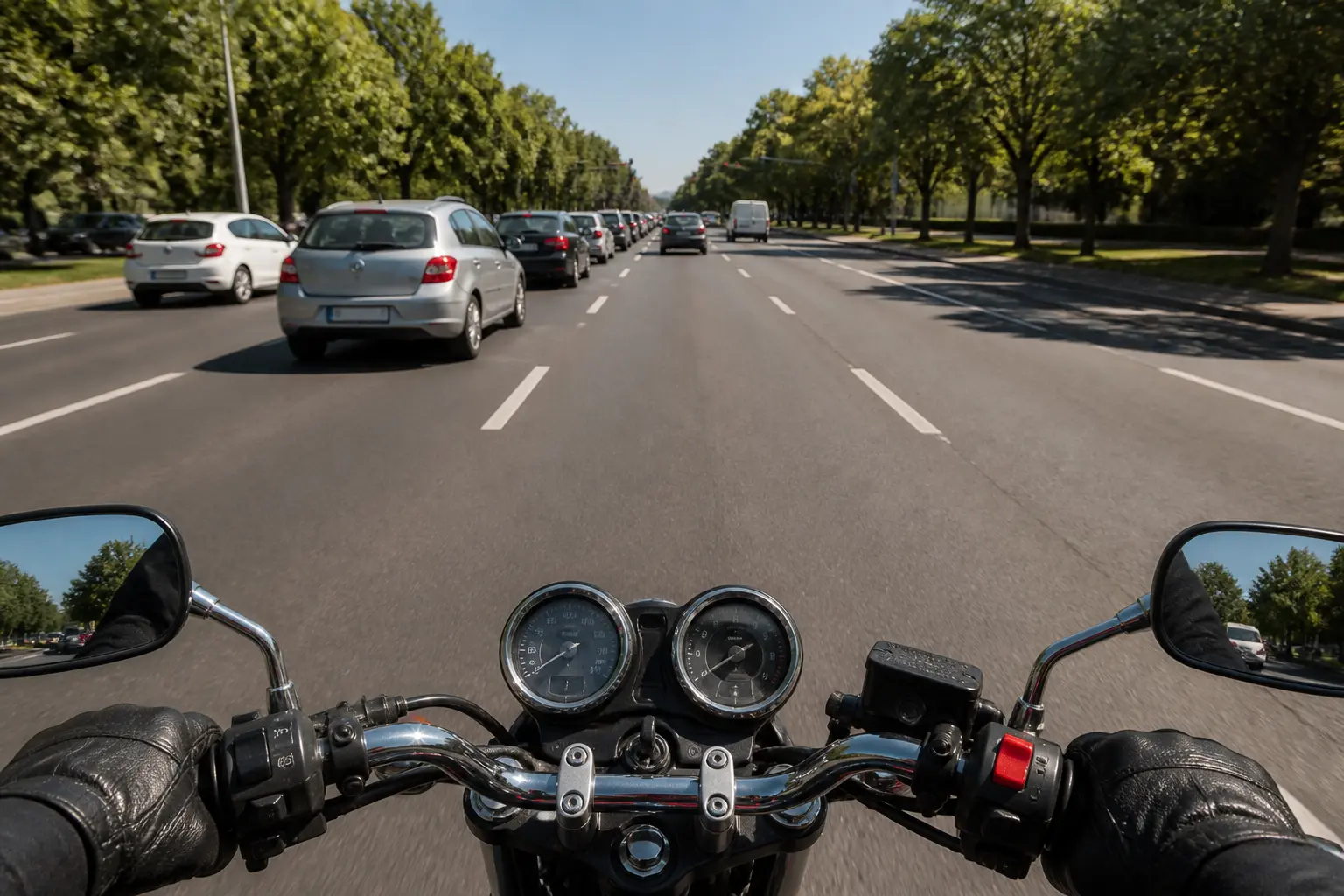
Search is the active collection of information. It is more than looking generally ahead. It means repeatedly building a picture of where conflicts may develop before they demand an emergency response.
Keep attention moving between the farther path of travel and the nearer area where the motorcycle will soon be. Farther ahead, look for changing traffic flow, vehicles waiting to turn, road entries, queued traffic, lane reductions, and areas where your view is blocked. Closer in, reassess the space immediately around the motorcycle and the condition of your intended path.
Searching is also a side-and-rear task. Mirrors offer useful information but do not show every area around a motorcycle. Before a lane change or other lateral movement, make an appropriate head check as part of your observation routine. MSF’s blind-spot guidance emphasizes that lane awareness, visibility aids, headlights, and a second look work together rather than serving as substitutes for one another (Check Your Blind Spots — An Extra Look Can Save a Life).
A productive search habit is to refresh your picture whenever circumstances change. Ask yourself:
- Has a vehicle moved into a nearby lane or begun closing a gap?
- Is a car at a side road positioned to enter traffic?
- Is a vehicle ahead behaving differently from a moment ago?
- Has a large vehicle removed your view of what is beyond it?
- Is someone near a parked vehicle likely to enter the roadway?
- Has the available space behind or beside you narrowed?
This is not about trying to watch every object simultaneously. It is about refusing to let your mental picture become stale. A bright jacket cannot identify a vehicle that is beginning to move. A reflective panel cannot tell you that a gap is closing. Search remains the rider’s work.
Evaluate uncertainty before it becomes a conflict
Evaluation turns what you see into a decision. It means treating uncertain traffic behavior as uncertain instead of promoting hopeful clues into guarantees.
A driver who appears to look your way may still not have registered the motorcycle. A vehicle that is waiting may begin to turn. A turn signal may be delayed, forgotten, or changed. A gap in traffic may look available until the vehicle behind accelerates. The safer mindset is not suspicion of every person; it is recognition that other people’s intentions can be unclear.
When you identify a possible conflict, consider both the vehicle’s likely movement and your available margin. A vehicle waiting to turn across your path, a car travelling beside you, a lane ending ahead, or a vehicle following too closely are all situations where the answer may be to create more time or more separation early.
That can be as simple as easing off the pace, postponing a lane change, selecting a position with better sight lines, or allowing a vehicle to move ahead. The objective is not to make dramatic avoidance maneuvers. It is to act while choices are still smooth and ordinary.
Do not elevate eye contact into proof that it is safe to proceed. It may provide information, but it does not remove the need to evaluate speed, path, space, and possible errors. Similarly, do not assume bright or reflective clothing means another driver has accurately understood what you are doing.
A useful personal standard is this: if your plan depends on a stranger reacting perfectly, make a different plan.
Execute with time, space, and an escape option
Execute is the action phase of SEE. Strong execution is rarely a last-second swerve. More often, it is a small, timely decision made because the rider searched early and judged uncertainty realistically.
Time and space are what make those choices possible. Following at a distance that supports observation gives you more opportunity to see changes. Avoiding prolonged side-by-side travel can reduce exposure to a vehicle’s blind area. Maintaining usable room around the motorcycle can help prevent feeling trapped when traffic compresses.
An escape option is not a preselected route that will always be open. It is a currently usable area that might help if your intended path becomes unsafe. Depending on the situation, it could be clear space within your lane, an open area beside the motorcycle, or sufficient room to slow without being pressured into an abrupt decision.
Because traffic changes continuously, the escape option needs continuous review. A place that looked open a moment ago may now contain a vehicle, pedestrian, obstacle, poor surface, or closing gap. The point is not to memorize one exit; it is to avoid riding with no alternative at all.
MSF specifically includes maintaining an escape route in its general motorcycle safety recommendations (If You Ride A Motorcycle). That guidance explains why gear alone is never enough. Even when another road user notices you, that person may still turn too soon, stop unexpectedly, or judge your approach poorly. Space is what keeps a mistake by someone else from becoming your emergency.
Lane position and blind spots: reduce exposure, do not seek attention
Lane position can affect both what you see and how easily others may detect you. It can also influence the room available if conditions change. For those reasons, it is a strategic tool—not a magic visibility setting.
A position that gives you a clearer view around the vehicle ahead may help you identify a developing issue sooner. A position that avoids being hidden directly behind another vehicle may make your presence easier to notice. Positioning that preserves room to one side can also improve your options.
But there is no single lane location that is always best. The useful choice depends on curves, surface condition, traffic flow, parked vehicles, road width, entries, exits, and the behavior of nearby drivers. Do not move merely to display your gear more prominently. Move only when the new position improves information, separation, or options without creating another problem.
Blind spots illustrate the limits of visibility equipment particularly well. A rider cannot know that a driver has checked a mirror at the right moment, and cannot guarantee that the motorcycle is within that mirror’s usable view. The practical response is to avoid staying in a difficult-to-see area longer than necessary.
When it is safe, create separation rather than matching another vehicle’s speed indefinitely. You might allow it to move ahead, move ahead yourself with appropriate room, or wait before changing lanes. Any adjustment still requires a full search and an evaluation of traffic around you. A sudden move intended to escape one blind spot can create a more immediate conflict elsewhere.
Bright gear may help when a driver looks toward you. It cannot compel that look. The strategy is to shorten your exposure and keep alternatives available.
Conditions that make visibility less reliable
Dusk, darkness, glare, rain, fog, visual clutter, and rapidly changing light all reduce the value of assuming you have been seen. Reflective material may be more relevant when illuminated, while bright colors may offer less useful contrast as daylight fades. Headlights may be visually mixed with many other lights or made harder to interpret through glare and wet-road reflections.
The right response is not to decide that a particular item of gear “works” or “does not work.” Assess whether your total margin fits the conditions.
Ask whether you can see far enough ahead to recognize hazards early. Consider whether other road users may be struggling with the same low sun, rain, glare, or clutter that affects you. Increase the importance of space when the available view is reduced. If conditions leave you unable to maintain a reasonable margin, slowing down, changing the route, taking a break, or postponing the ride may be the safer decision.
Keep motorcycle condition separate from clothing choices. Use the owner’s manual and equipment manufacturers’ instructions for model-specific checks, care, and service requirements. If a light, switch, mounting point, or other safety-related item does not function as intended, do not rely on a generic article for an exact repair. Consult the appropriate documentation and use qualified service support where needed.
A manufacturer-first visibility check
Before treating visibility as a riding issue, make sure the motorcycle and equipment are in appropriate condition. Manufacturer documentation comes first because models and components differ.
Use this order of priorities:
- Check the owner’s manual for the motorcycle’s required lighting, controls, and inspection guidance.
- Confirm that nothing added to the motorcycle obstructs lighting, reflectors, controls, the rider’s view, or required markings.
- Follow garment, helmet, and accessory care instructions so cleaning and storage do not damage useful features or protective components.
- Address unresolved safety-related faults through the manufacturer’s recommended service path or a qualified technician.
- Treat a safety concern as a reason to delay the ride, not as a reason to compensate with brighter clothing.
This approach prevents category errors. A failed light is a condition issue, not an apparel issue. A loose accessory is not acceptable because it is reflective. A visibility enhancement should never interfere with vehicle operation, protective gear function, or your ability to control the motorcycle.
For wider condition-planning habits, see the Motorcycle Maintenance Guide. Then return to the owner’s manual for the details that apply to your motorcycle.
Pre-ride visibility and riding-strategy checklist
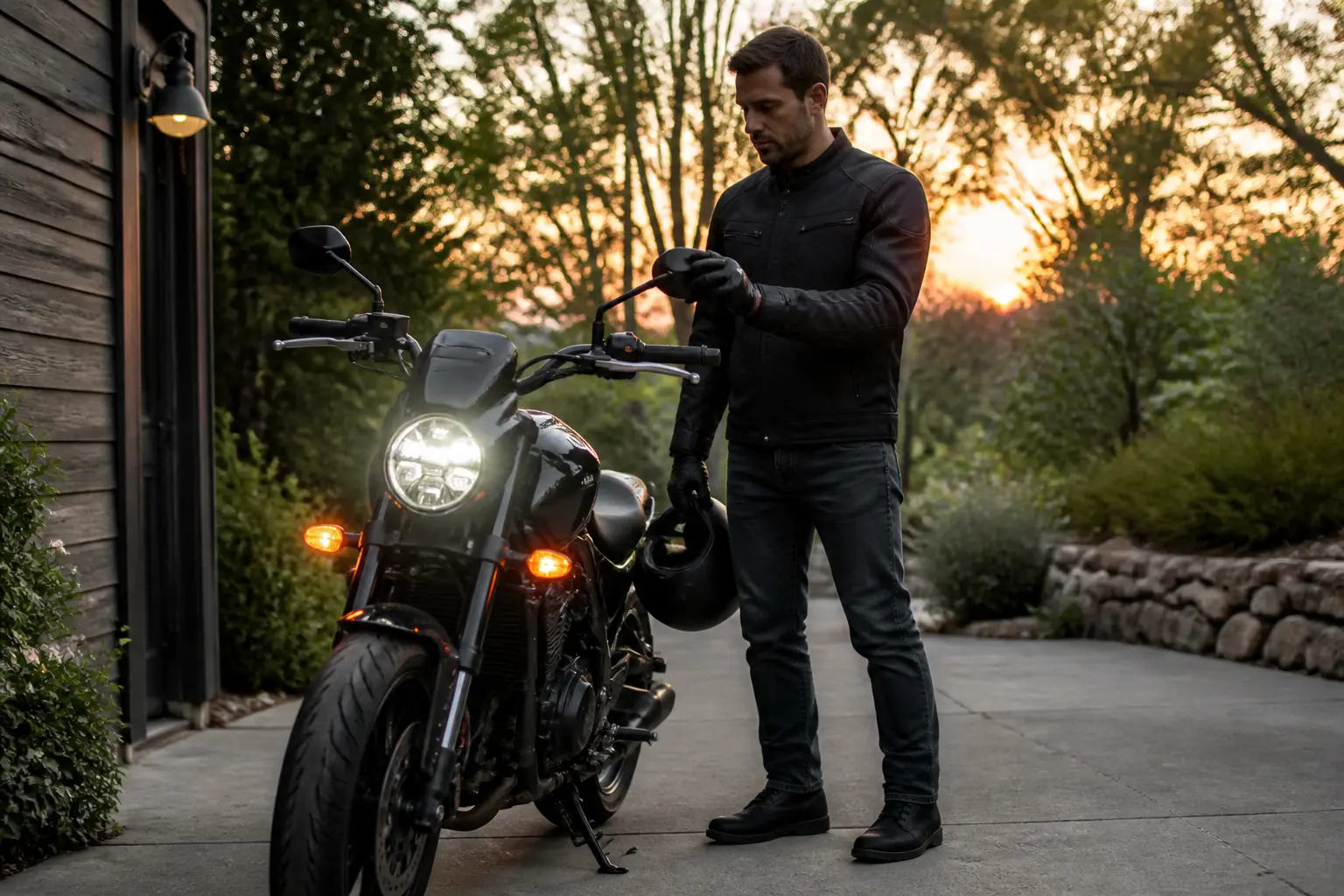
This checklist supports—not replaces—the manufacturer-specified inspection for your motorcycle.
Motorcycle condition
- Required lighting and indicators operate as described in the owner’s manual.
- Lenses, mirrors, and eye protection are clean enough for expected conditions.
- Added items do not interfere with lights, controls, sight lines, or required motorcycle equipment.
- No new damage, looseness, leak, warning, or unresolved safety concern is being ignored.
Rider and gear
- Protective equipment fits securely and allows normal control use.
- Bright or reflective elements are clean, intact, and cared for according to manufacturer guidance.
- Eye protection supports a clear view in the expected light and weather.
- Nothing loose is likely to flap, distract, or interfere with riding.
Riding plan
- I have considered traffic density, route complexity, weather, and changing light.
- I will actively search ahead, beside, and behind the motorcycle.
- I will avoid prolonged travel in vehicle blind spots.
- I will preserve following distance and look for usable escape space.
- I am prepared to slow, stop, reroute, or postpone when the available margin is too small.
The final item gives the checklist its value. A routine that can never produce a no-go decision is only an inventory. A useful safety check changes the plan when the motorcycle, conditions, or rider readiness do not support a comfortable margin.
How Vojo Helps
Use Vojo to turn a general visibility habit into a repeatable record. Before an evening, wet-weather, or traffic-heavy ride, open the bike in the motorcycle maintenance tracker and review your last recorded check for lighting, mirrors, and other relevant inspection items. Add a pre-ride note about conditions that may reduce conspicuity, such as glare, darkness, rain, or dense traffic. After the ride, log any concern—such as a light that needs attention or a recurring blind-spot situation—as a follow-up item so it is not left to memory. This connects motorcycle condition with your riding decisions while keeping the owner’s manual and qualified service guidance in charge of model-specific work.
Quick answers
Frequently asked questions
Can reflective motorcycle clothing make other drivers see me?
It may improve how noticeable you are when conditions support it, but it cannot ensure another road user is looking, recognizes your path, or responds correctly. Continue to scan, preserve space, and avoid assuming you have been seen.
Is bright clothing more useful than reflective material?
They can help in different situations. Bright clothing may create contrast in some daylight environments, while reflective material can be relevant when illuminated. Neither replaces a working motorcycle lighting system or a careful riding plan.
Should I ride as if nobody can see my motorcycle?
Use visibility measures, but avoid making decisions that depend on others noticing you in time. Actively search for conflicts, evaluate uncertain behavior, and maintain room to respond if another road user makes a mistake.
How do I spend less time in a vehicle blind spot?
Avoid matching a nearby vehicle’s speed for an extended period in a hard-to-see area. When traffic conditions safely allow, create separation by letting the vehicle move ahead, moving ahead with room, or changing position after a full observation check.
What does an escape option mean for a motorcyclist?
It is a currently usable area or margin that may help if your intended path becomes unsafe. It is not permanent: keep reassessing it as vehicles, road conditions, and available space change.
What should I do if a light or reflector-related component is not working?
Follow the motorcycle owner’s manual and applicable component instructions. Do not substitute bright clothing for an unresolved safety-related fault. If you cannot verify the issue safely, postpone riding and seek qualified or authorized service guidance.