
Motorcycle Group Hand Signals: Agree Before You Ride
Build a short, shared motorcycle group hand-signal vocabulary before departure, then combine it with regroup points, clear roles, and no-pressure riding.
Fact-checked against cited official documentation
Reviewed against Fact-checked against MSF group-riding guidance, the MSF group-ride quick tips, and the MSF operator manual’s illustrated group-riding signals..
Last updated October 22, 2026
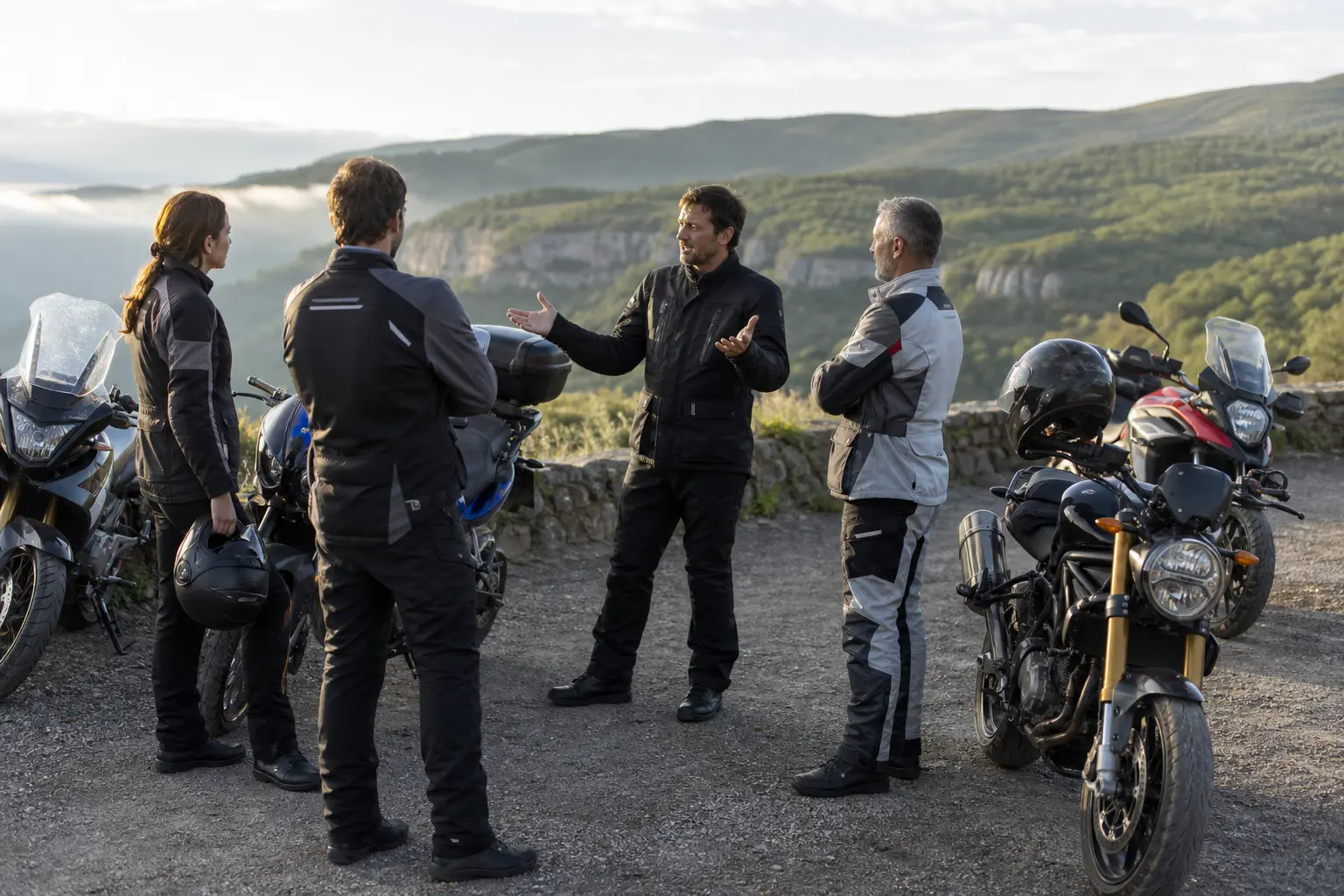
A hand signal only works when the other riders know what it means, can see it in time, and have enough attention left to respond safely. That is why motorcycle group ride hand signals should be agreed at the riders’ meeting—not invented halfway through a corner or copied from a rider several places ahead.
The practical goal is not to memorize every possible gesture. It is to create a small, shared vocabulary for the situations your route is likely to produce: a hazard, a turn, a fuel stop, a comfort break, a change in the plan, or a rider who needs the group to pull off. The Motorcycle Safety Foundation’s group-riding guidance puts that conversation alongside the route, stops, and regroup plan before departure. Its quick guide also provides a reference set of group-riding hand signals. Read the Motorcycle Safety Foundation group-riding guidance.
Signals are a communication aid, not a substitute for a sound ride plan. Each rider remains responsible for controlling the motorcycle, reading the road, maintaining space, and deciding whether a maneuver is appropriate. If signaling would compromise those tasks, control comes first.
Why a Shared Signal Set Matters
A group can lose time and clarity when each rider uses a different gesture for the same message. One rider may point down to mean “road debris,” while another uses the same movement to mean “slow down.” A rider at the back may see only part of a gesture, or see it after the relevant junction has passed. Even a familiar signal can become ambiguous when it is made near a turn, traffic light, driveway, or roadside business.
A short briefing solves several problems before the wheels move:
- It gives every rider the same interpretation.
- It identifies which signals will actually be used on this route.
- It gives the group a response to missed or misunderstood signals.
- It reminds riders not to copy a maneuver blindly.
- It makes stops and route changes less dependent on cellular service or shouted instructions.
This is especially useful when the group includes riders who have not ridden together before. Familiarity with one club, training program, or friend group does not guarantee a universal vocabulary. The official MSF quick guide is a useful starting reference, but the leader should still explain the selected signals aloud and invite questions before departure: view the MSF group-ride quick tips.
The briefing should be short enough that people remember it. Five clearly explained signals are more useful than fifteen gestures nobody can recall under pressure.
Choose Signals for the Actual Route
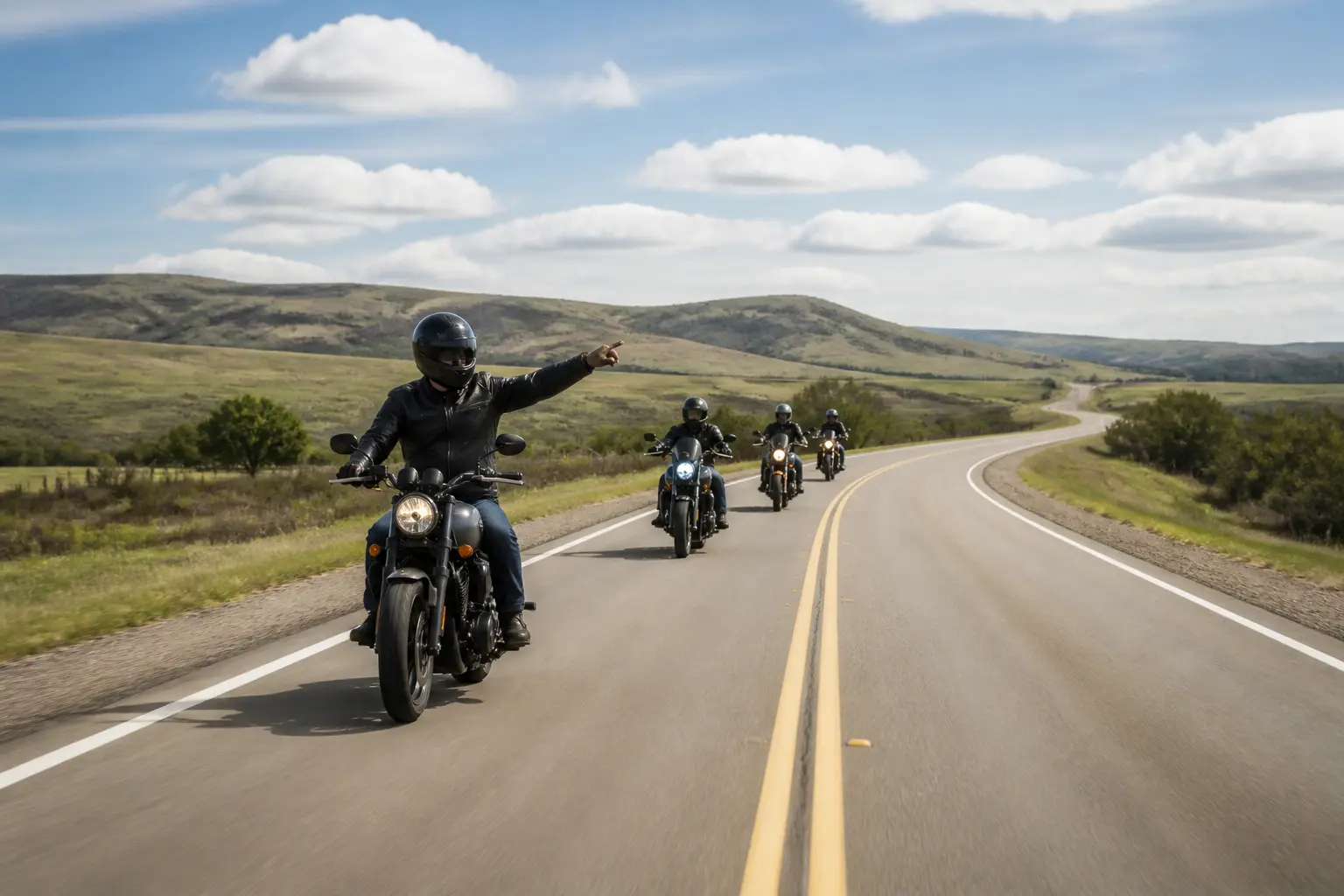
Start with the route rather than a generic list. Ask what the group is likely to need during this particular ride.
A relaxed fuel-and-coffee ride may need signals for turns, hazards, fuel, a comfort stop, and pulling off. A longer route may also need a signal for a change in destination or a rider who is leaving the group. A route with frequent construction, narrow roads, or poor sightlines may require an especially clear hazard discussion and more planned stops.
The MSF materials identify common group-riding signals including roadway hazards, fuel, a comfort stop, a turn signal left on, and pulling off. The MSF motorcycle operator manual with supplementary information also illustrates group-riding hand signals. Use those official references as a conversation starter, then make the group’s final meanings explicit: consult the MSF operator manual.
A useful briefing has four parts for each selected signal:
- The gesture: What the rider will do with a hand or arm.
- The meaning: The one plain-language message attached to it.
- The expected response: Repeat it, increase awareness, prepare to stop, or do nothing beyond observing.
- The limitation: What riders must not assume from it.
For example, “hazard” should not mean “move immediately toward the other side of the lane.” It means “look for the hazard and choose a safe response yourself.” A rider behind may have a different line, a different sight picture, or less room. The signal transfers awareness; it does not issue an automatic steering command.
Likewise, a fuel signal should not mean “turn into the next station now.” It should prompt riders to confirm the location, traffic, and stopping space. The lead rider’s plan and the road situation still matter.
A Practical Pre-Ride Signal Vocabulary
The following table is a planning framework, not a replacement for the official MSF illustrations. Show the group the reference you are using, say each meaning aloud, and keep only the signals that fit the ride.
| Message | What the group should understand | Sensible response | Common mistake to avoid |
|---|---|---|---|
| Roadway hazard | Something in or near the travel path deserves attention | Scan, adjust speed or position as appropriate, and preserve control | Treating the gesture as an instruction to swerve immediately |
| Turn or route direction | A planned direction change is approaching | Confirm the road, traffic, and navigation for yourself | Following the motorcycle ahead without independently checking |
| Fuel stop | The group should plan for fuel or identify the next opportunity | Acknowledge the plan and stop only when the location and approach are safe | Braking sharply because the signal appeared late |
| Comfort stop | A break is planned for rider needs, not necessarily fuel | Continue safely to the agreed stopping location or regroup point | Assuming every rider must endure discomfort until the leader stops |
| Turn signal left on | A rider’s indicator may not have canceled | Create space and communicate only if it can be done without losing control | Fixating on the signal instead of the road |
| Pull off or regroup | The group should leave the active travel flow and gather safely | Use the agreed location or next safe opportunity; do not stop unpredictably | Stopping on a poor shoulder or forcing following riders to stop there |
| Change or emergency communication | The original plan may no longer apply | Follow the pre-ride plan for separation, contact, or regrouping | Creating a new code during a stressful moment |
The table separates a message from a maneuver on purpose. A gesture can alert a rider, but it cannot assess that rider’s lane, traction, sight distance, or traffic. Everyone must make the final riding decision independently.
Control Comes Before Signaling
The safest signal is one made without destabilizing the motorcycle or reducing attention at the wrong moment. A rider may need both hands for braking, steering, or managing an unexpected surface. A curve, intersection, narrow lane, heavy traffic, poor visibility, or sudden obstacle may leave no safe opportunity to gesture.
Use this priority order:
- Stabilize the motorcycle and maintain a safe path.
- Read the immediate traffic and surface conditions.
- Make the signal only if it can be done smoothly and visibly.
- Return both hands and full attention to riding.
- Let the next safe opportunity carry the message if the first opportunity was unsuitable.
That means a signal can be delayed, omitted, or replaced by the group’s regroup plan. No rider should feel obligated to remove a hand from the controls because another rider is waiting for a gesture. A rider who misses a signal has not failed the group; the plan should account for ordinary communication gaps.
This principle also limits signaling from the lead position. A leader may be tempted to communicate every road feature, route adjustment, or change of pace. Too many gestures create noise and make important messages harder to identify. The leader should communicate what the group needs, not narrate every decision.
The trailing rider has a different role. The last rider may be able to notice a separated motorcycle, a mechanical concern, or a rider who has stopped. That rider should not turn a signal into a risky chase. If the group’s procedure is unclear, the safer answer is to use a planned regroup point or contact method rather than accelerating to close a gap.
Explain the Signals at the Riders’ Meeting
The riders’ meeting is where a signal becomes a group agreement. Hold it before engines start, in a place where everyone can hear, see the reference illustrations, and ask questions.
A concise meeting can follow this order:
1. Name the ride leader and sweep
Everyone should know who is responsible for navigation and who is expected to be last. The titles matter less than a shared understanding of roles. If the group separates, riders need to know whether to wait, continue to the next planned point, or contact someone.
2. Identify the route and decision points
Discuss the destination, major turns, fuel opportunities, rest stops, and likely regroup locations. A turn signal is much easier to interpret when riders already know that a junction is coming.
3. Select the signal set
Show the official reference and choose only the relevant messages. Explain any local variation. Do not assume that a nod, wave, pointed finger, or arm position means the same thing to everyone.
4. Explain repetition
Decide whether riders will pass a signal rearward. If so, make clear that repeating a message means “I received the communication,” not “I have verified the road is clear” or “I am ordering the next rider to maneuver.”
5. Explain missed signals
This is the most important part. State where the group will regroup if someone misses a turn, becomes separated, or cannot safely respond to a gesture. A rider should never need to hurry, pass aggressively, or ride beyond their ability to rejoin.
6. Set the no-pressure rule
Any rider may slow down, skip a maneuver, leave space, or stop at a safe location. The group’s response is to regroup according to the plan—not to pressure that rider into catching up.
7. Confirm understanding
Ask riders to repeat the selected meanings or invite questions about an ambiguous signal. A quick confirmation is more valuable than a long speech that nobody remembers.
Signals Are Not Navigation Instructions
A gesture from another rider is a prompt to pay attention. It is not proof that a turn is legal, open, clear, or appropriate for you. Check your own lane, mirrors, traffic, surface, and route information before changing direction or position.
This distinction matters most at intersections. A lead rider may have entered a turn with a clear view while a following rider arrives after traffic changes. The follower must make a separate decision. The same is true for hazards: a rider ahead may have crossed a patch of debris, while the following motorcycle reaches it at a different angle or speed.
Avoid treating a signal as permission to compress the group. Closing a gap quickly can create more risk than missing a turn. The group should be organized around predictable riding, not visual imitation. Maintain a position and spacing that allow you to see, think, and respond.
If the route includes navigation devices, riders should know whether they are expected to use their own directions or follow the leader. A signal vocabulary cannot compensate for conflicting routes. Agree on the route before departure and identify the next regroup location whenever navigation becomes uncertain.
What to Do When a Signal Is Missed
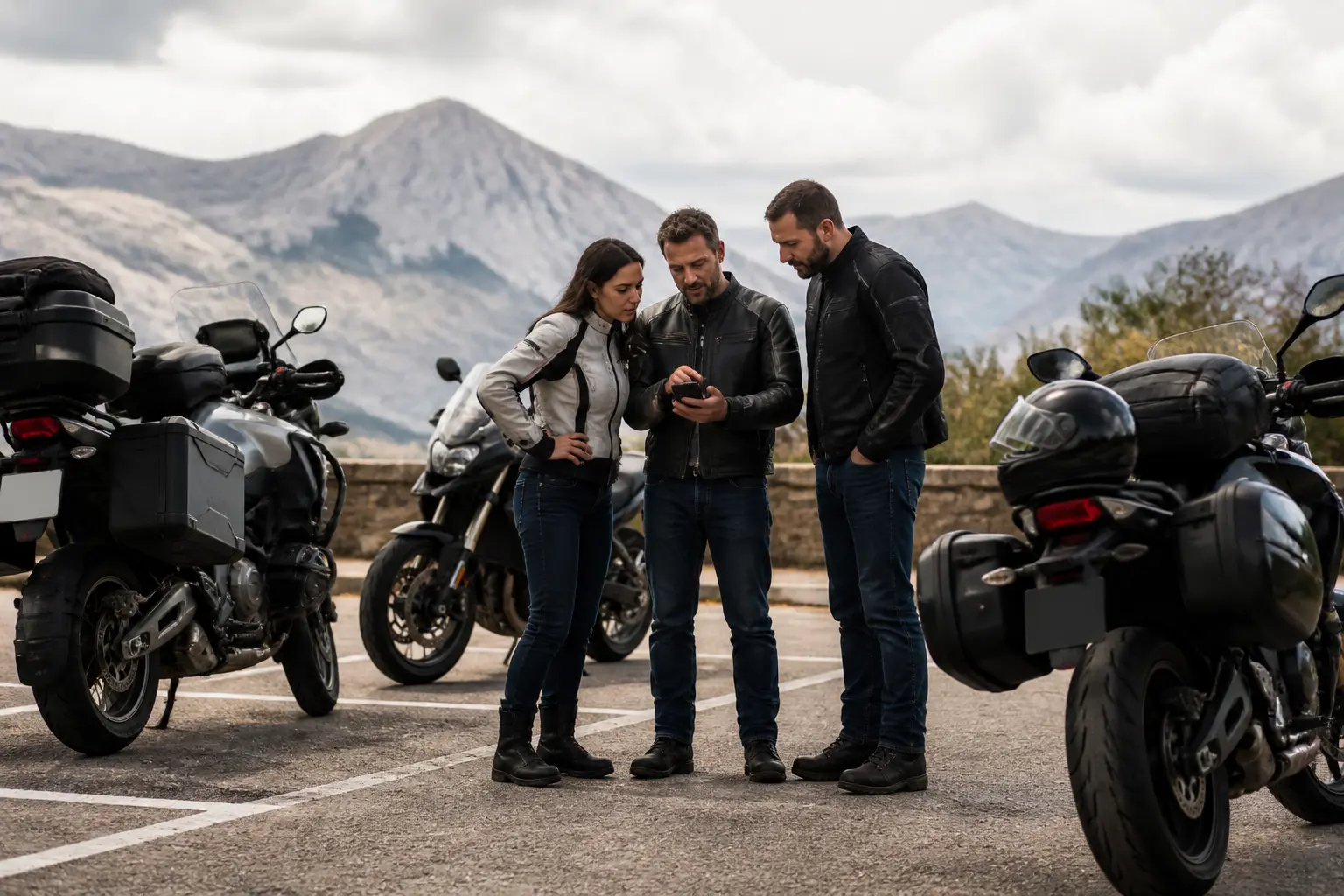
A missed signal is normal group-riding friction. The dangerous response is turning it into an emergency by trying to repair the communication immediately at speed.
Use a calm sequence:
- Continue with control rather than making a sudden turn or stop.
- Do not chase the group beyond your comfort, skill, or visibility limits.
- Use the pre-ride route and regroup plan if you know it.
- Move to a safe stopping or waiting location when appropriate.
- Contact the designated person if that is part of the plan.
- Let the group reunite at the next agreed point.
The group leader should plan for this possibility before departure. Choose regroup locations that are visible, lawful, and large enough for motorcycles to gather without creating a roadside hazard. The location should not depend on every rider seeing the same hand signal at the same moment.
If one motorcycle has not arrived, the group should avoid sending multiple riders back into uncertain traffic without a clear procedure. A phone call, text, navigation check, or designated sweep process may be more useful than an improvised search. The precise response depends on the route and local conditions, but the governing principle is consistent: resolve separation without creating a second hazard.
A rider who needs to stop should not feel embarrassed about using the plan. Fuel, fatigue, discomfort, navigation uncertainty, and a motorcycle concern are legitimate reasons to regroup. The group’s pace should be compatible with its least confident rider and the conditions, not with a target arrival time.
When Not to Signal
There are moments when communication must wait. Do not force a hand signal while:
- Braking for a developing hazard or traffic conflict.
- Entering or negotiating a curve that demands both hands and full attention.
- Riding over an uncertain surface.
- Managing a crosswind, reduced visibility, or tight lane.
- Preparing for an intersection or lane change.
- Recovering from an error or unexpected motorcycle movement.
- Trying to maintain a safe escape path.
A rider can communicate later at a stop, at the next safe straight section, or through the regroup system. A delayed message is preferable to a destabilized motorcycle.
The same caution applies to interpreting signals. Do not stare at another rider’s hand so intently that you stop scanning the road. Peripheral awareness may be enough to recognize a familiar gesture, but the road remains the primary source of information.
A Clearly Titled Checklist: Group Signal Briefing Before Departure
Use this checklist at the meeting point. Adapt it to the route, group size, local rules, and the manufacturer’s instructions for each motorcycle. It is a communication checklist, not a substitute for rider training or an owner’s manual.
- Name the ride leader, sweep, and any alternate contact.
- Confirm the destination, route, major turns, fuel opportunities, and rest stops.
- Select a short set of signals relevant to this ride.
- Show the official reference illustrations rather than relying on memory.
- Say the meaning of each signal in plain language.
- Explain whether signals are repeated rearward and what repetition does—and does not—mean.
- State that every rider checks the road independently before acting.
- Agree that control, spacing, and a safe path take priority over signaling.
- Identify safe regroup locations and what to do after a missed turn.
- Explain how a rider can request a stop without pressure or embarrassment.
- Confirm the no-chase rule: nobody rides beyond their ability to rejoin.
- Check that everyone can hear, see, and ask questions.
- Revisit the plan if weather, traffic, route, or group size changes.
After the briefing, keep the first section of the ride conservative. It gives the group a chance to discover whether the vocabulary is actually visible and understandable. If a gesture causes confusion, stop and clarify it rather than allowing the misunderstanding to continue for miles.
Manufacturer-First Safety Guidance
Hand-signal guidance is general group-riding information. It does not override the motorcycle manufacturer’s owner’s manual, safety notices, restrictions, or local traffic law. Before a ride, follow the manufacturer’s guidance for controls, approved equipment, passenger and load limits, tire condition, and any model-specific warnings. If the motorcycle has a communication system, navigation device, auxiliary lighting, or other equipment, use it only as described by its manufacturer.
Do not use this article as an exact repair, inspection, or modification procedure. A warning light, control concern, damaged component, or unusual handling issue should be handled according to the owner’s manual and qualified service guidance before joining a group ride. When the manual and a group custom disagree, the manual and applicable law take priority.
The same principle applies to rider capability. A signal vocabulary cannot make an unfamiliar route, motorcycle, passenger load, weather condition, or riding skill level safe by itself. Reduce the plan, delay the ride, or seek appropriate instruction when the conditions exceed the rider or motorcycle’s readiness.
For broader preparation, pair this communication plan with the Motorcycle Maintenance Guide, then keep the ride itself within the limits described by the manufacturer and the riders’ actual experience.
How Vojo Helps
Vojo can turn the pre-ride agreement into a repeatable workflow instead of a conversation that disappears when everyone starts putting on gloves. Before the ride, create a route entry and add the planned fuel, rest, and regroup locations. In the ride notes, record the small signal set your group agreed to, who is leading and sweeping, and what riders should do after a missed turn. After the briefing, share or review the same plan with the group so the vocabulary and no-pressure rule are visible before departure.
After the ride, use Vojo’s motorcycle ride app workflow to note which signals were clear, where the group became separated, and which regroup point worked best. That short debrief helps improve the next briefing without adding more gestures than the group can remember. Keep maintenance and safety concerns in their appropriate records, and use the manufacturer’s documentation for model-specific decisions.
Quick answers
Frequently asked questions
What are the most useful motorcycle group ride hand signals?
Choose only the signals your route needs. Common examples in Motorcycle Safety Foundation materials include roadway hazard, fuel, comfort stop, turn signal left on, and pull off. Explain the meaning and expected response before departure rather than assuming every rider uses the same vocabulary.
Should every rider repeat a hand signal?
Only if the group agreed to do so. Repetition can confirm that a message was seen, but it does not confirm that the road is clear or require the next rider to make the same maneuver. Each rider must assess traffic, surface, spacing, and control independently.
What should I do if I miss a group-riding hand signal?
Maintain control and do not chase the group or make a sudden maneuver. Follow the pre-ride route and continue to the agreed regroup location when practical, or stop safely and use the group’s contact procedure. The plan should remove pressure to catch up.
Can I signal while cornering?
Do not force a signal when cornering, braking, handling an uncertain surface, or managing traffic. Motorcycle control and road awareness come first. Wait for a safe opportunity or rely on the regroup plan.
Are motorcycle hand signals universal?
No. Official references provide useful examples, but groups should still agree on the meanings they will use. Riders may come from different clubs, countries, training backgrounds, or riding communities, so a short briefing prevents avoidable ambiguity.
Do hand signals replace motorcycle communication systems?
No. Hand signals are one communication aid. A group still needs a route, roles, fuel and rest plans, regroup locations, and a response to separation. Any electronic communication equipment should be used according to its manufacturer’s instructions and should not distract from riding.