
Motorcycle Gloves and Boots: Fit Checks That Protect You Without Compromising Control Feel
Use practical motorcycle glove and boot fit checks to protect your hands and feet while preserving confident feel at the levers, shifter, and brake pedal.
Fact-checked against cited official documentation
Reviewed against Fact-checked against MSF protective-gear and Basic RiderCourse guidance plus Harley-Davidson rider guidance on full-finger gloves, over-the-ankle boots, and primary control locations..
Last updated October 11, 2026
Motorcycle gloves and boots are often discussed as protection purchases, but their fit also changes the way you operate the motorcycle. A glove that bunches in the palm, crowds the fingertips, or slides around the hand can make the controls feel vague. A boot that is loose at the heel, bulky at the toe, or insecure on the ground can make shifting, rear-brake use, and stops feel less predictable.
The goal is not to find the thinnest glove or the softest casual shoe. It is to choose motorcycle-specific gear that gives your hands and feet coverage while leaving you able to recognize where the controls are, operate them smoothly, and put a stable foot down when stopped. The Motorcycle Safety Foundation (MSF) identifies full-finger gloves and over-the-ankle footwear as core rider gear; it also specifically calls for proper glove fit and notes the value of oil-resistant boot soles for grip. (msf-usa.org)
This guide gives you a practical fit-check process to use in a store, at home with your motorcycle parked, and before leaving for a ride. It does not replace your motorcycle’s owner’s manual, hands-on training, or a qualified gear fitting when you need one. If a new piece of gear alters your ability to use a control with certainty, treat that as a reason to pause—not a problem to solve in traffic.
Start With the Safety Baseline, Then Test Control Feel
Begin with the non-negotiable purpose of riding gear: reducing exposure in a fall and protecting you from weather, debris, heat, and contact with the motorcycle. That baseline should come before fashion, color, or whether a product feels familiar from ordinary footwear or workwear.
For training, the MSF Basic RiderCourse lists sturdy, non-canvas, over-the-ankle boots and full-finger gloves—preferably leather—among its required apparel. Its course also teaches control use, shifting, stopping, turning, swerving, and braking. That connection matters: hands and feet are not passive passengers inside the gear. They are the body parts that meet the motorcycle’s primary hand and foot controls. (msf-usa.org)
Harley-Davidson likewise advises full-finger gloves designed for riding and boots that cover the ankle, while its rider guidance identifies the right-hand throttle and front brake lever, left-hand clutch lever, shift lever, and rear brake lever as key controls. Your exact motorcycle may arrange or operate controls differently, so confirm their functions in the owner’s manual before judging fit. (harley-davidson.com)
A useful way to think about fit is to test four separate jobs:
- Retention: Does the item stay where it belongs when you move?
- Reach: Can your fingers and feet reach the controls without stretching, twisting, or searching?
- Feedback: Can you sense lever movement, grip position, pedal contact, and ground contact clearly enough to operate deliberately?
- Freedom: Can you move through your normal control range without pinching, snagging, pressure points, or accidental input?
Protection and control are not opposites. Good motorcycle gear should support both. The mistake is assuming that a gear item is safe simply because it is marketed for motorcycles, or that it fits simply because you can fasten it.
| Area to check | What a workable fit feels like | Warning sign | Safer next step |
|---|---|---|---|
| Glove fingers | Fingertips sit near the ends without hard pressure or loose empty space | Numbness, curled fingertips, or excess material at finger ends | Try another size, cut, or glove pattern |
| Glove palm | Material lies relatively smooth around the grip | Palm seam or fold sits directly under the grip | Choose a different palm shape before riding |
| Wrist closure | Glove remains secure through normal hand movement | Cuff rotates or glove can shift off the hand | Refit or select a more secure closure |
| Boot heel | Heel stays located when walking and operating controls | Heel lifts or slides inside the boot | Try another size or shape |
| Toe and instep | Enough room to move, without a loose, wandering forefoot | Toe contacts controls unintentionally or cannot get beneath shifter | Test another boot profile on the parked motorcycle |
| Sole and footing | Sole contacts the ground and footpeg predictably | Foot feels unstable on pavement, peg, or a slick surface | Do not treat the boot as ride-ready yet |
The table is a screening tool, not a substitute for professional fitting or rider training. Its purpose is to expose a mismatch before the motorcycle is moving.
Glove Fit: Protection Must Not Turn Into Vague Lever Feel
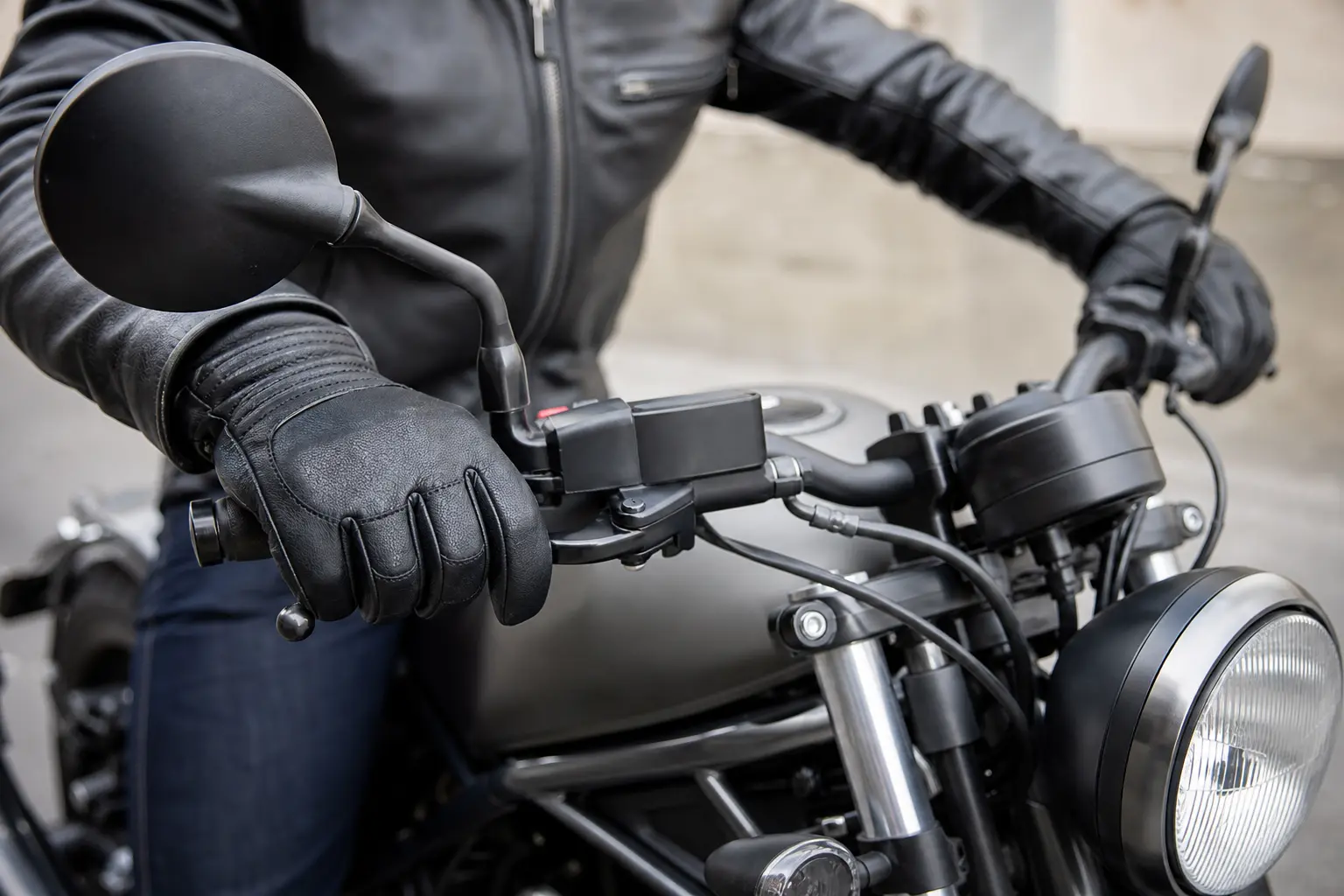
A glove can be protective and still be the wrong glove for your hand. Fit is more than circumference around the knuckles. Finger length, palm width, thumb shape, wrist size, cuff design, and the way you naturally hold a grip all matter.
Put both gloves on and secure their closures as you would for a ride. Do not evaluate one hand only. Many riders have small but meaningful differences between their left and right hands, and the left glove must work for clutch operation while the right must work for throttle and front-brake operation.
Start at the fingertips. Your fingers should reach close to the ends without being compressed into them. Hard contact at the fingertip can become distracting when you curl your fingers around a lever. Too much unused length is different but equally unhelpful: it may fold at the tips, make it harder to judge where your fingers are, and create a vague sensation on switches or levers.
Next, close your hand as though holding a handlebar. You are looking for smoothness across the palm and a natural bend at the finger joints. A small amount of material movement is normal. What is not useful is a thick ridge, stiff seam, or folded panel directly where your palm meets the grip. That interference may tempt you to grip harder simply to feel settled. A firmer grip is not automatically better control; it can add fatigue and make your inputs less relaxed.
Pay particular attention to the thumb. Thumbs do more than hang alongside the grip. They help stabilize hand position, manage switches, and work around the controls. If the thumb gusset pulls sharply when you wrap your hand around the bar, or if the material gathers in the web between thumb and index finger, the glove’s pattern may not suit your hand even if the label size seems correct.
Then check the wrist and cuff. A glove should remain securely positioned when you open and close the hand, rotate the wrist, and reach toward the controls. If it creeps around the hand or the closure seems unable to keep it in place, do not assume a jacket cuff will solve the issue. A loose glove can migrate at exactly the time you need consistent feel.
A parked-motorcycle glove test
With the motorcycle switched off, stable, and supported according to its owner’s manual, sit in your normal riding position. Use only familiar, gentle motions—this is a fit assessment, not a practice session.
- Place both hands on the grips without changing your posture to accommodate the gloves.
- Rest your fingers where you normally operate the clutch and front brake.
- Open and close each hand slowly several times.
- Reach the switches you use routinely without looking for them through thick folds of material.
- Rotate the throttle grip only as appropriate for your motorcycle while confirming that the glove does not bind, catch, or force your wrist into an awkward angle.
- Turn the handlebar through its stationary range only if your motorcycle is safely parked and the owner’s manual permits it, watching for a cuff that catches on a jacket sleeve or interferes with your movement.
This is not a test of braking ability or reaction time. It is a simple question: does the glove disappear from your attention while you operate familiar controls? If the answer is no, investigate why before riding.
Gloves can also change with temperature and use. Cold material may initially feel stiffer; sweaty hands can make a marginally loose glove move more; wet weather can alter comfort and grip. That does not mean you should accept a poor fit because it might improve later. It means your assessment should be conservative, especially if you bought gear for a season or trip with different weather than your usual ride.
Do not “break in” a glove by wearing it on a demanding first ride. Use an easy, low-pressure setting only after it has passed the parked checks, and stop using it if you notice hand pain, numbness, loss of confident lever reach, closure failure, or a distracting shift in the glove’s position.
Boot Fit: Stable Footing, Clear Shifting, and Deliberate Pedal Contact
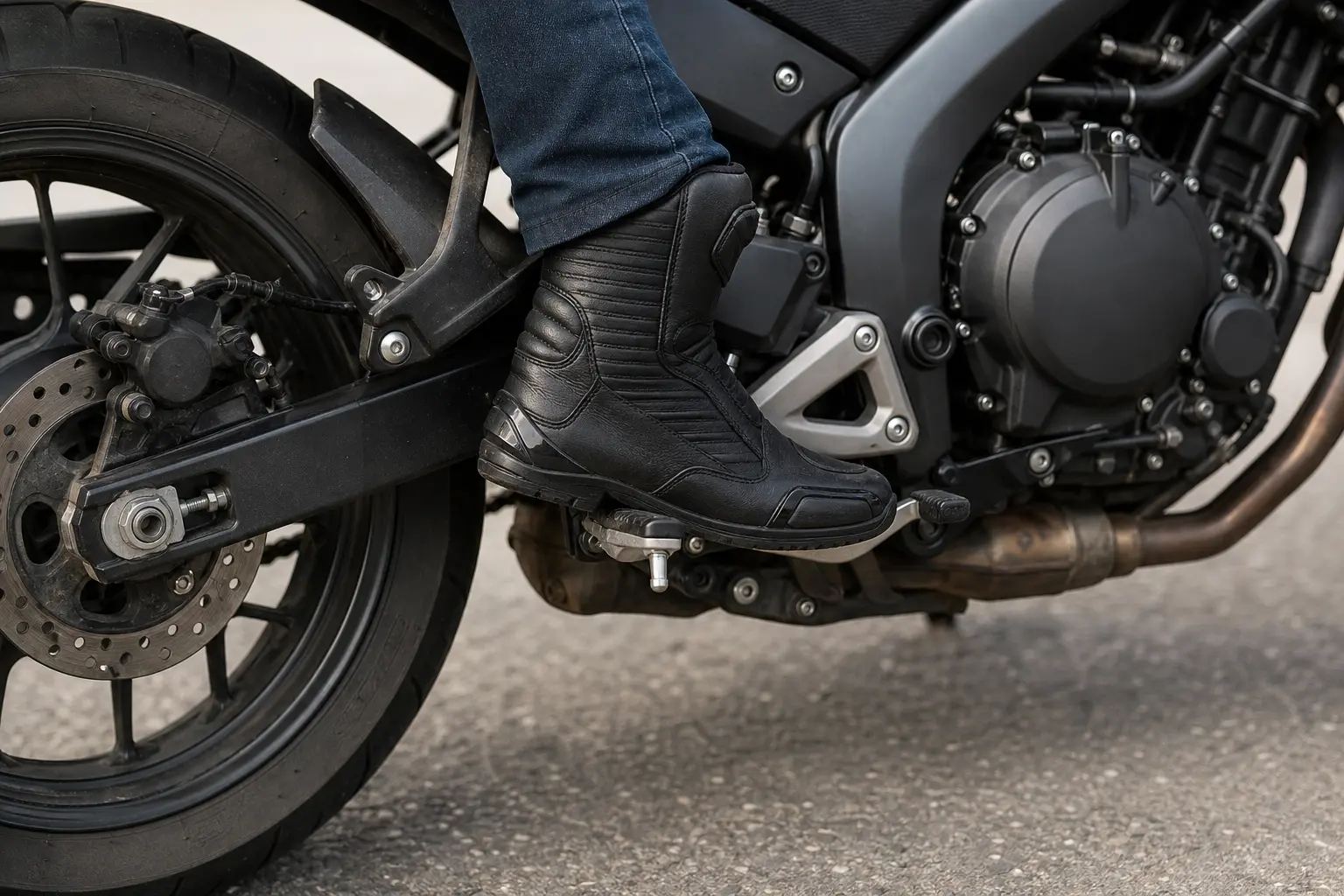
Motorcycle boots have a broader job than ordinary shoes. They need to cover and protect the ankle area, stay on the foot, provide a usable interface with the footpeg and pavement, and still let you find the shifter and rear brake deliberately. MSF specifically recommends over-the-ankle boots with oil-resistant soles for protection and grip. (msf-usa.org)
A boot that feels comfortable while standing in a store may behave differently on the motorcycle. The important movements are not just walking. They include reaching down to a peg, placing the foot on a brake pedal, moving the toe around a shift lever, supporting the motorcycle at a stop, and walking the motorcycle carefully in a parking space.
Start with the heel. When the boot is laced, zipped, buckled, or otherwise secured as intended, your heel should feel located rather than free to rise and slide. Heel movement makes the boot less predictable on a peg and can change where the toe arrives relative to a control.
Check toe room separately from overall looseness. You need enough room that your toes are not painfully compressed, especially when the foot is placed on a peg. But a boot with a large, floppy forefoot can make it harder to distinguish the shifter from empty space—or can make the toe more likely to contact a control when you did not intend it. The right profile is not necessarily the narrowest one. It is one that lets you place the foot accurately.
The instep and ankle deserve attention too. A boot can feel secure in a chair yet pinch when you bend the ankle on the peg. Conversely, a very flexible boot may feel easy initially but offer less support or retention than you need. There is no universal stiffness level that suits every motorcycle or rider. Your objective is to find a boot that remains secure and lets you move your ankle without painful restriction or uncontrolled slop.
Sole design matters for two different contacts: the motorcycle and the ground. On the motorcycle, you want to recognize when your foot is planted on the peg or pedal. At a stop, you want a stable, confident contact patch with the surface. MSF’s guidance about oil-resistant soles is a reminder that walking and supporting a motorcycle can involve contaminated or slick surfaces; do not assume any casual sneaker-like sole gives the same footing. (msf-usa.org)
The no-shortcuts boot assessment
Try the boots with the socks you genuinely expect to ride in. A thin shop sock can hide a fit problem that appears with your normal riding sock. Fasten the boot as designed, stand up, walk a short distance, and note whether the heel stays planted and whether the boot rolls, twists, or presses painfully.
Then, with the motorcycle parked and stable:
- Sit in your typical riding position.
- Put each foot on its usual peg location.
- Find the rear brake pedal with your right foot without dragging or hunting for it.
- Locate the shift lever with your left foot without forcing the ankle into an uncomfortable position.
- Confirm that the boot does not hook under, press against, or rest on a control unintentionally.
- Place each foot on the ground as you would at a normal stop, while keeping the motorcycle securely supported and stationary.
- Walk beside the parked motorcycle only if you can do so safely and without trying to balance its full weight on uncertain footing.
If you must point the toe excessively, lift the whole leg, twist the knee, or change your normal foot position merely to reach a control, stop and reassess. The issue could be boot bulk, boot shape, motorcycle ergonomics, or a combination. It is not something to dismiss just because other riders use a similar style of boot.
Avoid changing control positions or altering the motorcycle simply to make an unproven boot work unless a qualified technician and your owner’s manual support that change. The safer immediate answer is often a different boot shape or a fitting assessment.
When Gloves or Boots Interfere With Controls
Interference does not always announce itself as a dramatic problem. More often, it appears as a small hesitation: a finger catches, a cuff snags, a toe cannot find the shifter cleanly, or a sole feels uncertain on the pavement. Those small signals deserve attention because riding requires repeated, deliberate control inputs.
Use this distinction:
- Normal adaptation: You notice a different texture or slightly more structure, but you can operate every familiar control smoothly and without changing your posture.
- Possible mismatch: You need to look down repeatedly, reposition your hand or foot, use excess force, or compensate with an awkward wrist, ankle, knee, or hip movement.
- Stop-and-solve signal: The gear causes pain, numbness, loss of reach, accidental contact with a control, slipping at a stop, or uncertainty about braking, shifting, or throttle control.
A mismatch can become more apparent after a short period because hands and feet swell, gear warms up, and fatigue reveals pressure points. That is why a gear test should begin in an undemanding environment rather than during a commute, group ride, mountain route, rain ride, or unfamiliar trip.
Do not let a product’s protective features distract from a basic operational problem. A glove may have robust knuckle coverage yet place a hard seam under your palm. A boot may cover the ankle yet be too bulky for your bike’s control spacing. Safety gear is part of a system that includes your body, motorcycle setup, training, route, and riding conditions.
For a larger pre-ride system that includes the machine as well as your gear, use the Motorcycle Maintenance Guide. Your glove and boot check should sit beside—not replace—checks of tires, lights, brakes, fluids, controls, and the condition of the motorcycle.
Clearly Titled Checklist: Gloves and Boots Before You Ride
Use this checklist when buying new gear, returning to riding after a break, changing seasonal gear, or noticing that the controls feel different.
Gloves
- Both gloves are full-fingered and designed for motorcycle riding.
- Each glove is secured at the wrist and stays positioned when you flex, open, and close your hand.
- Fingertips are not painfully compressed and do not have excessive empty length.
- The palm does not create a thick fold, hard seam, or pressure ridge where it meets the grip.
- The thumb moves naturally around the grip and switch area.
- You can reach familiar levers and switches without stretching, changing posture, or fighting the glove.
- The cuff does not snag on your jacket or restrict wrist movement in your normal riding position.
- There is no numbness, tingling, pain, or distracting pressure before departure.
Boots
- Boots cover the ankle and are secured as designed.
- Your heel stays located rather than lifting or sliding inside the boot.
- Toes have room without the forefoot feeling loose or oversized.
- You can find the shifter and rear brake pedal deliberately while the motorcycle is parked.
- The boot does not rest on, catch under, or contact a control accidentally.
- The sole feels stable on the footpeg and when placing a foot on the ground.
- Walking a short distance does not reveal a painful pressure point, twist, or loose heel.
- You have tested the boots with the socks and riding pants you will actually use.
Decision
- If any item changes your ability to operate a control confidently, do not make the first test a demanding ride.
- If discomfort, numbness, slipping, or accidental control contact appears, pause riding and choose another fit, seek a professional fitting, or arrange training support.
- Recheck fit whenever you change glove liners, socks, rain layers, pants, or seasonal gear.
Fit Changes With the Whole Riding Outfit
Gloves and boots do not operate alone. A jacket sleeve can overlap or obstruct a glove cuff. A rain layer can change wrist mobility. Thick socks can reduce toe room. Pants with a narrow lower leg can bunch above a boot and limit ankle movement. Heated liners, hand guards, luggage, a new seat, or a different riding position can all change your experience of the controls.
That is why the final assessment should happen in the complete outfit you expect to wear. Put on the helmet, jacket, pants, gloves, and boots together. Sit on the parked motorcycle in the posture you use on the road. Check whether you can turn your head, reach the controls, put feet down, and move normally without one layer pulling another out of place.
Seasonal changes deserve special caution. A winter glove may be bulkier than a warm-weather glove. A waterproof boot may have a different sole and toe profile than a ventilated boot. Neither is automatically wrong, but each should get its own parked-bike check. Do not assume that because a summer setup worked, a cold-weather setup will preserve the same hand and foot placement.
If you are a newer rider, avoid stacking multiple unfamiliar changes at once. New motorcycle, new boots, new gloves, rain gear, and a long trip create too many variables. Introduce one meaningful change at a time, evaluate it conservatively, and keep the first rides simple.
Choose Training Over Guesswork
Gear fit can reveal a skill or confidence issue that gear alone cannot resolve. If you are unsure whether you are reaching the controls correctly, have trouble coordinating shifting or braking, or feel unstable at stops, do not attempt to diagnose the problem only through equipment changes.
The MSF Basic RiderCourse is structured around fundamental motorcycle operation and safety-oriented strategies, including familiarization with controls, shifting, stopping, turning, swerving, and braking. It requires the protective basics discussed here and provides coached riding practice. (msf-usa.org)
Training is particularly valuable if you find yourself choosing gloves only for thinness or boots only for easy ground reach. A trained instructor can help separate a genuine fit conflict from a habit, posture, motorcycle fit, or skill-development issue. That is safer than trying to force a solution while riding in traffic.
How Vojo Helps
Create a recurring Gear and Controls Fit Check in the Vojo Motorcycle Maintenance Tracker before a new season, a training course, or any ride using new gloves or boots. Add checklist items for glove closure, fingertip room, palm bunching, heel retention, shifter clearance, rear-brake reach, and stable footing. After the parked assessment, record a short note about what changed—such as thicker socks, a rain layer, or a new cuff style—and attach a photo of the gear if useful. On the next low-pressure ride, log any discomfort or interference immediately afterward. That history makes it easier to spot a recurring fit problem instead of repeatedly adapting around it.
Download Vojo on the App Store
Frequently Asked Questions
Should motorcycle gloves feel tight when they are new?
They should feel secure, not painfully tight. Your fingertips should not be compressed, your hand should be able to close around the grip naturally, and the glove should not create numbness, sharp pressure, or a seam ridge that changes control feel. Judge the fit while operating familiar controls on a safely parked motorcycle, not only while standing in a shop.
Can I ride in work boots or hiking boots instead of motorcycle boots?
Do not assume that ordinary boots provide the same motorcycle-specific coverage, retention, sole behavior, or control compatibility. MSF guidance calls for sturdy over-the-ankle boots and identifies oil-resistant soles as beneficial for protection and grip. Assess any footwear conservatively on your own parked motorcycle; if control access or footing is uncertain, choose purpose-built gear or seek fitting help. (msf-usa.org)
How much toe room should a motorcycle boot have?
Enough to avoid painful compression, but not so much that the foot slides, the heel lifts, or the toe becomes hard to place accurately around the shifter and rear brake. There is no single measurement that applies to every rider and boot. The practical test is stable heel retention plus deliberate, comfortable access to the controls.
Why do my gloves feel fine until I hold the handlebars?
A glove can fit acceptably with a relaxed hand but reveal a pattern problem when the palm wraps around a grip or the fingers curl toward a lever. Look for material bunching, a seam under the palm, thumb-web tension, cuff restriction, or fingertip pressure. If it distracts you on a stationary check, it deserves attention before a ride.
Should I alter my motorcycle controls to fit a new boot?
Do not make an adjustment solely because a new boot feels unfamiliar. First confirm the boot is correctly fitted and compatible with the motorcycle’s original control layout. Consult the owner’s manual and a qualified technician before any control-related change. If the new boot causes accidental contact, poor reach, or uncertainty, choosing a different boot is often the safer immediate decision.
What is the safest first ride in new gloves or boots?
After a successful stationary fit check, choose a familiar, low-pressure route in good conditions and avoid adding other unfamiliar variables. Stop if you notice pain, numbness, slipping, difficulty locating a control, or a change in your ability to shift or brake confidently. New gear should earn trust gradually; it should not be tested during a high-demand ride.
The Bottom Line
Motorcycle gloves and boots should protect you without making the motorcycle feel distant or unpredictable. Start with full-finger gloves and sturdy over-the-ankle boots, then test whether they stay secure, let you reach the controls naturally, preserve useful feedback, and give you stable footing. MSF and Harley-Davidson both place gloves and ankle-covering boots among fundamental rider gear; the practical next step is ensuring the particular pair works with your hands, feet, complete outfit, and exact motorcycle. (msf-usa.org)
If a glove bunches, a boot wanders, or a control becomes uncertain, take that signal seriously. Pause, reassess the fit, consult the motorcycle’s documentation, and use professional fitting or rider training where needed. Confidence should come from gear that supports deliberate control—not from learning to tolerate interference.
Quick answers
Frequently asked questions
Should motorcycle gloves feel tight when they are new?
They should feel secure rather than painful. Check fingertip pressure, palm bunching, wrist retention, and whether you can operate familiar controls naturally on a safely parked motorcycle.
Can I use work boots or hiking boots for motorcycle riding?
Do not assume ordinary boots provide equivalent coverage, sole behavior, retention, or control compatibility. Start with sturdy over-the-ankle footwear and assess it conservatively on your own parked motorcycle.
How much toe room should motorcycle boots have?
Enough to avoid compression, but not so much that the heel lifts, the foot slides, or accurate shifting and rear-brake contact become difficult.
Why do gloves feel fine until I grip the handlebars?
Holding a grip can reveal palm bunching, seam pressure, thumb-web tension, cuff restriction, or fingertip compression that is not obvious with a relaxed hand.
Should I modify my controls to suit a new boot?
First verify boot fit and compatibility with the original control layout. Consult the owner’s manual and a qualified technician before any control-related change.