
Your First Ride Home on a New Motorcycle: A Low-Pressure Route and Familiarization Plan
Plan your first motorcycle ride home from the dealer with a controlled familiarization stop, a low-pressure route, practical gear checks, and permission to delay.
Fact-checked against cited official documentation
Reviewed against Fact-checked against MSF guidance on pre-ride checks, training, visibility, SEE risk management, and NHTSA guidance on controlled familiarization, protective gear, and pre-ride readiness..
Last updated October 8, 2026
Buying a motorcycle and riding it home do not have to be the same event. The first motorcycle ride home from dealer can be a satisfying first chapter, but it can also stack unfamiliar controls, traffic, paperwork fatigue, weather, navigation, and the natural pressure of having just taken possession of an expensive machine.
The safer goal is not to prove that you can manage the longest or quickest route. It is to create the easiest possible first outing: one that lets you become acquainted with your motorcycle, preserves room for changing your mind, and ends before tiredness or urgency starts making decisions for you.
That approach matches the core safety direction from the Motorcycle Safety Foundation (MSF): know the motorcycle through its owner’s manual, conduct a pre-ride check, build skills before traffic, and use active risk management while riding. NHTSA similarly advises riders to get accustomed to a new or unfamiliar motorcycle in a controlled area before taking it into traffic. [1]2
This is not a substitute for formal rider education, licensing, or the instructions for your exact model. It is a conservative planning framework for deciding whether to ride the motorcycle home, arrange delivery, or leave it securely with the dealer and return under better conditions.
Start With the Right Definition of Success
A successful first ride home is not measured by speed, distance, freeway use, a scenic detour, or whether friends think the route was easy. It is measured by whether you arrived calm, unhurried, uninjured, and with a clearer understanding of the motorcycle.
That definition removes a common trap: treating the dealer handover as the moment when you must suddenly perform at your best. A purchase can be exciting and mentally draining. You may have spent time reviewing documents, waiting for financing or registration details, talking with staff, fitting luggage, or taking photos. Even a rider who has trained recently can be less fresh after a long dealership visit.
Give yourself an uncomplicated objective instead:
Get the motorcycle from the dealer to a familiar, legal, low-demand destination while keeping enough margin to stop, reassess, or choose another plan.
The destination does not even have to be home. A nearby parking area, a trusted friend’s driveway, or another calm, lawful place where you can pause may be the better first stage. If the trip needs to happen in stages, that is planning—not failure.
A first ride is also a poor time to add optional difficulty. Do not treat it as the occasion to carry a passenger, test luggage capacity, ride in a group, take an unfamiliar scenic road, ride after dark, or practice advanced maneuvers in traffic. Each variable competes for the attention you need for basic familiarization.
Delivery, Pickup, or a Later Ride: Make a No-Pressure Choice
Riding home is only one valid pickup method. Delivery, a trailer or transport service, a trusted qualified rider, or returning another day can all be better choices depending on the situation. The motorcycle will still be yours if its first trip is not ridden by you.
Use the choice as a risk-management decision rather than a test of identity. MSF guidance emphasizes space, time, visible positioning, escape options, and riding within both skill and situational limits. 1 If those margins are narrow before you have left the dealership, adjust the plan before the wheels turn.
| Pickup option | When it may be the sensible choice | Planning focus | A reason to reconsider |
|---|---|---|---|
| Ride it home yourself | You are properly licensed, rested, geared up, familiar enough with the controls, and have a calm route in favorable conditions | Create a simple route with an early stop option | You feel rushed, uneasy, or unable to identify a low-demand route |
| Dealer or professional delivery | Weather, distance, traffic, timing, or inexperience would turn the first ride into a high-demand task | Confirm delivery location, access, and a time when you can inspect the motorcycle calmly | Delivery timing would leave the motorcycle in an unsuitable or insecure place |
| Trailer or transport | You want familiarization at home or at a controlled location before entering public traffic | Confirm secure transport and unloading arrangements with people equipped to handle it | You lack appropriate equipment or competent help |
| Return another day | Daylight, weather, traffic, gear, paperwork, or personal readiness are not favorable today | Leave the bike with the dealer only if that is agreed and secure; set a new plan | You are accepting pressure from the dealership, companions, or your own schedule |
There is no need to manufacture a reason to ride. “I would rather start fresh in daylight” is enough. “The route has faster roads than I am ready to manage today” is enough. “I do not have the required gear with me” is enough.
If you decide to ride, give the dealer a clear expectation: you intend to spend a few minutes becoming familiar with the motorcycle before leaving the area. A reasonable handover should support questions about the owner’s manual, key functions, fuel requirement, warning indicators, supplied equipment, and any delivery-specific instructions. Do not ask staff to override or replace the manufacturer’s instructions; use the manual as the primary reference for your model.
Read the Motorcycle Before You Read the Route
Before navigation comes familiarization. The owner’s manual is the model-specific authority for operating information, warnings, required fuel, controls, break-in guidance, service expectations, loading limits, and any special conditions. Generic internet advice cannot tell you what a particular warning display, ride mode, starting sequence, adjustment, or limitation means on your exact motorcycle.
You do not need to memorize the entire manual in the showroom. You do need to know where it is, whether a digital version is available, and which sections you will consult before riding. At minimum, locate the portions on controls and instruments, pre-ride information, warning messages, fuel, tires, break-in, and any motorcycle-specific restrictions. Manufacturer instructions come first if they differ from general advice in this article.
Then take a parked-bike orientation. With the motorcycle stable and the engine off where practical, identify the items you will use or see during the trip:
- ignition and steering-lock positions;
- engine stop switch and starter control;
- clutch, throttle, front brake lever, rear brake pedal, and shift lever;
- turn-signal control, horn, high/low beam control, and hazard switch if fitted;
- instrument display, fuel indication, neutral indicator, turn-signal indication, and warning lights;
- side stand and the parking position that makes the motorcycle stable;
- mirrors and the seating position that lets you reach the controls without strain;
- any mode selector or electronic setting that the manual says requires attention before riding.
This is orientation, not a repair session and not an invitation to change settings blindly. If something is unclear, ask the dealer to point it out and then verify its purpose in the owner’s manual. If a warning remains after the conditions described in the manual are met, or a control does not behave as expected, pause the ride and seek model-appropriate support rather than improvising a diagnosis.
NHTSA advises checking tire pressure and tread, brakes, lighting and signal functions, fluid levels, and signs of leaks before riding. It also notes that cargo should be secured and balanced, with manufacturer guidance used for any load-related adjustments. 2 For a new motorcycle, the dealer’s setup and inspection do not eliminate your responsibility to make a final rider-facing check before departure.
For a broader routine that separates a quick departure scan from a more deliberate parked-bike review, see the Motorcycle Maintenance Guide.
A Controlled Familiarization Stop Comes Before Traffic
The dealership parking area may or may not be an appropriate place to ride. It can have pedestrians, cars moving unpredictably, tight spaces, uneven pavement, delivery vehicles, and customers distracted by their own errands. Do not turn a busy forecourt into a practice range.
Instead, identify a lawful, open, low-traffic area nearby where you can stop without blocking others or creating a hazard. Its purpose is not to perform a scripted skills test. Its purpose is to let you notice how the motorcycle feels at low demand before you add faster traffic, complicated intersections, or route pressure.
Use the familiarization stop to answer ordinary rider questions:
- Can you reach and operate the controls comfortably while wearing your actual gloves and boots?
- Are the mirrors adjusted so they show useful rearward views without forcing an awkward posture?
- Does the motorcycle’s size, balance, seating position, and response feel different from what you trained on or last rode?
- Can you find neutral, activate the signals, cancel them, and read the basic display without hunting for controls?
- Are you physically comfortable, mentally settled, and able to give full attention to the road?
NHTSA specifically recommends becoming accustomed to a new or unfamiliar motorcycle in a controlled area before proceeding into traffic. 2 Treat that guidance literally: traffic is not the place to discover that the clutch engagement, brake feel, turning response, display layout, or riding position requires more attention than expected.
If the familiarization stop increases your concern instead of your comfort, honor that information. Park safely. Call the dealer, a transport provider, or someone who can help arrange the next step. A motorcycle purchase does not create an obligation to ride under conditions that no longer feel manageable.
Build a Route for Fewer Decisions, Not Fewer Miles
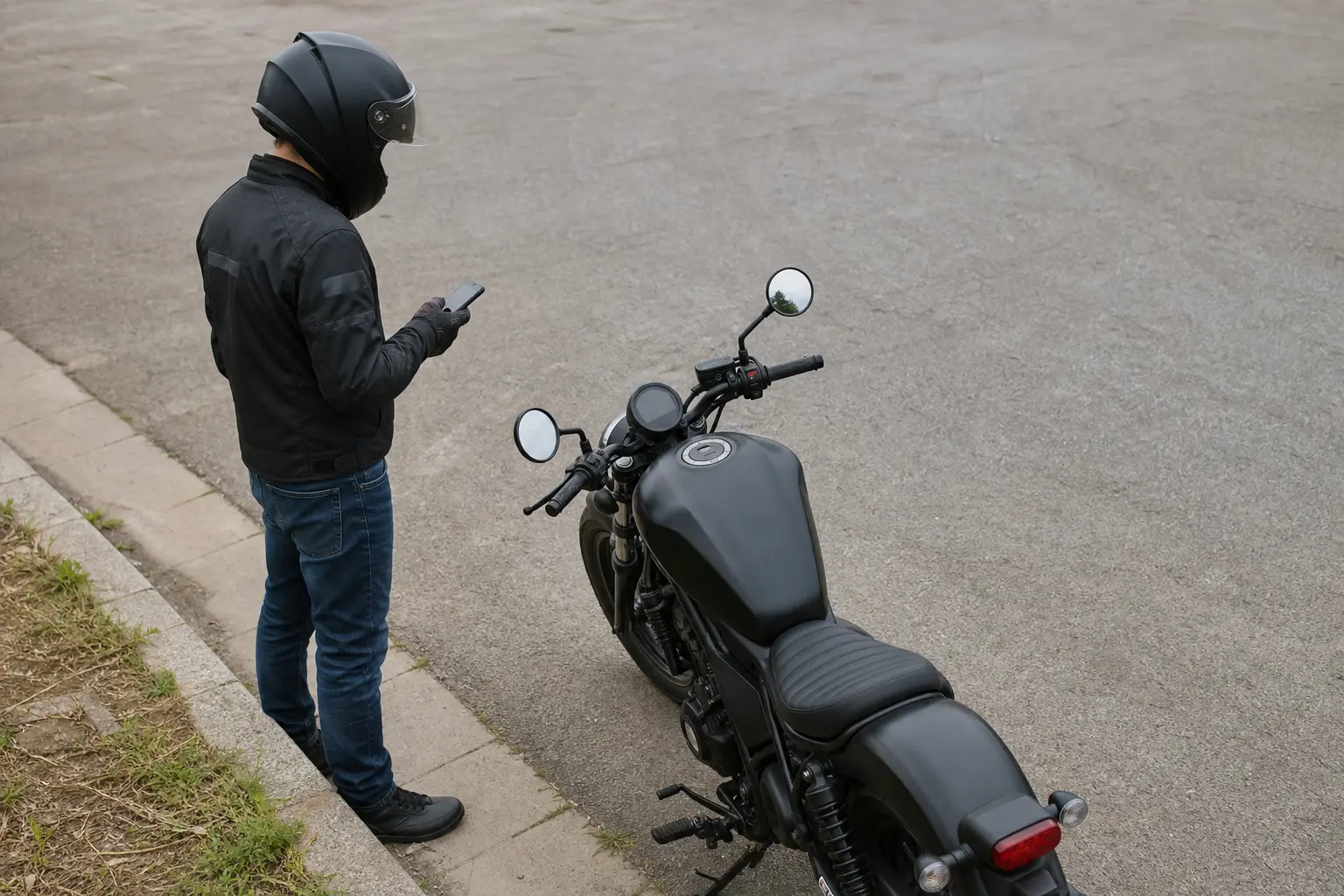
The shortest mapping route is not automatically the easiest route. It may include multi-lane merges, high-speed traffic, complex interchanges, abrupt turns, construction, limited places to stop, or a destination that requires awkward parking. For a first trip, route quality matters more than route efficiency.
A low-pressure route usually favors familiar streets, daylight, predictable traffic flow, generous lanes, simple intersections, frequent legal places to pull over, and a destination with an easy approach. It avoids optional stressors: freeways if you are not ready for them, multilane roundabouts if alternatives exist, dense commercial strips, major event traffic, steep or loose-surface parking areas, and roads known for fast pace or confusing lane changes.
Use the MSF SEE framework as a planning tool before you leave, not only as an on-road reaction tool. MSF defines SEE as Search, Evaluate, and Execute: actively identify factors that increase risk, consider how they may interact, then use the physical skills needed to prevent or avoid the resulting hazard. 3
Search: identify what will ask for attention
Look at the route in layers rather than merely tracing a line on a map. Search for the first demanding point: the dealership exit, the first left turn, a railroad crossing, a congested intersection, a multilane segment, or the final parking location. Identify where you may be exposed to changing traffic, reduced sightlines, surface changes, or confusing lane choices.
Also search your personal conditions. Are you hungry, overheated, cold, tired, emotionally keyed up, or running late? Are your helmet visor and eye protection clean enough for the available light? Do you have a charged phone, but a plan to leave it alone while moving? Is your clothing suitable if the trip takes longer than expected?
Evaluate: reduce combined risk, not just individual risk
A single issue may be manageable. Several manageable issues at once can become a poor first-ride environment. An unfamiliar motorcycle plus wet pavement plus rush hour plus a complicated navigation prompt is a very different task from the same motorcycle on a dry, quiet street in daylight.
When you evaluate, ask: What happens if the next decision takes longer than expected? If the route has no convenient stop, no easy turnaround, and no quiet alternative after the first difficult junction, it has too little margin for a first ride. Choose another route or another pickup plan.
Avoid solving every concern with confidence alone. If you are uncertain about freeway entry, select surface streets. If traffic is building, wait until it settles or reschedule. If rain begins, use the manufacturer’s information and your own readiness to decide whether to delay; do not assume a new motorcycle makes conditions easier. If navigation is unfamiliar, study the broad sequence before moving and stop legally if you need to recalculate.
Execute: choose an early, simple response
Execution on a first ride should usually mean choosing the least dramatic safe option early: slow appropriately, increase space, take the next simple turn rather than forcing a lane change, pull into a safe legal location to reset navigation, or stop the ride. It does not mean pressing on to preserve a schedule.
On the road, keep scanning well ahead and around the motorcycle. MSF advises riders to search constantly for changing conditions, allow space and time for hazards and escape paths, use lane position to see and be seen, and anticipate vehicles that may turn across the rider’s path. 1 NHTSA likewise emphasizes defensive riding, space from other traffic, signaling, and caution at intersections. 2
Choose Time, Weather, and Company Carefully
A short route can still be demanding at the wrong time. Favor a period when you can leave without rushing, when daylight gives you useful visibility, and when traffic is likely to be lower. Check conditions close to departure, not merely the night before. If weather, roadway conditions, or traffic differ from the plan, you are allowed to change the plan.
Do not make your first trip a social event that controls your pace. Friends may mean well, but a lead rider who accelerates away, a group that expects a particular route, or spectators waiting at the destination can create a quiet pressure to continue. A good companion respects your decision to stop, turn around, arrange transport, or take a simpler route without debate.
If another rider accompanies you, agree beforehand that they will not set a pace you feel compelled to chase. They can ride behind with enough space to avoid crowding you, meet you at a planned stop, or simply remain available by phone. The important point is that your route, speed, stop decisions, and readiness remain your own.
Do not bring a passenger for the initial ride home. Passenger carrying changes the motorcycle’s load and adds communication, balance, braking, and comfort demands. It is a separate readiness decision that should follow the manufacturer’s limits and instructions, not an accessory to a celebratory pickup.
First Ride Home Checklist
Use this checklist as a go/no-go decision aid. It is intentionally conservative. A single unchecked item does not always mean something is wrong with the motorcycle, but it may mean today is not the right moment to ride it home.
Before you leave for the dealer
- I hold the license or endorsement required where I will ride, and I have any required documents with me.
- I have completed appropriate training for my current level, or I have chosen delivery/transport instead of riding.
- I have a properly fitting helmet and eye protection, plus protective clothing appropriate for the trip.
- I am rested, sober, unhurried, and not affected by medication or another condition that could impair riding.
- I have checked expected weather, daylight, and the broad traffic picture close to departure.
- I have selected a simple primary route and one easier fallback option.
- I know where I can make an early, legal familiarization stop.
- I have decided in advance that delaying, delivery, or transport is an acceptable outcome.
At the dealer, before the motorcycle moves
- I have the owner’s manual or confirmed access to the correct official manual for this exact model.
- I understand the basic controls, display, warning information, parking method, and fuel requirements as described by the manufacturer.
- I have completed a rider-facing pre-ride review consistent with the owner’s manual, including the items I can responsibly check.
- I have looked for obvious signs of fluid leakage beneath the motorcycle.
- I have confirmed lights and signal indicators are functioning as expected.
- I have no loose cargo, unsecured accessories, or passenger on this first trip.
- My mirrors, gloves, boots, helmet, and clothing are ready before I start moving.
- I know who to contact if an unfamiliar warning, concern, or condition means I should not ride.
During the controlled familiarization stop
- I can reach the controls comfortably and use them without distraction.
- I can read the instruments and recognize the basic indications I need for the trip.
- I can operate the signals and confirm their status without uncertainty.
- I feel composed enough to direct attention outward to traffic, not inward to the motorcycle.
- I have reassessed the route, weather, traffic, and my own energy.
- I am willing to stop the plan if I am not ready for the next stage.
On the way home
- I am using a pace and route that fit my present skill and the conditions.
- I am actively scanning for changes, intersections, other road users, surface hazards, and places to stop.
- I leave enough room to respond rather than riding close to other vehicles.
- I signal deliberately and avoid forcing late lane changes or rushed turns.
- If I miss a turn or navigation becomes distracting, I will continue safely and stop later to reset.
- If anything feels wrong with the motorcycle, the road, or my condition, I will choose the safest available place to stop and reassess.
What to Do When the Plan Changes
The first plan should contain a second plan. This is especially important because the ride begins in an unfamiliar context: you may not know precisely how the bike feels, how dealership traffic flows, or how your body reacts once the helmet is on and the trip is real.
If you miss a turn, do not attempt an abrupt correction. Continue in a safe, lawful direction, then stop somewhere appropriate to revise the route. A longer route with a calm reset is better than a sudden maneuver made to save a few minutes.
If you become overwhelmed, the correct response is not necessarily to “push through.” Find a safe, legal place to stop. Take a breath, hydrate if needed, remove yourself from traffic pressure, and decide whether to continue, wait, call for help, or arrange transport. NHTSA notes that riding safely requires balance, coordination, and judgment; preserving those capacities matters more than completing the original route. 2
If a warning indicator appears, a control feels abnormal, a fluid leak is visible, a tire concern becomes apparent, or the motorcycle does not operate as the manual says it should, avoid guessing at a repair or treating it as a normal new-bike quirk. Park safely when possible, consult the owner’s manual, and contact the dealer or a qualified service resource as appropriate. This article deliberately does not provide model-independent repair steps because safe diagnosis and repair requirements vary by motorcycle.
If conditions worsen—rain begins, wind rises, daylight fades, traffic becomes unusually aggressive, or you notice your focus dropping—the plan can end early. That is the value of identifying legal stopping places and an alternative pickup method before departure.
Park the Ending Before You Ride the Beginning
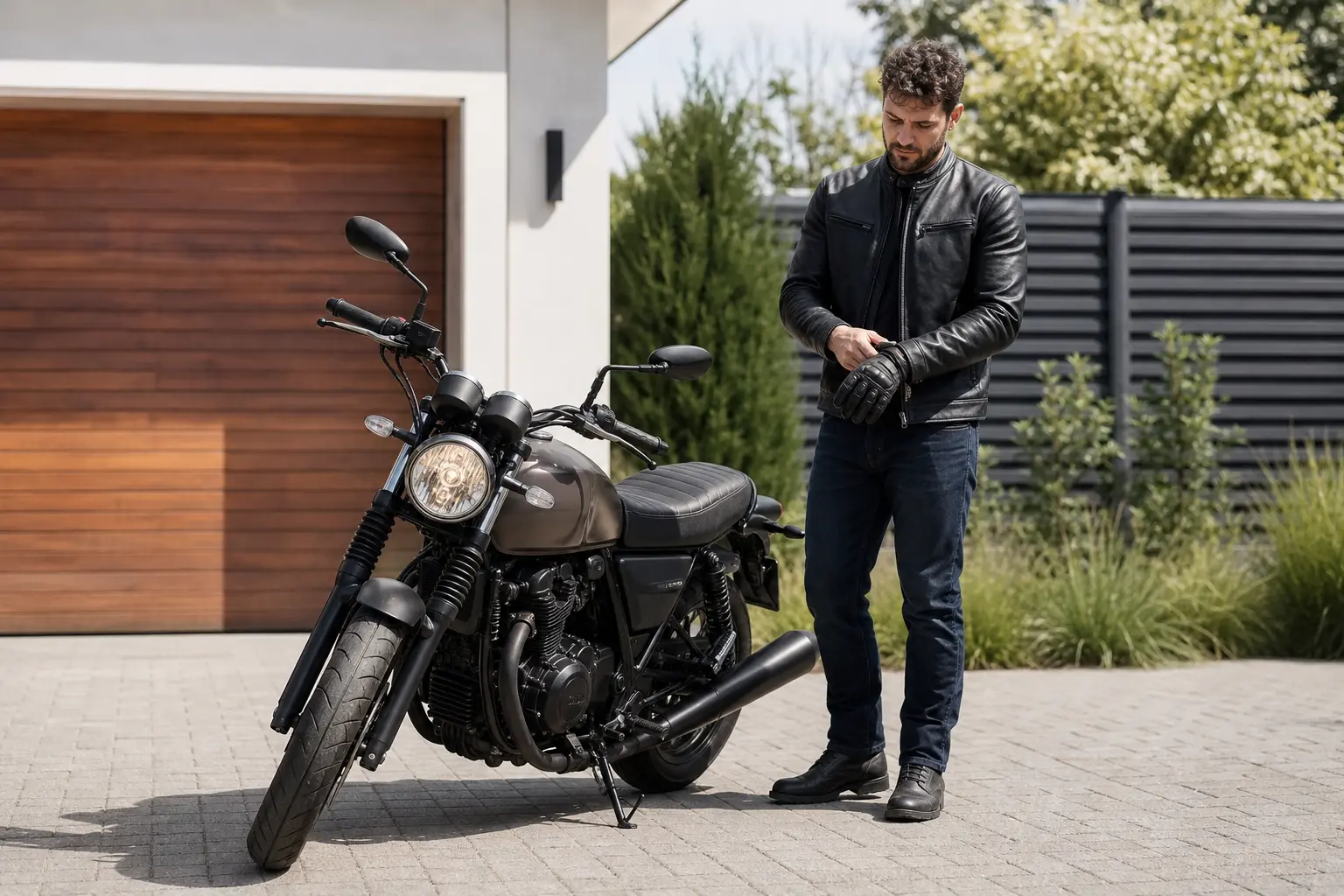
Many riders plan the road portion but not the final minute. Yet arriving at home can add a tight driveway, loose gravel, a slope, a crowded curb, a gate, poor lighting, or the temptation to turn the motorcycle around repeatedly while tired. Look at the destination before pickup if possible.
Choose an arrival space that is stable, legal, sufficiently level for the motorcycle’s parking arrangement, and easy to leave later. Think through whether you will need to back out, negotiate a narrow path, or park on a surface that becomes less predictable when wet. If the home parking situation is demanding, consider ending the first ride at a simpler nearby location and returning with help or more time.
Once parked, do not rush into another ride because you want to “get more comfortable.” Record first impressions while they are fresh: what felt natural, what required attention, which manual pages you need to revisit, and what part of the route you would alter next time. Familiarity grows through repeated, deliberate exposure—not through cramming every riding challenge into day one.
How Vojo Helps
After you arrive, create a motorcycle entry in the Vojo motorcycle maintenance tracker, then log the pickup date, starting mileage, dealer handover notes, first impressions, and the manufacturer’s break-in and initial-service reminders from your exact owner’s manual. Before the next ride, open that record to review the unresolved questions you noted—such as a display feature to read about or a route condition to avoid—and add a simple pre-ride reminder rather than relying on memory.
Download Vojo on the App Store
A Calm First Ride Builds Better Habits
The first ride home is a chance to set the tone for ownership. Start by following the manufacturer’s documentation, use formal training as the foundation for skill, inspect before riding, and make route decisions that leave space for uncertainty. The motorcycle does not need to be challenged on its first day with you, and you do not need to demonstrate anything to anyone.
A low-pressure route, a controlled familiarization stop, protective gear, active scanning, and permission to delay give you a practical margin. That margin is what turns a dealer pickup from a stressful obligation into a manageable first ride.
Sources
1 Motorcycle Safety Foundation, If You Ride A Motorcycle.
2 National Highway Traffic Safety Administration, Motorcycle Safety.
3 Motorcycle Safety Foundation, Why it Helps to SEE.
Quick answers
Frequently asked questions
Should I ride my new motorcycle home from the dealer?
Ride it home only when you are properly licensed, trained for the task, rested, equipped, and able to use a low-demand route in suitable conditions. Delivery, transport, or returning another day are equally valid choices when those conditions are not present.
Where should I practice before riding a new motorcycle in traffic?
Choose a lawful, open, low-traffic controlled area where you will not obstruct pedestrians or vehicles. The aim is basic familiarization with the motorcycle’s fit, controls, instruments, and response—not an improvised high-speed practice session.
Is the shortest route home best for a first motorcycle ride?
Not necessarily. A slightly longer route can be better if it avoids freeway merges, difficult intersections, dense traffic, abrupt lane changes, poor surfaces, or a stressful final parking approach. Favor fewer demanding decisions and more places to stop safely.
What should I ask the dealer before leaving on a new motorcycle?
Ask where to find the official owner’s manual, how to identify the controls and normal instrument indications, what fuel the manufacturer specifies, what break-in and initial-service guidance applies, and whom to contact if a concern arises. Use the manual as the final authority for your model.
What if I become nervous after I have already left the dealer?
Treat that as useful information. Continue predictably until you can stop legally and safely, then reassess without pressure. You can rest, change to an easier route, call for support, or arrange transport. Avoid abrupt turns, rushed lane changes, or continuing merely to meet the original plan.