
Parking a Motorcycle on a Slope or Soft Surface: A Conservative Arrival-and-Exit Plan
Learn how to park a motorcycle on a hill or soft ground with a conservative plan for surface checks, stand inspection, stability, and an easier exit.

Fact-checked against cited official documentation
Reviewed against Fact-checked against Harley-Davidson’s parking guidance on stable surfaces, maneuvering room, stand deployment and hills, plus MSF T-CLOCS stand-condition and retention checks..
Last updated September 30, 2026
Parking a motorcycle on a slope or soft surface is not a test of bravery or precision. It is an arrival-and-exit decision: can you stop with control, support the motorcycle predictably, walk away without uncertainty, and leave later without having to wrestle the bike uphill, downhill, or out of loose ground?
The conservative answer to how to park a motorcycle on a hill is simple: do not commit to a space until you have assessed the surface, the grade, your footing, the motorcycle’s support arrangement, and the direction of your eventual departure. If any one of those looks doubtful, keep moving and choose a flatter, firmer, less complicated place.
That approach matters because “park there” is never the whole task. A space that seems acceptable while rolling past may become a problem when the side stand reaches soft asphalt, a boot slips on gravel, a passenger shifts, the bike settles into warm pavement, or the only exit requires backing a loaded motorcycle uphill. Harley-Davidson’s official parking guidance similarly emphasizes selecting a level, stable surface, leaving room to maneuver when departing, fully deploying the side stand, and checking for wobble before releasing the motorcycle. (harley-davidson.com)
This is intentionally not a universal rulebook for bike orientation. Stand geometry, ground clearance, steering lock, loading, terrain, parking restrictions, and the exact instructions in an owner’s manual differ by motorcycle. Your model’s manual is the controlling source for its stand use, parking instructions, transmission position, and any center-stand guidance. When the manual and a generic habit conflict, follow the manual.
Before building a parking routine, make basic condition checks part of your normal riding preparation. The Motorcycle Safety Foundation’s T-CLOCS checklist specifically includes side-stand and center-stand condition, bending or cracks, retention springs, and stand-pad equipment where fitted. A questionable stand is not something to “work around” on a slope. (msf-usa.org)
Treat the Parking Space as Part of the Ride
Parking risk begins before the motorcycle comes to a stop. A rider who scans the destination only at walking speed has less time and space to decline a bad spot. Instead, look ahead as you enter a lot, roadside pull-off, trailhead, fuel stop, campground, or driveway. Identify the flat, firm areas first, then ask whether you can arrive and depart without an awkward repositioning sequence.
A useful mental model is to evaluate four separate questions:
- Will the tires and your boots have reliable footing while you stop?
- Will the stand contact solid, durable ground and support the parked bike as intended?
- Will the motorcycle remain stable if the ground, temperature, or load changes slightly?
- Can you leave without an unnecessary uphill push, blind reverse move, or tight turn into traffic?
If the answer to any question is “I am not sure,” the conservative choice is another space. A longer walk is usually cheaper than a dropped motorcycle, damaged control, injured ankle, or a difficult departure made worse by traffic and fatigue.
This is also why parking should be considered during route planning. For day rides, note whether likely stops involve gravel overlooks, sloped restaurant lots, hot pavement, grass event fields, beach access roads, or packed-dirt trailheads. For longer travel, add parking conditions to your normal Motorcycle Maintenance Guide routine: a sound motorcycle still needs a sound place to stand.
Read the Ground Before You Enter It
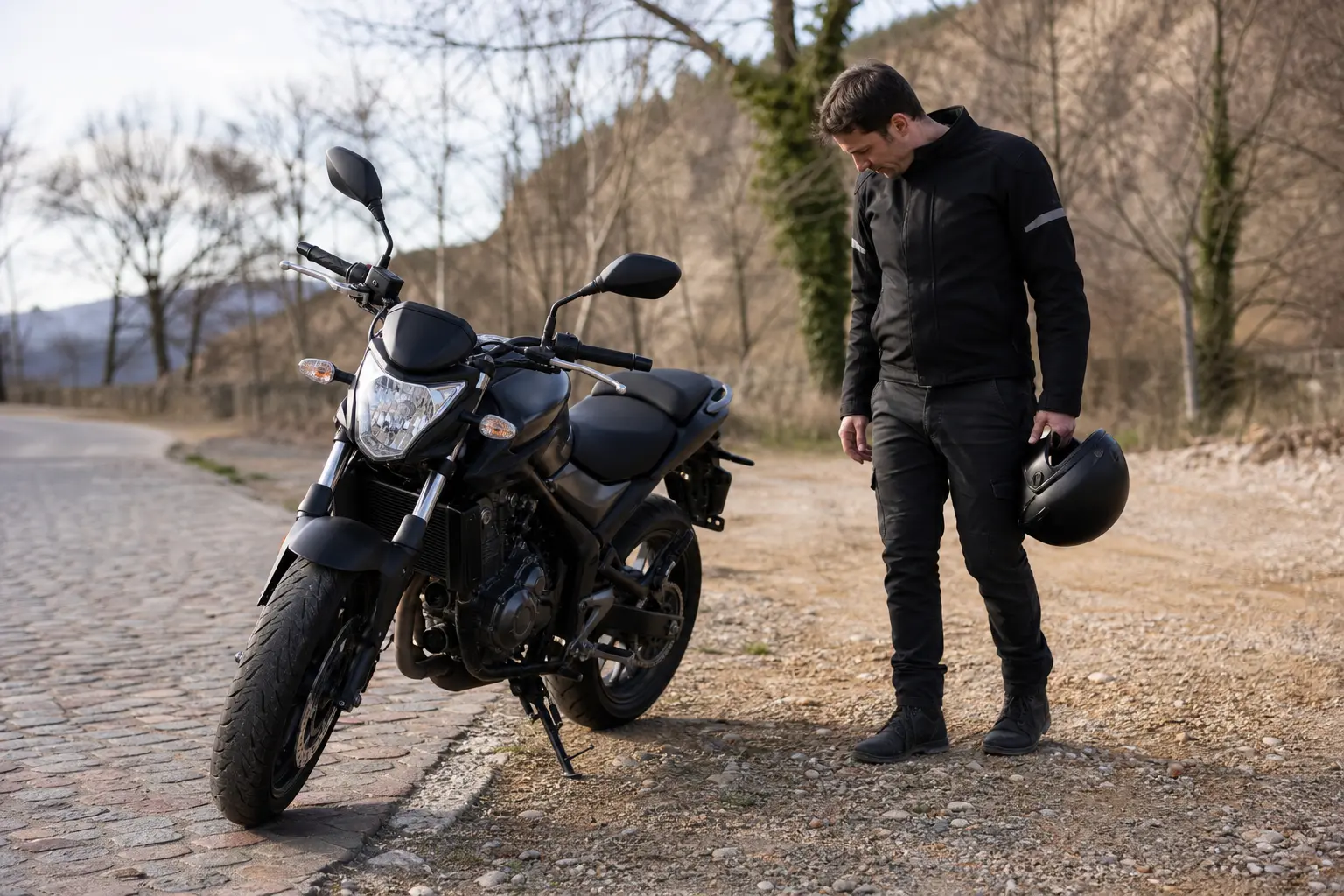
A surface can appear solid from the saddle while hiding the detail that matters most: what is under the tires, your boots, and the stand foot.
Look for obvious changes in texture and color. Loose aggregate, polished concrete, wet leaves, mud, oil-stained pavement, paint, metal covers, deep ruts, potholes, broken asphalt edges, and uneven pavers all reduce predictability. So do surfaces that may change while the motorcycle is parked, including sun-softened asphalt, thawing ground, saturated grass, loose sand, or a shoulder that crumbles toward a drainage ditch.
The right question is not whether another rider could park there. It is whether you can support your motorcycle there today, with its present fuel level, luggage, passenger load, footwear, reach to the ground, and experience level.
| Parking condition | Conservative concern | Better decision or safeguard |
|---|---|---|
| Firm, nearly level pavement | Usually the most predictable option, but inspect for oil, debris, broken edges, and traffic exposure. | Use the space only if it also leaves clear room to walk around and depart. |
| Moderate slope with firm pavement | The bike may be harder to balance at the stop and harder to move on departure. | Pause early, assess your exit, and choose a flatter option if the grade makes you uncertain. |
| Loose gravel or uneven stone | Tires, boots, and stand contact can shift independently. | Prefer a firmer area; do not assume a compact-looking patch will hold. |
| Grass, dirt, sand, or mud | Surface strength can vary beneath the top layer and change with moisture. | Choose a prepared surface or a different location whenever possible. |
| Hot or soft asphalt | A small contact area may sink or tilt as the surface warms. | Use a purpose-made support only when it is stable and compatible with the surface; otherwise relocate. |
| Sloped shoulder beside traffic | The surface and departure path can both be compromised. | Keep looking for a location with more space, firmer footing, and lower traffic pressure. |
A stand support pad or coaster can be useful on an otherwise suitable soft surface, but it is not permission to park anywhere. Harley-Davidson specifically notes using a stand coaster to reduce the chance of a stand sinking into asphalt. (harley-davidson.com) The practical limit is important: a pad does not correct a steep slope, stabilize loose gravel, repair damaged ground, compensate for a faulty stand, or make a poor exit plan good.
Do not improvise with an object that may crack, slide, sink, or become difficult to retrieve. If you cannot place a suitable support safely and without rushing, the spot is not suitable. Avoid making the parking decision depend on a thin, unstable, or unknown object scavenged from the ground.
Build an Exit Plan Before the Engine Is Off
The best parking position is not simply the one that holds the motorcycle upright. It is the one that lets you leave with controlled options.
Before rolling into a space, picture the first few moments of departure. Where will you stand? Which direction will the motorcycle need to move? Is there clear ground around both wheels? Does the front wheel point toward a curb, a drop, a drain, another motorcycle, or a parked vehicle? Will you need to back the motorcycle uphill? Is there enough room to straighten and roll forward without a sharp, low-speed turn?
A conservative parking plan minimizes the need to move a heavy motorcycle manually against gravity. That is particularly important when you are alone, carrying luggage, tired after a long ride, wearing stiff boots, or parked where traffic may pressure you to hurry. If leaving later appears likely to require an uphill reverse move or a complex shuffle in loose ground, select a different space while you still have momentum and time.
This is not an argument for a single universal orientation on every hill. Surface shape and each motorcycle’s layout vary too much. It is an argument for choosing an orientation that gives the motorcycle stable support and gives you an uncomplicated departure. Harley-Davidson’s parking guidance recommends choosing a space with room to maneuver when leaving and advises hill riders to look for firm footing; those principles are more durable than copying a position without reading the actual site. (harley-davidson.com)
If you arrive with a passenger, make the plan before the stop. A passenger movement at the wrong moment can change balance when the bike is already affected by slope or loose ground. Use a clear, calm agreement about when they dismount, where they should stand, and when you are ready for them to remount. If the surface does not give both of you secure footing, find another spot.
Use a Slow, Deliberate Arrival Sequence
Once you have selected a location, remove hurry from the process. Signal appropriately where traffic is present, reduce speed smoothly, and approach only as far as needed to confirm the final position. Harley-Davidson recommends signaling parking intent, braking gradually, and keeping the rider’s feet firmly planted at the stop. (harley-davidson.com)
On a slope or compromised surface, avoid turning a minor parking decision into a low-speed correction contest. Stop, assess, and reposition before committing if you need more information. It is better to roll on and make a second approach than to force the motorcycle through an uncertain turn with a foot down on loose material.
At the final stop, focus on control rather than speed:
- Keep your attention on footing, surrounding traffic, and the area immediately beneath the motorcycle.
- Avoid stopping with a boot where it may slide, sink, catch on an edge, or disappear into a rut.
- Keep passengers and bystanders clear until the motorcycle is supported and stable.
- Do not rush to dismount because someone is waiting behind you; move to a safer location if traffic pressure makes the stop unsafe.
- If the bike feels unexpectedly heavy, off-balance, or difficult to hold, do not try to save the original plan through force. Regain control and choose another location.
The point is not to make every stop look effortless. The point is to avoid allowing a small surprise at zero speed to become a fall.
Confirm the Support System Before You Let Go
Your stand, its mounting, its spring or retention arrangement, and the surface beneath it are all part of the parking system. They deserve the same attention you give a route hazard.
Follow the exact parking and stand instructions in your owner’s manual. On motorcycles equipped with a side stand, Harley-Davidson advises fully extending the stand, leaning the motorcycle onto it, and checking for wobble before releasing it. (harley-davidson.com) The MSF inspection checklist calls for checking side stands and center stands for cracks or bending and checking that their springs are present and retain the stand correctly. (msf-usa.org)
That means a safe parked-bike check is not a kick at the stand followed by walking away. Pause and visually confirm:
- The stand is in the intended fully deployed position for your motorcycle.
- Its foot is contacting an area that appears firm and not likely to crumble, slide, or sink.
- The motorcycle is resting in a stable attitude rather than barely balanced.
- Nothing is trapped under the stand or tire that could move as weight settles.
- The bars, luggage, cover, and nearby objects are not creating a new instability or blocking your return.
- The bike does not rock, shift, or appear to be loading the stand awkwardly.
Do not attempt to straighten, bend, modify, shim, weld, or otherwise repair a stand at the roadside. If you see damage, missing retention hardware, abnormal movement, or an unexplained change in how the motorcycle rests, treat that as a reason not to rely on the stand and arrange appropriate inspection according to the manufacturer’s guidance.
A transmission position may also be part of a manufacturer’s parking instructions. Harley-Davidson recommends first gear as part of its parking guidance, including on hills. (harley-davidson.com) But riders should not turn that into an all-model claim: consult the exact manual for your machine, especially if it has an automatic, semi-automatic, electric drivetrain, center stand, unusual parking brake arrangement, or manufacturer-specific procedure.
Clearly Titled Checklist: Hill and Soft-Surface Parking Go/No-Go Check
Use this checklist before you commit to a challenging parking space.
Before entering the space
- I can see a firm, stable area for both tires, my boots, and the stand foot.
- I have looked for loose gravel, wet or polished areas, soft asphalt, ruts, holes, edges, debris, and drainage paths.
- The slope does not make me feel rushed, stretched, or unsure of my footing.
- I have enough space to arrive without a forced low-speed turn or abrupt stop.
- I have a practical departure path that does not depend on backing uphill or squeezing past hazards.
- I have considered passengers, luggage, fuel load, weather, and fatigue.
While stopping and parking
- I am moving slowly and smoothly, with time to abandon the space if it feels wrong.
- My feet have dependable footing before I transfer the motorcycle’s weight.
- I have followed my owner’s manual for the correct stand and parking process.
- The stand is fully deployed as intended and is on solid contact.
- I have checked that the motorcycle does not wobble or settle unpredictably before I release it.
- If the surface is soft but otherwise suitable, any purpose-made support is positioned securely and is not being used to compensate for a steep or unstable location.
Before walking away
- I can return to the motorcycle without stepping into traffic, mud, loose stone, or a blind area.
- Nothing around the motorcycle can catch the bars, interfere with the stand, or block the departure line.
- The motorcycle’s stand condition is normal: no visible damage, abnormal bend, or retention concern.
- I have secured the motorcycle according to my needs without destabilizing it.
- If any item remains uncertain, I am moving the motorcycle now rather than hoping it will be fine later.
Know When the Correct Answer Is “Park Somewhere Else”
Riders sometimes stay committed to a poor location because they have already signaled, friends have parked nearby, the last open space is inconvenient, or a destination is only a few steps away. Those reasons do not improve ground conditions.
Choose another location when the stand might sink, the ground is visibly loose, the bike cannot rest with a comfortable margin of stability, your boot placement is uncertain, the grade makes a departure unclear, or traffic forces a rushed decision. Also relocate if you need to lean the motorcycle farther than feels normal just to reach support, if the bike seems loaded differently than expected, or if you cannot verify a stable place for a passenger to stand.
A minor inconvenience is an acceptable trade for a more controlled stop. Park farther away. Wait for another vehicle to leave. Use a different entrance. Ask a companion to watch traffic while you make a safer approach. If conditions are beyond your current comfort or skill, choose a location that removes the challenge rather than trying to solve it under pressure.
That judgment remains useful even on familiar ground. Driveways change with rain. Gravel shifts. Asphalt softens in heat. A routine fuel stop can be busy at a different time of day. A parking area that worked with an unladen bike may feel different with camping gear or a passenger. Conservative parking is not about memorizing a “correct” angle; it is about reassessing the support and exit conditions every time.
Leaving Without Creating a Second Parking Problem

Return to the motorcycle with the same attention you used on arrival. Do not assume the ground is unchanged. Look for fresh rain, settled asphalt, loose material displaced by another vehicle, a cover caught in the stand area, or an obstacle that appeared after you parked.
Before lifting the motorcycle from its stand, decide where it must go first. Clear loose luggage, remove locks or supports, and make sure your intended travel path is genuinely open. If the exit plan now seems uncertain, pause. There is no requirement to leave immediately just because you are standing next to the bike.
Avoid trying to muscle the motorcycle through a difficult manual repositioning move on a slope or soft surface. If you cannot confidently manage the required movement, seek assistance or change the departure plan. Ask for help from a capable person only if they understand that you are asking for controlled support, not an abrupt pull on the bars or luggage. Keep bystanders away from pinch zones and avoid having anyone stand downhill or directly in the likely path of the motorcycle.
Once clear of the parking space, take a moment to verify normal control before rejoining traffic. This is especially valuable after parking on dust, gravel, grass, or damp ground, where footwear or tires may have picked up material. Let the motorcycle’s condition, your surroundings, and the owner’s manual—not impatience—set the pace.
Practice the Decision, Not Just the Maneuver
Confidence on hills and low-traction parking surfaces comes from repeated, low-pressure practice. The right place to practice is a controlled, open area with minimal traffic, known ground conditions, adequate runoff, and no audience pressure. Harley-Davidson likewise recommends practicing parking maneuvers in a safe open area and developing familiarity with hills and tighter spaces progressively. (harley-davidson.com)
Practice should improve your ability to recognize a bad parking choice early. Start by walking around a parked motorcycle and naming what makes a location acceptable or unacceptable: slope direction, stand contact, loose material, available foot placement, traffic exposure, and exit room. Then build skill gradually with easy locations rather than treating a steep or soft surface as the first lesson.
Formal rider training can also provide a structured setting for low-speed control and judgment. Training does not eliminate the need to assess every real-world parking surface, but it can help you slow the situation down mentally and make a no-go choice sooner.
How Vojo Helps
Use Vojo to turn this advice into a repeatable arrival workflow: before a ride, create a short parking note in your motorcycle profile for planned stops that may involve hills, gravel, grass, or hot pavement; add reminders such as “check firm stand contact” and “preserve a forward exit”; then, after the ride, record any parking issue or stand concern in your service history so it is not forgotten before the next trip. Pair that routine with the Motorcycle Maintenance Tracker to schedule a follow-up inspection when a stand, spring, pad, or mounting area seems abnormal.
Quick answers
Frequently asked questions
Should I park a motorcycle on a hill?
Only when the location gives you firm footing, stable stand support, and a clear departure plan. A flatter, firmer alternative is the better choice whenever the slope or exit creates doubt. Follow the parking instructions in your exact owner’s manual.
Can I park a motorcycle on grass, dirt, gravel, or sand?
These surfaces can be less predictable than prepared pavement because tires, boots, and the stand foot may move or sink. Prefer firm, prepared ground. If a soft surface cannot be avoided, assess it carefully and relocate if the support or departure path is uncertain.
Should I leave my motorcycle in gear when parked on a hill?
Harley-Davidson recommends first gear in its parking guidance, including on hills. However, parking instructions vary by motorcycle and drivetrain, so use your owner’s manual as the final authority for your specific model. ([harley-davidson.com](https://www.harley-davidson.com/us/en/content/expert-advice/how-to-park-a-motorcycle.html))
What should I inspect on a motorcycle side stand?
Look for visible cracks or bending, confirm that retention springs are present and functioning normally, and check any fitted stand pad. The MSF T-CLOCS checklist identifies these as stand inspection items. If the stand appears damaged or behaves abnormally, do not rely on it until the motorcycle has been appropriately inspected. ([msf-usa.org](https://msf-usa.org/documents/library/t-clocs-pre-ride-inspection-checklist/))
Can a stand pad make soft ground safe for parking?
A purpose-made pad may help distribute load on an otherwise suitable surface, but it does not solve a steep grade, loose ground, damaged stand, poor footing, or difficult exit. Treat it as a limited safeguard, not a guarantee.