
Motorcycle Helmet Safety: Fit, Certification, and When to Replace It
Choose a motorcycle helmet by starting with DOT compliance, then confirming secure fit, intended use, condition, and a sensible replacement plan.
Fact-checked against cited official documentation
Reviewed against Fact-checked against NHTSA FMVSS 218 consumer guidance, MSF rider-course gear requirements, and Harley-Davidson helmet manuals on fit, use, care, and post-impact replacement..
Last updated August 31, 2026
A motorcycle helmet is a last line of defense—not a license to take more risk
A motorcycle helmet is important because it is designed to reduce head-injury risk in a crash. It cannot make a crash safe, protect every part of the body, or guarantee prevention of brain, neck, or spinal injury. That limitation matters: the right response to having good gear is still to ride within your sight distance, skill level, and the conditions—not to treat certification labels or premium materials as a promise of invulnerability. Harley-Davidson’s helmet guidance makes the same point directly: a helmet can reduce or prevent some injuries, but no helmet can protect against every possible impact or injury. (serviceinfo.harley-davidson.com)
The useful question is not, “Which helmet is indestructible?” It is: Which helmet is legitimately certified for my road use, fits my head correctly, suits the way I ride, and remains in serviceable condition?
For riders in the United States, start with a helmet made for motorcycle use and marked with the Department of Transportation (DOT) symbol. NHTSA says the symbol on the outside rear of a helmet is the manufacturer’s certification that it meets Federal Motor Vehicle Safety Standard (FMVSS) No. 218. NHTSA does not pre-approve each helmet before sale; manufacturers self-certify and NHTSA conducts marketplace testing and enforcement. (nhtsa.gov)
That makes a careful buying process more valuable than chasing a badge, an influencer’s favorite shell material, or a lowest-price listing.
Start with legal, motorcycle-specific protection
If you ride on public roads in the United States, put DOT compliance first. Look for the DOT mark on the outside rear of the helmet, then inspect the permanent manufacturer labeling inside or on the helmet. NHTSA says compliant helmets are required to carry identifying information including the manufacturer or brand, model designation, size, and certification information. A loose DOT decal supplied separately is not proof that an otherwise noncompliant helmet meets FMVSS No. 218. (nhtsa.gov)
A DOT mark alone is not a reason to abandon normal judgment. Buy through a reputable retailer, verify that the model and size are clearly identified, and be skeptical of listings that seem designed to imitate motorcycle helmets while emphasizing how thin, tiny, or ultra-light they are. NHTSA warns that unsafe novelty helmets may lack a stiff foam liner, use weak retention hardware, or be conspicuously thin and light. (nhtsa.gov)
For a road rider, helmet style should follow the riding job:
| Riding use | Practical helmet starting point | What to confirm before buying |
|---|---|---|
| Daily street or highway riding | Full-face helmet | DOT mark, clear forward/side vision, secure chin strap, comfortable ventilation and shield operation |
| Touring or commuting with frequent stops | Full-face or modular helmet | Follow the helmet maker’s instructions for use; confirm fit with the chin section closed and latched |
| Dual-sport travel | Dual-sport helmet | Compatibility with your eye protection, stable fit, and visibility in your normal riding posture |
| Motocross or trail riding | Off-road helmet and goggles designed to work together | Correct goggle seal and retention; use only where the helmet’s intended purpose and local rules fit your ride |
| Passenger use | A separate, correctly sized helmet | Never assume the rider’s spare helmet fits another person safely |
NHTSA describes full-face, modular, dual-sport, off-road, open-face, and half-helmet categories as having different coverage and use characteristics. It specifically notes that half and open-face designs have no chin guard and provide only some protection. That does not make one silhouette automatically right for every ride, but it is a meaningful coverage tradeoff to understand before purchase. (nhtsa.gov)
Fit matters before features
A helmet can have legitimate certification and still be the wrong helmet for you if it is loose, unstable, painful, or blocks your usable view. Fit is not a cosmetic preference. It determines whether the helmet stays where it belongs and whether you will actually wear it properly for the entire ride.
Begin with the manufacturer’s sizing chart for the exact model. Measure around the head just above the eyebrows and around the fullest point at the back, then use that measurement only as a starting size. NHTSA advises that a properly sized helmet should feel slightly tight with even pressure, without painful pressure points, and should not move when you shake your head. (nhtsa.gov)
Try the helmet on correctly: use the chin straps to pull it fully into place rather than forcing it on by the shell. The crown should contact the interior; the cheek pads should contact the cheeks on applicable designs; and there should not be empty space around the brow. Harley-Davidson’s helmet manual also advises checking your field of vision in the positions you use while riding—left, right, up, and down—before purchase. (serviceinfo.harley-davidson.com)
A good in-store fit test has four parts:
- Even pressure: The helmet should be snug around the crown and cheeks, but it should not create a sharp, localized hot spot.
- Movement check: With the chin strap fastened, try to rotate the helmet and move it front to back. Your skin should move with the liner; the helmet should not slide independently around your head.
- Roll-off attempt: Hold the rear edge and gently try to roll the helmet forward. If it can be rolled off easily, reject that fit.
- Time check: Wear it indoors for 30 to 45 minutes before its first ride. NHTSA recommends this period because pressure points may only become clear over time. (nhtsa.gov)
Do not solve pressure points by cutting, shaving, compressing, or otherwise altering the impact liner. NHTSA cautions that changes beyond manufacturer-provided replaceable cheek pads or liners can compromise helmet integrity and may void the warranty. Use only fit components and adjustment methods the helmet manufacturer approves for that model. (nhtsa.gov)
Choose for your normal riding posture—not an imagined one
A helmet that feels acceptable while standing in a store may not work once you are seated on your motorcycle. Your windscreen height, bar position, riding posture, eyewear, and preferred route all affect comfort and usable vision.
Before removing tags, sit on your motorcycle while stationary. Adopt your ordinary posture, then your common checks: mirrors, instruments, shoulder checks, and a slight tuck if you ride at highway speed. Verify that the eye port does not interfere with those views. If you use prescription glasses, sunglasses, earplugs, a communications system, or goggles, test compatibility without forcing components into the liner or trapping pressure against the temples.
Also check the face shield. A shield marked for daytime use only should not be used in darkness or low visibility. Harley-Davidson’s helmet instructions make that warning explicit and also direct riders to use a sun shield only with the main visor closed where the helmet’s design requires it. (serviceinfo.harley-davidson.com)
This is manufacturer-first safety guidance in practice: the helmet’s included manual and labels control how its shield, vents, liners, retention system, and optional accessories are intended to work. A generic internet workaround is never a better authority than the instructions for the product in your hands.
Treat used, modified, and crash-damaged helmets cautiously
A used helmet can be difficult to assess because the protective liner and comfort components may already be shaped to someone else’s head, while prior impact history may be unknown. Harley-Davidson’s helmet manual advises against buying used or borrowing another person’s helmet for this reason. (serviceinfo.harley-davidson.com)
Avoid attaching unapproved accessories, drilling the shell, modifying the retention system, or substituting random hardware. NHTSA identifies rigid exterior projections as a compliance concern, while Harley-Davidson’s helmet guidance directs owners to use original or manufacturer-approved replacement parts and not to disassemble or modify the product outside the manual’s instructions. (nhtsa.gov)
After a crash, fall, or other impact, do not make a return-to-service decision based only on whether the paint looks good. The helmet maker’s instructions take priority. For example, Harley-Davidson states that the full protective function cannot be guaranteed after an accident or impact because internal or outer-shell damage may not be visible, and directs replacement after a fall, accident, or other violent impact. (serviceinfo.harley-davidson.com)
For any helmet, stop using it immediately if you find a cracked shell, damaged or loose retention hardware, a compromised chin strap, damage to the impact liner, or a shield/closure problem that obstructs vision or prevents secure use. Contact the manufacturer or an authorized dealer when the manual does not make the answer clear. Do not rely on a forum consensus to overrule the brand’s inspection and replacement instructions.
Motorcycle Helmet Pre-Ride Checklist
Use this short check before a ride, after cleaning, and after the helmet has been dropped or handled roughly:
- Confirm the helmet is the correct one for today’s riding environment and intended use.
- Check the DOT symbol on the rear and the permanent manufacturer/model/size label.
- Inspect the shell for cracks, deep gouges, loose trim, or unauthorized attachments.
- Look inside for damaged, loose, contaminated, or visibly crushed liner material.
- Fasten and tug-test the chin strap and buckle; confirm the strap lies flat and is not frayed.
- Operate the face shield and vents; make sure your view is clear and unobstructed.
- Confirm the helmet stays snug when you shake and turn your head.
- Use the helmet manufacturer’s manual—not household improvisation—for cleaning agents, liner removal, replacement parts, and post-impact decisions.
Build protection around the helmet
A helmet is one part of a riding system. NHTSA recommends additional protective clothing and eye protection, while the Motorcycle Safety Foundation’s Basic RiderCourse requires a DOT-compliant helmet, eye protection, long sleeves, long pants, over-the-ankle footwear, and full-finger gloves for its on-motorcycle activities. (nhtsa.gov)
That does not mean every item eliminates injury. It means a rider can reduce avoidable exposure through gear, training, sober decision-making, controlled speed, room to react, and a motorcycle that is inspected before use. If you are new to riding or returning after time away, a hands-on course is a better safety upgrade than assuming a helmet purchase alone changes your risk. MSF’s Basic RiderCourse includes supervised practice in braking, shifting, turning, swerving, and low-speed control. (msf-usa.org)
How Vojo Helps
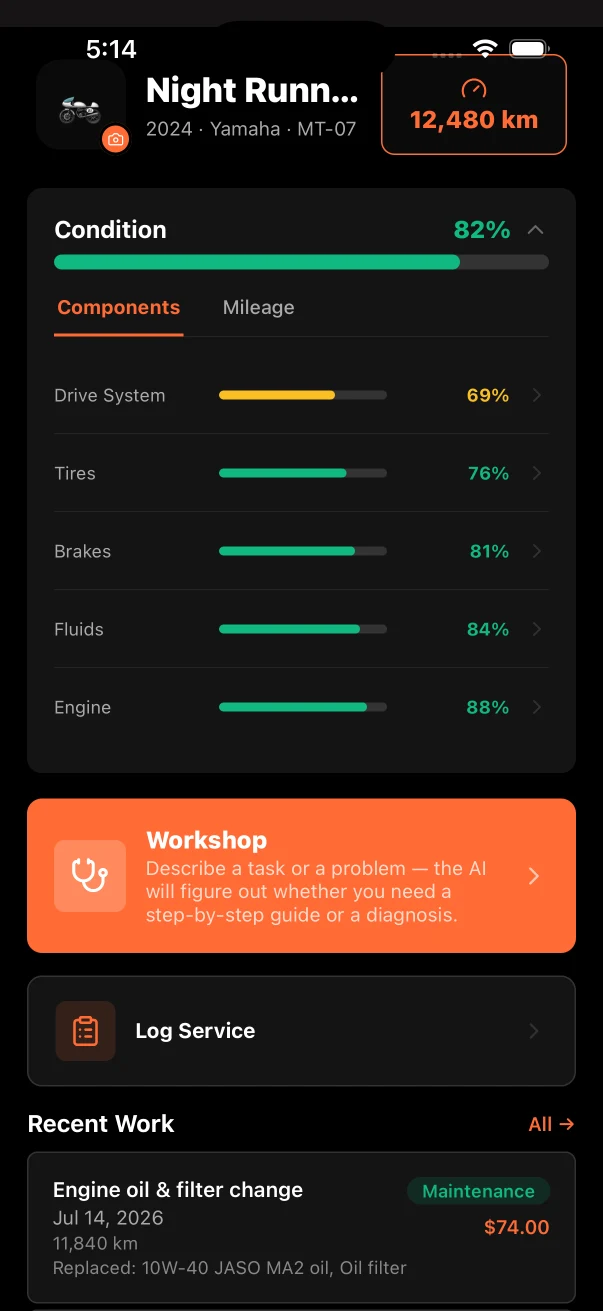
Create a recurring “Helmet Inspection” task in your motorcycle maintenance tracker before your first ride of each month. Add the checklist items above—shell, liner, strap, shield, fit, and manufacturer-manual review—then attach a photo of the helmet’s labels and note any drop, crash, replacement-part purchase, or fit change. If an inspection reveals damage or the helmet maker directs replacement after an impact, close the task as “do not ride with this helmet” and record the replacement date for future reference.
Inside Vojo
Keep recurring safety checks in the same riding record
Quick answers
Frequently asked questions
Does a DOT sticker mean NHTSA approved my exact helmet?
No. In the U.S., the DOT symbol is the manufacturer’s certification that the helmet meets FMVSS No. 218. NHTSA uses a self-certification system and conducts marketplace testing and enforcement rather than approving every helmet before sale.
How tight should a motorcycle helmet be?
It should feel slightly tight with even pressure, without sharp pain or pressure points. With the strap fastened, it should not shift independently when you shake or turn your head. Follow the exact model’s sizing chart and fitting instructions.
Should I buy a helmet one size larger for a balaclava or comfort?
No. Start with the fit specified by the helmet manufacturer. A helmet that moves on your head is not a correct fit. If you need cold-weather gear, use only thin, compatible items and re-check fit; do not size up casually.
Can I modify the liner to remove a pressure point?
Do not cut, shave, compress, or otherwise alter the liner. NHTSA warns that changes beyond manufacturer-provided fit components can compromise integrity. Try another head shape or model instead.
When should I replace a motorcycle helmet after a fall?
Follow the helmet manufacturer’s manual. Harley-Davidson’s helmet guidance, for example, says protective function cannot be guaranteed after an accident or impact and directs replacement after a fall, accident, or other violent impact. If there is visible shell, liner, strap, or retention damage, stop using it immediately.