
Motorcycle Fuel-Hose Aging: Cracks, Chafing, and When Inspection Should End the Ride
Learn how to inspect aging motorcycle fuel hoses for cracks, chafing, leaks, and routing concerns—and when a visual finding means you should stop riding.
Fact-checked against cited official documentation
Reviewed against Fact-checked against MSF’s T-CLOCS fuel-line and leak inspection framework and its guidance on pre-ride maintenance and equipment failures..
Last updated October 29, 2026
Fuel-hose aging is easy to overlook because it often starts as a visual change rather than a dramatic breakdown. A hose may look dull, stiff, rubbed, swollen, or lightly cracked before fuel appears on the floor. That early stage matters: a fuel-system concern can change from something you document for service into a reason to stop the ride.
This guide focuses on motorcycle fuel hose cracks inspection before riding. It is not a hose-replacement tutorial, a diagnosis of a particular motorcycle, or permission to work around a pressurized or hot fuel system. The safe question is narrower and more useful: what can you observe while the motorcycle is parked, and which findings should end the ride until the manufacturer’s service information or a qualified technician has been consulted?
The Motorcycle Safety Foundation’s T-CLOCS pre-ride inspection checklist specifically brings fuel lines, fuel valves, and fuel-related leaks into a pre-ride inspection. Its broader riding guidance also treats routine inspection and equipment condition as part of responsible risk management. Those principles support a conservative approach: notice deterioration early, avoid turning a visual check into an improvised repair, and do not ride when fuel-system integrity is uncertain.
Why Fuel-Hose Condition Deserves an Early Check
A fuel hose is not merely a piece of rubber that carries liquid. Its surroundings, routing, connections, heat exposure, vibration, movement, and the motorcycle’s fuel-system design all affect how a visible defect should be interpreted. The same-looking line may have a different purpose on a carbureted motorcycle, a fuel-injected motorcycle, or a model with evaporative-emissions plumbing.
That is why generic internet advice cannot establish a replacement interval or confirm that a particular hose is suitable. Manufacturer instructions and model-specific service information come first. If your owner’s manual gives a fuel-system inspection requirement, follow it. If a warning appears in a service bulletin or maintenance schedule, use the manufacturer’s direction rather than a universal age rule.
A pre-ride inspection can still identify useful clues. Look for a change from the hose’s normal appearance, evidence of contact with another component, dampness, staining, an unusual fuel smell, or a line that appears displaced. You are not proving the hose is safe; you are screening for reasons not to ride and recording information for the next decision.
Fuel concerns deserve extra caution because a small visible change may not reveal the full condition inside the hose or at its connection. A dry exterior does not prove that an aging line has no internal deterioration. Conversely, a surface mark may be cosmetic, but a rider cannot reliably classify every mark without knowing the hose construction and its intended location. When the finding is ambiguous, the safer outcome is qualified inspection rather than a test ride.
What Aging, Cracking, and Chafing Can Look Like
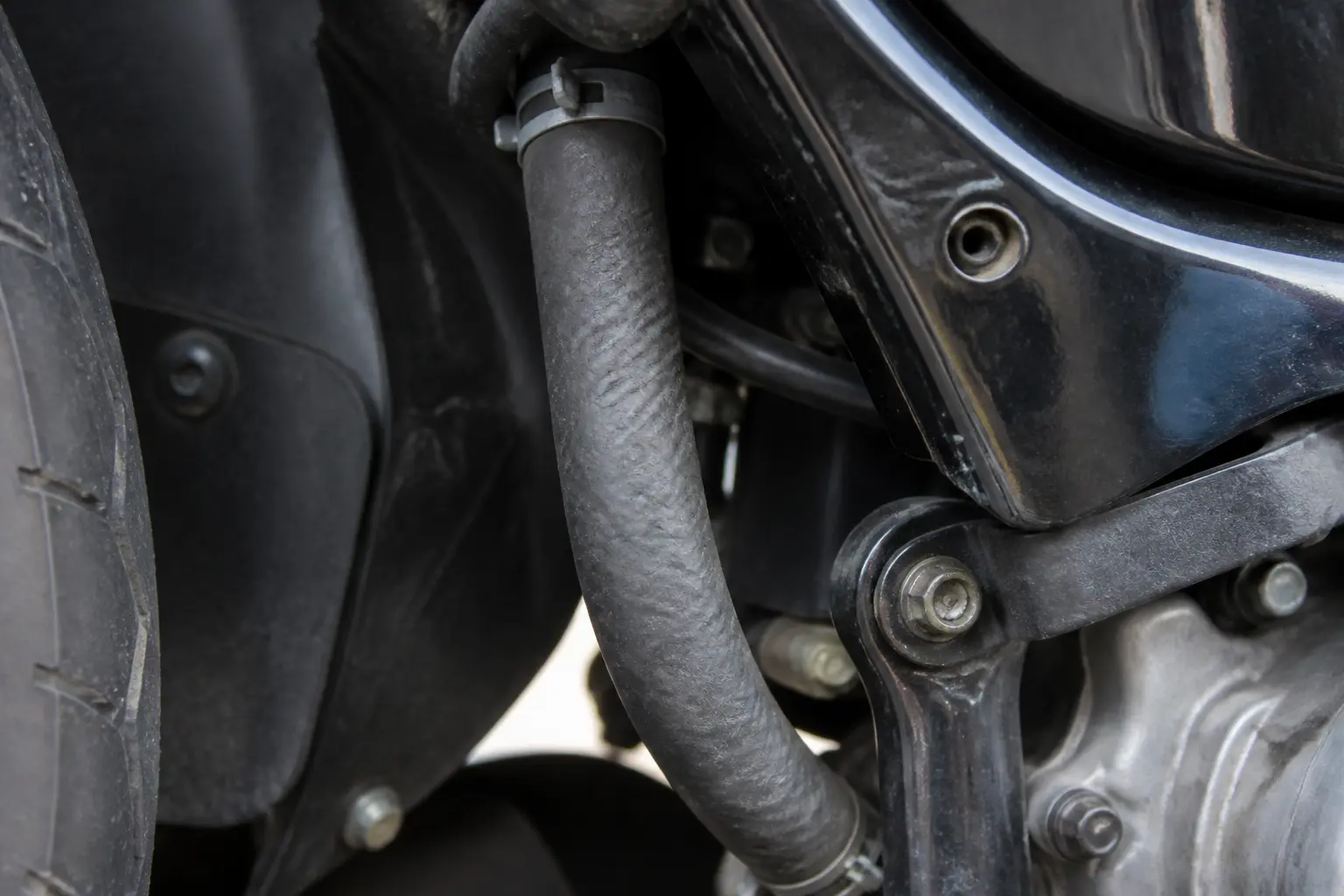
Aged fuel hoses do not all fail in the same visible way. Use the following descriptions as observation categories, not as a substitute for the manufacturer’s inspection criteria.
| Visible finding | What it may suggest | Conservative next step |
|---|---|---|
| Fine surface lines or checking | Material aging, environmental exposure, or flex-related deterioration | Do not assume it is harmless; photograph it and arrange model-specific inspection |
| A cut, split, or opening | Direct loss of hose integrity | Do not start or ride the motorcycle; arrange qualified service |
| Wetness, droplets, or fuel staining | A possible active or recent leak at the hose, fitting, valve, or nearby component | Stop the ride and keep ignition sources away while arranging help |
| Shiny rubbed area or flattened section | Contact, compression, or movement against another part | Do not reposition or secure it by guesswork; have routing assessed |
| Swelling, softening, unusual stiffness, or distortion | Material or heat-related change, fluid compatibility concern, or age | Treat as a service concern; use manufacturer-approved parts only |
| Hose displaced from its expected path | Routing, support, or retention problem | Do not ride if it can contact hot, moving, or sharp parts |
| Fuel smell without visible wetness | Possible seepage, vapor-system concern, spill, or another source | Ventilate safely, avoid starting the engine, and arrange inspection |
These categories overlap. For example, a hose can be both chafed and cracked, or a fitting can leak while the hose itself looks intact. Avoid making the visible hose the only suspect. The fuel system includes connections, valves, tank interfaces, and other model-specific components. A smell or stain should be treated as a system-level warning until its source has been established safely.
A particularly important distinction is between surface discoloration and material damage. Dust, old cleaner, or a shadow can make a hose look worse than it is. However, cleaning aggressively, flexing the hose to “see whether the crack opens,” or wiping a damp area and then restarting the motorcycle can create risk and destroy useful evidence. A visual inspection should remain visual.
Motorcycle Fuel Hose Cracks Inspection: A Parked-Bike Method
Perform this check in a well-ventilated place, with the motorcycle stable and cool enough for a safe visual assessment. Follow the owner’s manual for parking position and any model-specific precautions. Do not smoke, create sparks, or use an open flame. Do not remove fuel-system components merely to see better.
1. Establish the baseline
Before interpreting a mark, identify what normal looks like on your motorcycle. Use the owner’s manual, the maintenance section, and manufacturer diagrams if they are available. Note the general path of visible fuel lines, the locations of valves or fittings, and any protective covering or supports. A photograph from a normal inspection can make later changes easier to recognize.
Do not rely on a photograph from another model. Two motorcycles from the same manufacturer may route fuel-system parts differently, and an aftermarket modification may alter the original arrangement.
2. Look without disturbing the system
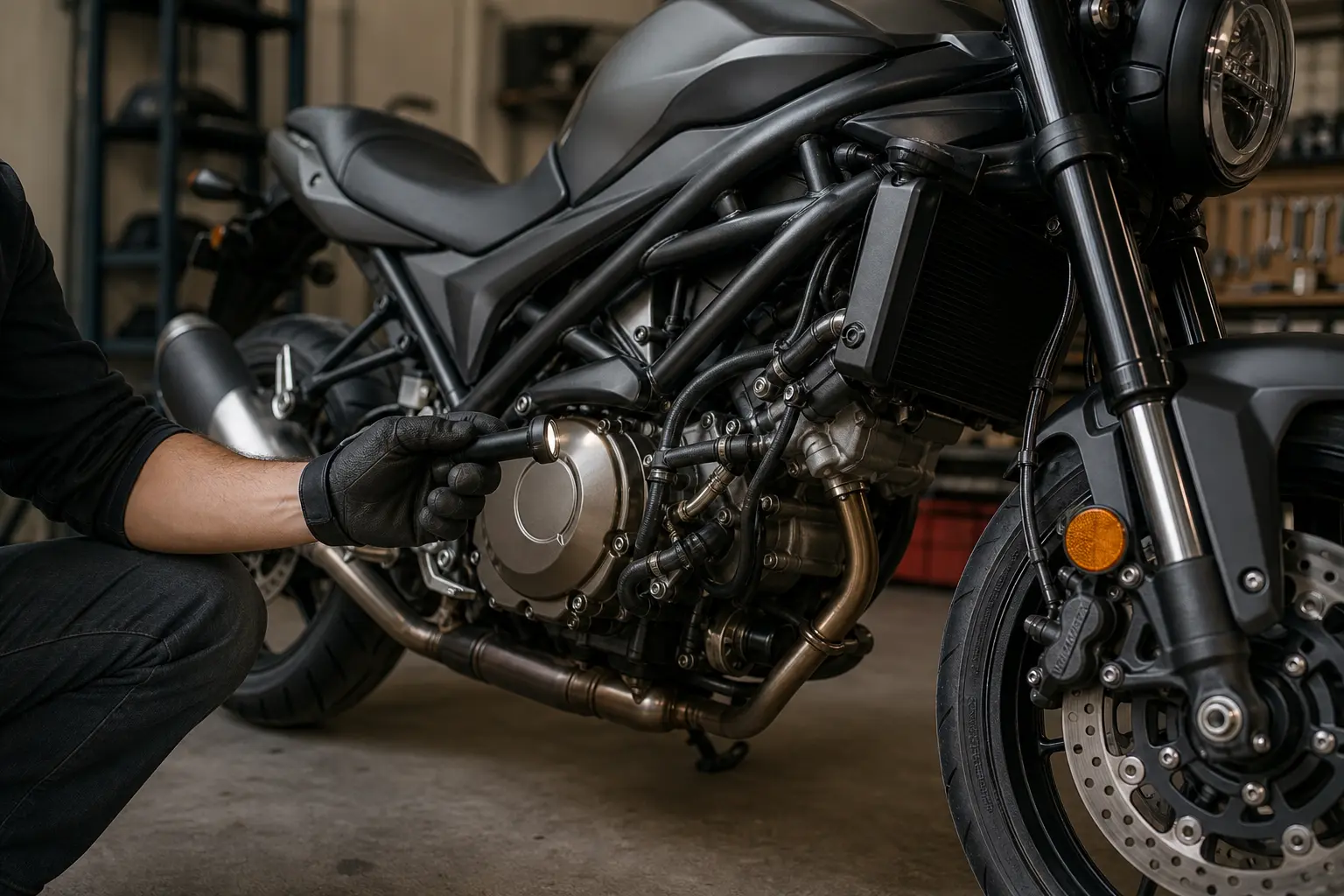
With the motorcycle parked securely, inspect the visible lines from more than one angle. Look for cracks, cuts, abrasion, flattening, swelling, discoloration, exposed reinforcement, loose retention, and signs that a line has moved. Check the areas where a hose approaches the tank, engine, frame, fuel valve, filter, or other fittings, but do not pull on connections or bend a line for access.
Use a light only in a way that does not introduce heat or sparks. If visibility is poor, improve the environment rather than forcing the inspection. A mirror or camera can help you observe a hidden area, but it does not make a concealed defect safe to ignore.
3. Trace the surroundings
Chafing is a relationship between the hose and something near it. Look for evidence of repeated contact with a bracket, frame edge, cover, wiring, cable, fastener, or moving part. Also consider heat exposure near the engine or exhaust area. The visible mark may be the result of a routing problem, but the correct correction is model-specific. Do not pull the hose away, add tape, install an improvised tie, or change its path without proper guidance.
The goal is to document the concern, not to redesign the motorcycle at the roadside.
4. Check for evidence of fuel
Look for wetness, a glossy patch, staining, residue, or an odor that is stronger than expected. Do not use your fingers to identify an unknown liquid. Do not taste or deliberately sniff closely. If you suspect fuel, move people away from ignition sources and follow the motorcycle manufacturer’s safety guidance. Avoid starting the engine to reproduce the concern.
A smell after refueling may have a benign explanation, but it can also indicate a spill, loose cap, leak, or vapor-system issue. Context matters: where the smell is strongest, whether it persists, and whether there is visible wetness are useful facts for a technician. They are not reasons to perform a live test ride.
5. Compare, record, and stop
Take clear photographs without removing guards or components. Record when you noticed the change, whether the motorcycle had recently been refueled, whether it was hot or cold, and whether the smell or wetness changed. If a line is cracked, cut, wet, badly abraded, displaced, or exposed to a potentially damaging path, end the ride decision there.
A record helps a qualified technician work efficiently. It should not become a reason to postpone service while continuing to ride.
When Inspection Should End the Ride

The safest decision is generally do not ride when you see an opening, split, active wetness, fuel dripping, a strong unexplained fuel odor, severe abrasion, a hose that can contact a hot or moving part, or a connection that appears loose or displaced. The same applies when fuel has reached an area where ignition risk or loss of control could result.
Do not start the motorcycle “just for a minute” to see whether the concern returns. Starting can add heat, vibration, pressure, and ignition sources to a problem that has not been understood. It can also spread fuel or make a small seep more difficult to contain. A short ride to a shop is still a ride; distance does not make an uncertain fuel system predictable.
Arrange qualified service when the finding is less dramatic but still abnormal: fine cracking, unusual stiffness, swelling, persistent smell, repeated staining, or unexplained chafing. The distinction is not that these findings are proven safe. It is that they may allow a controlled conversation with a technician about transport and urgency, whereas an active leak or compromised line should be treated as an immediate no-ride concern.
If you are already away from home and notice a fuel concern, move to a safe location only if the motorcycle can be stopped without increasing danger. Turn the engine off, keep away from traffic and ignition sources, and contact roadside assistance or a qualified service provider. Do not attempt an exact repair procedure from roadside advice, and do not use tape, sealant, clamps, or a substitute hose as a temporary fix unless the motorcycle manufacturer’s documentation specifically directs an approved action.
Manufacturer-First Decisions About Replacement and Service
Fuel hose selection is not a universal “same diameter, same job” decision. The correct part may depend on fuel compatibility, pressure, temperature, routing, connection design, emissions requirements, and the motorcycle’s intended system. A hose that appears to fit may not be approved for the application.
Use this order of authority:
- Owner’s manual: Check the inspection, fuel-system safety, storage, and maintenance sections.
- Manufacturer service information: Use model-specific procedures and part specifications when service is required.
- Authorized dealer or qualified technician: Ask for inspection when the hose, connection, or leak source is uncertain.
- Approved replacement parts: Confirm compatibility rather than selecting by appearance alone.
- Safety documentation: Follow fuel-handling, ventilation, fire-prevention, and disposal instructions.
Avoid assuming that an older motorcycle can be evaluated by modern fuel-system advice, or that a modern motorcycle can use a universal carburetor hose. Do not infer a replacement interval from the hose’s age alone unless the manufacturer specifies one. Age is useful context, but visible condition, environment, service history, and model design all matter.
This is also where the Motorcycle Maintenance Guide can help you organize questions and records without replacing the motorcycle maker’s documentation. A maintenance tracker is valuable for remembering observations and service dates; it is not an authority for approving an unverified repair.
A Practical No-Ride Decision Framework
When deciding whether to continue, ask five questions:
Is there evidence of fuel now? Wetness, dripping, staining, or a strong unexplained odor should move the decision toward stopping and arranging help.
Is the hose’s physical integrity visibly compromised? A split, opening, deep abrasion, exposed reinforcement, or severe distortion is not a “watch it for a few rides” finding.
Can the hose contact heat, movement, or a sharp edge? If yes, the concern may worsen while riding even if it is dry at the moment.
Can you identify the correct manufacturer guidance? If you cannot establish what the line is, what it carries, or how it should be evaluated, uncertainty itself is a reason to avoid a test ride.
Would you be comfortable explaining the decision after a failure? This is not a technical test, but it is a useful risk check. If your decision depends on hoping a visible defect remains unchanged, do not ride.
A clean, dry hose with no visible abnormality does not guarantee the entire fuel system is sound. The purpose of a pre-ride check is screening, not certification. Keep the check proportional and repeat it whenever the motorcycle has been stored, dropped, modified, refueled after a long interval, or exposed to unusual heat or contamination.
Fuel-Hose Inspection Checklist
Use this checklist with the motorcycle parked and the engine off. Stop at any point if you smell or see fuel.
- Read the owner’s manual for model-specific fuel-system warnings.
- Park securely in a well-ventilated area away from flames, cigarettes, and sparks.
- Confirm the motorcycle’s normal visible hose routing before judging a change.
- Look for fine cracks, cuts, splits, swelling, flattening, stiffness, or exposed reinforcement.
- Look for shiny rubbed areas and contact with brackets, frame edges, wiring, cables, or moving parts.
- Check visible connections and valves for wetness, staining, or displacement without pulling on them.
- Note unusual fuel odor without deliberately handling or sniffing the liquid.
- Do not start the engine to reproduce a suspected leak.
- Photograph and record any abnormal finding, including when it was noticed.
- Do not tape, seal, clamp, reroute, or substitute a hose based on guesswork.
- Do not ride with an active leak, compromised hose, strong unexplained fuel smell, or uncertain routing near heat or movement.
- Contact the manufacturer, authorized dealer, qualified technician, or roadside provider.
The checklist is deliberately conservative. It helps you decide when inspection should end, not when an amateur repair is acceptable.
How Vojo Helps
A practical workflow is to create a fuel-system observation in Vojo immediately after the parked inspection. Add the motorcycle, record the date and odometer, attach photographs of the hose and surrounding routing, and write the exact symptom: “fine surface lines near frame bracket,” “fuel smell after refueling,” or “wetness at visible connection.” Set the status to needs inspection rather than completed, then attach the manufacturer or technician’s recommendation when the concern is resolved. This keeps an observation separate from a verified service event and gives you a clear history if the condition changes.
You can organize that record in the Motorcycle Maintenance Tracker, then use the entry when speaking with a dealer or arranging transport. Vojo can help you remember what you saw; it cannot approve a repair or replace manufacturer service information.
Quick answers
Frequently asked questions
Can I ride with small cracks on a motorcycle fuel hose?
Do not assume small cracks are safe. Fine cracking can indicate aging or deterioration, and its significance depends on the hose and model. Photograph the finding, consult manufacturer guidance, and arrange qualified inspection rather than using a test ride to evaluate it.
What should I do if my motorcycle smells like fuel but I cannot see a leak?
Turn the engine off, avoid flames and sparks, ventilate the area safely, and do not start the motorcycle to reproduce the smell. Record when it occurs and arrange inspection because the source may be a hose, connection, valve, tank interface, or another fuel-system component.
Can I use tape as a temporary repair for a cracked fuel hose?
Do not rely on tape, sealant, an improvised clamp, or a substitute hose. Fuel-system compatibility and pressure requirements are model-specific. Follow the manufacturer’s documentation or have a qualified technician inspect and repair the motorcycle.
Is chafing on a fuel hose always dangerous?
Chafing is a warning sign that the hose may be contacting another component or moving from its intended path. Its severity cannot be judged from appearance alone. If the hose is deeply worn, exposed, wet, or near heat or moving parts, do not ride; otherwise arrange a model-specific inspection before deciding.
Does a dry fuel hose mean the motorcycle is safe to ride?
No. A dry exterior is reassuring only in a limited visual sense. It does not prove there is no internal deterioration, hidden leak, routing problem, or connection issue. Use the visual check as a screen and follow the manufacturer’s inspection requirements.
Should I replace a fuel hose based only on its age?
Not by a universal rule. Manufacturer requirements, hose type, environment, service history, visible condition, and motorcycle design all matter. Use model-specific documentation and approved parts, and ask a qualified technician when the correct specification is uncertain.