
Motorcycle Control Cables and Hoses: A Routing Check Before They Become a Control Problem
Use this parked-bike checklist to inspect motorcycle cable routing, throttle and clutch cables, brake hoses, chafing, kinks, and steering interference.

Fact-checked against cited official documentation
Reviewed against Fact-checked against MSF pre-ride material covering control-line routing and condition, plus MSF rider guidance on owner manuals, pre-ride checks, and abnormal controls..
Last updated October 22, 2026
Control cables and hydraulic hoses are easy to ignore because much of their length is hidden. They pass behind the handlebar, through the steering area, beside bodywork, and around brackets before reaching the systems they serve. When their path changes, the problem may be visible long before it becomes obvious at the grip, lever, or pedal.
This motorcycle cable routing inspection covers throttle cables, clutch cables where fitted, and brake hoses. It is a parked-bike screening process, not a repair guide. Its purpose is to help you spot a line that is rubbing, pinched, sharply folded, stretched during steering movement, or crowded by another component.
Start with the manufacturer’s documentation for your exact motorcycle. It is the authority for intended routing, control checks, service intervals, component limits, and any work involving safety-related parts. The Motorcycle Safety Foundation also places routing and condition checks for control lines within its pre-ride inspection material, while its rider guidance advises studying the owner’s manual, conducting pre-ride checks, and avoiding operation when controls do not behave normally (T-CLOCS Pre-Ride Inspection Checklist; If You Ride A Motorcycle).
The conservative rule is simple: if a line appears damaged, its route is uncertain, steering movement makes it bind, or a control works differently than usual, pause the ride and get model-specific guidance. Do not try to make a safety concern disappear by forcing, bending, lubricating, tying, or repositioning a line without the manufacturer’s instructions.
Motorcycle Cable Routing Inspection: What You Are Checking
A cable or hose does more than connect two points. It needs enough clearance and movement allowance to work while the motorcycle is parked, steered, compressed in use, and exposed to ordinary vibration. Its route must coexist with the handlebar, fork assembly, frame, body panels, wiring, brackets, and any fitted accessories.
A useful visual inspection asks four practical questions:
- Condition: Is the visible outer surface intact and free from obvious crushing, cuts, splitting, deep abrasion, or an abnormal change in shape?
- Path: Does the line appear to follow a controlled route through guides or retained positions rather than wandering toward edges or moving parts?
- Clearance: Is there evidence of rubbing, trapping, crowding, or contact that could worsen with movement?
- Movement: When the handlebar moves through its normal range, does the line remain free of obvious tension, snagging, sharp bending, or interference?
This approach deliberately does not assign universal bend-radius limits, cable free-play figures, hose replacement schedules, or acceptable wear thresholds. Those are not interchangeable between motorcycles. A route that is correct on one design can be wrong on another, and a line that appears slack in one steering position may need that apparent slack to function as intended.
The objective is not to prove that a component is safe by eye. It is to identify a change that deserves attention before riding.
Why Throttle, Clutch, and Brake-Hose Routing Can Change
Routing concerns are often caused by an event rather than gradual aging alone. That does not mean every recent event created a fault; it means the event is relevant context for an inspection.
Consider a closer check after:
- handlebar, control, mirror, handguard, windscreen, or accessory work;
- removal or refitting of body panels near the front of the motorcycle;
- service involving the steering area, front suspension, brakes, or controls;
- a tip-over, trailer transport, or a tight tie-down arrangement;
- a new phone mount, auxiliary switch, heated-grip wiring, or luggage-related hardware;
- an unfamiliar steering feel, changed lever feel, or throttle operation that is no longer normal.
The front of a motorcycle is a shared space. A line can be displaced when another item is installed, when a guide is no longer doing its job, or when refitted panels create a new contact point. A line may also look acceptable while the wheel points straight ahead but become tight at one end of handlebar travel.
That is why this is more than a quick glance at the grips. You need to observe the route from the controls toward the steering head and along every accessible section. There is no need to dismantle the motorcycle to do a useful screen. If an area is concealed and an accessible section suggests a concern, that is a reason for professional assessment rather than a reason to force access.
Parked-Bike Motorcycle Cable Routing Inspection

Choose a stable, well-lit place and leave the motorcycle switched off. Use the stand and parking arrangement specified by the manufacturer. Do not conduct a close inspection while the bike is unstable, while the engine is running, or while someone is moving the motorcycle.
Before beginning, open the owner’s manual if it provides routing illustrations, control checks, or a pre-ride list. A factory image or model-specific instruction is more useful than memory, an online photograph, or the appearance of another motorcycle.
Start with an overview, not a fix
Stand in front of the motorcycle and observe the handlebar, steering head, fork area, and visible lines from both sides. Look for anything that appears newly out of place: an unusual loop, a line outside a guide, contact with an accessory, or a section pressed against bodywork.
Think about what has changed since the route last looked normal. Was the motorcycle transported? Did it visit a workshop? Were grips, guards, a screen, controls, or front-end accessories changed? Has it fallen over? Record the context, but do not use it to dismiss a visible concern.
A few overview photographs can help establish a personal reference point. They are useful records for a technician and for future comparisons. They do not confirm that the current arrangement is factory-correct.
Follow one line at a time
Avoid trying to understand every cable, hose, and wire simultaneously. Begin at one control and follow its visible run as far as practical. Then return to the start and repeat with the next line.
For a throttle cable or cable housing, inspect the area at the grip and trace it into the steering area. For a clutch cable, where fitted, follow it from the lever toward the parts hidden behind the frame or panels. For brake hoses, inspect the visible path from the master-cylinder area toward the front brake and, where accessible, other portions of the brake system.
You are not required to identify every bracket or hidden connection. It is enough to note where the line enters a guide, approaches another component, or disappears behind a panel. An unexplained route is an observation to document, not an invitation to tug on the line.
Examine the outer surface and shape
Look along the accessible length for clearly abnormal signs such as a cut, split outer layer, flattened area, deep rub mark, obvious crushing, or abrupt crease. Also look for a section whose form differs markedly from the rest of the line.
Pay closer attention where the route turns, crosses hardware, passes through a guide, enters a protective sleeve, or comes close to the steering assembly. These are places where motion and contact can be concentrated.
Do not judge a line solely by cleanliness. Dirt can hide marks, but aggressive cleaning or handling can create another issue. Use only care methods approved by the manufacturer. If the surface cannot be assessed clearly, record that limitation and seek appropriate advice rather than assuming the hidden condition is acceptable.
Look for contact and crowding
Not every point of contact is wrong. Manufacturers may use guides, retainers, and protective materials that place a line close to other parts. The concern is unexplained contact, especially where there is wear, a sharp edge, a clamp-like pinch point, or an accessory pressing on the line.
Inspect around:
- handlebar mounts and control housings;
- the steering head and visible fork area;
- brackets, guides, clips, and protective sleeves;
- body panels, screens, and trim edges;
- handguards, mounts, added switches, and accessory wiring;
- places where multiple lines converge or cross.
A mark on adjacent hardware can be as useful as a mark on the cable or hose itself. Repeated contact may leave polished paint, scuffed plastic, worn protective material, or a displaced guide. None of these clues alone proves the underlying condition, but they justify a closer manufacturer-led review.
Observe normal steering movement
With the motorcycle secure, turn the handlebar slowly from one normal end of travel to the other. Do not push past the motorcycle’s normal steering stop and do not force a handlebar that feels restricted.
Watch the line rather than merely watching the front wheel. Notice whether it shifts naturally or whether it becomes visibly taut, caught, pinched, dragged across an edge, or folded into a sharp angle. Repeat from the other side of the motorcycle if that gives you a clearer view.
Slight movement is not automatically a defect. The critical point is whether steering produces an obvious restriction or an apparent loss of needed clearance. One side may look normal while the other reveals the issue, so both directions matter.
If steering catches, feels unusually heavy, or does not move normally, stop. Cable and hose routing may be related, but steering irregularity can have several causes and should not be diagnosed from a parked visual check.
Check familiar control behavior
Use the owner’s manual’s normal operating guidance to make a basic parked check of the throttle and clutch control where fitted. The comparison is to the motorcycle’s established normal behavior, not to another rider’s bike.
For the throttle, look for any unusual feel or behavior as the handlebar position changes. For the clutch, notice whether the lever action is unexpectedly different. For brake controls, do not attempt a repair test; observe whether operation is normal and whether the visible hose route remains undisturbed and free from obvious damage.
The MSF rider material advises against operating a motorcycle with abnormal controls. Treat a new control change seriously even if the line looks ordinary. Conversely, a line that looks suspicious deserves assessment even if the control still seems usable. A visual screen cannot rule out an internal issue.
What Each Area Can Tell You
| Inspection area | What to observe while parked | Conservative next step |
|---|---|---|
| Throttle cable or housing | Rubbing, sharp folds, crowding, damage to the outer covering, or a change in normal throttle behavior | Do not ride with unusual operation; use the owner’s manual or arrange qualified inspection |
| Clutch cable, where fitted | Visible wear, crushing, a displaced guide, a kink-like shape, or unfamiliar lever action | Pause riding if there is damage, uncertainty, or abnormal operation |
| Brake hoses | Cuts, pinching, unexpected contact, displacement, or a brake control that does not feel normal | Treat damage or unusual brake operation as a no-ride concern and seek qualified service |
| Steering-head zone | A line that goes taut, becomes trapped, or contacts an edge during handlebar movement | Do not ride until routing and steering movement are evaluated |
| Guides and retainers | A line outside its expected support, contact marks, or hardware that appears to crowd it | Compare with manufacturer information; avoid improvised securing methods |
| Added equipment | New pressure or interference from mounts, guards, wiring, screens, or other accessories | Leave the motorcycle out of service until the interaction is assessed |
The table is a decision aid, not a specification sheet. It does not authorize adjustment or replacement. The manufacturer’s information remains the source for any model-specific action.
Clearly Titled Checklist: Motorcycle Cable and Hose Routing Check
Use this list for a deliberate parked inspection. If an answer is uncertain, mark it as uncertain. Do not convert uncertainty into a pass.
Setup and reference
- The motorcycle is switched off, stable, and in adequate light.
- I have checked the owner’s manual for relevant control or routing information.
- I noted recent work, accessories, transport, a tip-over, or other events that may affect the area.
- I am inspecting without forcing, adjusting, disconnecting, or rerouting a component.
Visible condition and path
- I traced each accessible throttle cable or housing from the control area.
- I inspected the clutch cable or comparable control line where fitted.
- I reviewed the visible front brake-hose route without disturbing fittings.
- I found no clearly abnormal cut, split, crushed spot, deep abrasion, severe bend, or altered shape.
- I checked guides, brackets, sleeves, transitions, and the points where lines disappear from view.
- I found no unexplained contact with edges, bodywork, moving parts, or accessories.
Steering and control screen
- I watched the lines while turning the handlebar through its normal range in both directions.
- No visible line became trapped, taut, sharply folded, or snagged.
- The throttle feels normal for this motorcycle.
- The clutch control feels normal where fitted.
- Brake-control operation is not unusual.
- The steering movement itself is normal and unrestricted.
Decision and record
- The visible arrangement agrees with my model-specific reference or established documented baseline.
- I found no damage, unexplained change, or abnormal control behavior.
- If I found a concern, I documented the location and the steering position that makes it visible.
- If anything is damaged, uncertain, or abnormal, I have paused the ride and chosen a manufacturer-led or qualified-service next step.
When to Stop Riding Instead of Monitoring
A light superficial mark may be difficult to interpret from a general guide, but some observations should not be managed as “watch it and see.” Do not ride when a control operates unusually, when steering movement is restricted, or when a cable or hose is visibly cut, crushed, trapped, or pulled tight.
Use the same conservative approach for a brake hose that appears damaged or displaced, and for a brake control that feels different. Do not ride to test whether a brake-related concern is harmless. Arrange qualified inspection according to the manufacturer’s guidance.
Avoid temporary-looking solutions that become permanent: tape over a rub point, an unapproved tie around a line, a spacer added by guesswork, or a cable simply moved away from where it looks untidy. These actions can hide evidence, create a new pinch point, or remove movement allowance needed elsewhere.
If a motorcycle is under warranty, recently serviced, or recently modified, contact the manufacturer’s dealer network or the workshop that performed the work first. Give useful details: the motorcycle model, the affected line, where the issue appears, whether it changes at a particular steering position, what recently changed, and whether the control behavior changed too.
Build Routing Checks Into Your Maintenance Habit
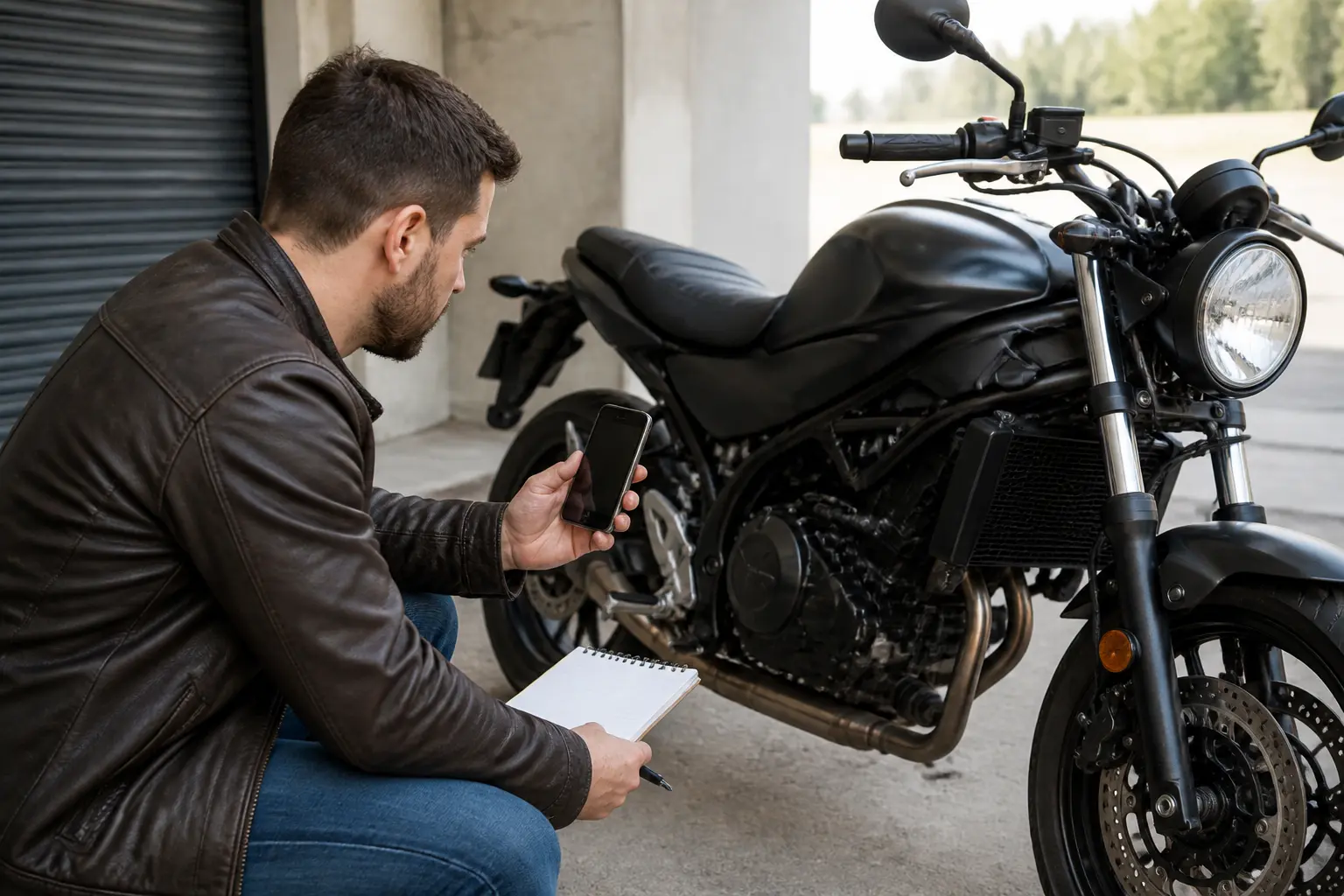
This article does not set a mileage interval because the correct maintenance schedule belongs to the manufacturer. Instead, make routing inspection event-based and repeatable. Add a brief visual scan to normal pre-ride habits, and perform the fuller parked check after relevant service, accessory changes, a tip-over, transport, or an unexplained difference in control feel.
Keep the quick check and the detailed check separate. A pre-ride scan can reveal an obvious snag, displaced line, or abnormal control. The longer inspection is for good lighting, a stable parked motorcycle, and enough time to observe the route during normal handlebar movement.
Create a record when you notice something new. Write down the date, side of the motorcycle, the line involved, its nearby components, and the steering position where the change appears. A photograph from a parked, safe position can supplement the note. This preserves useful context without pretending that a photo can diagnose a safety-critical component.
For a broader routine covering inspection habits, service records, and other motorcycle systems, see the Motorcycle Maintenance Guide. General checklists help identify questions; manufacturer documentation answers the motorcycle-specific ones.
How Vojo Helps
Use Vojo to make the routing check traceable rather than relying on memory. After a parked inspection, open the motorcycle’s record in the Motorcycle Maintenance Tracker and create a dated inspection entry. Record the line you checked, whether the concern appears at straight-ahead, left, or right steering, and attach a contextual photo if you found a rub mark or possible interference. If the result is uncertain, label the entry as a paused ride decision rather than completed maintenance. After a dealer or qualified technician evaluates the motorcycle, add their outcome to the same record so the next inspection has a clear baseline.
Download Vojo on the App Store
Frequently Asked Questions
How often should I inspect motorcycle cable and hose routing?
Use a quick pre-ride screen and do a more deliberate parked inspection after a relevant change, such as control-area work, an accessory installation, transport, a tip-over, or unusual control behavior. Follow the owner’s manual for any model-specific maintenance schedule.
Can I reroute a motorcycle cable that is rubbing?
Do not create your own permanent route based only on what looks better from the outside. The intended path may depend on steering clearance and movement allowance that is not obvious. Compare it with manufacturer information or have a qualified technician assess it.
Is a small mark on a brake hose safe to ride with?
A general article cannot classify a particular hose mark as safe. Document its location and avoid disturbing the hose or fittings. If there is visible damage, crushing, displacement, or abnormal brake operation, do not ride and arrange qualified inspection.
Should motorcycle throttle cables move as I turn the handlebars?
Some visible movement may be normal, depending on the motorcycle. What matters is whether normal steering makes a line bind, stretch, snag, or alter throttle behavior. If that happens, do not ride until the issue is evaluated using the owner’s manual or qualified service.
What if part of the cable or hose route is hidden behind a panel?
Inspect all accessible sections and note where the line disappears. Do not assume a concealed portion is fine if visible sections show rubbing, displacement, or damage. Avoid removing parts or changing the route unless manufacturer instructions support the work.
Is an unusual lever feel always caused by cable routing?
No. Routing is only one possible explanation, and brake, clutch, and throttle concerns can have different causes. Do not diagnose or repair from feel alone. Treat a newly abnormal control conservatively and seek model-specific guidance or qualified inspection.
Quick answers
Frequently asked questions
How often should I inspect motorcycle cable and hose routing?
Use a quick pre-ride screen and a fuller parked inspection after relevant work, accessory changes, transport, a tip-over, or unusual control behavior. Follow the owner’s manual for model-specific schedules.
Can I reroute a motorcycle cable that is rubbing?
Do not improvise a permanent route based on appearance. Compare the route with manufacturer information or arrange qualified assessment.
Is a small mark on a brake hose safe to ride with?
A general guide cannot classify a specific mark as safe. If damage, crushing, displacement, or unusual brake operation is present, do not ride and arrange qualified inspection.
Should motorcycle throttle cables move as I turn the handlebars?
Some movement may be normal, but steering must not make the line bind, stretch, snag, or alter throttle behavior. If it does, do not ride until assessed.
What if part of the cable or hose route is hidden behind a panel?
Inspect accessible sections, document where the line disappears, and seek manufacturer-guided or qualified inspection if visible clues suggest a concern.