
Motorcycle Cargo Load Changes: Braking, Clearance, and Control
Understand how motorcycle cargo affects braking, clearance, steering, and control, then use a conservative inspection and shakedown plan before riding.
Fact-checked against cited official documentation
Reviewed against Fact-checked against MSF operator and passenger guidance on altered load response, steering interference, rider clearance, tires, suspension, weight limits, and cautious practice..
Last updated November 10, 2026
Loading a motorcycle changes more than the amount you can carry. It changes the machine you are riding. A bag of groceries, a full top case, side cases for a weekend away, camping gear, or a passenger all add weight to the motorcycle’s working load. The bike may still look normal in the driveway, but it can feel different while stopping, leaning, turning slowly, crossing a dip, or parking on an uneven surface.
The central issue with motorcycle cargo load changes braking clearance handling is not finding a universal amount of “safe” weight. There is no useful universal figure because motorcycles, racks, tires, suspension settings, accessories, riders, and road conditions differ. The manufacturer’s owner’s manual and the instructions for the installed luggage are the first authority for load limits, mounting, tires, and any load-related setup.
The Motorcycle Safety Foundation (MSF) advises riders that a motorcycle’s acceleration and stopping response can change when it carries a load. Its guidance also cautions against luggage that restricts steering or touches the rider, and identifies suspension and tire pressure as items that may need attention when weight is added. Read the applicable model documentation before departure, then use a calm, low-risk test ride to learn the new feel rather than discovering it during busy traffic or a fast road. The MSF Motorcycle Operator Manual is a useful safety reference alongside your motorcycle’s own documentation.
This article is deliberately manufacturer-first. It does not supply a substitute maximum load, tire-pressure figure, rack capacity, or suspension setting. If your motorcycle or luggage instructions do not clearly support the configuration, reduce the load or get model-specific help. For routine preparation around a loaded trip, pair these checks with the Motorcycle Maintenance Guide.
How Motorcycle Cargo Changes Braking
Cargo adds to the total moving weight that the tires, brakes, suspension, and rider must manage. In ordinary riding, that can show up as a motorcycle that feels less eager when accelerating and takes a different amount of space and time to slow. The exact effect is not predictable from cargo weight alone. Surface grip, speed, tire condition, road slope, rider inputs, motorcycle design, and the location of the load all contribute.
The practical takeaway is simple: do not use empty-bike spacing as your automatic reference. If you normally begin slowing at a certain sign, shadow, road marking, or following distance, begin earlier when the bike is loaded until you have learned the new response. Build extra room before intersections, downhill approaches, traffic queues, blind crests, and corners where you may need to reduce speed.
Good braking margin begins well before the brake lever or pedal is used. Scan farther ahead, identify a place to stop if traffic compresses, and avoid following closely enough that a normal slowdown becomes urgent. A packed motorcycle may be perfectly serviceable and still require a more deliberate pace.
Do not use public traffic as a braking experiment. Instead, after verifying the load and the motorcycle’s condition, choose a clean, open place away from vehicles, pedestrians, loose material, curbs, and distractions. Start with gentle deceleration at low speed. The point is to notice control feel and confirm that cargo stays secure—not to pursue a maximum-braking test.
If the motorcycle feels unstable, pulls unexpectedly, shifts under braking, restricts normal control use, or reveals a loose bag or strap, end the test. Find a safe place, secure the motorcycle, and reassess the arrangement. Earlier braking is valuable for a correctly loaded motorcycle; it is not a workaround for an unresolved fault or an uncertain load limit.
How Motorcycle Cargo Changes Clearance
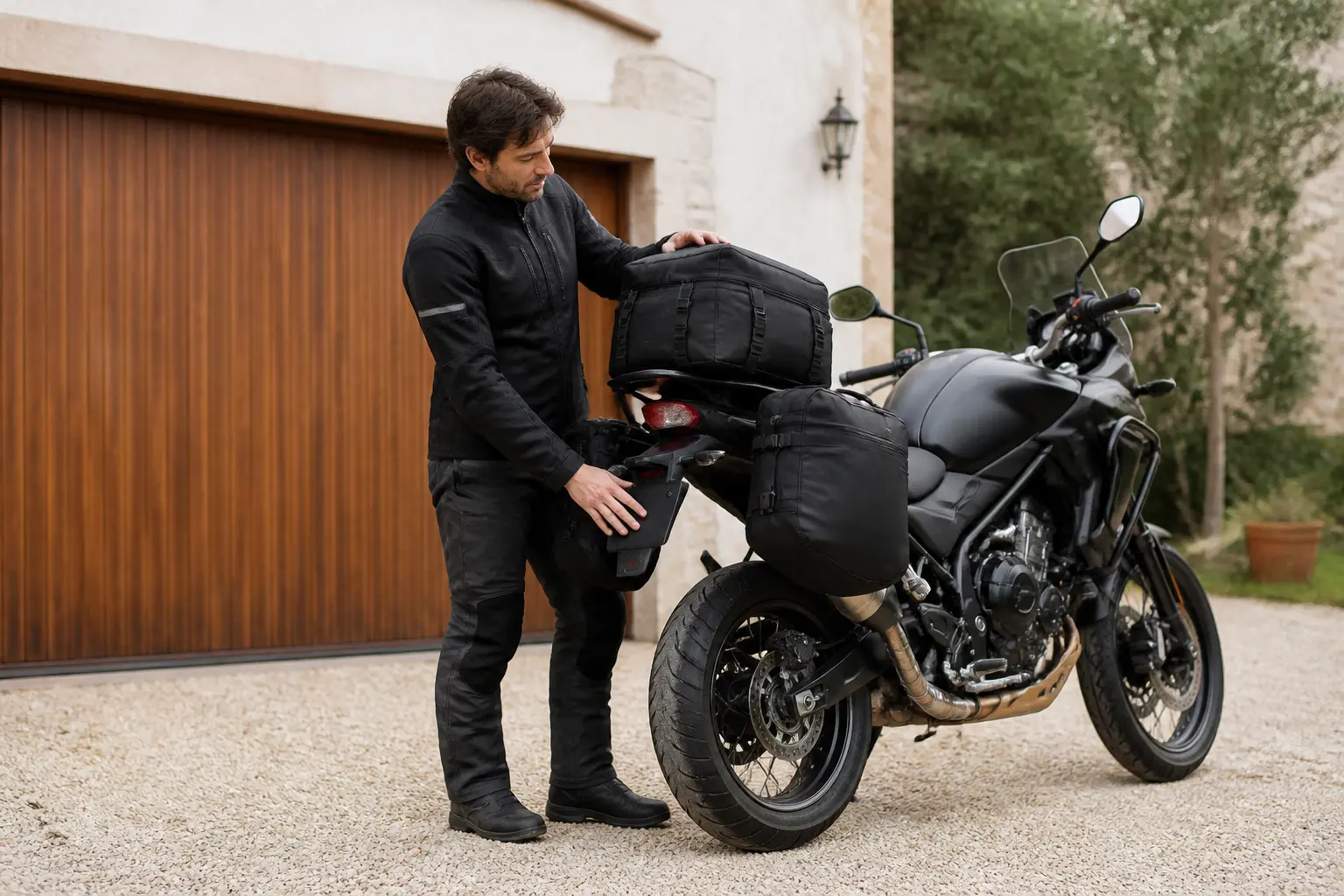
Clearance is often misunderstood as a static driveway check. A bag may look well away from a tire while the bike is parked, then become a concern when the suspension moves over a bump or when the motorcycle leans through a turn. Cargo can also create clearance issues with the rider, passenger, steering range, lighting, foot areas, or luggage mounting hardware.
Added weight can change how the motorcycle sits and how it responds to ordinary surface changes. That is why a clearance review should consider the motorcycle as it will actually be ridden: loaded, with the rider aboard, and with any passenger or accessories included. Follow the motorcycle manufacturer’s prescribed method for any checks involving suspension or adjustment. Do not improvise a test that places a person near hot, moving, or unstable components.
Pay close attention to items that can move. Soft luggage, loose webbing, rain covers, and accessory straps may create a problem even when the bag itself is firmly attached. Secure loose ends so they cannot migrate toward the wheel, tire, chain or belt area, exhaust, suspension, or controls. Verify that luggage does not hide required lighting or other road-legal equipment, subject to local requirements.
Rider clearance matters too. A bulky tail bag can limit how naturally you slide, brace, reach the controls, or put a foot down. A passenger may have less room to sit or use foot supports. If luggage touches either person during normal movement, it is not ready for a ride simply because it appears tightly strapped down.
Road conditions can expose a marginal arrangement. Driveway lips, rough pavement, fuel-station entrances, potholes, construction transitions, and dips can all make the suspension work. Leave more margin over these features, slow smoothly before them, and stop to inspect if you hear contact, feel a new movement, or notice a change in the motorcycle’s behavior.
How Motorcycle Cargo Changes Handling and Steering
The placement of cargo influences how manageable the motorcycle feels. Weight mounted high can be more noticeable in slow turns and parking maneuvers. Weight far toward the rear can make the overall machine feel different from a lightly loaded bike. A pronounced difference between left and right sides can be noticeable when balancing, changing direction, or stopping on an uneven surface.
These are not reasons to assume that any particular luggage location is unsafe. They are reasons to respect the locations and capacities approved for your motorcycle and luggage system. A case that fits a rack physically is not automatically approved for that rack, and a bag’s own advertised capacity does not establish what the motorcycle may carry.
Low-speed situations deserve special attention because the rider is managing balance with small, precise inputs. Before joining traffic, check how the loaded motorcycle feels during a straight rollout, a controlled stop, a wide turn, and a gentle direction change. If the bike feels awkward, do not try to solve the discomfort by riding faster. Return to the load, reduce it, redistribute it within approved locations, or seek advice from the manufacturer or a qualified technician.
Steering must move freely through its normal range. The MSF operator guidance specifically treats interference with steering and rider contact as unacceptable luggage outcomes. That means checking more than whether the bars can move while the motorcycle is on a stand. Confirm that nothing crowds the rider’s hands, arms, knees, body position, or normal access to the controls. Review the MSF Motorcycle Operator Manual before relying on a newly loaded configuration.
A calm riding style gives you more options while adapting to a load. Make speed changes early, keep turns smooth, and leave room for surface imperfections. Avoid trying to match an unloaded pace on a route that combines traffic, tight corners, poor pavement, weather, or fatigue. The goal is predictable control, not proving that the motorcycle can carry everything.
Cargo Position: A Practical Decision Table
Use this table to think through common load locations. It is not an approval chart. The owner’s manual, rack instructions, case instructions, and stated weight limits decide whether a particular arrangement is permitted.
| Cargo position or condition | Likely riding consideration | Check before departure |
|---|---|---|
| Low and close to the motorcycle’s center | Usually creates less noticeable leverage than a tall or distant load | Confirm approved mounting, securement, and clearance from moving or hot parts |
| High on a rear carrier or in a top case | Can be more apparent during slow balance and direction changes | Verify carrier and case limits, attachment security, and rider movement |
| Far behind the rider | May make the loaded motorcycle feel different at the front and rear | Confirm model-specific limits and perform a conservative shakedown |
| Uneven side loading | Can create a different balance sensation from one side to the other | Repack when possible to avoid a clearly lopsided arrangement |
| Cargo beside the rider or passenger | May reduce body movement, seating room, or access to controls | Check hands, knees, feet, passenger space, and control access |
| Loose straps or external items | Can shift or reach unsafe areas during vibration and movement | Restrain all loose material and recheck after a short ride |
A useful packing principle is to avoid making the motorcycle needlessly top-heavy, rear-heavy, or one-sided. But this principle never overrides manufacturer instructions. Do not place an item in an unapproved area simply because it seems lower or more centered.
Keep the load compact and stable. Dense items should not be allowed to roll or slide within a case or bag. Use luggage and mounting hardware as intended by their manufacturers. If a setup requires repeated improvisation to stay in place, it is a signal to simplify the load or choose equipment designed for the task.
Remember that the actual trip load can evolve. Water gets consumed, wet gear is added, food is purchased, and souvenirs appear. A setup that was balanced at home can be altered at a stop. Treat each meaningful addition as a reason to repeat the limits, securement, clearance, and rider-movement review.
Passenger and Cargo: Treat the Combined Load Seriously
A passenger is not interchangeable with a suitcase. A passenger can move, brace, shift position, and affect how the motorcycle feels, especially during low-speed riding and braking. Both the rider and passenger need enough room to sit and use approved seating and foot support naturally.
The MSF’s passenger guidance emphasizes checking weight limits, clearance, tire pressure, suspension considerations, and practicing in a low-risk setting before ordinary riding with a passenger. Read Riding With A Passenger together with your motorcycle’s owner’s manual before combining a passenger with substantial luggage.
Plan the total load, not only the luggage. The relevant load can include the motorcycle’s rider, passenger, cargo, and installed accessories where the manufacturer includes them. If you cannot verify that the complete combination is within the motorcycle’s stated limits, do not estimate based on appearance or past experience.
Before leaving, agree on simple expectations with the passenger: wait until the rider signals before mounting or dismounting, keep movement calm, and tell the rider promptly if something feels loose, hot, crowded, or uncomfortable. Select an easy initial route with straightforward places to stop. The first ride with a new passenger-and-cargo combination is not the time for dense traffic, technical roads, or a schedule that pressures you to continue.
A Conservative Cargo and Control Checklist
Use this checklist whenever the load changes materially, before a day ride, a trip, or a ride with a passenger. It supports—rather than replaces—the motorcycle and luggage manufacturers’ instructions.
Manufacturer limits and readiness
- Read the owner’s manual for total-load limits and any load-specific cautions.
- Confirm the rack, carrier, case, bag, and mounting system are approved and within their own limits.
- Include rider, passenger, cargo, and applicable accessories when assessing the intended load.
- Use only the tire-pressure guidance specified for your motorcycle and intended load.
- Review any manufacturer instructions concerning suspension when carrying added weight.
- Postpone the ride if a limit, installation, or mounting point is uncertain.
Securement, space, and clearance
- Confirm bags, cases, fasteners, covers, and straps are secure.
- Restrain every loose strap end and item that could move in wind or vibration.
- Verify free steering movement and natural rider access to all controls.
- Confirm cargo does not touch the rider or passenger during normal seated movement.
- Keep luggage clear of wheels, tires, drivetrain areas, exhaust, suspension, and controls.
- Check that lighting and other required equipment are not obstructed.
- Inspect for obvious contact risks around luggage mounts and the rear of the motorcycle.
Low-risk shakedown
- Start in a quiet, familiar location away from traffic and fixed hazards.
- Practice simple starts, straight stops, wide turns, and gentle deceleration first.
- Notice whether the motorcycle remains predictable and whether the rider can move normally.
- Stop after the initial short segment and inspect straps, mounts, bags, and cases again.
- Increase distance, speed, and route complexity only after the load remains secure and the motorcycle feels controlled.
A Low-Risk Shakedown Before the Trip

A shakedown ride is a structured confidence check, not a performance test. Load the motorcycle in the same form you expect to use on the trip. Include the items that matter: full luggage, water, tools, clothing, passenger equipment, and any gear that would change the final arrangement. Testing empty luggage tells you little about the loaded motorcycle.
Begin with a stationary review. Look from both sides and behind the motorcycle. Confirm that the load is properly located, that straps are contained, and that the rider can sit normally and use the controls. Review the applicable documentation one more time if there is any doubt about a limit, tire guidance, or accessory compatibility.
For the first moving check, use low speeds and uncomplicated space. Ride straight, stop smoothly, move through broad turns, and observe the motorcycle over normal pavement. Keep the test intentionally boring. It should reveal shifting cargo, restricted movement, unusual instability, or unexpected control feel without adding the risk of traffic or aggressive maneuvers.
Stop and inspect after the first short segment. Vibration can settle an item into a new position, and hardware or webbing that looked satisfactory while stationary may need attention after movement. If anything has moved, do not merely tighten it and assume the issue is resolved. Determine whether the luggage system, mounting method, item placement, or total load needs to change.
If the motorcycle remains predictable and the load stays secure, extend the ride gradually. Continue to give yourself more following distance and earlier braking points than you would on an unloaded local ride. On a longer trip, repeat a brief visual check at fuel, meal, and rest stops, particularly after adding or removing items.
When to Stop Riding and Get Help
Stop at the first safe opportunity if luggage shifts, a case opens, a strap works loose, steering becomes restricted, the rider cannot use controls normally, or the motorcycle develops an unexpected unstable sensation. Also stop if you suspect contact with a wheel, tire, drivetrain area, exhaust, suspension, or another component.
Do not expect a new noise, vibration, steering change, or cargo movement to improve by continuing at speed. Speed may temporarily make a symptom less noticeable while leaving you with less time and space to respond. Park safely, avoid contact with hot or moving parts, and inspect the arrangement carefully.
Contact the motorcycle manufacturer, accessory manufacturer, or a qualified technician when a mount is damaged, installation instructions are unclear, a load limit cannot be confirmed, or the motorcycle’s behavior remains unfamiliar after a basic check. Cargo setup is not the place to treat generic internet advice as a substitute for model-specific information.
How Vojo Helps
Use Vojo to make each loaded configuration repeatable instead of relying on memory. In the Motorcycle Maintenance Tracker, create a pre-trip task called “Loaded Ride Check.” Add the owner’s-manual load reference, luggage mount inspection, tire guidance review, steering-clearance check, and a short shakedown reminder. Before departure, record what changed—such as a passenger, top case, side bags, or heavier camping gear—and add a note after the first stop about braking feel, clearance, or anything that needed adjustment.
For the next similar trip, review the completed task instead of reconstructing the setup from memory. If a strap loosened, a bag restricted movement, or the bike felt different under braking, you have a clear reminder to resolve it before repeating the configuration. Vojo can organize your observations and reminders; the motorcycle and luggage manufacturers remain the authority for limits and setup.
Quick answers
Frequently asked questions
Does added cargo always make a motorcycle take longer to stop?
Added load can change how a motorcycle accelerates and slows, but there is no universal stopping-distance number. Surface, speed, tires, slope, motorcycle design, load placement, and rider input all matter. Leave extra space, begin slowing earlier, and learn the changed response gradually in a low-risk area.
Can I use a luggage case’s capacity as the motorcycle’s load limit?
No. The motorcycle, carrier, rack, mounting hardware, and case can each have separate limits or conditions. A case that can physically hold an item does not prove that the carrier or motorcycle is approved to carry it. Use the relevant manufacturer documentation for the complete system.
Why does high or rearward cargo feel different at low speed?
Where cargo sits can change how the motorcycle feels while balancing, stopping, and turning slowly. Rather than trying to calculate the effect, keep within approved load locations and capacities, avoid an obviously uneven arrangement, and use a cautious shakedown to evaluate the real setup.
Should I change tire pressure when carrying luggage?
Possibly. MSF identifies tire pressure as an area that may require attention when the motorcycle’s load changes. Use the load-related tire guidance in your specific owner’s manual; do not copy a number from another motorcycle, an accessory advertisement, or a forum.
How should I test a loaded motorcycle before a long ride?
Inspect the final load while stationary, then start in a quiet open area with simple starts, smooth stops, broad turns, and gentle braking. Stop after a short segment to inspect the luggage again. Increase speed, distance, and traffic exposure only if the motorcycle remains predictable and the load stays secure.
Is carrying a passenger the same as carrying cargo?
A passenger changes the load but also moves and needs safe seating, foot support, space, and communication. Follow the motorcycle manufacturer’s passenger guidance and use low-risk practice before combining a passenger with significant luggage.