
How to Acclimate to an Unfamiliar Motorcycle Before Entering Traffic
Use a conservative, controlled-area checklist to get comfortable with a borrowed, rented, or new-to-you motorcycle before joining traffic.
Fact-checked against cited official documentation
Reviewed against Reviewed against MSF Basic RiderCourse information and MSF rider guidance on knowing the motorcycle, consulting its manual, practicing core skills, and riding within limits..
Last updated November 8, 2026
A borrowed motorcycle, rental, recent purchase, or temporary swap can challenge even an experienced rider. You may understand traffic, anticipate hazards, and have dependable habits on your usual bike, yet still need time to understand the machine beneath you. A different riding position, control layout, balance point, display, or response can turn an ordinary stop or turn into a moment of uncertainty.
That is why how to get used to an unfamiliar motorcycle before traffic is best treated as a deliberate safety task, not as a quick lap around the block. The goal is not to test performance or prove confidence. It is to reduce uncertainty while the consequences of a mistake are lower: with room, time, a clear surface, and no traffic decisions competing for attention.
Start with the manufacturer’s information for that motorcycle. The owner’s manual is the authority for its controls, warnings, operating limits, and model-specific instructions. If it is a rental, borrow, or dealership motorcycle, ask the provider to explain anything that is unfamiliar rather than assuming it functions like your previous machine. If the manual is unavailable, a warning cannot be understood, or the motorcycle appears unsuitable, choose another plan.
The Motorcycle Safety Foundation describes its Basic RiderCourse as structured instruction covering core riding tasks including shifting, braking, cornering, U-turns, lane changes, and limited-space maneuvers. That training-based progression offers a sensible principle for an unfamiliar motorcycle: isolate one basic task, gain calm familiarity, then add complexity gradually. MSF Basic RiderCourse
How to Get Used to an Unfamiliar Motorcycle Before Traffic
Familiarity is more than knowing which hand operates the front brake. Before traffic, you want enough comfort that your attention can return to the environment: other road users, changing surfaces, signs, route choices, and space around the motorcycle. If operating the bike still takes most of your concentration, traffic adds too many demands at once.
A useful standard is not speed, distance, or a fixed number of practice minutes. Instead, ask whether you can perform basic actions without hunting for a control, being surprised by the motorcycle, or feeling pushed to recover from the last action. A rider who decides to wait has made a sound decision, not failed an assessment.
Start by identifying the questions that must be answered before you leave a controlled area:
- Can you locate the ignition, engine-stop switch, starter, throttle, clutch, brakes, shifter, turn signals, horn, and stand without guessing?
- Do you understand what appears on the instruments when the motorcycle is switched on, including any message or warning that needs attention?
- Can you sit, reach the controls, and make a stable plan for ordinary stops on level ground?
- Can you move away, travel a short distance, and stop without urgency?
- Can you complete gentle left and right changes of direction with plenty of room?
- Are you physically comfortable, alert, properly equipped, and free from a deadline?
These questions apply whether the machine is smaller, larger, older, newer, or simply different from your own. Riding experience remains valuable, but it does not transfer every automatic response from one motorcycle to another.
MSF rider guidance advises riders to know their motorcycles, read the owner’s manual, practice braking and swerving, and stay within personal and situational limits. Use that advice conservatively here: learn motorcycle-specific information from its documentation, and use a controlled environment before adding road traffic. If You Ride A Motorcycle
Select a Low-Pressure Practice Setting
Your first practice location should make it easy to pause, repeat, and stop. Look for a lawful place where you have permission to be, a clear view across the area, firm pavement, and generous distance from people, parked vehicles, curbs, walls, entrances, and other fixed objects. A formal training site is ideal when available. A private paved space may be suitable only when access is permitted and the area is genuinely clear.
A quiet commercial parking lot is not automatically a practice area. A driver can reverse, a pedestrian can appear between vehicles, a delivery vehicle can arrive, and the surface may include debris, fluid, markings, or uneven sections. A roadside shoulder also places you next to traffic before you have established basic familiarity. “Quiet” does not mean controlled.
Walk through the chosen area before starting. Notice where you could make a short straight run, where you could turn with a large margin, and where you would stop if someone entered the space. If the location requires you to squeeze past obstacles or react to frequent movement, it is not the right first setting.
| Area check | Suitable condition | Conservative response when it is not met |
|---|---|---|
| Permission | You are allowed to use the space and are not disrupting others | Find a permitted location or postpone |
| Surface | The pavement appears clear enough for cautious practice | Move elsewhere if debris, contamination, or uncertainty is present |
| Sightlines | You can see potential entrances, people, and moving vehicles | Avoid hidden approaches and blind corners |
| Room | There is open space beyond the planned path and stopping point | Choose a larger area rather than tightening the exercise |
| Conditions | Light, weather, wind, and temperature do not add avoidable difficulty | Wait for less demanding conditions |
| Time | You can stop and reassess without pressure | Reschedule if a handover, appointment, or group is rushing you |
Your personal condition matters as much as the practice area. Wear gear that allows you to see clearly, use the controls naturally, and place your feet securely. If you are cold, exhausted, distracted, ill, or anxious about being late, do not expect determination to cancel those limitations. An unfamiliar motorcycle deserves more of your available attention, not less.
Learn the Motorcycle While It Is Still Parked
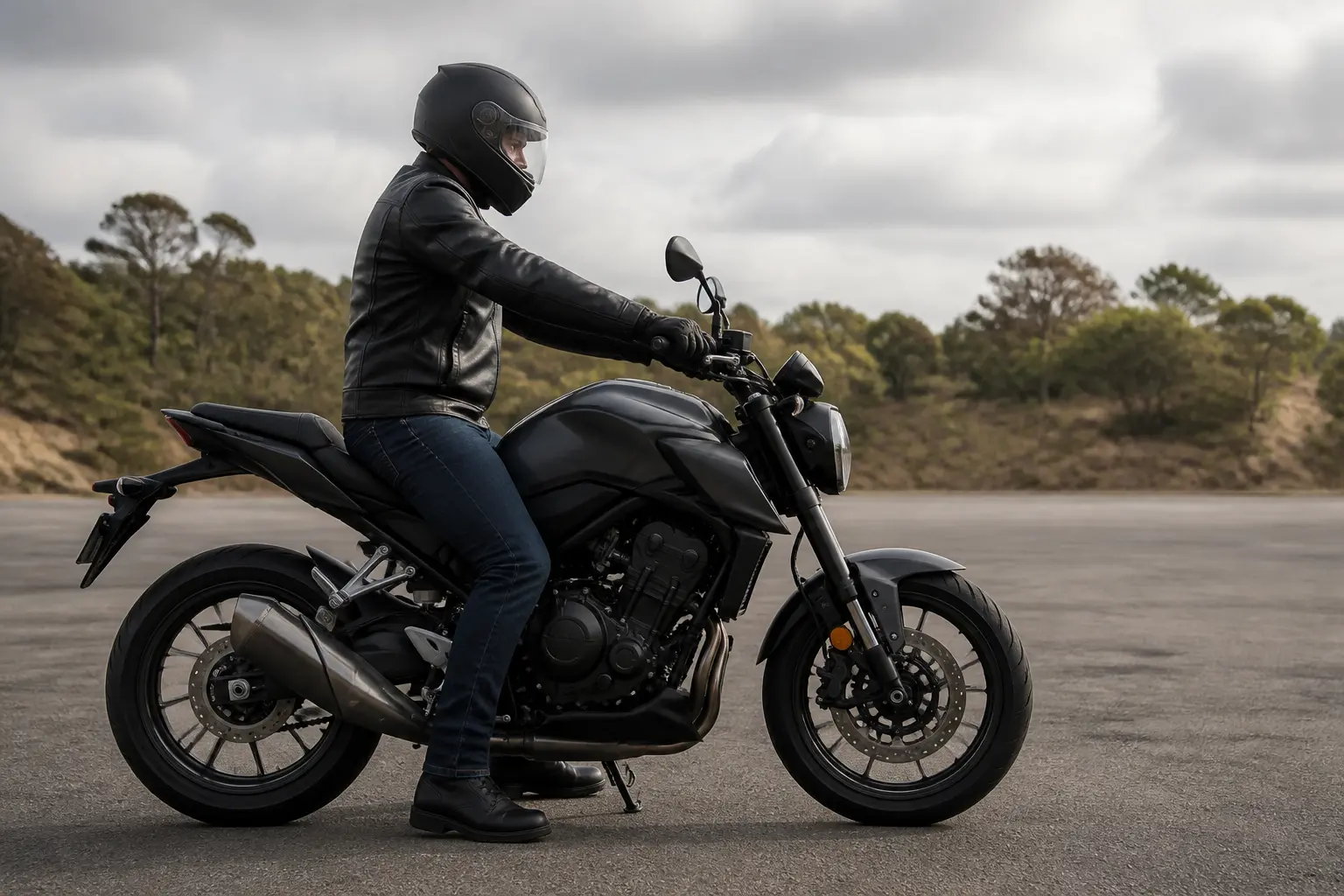
Do the first review with the engine off and the motorcycle supported as its manufacturer directs. This is the least pressured time to study the layout, check fit, and identify questions. Do not start by experimenting with unknown switches. Read the manual or ask the owner, rental provider, dealer, or instructor what a control does before relying on it.
Sit in your normal riding position. Notice the relationship between the seat, handlebars, levers, pedals, mirrors, and ground. You are not looking for a perfect comparison with your regular bike; you are deciding whether you can operate this motorcycle with a stable, realistic posture. A seat height, handlebar reach, or control position that is merely different may be manageable after practice. One that leaves you strained, insecure, or unable to support the machine calmly is meaningful information.
Use the parked review to identify the following:
- Starting and stopping controls, including ignition, starter, and engine-stop switch.
- The front brake lever, rear brake pedal, clutch lever, throttle, and gear selector.
- Turn-signal, horn, lighting, and high-beam controls.
- The instrument display, fuel information, and any warning or message that appears during startup.
- The stand arrangement and any starting or parking conditions described in the manual.
- Mirrors adjusted from your actual seated position.
Move your hands and feet through their normal operating positions without looking down each time. This is not a riding test. It is a chance to discover whether a lever, switch, or pedal is somewhere your muscle memory does not expect. If you must repeatedly search for a basic control while stationary, do not assume it will become easier while managing a junction.
Then make a simple visible-condition scan. Look for anything that appears wrong or unexplained: signs of a leak, obvious damage, a loose-looking part, a tire concern, an unclear warning, a compromised control, or an unstable parking position. Do not diagnose or attempt a repair. Stop and seek appropriate help from the owner, provider, dealer, or qualified professional if something raises doubt.
For a broader framework for routine records and checks, see the Motorcycle Maintenance Guide. The relevant manual remains the first source for any motorcycle-specific requirement.
Build Familiarity One Task at a Time
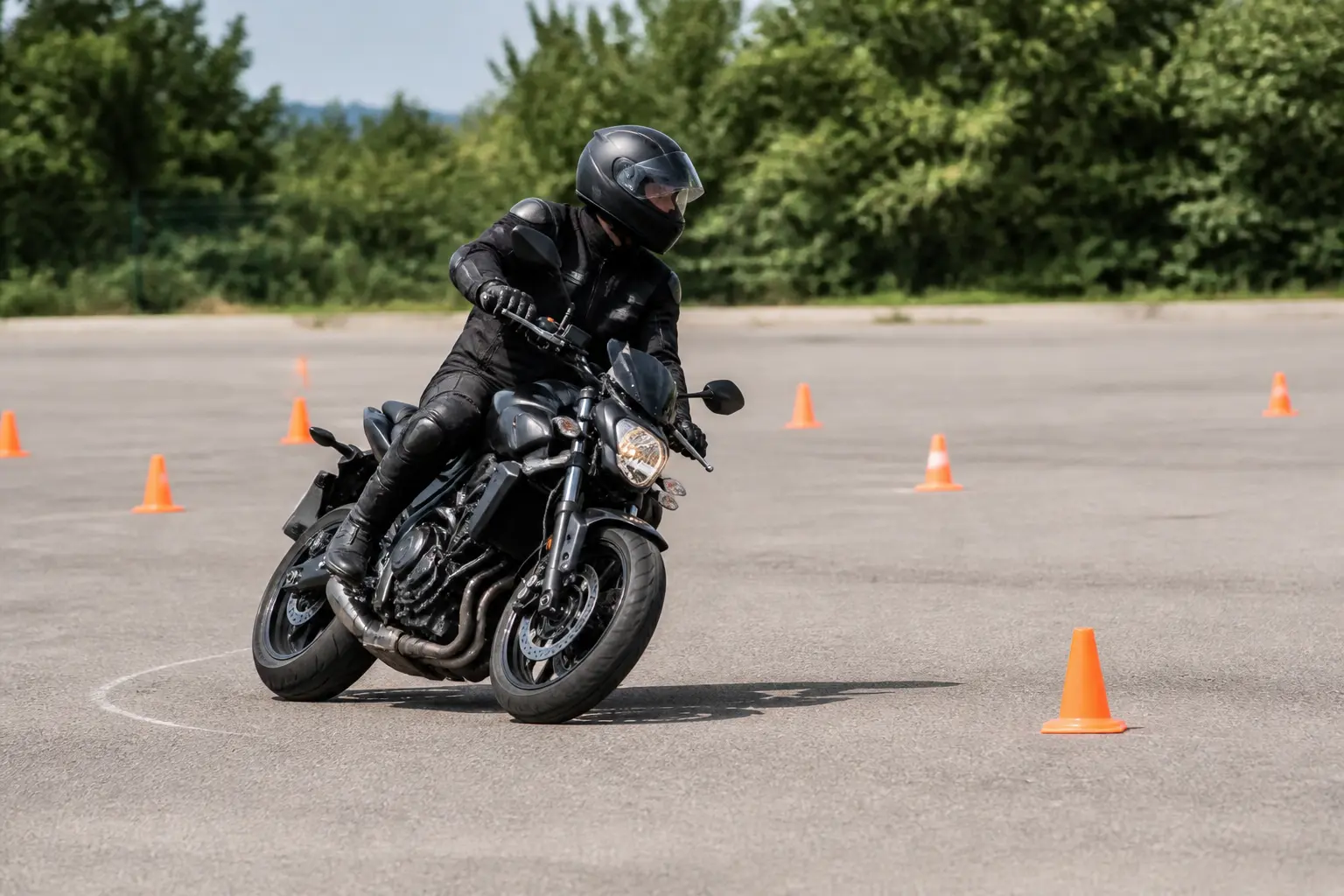
Once the motorcycle, location, and your readiness all look suitable, use short stages. The point is to keep each attempt simple enough that you can recognize what the bike is doing and what you need next. Repetition is useful when it brings calm consistency, not when it becomes an attempt to overpower discomfort.
Begin with a short, planned movement
Start the motorcycle according to the manufacturer’s instructions. Before moving, look around the practice area again. Conditions can change while you have been preparing, and the next stop should be chosen before the first movement begins.
Make only a brief, intentional roll and stop with considerable space remaining. Pay attention to the basics: whether you find the controls naturally, whether your posture remains relaxed, how the motorcycle feels as it moves away, and whether you can settle it at the stop without surprise. There is no need to travel farther simply because the first few metres went well.
After stopping, pause. If a warning appears, your footing is uncertain, the controls felt confusing, or the response was not what you anticipated, return to the parked review. A short first movement is valuable precisely because it can reveal a concern early.
Repeat straight-line starts and planned stops
When the initial movement feels settled, repeat straightforward starts and stops along an open path. Keep the task narrow: travel in a straight line, maintain awareness of the space ahead, and stop where you planned. Leave so much room that no action needs to be abrupt.
This stage helps you learn how your body fits the bike during ordinary movement and how the controls feel in use. It also shows whether your attention is staying outside the motorcycle or becoming fixed on the levers, pedals, or display. If you are staring down, repeatedly rushing a stop, or tensing up, make the exercise easier rather than adding speed.
Avoid comparing every sensation to your usual motorcycle. The useful question is not “does it feel identical?” It is “can I predict it well enough to operate calmly and leave attention available for the environment?”
Add wide, gentle changes of direction
Low-speed turning can expose unfamiliarity with balance, steering feel, reach, and confidence at a stop. Use the most open part of the practice area and make broad arcs with room to straighten out. Treat left and right separately; one direction can feel more awkward than the other.
Keep your vision directed toward the open path you want to follow rather than down toward the front of the motorcycle. If a turn starts to feel cramped, widen it, stop if safe, or reset the exercise. Do not turn a limited-space maneuver into a test of resolve.
A tight U-turn may be a valuable training skill, but it is not required to establish first familiarity with an unfamiliar motorcycle. If it is needed for your planned route and you cannot do it comfortably in a suitable practice setting, change the route, arrange assistance, seek instruction, or select another transport option.
Confirm gear use without creating pressure
After basic starts and stops are calm, practice gear selection only where you have enough open space to slow down and stop comfortably. Confirm the operating guidance from the owner’s manual first. A familiar general pattern does not replace the correct information for this particular motorcycle.
Keep the aim modest. You are learning to coordinate controls while maintaining awareness of where you are going, not exploring acceleration or trying to memorize every sound the machine makes. If you lose track of the selected gear, become absorbed by the display, or feel hurried, simplify the session and return to the previous stage.
Give braking focused attention
Braking is central to creating and preserving space. In a clear, straight section of the practice area, use modest speeds, a long run-off margin, and smooth, deliberate inputs. Notice that an unfamiliar motorcycle may not communicate through its controls in the same way as your usual one.
Do not use this session to find the limits of traction, braking, or any rider-assistance system. Surface condition, weather, tires, load, and other factors influence outcomes, while model-specific systems require the information in the manual. If you need to learn or refresh emergency-braking and swerving skills, formal training offers a better setting than an improvised practice session. MSF materials include those core skills within rider education and safety guidance. MSF Basic RiderCourse
Decide Deliberately Whether Traffic Is Appropriate
Do not let the exit of the practice area make the decision for you. Stop, assess, and choose either a limited next ride or a no-go. A no-go decision is appropriate when a motorcycle issue, rider issue, or environmental issue remains unresolved.
| What you notice after practice | Decision | Next step |
|---|---|---|
| A warning, display message, or operating control remains unclear | No-go | Consult the manual and the owner, provider, dealer, or qualified professional |
| There is a possible leak, damage concern, tire concern, or compromised control | No-go | Do not ride until the concern is properly assessed |
| Starts and stops still require searching, rushing, or repeated correction | No-go | Continue in a controlled setting or seek training |
| You feel insecure supporting the motorcycle at a normal stop | No-go | Reassess fit, location, and options without forcing the issue |
| Basic straight travel, broad turns, gear use, and planned stops are calm | Possible next step | Consider only a simple route if conditions remain favorable |
| You are tired, distracted, cold, pressured, or unsettled | No-go | End the session and return when ready |
| Weather, light, traffic, or the surface has become more demanding | No-go | Postpone rather than add risk |
“Possible next step” is not a promise that traffic is safe. It means only that the motorcycle is no longer demanding all of your focus during basic operation. Local legal requirements, weather, route complexity, and your personal readiness still matter.
Keep the First Traffic Ride Intentionally Simple
If you decide to proceed, choose a short route you know well, at a time when road conditions are less demanding. Favor good visibility, simple intersections, predictable surfaces, and places where you can safely stop if you need a break. Avoid turning the first ride into a commute deadline, group-ride catch-up, or navigation challenge.
Give yourself more following space than usual and leave time for an unhurried pace. Do not add a passenger while you are still learning the motorcycle’s feel. A passenger changes the riding task and adds demands on balance, communication, braking, and space management. Follow the owner’s manual for any model-specific guidance.
The first traffic ride is not the place to test strong acceleration, maximum braking, high-speed handling, or unfamiliar electronic features. Its purpose is much narrower: confirm that the bike can be operated without distracting you from road users, surface changes, traffic signs, and available escape space.
Pull over at a safe place if you notice increasing tension, persistent confusion, difficulty locating a control, or a feeling that the motorcycle is taking too much attention. You can return to the controlled area, take a break, call for help, or choose another way to travel. Ending early is prudent risk management.
Checklist: Before You Take an Unfamiliar Motorcycle Into Traffic
Motorcycle information and visible condition
- I have checked the correct owner’s manual or obtained reliable guidance from the owner, provider, dealer, or instructor.
- I can identify the essential operating controls without relying on guesswork.
- I understand the startup display and have not dismissed an unexplained warning or message.
- I have looked for obvious damage, leaks, tire concerns, loose-looking components, lighting concerns, and control concerns.
- I know who to contact if the motorcycle does not operate as expected.
Rider readiness and practice area
- My helmet and other riding gear fit and allow normal vision and control movement.
- My footwear gives me dependable contact with the ground and controls.
- I am alert, comfortable, and not under time pressure.
- The practice area is permitted, open, visible, and clear of avoidable conflicts.
- Weather, light, wind, and surface conditions support cautious practice.
Controlled-area familiarity
- I can start and stop without searching for a control.
- I can perform several calm straight starts and planned stops with ample room.
- I can ride slowly while looking toward the open path ahead.
- I can select gears without losing awareness of my surroundings.
- I can make broad left and right turns without forcing a tight maneuver.
- I am willing to stop the session if something remains uncertain.
Before entering traffic
- I have selected a short, familiar, low-complexity route.
- I know where I could safely pull over if I need to reassess.
- I have left extra time and space rather than riding to a deadline.
- I will not use the first ride to test the motorcycle’s limits.
- I will change the plan if the motorcycle, my condition, or conditions outside worsen.
When Training or a Different Plan Is the Better Choice
A controlled familiarization session cannot replace rider education. Formal instruction is especially worthwhile if you are returning after a long break, changing to a substantially different motorcycle, struggling with slow-speed confidence, or unable to locate a lawful practice space. A structured course gives you a progression and feedback that a hurried handover cannot provide.
Choose transport, a replacement rental, or another motorcycle when fit remains poor, basic controls stay confusing, a concern cannot be explained, or the intended route exceeds what you can presently manage. A reservation, purchase, meeting, or group plan is not a reason to override a clear no-go signal.
Sometimes the best result is deciding not to enter traffic today. You have still learned something important: whether this motorcycle, your current skills, and the available conditions are a suitable match.
How Vojo Helps
Use Vojo to turn a one-off familiarization session into a repeatable workflow. Add the borrowed, rented, or new motorcycle to your records, then create a pre-ride note that lists the manual location, provider instructions, warning questions, and control differences you need to confirm. In the motorcycle maintenance tracker, save a checklist for the parked review, visible-condition scan, controlled-area stages, and final go-or-no-go decision. After practice, record what felt natural, what required more attention, and whether another session is needed before the next route.
Quick answers
Frequently asked questions
How long should I practice an unfamiliar motorcycle before entering traffic?
There is no universal time requirement. Continue only until basic control tasks are calm and repeatable: you can locate essential controls, start, stop, select gears, and make broad turns without surprise or pressure. If uncertainty remains, stay in a controlled area or seek instruction.
Can an experienced rider skip the owner’s manual on a borrowed motorcycle?
No. Experience does not make every motorcycle’s controls, warnings, starting arrangement, or operating guidance the same. Use the correct owner’s manual first for motorcycle-specific information, and ask the owner or provider about anything you do not understand.
Is a quiet public street suitable for first practice?
A permitted controlled space is the more conservative choice. Even a quiet street can introduce intersections, parked vehicles, pedestrians, changing surfaces, and moving traffic before you have established basic familiarity with the motorcycle.
What if the motorcycle feels too tall, heavy, or awkward at a stop?
Do not compensate by rushing or attempting more difficult maneuvers. Reassess your fit and stopping comfort in a safe location. If you cannot manage ordinary stops calmly, seek training, arrange transport, or choose a motorcycle that better suits your present needs.
Should I take a passenger on the first ride with an unfamiliar motorcycle?
It is more conservative to establish your own familiarity first. A passenger adds demands on balance, braking, communication, and space management. Follow the owner’s manual for motorcycle-specific information and wait until basic operation feels settled.