
Cold-Weather Motorcycle Riding: Grip, Visibility, and Rider Readiness
Use a practical cold-weather motorcycle riding checklist to judge tire grip, visibility, clothing, road changes, and when conditions exceed your safety margin.
Fact-checked against cited official documentation
Reviewed against Fact-checked against Motorcycle Safety Foundation guidance on autumn hazards, tire warm-up, tire-pressure checks, layers, visibility, adaptation, escape paths, and riding within personal limits..
Last updated October 25, 2026
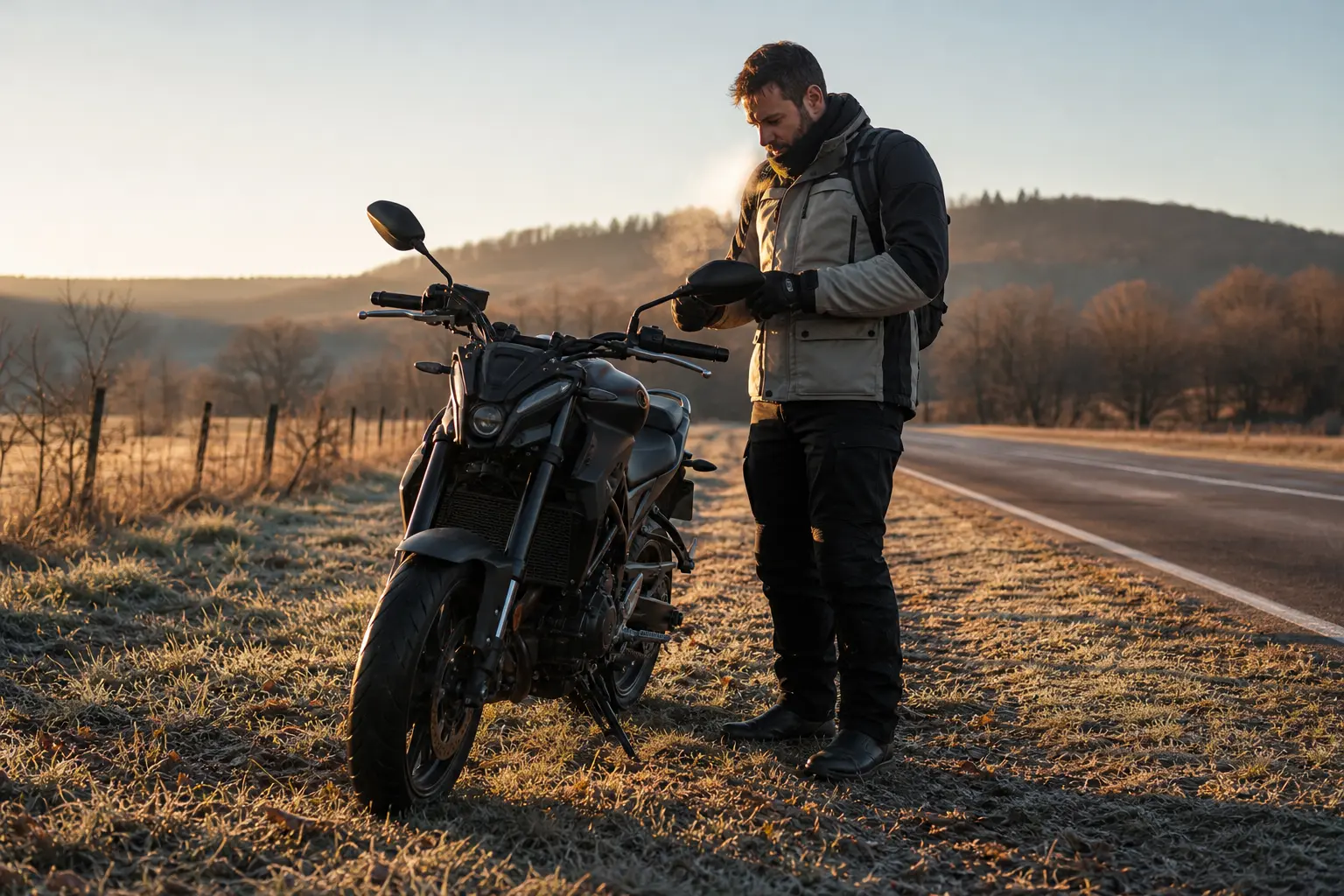
Cold weather changes a motorcycle ride before the road looks obviously dangerous. Temperatures fall, daylight disappears earlier, tires may take longer to reach useful operating temperature, and a familiar route can contain shaded frost, damp surfaces, debris, or wildlife activity. Your hands may also become less dexterous while extra clothing can affect comfort and control.
That does not mean every chilly ride is unsafe. It means the margin deserves deliberate management. A good cold-weather plan starts with the motorcycle, continues with the rider, and ends with a willingness to postpone the trip when the conditions no longer match your experience or equipment.
This guide focuses on three connected questions: how to preserve available grip, how to remain visible as daylight and weather change, and how to decide whether you are ready to ride at all. Use the motorcycle’s owner’s manual and manufacturer instructions as the authority for model-specific tire pressures, equipment, controls, service, and operating limits. The Motorcycle Safety Foundation’s autumn guidance also highlights colder temperatures, shorter days, longer tire warm-up, debris, wet leaves, suitable layers, reflective gear, and tire-pressure checks as seasonal concerns (Motorcycle Safety Foundation).
Why Cold Weather Changes the Ride
Cold-weather riding is not simply wet-weather riding with a lower temperature. Several variables can arrive together, and each one can reduce the space available for mistakes.
Tire grip may build more slowly
A tire that feels normal after a warm-weather start may feel different during the first part of a cold ride. The issue is not a universal temperature threshold that applies to every tire and motorcycle. Tire construction, compound, pressure, road surface, speed, load, and ambient conditions all matter. The practical point is simpler: expect the early part of the ride to demand patience rather than abrupt acceleration, braking, or cornering.
Keep your inputs progressive. Accelerate, brake, and lean in a way that leaves room to notice how the motorcycle responds. Do not try to “scrub in” warmth with aggressive weaving or hard acceleration. Those actions consume traction when you have the least information about the surface.
Daylight and contrast change
Shorter days can put the start or finish of a ride in low light. Shadows conceal surface changes, headlights from approaching traffic can reduce your ability to see, and a dark motorcycle or dark clothing can blend into the background. Visibility is a shared responsibility: you need to see, and other road users need a reasonable chance to recognize you.
The MSF recommends visibility measures alongside active observation. Reflective elements, appropriate lighting, lane positioning, and a deliberate scan are useful together; none should be treated as a guarantee that a driver has seen you. The general MSF guidance also emphasizes maintaining escape paths and adapting technique to changing conditions (If You Ride A Motorcycle).
Road conditions may change within one mile
Cold air often makes shaded sections, bridges, and low areas feel different from sunlit pavement. Leaves, grit, moisture, frost, and other debris can collect where traffic patterns or drainage place them. A route that was clean yesterday may not be clean today.
Avoid turning seasonal assumptions into automatic conclusions. “It is dry” does not mean every corner is equally dry. “The road department treated it” does not tell you how much residue remains. Scan beyond the motorcycle’s immediate path and create time to respond.
The rider can become the limiting factor
Cold hands, a stiff neck, fogging eyewear, restricted movement, and fatigue can interfere with smooth control or observation. Layering is valuable only when the clothing remains compatible with the motorcycle and your controls. Bulky garments can alter reach, pressure points, or the way protective gear fits.
If you cannot comfortably operate every control, turn your head to scan, or see clearly through your eye protection, the ride is not ready to begin. Do not solve a gear problem by simply riding more slowly on a public road; correct the problem or postpone the trip.
The Cold-Weather Go-or-No-Go Decision
A checklist is most useful before the engine starts. Consider the whole trip rather than only the first few miles.
Ask yourself:
- Will the coldest part of the ride occur after sunset or before sunrise?
- Is there a forecast change that could introduce rain, freezing conditions, fog, or strong wind?
- Does the route include bridges, shaded bends, exposed high ground, or roads that may carry debris?
- Can you return or stop safely if your hands become numb, your visor fogs, or visibility falls?
- Are you rested, alert, and familiar enough with the motorcycle for the conditions?
- Is there a non-riding alternative that avoids forcing a marginal decision?
A “no” answer does not always end the ride. It identifies something to change: shorten the route, delay departure, choose a brighter time, add an appropriate layer, arrange a recovery option, or use another form of transport. A “yes” answer is not a promise of safety. It is evidence that you have considered the main variables.
Your skill level matters as much as the forecast. A rider who is comfortable in cool, dry conditions may not have the same margin on a dark route with scattered debris. The MSF’s general guidance is consistent with adapting riding to the situation and staying within personal limits rather than relying on a single piece of equipment or a fixed rule (Motorcycle Safety Foundation).
Tire Grip: A Practical Cold-Start Plan
Confirm the motorcycle’s baseline
Before a cold-weather ride, use the owner’s manual and the tire manufacturer’s approved information for the correct tire-pressure procedure and setting. Pressure should not be guessed from a generic internet number, a label for a different model, or a reading taken after the tires have been warmed by riding. If the motorcycle is carrying a passenger or luggage, confirm the manufacturer’s applicable load guidance.
Inspect the tires visually. Look for obvious damage, unusual wear, embedded objects, or age-related concerns, and do not treat adequate-looking tread as proof that a tire is suitable. If anything is uncertain, obtain a qualified inspection rather than attempting a roadside experiment. Our Motorcycle Maintenance Guide provides a broader model-first approach to routine checks.
Also look for changes since the previous ride. A pressure warning, a new vibration, a handling change, or a slow leak is a reason to pause. Cold weather is not an explanation that should be used to dismiss a new symptom.
Make the first miles information-gathering miles
The opening section of the route should be the least demanding part available. Avoid beginning with a fast road, a steep descent, a series of tight bends, or heavy traffic. Use this time to assess whether the motorcycle tracks normally and whether your controls remain comfortable.
Smoothness is the theme. Leave extra following distance so braking can be gradual. Select a speed that gives you time to identify surface changes. Finish braking before a corner when possible, and avoid sudden throttle or steering corrections over questionable pavement. These are not cold-weather tricks; they are ways to preserve options when grip and visibility are less predictable.
Do not assume a tire has reached a particular condition because a certain number of minutes has passed. There is no universal warm-up time that can be responsibly substituted for the motorcycle’s behavior and the actual road. Ride according to the conditions you can observe.
Treat surface changes as separate hazards
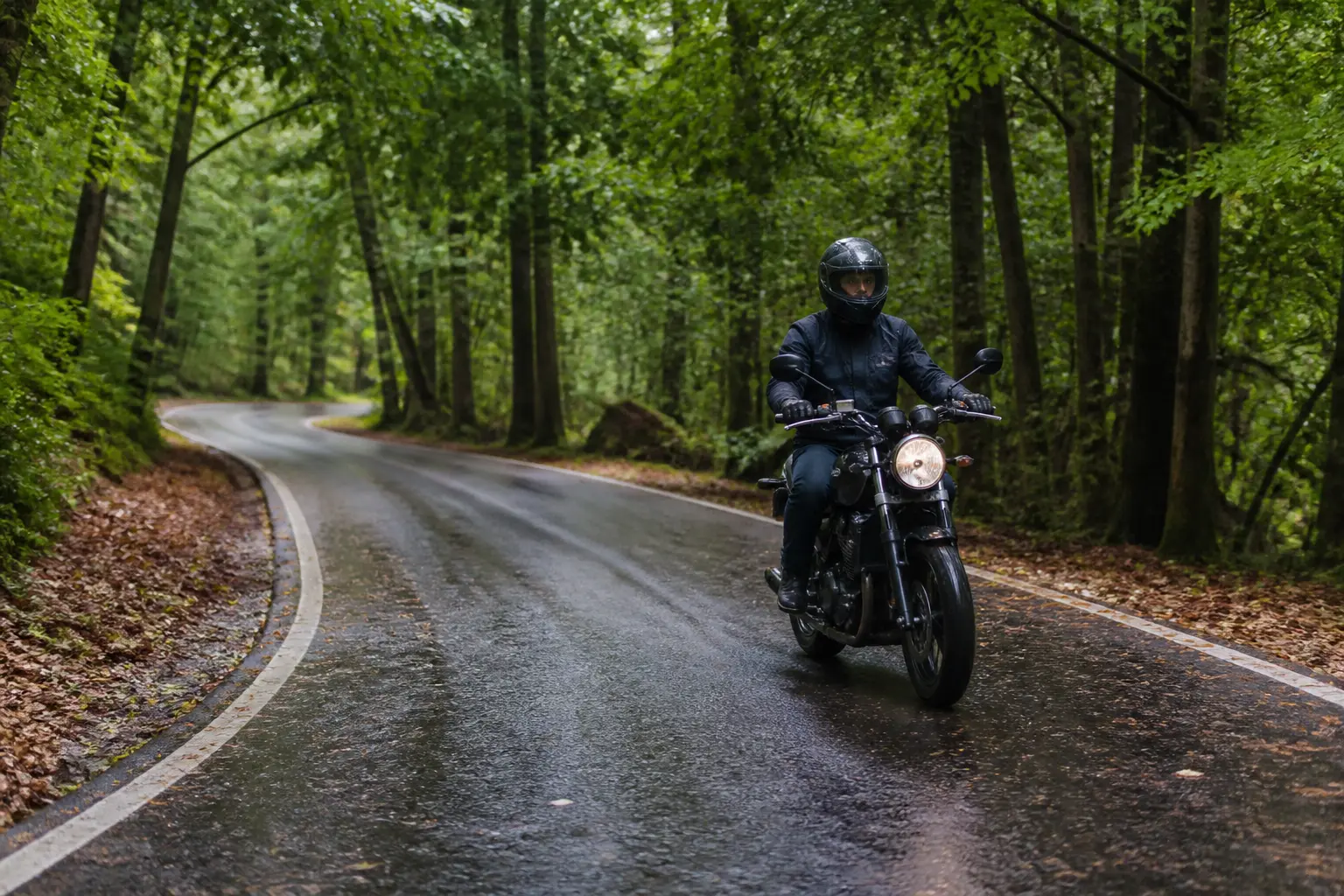
A clean, dry lane can become less forgiving at an intersection, on a painted marking, near a curb, or beneath a canopy of trees. If you see dampness, leaves, grit, or frost, reduce speed before reaching it and choose a line that leaves room around the hazard. Avoid abrupt changes while crossing it.
If the surface is wet, sandy, uneven, or contaminated, the MSF recommends adapting technique rather than maintaining normal dry-road assumptions. That means earlier decisions, gentler controls, and a larger escape margin. If the hazard occupies the route or conditions are too uncertain, stopping and rerouting is a valid riding decision.
| Cold-weather factor | What can change | Conservative response | Stop or postpone when |
|---|---|---|---|
| Low temperature | Tires and controls may feel different at the start | Check the motorcycle as specified by the manufacturer; use smooth inputs | A new handling change, warning, or damage is present |
| Short daylight | Contrast and recognition can deteriorate | Plan the timing, use visibility measures, and scan actively | You cannot see the route or others have little chance to see you |
| Shaded pavement | Dampness, frost, or debris may remain after nearby pavement dries | Slow before the section and avoid abrupt inputs | The surface cannot be read in time to choose a safe line |
| Cold hands | Dexterity and comfort can decline | Use suitable protective layers and check control access | You cannot operate controls or scan comfortably |
| Changing weather | Rain, fog, wind, or freezing conditions may arrive | Recheck the forecast and create a return plan | The forecast exceeds your equipment or experience |
| Longer ride home | Fatigue and darkness may arrive together | Set a turnaround time and keep a recovery option | Continuing would depend on deteriorating judgment |
Visibility: See, Be Recognized, and Keep an Escape Path
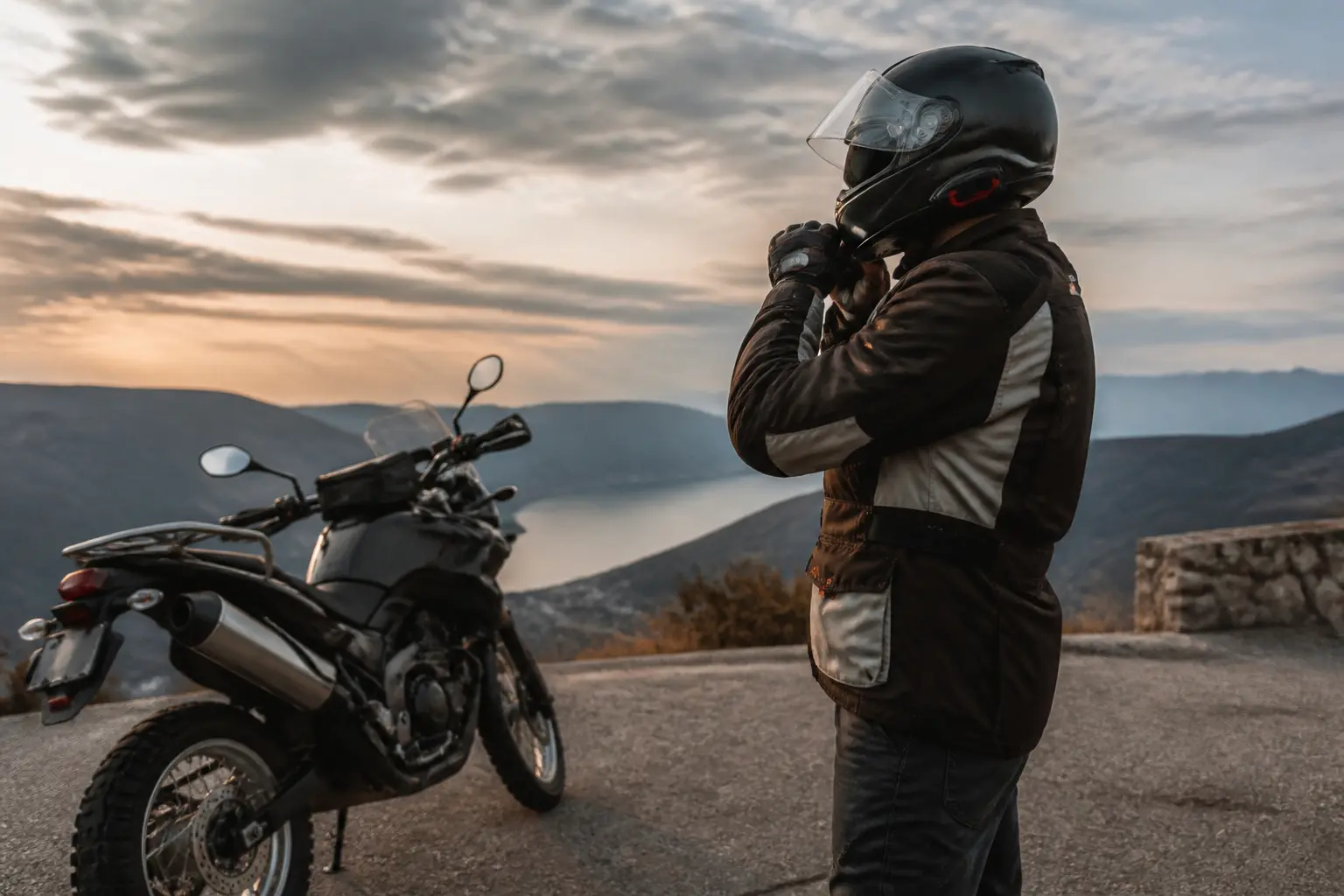
Visibility is more than wearing a bright jacket. It has three parts: your ability to see the environment, the chance that other road users recognize you, and the space available if they do not.
Improve what you can control
Clean, correctly fitted eye protection helps you see clearly. Check for fogging, scratches, dirt, and reduced contrast before departure. Plan where you can stop safely if conditions change; do not continue while trying to wipe or adjust equipment in motion.
Use the motorcycle’s lighting as specified by the manufacturer and make sure you understand any restrictions on accessories or modifications. Do not cover required lights with luggage or clothing. Reflective material can help in low light, especially from side angles, but it does not replace active scanning or a safe lane position.
Choose layers that remain secure at riding speed and do not interfere with your helmet, gloves, controls, or protective fit. A heated garment or additional layer may be appropriate only if it is approved and used according to its manufacturer’s directions. Never treat visibility clothing as permission to ride faster or enter a situation with no escape option.
Ride so you can respond to being missed
Assume that a driver may not detect you, particularly at intersections, when emerging from a shaded background, or when glare and low light reduce contrast. Select a lane position that improves your view and gives you space, while following the motorcycle manufacturer’s guidance and local traffic laws. Avoid sitting in a blind spot or riding beside another vehicle longer than necessary.
Watch wheels, front tires, vehicle movement, gaps, and turn indicators rather than waiting for a driver’s face or hand signal to confirm awareness. Covering a control may be appropriate in some situations, but do not create tension or fatigue by gripping excessively. The objective is readiness, not panic.
The MSF’s guidance supports an escape-path mindset. Before entering a conflict area, identify where you could go if a vehicle moves unexpectedly. That space might be a clear lane position, an open shoulder where lawful and safe, or simply enough following distance to stop. If no option exists, reduce speed and delay your entry.
Clothing and Rider Readiness
Cold-weather gear should protect against temperature without creating a new control problem. Start with the manufacturer’s requirements for the motorcycle and protective equipment, then check how the complete outfit works together.
Use layers deliberately
Layers let you adjust as the ride progresses. The outer layer should manage wind and weather; insulating layers should provide warmth without compressing movement; base layers should remain comfortable and avoid exposed gaps. Gloves deserve special attention because cold fingers can reduce feel and dexterity. Carrying a spare pair or a way to adjust layers may be more useful than beginning overdressed and becoming fatigued.
Do a seated control check before leaving. Turn the handlebars through the normal range while stationary, operate the levers and switches, look over both shoulders, and confirm that cuffs, straps, and closures do not catch. This is a fit check, not a repair procedure. If something interferes, correct it according to the gear manufacturer’s instructions.
Watch for cold-related judgment errors
Cold stress can encourage a rider to rush: rushing a pre-ride check, riding faster to reach warmth, or continuing because the destination is close. Build in an early stop where you can assess your hands, vision, comfort, and concentration. A short break is a decision point, not an admission that the plan failed.
If you are shivering, losing feeling, distracted by discomfort, or unable to think clearly, stop riding. Move to a safe location and warm up. If the motorcycle cannot be left safely, arrange assistance rather than making a deteriorating ride longer.
A Clearly Titled Cold-Weather Pre-Ride Checklist
Motorcycle and tires
- Read the owner’s manual for model-specific operating, load, lighting, and tire guidance.
- Check tire pressure using the manufacturer’s specified method and setting.
- Look for visible tire damage, unusual wear, embedded objects, or a new pressure concern.
- Confirm that lights, indicators, mirrors, and required equipment are unobstructed and functioning as intended.
- Check for new leaks, warning messages, unusual noises, or changes in handling.
- Confirm that luggage and clothing cannot interfere with controls, lights, or movement.
- Plan a qualified inspection if any condition is uncertain.
Rider and gear
- Wear protective gear and layers that preserve movement and control access.
- Confirm that gloves allow reliable operation of every required control.
- Check helmet and eye protection for clear vision and likely fogging problems.
- Add reflective visibility where appropriate without relying on it alone.
- Carry communication, identification, emergency contacts, and a practical recovery plan.
- Set a turnaround time before fatigue and darkness narrow your options.
Route and conditions
- Check the complete forecast, including the return journey.
- Identify shaded roads, bridges, exposed areas, debris-prone sections, and low-light travel.
- Choose a route with safe places to stop, warm up, or reroute.
- Allow extra time and following distance.
- Plan for wet, sandy, uneven, or contaminated surfaces rather than assuming they will be absent.
- Decide in advance what conditions will make you postpone or turn around.
First miles and ongoing scan
- Begin on a lower-demand section where you can assess comfort and motorcycle response.
- Use gradual throttle, braking, and steering inputs.
- Scan beyond the immediate road for surface changes, vehicles, wildlife, and reduced visibility.
- Preserve an escape path before entering intersections or passing parked traffic.
- Stop safely if your vision, hands, judgment, or motorcycle behavior deteriorates.
When to Turn Around
Turning around is not a failure of preparation. It is the final part of preparation. Conditions can exceed your margin even when the motorcycle passed its inspection.
Turn around or stop when visibility prevents you from reading the road far enough ahead, when precipitation or freezing conditions arrive beyond your equipment, or when wind and surface contamination make your planned line unreliable. Do the same if your hands become numb, your eye protection repeatedly fogs, or fatigue makes scanning inconsistent.
A mechanical change deserves equal respect. A new vibration, pressure loss, warning indicator, fluid leak, control problem, or handling difference should not be explained away as cold weather. Stop in a safe location, consult the owner’s manual where appropriate, and arrange qualified help. This article deliberately does not provide roadside repair instructions because the correct response depends on the motorcycle and the failure.
If you are already committed to the route, use the safest available exit rather than trying to prove that you can complete it. Reduce exposure, communicate your delay, and use recovery support. The best cold-weather ride is not the one that finishes despite every warning; it is the one that keeps enough margin to make a good decision.
How Vojo Helps
Use Vojo as a simple decision trail for seasonal riding. Before a cold-weather trip, open your motorcycle’s record and review the latest tire, lighting, inspection, and service notes. Add a planned pre-ride task for pressure and visible-condition checks, then record the date, weather, route conditions, and any symptom you noticed after the ride. If a new vibration, warning, or tire concern appears, attach a note for a qualified inspection instead of relying on memory. The Motorcycle Maintenance Tracker gives that workflow a repeatable place to live, while your service history can show whether a seasonal concern is new or recurring.
That record does not replace the owner’s manual, a manufacturer’s instructions, or professional judgment. It helps you notice changes early, prepare consistently, and make a calmer go-or-no-go decision before the motorcycle leaves the driveway.
Quick answers
Frequently asked questions
Is it safe to ride a motorcycle in cold weather?
It can be, when the motorcycle, protective gear, route, forecast, and rider readiness match the conditions. Cold weather can reduce comfort, extend tire warm-up, shorten daylight, and increase uncertainty around shaded or contaminated pavement. Use the owner’s manual and make a conservative go-or-no-go decision rather than relying on a single temperature rule.
How should I warm motorcycle tires in cold weather?
Do not use aggressive weaving, hard acceleration, or heavy braking to warm them. Check pressure as specified by the motorcycle and tire manufacturers, then begin on a low-demand route with gradual inputs and extra following distance. Let the motorcycle’s response and the actual surface guide your pace; there is no universal warm-up time for every tire and motorcycle.
What should I wear for cold-weather motorcycle riding?
Use protective layers that block wind and preserve movement, control access, vision, and helmet fit. Give gloves special attention because cold hands can reduce dexterity. If clothing interferes with controls, causes fogging, or leaves you unable to scan comfortably, correct the problem or postpone the ride.
How can I stay visible on a motorcycle in shorter daylight?
Keep required lighting unobstructed and operating as intended, use suitable reflective elements, choose a lane position that improves your view, and assume other road users may not see you. Visibility equipment supports but does not replace active scanning, following distance, speed control, and an escape path.
When should I turn around during a cold-weather ride?
Turn around or stop when visibility falls, surfaces become unreadable, freezing or severe weather exceeds your equipment, your hands or vision deteriorate, fatigue affects judgment, or the motorcycle develops a new warning, leak, vibration, pressure loss, or handling change. Arrange qualified help rather than attempting an uncertain roadside repair.