
When Should You Service a Motorcycle Air Filter? Why “Clean It” Is Not One Universal Answer
When should I replace motorcycle air filter? Learn why material, riding conditions, contamination, and your exact manual decide whether to inspect, clean, or replace.

Fact-checked against cited official documentation
Reviewed against Harley-Davidson service information on dry paper/wire-mesh and cotton elements, plus Honda owner manuals on viscous filters and severe-use air-cleaner maintenance..
Last updated October 16, 2026
A motorcycle air filter should be serviced or replaced at the interval and in the manner specified for your exact motorcycle—but that is only the starting point. The right answer changes with the filter material, its design, where and how you ride, and whether the element has been exposed to dirt, water, oil, damage, or an incorrect previous service.
That is why “just clean it” is poor universal advice. Some elements are designed to be cleaned and reused only with a specified method. Others are dry or viscous elements that should not be oiled, blown out, or otherwise treated as reusable foam or cotton filters. In some cases, dirt, torn media, a distorted sealing edge, water saturation, or oil contamination makes replacement the safer choice instead of another attempt to restore the filter.
The useful question is not simply, “How many miles has it been?” It is: What does the manufacturer say this particular element is, how is it meant to be serviced, and has my riding environment moved service forward? Harley-Davidson documentation illustrates the variation: one official procedure describes cleaning a paper/wire-mesh element without filter oil, while other Harley documentation covers a cotton element with a specific inspection and replacement schedule and an oiling requirement. Honda owner documentation likewise warns that a viscous-type element cannot be cleaned with compressed air or similar methods without reducing performance. [1][2]3
This guide helps you make that decision without assuming every motorcycle uses the same filter or needs the same treatment.
The short answer: service by the manual, then adjust for use
If you are asking when should I replace motorcycle air filter, begin with the maintenance schedule and air-cleaner section in the owner’s manual for the motorcycle’s exact year and model. Record both parts of the instruction:
- the scheduled inspection, cleaning, or replacement interval; and
- the conditions that call for more frequent attention.
The scheduled interval is not a promise that the filter will be healthy until that mileage or date. It is a planning point based on assumed use. Dusty roads, construction zones, unpaved routes, trail riding, repeated wet exposure, heavy traffic grime, or a previous intake-related concern can justify an earlier inspection. Honda states that its maintenance schedules are based on average conditions and that more frequent servicing is needed in unusually wet or dusty use; its off-road guidance emphasizes the importance of more frequent air-cleaner service in those conditions. [2]4
Conversely, do not replace a serviceable component early just because it looks slightly discolored. Filter media traps contaminants; a change in color alone does not establish failure. The manual’s inspection criteria, the condition of the media and seal, and the element’s service design matter more than a generic visual rule.
Why “clean it” is not a universal answer
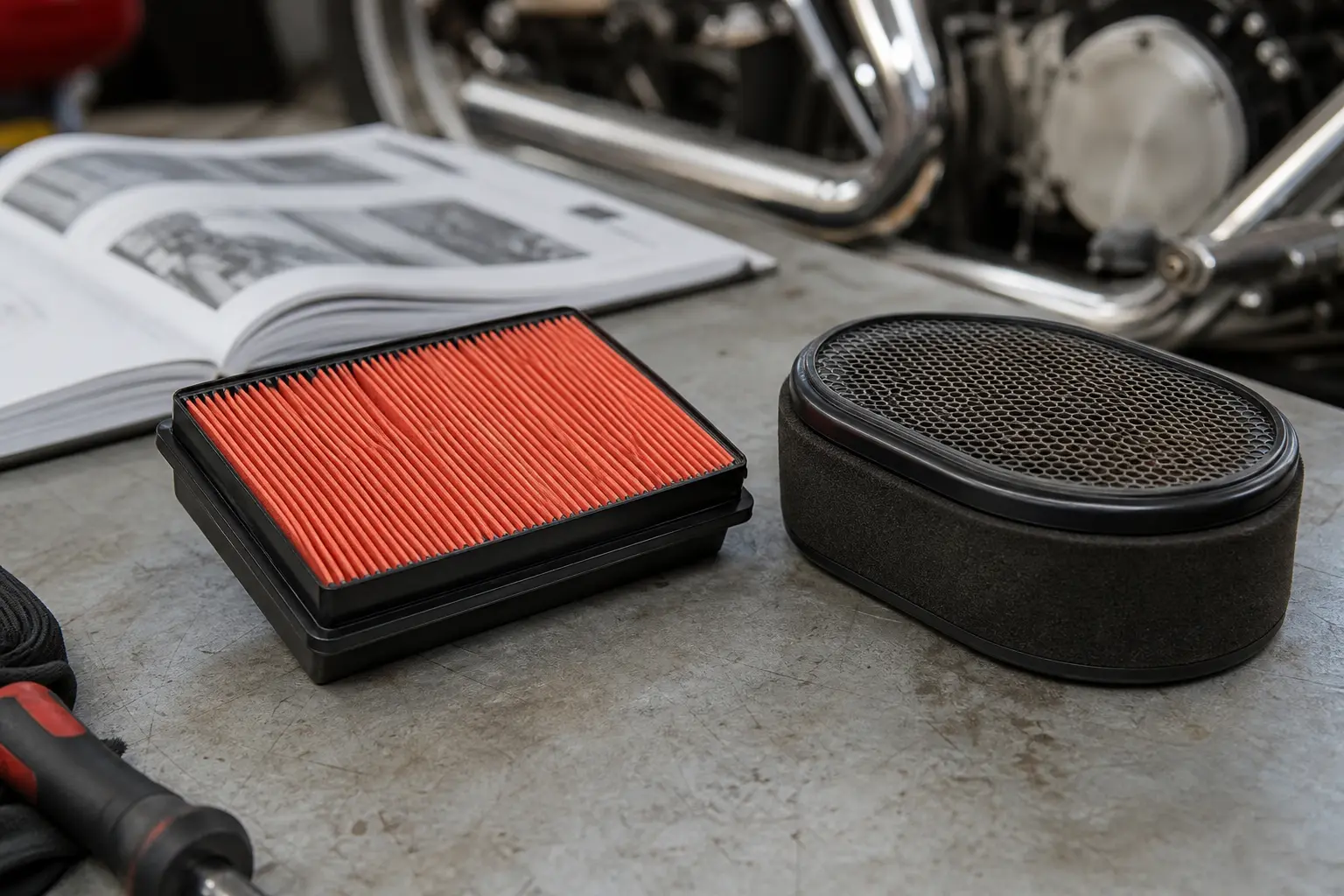
“Air filter” describes a job, not one material or one service method. A motorcycle may use a paper-like dry element, paper/wire-mesh construction, a viscous element, foam, cotton gauze, a pre-filter plus a main element, or another manufacturer-specific arrangement. Those designs can have different rules for cleaning, drying, oiling, and replacement.
A safe maintenance decision therefore has two stages:
- Identify the element and the manual’s service category. Is the instruction inspect, clean, replace, or some combination? Does it specify a permitted cleaner, drying approach, or oil? Is there a pre-filter with separate instructions?
- Assess the present condition. Is the media intact? Is the sealing surface sound? Is there evidence of moisture, oil, heavy dirt loading, or damage? If the filter cannot meet the manual’s condition standard, replacement is the answer even if the usual interval has not arrived.
Harley-Davidson’s official service information makes the point clearly. One procedure calls for inspection and allows washing a paper/wire-mesh element in mild detergent, while specifically stating not to use air-cleaner filter oil on that element. It also says to replace the element if it is damaged or cannot be adequately cleaned. 1 A separate Harley document for a cotton element calls for regular inspection, specifies a replacement interval, and warns against over-oiling. 2
Those documents are not a transferable recipe for every motorcycle. They are evidence that the phrase “clean the air filter” must always be translated through the instructions for the filter actually fitted to the bike.
The four factors that determine the right interval
1. The manufacturer’s maintenance schedule
Your owner’s manual is the controlling document for ordinary service timing. Look beyond a single mileage number. Many schedules use distance, time, engine hours, or a combination, and some distinguish normal from severe use. On off-road-oriented motorcycles, the schedule may be much more closely tied to hours and conditions than to road mileage.
Also check the notes attached to the schedule. A footnote may change the interval for dust, rain, competition, full-throttle operation, or other demanding use. Honda’s owner materials expressly tell riders to consult the maintenance section of the manual and note that certain items need more frequent service in unusually wet or dusty areas or with full-throttle riding. 4
If you bought the motorcycle used, do not assume the prior owner followed the schedule. Treat a missing service record as a reason to establish a known baseline. That does not mean automatically using a one-size-fits-all cleaner or oil; it means identifying the correct element and getting the right documentation before deciding its condition and next service.
2. Filter material and construction
Material is the main reason generic advice causes mistakes. A filter that is correctly serviced with a particular cleaner and oil can be harmed by the wrong treatment. A dry element may be damaged or compromised by oil. A viscous-type element may not tolerate compressed-air cleaning. A reusable element may have an approved cleaning and re-oiling process that is not appropriate for a disposable one.
Use the wording in the manual, parts catalog, or manufacturer service information. Labels such as dry, viscous, foam, cotton, paper, reusable, and replace are meaningful. If the information is unclear, pause rather than filling the gap with a popular online technique.
The safest principle is simple: only use a cleaning, drying, and oiling method that the manufacturer authorizes for that exact element. Harley’s documents show both sides of this issue: a dry paper/wire-mesh element that must not be oiled and a cotton element for which the manufacturer specifies an oiling process. [1]2
3. The air your motorcycle has actually consumed
The odometer does not measure dust concentration. Two motorcycles can travel the same distance while giving their air filters dramatically different workloads.
Frequent service may be appropriate sooner than the standard schedule when your riding includes:
- gravel, dirt roads, trails, agricultural roads, or desert terrain;
- group off-road riding or following vehicles that generate dust;
- construction detours, dry shoulders, or unpaved parking areas;
- frequent rain, deep water exposure, or a water-soaked intake area;
- an overturned motorcycle or an event that may have affected the intake;
- sustained high-load use where the manual identifies it as severe service.
This is not an invitation to service the element randomly after every ride. It is a prompt to inspect earlier, then apply the manual’s criteria. Honda specifically says more frequent service is needed in unusually wet or dusty environments and notes that a dirty, water-soaked, worn, or defective filter can allow contaminants toward the engine. 4
4. Condition at inspection
An interval tells you when to look; condition tells you what to do next. Common reasons to replace rather than continue with routine service include damage to the media, a compromised sealing area, a filter that cannot be restored to the manufacturer’s condition standard, or contamination the manual treats as disqualifying.
Be careful not to turn normal trapped dirt into a diagnosis. A filter’s job is to capture particles. However, visible tears, holes, loose bonding, distorted pleats, crumbling foam, an unreliable seal, or unexplained oily or wet contamination deserve closer attention. The filter is only one part of an intake system; finding contamination may warrant checking the surrounding airbox, drain arrangement, breather system, and fitment through the procedures appropriate to the model.
Do not start or run the engine with the air-filter element removed unless the manufacturer’s documentation explicitly permits the circumstance. Harley-Davidson warns that operating without the filter installed can allow debris into the engine. 1
A practical decision table
Use this table as a decision framework, not as a substitute service specification. The owner’s manual remains the authority for your motorcycle.
| What you find | Best next decision | What not to assume |
|---|---|---|
| The scheduled interval is approaching, but the bike has had normal paved-road use | Consult the exact manual and inspect or service as scheduled | That every filter must be replaced at the same mileage |
| The bike has been used in dust, on unpaved roads, or in unusually wet conditions | Move the inspection forward and follow severe-use notes | That the normal-road interval still applies unchanged |
| The element is identified as dry, paper, wire-mesh, or viscous type | Follow the specific authorized handling method; replace if the documentation calls for it | That filter oil, compressed air, or a universal cleaner is safe |
| The element is identified as reusable foam or cotton | Use only the approved service method and products for that element | That another reusable-filter method is interchangeable |
| The filter media, seal, or structure is visibly damaged | Replace the element and assess related intake concerns as appropriate | That cleaning will restore a damaged filter |
| The element is wet, oil-soaked, or otherwise contaminated | Use the manual to determine whether replacement, inspection, or qualified service is needed | That drying it out automatically resolves the cause |
| You cannot identify the filter type or find the correct instructions | Obtain the owner’s manual or ask an authorized dealer/qualified technician | That forum photos or a generic video can safely fill the gap |
What an inspection can tell you—and what it cannot
A careful inspection can help you decide whether you need to act sooner than the calendar says. It can reveal obvious accumulated dirt, moisture, physical damage, a displaced seal, or signs that a previous service used an unsuitable material or method.
It cannot reliably tell you every intake-system fact. For example, reduced performance, poor fuel economy, or difficult starting can have many causes beyond the air filter. Do not use an air-filter service interval as a shortcut diagnosis. If the motorcycle has warning lights, fuel-system concerns, unusual running behavior, or recurring contamination, use model-specific diagnostic guidance or arrange qualified inspection rather than repeatedly servicing a filter and hoping the symptom disappears.
Likewise, a clean-looking intake cover does not prove the filter or its sealing surface is healthy. The important component is the element and the way it interfaces with the airbox or intake assembly. Manufacturer documentation may require inspection of associated seals, hardware, or drainage features. Follow the model manual rather than judging fit solely by appearance.
Manufacturer-first safety guidance
Air-filter maintenance is normally routine, but it can become a safety and reliability issue when shortcuts introduce fire risk, intake leaks, loose components, or debris ingestion.
Start with these boundaries:
- Use the exact owner’s manual and service information for the motorcycle. A same-brand motorcycle or an aftermarket filter may use different requirements.
- Avoid unapproved chemicals. Harley-Davidson warns not to use gasoline or solvents to clean a filter element because flammable cleaners can create an intake-system fire risk. 1
- Do not invent a compressed-air rule. Harley permits low-pressure air from the clean side for one documented paper/wire-mesh element, while Honda says a viscous element cannot be cleaned with compressed air or otherwise without degrading performance. [1]3 The difference is precisely why the manual must decide.
- Do not add oil unless the documentation requires it. Oil is not a general performance upgrade. The wrong amount or wrong application can create problems, and Harley specifically warns not to over-oil the cotton element covered in its documentation. 2
- Do not ride after incomplete reassembly or with uncertain intake sealing. If you are unsure whether the element, cover, seal, or hardware is correctly fitted, stop and use the manual or qualified help before riding.
- Escalate when contamination has a cause. Repeated water, oil, or heavy debris in the airbox is not just a filter-cleaning task. It may call for inspection of related systems or riding conditions.
This conservative approach protects more than the engine. An unreliable motorcycle can distract a rider, reduce confidence, and turn a routine ride into an avoidable roadside problem.
Air-filter service checklist: decide before you touch the element

Use this checklist before scheduling or carrying out service. It is intentionally a planning and inspection checklist, not an exact repair procedure.
- Confirm the motorcycle’s exact year, model, engine configuration, and any intake modifications.
- Find the owner’s manual maintenance schedule and the air-cleaner section.
- Record the stated action: inspect, clean, replace, or a combination.
- Read all severe-use notes, including dust, wet conditions, off-road riding, or hours-based service.
- Identify the filter type from the manual, installed part information, or authorized dealer support.
- Confirm whether the element is dry, oiled, washable, reusable, viscous, or replacement-only.
- Check whether the manual specifies approved products or prohibits products such as oil, solvents, or compressed air.
- Inspect for visible damage, poor sealing, water exposure, oil contamination, or unusually heavy dirt loading.
- If you cannot verify the filter’s type or approved method, do not guess—obtain documentation or qualified help.
- Log the inspection date, mileage or hours, riding conditions, decision made, and next planned review.
A written record matters because the next inspection is easier to judge when you know whether the bike spent the last month commuting on paved roads or following a group down dry trails. For broader planning, see the Motorcycle Maintenance Guide.
Build a service plan around your real riding
A useful air-filter plan has three layers.
First, retain the manufacturer interval. Put the scheduled inspection or replacement point on your maintenance calendar. This is the baseline that prevents the item from disappearing behind oil changes, tires, and other more visible maintenance.
Second, add condition-based triggers. Decide which real-world events will prompt an earlier look: a dusty trip, an extended unpaved route, a water crossing, repeated rain exposure, a tip-over, or a suspected intake concern. These are inspection triggers, not automatic instructions to wash or replace the element.
Third, record the result. Note whether the filter was inspected, cleaned according to its approved method, replaced, or referred for service. Include the riding context. Over time, this record can show that your personal conditions require a shorter practical inspection cycle than the default schedule, without pretending that a generic number suits all riders.
This plan also helps when you sell the motorcycle or buy one used. An air-filter record is not glamorous, but it indicates whether the owner understood that intake service is more than an occasional cosmetic task.
How Vojo Helps
Create a recurring air-filter inspection task in the Motorcycle Maintenance Tracker using the interval from your exact owner’s manual. After dusty, wet, or off-road rides, add a ride note that flags an early inspection trigger; when you inspect the filter, record the mileage or hours, riding conditions, filter type, action taken, and the next due point. That gives you a service history based on your motorcycle and your real use rather than a vague memory.
Download Vojo on the App Store
The bottom line
Replace a motorcycle air filter when the manual specifies replacement, when inspection finds damage or contamination that the manufacturer does not permit you to remedy, or when the element cannot be returned to the documented condition standard. Service it earlier than the normal schedule when your riding conditions justify an earlier inspection.
Do not decide based on color alone. Do not decide based on another rider’s filter type. And do not assume cleaning, oiling, solvents, or compressed air are universally appropriate. The safest answer is manufacturer-first: identify the element, follow the exact schedule and approved method, account for severe use, and replace rather than improvise when condition or documentation leaves doubt.
Official references
1 Harley-Davidson Service Information: air-filter inspection, cleaning limits, fire warning, and no-oil direction for a documented paper/wire-mesh element.
2 Harley-Davidson Service Information: documented cotton air-filter inspection, replacement interval, and oiling cautions.
3 Honda owner documentation: viscous-type air-cleaner element that should not be cleaned with compressed air or similar methods.
4 Honda owner documentation: maintenance schedules are condition-dependent, with more frequent service needed for unusually wet or dusty use.
Quick answers
Frequently asked questions
When should I replace motorcycle air filter if I mostly ride on pavement?
Use the inspection and replacement timing in your exact owner’s manual as the baseline. Mostly paved riding may fit the normal schedule, but local construction dust, rain exposure, a damaged element, or uncertain service history can justify an earlier inspection. Do not replace solely because the filter has changed color; follow the manual’s condition criteria and replacement instruction.
Can I clean every motorcycle air filter instead of replacing it?
No. Filter construction controls the answer. Some elements have a manufacturer-approved cleaning process, while others are intended to be replaced or have restrictions on oil, compressed air, or cleaning products. Honda documentation, for example, says a viscous-type element cannot be cleaned with compressed air or similar methods without degrading performance. Verify the exact element before choosing a method.
Should I oil my motorcycle air filter after cleaning it?
Only if the documentation for that exact filter requires oil. Oil is correct for some reusable filter designs and incorrect for others. Harley-Davidson service information includes both a paper/wire-mesh element that must not be oiled and a cotton element with a specified oiling process. Treat “oil it” as a model- and filter-specific instruction, not a general rule.
How often should I inspect the air filter after dusty riding?
Inspect sooner than the standard interval when the owner’s manual identifies dusty conditions as severe use or when your ride involved substantial airborne dirt. There is no universal mileage or ride-count shortcut. Set an earlier inspection trigger, assess the element using the model documentation, and record what you find so future scheduling reflects your actual environment.
Can a dirty air filter explain poor motorcycle performance?
A restricted or compromised filter may be relevant, but poor running can have many causes. Do not assume a filter service will diagnose or solve a fuel, ignition, sensor, intake-leak, or mechanical issue. If symptoms persist after appropriate manual-based maintenance—or if the filter repeatedly becomes wet or oily—arrange model-specific diagnosis or qualified inspection.