
Passing on a Motorcycle: A Safer Plan for Passing and Being Passed
Learn how to pass safely on a motorcycle and handle being passed with a repeatable plan for space, sightlines, signals, blind spots, and escape options.
Fact-checked against cited official documentation
Reviewed against Fact-checked against MSF’s Motorcycle Operator Manual and You and Your Motorcycle: Riding Tips materials for passing, blind spots, lane position, signaling, and SEE guidance..
Last updated October 26, 2026
Passing is not a test of acceleration. It is a decision about whether you can create enough time and space to move around another road user, remain visible, and return to your lane without forcing anyone else to react.
That distinction matters because a motorcycle can fit into a smaller physical gap than a car, but fitting is not the same as having a safe margin. A vehicle ahead may change speed. An approaching vehicle may be closer or faster than it first appeared. A driver behind you may begin an overtake at the same time. A bend, crest, junction, parked vehicle, or roadside entrance can erase the information you need.
The safest answer is often to wait. When a pass is appropriate, use a sequence rather than an impulse: build space, read the road, check behind, signal, check again, move decisively, and return only when you have room. When another vehicle passes you, avoid turning the event into a contest. Make room, hold a predictable line, and let the conflict end.
This guide focuses on street-riding judgment, not a model-specific maneuver. Always put the motorcycle manufacturer’s instructions, local traffic law, and your riding training first. The Motorcycle Maintenance Guide can help with the separate question of keeping controls, lights, tires, and mirrors ready for normal riding; it cannot make an unsuitable passing opportunity safe.
The Core Decision: Do You Need to Pass?
Before evaluating technique, question the reason for the maneuver. Are you passing because the vehicle ahead is genuinely limiting your progress, or because its pace feels inconvenient? Are you approaching a planned turn, a fuel stop, or a route split where staying behind is simpler? Is the road about to become more open, or are you already entering a complex section?
A pass consumes attention. You must evaluate the vehicle ahead, the road beyond it, traffic behind you, your intended lane, and the return path. If the road does not offer a clear picture of all of those areas, postponing the pass preserves options.
The Motorcycle Safety Foundation’s operator manual frames passing as a structured process rather than a single burst of throttle. Its sequence includes maintaining following distance, positioning, signaling, checking mirrors and the blind spot, and completing the pass without crowding the other vehicle (MSF Motorcycle Operator Manual). MSF’s riding-tips booklet similarly emphasizes a gap, a check for traffic behind, oncoming traffic, and avoiding unsafe overtakes near corners and intersections (You and Your Motorcycle: Riding Tips).
Use this simple gate before doing anything else:
- Purpose: You have a clear reason to pass.
- View: You can see far enough ahead to identify developing hazards, not merely the immediate patch of road.
- Space: The available lane and return path provide a margin, not just a motorcycle-sized opening.
- Time: You can complete the maneuver without rushing because the road is about to change.
- Condition: You are alert, your motorcycle is behaving normally, and the surface and weather support predictable control.
If one answer is uncertain, remain behind and reassess later. A missed passing opportunity is temporary. A pass started without a reliable view can become a problem before you have a useful escape option.
A Safer Passing Sequence
1. Establish a useful following position
Do not begin by riding close to the vehicle you intend to pass. A close position reduces your view, leaves less time to react if that vehicle brakes, and can hide you from its mirrors. Create a usable following gap first. The MSF riding guide discusses a two-second gap as a baseline for passing decisions, but conditions can call for more space. Increase it when visibility, grip, traffic speed, fatigue, or the vehicle ahead makes events harder to predict.
A larger gap also gives you time to observe. Is the driver wandering within the lane? Are brake lights appearing repeatedly? Is the vehicle approaching a side street, a turning lane, a parked car, or a pedestrian crossing? Does its speed suggest that the driver may be preparing to turn or stop?
Do not treat a gap as a countdown that guarantees a pass. It is working room for observation and control.
2. Read beyond the vehicle ahead
Look through and around the vehicle when possible, but do not confuse a partial view with a clear one. You need to evaluate the intended passing area, oncoming traffic, road markings, surface changes, and what could enter from the side.
A straight section can still be deceptive. A dip can hide an approaching vehicle. A crest can conceal traffic. A wide driveway can introduce a turning vehicle. A row of parked vehicles can obscure someone crossing or pulling out. Near a corner, your sightline may end where the road changes direction, while another road user continues toward you.
Do not pass when the road’s shape prevents you from seeing the space you will occupy. Waiting for a longer, more open view is a skill, not a failure of confidence.
3. Check behind before you announce your intention
A rider can be focused so intently on the vehicle ahead that a faster vehicle behind goes unnoticed. Before signaling or moving laterally, check mirrors and make a deliberate head check for the relevant blind area. The official MSF material treats this rearward check as part of the passing sequence, not as an optional courtesy.
Look for a vehicle already approaching from behind, a motorcycle filtering or moving between lanes where legal, and a vehicle whose driver may have begun passing you. If someone is already committed to coming around, do not move into that path. Hold a predictable line, reduce unnecessary changes, and let the situation develop with space.
A mirror check tells you what the mirror shows. A head check helps address the area the mirror may not show. Neither check is a license to drift; keep the motorcycle stable while you look.
4. Signal early enough to communicate
Use the motorcycle’s signal according to local law and the traffic situation. Signaling communicates an intention; it does not create priority or make an unsafe gap acceptable. Continue to verify the path after signaling because traffic can change while the signal is active.
The rider’s position should support visibility and a clear decision. Avoid hiding beside the vehicle ahead or sitting in a place where its driver is unlikely to see you. Do not assume that a driver has noticed the signal, made eye contact, or understood your plan.
5. Move through the passing area decisively
Once the opportunity is legal, visible, and genuinely open, avoid lingering alongside the other vehicle. Prolonged side-by-side riding keeps you in a vulnerable area and increases the time during which either road user can change position.
“Decisive” does not mean aggressive. It means a smooth, controlled change of position with enough acceleration for the motorcycle to spend as little unnecessary time beside the vehicle as practical. Keep your attention moving: monitor the vehicle, the road ahead, and the return space rather than staring at one target.
Do not use speed to repair a poor decision. If the pass requires a dramatic burst, a late move, or pressure on another driver, the opportunity was not adequate. Return behind when that is the safer available option, provided you can do so smoothly and legally.
6. Keep a margin from the vehicle
Avoid crowding the vehicle you are passing. Its driver may not see you, may need to adjust around a surface hazard, or may drift within the lane. A motorcycle also needs room to respond if the vehicle’s behavior changes.
Do not pass so closely that your only escape is forward. Keep enough lateral and longitudinal space to account for movement, wind, surface problems, and an imperfect human decision. The larger vehicle may also block your view of what comes next, so do not cut back in immediately simply because your front wheel is ahead.
7. Return only when you can see the whole situation
The pass is not complete when you are level with the front of the other vehicle. You still need a safe return path and enough distance so you do not make the other driver brake or close the gap abruptly.
Use your mirrors and awareness of the vehicle’s position to judge when you can return. Move back smoothly, cancel the signal when appropriate, and rebuild a normal following relationship. If the vehicle ahead is traveling slower than expected, or if a new hazard appears, preserve your lane and space rather than forcing a tight merge.
When Not to Pass
Some locations are poor choices because they remove the sightline or the escape route needed for a sound decision. The MSF guidance specifically warns riders about passing near corners and intersections. Extend that caution to any place where another road user can appear from behind an obstruction or where road users may change direction unexpectedly.
Avoid treating these situations as routine passing zones:
| Situation | What is missing | Conservative response |
|---|---|---|
| Blind bend or crest | A reliable view of approaching traffic | Stay behind until the road opens |
| Intersection or driveway cluster | Predictable paths for turning and entering traffic | Wait and reassess after the conflict area |
| Narrow bridge or constrained lane | Lateral and escape space | Maintain position and distance |
| Heavy traffic with frequent lane changes | Stable gaps and clear intentions | Delay the pass; reduce complexity |
| Poor visibility, glare, rain, or spray | Accurate distance and speed judgment | Increase margin or stop the plan |
| Vehicle ahead braking or wandering | Confidence in the vehicle’s next move | Create space and observe |
| You are tired, rushed, or angry | Reliable judgment and restraint | Do not pass; take a break if needed |
Road markings and local law matter. A physically open road is not automatically a legally permissible one. If you are unsure about the rule, do not make the maneuver until you can verify it safely.
How to Handle Being Passed
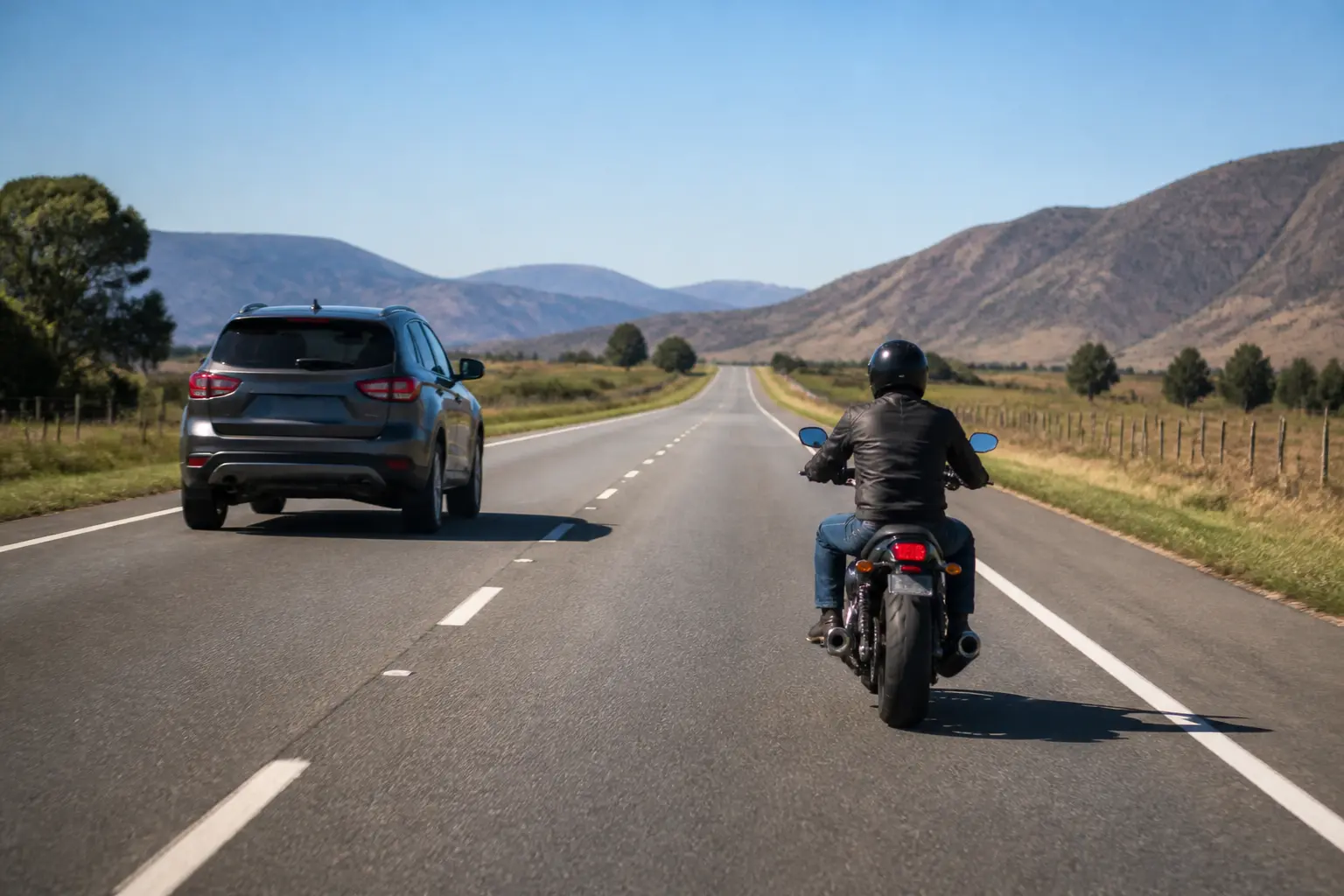
Being passed can trigger a reflex: accelerate to stay alongside, move toward the passing vehicle, or immediately pass it back. Those reactions turn another rider’s or driver’s decision into your problem. The safer objective is predictability.
First, notice the approach. Check mirrors regularly enough that a passing vehicle does not surprise you, but do not make abrupt head movements or lane changes. If a vehicle is closing quickly, hold a steady, visible line and avoid accelerating simply to prevent it from passing.
If the road and law allow, create useful room by maintaining your lane position and leaving the passing vehicle a clear path. Do not hug an edge where the surface may be poor, debris may collect, or your escape space disappears. Do not move toward the centerline or into the passing path to discourage the maneuver. Your exact position should follow local road layout and safe lane practice, but the principle is constant: remain predictable and preserve an option to respond.
As the vehicle comes alongside, keep your attention on the road ahead and your motorcycle stable. Expect that the driver may return too soon, that wind or turbulence may affect your comfort, or that the vehicle may reveal a hazard you could not previously see. Do not stare at the vehicle or make gestures. If the pass becomes uncomfortably close, reduce the situation’s urgency with smooth control and space rather than a confrontation.
After the vehicle clears you, reestablish a reasonable gap. There is no requirement to reclaim the position. If you later choose to pass, make that a new decision using the full sequence—not an emotional response to being overtaken.
The MSF’s broader riding-tips material connects this behavior to SEE: search, evaluate, and execute. In practice, that means continually searching behind and ahead, evaluating the changing space, and executing only a response that leaves you options (MSF You and Your Motorcycle library page).
A Checklist Before You Pass
Use this checklist as a mental reset. It is deliberately short enough to remember, but it should not replace local law, formal training, or the owner’s manual.
PASS checklist
- P — Purpose: Why am I passing, and can I simply wait?
- A — Ahead: Can I see the passing area, return path, and developing hazards?
- S — Space: Do I have a following gap, lateral margin, and room to finish without crowding?
- S — Surroundings: Have I checked mirrors, blind areas, oncoming traffic, intersections, bends, and surface changes?
- S — Signal and settle: Have I communicated, confirmed again, and prepared for a smooth, controlled move?
After the maneuver, ask one more question: Can I return without making the other road user alter speed or direction abruptly? If not, the pass is not ready.
For being passed, use a matching reset:
- Notice the vehicle early.
- Hold a predictable line.
- Do not race, block, or move toward it.
- Preserve a usable escape area.
- Let the event finish before making another maneuver.
Practice the Judgment, Not the Gamble
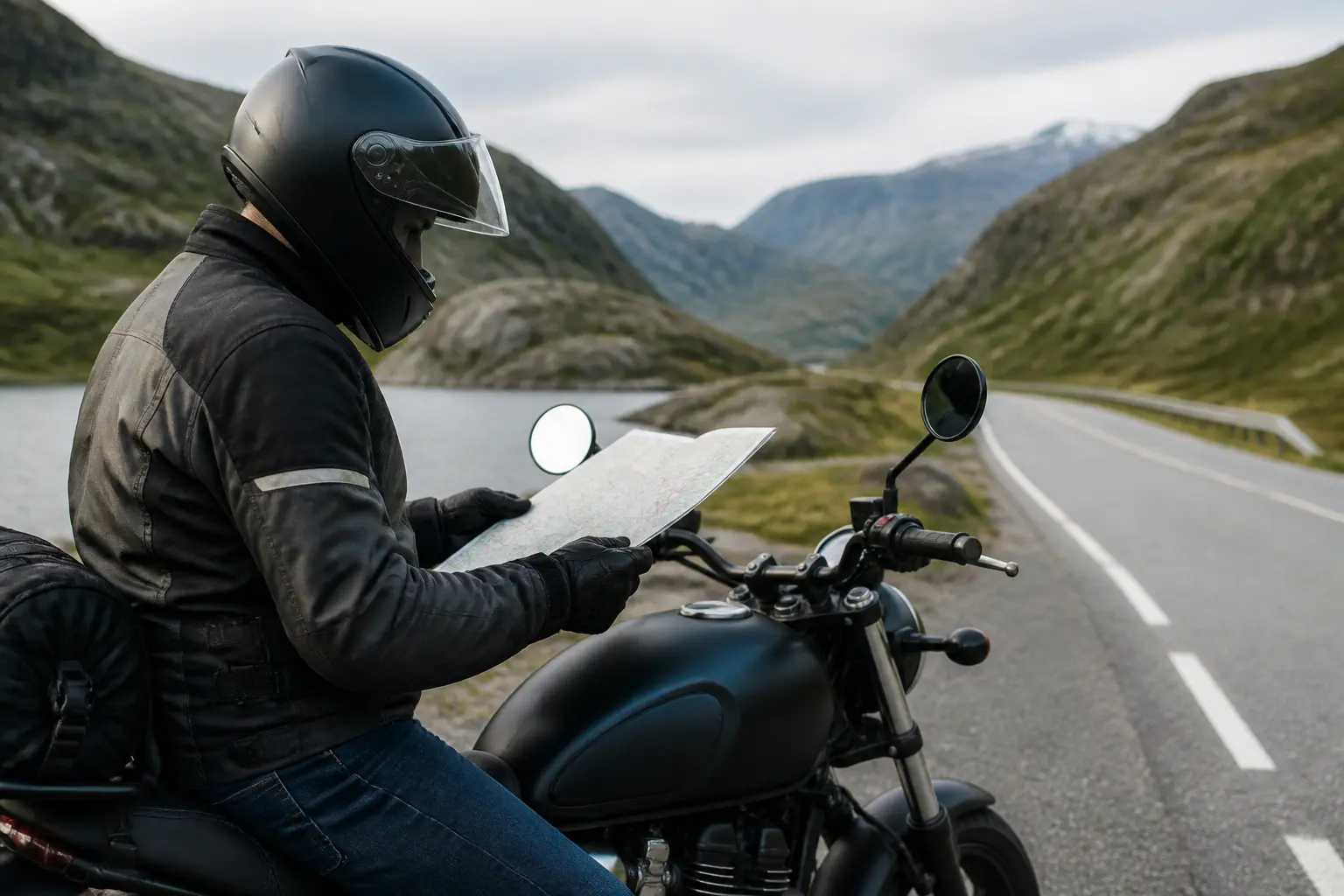
Passing skill improves through better observation and decision timing, not by repeatedly attempting tighter gaps. On a quiet, legal route, practice identifying the point at which you would begin evaluating a pass, then deliberately choosing to wait. Notice how sightlines change over a crest, how a parked vehicle hides a side street, and how quickly a following gap disappears when you become fixated on the vehicle ahead.
A formal rider-training course can provide a controlled place to work on scanning, lane positioning, braking, and smooth control. Do not use public traffic as a practice area for high-risk overtakes. If you are uncomfortable judging speed, distance, or blind spots, make training the next step rather than trying to gain confidence through pressure.
Your motorcycle’s condition is part of readiness. Before a ride, follow the manufacturer’s inspection guidance for items such as tires, controls, lights, mirrors, and fluid levels. A loose mirror or unreliable signal adds uncertainty to an already information-heavy maneuver. But even a perfectly maintained motorcycle cannot compensate for an obstructed view or inadequate space.
How Vojo Helps
Turn the advice into a pre-ride and post-ride workflow in Vojo. Before leaving, open your motorcycle’s record in the motorcycle service history and review unresolved notes that could affect visibility or control, such as a mirror, signal, tire, or lighting concern. Add a short ride note: “Wait for open sightline; no passing near intersections; hold line when passed.” After the ride, record where your plan became difficult—rear traffic, glare, a blind crest, or pressure from a fast vehicle—and convert that observation into the next route or training reminder. This keeps passing decisions connected to the motorcycle, the route, and your actual riding habits instead of relying on memory.
Quick answers
Frequently asked questions
What is the safest way to pass a car on a motorcycle?
Start with a usable following gap, confirm a clear view of the passing and return areas, check mirrors and blind spots, signal, and move smoothly without lingering beside the vehicle. Return only when you can do so without crowding or forcing the other driver to react. If any part of the view or space is uncertain, wait.
Should I accelerate when another vehicle is passing me?
Usually, no. Hold a predictable line and avoid turning the event into a race. Do not move toward the passing path or accelerate simply to prevent the pass. Preserve space, let the vehicle clear you, and reassess only after the situation has settled.
How much following distance should I leave before passing?
MSF discusses a two-second gap as a baseline in its rider guidance, but it is not a universal guarantee. Use more space when visibility, grip, traffic, speed differences, fatigue, or the vehicle’s behavior make events less predictable.
Why should I avoid passing near a corner or intersection?
A corner can hide oncoming traffic, while an intersection can introduce turning, entering, crossing, or stopping vehicles. These locations reduce the sightline and increase the number of possible conflicts, so waiting for a clearer section preserves more options.
Is a turn signal enough to make a motorcycle pass safe?
No. A signal communicates intention but does not create a safe gap, confirm that another road user has seen you, or make an illegal maneuver acceptable. Continue checking traffic and the road after signaling, and proceed only when the complete path is clear and permitted.
What should I do if I feel pressured to pass?
Do not let a following driver set your risk level. Maintain a stable line and a suitable gap, allow faster traffic to pass when possible, and wait for a genuinely clear opportunity. If stress or fatigue is affecting judgment, take a safe break rather than forcing a decision.