
Motorcycle Turn Signal Not Working: A Parked-Bike Safety Check Before You Ride in Traffic
A motorcycle turn signal not working changes your traffic communication plan. Use this parked-bike safety check to decide when to pause and arrange service.
Fact-checked against cited official documentation
Reviewed against Fact-checked against MSF signaling and pre-ride guidance, NHTSA motorcycle lighting material, Honda owner-manual examples of model-specific signal behavior, and Harley-Davidson lighting-inspection reference material..
Last updated October 14, 2026
A motorcycle turn signal not working is a pre-ride safety decision before it is a troubleshooting project. A signal gives nearby road users information about your intended turn or lane movement. When that information is missing, weak, inconsistent, or physically damaged, the motorcycle’s normal communication system is no longer dependable.
The practical response is not to guess which component failed or attempt a quick electrical fix at the curb. Keep the motorcycle parked, confirm exactly what happens at the exterior lamps, note any obvious damage or related electrical symptoms, consult documentation for the exact motorcycle, and choose a conservative next step.
The Motorcycle Safety Foundation advises riders to use turn signals for every turn and lane change, make a pre-ride check habitual, use lane position to improve sightlines, and preserve an escape route. Those recommendations matter here because a signal is only one layer of traffic communication—not a substitute for observation, spacing, or judgment. If that layer is unavailable, the rest of the ride needs a more cautious reassessment.
This article is intentionally limited to observations a rider can make with the motorcycle safely parked. It does not identify a failed part, prescribe a repair sequence, recommend alternate wiring, or authorize an equipment modification. Signal layouts, electronics, lamp types, automatic-cancel features, diagnostic warnings, and approved replacement parts differ by model and market.
Motorcycle Turn Signal Not Working: Decide Before You Diagnose
Start with the question that matters most: does this motorcycle belong in public traffic today? A bike can start normally and still be a poor choice for a ride if it cannot reliably show its intended direction.
A turn-signal concern deserves more caution when the planned trip includes multilane roads, busy junctions, rain, darkness, unfamiliar streets, passengers, group-riding pressure, or a schedule that makes you feel rushed. These are situations where other people need more time to understand what you are doing and where you need both hands and full attention on controlling the motorcycle.
Do not make the ride decision depend on whether you think you can compensate with extra caution. Bright clothing, a headlight, careful lane placement, head checks, and deliberate riding are worthwhile safety habits, but they do not recreate a working turn-signal system. They also cannot establish that an electrical fault is isolated.
A conservative default is to postpone a traffic ride if you cannot verify normal left and right signaling at the locations fitted to your motorcycle. This is especially sensible if the behavior is intermittent, both sides are affected, the fault appeared after a fall or accessory installation, or other lights also seem unusual.
Some observations should move the decision firmly into do not ride; arrange help or inspection territory:
- A lens, stalk, bracket, or lamp housing is hanging loose, missing, or visibly damaged.
- You see exposed conductors, crushed cable sheathing, melted plastic, or moisture inside a component where it appears abnormal.
- There is smoke, a hot-electrical odor, unusual heat, or a warning display you do not understand.
- Several lamps or electrical functions behave abnormally at once.
- The signal changes state when the steering is moved, the motorcycle is jostled, or the ignition is cycled.
- The problem followed collision damage, transport, battery work, heavy water exposure, or an unknown modification on a used motorcycle.
These are not diagnoses. They are risk signals. A motorcycle with a lighting fault plus physical damage or broader electrical oddities calls for a higher level of caution than one clearly documented, isolated lamp issue.
Motorcycle Turn Signal Not Working: Map the Symptom While Parked
“Blinker not working” is useful shorthand, but it is not enough detail for a sound ride decision or a helpful service conversation. The goal of a parked check is to turn that shorthand into a precise observation without taking anything apart.
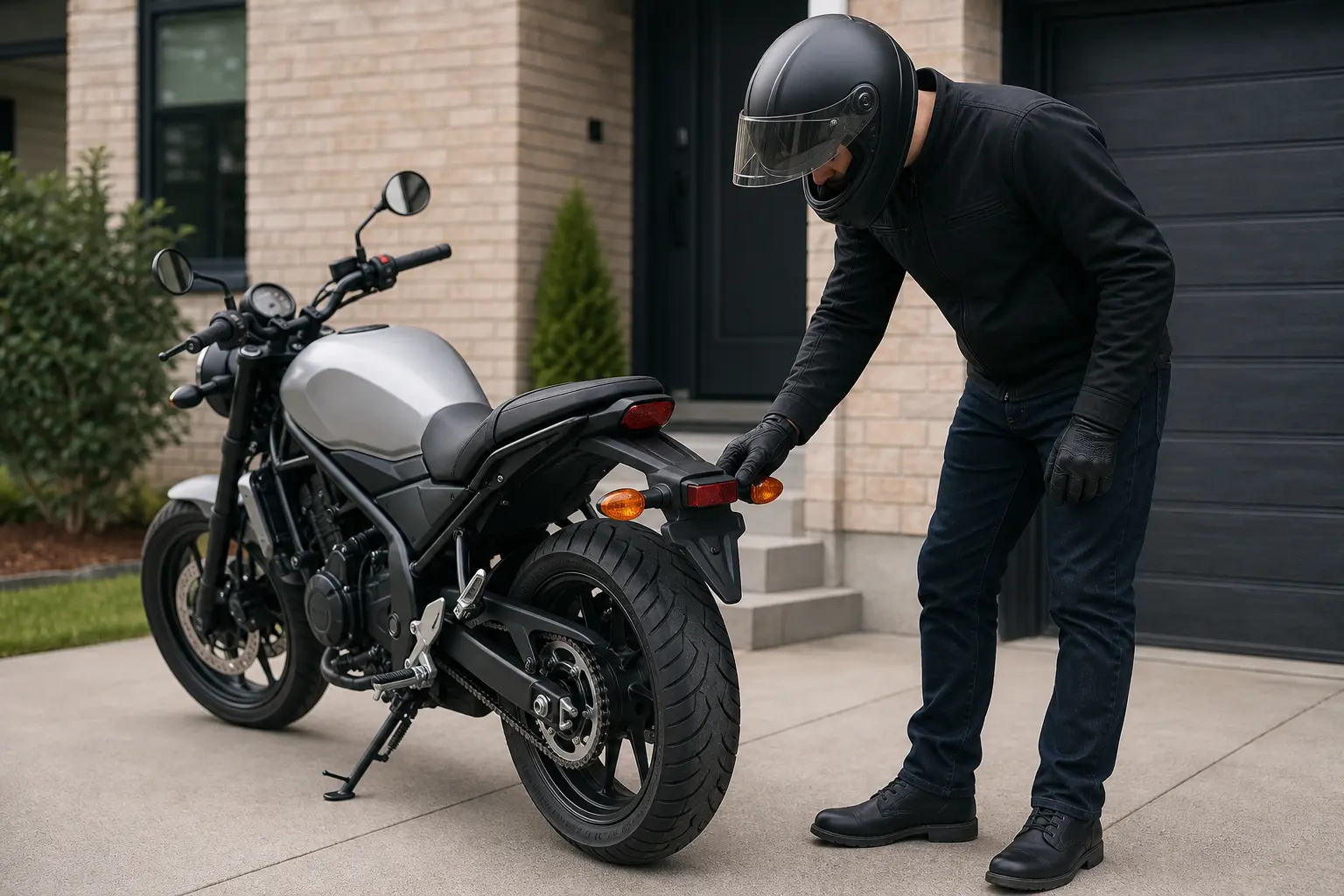
Park on firm, level ground with adequate room and light. Secure the motorcycle according to its normal parking method. Follow the owner’s manual for the ignition position and operating conditions needed to check the lighting. Do not perform the check while the motorcycle is in moving traffic, on an unstable surface, or where exhaust, weather, or distractions make observation difficult.
Select the left signal using the normal control. Look at the actual left-side lamps fitted at the front and rear. If you cannot see both safely from one position, use a reflection, ask a helper to watch, or make separate observations while the motorcycle remains stationary. A dashboard arrow can be useful information, but it is not a substitute for seeing the exterior lamps.
Cancel the left signal in the normal way, then repeat the check for the right side. If the motorcycle has a hazard-warning feature, observe it separately only if the owner’s manual describes it. Hazard behavior is not automatically proof that the normal left/right selection function is operating correctly, and normal turn-signal operation does not prove that every hazard-light behavior is normal.
Use the table as a language tool, not a fault-finding chart. It helps you record what you saw without assuming the cause.
| Parked-bike observation | What it establishes | Safer next action |
|---|---|---|
| One signal location on one side does not illuminate, while other lamps on that side appear to operate | There is an observed problem at one lamp location; the cause remains unknown | Keep the bike parked if traffic use would be affected; check the model documentation and arrange appropriate assessment |
| The front and rear signal locations on one selected side do not operate | One direction cannot be confirmed through the motorcycle’s usual signaling system | Postpone traffic riding and document the exact behavior |
| Neither left nor right selection produces normal exterior signaling | Normal directional communication cannot be verified | Do not ride in traffic; arrange model-specific service guidance |
| A lamp remains steadily lit, flashes unpredictably, or stops after beginning normally | The signal function is not behaving consistently | Treat it as an unresolved fault rather than a minor quirk |
| The dash indicator appears normal but one or more exterior lamps do not | The instrument display does not confirm complete exterior operation | Record both observations and inspect the actual lamp locations |
| Behavior changes as handlebars move or after slight movement of the motorcycle | An intermittent condition is present | Do not ride; avoid manipulating wiring and arrange inspection |
| A lamp unit or its mount is cracked, bent, loose, or absent | Visibility and component retention may both be compromised | Keep the motorcycle off public roads until assessed |
The distinction between observation and diagnosis matters. One non-functioning lamp does not automatically identify a bulb, LED module, connector, relay, fuse, switch, ground, battery, harness, or control unit. Modern motorcycles may also monitor lighting differently from older designs. Treat a visible symptom as evidence for a qualified next step, not permission to select a part at random.
The National Highway Traffic Safety Administration’s lighting materials underscore that turn-signal lamps are safety equipment with requirements relating to their placement and effectiveness. That is a useful reminder not to treat lamp location, mounting, or visibility as cosmetic details—particularly after a tip-over or an aftermarket lighting change.
Motorcycle Turn Signal Not Working: Parked-Bike Checklist
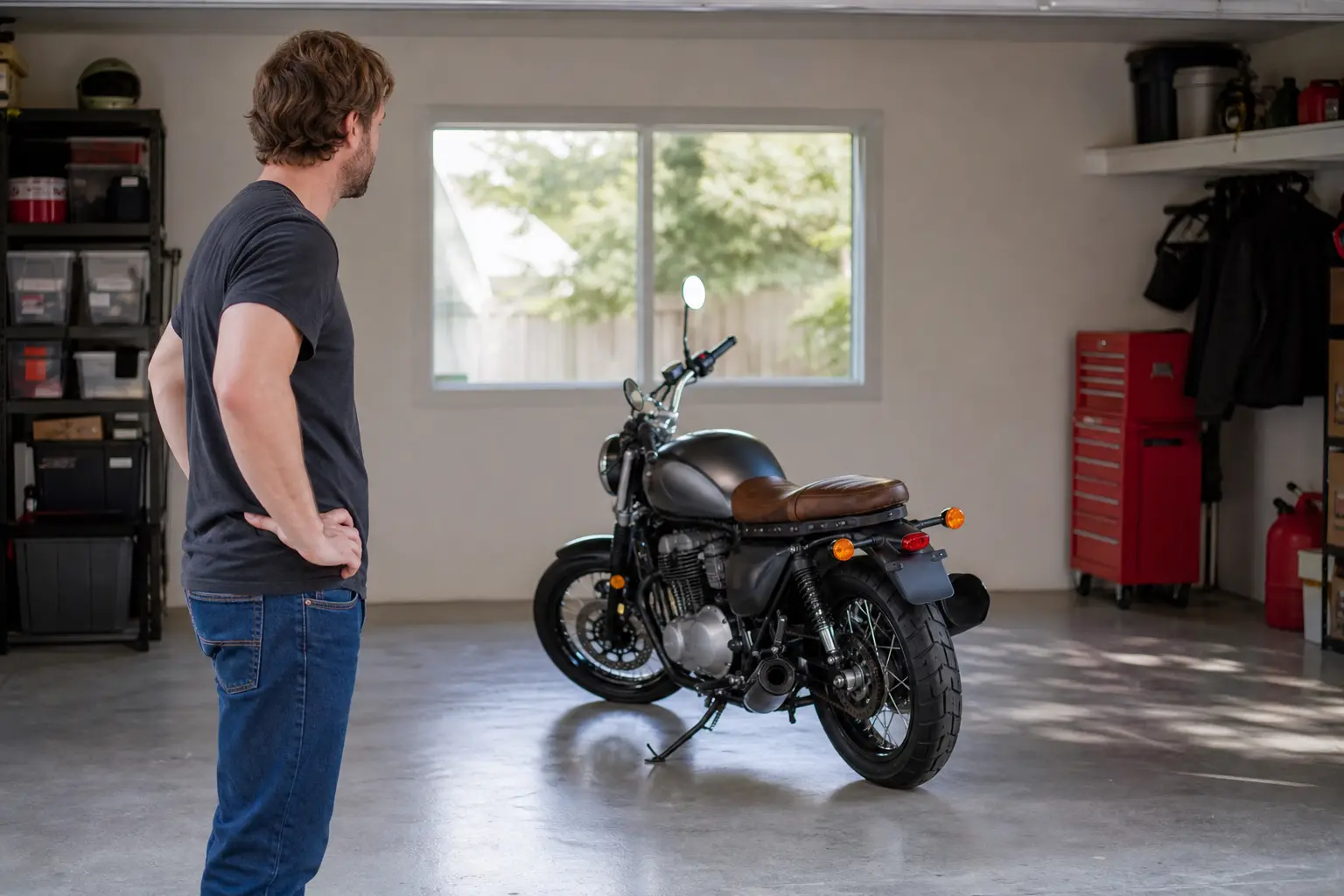
Use this checklist before deciding whether to leave for work, meet a group, or continue with a planned ride.
- Park on stable, level ground with enough light to see the lamps and their mountings.
- Identify the motorcycle accurately: model, model year, market version if known, and relevant accessories or lighting changes.
- Open the owner’s manual section covering switches, indicators, warning lights, pre-ride checks, and lighting.
- Select the left signal and observe the exterior front and rear left-side lamp locations.
- Cancel it through the normal control, then repeat the observation for the right side.
- Treat the dashboard indication as supporting information rather than proof that all exterior lamps are operating.
- Note whether each observed lamp flashes normally, stays illuminated, is dark, or behaves inconsistently.
- If the motorcycle is equipped with hazards and the manual addresses their operation, observe that function as a separate check.
- Look for obvious external problems only: a loose unit, cracked lens, bent bracket, missing component, pinched-looking wire, exposed conductor, or signs of overheating.
- Stop the check and do not ride if you notice smoke, burning smell, heat damage, multiple lighting concerns, an unfamiliar warning, or changing behavior with steering movement.
- Consider the route and conditions honestly. Darkness, wet weather, dense traffic, highway lane changes, a passenger, and time pressure reduce the margin for continuing with a communication fault.
- Photograph the condition or make a brief parked video if it can be done safely. Record the date and odometer reading for the service handoff.
This checklist has a deliberately modest outcome. It is successful when it produces an accurate statement such as: “The right-side front and rear signals did not operate during a parked check. The left side operated. The indicator on the dash did/did not illuminate. No obvious impact damage was seen.” That is much more useful than “the bike has an electrical issue.”
Avoid changing the evidence before service. Repeatedly cycling the ignition, moving components side to side, pulling trim apart, replacing fuses without documentation, or forcing connectors can create a second problem and make an intermittent original symptom harder to reproduce.
Motorcycle Turn Signal Not Working After Accessories or a Tip-Over
Recent changes are important context, even though they are not automatic proof of cause. A signal fault that appears after a tail tidy, LED conversion, integrated rear lamp, accessory harness, alarm, charger lead, heated-gear connection, repair, transport, or crash deserves a documentation-first approach.
Aftermarket lighting can complicate the assumptions a rider makes from the outside. A component may look securely mounted yet be unsuitable for the motorcycle’s electrical system or intended lighting arrangement. Conversely, an accessory may have worked for a period before another issue appeared. Neither observation settles compatibility, installation quality, visibility, weather resistance, or whether the motorcycle’s original protection and monitoring logic has been affected.
This is why “it is LED” is not a diagnosis and “it worked last week” is not a safety clearance. Some motorcycles use LED signal assemblies from the factory; some use different approaches; some may have automatic-cancel behavior or instrument indications that depend on their exact design. Honda owner documentation for some models, for example, shows that signal controls and automatic-cancel behavior can be model-specific. Your own manual—not a general online fix—controls what normal operation looks like for your machine.
Do not use a random resistor, fuse rating, connector swap, direct power feed, or bypass as a way to get through today’s ride. Those are repair choices with model-specific implications. A change that appears to restore flashing may leave an underlying fault unresolved, defeat protective behavior, create heat concerns, or obscure a problem that returns at the worst time.
A used motorcycle needs extra skepticism. Accessories may have been installed by a prior owner, an unknown shop, or a seller who no longer has records. Look for receipts, installation notes, packaging, or service history, but do not assume that a tidy appearance means the setup is appropriate. Tell the service provider about every lighting and electrical modification you know about, including equipment that seems unrelated.
After a tip-over, do not focus only on whether the lamp lights. A working lamp can still be attached to a damaged stalk, bracket, fairing panel, or mounting point. A loose item can become a distraction, make the signal harder to see, or contact another motorcycle part as the bike moves. A visual assessment of retention and surrounding damage is therefore part of the safety decision.
Motorcycle Turn Signal Not Working: Separate Visibility From Predictability
A turn signal helps communicate an intention; it does not guarantee that someone has noticed or understood it. MSF guidance encourages riders to search for hazards, use space and lane position strategically, and maintain an escape option because drivers may fail to see motorcycles. Those habits remain essential when every lamp is working—and they become even more important when a signal concern ends a ride or develops unexpectedly.
Do not tell yourself that a working headlight or high-visibility gear makes an inoperative signal insignificant. Other road users receive information in different ways and at different times. Someone approaching from behind may rely on rear communication. Someone waiting at a side street may interpret your path differently from someone in an adjacent lane. At a busy intersection, an absent signal can add uncertainty exactly when multiple people are deciding whether to move.
If the issue begins while you are already riding, the immediate priority is motorcycle control. Do not make an abrupt lane change, a rushed turn, or a sudden roadside stop because you noticed a dashboard indication. Continue scanning, keep a stable path, reduce the demands on the ride, and move toward a safe legal stopping opportunity as conditions permit.
Once stopped, repeat the calm parked observation. If normal signaling cannot be confirmed, end the traffic ride rather than extending it because home, work, or the next stop seems close. The remaining distance may still include the merge, intersection, or lane change where clear communication matters most.
For a broader routine that puts lights alongside tires, controls, fluids, and visible damage, see the Motorcycle Maintenance Guide.
Motorcycle Turn Signal Not Working: When the Ride Should End
There is no universal shortcut—no particular trip length, weather condition, hand gesture, or familiar route—that turns a malfunctioning installed signal into a normal road-ready system. The prudent decision depends on what you can confirm, the condition of the rest of the motorcycle, and the traffic demands ahead.
End or delay the ride when one or more of these conditions applies:
- You cannot confirm normal left and right signaling at the lamp locations the motorcycle is designed to use.
- The fault is intermittent, affects both directions, or appears alongside unusual behavior in other lights or electrical functions.
- There is visible collision damage, loose equipment, exposed wiring, moisture intrusion, heat damage, or an unfamiliar warning.
- The route involves low visibility, wet roads, complex intersections, fast traffic, frequent lane movement, or unfamiliar navigation.
- You are carrying a passenger or feel social, work, or schedule pressure to continue.
- The motorcycle has recently had lighting or electrical work and you cannot verify the configuration against its manufacturer documentation.
There is a difference between repositioning a motorcycle on private property to secure it and deciding to use public roads for an errand or commute. The latter introduces other road users, changing sightlines, and legal obligations that vary by location. Do not make assumptions about local equipment rules or hand-signal alternatives; check the applicable rules where you ride. More importantly, do not let a possible legal workaround become a reason to accept an avoidable safety disadvantage.
Choosing alternate transport, delaying the ride, arranging a pickup, or booking service is not overreacting. It is a proportionate answer to uncertainty in a system designed to make your intentions easier for others to understand.
Motorcycle Turn Signal Not Working: Document It for Service
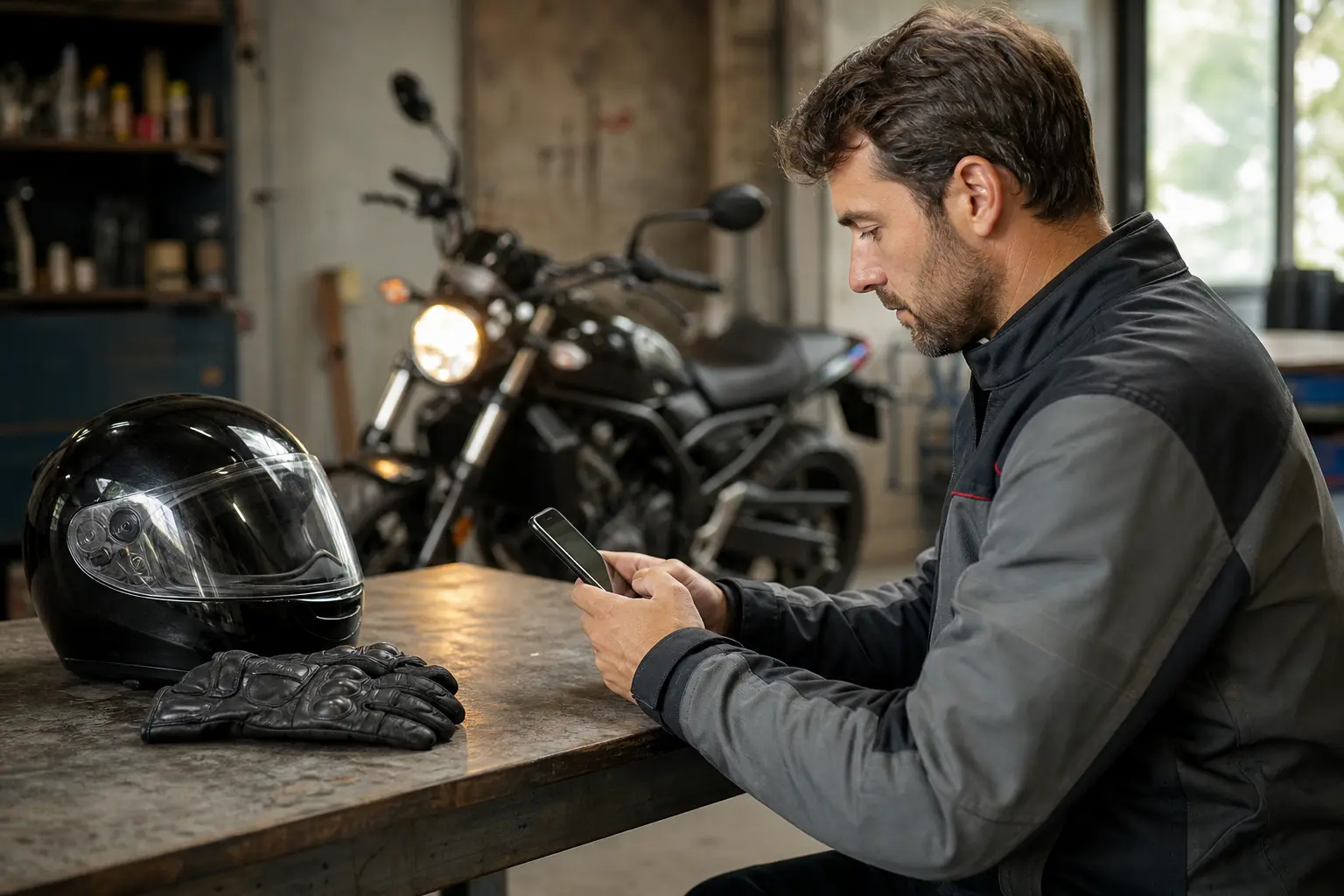
Electrical concerns can be intermittent, which makes a good handoff valuable. You are not expected to diagnose the motorcycle before seeking help. You can, however, provide a useful record that saves time and prevents the concern from being dismissed as vague.
Write down the date, odometer reading, weather, and whether the motorcycle had recently been washed, stored, transported, serviced, or modified. Describe which direction you selected and what each visible lamp did. Include the dashboard indication, the hazard function if equipped and checked according to the manual, and whether the symptom was continuous or came and went.
If conditions are safe, capture a short video while the motorcycle is stationary. Frame the selected control only if it can be shown safely, then show the affected lamp behavior. Do not ask someone to film while riding and do not operate a phone while on the road. A simple still photo of a cracked housing or loose mount can also be valuable.
Add relevant history without treating it as a conclusion: recent battery work, a tip-over, a trailer trip, a new accessory, rain exposure, a lighting replacement, or a recent service visit. This context helps a technician decide what questions to ask. It does not mean that the last thing changed is necessarily the cause.
Keep the owner’s manual and any accessory paperwork available for the appointment. If records identify an aftermarket lighting part or installer, include that information. Clear documentation supports a safer service process because it tells the next person what the motorcycle did before anyone disturbed the fault.
How Vojo Helps
Create a Turn-Signal Fault record in the motorcycle service history for the exact bike affected. Log the date, odometer reading, affected side, front and rear lamp observations, dashboard behavior, weather exposure, recent accessory work, and your decision to postpone the ride. Attach a parked photo or video, then add a follow-up reminder for the inspection appointment. After service, record the work completed and repeat the same left-and-right parked check before closing the issue. That workflow gives you a usable timeline if the symptom returns and makes a future service conversation more specific.
Download Vojo on the App Store
Motorcycle Turn Signal Not Working: Build a Better Pre-Ride Habit
The most useful time to discover a signal problem is before you are helmeted, late, loaded for a trip, or already rolling toward the street. A quick lighting observation belongs in the same category as checking whether the motorcycle is visibly ready for the ride you intend to make.
That does not mean every departure requires an elaborate inspection. A regular short check can confirm that the lighting and controls appear normal. A more deliberate parked review is sensible after storage, severe weather exposure, a fall, battery work, transport, electrical modifications, or any behavior that seems different from the motorcycle’s normal pattern.
The habit is not about becoming your own electrical specialist. It is about recognizing a change, resisting unsupported assumptions, checking the exact owner documentation, and selecting the safer next move. The standard is practical: before joining traffic, can the motorcycle communicate your intended direction through its normal equipment in a dependable way?
If the answer is uncertain, the motorcycle has already given you the right priority: resolve that uncertainty before the next traffic ride.
Quick answers
Frequently asked questions
Can I ride if one motorcycle turn signal is not working?
A conservative approach is to postpone public-road riding until normal left and right signaling can be confirmed or the motorcycle has been assessed. A missing signal reduces traffic communication and may not be an isolated issue.
Why does the turn indicator on my dash work when an outside lamp does not?
The dashboard indication and exterior lamps are separate observations. An indicator can show that the control was selected without proving that every front and rear signal location is operating normally. Check the actual lamps while parked.
Do hazard lights prove that my motorcycle turn signals are okay?
No. Hazard operation and normal left/right signal selection should be treated as separate functions. If your motorcycle has hazards, follow its owner’s manual and confirm the normal directional signals independently.
Could aftermarket LED signals cause a turn-signal problem?
A lighting modification can be relevant, but it does not establish the cause by itself. Electrical behavior, mounting, weather protection, and compatibility are model-specific. Document all changes and provide that information when arranging service.
Can I use hand signals instead of fixing the motorcycle?
Do not assume hand signals make an unreliable installed signal acceptable. Their legality and practical usefulness vary by location and conditions, and they do not address the underlying fault. A conservative no-ride decision is usually safer when normal signaling cannot be verified.